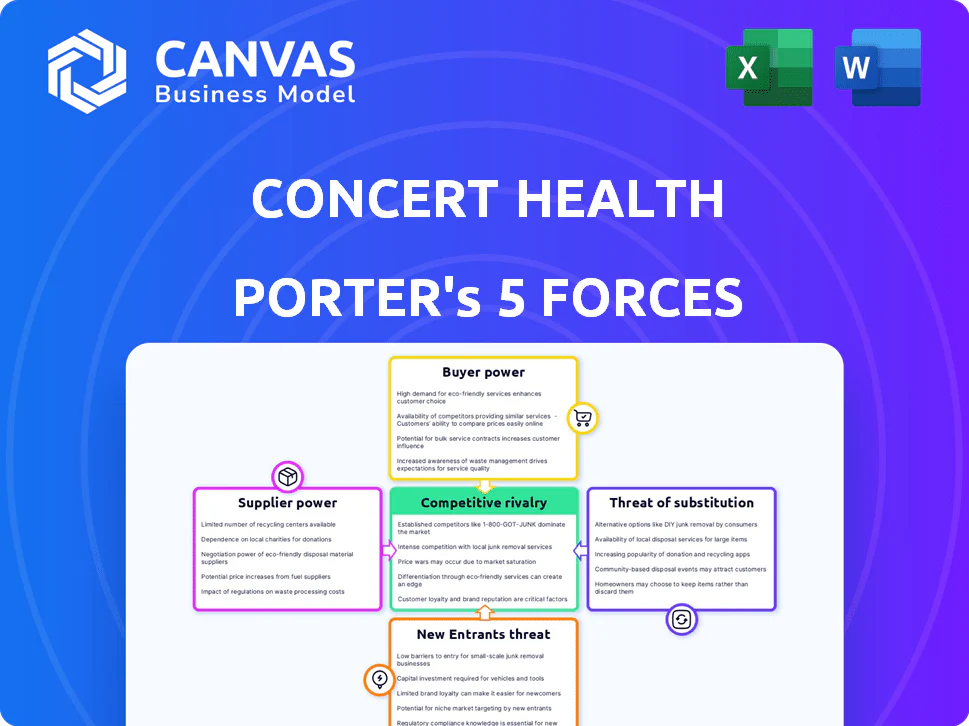
CONCERT HEALTH PORTER'S FIVE FORCES TEMPLATE RESEARCH
What is included in the product
 Detailed Word Document
Tailored exclusively for Concert Health, analyzing its position within its competitive landscape.

 Customizable Excel Spreadsheet
Customize pressure levels based on new data or evolving market trends.
Same Document Delivered
Concert Health Porter's Five Forces Analysis
This preview is the complete Concert Health Porter's Five Forces analysis. It details the competitive landscape, market structure, and profitability factors. The document includes in-depth assessments of each force impacting the company. You'll receive the identical analysis file immediately after purchase. It is ready to download and use.

Porter's Five Forces Analysis Template

A Must-Have Tool for Decision-Makers
Concert Health faces complex competitive dynamics. The healthcare sector's rivalry, with established players and startups, is intense. Buyer power, driven by insurance companies, significantly impacts pricing. The threat of new entrants, while moderate, necessitates continuous innovation. Substitute services, like telehealth platforms, pose a growing challenge. Supplier power, particularly from specialized healthcare providers, also plays a crucial role.
This preview is just the beginning. Dive into a complete, consultant-grade breakdown of Concert Health’s industry competitiveness—ready for immediate use.
Suppliers Bargaining Power

Availability of Qualified Behavioral Health Professionals
The availability of therapists, psychiatrists, and care managers heavily influences Concert Health. A shortage can raise costs and hinder scaling. Demand for these professionals is high, increasing their bargaining power in negotiations. In 2024, the U.S. faced a significant shortage of mental health professionals. This shortage drove up salaries and benefits.
Technology Providers and EHR Systems
Concert Health depends on tech for its telehealth platform and EHR integrations. Tech and EHR suppliers can wield power, especially if their systems are popular or unique. For instance, Epic Systems, a major EHR vendor, has a significant market share. Their pricing and terms impact Concert Health. Interoperability challenges between systems also play a role.

Healthcare Systems and Primary Care Practices
Concert Health collaborates with healthcare systems and primary care practices, which act as suppliers of patient access. These entities, particularly large healthcare systems, wield considerable bargaining power. For example, in 2024, the US healthcare industry saw a rise in consolidation, with 61% of physicians employed by hospitals or corporate entities. Their influence stems from the substantial patient volumes they control and their established infrastructure.

Payers and Insurance Companies
Insurance companies and government payers strongly influence Concert Health's financial health by setting reimbursement rates and coverage rules. These payers, including Medicare and Medicaid, are vital because they dictate how much Concert Health gets paid for its behavioral health services. Their decisions about payment models, like fee-for-service versus value-based care, affect Concert Health's profitability and long-term viability. The market is highly regulated, with payers holding significant power.
- In 2024, the Centers for Medicare & Medicaid Services (CMS) projected national health spending to reach $4.9 trillion.
- Medicaid spending on behavioral health services is substantial, with states allocating significant portions of their budgets.
- Insurance companies negotiate rates, often leading to lower reimbursements for providers.
- Value-based care models are gaining traction, shifting financial risk and rewards.
Sources of Funding
As a venture-backed company, Concert Health faces supplier bargaining power from its investors. These investors, who supply capital, expect returns and exert control over strategic decisions. This dynamic impacts the company's growth trajectory, as investors' demands influence resource allocation. Understanding this power balance is crucial for Concert Health's long-term success. The venture capital market saw a cool-down in 2023, with investments decreasing.
- VC investments in healthcare IT dropped by 30% in 2023.
- Investors often hold board seats, influencing strategic direction.
- Return expectations can pressure short-term profitability.
- Control can extend to hiring and operational decisions.
Supplier Power Dynamics in Mental Healthcare
Concert Health encounters supplier bargaining power in various forms. Key suppliers include mental health professionals, technology providers, and healthcare partners. The influence of suppliers impacts costs and operational efficiency. Understanding these dynamics is crucial for strategic planning.
| Supplier | Impact | 2024 Data |
|---|---|---|
| Mental Health Professionals | High demand; cost increases | Shortage persists; Salary growth 5-7% |
| Technology Providers | Pricing and interoperability issues | EHR market dominated by few vendors |
| Healthcare Systems | Patient access; negotiation leverage | Consolidation continues; 61% physicians employed |
Customers Bargaining Power

Primary Care Practices and Health Systems
Concert Health's customers include primary care practices and health systems. These entities possess bargaining power, selecting from various integrated behavioral health solutions. Larger practices, with more referral volume, often wield greater influence. In 2024, healthcare providers faced rising costs and sought value-based care models. This increased their bargaining power in vendor negotiations.
Patients
Patients, though not direct purchasers, wield indirect power. Their preferences for telehealth and satisfaction impact demand. In 2024, telehealth use in behavioral health grew, with 40% of patients preferring it. Patient satisfaction scores are critical; unhappy patients may deter providers.

Employers and Health Plans
Employers and health plans wield significant influence in healthcare. Their emphasis on cost-effectiveness and quality impacts integrated behavioral health models' adoption. This focus grants them bargaining power when negotiating with providers like Concert Health. In 2024, healthcare spending in the U.S. reached approximately $4.8 trillion, highlighting the financial stakes. This power shapes Concert Health's market dynamics and financial outcomes.

Government and Regulatory Bodies
Government and regulatory bodies wield considerable power in the behavioral health market, directly affecting Concert Health. These entities shape care delivery and funding models, impacting Concert Health's customers' decisions. For example, the Centers for Medicare & Medicaid Services (CMS) has been instrumental. In 2024, CMS invested billions in programs promoting integrated care. These regulations influence how Concert Health structures its services and interacts with its clients.
- CMS invested $3.2 billion in 2024 for behavioral health.
- Federal and state regulations heavily influence reimbursement rates.
- Compliance with these regulations is crucial for operational success.
- Legislative changes can significantly alter market dynamics.
Competitive Alternatives Available to Customers
The bargaining power of customers in the behavioral health market is substantial due to readily available alternatives. Primary care practices and patients can choose from various providers. These include traditional mental health clinics, other telehealth platforms, and in-house services. This competitive landscape gives customers leverage.
- Telehealth's growth: Telehealth use for mental health increased during and after the pandemic.
- Market competition: Numerous telehealth platforms and local providers compete for patients.
- Cost considerations: Patients and practices can compare costs and services.
- Service variety: Different models offer varying levels of care and convenience.
Bargaining Dynamics in Behavioral Health: A Look
Concert Health's customers, like primary care practices, have strong bargaining power, choosing from many behavioral health solutions. Larger practices significantly influence vendor negotiations. The market's competitiveness allows customers to compare costs and services. Telehealth use grew; in 2024, 40% of patients preferred it.
| Customer Type | Bargaining Power | Factors |
|---|---|---|
| Primary Care Practices | High | Multiple providers, cost comparisons, referral volume. |
| Patients | Indirect, Moderate | Telehealth preference, satisfaction impacting demand. |
| Employers/Health Plans | High | Cost-effectiveness, quality focus, negotiating power. |
Rivalry Among Competitors

Number and Diversity of Competitors
The integrated behavioral health market is heating up, with many players vying for a piece of the pie. This includes tech-driven startups and established mental health providers. In 2024, the market saw over $10 billion in investments, showing strong competition. Health systems are also joining in, adding to the rivalry.
Market Growth Rate
The U.S. behavioral health market is booming. It's fueled by rising mental health needs and integrated care. This growth, while offering opportunities, also draws in new competitors. The market is expected to reach $10.6 billion by 2024. This creates intense rivalry.

Differentiation of Services
Concert Health's Collaborative Care Model sets it apart, alongside its primary care partnerships. Rivals' ability to offer unique integrated care, tech, or networks affects competition intensity. In 2024, the behavioral health market saw significant growth. Competitors such as Talkiatry and Mindpath Health are also expanding. The competition is fierce.

Switching Costs for Customers
Switching costs for primary care practices and health systems from one integrated behavioral health partner to another can be significant. These costs encompass implementation expenses, workflow adjustments, and potential disruptions to patient care. Lower switching costs intensify rivalry because customers can more easily switch to competitors. In 2024, the average cost to implement new healthcare IT systems, which includes behavioral health integrations, ranged from $50,000 to $250,000, depending on the size and complexity of the practice.
- Implementation costs can range significantly.
- Workflow changes can disrupt patient care.
- Lower switching costs increase rivalry.
Industry Consolidation
Industry consolidation significantly impacts competitive rivalry in the behavioral health sector. Mergers and acquisitions create larger competitors with increased market power. This consolidation can heighten market concentration, leading to more intense rivalry among fewer, but more formidable, players. For instance, in 2024, several digital health companies merged, signaling increased competition.
- Increased market concentration: Fewer, larger players dominate the market.
- Intensified rivalry: Competition becomes fiercer among the remaining companies.
- Strategic responses: Companies may focus on differentiation or cost leadership.
- Impact on innovation: Consolidation might affect the pace of new product development.
Behavioral Health Market: Intense Rivalry
Competitive rivalry in the integrated behavioral health market is intense. The market saw over $10 billion in investments in 2024, with many players vying for market share. Switching costs and industry consolidation significantly impact the competitive landscape.
| Factor | Impact | 2024 Data |
|---|---|---|
| Market Growth | Attracts new entrants, intensifies competition. | Expected market size: $10.6 billion. |
| Switching Costs | Lower costs increase rivalry. | IT implementation: $50K-$250K. |
| Consolidation | Creates larger competitors. | Several digital health mergers. |
CONCERT HEALTH PORTER'S FIVE FORCES TEMPLATE RESEARCH
What is included in the product
Detailed Word Document
Tailored exclusively for Concert Health, analyzing its position within its competitive landscape.
Customizable Excel Spreadsheet
Customize pressure levels based on new data or evolving market trends.
Same Document Delivered
Concert Health Porter's Five Forces Analysis
This preview is the complete Concert Health Porter's Five Forces analysis. It details the competitive landscape, market structure, and profitability factors. The document includes in-depth assessments of each force impacting the company. You'll receive the identical analysis file immediately after purchase. It is ready to download and use.
Porter's Five Forces Analysis Template
A Must-Have Tool for Decision-Makers
Concert Health faces complex competitive dynamics. The healthcare sector's rivalry, with established players and startups, is intense. Buyer power, driven by insurance companies, significantly impacts pricing. The threat of new entrants, while moderate, necessitates continuous innovation. Substitute services, like telehealth platforms, pose a growing challenge. Supplier power, particularly from specialized healthcare providers, also plays a crucial role.
This preview is just the beginning. Dive into a complete, consultant-grade breakdown of Concert Health’s industry competitiveness—ready for immediate use.
Suppliers Bargaining Power
Availability of Qualified Behavioral Health Professionals
The availability of therapists, psychiatrists, and care managers heavily influences Concert Health. A shortage can raise costs and hinder scaling. Demand for these professionals is high, increasing their bargaining power in negotiations. In 2024, the U.S. faced a significant shortage of mental health professionals. This shortage drove up salaries and benefits.
Technology Providers and EHR Systems
Concert Health depends on tech for its telehealth platform and EHR integrations. Tech and EHR suppliers can wield power, especially if their systems are popular or unique. For instance, Epic Systems, a major EHR vendor, has a significant market share. Their pricing and terms impact Concert Health. Interoperability challenges between systems also play a role.
Healthcare Systems and Primary Care Practices
Concert Health collaborates with healthcare systems and primary care practices, which act as suppliers of patient access. These entities, particularly large healthcare systems, wield considerable bargaining power. For example, in 2024, the US healthcare industry saw a rise in consolidation, with 61% of physicians employed by hospitals or corporate entities. Their influence stems from the substantial patient volumes they control and their established infrastructure.
Payers and Insurance Companies
Insurance companies and government payers strongly influence Concert Health's financial health by setting reimbursement rates and coverage rules. These payers, including Medicare and Medicaid, are vital because they dictate how much Concert Health gets paid for its behavioral health services. Their decisions about payment models, like fee-for-service versus value-based care, affect Concert Health's profitability and long-term viability. The market is highly regulated, with payers holding significant power.
- In 2024, the Centers for Medicare & Medicaid Services (CMS) projected national health spending to reach $4.9 trillion.
- Medicaid spending on behavioral health services is substantial, with states allocating significant portions of their budgets.
- Insurance companies negotiate rates, often leading to lower reimbursements for providers.
- Value-based care models are gaining traction, shifting financial risk and rewards.
Sources of Funding
As a venture-backed company, Concert Health faces supplier bargaining power from its investors. These investors, who supply capital, expect returns and exert control over strategic decisions. This dynamic impacts the company's growth trajectory, as investors' demands influence resource allocation. Understanding this power balance is crucial for Concert Health's long-term success. The venture capital market saw a cool-down in 2023, with investments decreasing.
- VC investments in healthcare IT dropped by 30% in 2023.
- Investors often hold board seats, influencing strategic direction.
- Return expectations can pressure short-term profitability.
- Control can extend to hiring and operational decisions.
Supplier Power Dynamics in Mental Healthcare
Concert Health encounters supplier bargaining power in various forms. Key suppliers include mental health professionals, technology providers, and healthcare partners. The influence of suppliers impacts costs and operational efficiency. Understanding these dynamics is crucial for strategic planning.
| Supplier | Impact | 2024 Data |
|---|---|---|
| Mental Health Professionals | High demand; cost increases | Shortage persists; Salary growth 5-7% |
| Technology Providers | Pricing and interoperability issues | EHR market dominated by few vendors |
| Healthcare Systems | Patient access; negotiation leverage | Consolidation continues; 61% physicians employed |
Customers Bargaining Power
Primary Care Practices and Health Systems
Concert Health's customers include primary care practices and health systems. These entities possess bargaining power, selecting from various integrated behavioral health solutions. Larger practices, with more referral volume, often wield greater influence. In 2024, healthcare providers faced rising costs and sought value-based care models. This increased their bargaining power in vendor negotiations.
Patients
Patients, though not direct purchasers, wield indirect power. Their preferences for telehealth and satisfaction impact demand. In 2024, telehealth use in behavioral health grew, with 40% of patients preferring it. Patient satisfaction scores are critical; unhappy patients may deter providers.
Employers and Health Plans
Employers and health plans wield significant influence in healthcare. Their emphasis on cost-effectiveness and quality impacts integrated behavioral health models' adoption. This focus grants them bargaining power when negotiating with providers like Concert Health. In 2024, healthcare spending in the U.S. reached approximately $4.8 trillion, highlighting the financial stakes. This power shapes Concert Health's market dynamics and financial outcomes.
Government and Regulatory Bodies
Government and regulatory bodies wield considerable power in the behavioral health market, directly affecting Concert Health. These entities shape care delivery and funding models, impacting Concert Health's customers' decisions. For example, the Centers for Medicare & Medicaid Services (CMS) has been instrumental. In 2024, CMS invested billions in programs promoting integrated care. These regulations influence how Concert Health structures its services and interacts with its clients.
- CMS invested $3.2 billion in 2024 for behavioral health.
- Federal and state regulations heavily influence reimbursement rates.
- Compliance with these regulations is crucial for operational success.
- Legislative changes can significantly alter market dynamics.
Competitive Alternatives Available to Customers
The bargaining power of customers in the behavioral health market is substantial due to readily available alternatives. Primary care practices and patients can choose from various providers. These include traditional mental health clinics, other telehealth platforms, and in-house services. This competitive landscape gives customers leverage.
- Telehealth's growth: Telehealth use for mental health increased during and after the pandemic.
- Market competition: Numerous telehealth platforms and local providers compete for patients.
- Cost considerations: Patients and practices can compare costs and services.
- Service variety: Different models offer varying levels of care and convenience.
Bargaining Dynamics in Behavioral Health: A Look
Concert Health's customers, like primary care practices, have strong bargaining power, choosing from many behavioral health solutions. Larger practices significantly influence vendor negotiations. The market's competitiveness allows customers to compare costs and services. Telehealth use grew; in 2024, 40% of patients preferred it.
| Customer Type | Bargaining Power | Factors |
|---|---|---|
| Primary Care Practices | High | Multiple providers, cost comparisons, referral volume. |
| Patients | Indirect, Moderate | Telehealth preference, satisfaction impacting demand. |
| Employers/Health Plans | High | Cost-effectiveness, quality focus, negotiating power. |
Rivalry Among Competitors
Number and Diversity of Competitors
The integrated behavioral health market is heating up, with many players vying for a piece of the pie. This includes tech-driven startups and established mental health providers. In 2024, the market saw over $10 billion in investments, showing strong competition. Health systems are also joining in, adding to the rivalry.
Market Growth Rate
The U.S. behavioral health market is booming. It's fueled by rising mental health needs and integrated care. This growth, while offering opportunities, also draws in new competitors. The market is expected to reach $10.6 billion by 2024. This creates intense rivalry.
Differentiation of Services
Concert Health's Collaborative Care Model sets it apart, alongside its primary care partnerships. Rivals' ability to offer unique integrated care, tech, or networks affects competition intensity. In 2024, the behavioral health market saw significant growth. Competitors such as Talkiatry and Mindpath Health are also expanding. The competition is fierce.
Switching Costs for Customers
Switching costs for primary care practices and health systems from one integrated behavioral health partner to another can be significant. These costs encompass implementation expenses, workflow adjustments, and potential disruptions to patient care. Lower switching costs intensify rivalry because customers can more easily switch to competitors. In 2024, the average cost to implement new healthcare IT systems, which includes behavioral health integrations, ranged from $50,000 to $250,000, depending on the size and complexity of the practice.
- Implementation costs can range significantly.
- Workflow changes can disrupt patient care.
- Lower switching costs increase rivalry.
Industry Consolidation
Industry consolidation significantly impacts competitive rivalry in the behavioral health sector. Mergers and acquisitions create larger competitors with increased market power. This consolidation can heighten market concentration, leading to more intense rivalry among fewer, but more formidable, players. For instance, in 2024, several digital health companies merged, signaling increased competition.
- Increased market concentration: Fewer, larger players dominate the market.
- Intensified rivalry: Competition becomes fiercer among the remaining companies.
- Strategic responses: Companies may focus on differentiation or cost leadership.
- Impact on innovation: Consolidation might affect the pace of new product development.
Behavioral Health Market: Intense Rivalry
Competitive rivalry in the integrated behavioral health market is intense. The market saw over $10 billion in investments in 2024, with many players vying for market share. Switching costs and industry consolidation significantly impact the competitive landscape.
| Factor | Impact | 2024 Data |
|---|---|---|
| Market Growth | Attracts new entrants, intensifies competition. | Expected market size: $10.6 billion. |
| Switching Costs | Lower costs increase rivalry. | IT implementation: $50K-$250K. |
| Consolidation | Creates larger competitors. | Several digital health mergers. |
Product Information
Product Information
Shipping & Returns
Shipping & Returns
Description
What is included in the product
Detailed Word Document
Tailored exclusively for Concert Health, analyzing its position within its competitive landscape.
Customizable Excel Spreadsheet
Customize pressure levels based on new data or evolving market trends.
Same Document Delivered
Concert Health Porter's Five Forces Analysis
This preview is the complete Concert Health Porter's Five Forces analysis. It details the competitive landscape, market structure, and profitability factors. The document includes in-depth assessments of each force impacting the company. You'll receive the identical analysis file immediately after purchase. It is ready to download and use.
Porter's Five Forces Analysis Template
A Must-Have Tool for Decision-Makers
Concert Health faces complex competitive dynamics. The healthcare sector's rivalry, with established players and startups, is intense. Buyer power, driven by insurance companies, significantly impacts pricing. The threat of new entrants, while moderate, necessitates continuous innovation. Substitute services, like telehealth platforms, pose a growing challenge. Supplier power, particularly from specialized healthcare providers, also plays a crucial role.
This preview is just the beginning. Dive into a complete, consultant-grade breakdown of Concert Health’s industry competitiveness—ready for immediate use.
Suppliers Bargaining Power
Availability of Qualified Behavioral Health Professionals
The availability of therapists, psychiatrists, and care managers heavily influences Concert Health. A shortage can raise costs and hinder scaling. Demand for these professionals is high, increasing their bargaining power in negotiations. In 2024, the U.S. faced a significant shortage of mental health professionals. This shortage drove up salaries and benefits.
Technology Providers and EHR Systems
Concert Health depends on tech for its telehealth platform and EHR integrations. Tech and EHR suppliers can wield power, especially if their systems are popular or unique. For instance, Epic Systems, a major EHR vendor, has a significant market share. Their pricing and terms impact Concert Health. Interoperability challenges between systems also play a role.
Healthcare Systems and Primary Care Practices
Concert Health collaborates with healthcare systems and primary care practices, which act as suppliers of patient access. These entities, particularly large healthcare systems, wield considerable bargaining power. For example, in 2024, the US healthcare industry saw a rise in consolidation, with 61% of physicians employed by hospitals or corporate entities. Their influence stems from the substantial patient volumes they control and their established infrastructure.
Payers and Insurance Companies
Insurance companies and government payers strongly influence Concert Health's financial health by setting reimbursement rates and coverage rules. These payers, including Medicare and Medicaid, are vital because they dictate how much Concert Health gets paid for its behavioral health services. Their decisions about payment models, like fee-for-service versus value-based care, affect Concert Health's profitability and long-term viability. The market is highly regulated, with payers holding significant power.
- In 2024, the Centers for Medicare & Medicaid Services (CMS) projected national health spending to reach $4.9 trillion.
- Medicaid spending on behavioral health services is substantial, with states allocating significant portions of their budgets.
- Insurance companies negotiate rates, often leading to lower reimbursements for providers.
- Value-based care models are gaining traction, shifting financial risk and rewards.
Sources of Funding
As a venture-backed company, Concert Health faces supplier bargaining power from its investors. These investors, who supply capital, expect returns and exert control over strategic decisions. This dynamic impacts the company's growth trajectory, as investors' demands influence resource allocation. Understanding this power balance is crucial for Concert Health's long-term success. The venture capital market saw a cool-down in 2023, with investments decreasing.
- VC investments in healthcare IT dropped by 30% in 2023.
- Investors often hold board seats, influencing strategic direction.
- Return expectations can pressure short-term profitability.
- Control can extend to hiring and operational decisions.
Supplier Power Dynamics in Mental Healthcare
Concert Health encounters supplier bargaining power in various forms. Key suppliers include mental health professionals, technology providers, and healthcare partners. The influence of suppliers impacts costs and operational efficiency. Understanding these dynamics is crucial for strategic planning.
| Supplier | Impact | 2024 Data |
|---|---|---|
| Mental Health Professionals | High demand; cost increases | Shortage persists; Salary growth 5-7% |
| Technology Providers | Pricing and interoperability issues | EHR market dominated by few vendors |
| Healthcare Systems | Patient access; negotiation leverage | Consolidation continues; 61% physicians employed |
Customers Bargaining Power
Primary Care Practices and Health Systems
Concert Health's customers include primary care practices and health systems. These entities possess bargaining power, selecting from various integrated behavioral health solutions. Larger practices, with more referral volume, often wield greater influence. In 2024, healthcare providers faced rising costs and sought value-based care models. This increased their bargaining power in vendor negotiations.
Patients
Patients, though not direct purchasers, wield indirect power. Their preferences for telehealth and satisfaction impact demand. In 2024, telehealth use in behavioral health grew, with 40% of patients preferring it. Patient satisfaction scores are critical; unhappy patients may deter providers.
Employers and Health Plans
Employers and health plans wield significant influence in healthcare. Their emphasis on cost-effectiveness and quality impacts integrated behavioral health models' adoption. This focus grants them bargaining power when negotiating with providers like Concert Health. In 2024, healthcare spending in the U.S. reached approximately $4.8 trillion, highlighting the financial stakes. This power shapes Concert Health's market dynamics and financial outcomes.
Government and Regulatory Bodies
Government and regulatory bodies wield considerable power in the behavioral health market, directly affecting Concert Health. These entities shape care delivery and funding models, impacting Concert Health's customers' decisions. For example, the Centers for Medicare & Medicaid Services (CMS) has been instrumental. In 2024, CMS invested billions in programs promoting integrated care. These regulations influence how Concert Health structures its services and interacts with its clients.
- CMS invested $3.2 billion in 2024 for behavioral health.
- Federal and state regulations heavily influence reimbursement rates.
- Compliance with these regulations is crucial for operational success.
- Legislative changes can significantly alter market dynamics.
Competitive Alternatives Available to Customers
The bargaining power of customers in the behavioral health market is substantial due to readily available alternatives. Primary care practices and patients can choose from various providers. These include traditional mental health clinics, other telehealth platforms, and in-house services. This competitive landscape gives customers leverage.
- Telehealth's growth: Telehealth use for mental health increased during and after the pandemic.
- Market competition: Numerous telehealth platforms and local providers compete for patients.
- Cost considerations: Patients and practices can compare costs and services.
- Service variety: Different models offer varying levels of care and convenience.
Bargaining Dynamics in Behavioral Health: A Look
Concert Health's customers, like primary care practices, have strong bargaining power, choosing from many behavioral health solutions. Larger practices significantly influence vendor negotiations. The market's competitiveness allows customers to compare costs and services. Telehealth use grew; in 2024, 40% of patients preferred it.
| Customer Type | Bargaining Power | Factors |
|---|---|---|
| Primary Care Practices | High | Multiple providers, cost comparisons, referral volume. |
| Patients | Indirect, Moderate | Telehealth preference, satisfaction impacting demand. |
| Employers/Health Plans | High | Cost-effectiveness, quality focus, negotiating power. |
Rivalry Among Competitors
Number and Diversity of Competitors
The integrated behavioral health market is heating up, with many players vying for a piece of the pie. This includes tech-driven startups and established mental health providers. In 2024, the market saw over $10 billion in investments, showing strong competition. Health systems are also joining in, adding to the rivalry.
Market Growth Rate
The U.S. behavioral health market is booming. It's fueled by rising mental health needs and integrated care. This growth, while offering opportunities, also draws in new competitors. The market is expected to reach $10.6 billion by 2024. This creates intense rivalry.
Differentiation of Services
Concert Health's Collaborative Care Model sets it apart, alongside its primary care partnerships. Rivals' ability to offer unique integrated care, tech, or networks affects competition intensity. In 2024, the behavioral health market saw significant growth. Competitors such as Talkiatry and Mindpath Health are also expanding. The competition is fierce.
Switching Costs for Customers
Switching costs for primary care practices and health systems from one integrated behavioral health partner to another can be significant. These costs encompass implementation expenses, workflow adjustments, and potential disruptions to patient care. Lower switching costs intensify rivalry because customers can more easily switch to competitors. In 2024, the average cost to implement new healthcare IT systems, which includes behavioral health integrations, ranged from $50,000 to $250,000, depending on the size and complexity of the practice.
- Implementation costs can range significantly.
- Workflow changes can disrupt patient care.
- Lower switching costs increase rivalry.
Industry Consolidation
Industry consolidation significantly impacts competitive rivalry in the behavioral health sector. Mergers and acquisitions create larger competitors with increased market power. This consolidation can heighten market concentration, leading to more intense rivalry among fewer, but more formidable, players. For instance, in 2024, several digital health companies merged, signaling increased competition.
- Increased market concentration: Fewer, larger players dominate the market.
- Intensified rivalry: Competition becomes fiercer among the remaining companies.
- Strategic responses: Companies may focus on differentiation or cost leadership.
- Impact on innovation: Consolidation might affect the pace of new product development.
Behavioral Health Market: Intense Rivalry
Competitive rivalry in the integrated behavioral health market is intense. The market saw over $10 billion in investments in 2024, with many players vying for market share. Switching costs and industry consolidation significantly impact the competitive landscape.
| Factor | Impact | 2024 Data |
|---|---|---|
| Market Growth | Attracts new entrants, intensifies competition. | Expected market size: $10.6 billion. |
| Switching Costs | Lower costs increase rivalry. | IT implementation: $50K-$250K. |
| Consolidation | Creates larger competitors. | Several digital health mergers. |











