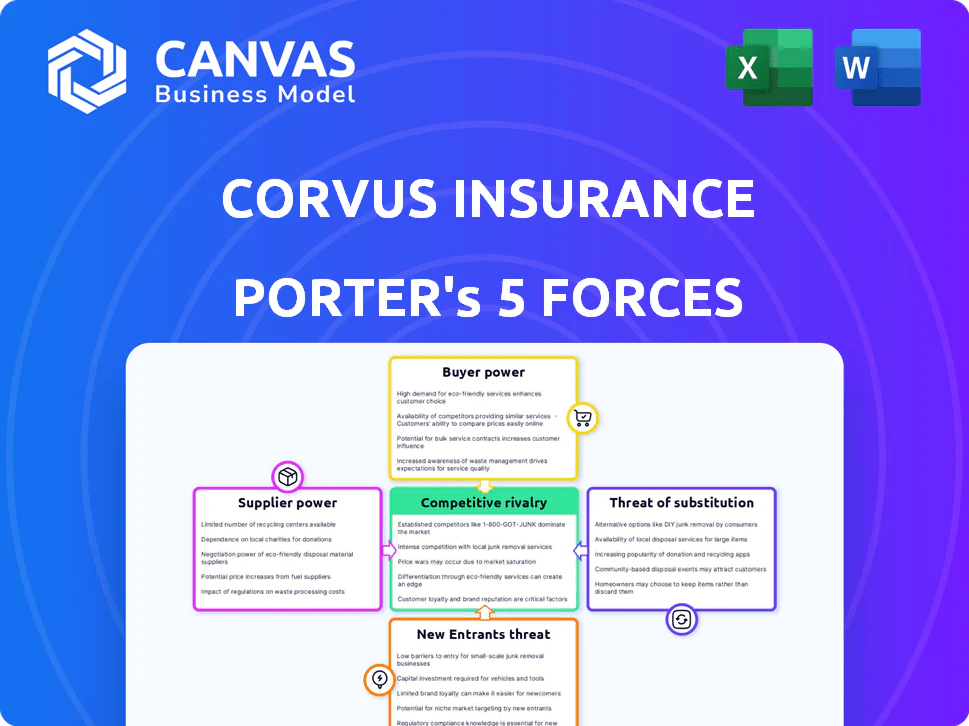
CORVUS INSURANCE PORTER'S FIVE FORCES TEMPLATE RESEARCH
What is included in the product
 Detailed Word Document
Detailed analysis of each competitive force, supported by industry data and strategic commentary.

 Customizable Excel Spreadsheet
Swap in custom data, labels, and notes to reflect the ever-changing insurance landscape.
Preview the Actual Deliverable
Corvus Insurance Porter's Five Forces Analysis
You're previewing the final version—precisely the same document that will be available to you instantly after buying. This Corvus Insurance Porter's Five Forces analysis examines the competitive landscape, detailing threat of new entrants, supplier power, buyer power, threat of substitutes, and rivalry. It assesses each force's impact on Corvus Insurance, identifying opportunities and threats. The analysis provides a clear understanding of the industry dynamics affecting Corvus. This is the complete, ready-to-use document.

Porter's Five Forces Analysis Template

From Overview to Strategy Blueprint
Corvus Insurance faces a competitive cyber insurance landscape, with moderate rivalry among existing players. Buyer power is somewhat strong due to readily available alternatives and price sensitivity. The threat of new entrants is limited by high capital requirements and regulatory hurdles. Substitute threats, like self-insurance, pose a moderate challenge. Supplier power, particularly from reinsurers, is also a factor.
This brief snapshot only scratches the surface. Unlock the full Porter's Five Forces Analysis to explore Corvus Insurance’s competitive dynamics, market pressures, and strategic advantages in detail.
Suppliers Bargaining Power

Key Technology Providers
Corvus Insurance's reliance on AI and data analytics means its key technology providers wield some bargaining power. These suppliers, offering unique or hard-to-duplicate tech, can influence pricing and terms. The AI insurance market's growth, projected to reach $2.8 billion globally by 2024, strengthens their position.
Data Providers
Corvus Insurance relies heavily on data for its AI-driven risk assessments, making data providers important. Suppliers like cybersecurity firms wield some power, especially with unique data. In 2024, the cybersecurity market was valued at over $200 billion, showing the value of their data. Data exclusivity further strengthens their position.

Underwriting Capacity Providers
Corvus Insurance, as an MGU, relies on capacity providers like Travelers. In 2024, Travelers' market share in commercial insurance was substantial, influencing Corvus's underwriting capabilities. The terms and availability of Corvus's policies are directly impacted by its relationship with key providers. This dynamic highlights the suppliers' bargaining power. Any shift in these partnerships affects Corvus's market position.

Insurance Brokers and Agents
Corvus Insurance relies on brokers and agents for distribution despite its tech focus. These intermediaries have bargaining power due to their influence over client placement. The commercial insurance market saw broker commissions around 10-15% in 2024. Brokers' ability to steer business impacts Corvus's distribution costs and reach. Their role remains crucial, affecting pricing and market access.
- Broker commissions typically range from 10-15% of premiums.
- Brokers control a significant portion of commercial insurance placements.
- Their influence impacts pricing strategies for insurers.
- Relationships with brokers affect market access.
Talent Pool
Corvus Insurance's reliance on specialized talent, including AI, cybersecurity, and insurance experts, gives these skilled professionals significant bargaining power. The demand for such specialists is high, making them valuable suppliers of labor. Increased competition for these professionals can lead to higher salary expectations and benefits. This impacts Corvus's operational costs and profitability. In 2024, the average salary for cybersecurity analysts in the US was around $102,600.
- High demand for specialized skills.
- Increased labor costs.
- Impact on profitability.
- Competition for talent.
Supplier Power Dynamics in AI Insurance
Corvus Insurance faces supplier bargaining power from tech providers, impacting pricing and terms. The AI insurance market's projected $2.8 billion value in 2024 boosts their leverage. Data providers, including cybersecurity firms (valued over $200 billion in 2024), also hold significant sway.
| Supplier Type | Impact on Corvus | 2024 Data Point |
|---|---|---|
| Tech Providers | Influence pricing & terms | AI insurance market: $2.8B |
| Data Providers | Control data access | Cybersecurity market: $200B+ |
| Capacity Providers | Affect underwriting | Travelers' market share |
Customers Bargaining Power

Large Commercial Clients
Large commercial clients, needing cyber insurance and tech E+O coverage, have complex needs and high premiums. Their size grants them bargaining power for favorable terms and pricing. In 2024, cyber insurance premiums rose 28% on average, giving large clients leverage. Clients with over $1 billion in revenue often secure better deals. This is due to their importance to insurers.
Brokers as Customer Advocates
Brokers, acting for clients, shape insurer choices. Corvus, using brokers, faces increased customer bargaining power as clients compare options. In 2024, the insurance brokerage market generated over $400 billion in revenue, showing brokers' influence. This dynamic affects pricing and service demands.

Availability of Alternatives
Customers can choose from multiple cyber insurance providers like traditional insurers and insurtechs. The presence of alternatives boosts customer power. For example, in 2024, the cyber insurance market saw over 100 providers. Customers can switch if they find better deals or service. This competition pressures Corvus to offer competitive pricing and value.

Access to Information
Insurers face strong customer bargaining power due to increased information access. Customers now research coverage and pricing online, making them more informed. This knowledge enables effective negotiation and comparison of different insurance providers. The shift to online platforms has further amplified this trend.
- Online insurance sales grew significantly, with direct-to-consumer sales representing a substantial portion of the market by 2024.
- Customers utilize comparison websites and review platforms to assess options.
- Data indicates that price comparison tools are used by a large percentage of insurance buyers.
- The trend towards digital self-service tools empowers customers.
Demand for Tailored Solutions
Commercial clients, particularly those in the tech sector, frequently seek specialized insurance to cover their unique risks. This demand for tailored solutions empowers customers, giving them bargaining power. Insurers that provide flexible and customized coverage can attract and keep these clients, which is crucial in a competitive market. For example, in 2024, the demand for cyber insurance, a specific type of coverage for tech firms, increased by 20%.
- Customization Needs: Clients in tech and other specialized sectors require insurance solutions tailored to their unique risks.
- Customer Power: The need for tailored solutions grants customers significant bargaining power.
- Provider Advantage: Insurers offering flexible, customized coverage can attract and retain clients.
- Market Impact: The demand for specialized insurance types, such as cyber insurance, has increased.
Cyber Insurance: How Clients Drive the Market
Large commercial clients and those in the tech sector wield significant bargaining power, especially when seeking cyber insurance and tech E+O coverage. Their size and specialized needs allow them to negotiate favorable terms and pricing. The availability of various insurance providers, including traditional insurers and insurtechs, further enhances customer power.
Brokers also play a crucial role, shaping insurer choices and intensifying customer bargaining power. Customers' access to online information and tools, such as comparison websites, enables informed decision-making and effective negotiation. In 2024, the direct-to-consumer insurance sales grew substantially, empowering customers further.
This dynamic compels insurers like Corvus to offer competitive pricing, flexible coverage, and customized solutions to attract and retain clients. The demand for cyber insurance increased by 20% in 2024, underscoring the importance of adapting to customer needs.
| Aspect | Impact | 2024 Data |
|---|---|---|
| Client Size | Bargaining Power | Cyber insurance premiums rose 28% |
| Brokerage Market | Influence | Over $400B in revenue |
| Market Competition | Customer Choice | 100+ cyber insurance providers |
Rivalry Among Competitors

Numerous Competitors
The cyber insurance market is highly competitive. Corvus Insurance competes with established carriers and insurtech companies. In 2024, the cyber insurance market was valued at around $7.8 billion. The competitive landscape includes players like Coalition and At-Bay. This rivalry impacts pricing and innovation.
Differentiation through Technology
Corvus Insurance uses an AI-driven platform and risk prevention to stand out. Competitors also utilize AI and data analytics. The rivalry focuses on technology and risk mitigation effectiveness. In 2024, AI in insurance grew, with InsurTech investments exceeding $14 billion, intensifying the tech competition.

Pricing Pressure
Intense competition in the cyber insurance market can lead to price wars. Despite market growth, the pressure to offer competitive rates impacts profitability. For example, in 2024, the average cyber insurance premium increased by 10-15% due to rising claims. This pricing pressure forces companies like Corvus to carefully manage costs to maintain margins.

Rapid Market Evolution
The cyber insurance market experiences rapid market evolution, intensifying competitive rivalry. Insurers must swiftly adapt to the changing cyber threat landscape. Innovation and product development are key for competitive advantage. For instance, in 2024, the global cyber insurance market was valued at $16.8 billion. This environment demands constant adaptation.
- Market growth fuels competition.
- Innovation determines success.
- Adaptability is crucial.
- Cyber threats evolve rapidly.
Acquisition by Travelers
The acquisition of Corvus Insurance by Travelers significantly impacts competitive rivalry within the insurance sector. This move integrates Corvus into a more extensive, established insurance framework, providing it with greater financial resources and an expanded market presence. However, this also means Corvus directly competes with other large insurance providers, intensifying the rivalry. The deal, valued at an estimated $400 million, reflects the ongoing consolidation within the industry.
- Travelers's market capitalization as of early 2024 was approximately $45 billion.
- The insurance industry's global revenue in 2023 was around $6.7 trillion.
- Mergers and acquisitions in the insurance sector totaled over $50 billion in 2023.
Cyber Insurance: Market Dynamics & Key Players
Competitive rivalry in the cyber insurance market is fierce, driven by market growth. Innovation, especially in AI and risk mitigation, determines success. Adaptability to evolving cyber threats is crucial. The acquisition of Corvus by Travelers intensifies this rivalry.
| Metric | Value (2024) | Source |
|---|---|---|
| Cyber Insurance Market Size | $7.8 billion | Industry Reports |
| InsurTech Investment | $14+ billion | Various Financial News |
| Average Premium Increase | 10-15% | Insurance Journals |
Original: $10.00
-65%$10.00
$3.50CORVUS INSURANCE PORTER'S FIVE FORCES TEMPLATE RESEARCH
What is included in the product
Detailed Word Document
Detailed analysis of each competitive force, supported by industry data and strategic commentary.
Customizable Excel Spreadsheet
Swap in custom data, labels, and notes to reflect the ever-changing insurance landscape.
Preview the Actual Deliverable
Corvus Insurance Porter's Five Forces Analysis
You're previewing the final version—precisely the same document that will be available to you instantly after buying. This Corvus Insurance Porter's Five Forces analysis examines the competitive landscape, detailing threat of new entrants, supplier power, buyer power, threat of substitutes, and rivalry. It assesses each force's impact on Corvus Insurance, identifying opportunities and threats. The analysis provides a clear understanding of the industry dynamics affecting Corvus. This is the complete, ready-to-use document.
Porter's Five Forces Analysis Template
From Overview to Strategy Blueprint
Corvus Insurance faces a competitive cyber insurance landscape, with moderate rivalry among existing players. Buyer power is somewhat strong due to readily available alternatives and price sensitivity. The threat of new entrants is limited by high capital requirements and regulatory hurdles. Substitute threats, like self-insurance, pose a moderate challenge. Supplier power, particularly from reinsurers, is also a factor.
This brief snapshot only scratches the surface. Unlock the full Porter's Five Forces Analysis to explore Corvus Insurance’s competitive dynamics, market pressures, and strategic advantages in detail.
Suppliers Bargaining Power
Key Technology Providers
Corvus Insurance's reliance on AI and data analytics means its key technology providers wield some bargaining power. These suppliers, offering unique or hard-to-duplicate tech, can influence pricing and terms. The AI insurance market's growth, projected to reach $2.8 billion globally by 2024, strengthens their position.
Data Providers
Corvus Insurance relies heavily on data for its AI-driven risk assessments, making data providers important. Suppliers like cybersecurity firms wield some power, especially with unique data. In 2024, the cybersecurity market was valued at over $200 billion, showing the value of their data. Data exclusivity further strengthens their position.
Underwriting Capacity Providers
Corvus Insurance, as an MGU, relies on capacity providers like Travelers. In 2024, Travelers' market share in commercial insurance was substantial, influencing Corvus's underwriting capabilities. The terms and availability of Corvus's policies are directly impacted by its relationship with key providers. This dynamic highlights the suppliers' bargaining power. Any shift in these partnerships affects Corvus's market position.
Insurance Brokers and Agents
Corvus Insurance relies on brokers and agents for distribution despite its tech focus. These intermediaries have bargaining power due to their influence over client placement. The commercial insurance market saw broker commissions around 10-15% in 2024. Brokers' ability to steer business impacts Corvus's distribution costs and reach. Their role remains crucial, affecting pricing and market access.
- Broker commissions typically range from 10-15% of premiums.
- Brokers control a significant portion of commercial insurance placements.
- Their influence impacts pricing strategies for insurers.
- Relationships with brokers affect market access.
Talent Pool
Corvus Insurance's reliance on specialized talent, including AI, cybersecurity, and insurance experts, gives these skilled professionals significant bargaining power. The demand for such specialists is high, making them valuable suppliers of labor. Increased competition for these professionals can lead to higher salary expectations and benefits. This impacts Corvus's operational costs and profitability. In 2024, the average salary for cybersecurity analysts in the US was around $102,600.
- High demand for specialized skills.
- Increased labor costs.
- Impact on profitability.
- Competition for talent.
Supplier Power Dynamics in AI Insurance
Corvus Insurance faces supplier bargaining power from tech providers, impacting pricing and terms. The AI insurance market's projected $2.8 billion value in 2024 boosts their leverage. Data providers, including cybersecurity firms (valued over $200 billion in 2024), also hold significant sway.
| Supplier Type | Impact on Corvus | 2024 Data Point |
|---|---|---|
| Tech Providers | Influence pricing & terms | AI insurance market: $2.8B |
| Data Providers | Control data access | Cybersecurity market: $200B+ |
| Capacity Providers | Affect underwriting | Travelers' market share |
Customers Bargaining Power
Large Commercial Clients
Large commercial clients, needing cyber insurance and tech E+O coverage, have complex needs and high premiums. Their size grants them bargaining power for favorable terms and pricing. In 2024, cyber insurance premiums rose 28% on average, giving large clients leverage. Clients with over $1 billion in revenue often secure better deals. This is due to their importance to insurers.
Brokers as Customer Advocates
Brokers, acting for clients, shape insurer choices. Corvus, using brokers, faces increased customer bargaining power as clients compare options. In 2024, the insurance brokerage market generated over $400 billion in revenue, showing brokers' influence. This dynamic affects pricing and service demands.
Availability of Alternatives
Customers can choose from multiple cyber insurance providers like traditional insurers and insurtechs. The presence of alternatives boosts customer power. For example, in 2024, the cyber insurance market saw over 100 providers. Customers can switch if they find better deals or service. This competition pressures Corvus to offer competitive pricing and value.
Access to Information
Insurers face strong customer bargaining power due to increased information access. Customers now research coverage and pricing online, making them more informed. This knowledge enables effective negotiation and comparison of different insurance providers. The shift to online platforms has further amplified this trend.
- Online insurance sales grew significantly, with direct-to-consumer sales representing a substantial portion of the market by 2024.
- Customers utilize comparison websites and review platforms to assess options.
- Data indicates that price comparison tools are used by a large percentage of insurance buyers.
- The trend towards digital self-service tools empowers customers.
Demand for Tailored Solutions
Commercial clients, particularly those in the tech sector, frequently seek specialized insurance to cover their unique risks. This demand for tailored solutions empowers customers, giving them bargaining power. Insurers that provide flexible and customized coverage can attract and keep these clients, which is crucial in a competitive market. For example, in 2024, the demand for cyber insurance, a specific type of coverage for tech firms, increased by 20%.
- Customization Needs: Clients in tech and other specialized sectors require insurance solutions tailored to their unique risks.
- Customer Power: The need for tailored solutions grants customers significant bargaining power.
- Provider Advantage: Insurers offering flexible, customized coverage can attract and retain clients.
- Market Impact: The demand for specialized insurance types, such as cyber insurance, has increased.
Cyber Insurance: How Clients Drive the Market
Large commercial clients and those in the tech sector wield significant bargaining power, especially when seeking cyber insurance and tech E+O coverage. Their size and specialized needs allow them to negotiate favorable terms and pricing. The availability of various insurance providers, including traditional insurers and insurtechs, further enhances customer power.
Brokers also play a crucial role, shaping insurer choices and intensifying customer bargaining power. Customers' access to online information and tools, such as comparison websites, enables informed decision-making and effective negotiation. In 2024, the direct-to-consumer insurance sales grew substantially, empowering customers further.
This dynamic compels insurers like Corvus to offer competitive pricing, flexible coverage, and customized solutions to attract and retain clients. The demand for cyber insurance increased by 20% in 2024, underscoring the importance of adapting to customer needs.
| Aspect | Impact | 2024 Data |
|---|---|---|
| Client Size | Bargaining Power | Cyber insurance premiums rose 28% |
| Brokerage Market | Influence | Over $400B in revenue |
| Market Competition | Customer Choice | 100+ cyber insurance providers |
Rivalry Among Competitors
Numerous Competitors
The cyber insurance market is highly competitive. Corvus Insurance competes with established carriers and insurtech companies. In 2024, the cyber insurance market was valued at around $7.8 billion. The competitive landscape includes players like Coalition and At-Bay. This rivalry impacts pricing and innovation.
Differentiation through Technology
Corvus Insurance uses an AI-driven platform and risk prevention to stand out. Competitors also utilize AI and data analytics. The rivalry focuses on technology and risk mitigation effectiveness. In 2024, AI in insurance grew, with InsurTech investments exceeding $14 billion, intensifying the tech competition.
Pricing Pressure
Intense competition in the cyber insurance market can lead to price wars. Despite market growth, the pressure to offer competitive rates impacts profitability. For example, in 2024, the average cyber insurance premium increased by 10-15% due to rising claims. This pricing pressure forces companies like Corvus to carefully manage costs to maintain margins.
Rapid Market Evolution
The cyber insurance market experiences rapid market evolution, intensifying competitive rivalry. Insurers must swiftly adapt to the changing cyber threat landscape. Innovation and product development are key for competitive advantage. For instance, in 2024, the global cyber insurance market was valued at $16.8 billion. This environment demands constant adaptation.
- Market growth fuels competition.
- Innovation determines success.
- Adaptability is crucial.
- Cyber threats evolve rapidly.
Acquisition by Travelers
The acquisition of Corvus Insurance by Travelers significantly impacts competitive rivalry within the insurance sector. This move integrates Corvus into a more extensive, established insurance framework, providing it with greater financial resources and an expanded market presence. However, this also means Corvus directly competes with other large insurance providers, intensifying the rivalry. The deal, valued at an estimated $400 million, reflects the ongoing consolidation within the industry.
- Travelers's market capitalization as of early 2024 was approximately $45 billion.
- The insurance industry's global revenue in 2023 was around $6.7 trillion.
- Mergers and acquisitions in the insurance sector totaled over $50 billion in 2023.
Cyber Insurance: Market Dynamics & Key Players
Competitive rivalry in the cyber insurance market is fierce, driven by market growth. Innovation, especially in AI and risk mitigation, determines success. Adaptability to evolving cyber threats is crucial. The acquisition of Corvus by Travelers intensifies this rivalry.
| Metric | Value (2024) | Source |
|---|---|---|
| Cyber Insurance Market Size | $7.8 billion | Industry Reports |
| InsurTech Investment | $14+ billion | Various Financial News |
| Average Premium Increase | 10-15% | Insurance Journals |
Product Information
Product Information
Shipping & Returns
Shipping & Returns
Description
What is included in the product
Detailed Word Document
Detailed analysis of each competitive force, supported by industry data and strategic commentary.
Customizable Excel Spreadsheet
Swap in custom data, labels, and notes to reflect the ever-changing insurance landscape.
Preview the Actual Deliverable
Corvus Insurance Porter's Five Forces Analysis
You're previewing the final version—precisely the same document that will be available to you instantly after buying. This Corvus Insurance Porter's Five Forces analysis examines the competitive landscape, detailing threat of new entrants, supplier power, buyer power, threat of substitutes, and rivalry. It assesses each force's impact on Corvus Insurance, identifying opportunities and threats. The analysis provides a clear understanding of the industry dynamics affecting Corvus. This is the complete, ready-to-use document.
Porter's Five Forces Analysis Template
From Overview to Strategy Blueprint
Corvus Insurance faces a competitive cyber insurance landscape, with moderate rivalry among existing players. Buyer power is somewhat strong due to readily available alternatives and price sensitivity. The threat of new entrants is limited by high capital requirements and regulatory hurdles. Substitute threats, like self-insurance, pose a moderate challenge. Supplier power, particularly from reinsurers, is also a factor.
This brief snapshot only scratches the surface. Unlock the full Porter's Five Forces Analysis to explore Corvus Insurance’s competitive dynamics, market pressures, and strategic advantages in detail.
Suppliers Bargaining Power
Key Technology Providers
Corvus Insurance's reliance on AI and data analytics means its key technology providers wield some bargaining power. These suppliers, offering unique or hard-to-duplicate tech, can influence pricing and terms. The AI insurance market's growth, projected to reach $2.8 billion globally by 2024, strengthens their position.
Data Providers
Corvus Insurance relies heavily on data for its AI-driven risk assessments, making data providers important. Suppliers like cybersecurity firms wield some power, especially with unique data. In 2024, the cybersecurity market was valued at over $200 billion, showing the value of their data. Data exclusivity further strengthens their position.
Underwriting Capacity Providers
Corvus Insurance, as an MGU, relies on capacity providers like Travelers. In 2024, Travelers' market share in commercial insurance was substantial, influencing Corvus's underwriting capabilities. The terms and availability of Corvus's policies are directly impacted by its relationship with key providers. This dynamic highlights the suppliers' bargaining power. Any shift in these partnerships affects Corvus's market position.
Insurance Brokers and Agents
Corvus Insurance relies on brokers and agents for distribution despite its tech focus. These intermediaries have bargaining power due to their influence over client placement. The commercial insurance market saw broker commissions around 10-15% in 2024. Brokers' ability to steer business impacts Corvus's distribution costs and reach. Their role remains crucial, affecting pricing and market access.
- Broker commissions typically range from 10-15% of premiums.
- Brokers control a significant portion of commercial insurance placements.
- Their influence impacts pricing strategies for insurers.
- Relationships with brokers affect market access.
Talent Pool
Corvus Insurance's reliance on specialized talent, including AI, cybersecurity, and insurance experts, gives these skilled professionals significant bargaining power. The demand for such specialists is high, making them valuable suppliers of labor. Increased competition for these professionals can lead to higher salary expectations and benefits. This impacts Corvus's operational costs and profitability. In 2024, the average salary for cybersecurity analysts in the US was around $102,600.
- High demand for specialized skills.
- Increased labor costs.
- Impact on profitability.
- Competition for talent.
Supplier Power Dynamics in AI Insurance
Corvus Insurance faces supplier bargaining power from tech providers, impacting pricing and terms. The AI insurance market's projected $2.8 billion value in 2024 boosts their leverage. Data providers, including cybersecurity firms (valued over $200 billion in 2024), also hold significant sway.
| Supplier Type | Impact on Corvus | 2024 Data Point |
|---|---|---|
| Tech Providers | Influence pricing & terms | AI insurance market: $2.8B |
| Data Providers | Control data access | Cybersecurity market: $200B+ |
| Capacity Providers | Affect underwriting | Travelers' market share |
Customers Bargaining Power
Large Commercial Clients
Large commercial clients, needing cyber insurance and tech E+O coverage, have complex needs and high premiums. Their size grants them bargaining power for favorable terms and pricing. In 2024, cyber insurance premiums rose 28% on average, giving large clients leverage. Clients with over $1 billion in revenue often secure better deals. This is due to their importance to insurers.
Brokers as Customer Advocates
Brokers, acting for clients, shape insurer choices. Corvus, using brokers, faces increased customer bargaining power as clients compare options. In 2024, the insurance brokerage market generated over $400 billion in revenue, showing brokers' influence. This dynamic affects pricing and service demands.
Availability of Alternatives
Customers can choose from multiple cyber insurance providers like traditional insurers and insurtechs. The presence of alternatives boosts customer power. For example, in 2024, the cyber insurance market saw over 100 providers. Customers can switch if they find better deals or service. This competition pressures Corvus to offer competitive pricing and value.
Access to Information
Insurers face strong customer bargaining power due to increased information access. Customers now research coverage and pricing online, making them more informed. This knowledge enables effective negotiation and comparison of different insurance providers. The shift to online platforms has further amplified this trend.
- Online insurance sales grew significantly, with direct-to-consumer sales representing a substantial portion of the market by 2024.
- Customers utilize comparison websites and review platforms to assess options.
- Data indicates that price comparison tools are used by a large percentage of insurance buyers.
- The trend towards digital self-service tools empowers customers.
Demand for Tailored Solutions
Commercial clients, particularly those in the tech sector, frequently seek specialized insurance to cover their unique risks. This demand for tailored solutions empowers customers, giving them bargaining power. Insurers that provide flexible and customized coverage can attract and keep these clients, which is crucial in a competitive market. For example, in 2024, the demand for cyber insurance, a specific type of coverage for tech firms, increased by 20%.
- Customization Needs: Clients in tech and other specialized sectors require insurance solutions tailored to their unique risks.
- Customer Power: The need for tailored solutions grants customers significant bargaining power.
- Provider Advantage: Insurers offering flexible, customized coverage can attract and retain clients.
- Market Impact: The demand for specialized insurance types, such as cyber insurance, has increased.
Cyber Insurance: How Clients Drive the Market
Large commercial clients and those in the tech sector wield significant bargaining power, especially when seeking cyber insurance and tech E+O coverage. Their size and specialized needs allow them to negotiate favorable terms and pricing. The availability of various insurance providers, including traditional insurers and insurtechs, further enhances customer power.
Brokers also play a crucial role, shaping insurer choices and intensifying customer bargaining power. Customers' access to online information and tools, such as comparison websites, enables informed decision-making and effective negotiation. In 2024, the direct-to-consumer insurance sales grew substantially, empowering customers further.
This dynamic compels insurers like Corvus to offer competitive pricing, flexible coverage, and customized solutions to attract and retain clients. The demand for cyber insurance increased by 20% in 2024, underscoring the importance of adapting to customer needs.
| Aspect | Impact | 2024 Data |
|---|---|---|
| Client Size | Bargaining Power | Cyber insurance premiums rose 28% |
| Brokerage Market | Influence | Over $400B in revenue |
| Market Competition | Customer Choice | 100+ cyber insurance providers |
Rivalry Among Competitors
Numerous Competitors
The cyber insurance market is highly competitive. Corvus Insurance competes with established carriers and insurtech companies. In 2024, the cyber insurance market was valued at around $7.8 billion. The competitive landscape includes players like Coalition and At-Bay. This rivalry impacts pricing and innovation.
Differentiation through Technology
Corvus Insurance uses an AI-driven platform and risk prevention to stand out. Competitors also utilize AI and data analytics. The rivalry focuses on technology and risk mitigation effectiveness. In 2024, AI in insurance grew, with InsurTech investments exceeding $14 billion, intensifying the tech competition.
Pricing Pressure
Intense competition in the cyber insurance market can lead to price wars. Despite market growth, the pressure to offer competitive rates impacts profitability. For example, in 2024, the average cyber insurance premium increased by 10-15% due to rising claims. This pricing pressure forces companies like Corvus to carefully manage costs to maintain margins.
Rapid Market Evolution
The cyber insurance market experiences rapid market evolution, intensifying competitive rivalry. Insurers must swiftly adapt to the changing cyber threat landscape. Innovation and product development are key for competitive advantage. For instance, in 2024, the global cyber insurance market was valued at $16.8 billion. This environment demands constant adaptation.
- Market growth fuels competition.
- Innovation determines success.
- Adaptability is crucial.
- Cyber threats evolve rapidly.
Acquisition by Travelers
The acquisition of Corvus Insurance by Travelers significantly impacts competitive rivalry within the insurance sector. This move integrates Corvus into a more extensive, established insurance framework, providing it with greater financial resources and an expanded market presence. However, this also means Corvus directly competes with other large insurance providers, intensifying the rivalry. The deal, valued at an estimated $400 million, reflects the ongoing consolidation within the industry.
- Travelers's market capitalization as of early 2024 was approximately $45 billion.
- The insurance industry's global revenue in 2023 was around $6.7 trillion.
- Mergers and acquisitions in the insurance sector totaled over $50 billion in 2023.
Cyber Insurance: Market Dynamics & Key Players
Competitive rivalry in the cyber insurance market is fierce, driven by market growth. Innovation, especially in AI and risk mitigation, determines success. Adaptability to evolving cyber threats is crucial. The acquisition of Corvus by Travelers intensifies this rivalry.
| Metric | Value (2024) | Source |
|---|---|---|
| Cyber Insurance Market Size | $7.8 billion | Industry Reports |
| InsurTech Investment | $14+ billion | Various Financial News |
| Average Premium Increase | 10-15% | Insurance Journals |











