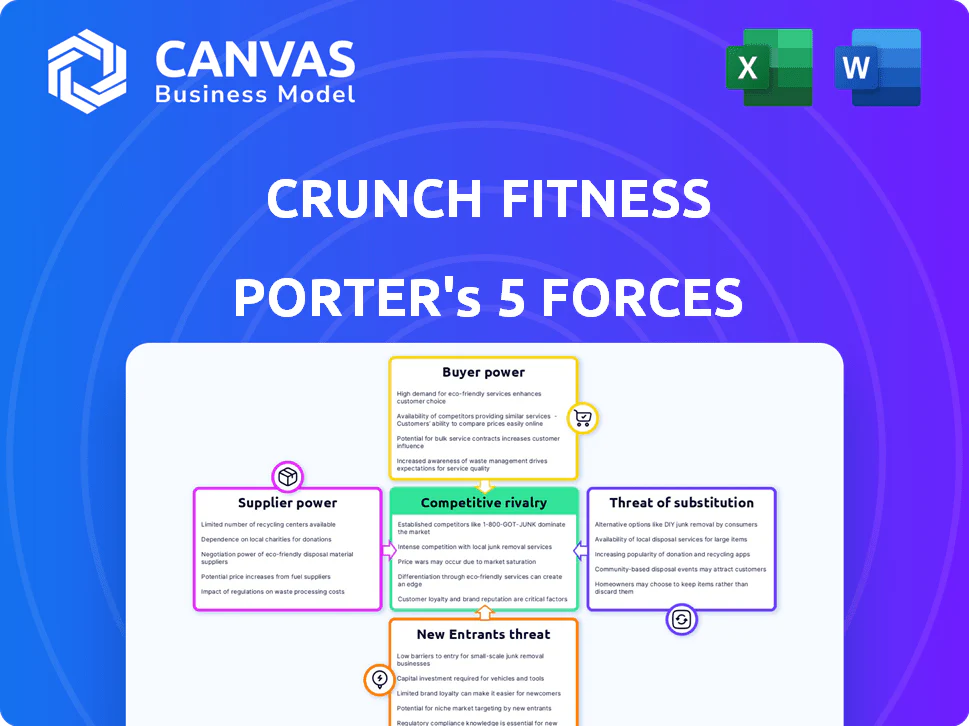
CRUNCH FITNESS PORTER'S FIVE FORCES TEMPLATE RESEARCH

A Must-Have Tool for Decision-Makers
Crunch Fitness faces intense rivalry from budget and boutique gyms, moderate buyer power driven by low switching costs, and manageable supplier influence for equipment and software-yet digital substitutes and new entrants pose rising threats.
This brief snapshot only scratches the surface. Unlock the full Porter's Five Forces Analysis to explore Crunch Fitness's competitive dynamics, market pressures, and strategic advantages in detail.
Suppliers Bargaining Power

Concentration of Equipment Manufacturers
The commercial gym equipment market is concentrated-Life Fitness, Matrix, and Precor hold roughly 45-60% of commercial unit share globally-so Crunch Fitness gains bulk discounts but remains dependent on their proprietary software and service contracts.
These suppliers charge premium maintenance-industry-average contract rates run 12-18% of equipment cost annually-tying Crunch to replacement parts and innovation cycles and raising switching costs and operational disruption risks.
Real Estate Landlord Leverage
Crunch Fitness needs large, high-traffic sites; average US retail rents rose 6.2% in 2025 to $26.40/sq ft, giving landlords leverage in prime ZIPs during lease talks.
Landlords push for longer leases and rent escalations; market vacancy fell to 5.1% in 2025, strengthening landlord bargaining power.
Property taxes and insurance rose-commercial insurance costs up ~22% YoY and property tax assessments up 7% in 2025-often passed to franchisees, compressing location-level margins.

Specialized Labor and Trainer Talent
Demand for certified personal trainers and energetic instructors remains strong; US Bureau of Labor Statistics shows fitness trainer employment at 392,400 in 2024, up 6% since 2020, tightening local markets.
Crunch Fitness' No Judgments culture aids retention, but top-tier talent commands premium pay-average gym trainer wages rose to $22.30/hr in 2024-pressuring margins.
Skilled instructors thus exert bargaining power over hourly wages and benefits, forcing Crunch Fitness to spend more on recruitment and development-industry training budgets rose ~8% in 2024, per IHRSA.

SaaS and Management Software Providers
Crunch Fitness relies heavily on member-management, billing, and app vendors; migrating ~1-3 million member records (typical mid‑scale chain) costs $2-5M and months of downtime, creating strong supplier stickiness.
As Crunch adds AI personalization, demand for niche SaaS (30-40% premium for AI features) raises vendor leverage and switching costs.
- High switching cost: $2-5M migration
- Data lock-in: 1-3M member records
- AI premium: 30-40% higher fees
Energy and Utility Monopolies
Crun ch Fitness faces high supplier power from regional energy monopolies: gyms average 30-50 kWh per m2 annually, and U.S. commercial electricity prices rose to $0.15/kWh in 2025, pushing annual energy spend for a 10,000 ft2 (930 m2) club to about $42k-70k.
Fixed utility costs are non‑negotiable, vary by state policy and grid outages, and a 10% tariff rise can cut margin by ~1-3% for franchised clubs.
- 10,000 ft2 club ≈ $42k-70k energy/yr
- U.S. avg price 2025 ≈ $0.15/kWh
- 10% tariff hike → ~1-3% margin hit
- Grid instability raises outage and HVAC risk
Suppliers Squeeze Margins: OEMs, SaaS AI Premiums, High Migration & Ops Costs
Suppliers hold meaningful power: equipment OEMs (45-60% share) and SaaS vendors (30-40% AI premium) create high switching costs ($2-5M migration, 1-3M member records), while landlords, energy ($0.15/kWh → $42k-70k/10,000ft2/yr) and trainer wage pressure ($22.30/hr) further compress margins.
| Item | 2025 Value |
|---|---|
| OEM market share | 45-60% |
| SaaS AI premium | 30-40% |
| Migration cost | $2-5M |
| Member records | 1-3M |
| Energy price | $0.15/kWh |
| Energy/10,000ft2 | $42k-70k/yr |
| Trainer wage | $22.30/hr |
What is included in the product
 Detailed Word Document
Tailored Porter's Five Forces analysis for Crunch Fitness that uncovers competitive drivers, buyer and supplier power, entry barriers, substitutes, and emerging threats to inform pricing, expansion, and retention strategies.

 Customizable Excel Spreadsheet
A focused Porter's Five Forces snapshot for Crunch Fitness-helping you spot membership rivalry, supplier/leasing pressure, and threat of boutique newcomers at a glance to speed strategic choices.
Customers Bargaining Power

Low Switching Costs for Members
The shift to month-to-month plans lets members leave Crunch Fitness with virtually no penalty, so churn rose industry-wide-U.S. gym monthly churn was ~11% in 2025, putting pressure on member retention and revenue predictability.
That lack of friction forces Crunch Fitness to deliver daily clean facilities and programming; failure risks immediate defections and lost monthly dues.
Without long-term contracts, members hold the leverage to 'vote with their feet' each month, making ongoing service quality crucial to stabilize membership revenue (2025 average revenue per member: ~$38/month).
Price Sensitivity in the HVLP Segment
Crunch Fitness' HVLP (high-value, low-price) members are highly price sensitive; a 2025 survey shows 62% of U.S. low-cost gym members would switch for a $5 monthly increase, forcing Crunch Fitness to keep dues near Planet Fitness' $10-$25 tier.

High Volume of Market Information
With 2025 data showing 86% of US gym seekers using online reviews and 72% comparing prices via apps, Crunch Fitness faces intense customer bargaining power; members can vet location cleanliness, equipment, and class schedules in minutes. Social ratings affect membership flows-a 0.5-star drop can cut new sign-ups by ~10%-so franchise-wide quality control is critical to protect revenue and brand value.

Demand for Seamless Digital Integration
Crunch Fitness faces high customer bargaining power as 72% of US gym members (2024 IHRSA) expect app-wearable integration; digital booking and tracking are now baseline expectations, not luxuries.
If Crunch's app lags-monthly active user churn could rise; 46% of members cite poor digital UX as a reason to switch (2025 survey).
- 72% expect sync with wearables
- 46% would switch over poor UX
- Digital failures raise churn, cut lifetime value
Preference for Flexible Wellness Options
Post-pandemic members favor hybrid fitness-gym, home, and outdoor-with 48% of US adults doing both gym and at-home workouts in 2025, so Crunch Fitness faces higher customer bargaining power.
Members reject rigid hours and policies; 62% cite flexible hours or on-demand classes as key to retention, forcing Crunch to offer late hours, digital classes, and flexible contracts.
Crunch must adapt services to customers' lifestyles-hybrid memberships, app-led coaching, and pay-per-use-to avoid churn and price sensitivity.
- 48% of US adults mix gym and home workouts (2025)
- 62% prioritize flexible hours/on-demand (2025)
- Adopt hybrid memberships, app coaching, pay-per-use
Crunch Fitness faces app-led churn risk: $5 hikes, reviews & wearables drive defections
High customer bargaining power: 2025 churn ~11% and ARPM ~$38/month; 62% would switch over a $5 hike; 86% use reviews and a 0.5-star drop cuts new sign-ups ~10%; 72% expect wearable sync and 46% cite poor app UX as a switch reason-forcing Crunch Fitness into hybrid, app-led, flexible offerings.
| Metric | 2025 Value |
|---|---|
| Churn (US gyms) | ~11% |
| Avg revenue per member | ~$38/month |
| Would switch for $5+ | 62% |
| Use online reviews | 86% |
| Expect wearable sync | 72% |
| Poor app UX = reason to switch | 46% |
Same Document Delivered
Crunch Fitness Porter's Five Forces Analysis
This preview shows the exact Crunch Fitness Porter's Five Forces analysis you'll receive immediately after purchase-fully formatted, professionally written, and ready to use; no placeholders or mockups, just the complete deliverable available for instant download upon payment.

Original: $10.00
-65%$10.00
$3.50CRUNCH FITNESS PORTER'S FIVE FORCES TEMPLATE RESEARCH
A Must-Have Tool for Decision-Makers
Crunch Fitness faces intense rivalry from budget and boutique gyms, moderate buyer power driven by low switching costs, and manageable supplier influence for equipment and software-yet digital substitutes and new entrants pose rising threats.
This brief snapshot only scratches the surface. Unlock the full Porter's Five Forces Analysis to explore Crunch Fitness's competitive dynamics, market pressures, and strategic advantages in detail.
Suppliers Bargaining Power
Concentration of Equipment Manufacturers
The commercial gym equipment market is concentrated-Life Fitness, Matrix, and Precor hold roughly 45-60% of commercial unit share globally-so Crunch Fitness gains bulk discounts but remains dependent on their proprietary software and service contracts.
These suppliers charge premium maintenance-industry-average contract rates run 12-18% of equipment cost annually-tying Crunch to replacement parts and innovation cycles and raising switching costs and operational disruption risks.
Real Estate Landlord Leverage
Crunch Fitness needs large, high-traffic sites; average US retail rents rose 6.2% in 2025 to $26.40/sq ft, giving landlords leverage in prime ZIPs during lease talks.
Landlords push for longer leases and rent escalations; market vacancy fell to 5.1% in 2025, strengthening landlord bargaining power.
Property taxes and insurance rose-commercial insurance costs up ~22% YoY and property tax assessments up 7% in 2025-often passed to franchisees, compressing location-level margins.
Specialized Labor and Trainer Talent
Demand for certified personal trainers and energetic instructors remains strong; US Bureau of Labor Statistics shows fitness trainer employment at 392,400 in 2024, up 6% since 2020, tightening local markets.
Crunch Fitness' No Judgments culture aids retention, but top-tier talent commands premium pay-average gym trainer wages rose to $22.30/hr in 2024-pressuring margins.
Skilled instructors thus exert bargaining power over hourly wages and benefits, forcing Crunch Fitness to spend more on recruitment and development-industry training budgets rose ~8% in 2024, per IHRSA.
SaaS and Management Software Providers
Crunch Fitness relies heavily on member-management, billing, and app vendors; migrating ~1-3 million member records (typical mid‑scale chain) costs $2-5M and months of downtime, creating strong supplier stickiness.
As Crunch adds AI personalization, demand for niche SaaS (30-40% premium for AI features) raises vendor leverage and switching costs.
- High switching cost: $2-5M migration
- Data lock-in: 1-3M member records
- AI premium: 30-40% higher fees
Energy and Utility Monopolies
Crun ch Fitness faces high supplier power from regional energy monopolies: gyms average 30-50 kWh per m2 annually, and U.S. commercial electricity prices rose to $0.15/kWh in 2025, pushing annual energy spend for a 10,000 ft2 (930 m2) club to about $42k-70k.
Fixed utility costs are non‑negotiable, vary by state policy and grid outages, and a 10% tariff rise can cut margin by ~1-3% for franchised clubs.
- 10,000 ft2 club ≈ $42k-70k energy/yr
- U.S. avg price 2025 ≈ $0.15/kWh
- 10% tariff hike → ~1-3% margin hit
- Grid instability raises outage and HVAC risk
Suppliers Squeeze Margins: OEMs, SaaS AI Premiums, High Migration & Ops Costs
Suppliers hold meaningful power: equipment OEMs (45-60% share) and SaaS vendors (30-40% AI premium) create high switching costs ($2-5M migration, 1-3M member records), while landlords, energy ($0.15/kWh → $42k-70k/10,000ft2/yr) and trainer wage pressure ($22.30/hr) further compress margins.
| Item | 2025 Value |
|---|---|
| OEM market share | 45-60% |
| SaaS AI premium | 30-40% |
| Migration cost | $2-5M |
| Member records | 1-3M |
| Energy price | $0.15/kWh |
| Energy/10,000ft2 | $42k-70k/yr |
| Trainer wage | $22.30/hr |
What is included in the product
Detailed Word Document
Tailored Porter's Five Forces analysis for Crunch Fitness that uncovers competitive drivers, buyer and supplier power, entry barriers, substitutes, and emerging threats to inform pricing, expansion, and retention strategies.
Customizable Excel Spreadsheet
A focused Porter's Five Forces snapshot for Crunch Fitness-helping you spot membership rivalry, supplier/leasing pressure, and threat of boutique newcomers at a glance to speed strategic choices.
Customers Bargaining Power
Low Switching Costs for Members
The shift to month-to-month plans lets members leave Crunch Fitness with virtually no penalty, so churn rose industry-wide-U.S. gym monthly churn was ~11% in 2025, putting pressure on member retention and revenue predictability.
That lack of friction forces Crunch Fitness to deliver daily clean facilities and programming; failure risks immediate defections and lost monthly dues.
Without long-term contracts, members hold the leverage to 'vote with their feet' each month, making ongoing service quality crucial to stabilize membership revenue (2025 average revenue per member: ~$38/month).
Price Sensitivity in the HVLP Segment
Crunch Fitness' HVLP (high-value, low-price) members are highly price sensitive; a 2025 survey shows 62% of U.S. low-cost gym members would switch for a $5 monthly increase, forcing Crunch Fitness to keep dues near Planet Fitness' $10-$25 tier.
High Volume of Market Information
With 2025 data showing 86% of US gym seekers using online reviews and 72% comparing prices via apps, Crunch Fitness faces intense customer bargaining power; members can vet location cleanliness, equipment, and class schedules in minutes. Social ratings affect membership flows-a 0.5-star drop can cut new sign-ups by ~10%-so franchise-wide quality control is critical to protect revenue and brand value.
Demand for Seamless Digital Integration
Crunch Fitness faces high customer bargaining power as 72% of US gym members (2024 IHRSA) expect app-wearable integration; digital booking and tracking are now baseline expectations, not luxuries.
If Crunch's app lags-monthly active user churn could rise; 46% of members cite poor digital UX as a reason to switch (2025 survey).
- 72% expect sync with wearables
- 46% would switch over poor UX
- Digital failures raise churn, cut lifetime value
Preference for Flexible Wellness Options
Post-pandemic members favor hybrid fitness-gym, home, and outdoor-with 48% of US adults doing both gym and at-home workouts in 2025, so Crunch Fitness faces higher customer bargaining power.
Members reject rigid hours and policies; 62% cite flexible hours or on-demand classes as key to retention, forcing Crunch to offer late hours, digital classes, and flexible contracts.
Crunch must adapt services to customers' lifestyles-hybrid memberships, app-led coaching, and pay-per-use-to avoid churn and price sensitivity.
- 48% of US adults mix gym and home workouts (2025)
- 62% prioritize flexible hours/on-demand (2025)
- Adopt hybrid memberships, app coaching, pay-per-use
Crunch Fitness faces app-led churn risk: $5 hikes, reviews & wearables drive defections
High customer bargaining power: 2025 churn ~11% and ARPM ~$38/month; 62% would switch over a $5 hike; 86% use reviews and a 0.5-star drop cuts new sign-ups ~10%; 72% expect wearable sync and 46% cite poor app UX as a switch reason-forcing Crunch Fitness into hybrid, app-led, flexible offerings.
| Metric | 2025 Value |
|---|---|
| Churn (US gyms) | ~11% |
| Avg revenue per member | ~$38/month |
| Would switch for $5+ | 62% |
| Use online reviews | 86% |
| Expect wearable sync | 72% |
| Poor app UX = reason to switch | 46% |
Same Document Delivered
Crunch Fitness Porter's Five Forces Analysis
This preview shows the exact Crunch Fitness Porter's Five Forces analysis you'll receive immediately after purchase-fully formatted, professionally written, and ready to use; no placeholders or mockups, just the complete deliverable available for instant download upon payment.
Product Information
Product Information
Shipping & Returns
Shipping & Returns
Description
A Must-Have Tool for Decision-Makers
Crunch Fitness faces intense rivalry from budget and boutique gyms, moderate buyer power driven by low switching costs, and manageable supplier influence for equipment and software-yet digital substitutes and new entrants pose rising threats.
This brief snapshot only scratches the surface. Unlock the full Porter's Five Forces Analysis to explore Crunch Fitness's competitive dynamics, market pressures, and strategic advantages in detail.
Suppliers Bargaining Power
Concentration of Equipment Manufacturers
The commercial gym equipment market is concentrated-Life Fitness, Matrix, and Precor hold roughly 45-60% of commercial unit share globally-so Crunch Fitness gains bulk discounts but remains dependent on their proprietary software and service contracts.
These suppliers charge premium maintenance-industry-average contract rates run 12-18% of equipment cost annually-tying Crunch to replacement parts and innovation cycles and raising switching costs and operational disruption risks.
Real Estate Landlord Leverage
Crunch Fitness needs large, high-traffic sites; average US retail rents rose 6.2% in 2025 to $26.40/sq ft, giving landlords leverage in prime ZIPs during lease talks.
Landlords push for longer leases and rent escalations; market vacancy fell to 5.1% in 2025, strengthening landlord bargaining power.
Property taxes and insurance rose-commercial insurance costs up ~22% YoY and property tax assessments up 7% in 2025-often passed to franchisees, compressing location-level margins.
Specialized Labor and Trainer Talent
Demand for certified personal trainers and energetic instructors remains strong; US Bureau of Labor Statistics shows fitness trainer employment at 392,400 in 2024, up 6% since 2020, tightening local markets.
Crunch Fitness' No Judgments culture aids retention, but top-tier talent commands premium pay-average gym trainer wages rose to $22.30/hr in 2024-pressuring margins.
Skilled instructors thus exert bargaining power over hourly wages and benefits, forcing Crunch Fitness to spend more on recruitment and development-industry training budgets rose ~8% in 2024, per IHRSA.
SaaS and Management Software Providers
Crunch Fitness relies heavily on member-management, billing, and app vendors; migrating ~1-3 million member records (typical mid‑scale chain) costs $2-5M and months of downtime, creating strong supplier stickiness.
As Crunch adds AI personalization, demand for niche SaaS (30-40% premium for AI features) raises vendor leverage and switching costs.
- High switching cost: $2-5M migration
- Data lock-in: 1-3M member records
- AI premium: 30-40% higher fees
Energy and Utility Monopolies
Crun ch Fitness faces high supplier power from regional energy monopolies: gyms average 30-50 kWh per m2 annually, and U.S. commercial electricity prices rose to $0.15/kWh in 2025, pushing annual energy spend for a 10,000 ft2 (930 m2) club to about $42k-70k.
Fixed utility costs are non‑negotiable, vary by state policy and grid outages, and a 10% tariff rise can cut margin by ~1-3% for franchised clubs.
- 10,000 ft2 club ≈ $42k-70k energy/yr
- U.S. avg price 2025 ≈ $0.15/kWh
- 10% tariff hike → ~1-3% margin hit
- Grid instability raises outage and HVAC risk
Suppliers Squeeze Margins: OEMs, SaaS AI Premiums, High Migration & Ops Costs
Suppliers hold meaningful power: equipment OEMs (45-60% share) and SaaS vendors (30-40% AI premium) create high switching costs ($2-5M migration, 1-3M member records), while landlords, energy ($0.15/kWh → $42k-70k/10,000ft2/yr) and trainer wage pressure ($22.30/hr) further compress margins.
| Item | 2025 Value |
|---|---|
| OEM market share | 45-60% |
| SaaS AI premium | 30-40% |
| Migration cost | $2-5M |
| Member records | 1-3M |
| Energy price | $0.15/kWh |
| Energy/10,000ft2 | $42k-70k/yr |
| Trainer wage | $22.30/hr |
What is included in the product
Detailed Word Document
Tailored Porter's Five Forces analysis for Crunch Fitness that uncovers competitive drivers, buyer and supplier power, entry barriers, substitutes, and emerging threats to inform pricing, expansion, and retention strategies.
Customizable Excel Spreadsheet
A focused Porter's Five Forces snapshot for Crunch Fitness-helping you spot membership rivalry, supplier/leasing pressure, and threat of boutique newcomers at a glance to speed strategic choices.
Customers Bargaining Power
Low Switching Costs for Members
The shift to month-to-month plans lets members leave Crunch Fitness with virtually no penalty, so churn rose industry-wide-U.S. gym monthly churn was ~11% in 2025, putting pressure on member retention and revenue predictability.
That lack of friction forces Crunch Fitness to deliver daily clean facilities and programming; failure risks immediate defections and lost monthly dues.
Without long-term contracts, members hold the leverage to 'vote with their feet' each month, making ongoing service quality crucial to stabilize membership revenue (2025 average revenue per member: ~$38/month).
Price Sensitivity in the HVLP Segment
Crunch Fitness' HVLP (high-value, low-price) members are highly price sensitive; a 2025 survey shows 62% of U.S. low-cost gym members would switch for a $5 monthly increase, forcing Crunch Fitness to keep dues near Planet Fitness' $10-$25 tier.
High Volume of Market Information
With 2025 data showing 86% of US gym seekers using online reviews and 72% comparing prices via apps, Crunch Fitness faces intense customer bargaining power; members can vet location cleanliness, equipment, and class schedules in minutes. Social ratings affect membership flows-a 0.5-star drop can cut new sign-ups by ~10%-so franchise-wide quality control is critical to protect revenue and brand value.
Demand for Seamless Digital Integration
Crunch Fitness faces high customer bargaining power as 72% of US gym members (2024 IHRSA) expect app-wearable integration; digital booking and tracking are now baseline expectations, not luxuries.
If Crunch's app lags-monthly active user churn could rise; 46% of members cite poor digital UX as a reason to switch (2025 survey).
- 72% expect sync with wearables
- 46% would switch over poor UX
- Digital failures raise churn, cut lifetime value
Preference for Flexible Wellness Options
Post-pandemic members favor hybrid fitness-gym, home, and outdoor-with 48% of US adults doing both gym and at-home workouts in 2025, so Crunch Fitness faces higher customer bargaining power.
Members reject rigid hours and policies; 62% cite flexible hours or on-demand classes as key to retention, forcing Crunch to offer late hours, digital classes, and flexible contracts.
Crunch must adapt services to customers' lifestyles-hybrid memberships, app-led coaching, and pay-per-use-to avoid churn and price sensitivity.
- 48% of US adults mix gym and home workouts (2025)
- 62% prioritize flexible hours/on-demand (2025)
- Adopt hybrid memberships, app coaching, pay-per-use
Crunch Fitness faces app-led churn risk: $5 hikes, reviews & wearables drive defections
High customer bargaining power: 2025 churn ~11% and ARPM ~$38/month; 62% would switch over a $5 hike; 86% use reviews and a 0.5-star drop cuts new sign-ups ~10%; 72% expect wearable sync and 46% cite poor app UX as a switch reason-forcing Crunch Fitness into hybrid, app-led, flexible offerings.
| Metric | 2025 Value |
|---|---|
| Churn (US gyms) | ~11% |
| Avg revenue per member | ~$38/month |
| Would switch for $5+ | 62% |
| Use online reviews | 86% |
| Expect wearable sync | 72% |
| Poor app UX = reason to switch | 46% |
Same Document Delivered
Crunch Fitness Porter's Five Forces Analysis
This preview shows the exact Crunch Fitness Porter's Five Forces analysis you'll receive immediately after purchase-fully formatted, professionally written, and ready to use; no placeholders or mockups, just the complete deliverable available for instant download upon payment.











