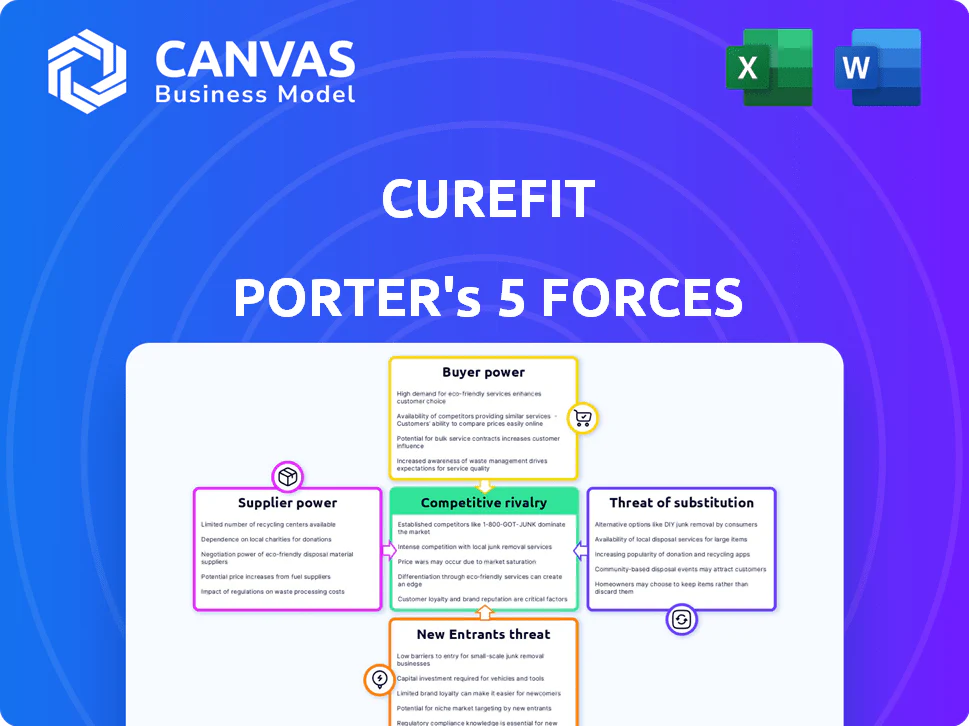
CUREFIT PORTER'S FIVE FORCES TEMPLATE RESEARCH
What is included in the product
 Detailed Word Document
Tailored exclusively for CureFit, analyzing its position within its competitive landscape.

 Customizable Excel Spreadsheet
Instantly identify threats & opportunities in fitness with a concise, dynamic analysis.
Preview the Actual Deliverable
CureFit Porter's Five Forces Analysis
This preview presents the complete Porter's Five Forces analysis for CureFit. The document analyzes industry competition, potential threats, and market dynamics. Every aspect, from the structure to the data, is the same as what you receive. It's a ready-to-use analysis, formatted for immediate application.

Porter's Five Forces Analysis Template

From Overview to Strategy Blueprint
CureFit faces diverse pressures in the fitness and wellness market.
Rivalry among existing competitors is intense, with established players and startups vying for market share.
Buyer power is moderate, as consumers have numerous options.
Suppliers have limited influence.
The threat of new entrants and substitutes exists but is manageable.
This brief snapshot only scratches the surface. Unlock the full Porter's Five Forces Analysis to explore CureFit’s competitive dynamics, market pressures, and strategic advantages in detail.
Suppliers Bargaining Power

Limited specialized healthcare providers
The bargaining power of suppliers is affected by the availability of specialized healthcare providers. In India, even though private hospitals are numerous, specialized centers have more power. This is due to concentrated demand and fewer providers, which boosts supplier leverage. For example, in 2024, the healthcare market in India was valued at $133 billion.
Dependency on quality medical equipment
CureFit depends on high-quality medical equipment, making it vulnerable to supplier price hikes. The global medical equipment market, valued at $495.5 billion in 2023, is projected to reach $671.4 billion by 2028. Any cost increase from suppliers directly affects CureFit's operational expenses. This reliance gives suppliers considerable bargaining power.

Potential for supplier consolidation
Consolidation in sectors like medical equipment and pharmaceuticals can strengthen supplier power. This reduces options, potentially raising costs for CureFit. For example, in 2024, the pharmaceutical industry saw significant mergers, impacting drug pricing. This could increase CureFit's expenses. The rising costs may affect profitability and service delivery.

Availability of alternative sources for generic medications
CureFit's bargaining power with suppliers is influenced by generic drug availability. India's strong generic drug production offers CureFit alternative sourcing. This reduces the dependence on specific pharmaceutical suppliers. This can lead to more favorable pricing for CureFit.
- India's generic drug market was valued at $29.7 billion in 2024.
- It is expected to reach $38.9 billion by 2028.
- This growth provides CureFit with more sourcing options.
Influence of suppliers in setting prices for proprietary health services
Suppliers of unique health services wield considerable pricing power, particularly when offering specialized or proprietary treatments. This influence stems from the scarcity and distinctiveness of their services. For instance, in 2024, the global health tech market reached an estimated $61.3 billion, showcasing the value of unique offerings. The ability to control access to these services allows suppliers to dictate prices, affecting profitability.
- Specialized treatments command premium prices.
- Proprietary services limit competition.
- Market size of health tech in 2024: $61.3 billion.
- Supplier control impacts CureFit's margins.
Supplier Power Dynamics: A Look at CureFit
CureFit faces supplier bargaining power challenges, especially with specialized services and equipment. The global medical equipment market, valued at $495.5 billion in 2023, influences CureFit's costs. India's generic drug market, worth $29.7 billion in 2024, offers some leverage.
| Factor | Impact | Data |
|---|---|---|
| Specialized Providers | High bargaining power | Global health tech market: $61.3B (2024) |
| Medical Equipment | Supplier cost influence | Medical equipment market: $495.5B (2023) |
| Generic Drugs | Mitigating power | India's generic drug market: $29.7B (2024) |
Customers Bargaining Power

Increasing health consciousness
The bargaining power of CureFit's customers is increasing due to growing health consciousness. Post-pandemic, more Indians prioritize health, boosting the wellness market. This gives customers more choices and leverage. In 2024, India's health and wellness market is valued at approximately $100 billion, reflecting customer influence.
Increased availability of competing brands
CureFit faces strong customer bargaining power due to many competitors. Customers can easily switch between brands like Cult.fit or others. In 2024, the online fitness market was valued at $6.2 billion, showing ample choices for consumers. This competition keeps prices competitive.

Ability to switch services easily
CureFit customers can easily switch to competitors like Cult.fit, or other online fitness programs. This ease of switching boosts customer bargaining power. The fitness app market valued at $4.3 billion in 2023, saw many new entrants. This makes it simple for users to find alternatives that offer better deals or features. Consumers have a high degree of choice, influencing CureFit's pricing and service offerings.

Higher expectations for personalized solutions
Customers now demand personalized healthcare and fitness experiences. Companies offering tailored services gain an edge in attracting and keeping clients. CureFit's ability to customize plans impacts its customer bargaining power. Offering unique solutions increases customer loyalty, affecting market dynamics. The global wellness market, valued at $4.9 trillion in 2023, highlights this shift.
- Personalized fitness plans boost customer retention rates by up to 30%.
- The demand for customized wellness programs grew by 20% in 2024.
- Businesses focusing on personalization see a 15% rise in customer lifetime value.
- CureFit's personalized approach could lead to a 25% increase in customer satisfaction.
Price sensitivity among different demographics
Customers' price sensitivity varies widely. Those with lower incomes often prioritize cost, seeking deals and discounts, while higher-income individuals may be less price-sensitive. In 2024, data showed that 68% of consumers consider price the most crucial factor when choosing fitness services. This can force companies to adjust pricing strategies.
- Lower-income customers are more price-sensitive.
- Higher-income customers may prioritize other factors.
- 68% of consumers prioritize price.
- Companies must offer competitive pricing.
Customer Power: Shaping the Fitness Landscape
CureFit's customers wield significant bargaining power, fueled by health awareness and market competition. The ease of switching to competitors and the demand for personalized services further amplify customer influence. Price sensitivity also plays a crucial role, with many prioritizing cost when selecting fitness options.
| Factor | Impact | 2024 Data |
|---|---|---|
| Market Competition | High switching options | Online fitness market: $6.2B |
| Personalization | Increased customer loyalty | Demand for customized programs grew by 20% |
| Price Sensitivity | Influences pricing | 68% of consumers prioritize price |
Rivalry Among Competitors

Numerous established players
In India's fitness sector, CureFit faces fierce rivalry. The market includes old gyms and digital fitness apps. Competition drives pricing and service innovation. For example, Cult.fit's revenue was about ₹700 crore in FY23. This intense rivalry impacts CureFit's market share.
Similar service offerings
CureFit faces intense rivalry due to many competitors offering similar services. This includes fitness classes, online workouts, and health-focused products. The market is crowded, with companies like Cult.fit and others vying for the same customers. In 2024, the fitness industry's revenue reached approximately $36 billion, highlighting the competition.

Hybrid fitness models gaining traction
The hybrid fitness model, blending digital and physical experiences, intensifies competitive rivalry within the fitness industry. This approach, adopted by companies like CureFit, forces competitors to innovate and provide flexible offerings. For instance, CureFit's revenue in 2024 reached $60 million, reflecting its success in the hybrid space. This forces others to match or exceed, increasing the pressure.

Innovation in technology and personalization
Competitive rivalry in the fitness industry is intense, significantly driven by constant innovation. Companies are increasingly using technology, including AI and wearable devices, to personalize fitness plans and boost user engagement. This focus on tech-driven personalization is a key battleground. The global fitness app market was valued at $1.4 billion in 2023, with projections to reach $4.5 billion by 2029, highlighting the growth fueled by innovation.
- Increased Competition: The rise of digital fitness platforms and personalized training apps.
- Technological Advancements: Integration of AI, wearables, and data analytics for customized fitness solutions.
- Market Growth: The fitness app market's projected growth from $1.4B in 2023 to $4.5B by 2029.
- User Engagement: Enhanced through personalized experiences and interactive features.
Expansion into Tier 2 and Tier 3 cities
The competitive rivalry intensifies as CureFit's rivals broaden their footprint into Tier 2 and Tier 3 cities, mirroring CureFit's expansion strategy. This move escalates competition outside of major cities, where Gym chains like Cult.fit are already making their presence felt, according to recent reports. This expansion means CureFit faces a more crowded market, potentially impacting its market share and profitability, especially in regions where brand recognition might be lower. The aggressive push into these areas by competitors necessitates a robust strategy from CureFit to maintain and grow its customer base.
- Cult.fit has aggressively expanded, opening numerous centers in smaller cities across India in 2024.
- Smaller fitness chains are also targeting these markets, increasing the overall competitive intensity.
- CureFit needs to differentiate itself through unique offerings and strong marketing to succeed.
- The expansion into smaller cities leads to increased price competition and reduced profit margins.
India's Fitness Market: A Competitive Landscape
CureFit faces intense competition in India's fitness market. Digital platforms and established gyms fiercely compete for customers. The market's growth, with the fitness app sector valued at $1.4 billion in 2023, fuels this rivalry.
| Aspect | Details | Impact |
|---|---|---|
| Key Competitors | Cult.fit, other gyms, digital apps | Increased price pressure |
| Market Growth | Fitness app market projected to $4.5B by 2029 | Attracts new entrants |
| Expansion | Rivals entering Tier 2/3 cities | Intensified competition |
Original: $10.00
-65%$10.00
$3.50CUREFIT PORTER'S FIVE FORCES TEMPLATE RESEARCH
What is included in the product
Detailed Word Document
Tailored exclusively for CureFit, analyzing its position within its competitive landscape.
Customizable Excel Spreadsheet
Instantly identify threats & opportunities in fitness with a concise, dynamic analysis.
Preview the Actual Deliverable
CureFit Porter's Five Forces Analysis
This preview presents the complete Porter's Five Forces analysis for CureFit. The document analyzes industry competition, potential threats, and market dynamics. Every aspect, from the structure to the data, is the same as what you receive. It's a ready-to-use analysis, formatted for immediate application.
Porter's Five Forces Analysis Template
From Overview to Strategy Blueprint
CureFit faces diverse pressures in the fitness and wellness market.
Rivalry among existing competitors is intense, with established players and startups vying for market share.
Buyer power is moderate, as consumers have numerous options.
Suppliers have limited influence.
The threat of new entrants and substitutes exists but is manageable.
This brief snapshot only scratches the surface. Unlock the full Porter's Five Forces Analysis to explore CureFit’s competitive dynamics, market pressures, and strategic advantages in detail.
Suppliers Bargaining Power
Limited specialized healthcare providers
The bargaining power of suppliers is affected by the availability of specialized healthcare providers. In India, even though private hospitals are numerous, specialized centers have more power. This is due to concentrated demand and fewer providers, which boosts supplier leverage. For example, in 2024, the healthcare market in India was valued at $133 billion.
Dependency on quality medical equipment
CureFit depends on high-quality medical equipment, making it vulnerable to supplier price hikes. The global medical equipment market, valued at $495.5 billion in 2023, is projected to reach $671.4 billion by 2028. Any cost increase from suppliers directly affects CureFit's operational expenses. This reliance gives suppliers considerable bargaining power.
Potential for supplier consolidation
Consolidation in sectors like medical equipment and pharmaceuticals can strengthen supplier power. This reduces options, potentially raising costs for CureFit. For example, in 2024, the pharmaceutical industry saw significant mergers, impacting drug pricing. This could increase CureFit's expenses. The rising costs may affect profitability and service delivery.
Availability of alternative sources for generic medications
CureFit's bargaining power with suppliers is influenced by generic drug availability. India's strong generic drug production offers CureFit alternative sourcing. This reduces the dependence on specific pharmaceutical suppliers. This can lead to more favorable pricing for CureFit.
- India's generic drug market was valued at $29.7 billion in 2024.
- It is expected to reach $38.9 billion by 2028.
- This growth provides CureFit with more sourcing options.
Influence of suppliers in setting prices for proprietary health services
Suppliers of unique health services wield considerable pricing power, particularly when offering specialized or proprietary treatments. This influence stems from the scarcity and distinctiveness of their services. For instance, in 2024, the global health tech market reached an estimated $61.3 billion, showcasing the value of unique offerings. The ability to control access to these services allows suppliers to dictate prices, affecting profitability.
- Specialized treatments command premium prices.
- Proprietary services limit competition.
- Market size of health tech in 2024: $61.3 billion.
- Supplier control impacts CureFit's margins.
Supplier Power Dynamics: A Look at CureFit
CureFit faces supplier bargaining power challenges, especially with specialized services and equipment. The global medical equipment market, valued at $495.5 billion in 2023, influences CureFit's costs. India's generic drug market, worth $29.7 billion in 2024, offers some leverage.
| Factor | Impact | Data |
|---|---|---|
| Specialized Providers | High bargaining power | Global health tech market: $61.3B (2024) |
| Medical Equipment | Supplier cost influence | Medical equipment market: $495.5B (2023) |
| Generic Drugs | Mitigating power | India's generic drug market: $29.7B (2024) |
Customers Bargaining Power
Increasing health consciousness
The bargaining power of CureFit's customers is increasing due to growing health consciousness. Post-pandemic, more Indians prioritize health, boosting the wellness market. This gives customers more choices and leverage. In 2024, India's health and wellness market is valued at approximately $100 billion, reflecting customer influence.
Increased availability of competing brands
CureFit faces strong customer bargaining power due to many competitors. Customers can easily switch between brands like Cult.fit or others. In 2024, the online fitness market was valued at $6.2 billion, showing ample choices for consumers. This competition keeps prices competitive.
Ability to switch services easily
CureFit customers can easily switch to competitors like Cult.fit, or other online fitness programs. This ease of switching boosts customer bargaining power. The fitness app market valued at $4.3 billion in 2023, saw many new entrants. This makes it simple for users to find alternatives that offer better deals or features. Consumers have a high degree of choice, influencing CureFit's pricing and service offerings.
Higher expectations for personalized solutions
Customers now demand personalized healthcare and fitness experiences. Companies offering tailored services gain an edge in attracting and keeping clients. CureFit's ability to customize plans impacts its customer bargaining power. Offering unique solutions increases customer loyalty, affecting market dynamics. The global wellness market, valued at $4.9 trillion in 2023, highlights this shift.
- Personalized fitness plans boost customer retention rates by up to 30%.
- The demand for customized wellness programs grew by 20% in 2024.
- Businesses focusing on personalization see a 15% rise in customer lifetime value.
- CureFit's personalized approach could lead to a 25% increase in customer satisfaction.
Price sensitivity among different demographics
Customers' price sensitivity varies widely. Those with lower incomes often prioritize cost, seeking deals and discounts, while higher-income individuals may be less price-sensitive. In 2024, data showed that 68% of consumers consider price the most crucial factor when choosing fitness services. This can force companies to adjust pricing strategies.
- Lower-income customers are more price-sensitive.
- Higher-income customers may prioritize other factors.
- 68% of consumers prioritize price.
- Companies must offer competitive pricing.
Customer Power: Shaping the Fitness Landscape
CureFit's customers wield significant bargaining power, fueled by health awareness and market competition. The ease of switching to competitors and the demand for personalized services further amplify customer influence. Price sensitivity also plays a crucial role, with many prioritizing cost when selecting fitness options.
| Factor | Impact | 2024 Data |
|---|---|---|
| Market Competition | High switching options | Online fitness market: $6.2B |
| Personalization | Increased customer loyalty | Demand for customized programs grew by 20% |
| Price Sensitivity | Influences pricing | 68% of consumers prioritize price |
Rivalry Among Competitors
Numerous established players
In India's fitness sector, CureFit faces fierce rivalry. The market includes old gyms and digital fitness apps. Competition drives pricing and service innovation. For example, Cult.fit's revenue was about ₹700 crore in FY23. This intense rivalry impacts CureFit's market share.
Similar service offerings
CureFit faces intense rivalry due to many competitors offering similar services. This includes fitness classes, online workouts, and health-focused products. The market is crowded, with companies like Cult.fit and others vying for the same customers. In 2024, the fitness industry's revenue reached approximately $36 billion, highlighting the competition.
Hybrid fitness models gaining traction
The hybrid fitness model, blending digital and physical experiences, intensifies competitive rivalry within the fitness industry. This approach, adopted by companies like CureFit, forces competitors to innovate and provide flexible offerings. For instance, CureFit's revenue in 2024 reached $60 million, reflecting its success in the hybrid space. This forces others to match or exceed, increasing the pressure.
Innovation in technology and personalization
Competitive rivalry in the fitness industry is intense, significantly driven by constant innovation. Companies are increasingly using technology, including AI and wearable devices, to personalize fitness plans and boost user engagement. This focus on tech-driven personalization is a key battleground. The global fitness app market was valued at $1.4 billion in 2023, with projections to reach $4.5 billion by 2029, highlighting the growth fueled by innovation.
- Increased Competition: The rise of digital fitness platforms and personalized training apps.
- Technological Advancements: Integration of AI, wearables, and data analytics for customized fitness solutions.
- Market Growth: The fitness app market's projected growth from $1.4B in 2023 to $4.5B by 2029.
- User Engagement: Enhanced through personalized experiences and interactive features.
Expansion into Tier 2 and Tier 3 cities
The competitive rivalry intensifies as CureFit's rivals broaden their footprint into Tier 2 and Tier 3 cities, mirroring CureFit's expansion strategy. This move escalates competition outside of major cities, where Gym chains like Cult.fit are already making their presence felt, according to recent reports. This expansion means CureFit faces a more crowded market, potentially impacting its market share and profitability, especially in regions where brand recognition might be lower. The aggressive push into these areas by competitors necessitates a robust strategy from CureFit to maintain and grow its customer base.
- Cult.fit has aggressively expanded, opening numerous centers in smaller cities across India in 2024.
- Smaller fitness chains are also targeting these markets, increasing the overall competitive intensity.
- CureFit needs to differentiate itself through unique offerings and strong marketing to succeed.
- The expansion into smaller cities leads to increased price competition and reduced profit margins.
India's Fitness Market: A Competitive Landscape
CureFit faces intense competition in India's fitness market. Digital platforms and established gyms fiercely compete for customers. The market's growth, with the fitness app sector valued at $1.4 billion in 2023, fuels this rivalry.
| Aspect | Details | Impact |
|---|---|---|
| Key Competitors | Cult.fit, other gyms, digital apps | Increased price pressure |
| Market Growth | Fitness app market projected to $4.5B by 2029 | Attracts new entrants |
| Expansion | Rivals entering Tier 2/3 cities | Intensified competition |
Product Information
Product Information
Shipping & Returns
Shipping & Returns
Description
What is included in the product
Detailed Word Document
Tailored exclusively for CureFit, analyzing its position within its competitive landscape.
Customizable Excel Spreadsheet
Instantly identify threats & opportunities in fitness with a concise, dynamic analysis.
Preview the Actual Deliverable
CureFit Porter's Five Forces Analysis
This preview presents the complete Porter's Five Forces analysis for CureFit. The document analyzes industry competition, potential threats, and market dynamics. Every aspect, from the structure to the data, is the same as what you receive. It's a ready-to-use analysis, formatted for immediate application.
Porter's Five Forces Analysis Template
From Overview to Strategy Blueprint
CureFit faces diverse pressures in the fitness and wellness market.
Rivalry among existing competitors is intense, with established players and startups vying for market share.
Buyer power is moderate, as consumers have numerous options.
Suppliers have limited influence.
The threat of new entrants and substitutes exists but is manageable.
This brief snapshot only scratches the surface. Unlock the full Porter's Five Forces Analysis to explore CureFit’s competitive dynamics, market pressures, and strategic advantages in detail.
Suppliers Bargaining Power
Limited specialized healthcare providers
The bargaining power of suppliers is affected by the availability of specialized healthcare providers. In India, even though private hospitals are numerous, specialized centers have more power. This is due to concentrated demand and fewer providers, which boosts supplier leverage. For example, in 2024, the healthcare market in India was valued at $133 billion.
Dependency on quality medical equipment
CureFit depends on high-quality medical equipment, making it vulnerable to supplier price hikes. The global medical equipment market, valued at $495.5 billion in 2023, is projected to reach $671.4 billion by 2028. Any cost increase from suppliers directly affects CureFit's operational expenses. This reliance gives suppliers considerable bargaining power.
Potential for supplier consolidation
Consolidation in sectors like medical equipment and pharmaceuticals can strengthen supplier power. This reduces options, potentially raising costs for CureFit. For example, in 2024, the pharmaceutical industry saw significant mergers, impacting drug pricing. This could increase CureFit's expenses. The rising costs may affect profitability and service delivery.
Availability of alternative sources for generic medications
CureFit's bargaining power with suppliers is influenced by generic drug availability. India's strong generic drug production offers CureFit alternative sourcing. This reduces the dependence on specific pharmaceutical suppliers. This can lead to more favorable pricing for CureFit.
- India's generic drug market was valued at $29.7 billion in 2024.
- It is expected to reach $38.9 billion by 2028.
- This growth provides CureFit with more sourcing options.
Influence of suppliers in setting prices for proprietary health services
Suppliers of unique health services wield considerable pricing power, particularly when offering specialized or proprietary treatments. This influence stems from the scarcity and distinctiveness of their services. For instance, in 2024, the global health tech market reached an estimated $61.3 billion, showcasing the value of unique offerings. The ability to control access to these services allows suppliers to dictate prices, affecting profitability.
- Specialized treatments command premium prices.
- Proprietary services limit competition.
- Market size of health tech in 2024: $61.3 billion.
- Supplier control impacts CureFit's margins.
Supplier Power Dynamics: A Look at CureFit
CureFit faces supplier bargaining power challenges, especially with specialized services and equipment. The global medical equipment market, valued at $495.5 billion in 2023, influences CureFit's costs. India's generic drug market, worth $29.7 billion in 2024, offers some leverage.
| Factor | Impact | Data |
|---|---|---|
| Specialized Providers | High bargaining power | Global health tech market: $61.3B (2024) |
| Medical Equipment | Supplier cost influence | Medical equipment market: $495.5B (2023) |
| Generic Drugs | Mitigating power | India's generic drug market: $29.7B (2024) |
Customers Bargaining Power
Increasing health consciousness
The bargaining power of CureFit's customers is increasing due to growing health consciousness. Post-pandemic, more Indians prioritize health, boosting the wellness market. This gives customers more choices and leverage. In 2024, India's health and wellness market is valued at approximately $100 billion, reflecting customer influence.
Increased availability of competing brands
CureFit faces strong customer bargaining power due to many competitors. Customers can easily switch between brands like Cult.fit or others. In 2024, the online fitness market was valued at $6.2 billion, showing ample choices for consumers. This competition keeps prices competitive.
Ability to switch services easily
CureFit customers can easily switch to competitors like Cult.fit, or other online fitness programs. This ease of switching boosts customer bargaining power. The fitness app market valued at $4.3 billion in 2023, saw many new entrants. This makes it simple for users to find alternatives that offer better deals or features. Consumers have a high degree of choice, influencing CureFit's pricing and service offerings.
Higher expectations for personalized solutions
Customers now demand personalized healthcare and fitness experiences. Companies offering tailored services gain an edge in attracting and keeping clients. CureFit's ability to customize plans impacts its customer bargaining power. Offering unique solutions increases customer loyalty, affecting market dynamics. The global wellness market, valued at $4.9 trillion in 2023, highlights this shift.
- Personalized fitness plans boost customer retention rates by up to 30%.
- The demand for customized wellness programs grew by 20% in 2024.
- Businesses focusing on personalization see a 15% rise in customer lifetime value.
- CureFit's personalized approach could lead to a 25% increase in customer satisfaction.
Price sensitivity among different demographics
Customers' price sensitivity varies widely. Those with lower incomes often prioritize cost, seeking deals and discounts, while higher-income individuals may be less price-sensitive. In 2024, data showed that 68% of consumers consider price the most crucial factor when choosing fitness services. This can force companies to adjust pricing strategies.
- Lower-income customers are more price-sensitive.
- Higher-income customers may prioritize other factors.
- 68% of consumers prioritize price.
- Companies must offer competitive pricing.
Customer Power: Shaping the Fitness Landscape
CureFit's customers wield significant bargaining power, fueled by health awareness and market competition. The ease of switching to competitors and the demand for personalized services further amplify customer influence. Price sensitivity also plays a crucial role, with many prioritizing cost when selecting fitness options.
| Factor | Impact | 2024 Data |
|---|---|---|
| Market Competition | High switching options | Online fitness market: $6.2B |
| Personalization | Increased customer loyalty | Demand for customized programs grew by 20% |
| Price Sensitivity | Influences pricing | 68% of consumers prioritize price |
Rivalry Among Competitors
Numerous established players
In India's fitness sector, CureFit faces fierce rivalry. The market includes old gyms and digital fitness apps. Competition drives pricing and service innovation. For example, Cult.fit's revenue was about ₹700 crore in FY23. This intense rivalry impacts CureFit's market share.
Similar service offerings
CureFit faces intense rivalry due to many competitors offering similar services. This includes fitness classes, online workouts, and health-focused products. The market is crowded, with companies like Cult.fit and others vying for the same customers. In 2024, the fitness industry's revenue reached approximately $36 billion, highlighting the competition.
Hybrid fitness models gaining traction
The hybrid fitness model, blending digital and physical experiences, intensifies competitive rivalry within the fitness industry. This approach, adopted by companies like CureFit, forces competitors to innovate and provide flexible offerings. For instance, CureFit's revenue in 2024 reached $60 million, reflecting its success in the hybrid space. This forces others to match or exceed, increasing the pressure.
Innovation in technology and personalization
Competitive rivalry in the fitness industry is intense, significantly driven by constant innovation. Companies are increasingly using technology, including AI and wearable devices, to personalize fitness plans and boost user engagement. This focus on tech-driven personalization is a key battleground. The global fitness app market was valued at $1.4 billion in 2023, with projections to reach $4.5 billion by 2029, highlighting the growth fueled by innovation.
- Increased Competition: The rise of digital fitness platforms and personalized training apps.
- Technological Advancements: Integration of AI, wearables, and data analytics for customized fitness solutions.
- Market Growth: The fitness app market's projected growth from $1.4B in 2023 to $4.5B by 2029.
- User Engagement: Enhanced through personalized experiences and interactive features.
Expansion into Tier 2 and Tier 3 cities
The competitive rivalry intensifies as CureFit's rivals broaden their footprint into Tier 2 and Tier 3 cities, mirroring CureFit's expansion strategy. This move escalates competition outside of major cities, where Gym chains like Cult.fit are already making their presence felt, according to recent reports. This expansion means CureFit faces a more crowded market, potentially impacting its market share and profitability, especially in regions where brand recognition might be lower. The aggressive push into these areas by competitors necessitates a robust strategy from CureFit to maintain and grow its customer base.
- Cult.fit has aggressively expanded, opening numerous centers in smaller cities across India in 2024.
- Smaller fitness chains are also targeting these markets, increasing the overall competitive intensity.
- CureFit needs to differentiate itself through unique offerings and strong marketing to succeed.
- The expansion into smaller cities leads to increased price competition and reduced profit margins.
India's Fitness Market: A Competitive Landscape
CureFit faces intense competition in India's fitness market. Digital platforms and established gyms fiercely compete for customers. The market's growth, with the fitness app sector valued at $1.4 billion in 2023, fuels this rivalry.
| Aspect | Details | Impact |
|---|---|---|
| Key Competitors | Cult.fit, other gyms, digital apps | Increased price pressure |
| Market Growth | Fitness app market projected to $4.5B by 2029 | Attracts new entrants |
| Expansion | Rivals entering Tier 2/3 cities | Intensified competition |











