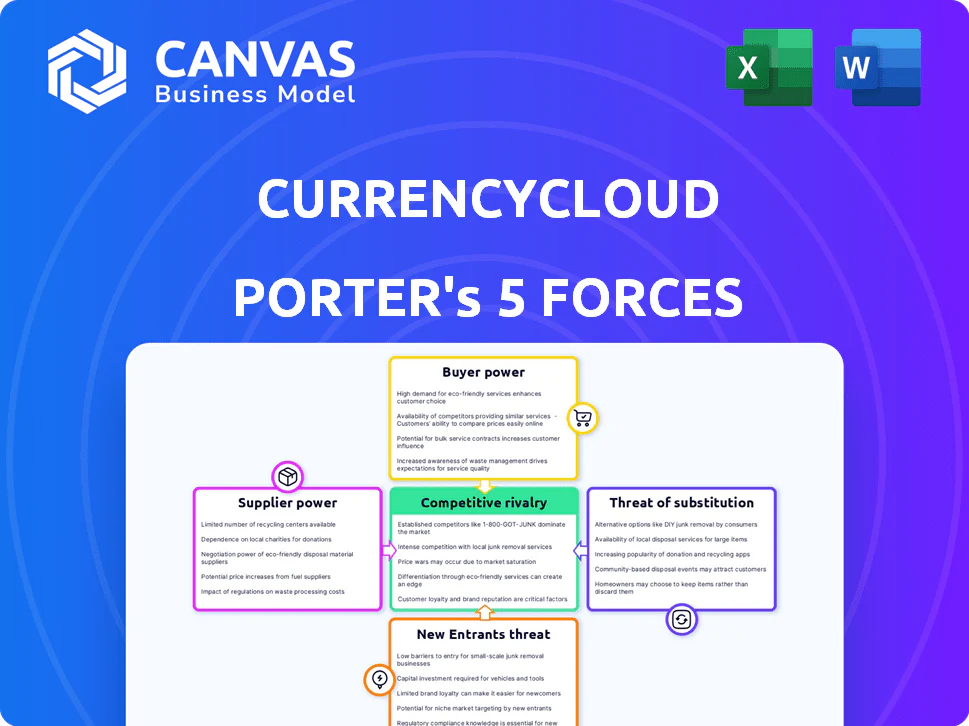
CURRENCYCLOUD PORTER'S FIVE FORCES TEMPLATE RESEARCH
What is included in the product
 Detailed Word Document
Evaluates control held by suppliers and buyers, and their influence on pricing and profitability.

 Customizable Excel Spreadsheet
Customize pressure levels to quickly adapt the analysis to shifting market dynamics.
Same Document Delivered
Currencycloud Porter's Five Forces Analysis
This preview unveils the Currencycloud Porter's Five Forces Analysis, showcasing the exact document you'll receive instantly post-purchase.
It meticulously examines the competitive landscape, assessing factors like threat of new entrants and bargaining power of suppliers.
The document provides a clear, concise, and professionally formatted analysis, ready for your immediate use.
No alterations or additional steps are needed; the preview reflects the final deliverable.
Get instant access to this comprehensive analysis upon purchase—exactly as displayed.

Porter's Five Forces Analysis Template

Elevate Your Analysis with the Complete Porter's Five Forces Analysis
Currencycloud's industry faces intense competition, particularly from established financial institutions and emerging fintech rivals. Supplier bargaining power is moderate, with a range of technology providers available. The threat of new entrants is significant due to low barriers to entry and readily available capital. Buyer power is high, driven by the availability of alternative payment solutions. The threat of substitutes remains a concern, including cryptocurrencies and other innovative payment methods.
This brief snapshot only scratches the surface. Unlock the full Porter's Five Forces Analysis to explore Currencycloud’s competitive dynamics, market pressures, and strategic advantages in detail.
Suppliers Bargaining Power

Access to Essential Infrastructure
Currencycloud's operations heavily depend on critical infrastructure like banking networks and payment systems. Suppliers, including correspondent banks and networks like SWIFT, hold significant bargaining power. In 2024, SWIFT processed an average of 45.1 million messages daily, highlighting its influence. Changes in fees or access terms from these suppliers directly impact Currencycloud's profitability and service delivery.
Technology Providers
Currencycloud's reliance on cloud technology and specialized financial tech creates a supplier landscape. Switching costs for essential components or data providers can affect their bargaining power. In 2024, the global cloud computing market is estimated at $670 billion, reflecting the industry's influence. Currencycloud must manage vendor relationships to mitigate risks.

Regulatory Bodies
Regulatory bodies, acting as non-traditional suppliers, hold considerable influence over Currencycloud. Compliance mandates and licensing, essential for legal operation, exert supplier power. Currencycloud must rigorously adhere to these requirements, impacting its operational costs and strategic flexibility. In 2024, the cost of regulatory compliance for fintech firms increased by an estimated 15%.

Liquidity Providers
Currencycloud relies heavily on liquidity providers, primarily large financial institutions, to facilitate currency exchange. These providers dictate the terms and rates at which Currencycloud can access various currencies, impacting its operational costs. The bargaining power of these suppliers is significant, especially for less liquid currencies. In 2024, the average spread on major currency pairs was approximately 0.05%, while spreads on exotic currencies could reach up to 0.5%. This can directly affect Currencycloud's profitability and competitive pricing.
- Liquidity providers are mainly large banks and financial institutions.
- They control the rates and terms for accessing currencies.
- Less liquid currencies give suppliers more power.
- Spreads on currency pairs can vary widely.
Talent Pool
Currencycloud's success hinges on its ability to attract and retain top talent. In the tech industry, the competition for skilled developers and compliance experts is fierce, which can increase labor costs. This puts upward pressure on operational expenses, potentially impacting profitability.
- In 2024, the average salary for a software developer in London, where Currencycloud has a significant presence, was around £65,000-£85,000.
- The fintech sector is experiencing a 10-15% annual increase in demand for compliance professionals.
- Employee turnover rates in tech companies can range from 15-20% annually.
- Currencycloud must offer competitive compensation packages.
Supplier Power Dynamics: A Look at the Numbers
Currencycloud faces supplier power from banks and payment networks like SWIFT. SWIFT processed 45.1M daily messages in 2024, impacting costs. Cloud tech and fintech suppliers also hold power, with the cloud market at $670B in 2024. Regulatory bodies and liquidity providers further increase supplier influence.
| Supplier Type | Impact on Currencycloud | 2024 Data |
|---|---|---|
| Correspondent Banks/SWIFT | Fees, access terms | SWIFT: 45.1M messages daily |
| Cloud/Fintech Providers | Switching costs | Cloud market: $670B |
| Regulatory Bodies | Compliance costs, licenses | Fintech compliance cost increase: 15% |
| Liquidity Providers | Currency exchange rates | Major currency spread: 0.05% |
Customers Bargaining Power

Diverse Customer Base
Currencycloud's varied customer base, from startups to established corporations, influences customer bargaining power. While some larger clients might negotiate better terms, the broad customer distribution dilutes the overall power. In 2024, the fintech sector saw a 15% increase in average contract values, indicating a balance. This balance helps maintain pricing stability.
Availability of Alternatives
Currencycloud's customers face many choices for international payments, including established banks and other fintech firms. This variety strengthens customer power. In 2024, the global fintech market was valued at over $150 billion, showing strong competition.

Integration Costs
Integration costs affect customer bargaining power. Businesses with Currencycloud deeply integrated face switching costs, reducing their power. For example, integrating new payment systems can cost thousands. A 2024 study showed integration projects often exceed budgets by 20%.

Price Sensitivity
Businesses, particularly SMEs, are often price-sensitive when it comes to international payments. The availability of transparent fees and exchange rates from different providers allows customers to easily compare and choose the most economical option. This heightened price awareness significantly boosts their bargaining power regarding pricing. In 2024, the average SME spent approximately 3% of its revenue on international transactions, highlighting the importance of cost optimization.
- Cost Transparency: Clear fee structures and exchange rates empower customers.
- Competitive Options: Multiple providers increase customer choice.
- SME Focus: SMEs are particularly cost-conscious.
- Financial Impact: Cost optimization directly affects profitability.
Demand for Specific Features
Customers with particular international payment demands, such as multi-currency wallets or specific API integrations, often wield more bargaining power. This is because they can readily switch to providers who best fulfill their needs. The shift to digital payments has amplified this, with 63% of businesses globally now using online payment systems, increasing customer choice. Currencycloud faces this pressure, needing to compete on features and pricing.
- Switching Costs: High switching costs (integration complexity) may reduce customer power.
- Feature Differentiation: Unique features increase pricing power, as seen with specialized FX hedging.
- Market Competition: Intense competition among payment providers boosts customer options.
- Customer Sophistication: Knowledgeable customers demand customized solutions.
Customer Power Dynamics in Fintech
Customer bargaining power at Currencycloud varies. Larger clients might negotiate better terms, but the broad customer base dilutes this. The fintech market saw a 15% rise in contract values in 2024, balancing customer influence.
Customers have numerous international payment options, increasing their power. In 2024, the global fintech market was valued over $150B, intensifying competition.
Switching costs and feature differentiation impact bargaining power. Businesses with complex integrations face higher costs. The shift to digital payments has amplified customer choice.
| Factor | Impact | 2024 Data |
|---|---|---|
| Price Sensitivity | High | SMEs spent ~3% revenue on transactions |
| Competitive Options | Increased | Global fintech market >$150B |
| Switching Costs | Reduced | Integration projects often exceeded budgets by 20% |
Rivalry Among Competitors

Numerous Competitors
The international payments sector is fiercely competitive. Currencycloud contends with hundreds of rivals. Competition includes banks and fintechs. In 2024, this landscape saw 20% growth in fintech investments. This intensifies rivalry.
Differentiated Offerings
Competitive rivalry in the international payments space is intense, with firms like Currencycloud vying for market share. Their offerings are differentiated through factors like pricing, transaction speed, and currency support. For instance, in 2024, the global cross-border payments market was estimated at $156 trillion. Companies also compete on API integration and value-added services. This competition drives innovation and benefits consumers.

Acquisition by Visa
Currencycloud's 2021 acquisition by Visa reshaped competition. Visa's backing offers greater resources and global reach. This strengthens Currencycloud, intensifying rivalry within the payment solutions market. Visa's revenue in 2024 is projected to be around $36 billion. This competitive advantage is significant.

Focus on Specific Niches
Competitors in the currency exchange market often target specific niches, such as small and medium-sized enterprises (SMEs) or particular geographic corridors. This focused approach can intensify competitive rivalry because businesses are directly competing for a smaller pool of customers or transactions. For example, in 2024, the SME segment saw a 15% increase in cross-border payments, driving several fintechs to concentrate on this area. This specialization creates a highly competitive environment where firms battle for market share within their chosen niche, leading to aggressive pricing and service enhancements.
- SME cross-border payments grew by 15% in 2024.
- Currencycloud's competition focuses on specific customer segments.
- Intense rivalry occurs within these niches.
- Aggressive pricing and service improvements are common.
Innovation and Technology
The fintech sector, including Currencycloud, faces fierce competition fueled by rapid tech advancements. Companies must constantly innovate to improve services and cut costs, intensifying rivalry. This drive leads to a competitive landscape focused on new features and better customer experiences. According to Statista, the global fintech market is projected to reach $324 billion in 2024.
- The fintech industry sees constant innovation to improve services and lower costs.
- This pushes companies to compete on technology and features.
- The global fintech market is expected to reach $324B in 2024.
Currencycloud's Competitive Landscape in Cross-Border Payments
Currencycloud faces intense competition in international payments. Rivals focus on pricing, speed, and currency support. The global cross-border payments market was $156 trillion in 2024. Visa's backing strengthens Currencycloud.
| Aspect | Details | 2024 Data |
|---|---|---|
| Market Size | Global Cross-Border Payments | $156 Trillion |
| Fintech Market | Global Market Forecast | $324 Billion |
| Visa Revenue | Projected Revenue | $36 Billion |
Original: $10.00
-65%$10.00
$3.50CURRENCYCLOUD PORTER'S FIVE FORCES TEMPLATE RESEARCH
What is included in the product
Detailed Word Document
Evaluates control held by suppliers and buyers, and their influence on pricing and profitability.
Customizable Excel Spreadsheet
Customize pressure levels to quickly adapt the analysis to shifting market dynamics.
Same Document Delivered
Currencycloud Porter's Five Forces Analysis
This preview unveils the Currencycloud Porter's Five Forces Analysis, showcasing the exact document you'll receive instantly post-purchase.
It meticulously examines the competitive landscape, assessing factors like threat of new entrants and bargaining power of suppliers.
The document provides a clear, concise, and professionally formatted analysis, ready for your immediate use.
No alterations or additional steps are needed; the preview reflects the final deliverable.
Get instant access to this comprehensive analysis upon purchase—exactly as displayed.
Porter's Five Forces Analysis Template
Elevate Your Analysis with the Complete Porter's Five Forces Analysis
Currencycloud's industry faces intense competition, particularly from established financial institutions and emerging fintech rivals. Supplier bargaining power is moderate, with a range of technology providers available. The threat of new entrants is significant due to low barriers to entry and readily available capital. Buyer power is high, driven by the availability of alternative payment solutions. The threat of substitutes remains a concern, including cryptocurrencies and other innovative payment methods.
This brief snapshot only scratches the surface. Unlock the full Porter's Five Forces Analysis to explore Currencycloud’s competitive dynamics, market pressures, and strategic advantages in detail.
Suppliers Bargaining Power
Access to Essential Infrastructure
Currencycloud's operations heavily depend on critical infrastructure like banking networks and payment systems. Suppliers, including correspondent banks and networks like SWIFT, hold significant bargaining power. In 2024, SWIFT processed an average of 45.1 million messages daily, highlighting its influence. Changes in fees or access terms from these suppliers directly impact Currencycloud's profitability and service delivery.
Technology Providers
Currencycloud's reliance on cloud technology and specialized financial tech creates a supplier landscape. Switching costs for essential components or data providers can affect their bargaining power. In 2024, the global cloud computing market is estimated at $670 billion, reflecting the industry's influence. Currencycloud must manage vendor relationships to mitigate risks.
Regulatory Bodies
Regulatory bodies, acting as non-traditional suppliers, hold considerable influence over Currencycloud. Compliance mandates and licensing, essential for legal operation, exert supplier power. Currencycloud must rigorously adhere to these requirements, impacting its operational costs and strategic flexibility. In 2024, the cost of regulatory compliance for fintech firms increased by an estimated 15%.
Liquidity Providers
Currencycloud relies heavily on liquidity providers, primarily large financial institutions, to facilitate currency exchange. These providers dictate the terms and rates at which Currencycloud can access various currencies, impacting its operational costs. The bargaining power of these suppliers is significant, especially for less liquid currencies. In 2024, the average spread on major currency pairs was approximately 0.05%, while spreads on exotic currencies could reach up to 0.5%. This can directly affect Currencycloud's profitability and competitive pricing.
- Liquidity providers are mainly large banks and financial institutions.
- They control the rates and terms for accessing currencies.
- Less liquid currencies give suppliers more power.
- Spreads on currency pairs can vary widely.
Talent Pool
Currencycloud's success hinges on its ability to attract and retain top talent. In the tech industry, the competition for skilled developers and compliance experts is fierce, which can increase labor costs. This puts upward pressure on operational expenses, potentially impacting profitability.
- In 2024, the average salary for a software developer in London, where Currencycloud has a significant presence, was around £65,000-£85,000.
- The fintech sector is experiencing a 10-15% annual increase in demand for compliance professionals.
- Employee turnover rates in tech companies can range from 15-20% annually.
- Currencycloud must offer competitive compensation packages.
Supplier Power Dynamics: A Look at the Numbers
Currencycloud faces supplier power from banks and payment networks like SWIFT. SWIFT processed 45.1M daily messages in 2024, impacting costs. Cloud tech and fintech suppliers also hold power, with the cloud market at $670B in 2024. Regulatory bodies and liquidity providers further increase supplier influence.
| Supplier Type | Impact on Currencycloud | 2024 Data |
|---|---|---|
| Correspondent Banks/SWIFT | Fees, access terms | SWIFT: 45.1M messages daily |
| Cloud/Fintech Providers | Switching costs | Cloud market: $670B |
| Regulatory Bodies | Compliance costs, licenses | Fintech compliance cost increase: 15% |
| Liquidity Providers | Currency exchange rates | Major currency spread: 0.05% |
Customers Bargaining Power
Diverse Customer Base
Currencycloud's varied customer base, from startups to established corporations, influences customer bargaining power. While some larger clients might negotiate better terms, the broad customer distribution dilutes the overall power. In 2024, the fintech sector saw a 15% increase in average contract values, indicating a balance. This balance helps maintain pricing stability.
Availability of Alternatives
Currencycloud's customers face many choices for international payments, including established banks and other fintech firms. This variety strengthens customer power. In 2024, the global fintech market was valued at over $150 billion, showing strong competition.
Integration Costs
Integration costs affect customer bargaining power. Businesses with Currencycloud deeply integrated face switching costs, reducing their power. For example, integrating new payment systems can cost thousands. A 2024 study showed integration projects often exceed budgets by 20%.
Price Sensitivity
Businesses, particularly SMEs, are often price-sensitive when it comes to international payments. The availability of transparent fees and exchange rates from different providers allows customers to easily compare and choose the most economical option. This heightened price awareness significantly boosts their bargaining power regarding pricing. In 2024, the average SME spent approximately 3% of its revenue on international transactions, highlighting the importance of cost optimization.
- Cost Transparency: Clear fee structures and exchange rates empower customers.
- Competitive Options: Multiple providers increase customer choice.
- SME Focus: SMEs are particularly cost-conscious.
- Financial Impact: Cost optimization directly affects profitability.
Demand for Specific Features
Customers with particular international payment demands, such as multi-currency wallets or specific API integrations, often wield more bargaining power. This is because they can readily switch to providers who best fulfill their needs. The shift to digital payments has amplified this, with 63% of businesses globally now using online payment systems, increasing customer choice. Currencycloud faces this pressure, needing to compete on features and pricing.
- Switching Costs: High switching costs (integration complexity) may reduce customer power.
- Feature Differentiation: Unique features increase pricing power, as seen with specialized FX hedging.
- Market Competition: Intense competition among payment providers boosts customer options.
- Customer Sophistication: Knowledgeable customers demand customized solutions.
Customer Power Dynamics in Fintech
Customer bargaining power at Currencycloud varies. Larger clients might negotiate better terms, but the broad customer base dilutes this. The fintech market saw a 15% rise in contract values in 2024, balancing customer influence.
Customers have numerous international payment options, increasing their power. In 2024, the global fintech market was valued over $150B, intensifying competition.
Switching costs and feature differentiation impact bargaining power. Businesses with complex integrations face higher costs. The shift to digital payments has amplified customer choice.
| Factor | Impact | 2024 Data |
|---|---|---|
| Price Sensitivity | High | SMEs spent ~3% revenue on transactions |
| Competitive Options | Increased | Global fintech market >$150B |
| Switching Costs | Reduced | Integration projects often exceeded budgets by 20% |
Rivalry Among Competitors
Numerous Competitors
The international payments sector is fiercely competitive. Currencycloud contends with hundreds of rivals. Competition includes banks and fintechs. In 2024, this landscape saw 20% growth in fintech investments. This intensifies rivalry.
Differentiated Offerings
Competitive rivalry in the international payments space is intense, with firms like Currencycloud vying for market share. Their offerings are differentiated through factors like pricing, transaction speed, and currency support. For instance, in 2024, the global cross-border payments market was estimated at $156 trillion. Companies also compete on API integration and value-added services. This competition drives innovation and benefits consumers.
Acquisition by Visa
Currencycloud's 2021 acquisition by Visa reshaped competition. Visa's backing offers greater resources and global reach. This strengthens Currencycloud, intensifying rivalry within the payment solutions market. Visa's revenue in 2024 is projected to be around $36 billion. This competitive advantage is significant.
Focus on Specific Niches
Competitors in the currency exchange market often target specific niches, such as small and medium-sized enterprises (SMEs) or particular geographic corridors. This focused approach can intensify competitive rivalry because businesses are directly competing for a smaller pool of customers or transactions. For example, in 2024, the SME segment saw a 15% increase in cross-border payments, driving several fintechs to concentrate on this area. This specialization creates a highly competitive environment where firms battle for market share within their chosen niche, leading to aggressive pricing and service enhancements.
- SME cross-border payments grew by 15% in 2024.
- Currencycloud's competition focuses on specific customer segments.
- Intense rivalry occurs within these niches.
- Aggressive pricing and service improvements are common.
Innovation and Technology
The fintech sector, including Currencycloud, faces fierce competition fueled by rapid tech advancements. Companies must constantly innovate to improve services and cut costs, intensifying rivalry. This drive leads to a competitive landscape focused on new features and better customer experiences. According to Statista, the global fintech market is projected to reach $324 billion in 2024.
- The fintech industry sees constant innovation to improve services and lower costs.
- This pushes companies to compete on technology and features.
- The global fintech market is expected to reach $324B in 2024.
Currencycloud's Competitive Landscape in Cross-Border Payments
Currencycloud faces intense competition in international payments. Rivals focus on pricing, speed, and currency support. The global cross-border payments market was $156 trillion in 2024. Visa's backing strengthens Currencycloud.
| Aspect | Details | 2024 Data |
|---|---|---|
| Market Size | Global Cross-Border Payments | $156 Trillion |
| Fintech Market | Global Market Forecast | $324 Billion |
| Visa Revenue | Projected Revenue | $36 Billion |
Product Information
Product Information
Shipping & Returns
Shipping & Returns
Description
What is included in the product
Detailed Word Document
Evaluates control held by suppliers and buyers, and their influence on pricing and profitability.
Customizable Excel Spreadsheet
Customize pressure levels to quickly adapt the analysis to shifting market dynamics.
Same Document Delivered
Currencycloud Porter's Five Forces Analysis
This preview unveils the Currencycloud Porter's Five Forces Analysis, showcasing the exact document you'll receive instantly post-purchase.
It meticulously examines the competitive landscape, assessing factors like threat of new entrants and bargaining power of suppliers.
The document provides a clear, concise, and professionally formatted analysis, ready for your immediate use.
No alterations or additional steps are needed; the preview reflects the final deliverable.
Get instant access to this comprehensive analysis upon purchase—exactly as displayed.
Porter's Five Forces Analysis Template
Elevate Your Analysis with the Complete Porter's Five Forces Analysis
Currencycloud's industry faces intense competition, particularly from established financial institutions and emerging fintech rivals. Supplier bargaining power is moderate, with a range of technology providers available. The threat of new entrants is significant due to low barriers to entry and readily available capital. Buyer power is high, driven by the availability of alternative payment solutions. The threat of substitutes remains a concern, including cryptocurrencies and other innovative payment methods.
This brief snapshot only scratches the surface. Unlock the full Porter's Five Forces Analysis to explore Currencycloud’s competitive dynamics, market pressures, and strategic advantages in detail.
Suppliers Bargaining Power
Access to Essential Infrastructure
Currencycloud's operations heavily depend on critical infrastructure like banking networks and payment systems. Suppliers, including correspondent banks and networks like SWIFT, hold significant bargaining power. In 2024, SWIFT processed an average of 45.1 million messages daily, highlighting its influence. Changes in fees or access terms from these suppliers directly impact Currencycloud's profitability and service delivery.
Technology Providers
Currencycloud's reliance on cloud technology and specialized financial tech creates a supplier landscape. Switching costs for essential components or data providers can affect their bargaining power. In 2024, the global cloud computing market is estimated at $670 billion, reflecting the industry's influence. Currencycloud must manage vendor relationships to mitigate risks.
Regulatory Bodies
Regulatory bodies, acting as non-traditional suppliers, hold considerable influence over Currencycloud. Compliance mandates and licensing, essential for legal operation, exert supplier power. Currencycloud must rigorously adhere to these requirements, impacting its operational costs and strategic flexibility. In 2024, the cost of regulatory compliance for fintech firms increased by an estimated 15%.
Liquidity Providers
Currencycloud relies heavily on liquidity providers, primarily large financial institutions, to facilitate currency exchange. These providers dictate the terms and rates at which Currencycloud can access various currencies, impacting its operational costs. The bargaining power of these suppliers is significant, especially for less liquid currencies. In 2024, the average spread on major currency pairs was approximately 0.05%, while spreads on exotic currencies could reach up to 0.5%. This can directly affect Currencycloud's profitability and competitive pricing.
- Liquidity providers are mainly large banks and financial institutions.
- They control the rates and terms for accessing currencies.
- Less liquid currencies give suppliers more power.
- Spreads on currency pairs can vary widely.
Talent Pool
Currencycloud's success hinges on its ability to attract and retain top talent. In the tech industry, the competition for skilled developers and compliance experts is fierce, which can increase labor costs. This puts upward pressure on operational expenses, potentially impacting profitability.
- In 2024, the average salary for a software developer in London, where Currencycloud has a significant presence, was around £65,000-£85,000.
- The fintech sector is experiencing a 10-15% annual increase in demand for compliance professionals.
- Employee turnover rates in tech companies can range from 15-20% annually.
- Currencycloud must offer competitive compensation packages.
Supplier Power Dynamics: A Look at the Numbers
Currencycloud faces supplier power from banks and payment networks like SWIFT. SWIFT processed 45.1M daily messages in 2024, impacting costs. Cloud tech and fintech suppliers also hold power, with the cloud market at $670B in 2024. Regulatory bodies and liquidity providers further increase supplier influence.
| Supplier Type | Impact on Currencycloud | 2024 Data |
|---|---|---|
| Correspondent Banks/SWIFT | Fees, access terms | SWIFT: 45.1M messages daily |
| Cloud/Fintech Providers | Switching costs | Cloud market: $670B |
| Regulatory Bodies | Compliance costs, licenses | Fintech compliance cost increase: 15% |
| Liquidity Providers | Currency exchange rates | Major currency spread: 0.05% |
Customers Bargaining Power
Diverse Customer Base
Currencycloud's varied customer base, from startups to established corporations, influences customer bargaining power. While some larger clients might negotiate better terms, the broad customer distribution dilutes the overall power. In 2024, the fintech sector saw a 15% increase in average contract values, indicating a balance. This balance helps maintain pricing stability.
Availability of Alternatives
Currencycloud's customers face many choices for international payments, including established banks and other fintech firms. This variety strengthens customer power. In 2024, the global fintech market was valued at over $150 billion, showing strong competition.
Integration Costs
Integration costs affect customer bargaining power. Businesses with Currencycloud deeply integrated face switching costs, reducing their power. For example, integrating new payment systems can cost thousands. A 2024 study showed integration projects often exceed budgets by 20%.
Price Sensitivity
Businesses, particularly SMEs, are often price-sensitive when it comes to international payments. The availability of transparent fees and exchange rates from different providers allows customers to easily compare and choose the most economical option. This heightened price awareness significantly boosts their bargaining power regarding pricing. In 2024, the average SME spent approximately 3% of its revenue on international transactions, highlighting the importance of cost optimization.
- Cost Transparency: Clear fee structures and exchange rates empower customers.
- Competitive Options: Multiple providers increase customer choice.
- SME Focus: SMEs are particularly cost-conscious.
- Financial Impact: Cost optimization directly affects profitability.
Demand for Specific Features
Customers with particular international payment demands, such as multi-currency wallets or specific API integrations, often wield more bargaining power. This is because they can readily switch to providers who best fulfill their needs. The shift to digital payments has amplified this, with 63% of businesses globally now using online payment systems, increasing customer choice. Currencycloud faces this pressure, needing to compete on features and pricing.
- Switching Costs: High switching costs (integration complexity) may reduce customer power.
- Feature Differentiation: Unique features increase pricing power, as seen with specialized FX hedging.
- Market Competition: Intense competition among payment providers boosts customer options.
- Customer Sophistication: Knowledgeable customers demand customized solutions.
Customer Power Dynamics in Fintech
Customer bargaining power at Currencycloud varies. Larger clients might negotiate better terms, but the broad customer base dilutes this. The fintech market saw a 15% rise in contract values in 2024, balancing customer influence.
Customers have numerous international payment options, increasing their power. In 2024, the global fintech market was valued over $150B, intensifying competition.
Switching costs and feature differentiation impact bargaining power. Businesses with complex integrations face higher costs. The shift to digital payments has amplified customer choice.
| Factor | Impact | 2024 Data |
|---|---|---|
| Price Sensitivity | High | SMEs spent ~3% revenue on transactions |
| Competitive Options | Increased | Global fintech market >$150B |
| Switching Costs | Reduced | Integration projects often exceeded budgets by 20% |
Rivalry Among Competitors
Numerous Competitors
The international payments sector is fiercely competitive. Currencycloud contends with hundreds of rivals. Competition includes banks and fintechs. In 2024, this landscape saw 20% growth in fintech investments. This intensifies rivalry.
Differentiated Offerings
Competitive rivalry in the international payments space is intense, with firms like Currencycloud vying for market share. Their offerings are differentiated through factors like pricing, transaction speed, and currency support. For instance, in 2024, the global cross-border payments market was estimated at $156 trillion. Companies also compete on API integration and value-added services. This competition drives innovation and benefits consumers.
Acquisition by Visa
Currencycloud's 2021 acquisition by Visa reshaped competition. Visa's backing offers greater resources and global reach. This strengthens Currencycloud, intensifying rivalry within the payment solutions market. Visa's revenue in 2024 is projected to be around $36 billion. This competitive advantage is significant.
Focus on Specific Niches
Competitors in the currency exchange market often target specific niches, such as small and medium-sized enterprises (SMEs) or particular geographic corridors. This focused approach can intensify competitive rivalry because businesses are directly competing for a smaller pool of customers or transactions. For example, in 2024, the SME segment saw a 15% increase in cross-border payments, driving several fintechs to concentrate on this area. This specialization creates a highly competitive environment where firms battle for market share within their chosen niche, leading to aggressive pricing and service enhancements.
- SME cross-border payments grew by 15% in 2024.
- Currencycloud's competition focuses on specific customer segments.
- Intense rivalry occurs within these niches.
- Aggressive pricing and service improvements are common.
Innovation and Technology
The fintech sector, including Currencycloud, faces fierce competition fueled by rapid tech advancements. Companies must constantly innovate to improve services and cut costs, intensifying rivalry. This drive leads to a competitive landscape focused on new features and better customer experiences. According to Statista, the global fintech market is projected to reach $324 billion in 2024.
- The fintech industry sees constant innovation to improve services and lower costs.
- This pushes companies to compete on technology and features.
- The global fintech market is expected to reach $324B in 2024.
Currencycloud's Competitive Landscape in Cross-Border Payments
Currencycloud faces intense competition in international payments. Rivals focus on pricing, speed, and currency support. The global cross-border payments market was $156 trillion in 2024. Visa's backing strengthens Currencycloud.
| Aspect | Details | 2024 Data |
|---|---|---|
| Market Size | Global Cross-Border Payments | $156 Trillion |
| Fintech Market | Global Market Forecast | $324 Billion |
| Visa Revenue | Projected Revenue | $36 Billion |











