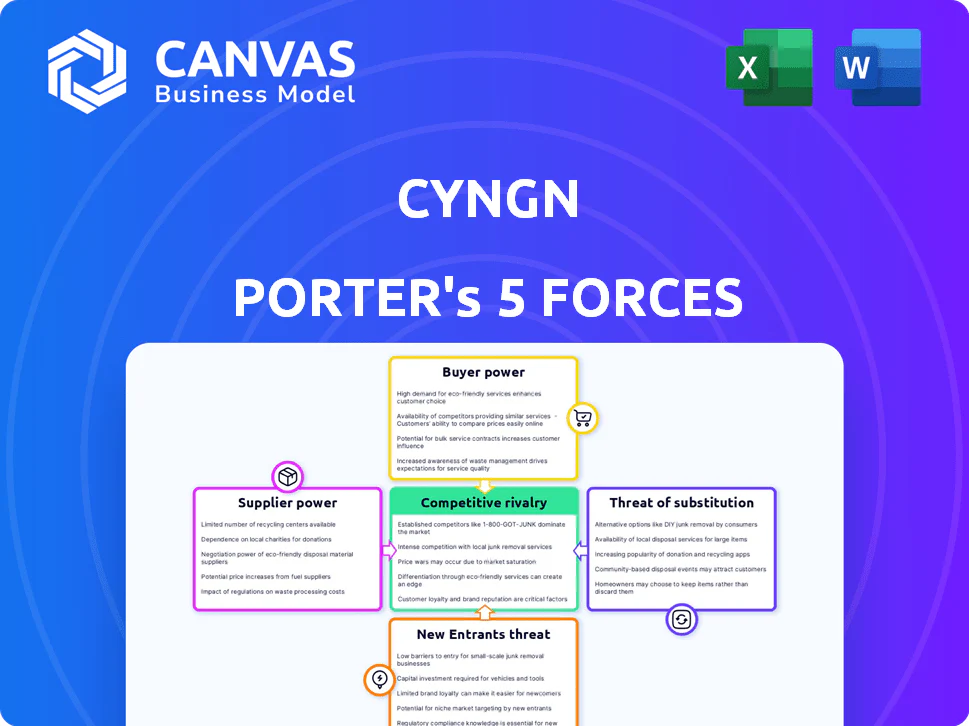
CYNGN PORTER'S FIVE FORCES TEMPLATE RESEARCH
What is included in the product
 Detailed Word Document
Evaluates control held by suppliers and buyers, and their influence on pricing and profitability.

 Customizable Excel Spreadsheet
CYNGN's Porter's Five Forces simplifies complex data with an instantly clear spider/radar chart.
Preview Before You Purchase
CYNGN Porter's Five Forces Analysis
This is the CYNGN Porter's Five Forces analysis preview, showing the complete report. The document displayed here is the full version you'll receive immediately after your purchase—ready for instant download. The insights into the industry competition, threats, and opportunities are all here.

Porter's Five Forces Analysis Template

A Must-Have Tool for Decision-Makers
CYNGN faces varied competitive pressures within the autonomous driving sector. Bargaining power of suppliers, particularly regarding key components, is a factor. The threat of new entrants remains moderate, given high capital requirements. Rivalry among existing players is intensifying, fueled by rapid technological advancements. Buyer power, driven by demand from OEMs, is considerable. Substitutes, such as established transportation modes, pose a persistent challenge.
This brief snapshot only scratches the surface. Unlock the full Porter's Five Forces Analysis to explore CYNGN’s competitive dynamics, market pressures, and strategic advantages in detail.
Suppliers Bargaining Power

Dependency on Hardware Components
Cyngn depends on suppliers for autonomous vehicle hardware like sensors and computing units. Suppliers' bargaining power is high if they offer specialized, proprietary tech. Cyngn's negotiation ability is affected by supplier concentration and switching costs. In 2024, the automotive sensor market was valued at over $30 billion, showcasing supplier influence. Switching costs can be substantial, impacting Cyngn's cost structure.
Software and AI Technology Providers
Cyngn's reliance on third-party software and AI providers for tools and models impacts its supplier power. The uniqueness and integration depth of these offerings are key. For example, in 2024, the AI market, including software, saw significant growth, with revenues reaching approximately $194 billion. Exclusive partnerships could increase supplier power.

Access to Industrial Vehicle Platforms
Cyngn integrates its technology into industrial vehicles, heavily relying on partnerships with OEMs like BYD and Motrec. The bargaining power of these vehicle manufacturers is significant. In 2024, BYD's market share in electric forklifts grew, influencing Cyngn's platform options. The availability of alternative vehicle types or manufacturers impacts Cyngn's deployment capabilities. This dynamic affects Cyngn's cost structure and market access.

Talent Pool and Expertise
Cyngn's reliance on skilled engineers and AI specialists significantly impacts its operational costs. The competition for this talent is fierce, increasing the bargaining power of potential employees. This can lead to higher labor costs, which could affect Cyngn's profitability. The tech sector faces a constant challenge in securing and retaining qualified staff.
- In 2024, the average salary for AI engineers in the US was $160,000, a 10% increase from 2023.
- The turnover rate for tech employees is around 15%, which means Cyngn needs to spend more on recruitment and training.
- Companies like Tesla and Waymo also compete for the same talent pool, increasing the pressure.
- Cyngn's ability to offer competitive compensation packages is critical for its success.
Data and Simulation Environment Providers
Data and simulation environment providers significantly impact CYNGN Porter's autonomous vehicle development. These suppliers offer critical resources, including data collection services and advanced simulation software. Their bargaining power increases with unique datasets or realistic simulation capabilities, essential for testing and validation.
- In 2024, the autonomous vehicle simulation market was valued at $2.5 billion.
- Companies like NVIDIA and Applied Intuition offer comprehensive simulation platforms.
- Data acquisition costs can range from $100,000 to millions, depending on complexity.
- High-fidelity simulation can reduce physical testing costs by up to 70%.
Supplier Dynamics: Tech & AI Drive Influence
Cyngn's supplier power stems from specialized tech and software providers. High switching costs and AI market growth, reaching $194B in 2024, bolster their influence. Partnerships with OEMs like BYD and Motrec also affect Cyngn's cost structure.
| Supplier Type | Impact on Cyngn | 2024 Market Data |
|---|---|---|
| Sensors | High, due to specialization. | $30B automotive sensor market |
| AI Software | Significant, influenced by exclusivity. | $194B AI market revenue |
| OEMs | Important, affects vehicle options. | BYD electric forklift market share growth |
Customers Bargaining Power

Concentrated Customer Base
If Cyngn's customers are mainly large industrial companies, their bargaining power increases. These major clients can impact pricing and demand specific customizations. For example, if 70% of Cyngn's revenue comes from just three clients, their influence is substantial. This concentration makes Cyngn vulnerable to their demands.
Switching Costs for Customers
Switching costs significantly influence customer bargaining power. High switching costs, like those from complex tech integration, weaken customer ability to negotiate. Cyngn's retrofit solutions aim to ease transitions, potentially increasing customer power. In 2024, the autonomous vehicle market saw shifting vendor relationships, highlighting the importance of switching ease.

Customer's Industry and Scale
Customers in sectors such as automotive manufacturing and logistics wield significant bargaining power due to their substantial deployment scale, a key focus for Cyngn. Their size and potential for large contracts give them negotiation leverage. Cyngn's strategic moves in these areas reflect an understanding of customer influence. For example, in 2024, the logistics sector saw a 15% increase in demand for autonomous solutions, highlighting the importance of customer scale in this domain.

Availability of Alternative Solutions
Customers of CYNGN Porter have considerable bargaining power due to the availability of alternative automation solutions. This includes options from direct competitors like Aurora Innovation, which, in 2024, had a market capitalization of approximately $3.5 billion. Customers can also opt for in-house development or alternative technologies, increasing their options. The existence of viable alternatives empowers customers to negotiate better terms.
- Aurora Innovation's market capitalization of around $3.5 billion in 2024 indicates a strong competitor.
- In-house development offers another route, potentially leveraging existing resources.
- Alternative technologies provide additional options, diversifying the landscape.
- Increased options strengthen customer negotiation positions.
Customer's Technical Expertise
Customers possessing strong technical expertise in automation or robotics can significantly influence Cyngn's Porter's Five Forces analysis. These customers, understanding the intricacies of automated systems, are better positioned to assess Cyngn's value proposition and negotiate favorable terms. Their deep knowledge allows them to evaluate alternatives effectively, enhancing their bargaining power. This expertise often leads to more demanding requirements and expectations regarding product performance and pricing.
- Expert customers can push for customized solutions, potentially increasing Cyngn's development costs.
- Their ability to evaluate alternatives might lead to price sensitivity and tougher negotiations.
- In 2024, the automation market is estimated at $200 billion, with expert buyers having significant leverage.
- These customers could demand rigorous performance metrics and service-level agreements.
Customer Power: Pricing & Customization Impact
Customer bargaining power significantly impacts Cyngn. Large industrial clients, especially those contributing significantly to revenue, exert considerable influence over pricing and customization. The availability of alternative automation solutions from competitors like Aurora Innovation, valued at approximately $3.5 billion in 2024, further strengthens customer negotiation positions.
| Factor | Impact | Example (2024 Data) |
|---|---|---|
| Customer Concentration | High concentration increases power. | 70% revenue from 3 clients. |
| Switching Costs | Low costs increase power. | Retrofit solutions aim to ease transitions. |
| Alternative Solutions | Many alternatives boost power. | Aurora Innovation ($3.5B market cap). |
Rivalry Among Competitors

Number and Diversity of Competitors
The industrial autonomous vehicle market features various competitors, including startups and established firms. This diversity, from niche players to those with wider automation offerings, heightens competitive rivalry. For example, in 2024, the market saw increased activity, with over $2 billion in investments across various autonomous vehicle sectors. This influx fuels competition.
Market Growth Rate
The autonomous industrial vehicle market's growth rate shapes competitive rivalry. Fast expansion allows multiple firms to thrive. Slower growth can heighten the battle for market share. The industrial vehicle market is expected to grow. In 2024, the global industrial vehicle market was valued at $160 billion.

Product Differentiation
Cyngn's ability to stand out through its technology is key in reducing rivalry. Unique features, performance, or pricing help Cyngn secure a stronger market position. Highly differentiated products often avoid intense price wars. Cyngn highlights its scalable and differentiated tech. In 2024, the autonomous vehicle market is fiercely competitive, with many players vying for market share.

Exit Barriers
High exit barriers, like sunk R&D costs, intensify competition. Autonomous vehicle tech is capital-intensive, raising these barriers. Companies may persist despite losses, pressuring rivals. This dynamic affects industry profitability and strategic decisions. For example, in 2024, Waymo's R&D spending was about $2.5 billion.
- Significant R&D investments.
- Specialized assets.
- Capital-intensive technology.
- Increased competitive pressure.
Industry Consolidation
Industry consolidation, driven by acquisitions and mergers, reshapes the competitive environment, often resulting in fewer but more powerful entities. This dynamic is particularly relevant in sectors like autonomous vehicles and industrial automation, where companies are constantly vying for market share. For instance, in 2024, there were notable mergers and acquisitions in the robotics and automation industries, with deals exceeding $20 billion globally. Keeping a close watch on these trends helps in anticipating shifts in market power and competitive strategies.
- 2024 saw over $20 billion in M&A deals in robotics and automation.
- Consolidation can lead to fewer, but stronger competitors.
- Autonomous vehicles and industrial automation are key sectors to monitor.
Autonomous Vehicle Market: Fierce Competition Ahead!
Competitive rivalry in the industrial autonomous vehicle market is shaped by a diverse range of players and significant investment. The market's growth rate and Cyngn's differentiation strategy also play key roles. High exit barriers and industry consolidation further intensify the competition.
| Factor | Impact | 2024 Data |
|---|---|---|
| Market Players | Increased competition | Over $2B in AV investments |
| Growth Rate | Influences rivalry intensity | Global industrial vehicle market at $160B |
| Exit Barriers | Intensify competition | Waymo's R&D spending ~$2.5B |
Original: $10.00
-65%$10.00
$3.50CYNGN PORTER'S FIVE FORCES TEMPLATE RESEARCH
What is included in the product
Detailed Word Document
Evaluates control held by suppliers and buyers, and their influence on pricing and profitability.
Customizable Excel Spreadsheet
CYNGN's Porter's Five Forces simplifies complex data with an instantly clear spider/radar chart.
Preview Before You Purchase
CYNGN Porter's Five Forces Analysis
This is the CYNGN Porter's Five Forces analysis preview, showing the complete report. The document displayed here is the full version you'll receive immediately after your purchase—ready for instant download. The insights into the industry competition, threats, and opportunities are all here.
Porter's Five Forces Analysis Template
A Must-Have Tool for Decision-Makers
CYNGN faces varied competitive pressures within the autonomous driving sector. Bargaining power of suppliers, particularly regarding key components, is a factor. The threat of new entrants remains moderate, given high capital requirements. Rivalry among existing players is intensifying, fueled by rapid technological advancements. Buyer power, driven by demand from OEMs, is considerable. Substitutes, such as established transportation modes, pose a persistent challenge.
This brief snapshot only scratches the surface. Unlock the full Porter's Five Forces Analysis to explore CYNGN’s competitive dynamics, market pressures, and strategic advantages in detail.
Suppliers Bargaining Power
Dependency on Hardware Components
Cyngn depends on suppliers for autonomous vehicle hardware like sensors and computing units. Suppliers' bargaining power is high if they offer specialized, proprietary tech. Cyngn's negotiation ability is affected by supplier concentration and switching costs. In 2024, the automotive sensor market was valued at over $30 billion, showcasing supplier influence. Switching costs can be substantial, impacting Cyngn's cost structure.
Software and AI Technology Providers
Cyngn's reliance on third-party software and AI providers for tools and models impacts its supplier power. The uniqueness and integration depth of these offerings are key. For example, in 2024, the AI market, including software, saw significant growth, with revenues reaching approximately $194 billion. Exclusive partnerships could increase supplier power.
Access to Industrial Vehicle Platforms
Cyngn integrates its technology into industrial vehicles, heavily relying on partnerships with OEMs like BYD and Motrec. The bargaining power of these vehicle manufacturers is significant. In 2024, BYD's market share in electric forklifts grew, influencing Cyngn's platform options. The availability of alternative vehicle types or manufacturers impacts Cyngn's deployment capabilities. This dynamic affects Cyngn's cost structure and market access.
Talent Pool and Expertise
Cyngn's reliance on skilled engineers and AI specialists significantly impacts its operational costs. The competition for this talent is fierce, increasing the bargaining power of potential employees. This can lead to higher labor costs, which could affect Cyngn's profitability. The tech sector faces a constant challenge in securing and retaining qualified staff.
- In 2024, the average salary for AI engineers in the US was $160,000, a 10% increase from 2023.
- The turnover rate for tech employees is around 15%, which means Cyngn needs to spend more on recruitment and training.
- Companies like Tesla and Waymo also compete for the same talent pool, increasing the pressure.
- Cyngn's ability to offer competitive compensation packages is critical for its success.
Data and Simulation Environment Providers
Data and simulation environment providers significantly impact CYNGN Porter's autonomous vehicle development. These suppliers offer critical resources, including data collection services and advanced simulation software. Their bargaining power increases with unique datasets or realistic simulation capabilities, essential for testing and validation.
- In 2024, the autonomous vehicle simulation market was valued at $2.5 billion.
- Companies like NVIDIA and Applied Intuition offer comprehensive simulation platforms.
- Data acquisition costs can range from $100,000 to millions, depending on complexity.
- High-fidelity simulation can reduce physical testing costs by up to 70%.
Supplier Dynamics: Tech & AI Drive Influence
Cyngn's supplier power stems from specialized tech and software providers. High switching costs and AI market growth, reaching $194B in 2024, bolster their influence. Partnerships with OEMs like BYD and Motrec also affect Cyngn's cost structure.
| Supplier Type | Impact on Cyngn | 2024 Market Data |
|---|---|---|
| Sensors | High, due to specialization. | $30B automotive sensor market |
| AI Software | Significant, influenced by exclusivity. | $194B AI market revenue |
| OEMs | Important, affects vehicle options. | BYD electric forklift market share growth |
Customers Bargaining Power
Concentrated Customer Base
If Cyngn's customers are mainly large industrial companies, their bargaining power increases. These major clients can impact pricing and demand specific customizations. For example, if 70% of Cyngn's revenue comes from just three clients, their influence is substantial. This concentration makes Cyngn vulnerable to their demands.
Switching Costs for Customers
Switching costs significantly influence customer bargaining power. High switching costs, like those from complex tech integration, weaken customer ability to negotiate. Cyngn's retrofit solutions aim to ease transitions, potentially increasing customer power. In 2024, the autonomous vehicle market saw shifting vendor relationships, highlighting the importance of switching ease.
Customer's Industry and Scale
Customers in sectors such as automotive manufacturing and logistics wield significant bargaining power due to their substantial deployment scale, a key focus for Cyngn. Their size and potential for large contracts give them negotiation leverage. Cyngn's strategic moves in these areas reflect an understanding of customer influence. For example, in 2024, the logistics sector saw a 15% increase in demand for autonomous solutions, highlighting the importance of customer scale in this domain.
Availability of Alternative Solutions
Customers of CYNGN Porter have considerable bargaining power due to the availability of alternative automation solutions. This includes options from direct competitors like Aurora Innovation, which, in 2024, had a market capitalization of approximately $3.5 billion. Customers can also opt for in-house development or alternative technologies, increasing their options. The existence of viable alternatives empowers customers to negotiate better terms.
- Aurora Innovation's market capitalization of around $3.5 billion in 2024 indicates a strong competitor.
- In-house development offers another route, potentially leveraging existing resources.
- Alternative technologies provide additional options, diversifying the landscape.
- Increased options strengthen customer negotiation positions.
Customer's Technical Expertise
Customers possessing strong technical expertise in automation or robotics can significantly influence Cyngn's Porter's Five Forces analysis. These customers, understanding the intricacies of automated systems, are better positioned to assess Cyngn's value proposition and negotiate favorable terms. Their deep knowledge allows them to evaluate alternatives effectively, enhancing their bargaining power. This expertise often leads to more demanding requirements and expectations regarding product performance and pricing.
- Expert customers can push for customized solutions, potentially increasing Cyngn's development costs.
- Their ability to evaluate alternatives might lead to price sensitivity and tougher negotiations.
- In 2024, the automation market is estimated at $200 billion, with expert buyers having significant leverage.
- These customers could demand rigorous performance metrics and service-level agreements.
Customer Power: Pricing & Customization Impact
Customer bargaining power significantly impacts Cyngn. Large industrial clients, especially those contributing significantly to revenue, exert considerable influence over pricing and customization. The availability of alternative automation solutions from competitors like Aurora Innovation, valued at approximately $3.5 billion in 2024, further strengthens customer negotiation positions.
| Factor | Impact | Example (2024 Data) |
|---|---|---|
| Customer Concentration | High concentration increases power. | 70% revenue from 3 clients. |
| Switching Costs | Low costs increase power. | Retrofit solutions aim to ease transitions. |
| Alternative Solutions | Many alternatives boost power. | Aurora Innovation ($3.5B market cap). |
Rivalry Among Competitors
Number and Diversity of Competitors
The industrial autonomous vehicle market features various competitors, including startups and established firms. This diversity, from niche players to those with wider automation offerings, heightens competitive rivalry. For example, in 2024, the market saw increased activity, with over $2 billion in investments across various autonomous vehicle sectors. This influx fuels competition.
Market Growth Rate
The autonomous industrial vehicle market's growth rate shapes competitive rivalry. Fast expansion allows multiple firms to thrive. Slower growth can heighten the battle for market share. The industrial vehicle market is expected to grow. In 2024, the global industrial vehicle market was valued at $160 billion.
Product Differentiation
Cyngn's ability to stand out through its technology is key in reducing rivalry. Unique features, performance, or pricing help Cyngn secure a stronger market position. Highly differentiated products often avoid intense price wars. Cyngn highlights its scalable and differentiated tech. In 2024, the autonomous vehicle market is fiercely competitive, with many players vying for market share.
Exit Barriers
High exit barriers, like sunk R&D costs, intensify competition. Autonomous vehicle tech is capital-intensive, raising these barriers. Companies may persist despite losses, pressuring rivals. This dynamic affects industry profitability and strategic decisions. For example, in 2024, Waymo's R&D spending was about $2.5 billion.
- Significant R&D investments.
- Specialized assets.
- Capital-intensive technology.
- Increased competitive pressure.
Industry Consolidation
Industry consolidation, driven by acquisitions and mergers, reshapes the competitive environment, often resulting in fewer but more powerful entities. This dynamic is particularly relevant in sectors like autonomous vehicles and industrial automation, where companies are constantly vying for market share. For instance, in 2024, there were notable mergers and acquisitions in the robotics and automation industries, with deals exceeding $20 billion globally. Keeping a close watch on these trends helps in anticipating shifts in market power and competitive strategies.
- 2024 saw over $20 billion in M&A deals in robotics and automation.
- Consolidation can lead to fewer, but stronger competitors.
- Autonomous vehicles and industrial automation are key sectors to monitor.
Autonomous Vehicle Market: Fierce Competition Ahead!
Competitive rivalry in the industrial autonomous vehicle market is shaped by a diverse range of players and significant investment. The market's growth rate and Cyngn's differentiation strategy also play key roles. High exit barriers and industry consolidation further intensify the competition.
| Factor | Impact | 2024 Data |
|---|---|---|
| Market Players | Increased competition | Over $2B in AV investments |
| Growth Rate | Influences rivalry intensity | Global industrial vehicle market at $160B |
| Exit Barriers | Intensify competition | Waymo's R&D spending ~$2.5B |
Product Information
Product Information
Shipping & Returns
Shipping & Returns
Description
What is included in the product
Detailed Word Document
Evaluates control held by suppliers and buyers, and their influence on pricing and profitability.
Customizable Excel Spreadsheet
CYNGN's Porter's Five Forces simplifies complex data with an instantly clear spider/radar chart.
Preview Before You Purchase
CYNGN Porter's Five Forces Analysis
This is the CYNGN Porter's Five Forces analysis preview, showing the complete report. The document displayed here is the full version you'll receive immediately after your purchase—ready for instant download. The insights into the industry competition, threats, and opportunities are all here.
Porter's Five Forces Analysis Template
A Must-Have Tool for Decision-Makers
CYNGN faces varied competitive pressures within the autonomous driving sector. Bargaining power of suppliers, particularly regarding key components, is a factor. The threat of new entrants remains moderate, given high capital requirements. Rivalry among existing players is intensifying, fueled by rapid technological advancements. Buyer power, driven by demand from OEMs, is considerable. Substitutes, such as established transportation modes, pose a persistent challenge.
This brief snapshot only scratches the surface. Unlock the full Porter's Five Forces Analysis to explore CYNGN’s competitive dynamics, market pressures, and strategic advantages in detail.
Suppliers Bargaining Power
Dependency on Hardware Components
Cyngn depends on suppliers for autonomous vehicle hardware like sensors and computing units. Suppliers' bargaining power is high if they offer specialized, proprietary tech. Cyngn's negotiation ability is affected by supplier concentration and switching costs. In 2024, the automotive sensor market was valued at over $30 billion, showcasing supplier influence. Switching costs can be substantial, impacting Cyngn's cost structure.
Software and AI Technology Providers
Cyngn's reliance on third-party software and AI providers for tools and models impacts its supplier power. The uniqueness and integration depth of these offerings are key. For example, in 2024, the AI market, including software, saw significant growth, with revenues reaching approximately $194 billion. Exclusive partnerships could increase supplier power.
Access to Industrial Vehicle Platforms
Cyngn integrates its technology into industrial vehicles, heavily relying on partnerships with OEMs like BYD and Motrec. The bargaining power of these vehicle manufacturers is significant. In 2024, BYD's market share in electric forklifts grew, influencing Cyngn's platform options. The availability of alternative vehicle types or manufacturers impacts Cyngn's deployment capabilities. This dynamic affects Cyngn's cost structure and market access.
Talent Pool and Expertise
Cyngn's reliance on skilled engineers and AI specialists significantly impacts its operational costs. The competition for this talent is fierce, increasing the bargaining power of potential employees. This can lead to higher labor costs, which could affect Cyngn's profitability. The tech sector faces a constant challenge in securing and retaining qualified staff.
- In 2024, the average salary for AI engineers in the US was $160,000, a 10% increase from 2023.
- The turnover rate for tech employees is around 15%, which means Cyngn needs to spend more on recruitment and training.
- Companies like Tesla and Waymo also compete for the same talent pool, increasing the pressure.
- Cyngn's ability to offer competitive compensation packages is critical for its success.
Data and Simulation Environment Providers
Data and simulation environment providers significantly impact CYNGN Porter's autonomous vehicle development. These suppliers offer critical resources, including data collection services and advanced simulation software. Their bargaining power increases with unique datasets or realistic simulation capabilities, essential for testing and validation.
- In 2024, the autonomous vehicle simulation market was valued at $2.5 billion.
- Companies like NVIDIA and Applied Intuition offer comprehensive simulation platforms.
- Data acquisition costs can range from $100,000 to millions, depending on complexity.
- High-fidelity simulation can reduce physical testing costs by up to 70%.
Supplier Dynamics: Tech & AI Drive Influence
Cyngn's supplier power stems from specialized tech and software providers. High switching costs and AI market growth, reaching $194B in 2024, bolster their influence. Partnerships with OEMs like BYD and Motrec also affect Cyngn's cost structure.
| Supplier Type | Impact on Cyngn | 2024 Market Data |
|---|---|---|
| Sensors | High, due to specialization. | $30B automotive sensor market |
| AI Software | Significant, influenced by exclusivity. | $194B AI market revenue |
| OEMs | Important, affects vehicle options. | BYD electric forklift market share growth |
Customers Bargaining Power
Concentrated Customer Base
If Cyngn's customers are mainly large industrial companies, their bargaining power increases. These major clients can impact pricing and demand specific customizations. For example, if 70% of Cyngn's revenue comes from just three clients, their influence is substantial. This concentration makes Cyngn vulnerable to their demands.
Switching Costs for Customers
Switching costs significantly influence customer bargaining power. High switching costs, like those from complex tech integration, weaken customer ability to negotiate. Cyngn's retrofit solutions aim to ease transitions, potentially increasing customer power. In 2024, the autonomous vehicle market saw shifting vendor relationships, highlighting the importance of switching ease.
Customer's Industry and Scale
Customers in sectors such as automotive manufacturing and logistics wield significant bargaining power due to their substantial deployment scale, a key focus for Cyngn. Their size and potential for large contracts give them negotiation leverage. Cyngn's strategic moves in these areas reflect an understanding of customer influence. For example, in 2024, the logistics sector saw a 15% increase in demand for autonomous solutions, highlighting the importance of customer scale in this domain.
Availability of Alternative Solutions
Customers of CYNGN Porter have considerable bargaining power due to the availability of alternative automation solutions. This includes options from direct competitors like Aurora Innovation, which, in 2024, had a market capitalization of approximately $3.5 billion. Customers can also opt for in-house development or alternative technologies, increasing their options. The existence of viable alternatives empowers customers to negotiate better terms.
- Aurora Innovation's market capitalization of around $3.5 billion in 2024 indicates a strong competitor.
- In-house development offers another route, potentially leveraging existing resources.
- Alternative technologies provide additional options, diversifying the landscape.
- Increased options strengthen customer negotiation positions.
Customer's Technical Expertise
Customers possessing strong technical expertise in automation or robotics can significantly influence Cyngn's Porter's Five Forces analysis. These customers, understanding the intricacies of automated systems, are better positioned to assess Cyngn's value proposition and negotiate favorable terms. Their deep knowledge allows them to evaluate alternatives effectively, enhancing their bargaining power. This expertise often leads to more demanding requirements and expectations regarding product performance and pricing.
- Expert customers can push for customized solutions, potentially increasing Cyngn's development costs.
- Their ability to evaluate alternatives might lead to price sensitivity and tougher negotiations.
- In 2024, the automation market is estimated at $200 billion, with expert buyers having significant leverage.
- These customers could demand rigorous performance metrics and service-level agreements.
Customer Power: Pricing & Customization Impact
Customer bargaining power significantly impacts Cyngn. Large industrial clients, especially those contributing significantly to revenue, exert considerable influence over pricing and customization. The availability of alternative automation solutions from competitors like Aurora Innovation, valued at approximately $3.5 billion in 2024, further strengthens customer negotiation positions.
| Factor | Impact | Example (2024 Data) |
|---|---|---|
| Customer Concentration | High concentration increases power. | 70% revenue from 3 clients. |
| Switching Costs | Low costs increase power. | Retrofit solutions aim to ease transitions. |
| Alternative Solutions | Many alternatives boost power. | Aurora Innovation ($3.5B market cap). |
Rivalry Among Competitors
Number and Diversity of Competitors
The industrial autonomous vehicle market features various competitors, including startups and established firms. This diversity, from niche players to those with wider automation offerings, heightens competitive rivalry. For example, in 2024, the market saw increased activity, with over $2 billion in investments across various autonomous vehicle sectors. This influx fuels competition.
Market Growth Rate
The autonomous industrial vehicle market's growth rate shapes competitive rivalry. Fast expansion allows multiple firms to thrive. Slower growth can heighten the battle for market share. The industrial vehicle market is expected to grow. In 2024, the global industrial vehicle market was valued at $160 billion.
Product Differentiation
Cyngn's ability to stand out through its technology is key in reducing rivalry. Unique features, performance, or pricing help Cyngn secure a stronger market position. Highly differentiated products often avoid intense price wars. Cyngn highlights its scalable and differentiated tech. In 2024, the autonomous vehicle market is fiercely competitive, with many players vying for market share.
Exit Barriers
High exit barriers, like sunk R&D costs, intensify competition. Autonomous vehicle tech is capital-intensive, raising these barriers. Companies may persist despite losses, pressuring rivals. This dynamic affects industry profitability and strategic decisions. For example, in 2024, Waymo's R&D spending was about $2.5 billion.
- Significant R&D investments.
- Specialized assets.
- Capital-intensive technology.
- Increased competitive pressure.
Industry Consolidation
Industry consolidation, driven by acquisitions and mergers, reshapes the competitive environment, often resulting in fewer but more powerful entities. This dynamic is particularly relevant in sectors like autonomous vehicles and industrial automation, where companies are constantly vying for market share. For instance, in 2024, there were notable mergers and acquisitions in the robotics and automation industries, with deals exceeding $20 billion globally. Keeping a close watch on these trends helps in anticipating shifts in market power and competitive strategies.
- 2024 saw over $20 billion in M&A deals in robotics and automation.
- Consolidation can lead to fewer, but stronger competitors.
- Autonomous vehicles and industrial automation are key sectors to monitor.
Autonomous Vehicle Market: Fierce Competition Ahead!
Competitive rivalry in the industrial autonomous vehicle market is shaped by a diverse range of players and significant investment. The market's growth rate and Cyngn's differentiation strategy also play key roles. High exit barriers and industry consolidation further intensify the competition.
| Factor | Impact | 2024 Data |
|---|---|---|
| Market Players | Increased competition | Over $2B in AV investments |
| Growth Rate | Influences rivalry intensity | Global industrial vehicle market at $160B |
| Exit Barriers | Intensify competition | Waymo's R&D spending ~$2.5B |











