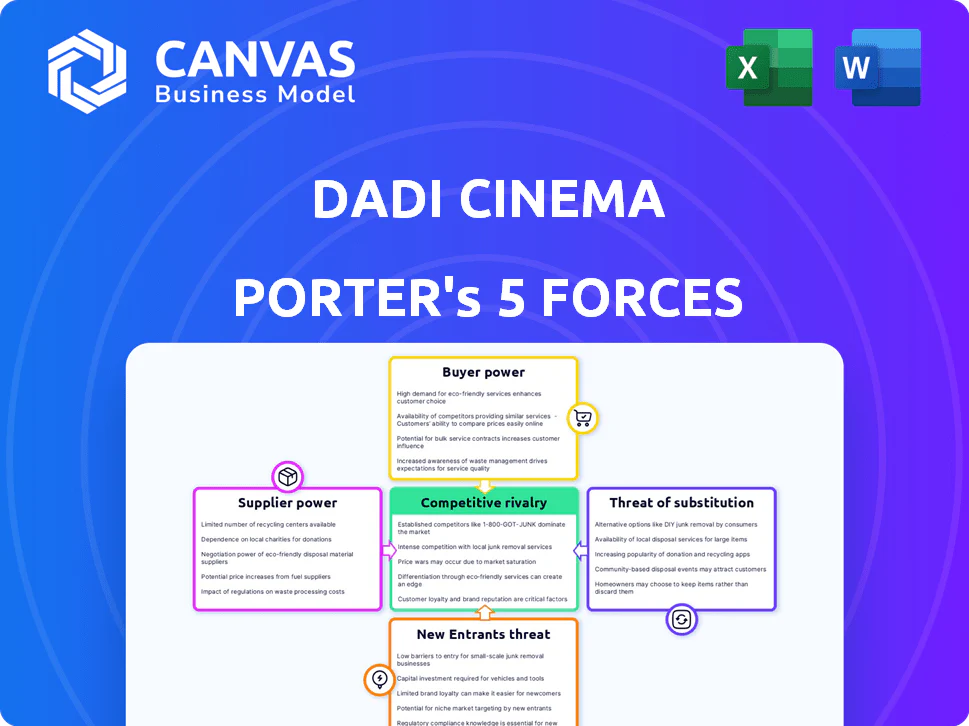
DADI CINEMA PORTER'S FIVE FORCES TEMPLATE RESEARCH
What is included in the product
 Detailed Word Document
Tailored exclusively for Dadi Cinema, analyzing its position within its competitive landscape.

 Customizable Excel Spreadsheet
Instantly identify areas of vulnerability with color-coded force levels.
What You See Is What You Get
Dadi Cinema Porter's Five Forces Analysis
This preview is the complete Porter's Five Forces analysis for Dadi Cinema. You’re seeing the exact, ready-to-use document you will download instantly after purchasing.

Porter's Five Forces Analysis Template

Don't Miss the Bigger Picture
Dadi Cinema's industry faces moderate rivalry, pressured by competitors like Wanda. Buyer power is significant, with consumers having many viewing options. The threat of new entrants is relatively low, due to high initial investment costs. Substitutes, such as streaming services, pose a considerable threat. Supplier power, especially from film distributors, also influences the market.
Our full Porter's Five Forces report goes deeper—offering a data-driven framework to understand Dadi Cinema's real business risks and market opportunities.
Suppliers Bargaining Power

Limited Number of High-Quality Content Creators
The film industry's reliance on content creators grants them substantial bargaining power. A scarcity of top-tier talent, including directors and actors, enables them to negotiate favorable terms. This includes higher compensation and creative control, impacting cinema chains. For instance, a blockbuster film can generate significant revenue, with top actors earning millions per film in 2024, reflecting their strong leverage.
Influence of Established Production Companies
Major film production companies, like China Film Group, significantly influence Dadi Cinema. These companies control the supply of popular movies, impacting Dadi's profitability through revenue-sharing agreements. They also dictate release windows; in 2024, this control remains strong, shaping the cinema's content availability. This strategic control is key.

High Switching Costs for Specialized Technology
Cinema operations heavily rely on specialized technology like projectors and sound systems. Switching suppliers is costly, considering installation and training. This dependence boosts supplier bargaining power. For example, in 2024, the global cinema equipment market was valued at approximately $2.5 billion. This highlights the significant influence suppliers hold.

Concessions and Other Suppliers
Dadi Cinema's concession suppliers, including food and beverage providers, hold some bargaining power. This is due to the essential nature of these supplies, which are crucial for cinema operations and customer satisfaction. However, the bargaining power of individual suppliers is often limited due to competition and the cinema's ability to switch vendors. The costs of concessions can significantly impact a cinema's profitability, representing a substantial portion of revenue. For instance, in 2024, concession sales accounted for approximately 30-40% of total revenue for major cinema chains globally.
- Concession sales represent a significant revenue stream for cinemas.
- Popular or unique items give suppliers more leverage.
- Competition among suppliers limits individual power.
- Cinema chains can negotiate bulk purchase.
Government and Regulatory Bodies
In China, governmental and regulatory bodies, such as the China Film Administration, wield substantial influence as suppliers. They dictate film censorship and distribution licenses, directly affecting the content available to Dadi Cinema. The decisions on film approvals and release timings give these bodies considerable power over exhibitors. This regulatory control impacts revenue streams and content offerings. For instance, in 2024, censorship delayed several major film releases, affecting box office takings.
- Censorship delays in 2024 decreased box office revenue by an estimated 15% for some films.
- The China Film Administration approved 600+ films for theatrical release in 2024.
- Distribution license approvals take, on average, 6-12 months.
- Regulatory changes in 2024 increased compliance costs by about 10% for cinemas.
Cinema's Power Dynamics: Who Calls the Shots?
Suppliers of film content, including production companies and content creators, wield considerable bargaining power over Dadi Cinema. They control the availability of popular movies and can dictate terms, affecting revenue and content offerings. The equipment market, valued at $2.5B in 2024, also gives suppliers leverage. Concession and regulatory bodies also have influence.
| Supplier Type | Bargaining Power | Impact on Dadi Cinema |
|---|---|---|
| Film Production Companies | High | Controls content availability, revenue sharing |
| Equipment Suppliers | Medium | Dictates technology, installation costs |
| Concession Suppliers | Medium | Impacts profitability, customer satisfaction |
| Regulatory Bodies | High | Dictates content, release timings |
Customers Bargaining Power

Price Sensitivity
Customers in the cinema market, especially younger audiences, often show price sensitivity, particularly given alternative entertainment choices. The affordability of tickets significantly influences their decision to visit a cinema. In 2024, the average movie ticket price in the U.S. was around $10.50, but prices can vary significantly. This price sensitivity impacts Dadi Cinema's revenue.
Availability of Alternative Entertainment
The proliferation of streaming services, like Netflix, and short-form video platforms, such as TikTok, presents customers with abundant entertainment alternatives to going to the cinema.
This surge in digital entertainment options weakens cinema's pricing power; customers can readily switch to these substitutes if ticket prices or other costs are perceived as too high.
For instance, in 2024, streaming services accounted for a significant portion of entertainment consumption, with over 70% of households subscribing to at least one streaming platform.
This shift means that Dadi Cinema, and other cinemas, face increased competition not just from other cinemas but from all forms of digital entertainment.
This competition limits the ability of cinemas to dictate terms, as customers have numerous, readily available alternatives.

Declining Moviegoing Frequency
The bargaining power of customers in Dadi Cinema's case is increasing due to declining moviegoing frequency. Reports show average movie visits in China dropped, with many going just once a year. This shift gives customers more control over their entertainment spending. In 2024, overall cinema attendance saw a decrease compared to previous years, reflecting changing consumer habits.

Influence of Film Quality and Appeal
Customer demand at Dadi Cinema is significantly swayed by film quality and appeal, influencing their bargaining power. If the movie lineup lacks enticing options, customers might opt for alternatives, impacting Dadi's revenue. This decision-making gives customers leverage in choosing where to spend their entertainment dollars.
- In 2024, the global box office revenue reached approximately $32.9 billion, showing customer influence.
- Poor film quality directly correlates with lower cinema attendance rates.
- Customer satisfaction scores often reflect film appeal and drive repeat visits.
- Streaming services offer an alternative, increasing customer options.
Online Ticketing Platforms and Discounts
Online ticketing platforms and the abundance of discounts significantly amplify customer bargaining power. Customers can effortlessly compare prices and seek out promotions, which compels cinemas to offer competitive pricing. This dynamic is further intensified by the ease with which customers can switch between different platforms and cinemas. For example, in 2024, online ticket sales accounted for over 70% of total cinema ticket revenue, highlighting the significant influence of these platforms.
- Price comparison tools enable customers to quickly identify the most affordable options.
- Promotions and discounts, such as student deals or loyalty programs, further enhance customer leverage.
- The ability to easily switch between cinemas and platforms encourages price competitiveness.
- The prevalence of online reviews and ratings also empowers customers to make informed choices.
Cinema's Shifting Sands: Customer Power in Focus
Customers wield substantial power in the cinema market, influenced by price sensitivity and entertainment alternatives. The availability of streaming services and short-form videos strengthens their bargaining position, as they can easily switch to substitutes. Declining moviegoing frequency and film quality also affect their choices. Online platforms and discounts further amplify customer leverage, pushing for competitive pricing.
| Factor | Impact | Data (2024) |
|---|---|---|
| Price Sensitivity | High | Avg. ticket price ~$10.50 in U.S. |
| Streaming Alternatives | Increased competition | 70%+ households with streaming |
| Online Ticketing | Enhanced customer power | 70%+ ticket sales online |
Rivalry Among Competitors

Numerous Competitors in the Market
The Chinese cinema market is highly competitive, with many players vying for dominance. Major chains and independent theaters all compete for audience share. In 2024, the top five cinema chains accounted for over 50% of the market share in China. This fragmentation leads to intense competition for box office revenue.
Competition from Other Entertainment Sectors
Dadi Cinema faces intense competition from diverse entertainment sectors. This rivalry includes streaming services like Netflix, which had over 260 million subscribers globally in 2024, and gaming platforms. These alternatives vie for consumer spending. This intensifies competitive pressure on Dadi Cinema's market share and profitability.

Emphasis on Differentiation and Innovation
To thrive, Dadi Cinema Porter faces fierce competition, pushing it to stand out. Differentiation is key, focusing on the movie experience, tech, and extra services. Innovation in design and offerings is vital. In 2024, the global cinema market was valued at $46.7 billion, highlighting the need for competitive strategies.

Price Competition
Price competition is a key aspect of rivalry in the cinema industry, often sparking price wars and promotional efforts as cinemas compete for audiences. Though beneficial to consumers in the short run, aggressive price competition can severely cut into cinema operators' profit margins. In 2024, the average ticket price in the U.S. was around $10.53, yet promotional offers and discounts are common to attract viewers.
- Promotional activities and price wars are common.
- Aggressive price competition can reduce profit margins.
- The average U.S. ticket price in 2024 was about $10.53.
- Cinema operators try to attract viewers by offers.
Geographic Concentration and Local Rivalry
Dadi Cinema faces fierce competition in concentrated geographic areas. The presence of multiple cinemas in close proximity drives up rivalry, impacting pricing and marketing strategies. Local market dynamics, including consumer preferences, play a significant role in shaping the competitive landscape. Strong local competitors can further intensify the pressure on Dadi Cinema's market share and profitability. In 2024, the cinema industry saw a 10% decline in revenue in areas with high cinema density.
- Geographic concentration leads to intense competition.
- Local market dynamics influence rivalry.
- Strong local competitors increase pressure.
- 2024 revenue decline in high-density areas.
Cinema Showdown: Profit Squeeze & Revenue Dip!
Dadi Cinema operates in a highly competitive landscape, with rivalry intensifying due to market fragmentation. Price wars and promotional activities are common, impacting profit margins, where the average U.S. ticket price was about $10.53 in 2024. Geographic concentration further fuels competition, especially where high cinema density led to a 10% revenue decline in 2024.
| Aspect | Impact | Data (2024) |
|---|---|---|
| Market Fragmentation | Intense Competition | Top 5 chains: >50% market share in China |
| Price Wars | Reduced Profit | U.S. avg. ticket price: $10.53 |
| Geographic Concentration | Increased Rivalry | 10% revenue decline in high-density areas |
Original: $10.00
-65%$10.00
$3.50DADI CINEMA PORTER'S FIVE FORCES TEMPLATE RESEARCH
What is included in the product
Detailed Word Document
Tailored exclusively for Dadi Cinema, analyzing its position within its competitive landscape.
Customizable Excel Spreadsheet
Instantly identify areas of vulnerability with color-coded force levels.
What You See Is What You Get
Dadi Cinema Porter's Five Forces Analysis
This preview is the complete Porter's Five Forces analysis for Dadi Cinema. You’re seeing the exact, ready-to-use document you will download instantly after purchasing.
Porter's Five Forces Analysis Template
Don't Miss the Bigger Picture
Dadi Cinema's industry faces moderate rivalry, pressured by competitors like Wanda. Buyer power is significant, with consumers having many viewing options. The threat of new entrants is relatively low, due to high initial investment costs. Substitutes, such as streaming services, pose a considerable threat. Supplier power, especially from film distributors, also influences the market.
Our full Porter's Five Forces report goes deeper—offering a data-driven framework to understand Dadi Cinema's real business risks and market opportunities.
Suppliers Bargaining Power
Limited Number of High-Quality Content Creators
The film industry's reliance on content creators grants them substantial bargaining power. A scarcity of top-tier talent, including directors and actors, enables them to negotiate favorable terms. This includes higher compensation and creative control, impacting cinema chains. For instance, a blockbuster film can generate significant revenue, with top actors earning millions per film in 2024, reflecting their strong leverage.
Influence of Established Production Companies
Major film production companies, like China Film Group, significantly influence Dadi Cinema. These companies control the supply of popular movies, impacting Dadi's profitability through revenue-sharing agreements. They also dictate release windows; in 2024, this control remains strong, shaping the cinema's content availability. This strategic control is key.
High Switching Costs for Specialized Technology
Cinema operations heavily rely on specialized technology like projectors and sound systems. Switching suppliers is costly, considering installation and training. This dependence boosts supplier bargaining power. For example, in 2024, the global cinema equipment market was valued at approximately $2.5 billion. This highlights the significant influence suppliers hold.
Concessions and Other Suppliers
Dadi Cinema's concession suppliers, including food and beverage providers, hold some bargaining power. This is due to the essential nature of these supplies, which are crucial for cinema operations and customer satisfaction. However, the bargaining power of individual suppliers is often limited due to competition and the cinema's ability to switch vendors. The costs of concessions can significantly impact a cinema's profitability, representing a substantial portion of revenue. For instance, in 2024, concession sales accounted for approximately 30-40% of total revenue for major cinema chains globally.
- Concession sales represent a significant revenue stream for cinemas.
- Popular or unique items give suppliers more leverage.
- Competition among suppliers limits individual power.
- Cinema chains can negotiate bulk purchase.
Government and Regulatory Bodies
In China, governmental and regulatory bodies, such as the China Film Administration, wield substantial influence as suppliers. They dictate film censorship and distribution licenses, directly affecting the content available to Dadi Cinema. The decisions on film approvals and release timings give these bodies considerable power over exhibitors. This regulatory control impacts revenue streams and content offerings. For instance, in 2024, censorship delayed several major film releases, affecting box office takings.
- Censorship delays in 2024 decreased box office revenue by an estimated 15% for some films.
- The China Film Administration approved 600+ films for theatrical release in 2024.
- Distribution license approvals take, on average, 6-12 months.
- Regulatory changes in 2024 increased compliance costs by about 10% for cinemas.
Cinema's Power Dynamics: Who Calls the Shots?
Suppliers of film content, including production companies and content creators, wield considerable bargaining power over Dadi Cinema. They control the availability of popular movies and can dictate terms, affecting revenue and content offerings. The equipment market, valued at $2.5B in 2024, also gives suppliers leverage. Concession and regulatory bodies also have influence.
| Supplier Type | Bargaining Power | Impact on Dadi Cinema |
|---|---|---|
| Film Production Companies | High | Controls content availability, revenue sharing |
| Equipment Suppliers | Medium | Dictates technology, installation costs |
| Concession Suppliers | Medium | Impacts profitability, customer satisfaction |
| Regulatory Bodies | High | Dictates content, release timings |
Customers Bargaining Power
Price Sensitivity
Customers in the cinema market, especially younger audiences, often show price sensitivity, particularly given alternative entertainment choices. The affordability of tickets significantly influences their decision to visit a cinema. In 2024, the average movie ticket price in the U.S. was around $10.50, but prices can vary significantly. This price sensitivity impacts Dadi Cinema's revenue.
Availability of Alternative Entertainment
The proliferation of streaming services, like Netflix, and short-form video platforms, such as TikTok, presents customers with abundant entertainment alternatives to going to the cinema.
This surge in digital entertainment options weakens cinema's pricing power; customers can readily switch to these substitutes if ticket prices or other costs are perceived as too high.
For instance, in 2024, streaming services accounted for a significant portion of entertainment consumption, with over 70% of households subscribing to at least one streaming platform.
This shift means that Dadi Cinema, and other cinemas, face increased competition not just from other cinemas but from all forms of digital entertainment.
This competition limits the ability of cinemas to dictate terms, as customers have numerous, readily available alternatives.
Declining Moviegoing Frequency
The bargaining power of customers in Dadi Cinema's case is increasing due to declining moviegoing frequency. Reports show average movie visits in China dropped, with many going just once a year. This shift gives customers more control over their entertainment spending. In 2024, overall cinema attendance saw a decrease compared to previous years, reflecting changing consumer habits.
Influence of Film Quality and Appeal
Customer demand at Dadi Cinema is significantly swayed by film quality and appeal, influencing their bargaining power. If the movie lineup lacks enticing options, customers might opt for alternatives, impacting Dadi's revenue. This decision-making gives customers leverage in choosing where to spend their entertainment dollars.
- In 2024, the global box office revenue reached approximately $32.9 billion, showing customer influence.
- Poor film quality directly correlates with lower cinema attendance rates.
- Customer satisfaction scores often reflect film appeal and drive repeat visits.
- Streaming services offer an alternative, increasing customer options.
Online Ticketing Platforms and Discounts
Online ticketing platforms and the abundance of discounts significantly amplify customer bargaining power. Customers can effortlessly compare prices and seek out promotions, which compels cinemas to offer competitive pricing. This dynamic is further intensified by the ease with which customers can switch between different platforms and cinemas. For example, in 2024, online ticket sales accounted for over 70% of total cinema ticket revenue, highlighting the significant influence of these platforms.
- Price comparison tools enable customers to quickly identify the most affordable options.
- Promotions and discounts, such as student deals or loyalty programs, further enhance customer leverage.
- The ability to easily switch between cinemas and platforms encourages price competitiveness.
- The prevalence of online reviews and ratings also empowers customers to make informed choices.
Cinema's Shifting Sands: Customer Power in Focus
Customers wield substantial power in the cinema market, influenced by price sensitivity and entertainment alternatives. The availability of streaming services and short-form videos strengthens their bargaining position, as they can easily switch to substitutes. Declining moviegoing frequency and film quality also affect their choices. Online platforms and discounts further amplify customer leverage, pushing for competitive pricing.
| Factor | Impact | Data (2024) |
|---|---|---|
| Price Sensitivity | High | Avg. ticket price ~$10.50 in U.S. |
| Streaming Alternatives | Increased competition | 70%+ households with streaming |
| Online Ticketing | Enhanced customer power | 70%+ ticket sales online |
Rivalry Among Competitors
Numerous Competitors in the Market
The Chinese cinema market is highly competitive, with many players vying for dominance. Major chains and independent theaters all compete for audience share. In 2024, the top five cinema chains accounted for over 50% of the market share in China. This fragmentation leads to intense competition for box office revenue.
Competition from Other Entertainment Sectors
Dadi Cinema faces intense competition from diverse entertainment sectors. This rivalry includes streaming services like Netflix, which had over 260 million subscribers globally in 2024, and gaming platforms. These alternatives vie for consumer spending. This intensifies competitive pressure on Dadi Cinema's market share and profitability.
Emphasis on Differentiation and Innovation
To thrive, Dadi Cinema Porter faces fierce competition, pushing it to stand out. Differentiation is key, focusing on the movie experience, tech, and extra services. Innovation in design and offerings is vital. In 2024, the global cinema market was valued at $46.7 billion, highlighting the need for competitive strategies.
Price Competition
Price competition is a key aspect of rivalry in the cinema industry, often sparking price wars and promotional efforts as cinemas compete for audiences. Though beneficial to consumers in the short run, aggressive price competition can severely cut into cinema operators' profit margins. In 2024, the average ticket price in the U.S. was around $10.53, yet promotional offers and discounts are common to attract viewers.
- Promotional activities and price wars are common.
- Aggressive price competition can reduce profit margins.
- The average U.S. ticket price in 2024 was about $10.53.
- Cinema operators try to attract viewers by offers.
Geographic Concentration and Local Rivalry
Dadi Cinema faces fierce competition in concentrated geographic areas. The presence of multiple cinemas in close proximity drives up rivalry, impacting pricing and marketing strategies. Local market dynamics, including consumer preferences, play a significant role in shaping the competitive landscape. Strong local competitors can further intensify the pressure on Dadi Cinema's market share and profitability. In 2024, the cinema industry saw a 10% decline in revenue in areas with high cinema density.
- Geographic concentration leads to intense competition.
- Local market dynamics influence rivalry.
- Strong local competitors increase pressure.
- 2024 revenue decline in high-density areas.
Cinema Showdown: Profit Squeeze & Revenue Dip!
Dadi Cinema operates in a highly competitive landscape, with rivalry intensifying due to market fragmentation. Price wars and promotional activities are common, impacting profit margins, where the average U.S. ticket price was about $10.53 in 2024. Geographic concentration further fuels competition, especially where high cinema density led to a 10% revenue decline in 2024.
| Aspect | Impact | Data (2024) |
|---|---|---|
| Market Fragmentation | Intense Competition | Top 5 chains: >50% market share in China |
| Price Wars | Reduced Profit | U.S. avg. ticket price: $10.53 |
| Geographic Concentration | Increased Rivalry | 10% revenue decline in high-density areas |
Product Information
Product Information
Shipping & Returns
Shipping & Returns
Description
What is included in the product
Detailed Word Document
Tailored exclusively for Dadi Cinema, analyzing its position within its competitive landscape.
Customizable Excel Spreadsheet
Instantly identify areas of vulnerability with color-coded force levels.
What You See Is What You Get
Dadi Cinema Porter's Five Forces Analysis
This preview is the complete Porter's Five Forces analysis for Dadi Cinema. You’re seeing the exact, ready-to-use document you will download instantly after purchasing.
Porter's Five Forces Analysis Template
Don't Miss the Bigger Picture
Dadi Cinema's industry faces moderate rivalry, pressured by competitors like Wanda. Buyer power is significant, with consumers having many viewing options. The threat of new entrants is relatively low, due to high initial investment costs. Substitutes, such as streaming services, pose a considerable threat. Supplier power, especially from film distributors, also influences the market.
Our full Porter's Five Forces report goes deeper—offering a data-driven framework to understand Dadi Cinema's real business risks and market opportunities.
Suppliers Bargaining Power
Limited Number of High-Quality Content Creators
The film industry's reliance on content creators grants them substantial bargaining power. A scarcity of top-tier talent, including directors and actors, enables them to negotiate favorable terms. This includes higher compensation and creative control, impacting cinema chains. For instance, a blockbuster film can generate significant revenue, with top actors earning millions per film in 2024, reflecting their strong leverage.
Influence of Established Production Companies
Major film production companies, like China Film Group, significantly influence Dadi Cinema. These companies control the supply of popular movies, impacting Dadi's profitability through revenue-sharing agreements. They also dictate release windows; in 2024, this control remains strong, shaping the cinema's content availability. This strategic control is key.
High Switching Costs for Specialized Technology
Cinema operations heavily rely on specialized technology like projectors and sound systems. Switching suppliers is costly, considering installation and training. This dependence boosts supplier bargaining power. For example, in 2024, the global cinema equipment market was valued at approximately $2.5 billion. This highlights the significant influence suppliers hold.
Concessions and Other Suppliers
Dadi Cinema's concession suppliers, including food and beverage providers, hold some bargaining power. This is due to the essential nature of these supplies, which are crucial for cinema operations and customer satisfaction. However, the bargaining power of individual suppliers is often limited due to competition and the cinema's ability to switch vendors. The costs of concessions can significantly impact a cinema's profitability, representing a substantial portion of revenue. For instance, in 2024, concession sales accounted for approximately 30-40% of total revenue for major cinema chains globally.
- Concession sales represent a significant revenue stream for cinemas.
- Popular or unique items give suppliers more leverage.
- Competition among suppliers limits individual power.
- Cinema chains can negotiate bulk purchase.
Government and Regulatory Bodies
In China, governmental and regulatory bodies, such as the China Film Administration, wield substantial influence as suppliers. They dictate film censorship and distribution licenses, directly affecting the content available to Dadi Cinema. The decisions on film approvals and release timings give these bodies considerable power over exhibitors. This regulatory control impacts revenue streams and content offerings. For instance, in 2024, censorship delayed several major film releases, affecting box office takings.
- Censorship delays in 2024 decreased box office revenue by an estimated 15% for some films.
- The China Film Administration approved 600+ films for theatrical release in 2024.
- Distribution license approvals take, on average, 6-12 months.
- Regulatory changes in 2024 increased compliance costs by about 10% for cinemas.
Cinema's Power Dynamics: Who Calls the Shots?
Suppliers of film content, including production companies and content creators, wield considerable bargaining power over Dadi Cinema. They control the availability of popular movies and can dictate terms, affecting revenue and content offerings. The equipment market, valued at $2.5B in 2024, also gives suppliers leverage. Concession and regulatory bodies also have influence.
| Supplier Type | Bargaining Power | Impact on Dadi Cinema |
|---|---|---|
| Film Production Companies | High | Controls content availability, revenue sharing |
| Equipment Suppliers | Medium | Dictates technology, installation costs |
| Concession Suppliers | Medium | Impacts profitability, customer satisfaction |
| Regulatory Bodies | High | Dictates content, release timings |
Customers Bargaining Power
Price Sensitivity
Customers in the cinema market, especially younger audiences, often show price sensitivity, particularly given alternative entertainment choices. The affordability of tickets significantly influences their decision to visit a cinema. In 2024, the average movie ticket price in the U.S. was around $10.50, but prices can vary significantly. This price sensitivity impacts Dadi Cinema's revenue.
Availability of Alternative Entertainment
The proliferation of streaming services, like Netflix, and short-form video platforms, such as TikTok, presents customers with abundant entertainment alternatives to going to the cinema.
This surge in digital entertainment options weakens cinema's pricing power; customers can readily switch to these substitutes if ticket prices or other costs are perceived as too high.
For instance, in 2024, streaming services accounted for a significant portion of entertainment consumption, with over 70% of households subscribing to at least one streaming platform.
This shift means that Dadi Cinema, and other cinemas, face increased competition not just from other cinemas but from all forms of digital entertainment.
This competition limits the ability of cinemas to dictate terms, as customers have numerous, readily available alternatives.
Declining Moviegoing Frequency
The bargaining power of customers in Dadi Cinema's case is increasing due to declining moviegoing frequency. Reports show average movie visits in China dropped, with many going just once a year. This shift gives customers more control over their entertainment spending. In 2024, overall cinema attendance saw a decrease compared to previous years, reflecting changing consumer habits.
Influence of Film Quality and Appeal
Customer demand at Dadi Cinema is significantly swayed by film quality and appeal, influencing their bargaining power. If the movie lineup lacks enticing options, customers might opt for alternatives, impacting Dadi's revenue. This decision-making gives customers leverage in choosing where to spend their entertainment dollars.
- In 2024, the global box office revenue reached approximately $32.9 billion, showing customer influence.
- Poor film quality directly correlates with lower cinema attendance rates.
- Customer satisfaction scores often reflect film appeal and drive repeat visits.
- Streaming services offer an alternative, increasing customer options.
Online Ticketing Platforms and Discounts
Online ticketing platforms and the abundance of discounts significantly amplify customer bargaining power. Customers can effortlessly compare prices and seek out promotions, which compels cinemas to offer competitive pricing. This dynamic is further intensified by the ease with which customers can switch between different platforms and cinemas. For example, in 2024, online ticket sales accounted for over 70% of total cinema ticket revenue, highlighting the significant influence of these platforms.
- Price comparison tools enable customers to quickly identify the most affordable options.
- Promotions and discounts, such as student deals or loyalty programs, further enhance customer leverage.
- The ability to easily switch between cinemas and platforms encourages price competitiveness.
- The prevalence of online reviews and ratings also empowers customers to make informed choices.
Cinema's Shifting Sands: Customer Power in Focus
Customers wield substantial power in the cinema market, influenced by price sensitivity and entertainment alternatives. The availability of streaming services and short-form videos strengthens their bargaining position, as they can easily switch to substitutes. Declining moviegoing frequency and film quality also affect their choices. Online platforms and discounts further amplify customer leverage, pushing for competitive pricing.
| Factor | Impact | Data (2024) |
|---|---|---|
| Price Sensitivity | High | Avg. ticket price ~$10.50 in U.S. |
| Streaming Alternatives | Increased competition | 70%+ households with streaming |
| Online Ticketing | Enhanced customer power | 70%+ ticket sales online |
Rivalry Among Competitors
Numerous Competitors in the Market
The Chinese cinema market is highly competitive, with many players vying for dominance. Major chains and independent theaters all compete for audience share. In 2024, the top five cinema chains accounted for over 50% of the market share in China. This fragmentation leads to intense competition for box office revenue.
Competition from Other Entertainment Sectors
Dadi Cinema faces intense competition from diverse entertainment sectors. This rivalry includes streaming services like Netflix, which had over 260 million subscribers globally in 2024, and gaming platforms. These alternatives vie for consumer spending. This intensifies competitive pressure on Dadi Cinema's market share and profitability.
Emphasis on Differentiation and Innovation
To thrive, Dadi Cinema Porter faces fierce competition, pushing it to stand out. Differentiation is key, focusing on the movie experience, tech, and extra services. Innovation in design and offerings is vital. In 2024, the global cinema market was valued at $46.7 billion, highlighting the need for competitive strategies.
Price Competition
Price competition is a key aspect of rivalry in the cinema industry, often sparking price wars and promotional efforts as cinemas compete for audiences. Though beneficial to consumers in the short run, aggressive price competition can severely cut into cinema operators' profit margins. In 2024, the average ticket price in the U.S. was around $10.53, yet promotional offers and discounts are common to attract viewers.
- Promotional activities and price wars are common.
- Aggressive price competition can reduce profit margins.
- The average U.S. ticket price in 2024 was about $10.53.
- Cinema operators try to attract viewers by offers.
Geographic Concentration and Local Rivalry
Dadi Cinema faces fierce competition in concentrated geographic areas. The presence of multiple cinemas in close proximity drives up rivalry, impacting pricing and marketing strategies. Local market dynamics, including consumer preferences, play a significant role in shaping the competitive landscape. Strong local competitors can further intensify the pressure on Dadi Cinema's market share and profitability. In 2024, the cinema industry saw a 10% decline in revenue in areas with high cinema density.
- Geographic concentration leads to intense competition.
- Local market dynamics influence rivalry.
- Strong local competitors increase pressure.
- 2024 revenue decline in high-density areas.
Cinema Showdown: Profit Squeeze & Revenue Dip!
Dadi Cinema operates in a highly competitive landscape, with rivalry intensifying due to market fragmentation. Price wars and promotional activities are common, impacting profit margins, where the average U.S. ticket price was about $10.53 in 2024. Geographic concentration further fuels competition, especially where high cinema density led to a 10% revenue decline in 2024.
| Aspect | Impact | Data (2024) |
|---|---|---|
| Market Fragmentation | Intense Competition | Top 5 chains: >50% market share in China |
| Price Wars | Reduced Profit | U.S. avg. ticket price: $10.53 |
| Geographic Concentration | Increased Rivalry | 10% revenue decline in high-density areas |











