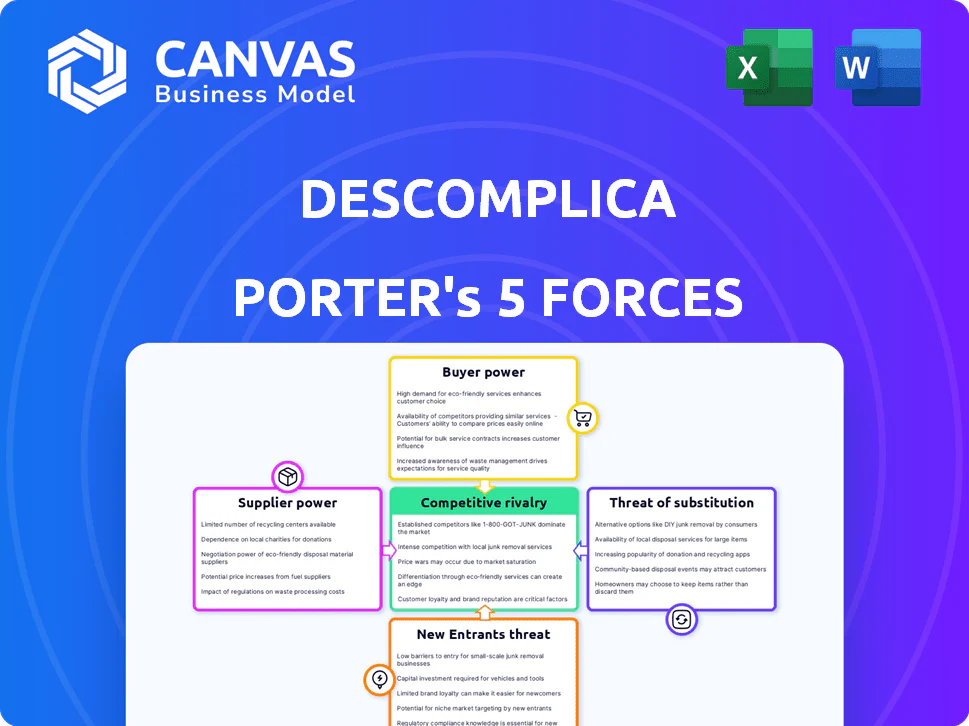
DESCOMPLICA PORTER'S FIVE FORCES TEMPLATE RESEARCH
What is included in the product
 Detailed Word Document
Analyzes Descomplica's competitive forces: rivals, buyers, suppliers, entrants, and substitutes.

 Customizable Excel Spreadsheet
Descomplica's analysis simplifies the Porter's Five Forces, empowering swift strategic assessments.
Full Version Awaits
Descomplica Porter's Five Forces Analysis
This is the complete Descomplica Porter's Five Forces analysis document. You're seeing the final, ready-to-use file. What you preview here is exactly what you’ll receive instantly after purchase, no hidden parts. It's a fully formatted document, professionally crafted for your needs.

Porter's Five Forces Analysis Template

Elevate Your Analysis with the Complete Porter's Five Forces Analysis
Descomplica's industry is shaped by diverse competitive forces. Buyer power, from students, impacts pricing & service demands. The threat of new entrants, like online platforms, is moderate. Substitute threats, like in-person tutoring, pose a challenge. Supplier power, like that of content creators, is crucial. Rivalry among competitors is high, affecting market share.
This brief snapshot only scratches the surface. Unlock the full Porter's Five Forces Analysis to explore Descomplica’s competitive dynamics, market pressures, and strategic advantages in detail.
Suppliers Bargaining Power

Content Creators and Educators
Descomplica depends on educators and experts for content. Their bargaining power shifts with reputation and subject demand. Top educators, especially in high-stakes areas like entrance exams, can command better terms. In 2024, the online education market was valued at over $250 billion, signaling strong demand for content creators. This gives sought-after educators leverage.
Technology Providers
Descomplica relies on tech like LMS and video hosting. Supplier power hinges on tech uniqueness, switching costs, and alternatives. If Descomplica is locked into a few providers, suppliers gain leverage. In 2024, the LMS market saw significant growth, with revenues exceeding $15 billion globally. Switching costs are high, as data migration can cost over $100,000.

Internet Service Providers
Descomplica heavily relies on internet access. ISPs' power affects costs and quality. Brazil's internet infrastructure varies. In 2024, Brazil had ~84% internet penetration. High penetration boosts online education.

Payment Gateway Providers
Descomplica relies on payment gateway providers for secure transactions. The bargaining power of these providers hinges on fees, reliability, and integration ease. The market offers numerous options, reducing the influence of any single provider. In 2024, the global payment gateway market was valued at approximately $40 billion.
- Transaction fees impact profitability.
- Reliability ensures consistent service.
- Ease of integration streamlines operations.
- Market competition limits provider power.
Marketing and Advertising Channels
Descomplica's marketing strategy relies heavily on external suppliers such as social media platforms and search engines to reach its target audience. The bargaining power of these suppliers is tied to their extensive reach and the effectiveness of their advertising tools, especially for reaching younger demographics. In 2024, digital advertising spending in Brazil is estimated to reach $10.5 billion, highlighting the substantial influence of these channels. Diversifying marketing efforts across different platforms can help mitigate the risk of being overly reliant on a single supplier's pricing or policies.
- Digital advertising spending in Brazil is projected to hit $10.5 billion in 2024.
- Social media platforms and search engines are key suppliers for reaching Descomplica's student demographic.
- Diversification of marketing channels can reduce supplier power.
Supplier Power in the Online Education Arena
Descomplica's supplier bargaining power varies. Content creators, especially in high-demand areas, can demand better terms. Tech providers and marketing platforms also hold influence. The online education market was over $250 billion in 2024, influencing supplier dynamics.
| Supplier Type | Bargaining Power Factors | 2024 Market Data |
|---|---|---|
| Content Creators | Expertise, Demand | Online Ed Market: $250B+ |
| Tech Providers | Uniqueness, Switching Costs | LMS Market: $15B+ |
| Marketing Platforms | Reach, Advertising Tools | Digital Ad Spend (Brazil): $10.5B |
Customers Bargaining Power

Price Sensitivity
Students preparing for college entrance exams in Brazil are often price-sensitive, looking for affordable educational resources. Descomplica's pricing strategy and the availability of free or cheaper competitors impact customer bargaining power. In 2024, the Brazilian e-learning market grew significantly, with a focus on cost-effective solutions. This reflects the increasing demand for accessible education.
Availability of Alternatives
In Brazil's online education, students have many options, boosting their power. The market is packed with platforms offering similar courses. A 2024 study showed over 300 online education providers in Brazil, intensifying competition. Alternatives include tutoring and free resources, giving students leverage.

Low Switching Costs
For students, switching between online education platforms like Descomplica is easy and cheap. This low switching cost boosts customer power. A 2024 study showed 60% of students would switch for better content. This means Descomplica must compete hard to keep customers.

Access to Information
Prospective students wield considerable bargaining power, thanks to readily available online information. This includes reviews, platform comparisons, and detailed course offerings. Such transparency allows students to make informed choices, enhancing their power. For instance, in 2024, online education platforms saw a 15% increase in user reviews, showing amplified customer influence.
- User reviews and ratings significantly impact enrollment decisions.
- Pricing transparency enables easy comparison of different educational platforms.
- Access to detailed course information empowers students to choose the best fit.
- Increased competition drives platforms to offer better value.
Influence of Social Circles and Recommendations
Students' choices, including those about Descomplica, are heavily influenced by their social circles and recommendations. Word-of-mouth plays a vital role, with positive reviews attracting and negative ones deterring customers. This dynamic directly impacts customer bargaining power, as reputation can sway demand. In 2024, 70% of students reported relying on peer reviews.
- Word-of-mouth's impact on brand reputation.
- Reliance on peer reviews.
- Customer bargaining power.
Brazilian Students: Power in Online Education
Students in Brazil have strong bargaining power in the online education market. They benefit from many choices and easy switching between platforms. Reviews and social recommendations also greatly influence their decisions.
| Factor | Impact | 2024 Data |
|---|---|---|
| Market Competition | High | Over 300 online providers |
| Switching Costs | Low | 60% would switch for better content |
| Information Access | High | 15% increase in user reviews |
Rivalry Among Competitors

Number and Diversity of Competitors
Brazil's online education market is highly competitive, featuring numerous platforms and institutions. This includes established players and emerging startups. The diversity among competitors heightens the competition for students. In 2024, the Brazilian edtech market was estimated to be worth over $4 billion.
Market Growth Rate
The Brazilian online education market is booming. In 2024, the market grew by an estimated 15%, fueled by increasing internet access and digital literacy. This growth attracts new competitors, and existing players fight for market share. For instance, Descomplica's revenue grew by 20% in 2024.

Differentiation of Offerings
Descomplica, like other online education providers, battles rivals by differentiating its offerings. Content quality, teaching methods, and platform features are key battlegrounds. In 2024, the online education market grew, with companies like Descomplica vying for market share. Strong differentiation allows Descomplica to command higher prices or attract more users.

Brand Recognition and Loyalty
Descomplica's brand strength and student retention significantly shape competitive dynamics. High brand recognition often translates to a loyal customer base, reducing price sensitivity. This loyalty acts as a barrier against new entrants and aggressive pricing strategies from competitors. In 2024, Descomplica's customer retention rate was approximately 60%, indicating a strong ability to maintain its market share.
- Brand strength helps Descomplica retain students.
- Loyalty reduces the impact of price wars.
- Retention rate of 60% in 2024 signifies market stability.
- Strong brand enhances the competitive advantage.
Exit Barriers
High exit barriers can intensify rivalry. If Descomplica invested heavily in technology, it might fight harder to stay in the market. Investments in content creation also create exit barriers. This could lead to intense competition. For example, Coursera reported $665.7 million in revenue in 2023, showing the scale of investment in online education.
- High exit barriers increase competition.
- Investments in tech and content are key.
- Coursera's 2023 revenue shows scale.
Brazil's Online Education: Fierce Competition & Key Metrics
Competitive rivalry in Brazil's online education is fierce, with numerous competitors vying for market share. Differentiation strategies are crucial for survival, influencing pricing and user acquisition. High brand recognition and customer retention rates, like Descomplica's 60% in 2024, provide a competitive edge.
| Aspect | Impact | 2024 Data |
|---|---|---|
| Market Growth | Attracts Competitors | 15% |
| Descomplica Revenue Growth | Competitive Pressure | 20% |
| Customer Retention | Competitive Advantage | 60% |
DESCOMPLICA PORTER'S FIVE FORCES TEMPLATE RESEARCH
What is included in the product
Detailed Word Document
Analyzes Descomplica's competitive forces: rivals, buyers, suppliers, entrants, and substitutes.
Customizable Excel Spreadsheet
Descomplica's analysis simplifies the Porter's Five Forces, empowering swift strategic assessments.
Full Version Awaits
Descomplica Porter's Five Forces Analysis
This is the complete Descomplica Porter's Five Forces analysis document. You're seeing the final, ready-to-use file. What you preview here is exactly what you’ll receive instantly after purchase, no hidden parts. It's a fully formatted document, professionally crafted for your needs.
Porter's Five Forces Analysis Template
Elevate Your Analysis with the Complete Porter's Five Forces Analysis
Descomplica's industry is shaped by diverse competitive forces. Buyer power, from students, impacts pricing & service demands. The threat of new entrants, like online platforms, is moderate. Substitute threats, like in-person tutoring, pose a challenge. Supplier power, like that of content creators, is crucial. Rivalry among competitors is high, affecting market share.
This brief snapshot only scratches the surface. Unlock the full Porter's Five Forces Analysis to explore Descomplica’s competitive dynamics, market pressures, and strategic advantages in detail.
Suppliers Bargaining Power
Content Creators and Educators
Descomplica depends on educators and experts for content. Their bargaining power shifts with reputation and subject demand. Top educators, especially in high-stakes areas like entrance exams, can command better terms. In 2024, the online education market was valued at over $250 billion, signaling strong demand for content creators. This gives sought-after educators leverage.
Technology Providers
Descomplica relies on tech like LMS and video hosting. Supplier power hinges on tech uniqueness, switching costs, and alternatives. If Descomplica is locked into a few providers, suppliers gain leverage. In 2024, the LMS market saw significant growth, with revenues exceeding $15 billion globally. Switching costs are high, as data migration can cost over $100,000.
Internet Service Providers
Descomplica heavily relies on internet access. ISPs' power affects costs and quality. Brazil's internet infrastructure varies. In 2024, Brazil had ~84% internet penetration. High penetration boosts online education.
Payment Gateway Providers
Descomplica relies on payment gateway providers for secure transactions. The bargaining power of these providers hinges on fees, reliability, and integration ease. The market offers numerous options, reducing the influence of any single provider. In 2024, the global payment gateway market was valued at approximately $40 billion.
- Transaction fees impact profitability.
- Reliability ensures consistent service.
- Ease of integration streamlines operations.
- Market competition limits provider power.
Marketing and Advertising Channels
Descomplica's marketing strategy relies heavily on external suppliers such as social media platforms and search engines to reach its target audience. The bargaining power of these suppliers is tied to their extensive reach and the effectiveness of their advertising tools, especially for reaching younger demographics. In 2024, digital advertising spending in Brazil is estimated to reach $10.5 billion, highlighting the substantial influence of these channels. Diversifying marketing efforts across different platforms can help mitigate the risk of being overly reliant on a single supplier's pricing or policies.
- Digital advertising spending in Brazil is projected to hit $10.5 billion in 2024.
- Social media platforms and search engines are key suppliers for reaching Descomplica's student demographic.
- Diversification of marketing channels can reduce supplier power.
Supplier Power in the Online Education Arena
Descomplica's supplier bargaining power varies. Content creators, especially in high-demand areas, can demand better terms. Tech providers and marketing platforms also hold influence. The online education market was over $250 billion in 2024, influencing supplier dynamics.
| Supplier Type | Bargaining Power Factors | 2024 Market Data |
|---|---|---|
| Content Creators | Expertise, Demand | Online Ed Market: $250B+ |
| Tech Providers | Uniqueness, Switching Costs | LMS Market: $15B+ |
| Marketing Platforms | Reach, Advertising Tools | Digital Ad Spend (Brazil): $10.5B |
Customers Bargaining Power
Price Sensitivity
Students preparing for college entrance exams in Brazil are often price-sensitive, looking for affordable educational resources. Descomplica's pricing strategy and the availability of free or cheaper competitors impact customer bargaining power. In 2024, the Brazilian e-learning market grew significantly, with a focus on cost-effective solutions. This reflects the increasing demand for accessible education.
Availability of Alternatives
In Brazil's online education, students have many options, boosting their power. The market is packed with platforms offering similar courses. A 2024 study showed over 300 online education providers in Brazil, intensifying competition. Alternatives include tutoring and free resources, giving students leverage.
Low Switching Costs
For students, switching between online education platforms like Descomplica is easy and cheap. This low switching cost boosts customer power. A 2024 study showed 60% of students would switch for better content. This means Descomplica must compete hard to keep customers.
Access to Information
Prospective students wield considerable bargaining power, thanks to readily available online information. This includes reviews, platform comparisons, and detailed course offerings. Such transparency allows students to make informed choices, enhancing their power. For instance, in 2024, online education platforms saw a 15% increase in user reviews, showing amplified customer influence.
- User reviews and ratings significantly impact enrollment decisions.
- Pricing transparency enables easy comparison of different educational platforms.
- Access to detailed course information empowers students to choose the best fit.
- Increased competition drives platforms to offer better value.
Influence of Social Circles and Recommendations
Students' choices, including those about Descomplica, are heavily influenced by their social circles and recommendations. Word-of-mouth plays a vital role, with positive reviews attracting and negative ones deterring customers. This dynamic directly impacts customer bargaining power, as reputation can sway demand. In 2024, 70% of students reported relying on peer reviews.
- Word-of-mouth's impact on brand reputation.
- Reliance on peer reviews.
- Customer bargaining power.
Brazilian Students: Power in Online Education
Students in Brazil have strong bargaining power in the online education market. They benefit from many choices and easy switching between platforms. Reviews and social recommendations also greatly influence their decisions.
| Factor | Impact | 2024 Data |
|---|---|---|
| Market Competition | High | Over 300 online providers |
| Switching Costs | Low | 60% would switch for better content |
| Information Access | High | 15% increase in user reviews |
Rivalry Among Competitors
Number and Diversity of Competitors
Brazil's online education market is highly competitive, featuring numerous platforms and institutions. This includes established players and emerging startups. The diversity among competitors heightens the competition for students. In 2024, the Brazilian edtech market was estimated to be worth over $4 billion.
Market Growth Rate
The Brazilian online education market is booming. In 2024, the market grew by an estimated 15%, fueled by increasing internet access and digital literacy. This growth attracts new competitors, and existing players fight for market share. For instance, Descomplica's revenue grew by 20% in 2024.
Differentiation of Offerings
Descomplica, like other online education providers, battles rivals by differentiating its offerings. Content quality, teaching methods, and platform features are key battlegrounds. In 2024, the online education market grew, with companies like Descomplica vying for market share. Strong differentiation allows Descomplica to command higher prices or attract more users.
Brand Recognition and Loyalty
Descomplica's brand strength and student retention significantly shape competitive dynamics. High brand recognition often translates to a loyal customer base, reducing price sensitivity. This loyalty acts as a barrier against new entrants and aggressive pricing strategies from competitors. In 2024, Descomplica's customer retention rate was approximately 60%, indicating a strong ability to maintain its market share.
- Brand strength helps Descomplica retain students.
- Loyalty reduces the impact of price wars.
- Retention rate of 60% in 2024 signifies market stability.
- Strong brand enhances the competitive advantage.
Exit Barriers
High exit barriers can intensify rivalry. If Descomplica invested heavily in technology, it might fight harder to stay in the market. Investments in content creation also create exit barriers. This could lead to intense competition. For example, Coursera reported $665.7 million in revenue in 2023, showing the scale of investment in online education.
- High exit barriers increase competition.
- Investments in tech and content are key.
- Coursera's 2023 revenue shows scale.
Brazil's Online Education: Fierce Competition & Key Metrics
Competitive rivalry in Brazil's online education is fierce, with numerous competitors vying for market share. Differentiation strategies are crucial for survival, influencing pricing and user acquisition. High brand recognition and customer retention rates, like Descomplica's 60% in 2024, provide a competitive edge.
| Aspect | Impact | 2024 Data |
|---|---|---|
| Market Growth | Attracts Competitors | 15% |
| Descomplica Revenue Growth | Competitive Pressure | 20% |
| Customer Retention | Competitive Advantage | 60% |
Product Information
Product Information
Shipping & Returns
Shipping & Returns
Description
What is included in the product
Detailed Word Document
Analyzes Descomplica's competitive forces: rivals, buyers, suppliers, entrants, and substitutes.
Customizable Excel Spreadsheet
Descomplica's analysis simplifies the Porter's Five Forces, empowering swift strategic assessments.
Full Version Awaits
Descomplica Porter's Five Forces Analysis
This is the complete Descomplica Porter's Five Forces analysis document. You're seeing the final, ready-to-use file. What you preview here is exactly what you’ll receive instantly after purchase, no hidden parts. It's a fully formatted document, professionally crafted for your needs.
Porter's Five Forces Analysis Template
Elevate Your Analysis with the Complete Porter's Five Forces Analysis
Descomplica's industry is shaped by diverse competitive forces. Buyer power, from students, impacts pricing & service demands. The threat of new entrants, like online platforms, is moderate. Substitute threats, like in-person tutoring, pose a challenge. Supplier power, like that of content creators, is crucial. Rivalry among competitors is high, affecting market share.
This brief snapshot only scratches the surface. Unlock the full Porter's Five Forces Analysis to explore Descomplica’s competitive dynamics, market pressures, and strategic advantages in detail.
Suppliers Bargaining Power
Content Creators and Educators
Descomplica depends on educators and experts for content. Their bargaining power shifts with reputation and subject demand. Top educators, especially in high-stakes areas like entrance exams, can command better terms. In 2024, the online education market was valued at over $250 billion, signaling strong demand for content creators. This gives sought-after educators leverage.
Technology Providers
Descomplica relies on tech like LMS and video hosting. Supplier power hinges on tech uniqueness, switching costs, and alternatives. If Descomplica is locked into a few providers, suppliers gain leverage. In 2024, the LMS market saw significant growth, with revenues exceeding $15 billion globally. Switching costs are high, as data migration can cost over $100,000.
Internet Service Providers
Descomplica heavily relies on internet access. ISPs' power affects costs and quality. Brazil's internet infrastructure varies. In 2024, Brazil had ~84% internet penetration. High penetration boosts online education.
Payment Gateway Providers
Descomplica relies on payment gateway providers for secure transactions. The bargaining power of these providers hinges on fees, reliability, and integration ease. The market offers numerous options, reducing the influence of any single provider. In 2024, the global payment gateway market was valued at approximately $40 billion.
- Transaction fees impact profitability.
- Reliability ensures consistent service.
- Ease of integration streamlines operations.
- Market competition limits provider power.
Marketing and Advertising Channels
Descomplica's marketing strategy relies heavily on external suppliers such as social media platforms and search engines to reach its target audience. The bargaining power of these suppliers is tied to their extensive reach and the effectiveness of their advertising tools, especially for reaching younger demographics. In 2024, digital advertising spending in Brazil is estimated to reach $10.5 billion, highlighting the substantial influence of these channels. Diversifying marketing efforts across different platforms can help mitigate the risk of being overly reliant on a single supplier's pricing or policies.
- Digital advertising spending in Brazil is projected to hit $10.5 billion in 2024.
- Social media platforms and search engines are key suppliers for reaching Descomplica's student demographic.
- Diversification of marketing channels can reduce supplier power.
Supplier Power in the Online Education Arena
Descomplica's supplier bargaining power varies. Content creators, especially in high-demand areas, can demand better terms. Tech providers and marketing platforms also hold influence. The online education market was over $250 billion in 2024, influencing supplier dynamics.
| Supplier Type | Bargaining Power Factors | 2024 Market Data |
|---|---|---|
| Content Creators | Expertise, Demand | Online Ed Market: $250B+ |
| Tech Providers | Uniqueness, Switching Costs | LMS Market: $15B+ |
| Marketing Platforms | Reach, Advertising Tools | Digital Ad Spend (Brazil): $10.5B |
Customers Bargaining Power
Price Sensitivity
Students preparing for college entrance exams in Brazil are often price-sensitive, looking for affordable educational resources. Descomplica's pricing strategy and the availability of free or cheaper competitors impact customer bargaining power. In 2024, the Brazilian e-learning market grew significantly, with a focus on cost-effective solutions. This reflects the increasing demand for accessible education.
Availability of Alternatives
In Brazil's online education, students have many options, boosting their power. The market is packed with platforms offering similar courses. A 2024 study showed over 300 online education providers in Brazil, intensifying competition. Alternatives include tutoring and free resources, giving students leverage.
Low Switching Costs
For students, switching between online education platforms like Descomplica is easy and cheap. This low switching cost boosts customer power. A 2024 study showed 60% of students would switch for better content. This means Descomplica must compete hard to keep customers.
Access to Information
Prospective students wield considerable bargaining power, thanks to readily available online information. This includes reviews, platform comparisons, and detailed course offerings. Such transparency allows students to make informed choices, enhancing their power. For instance, in 2024, online education platforms saw a 15% increase in user reviews, showing amplified customer influence.
- User reviews and ratings significantly impact enrollment decisions.
- Pricing transparency enables easy comparison of different educational platforms.
- Access to detailed course information empowers students to choose the best fit.
- Increased competition drives platforms to offer better value.
Influence of Social Circles and Recommendations
Students' choices, including those about Descomplica, are heavily influenced by their social circles and recommendations. Word-of-mouth plays a vital role, with positive reviews attracting and negative ones deterring customers. This dynamic directly impacts customer bargaining power, as reputation can sway demand. In 2024, 70% of students reported relying on peer reviews.
- Word-of-mouth's impact on brand reputation.
- Reliance on peer reviews.
- Customer bargaining power.
Brazilian Students: Power in Online Education
Students in Brazil have strong bargaining power in the online education market. They benefit from many choices and easy switching between platforms. Reviews and social recommendations also greatly influence their decisions.
| Factor | Impact | 2024 Data |
|---|---|---|
| Market Competition | High | Over 300 online providers |
| Switching Costs | Low | 60% would switch for better content |
| Information Access | High | 15% increase in user reviews |
Rivalry Among Competitors
Number and Diversity of Competitors
Brazil's online education market is highly competitive, featuring numerous platforms and institutions. This includes established players and emerging startups. The diversity among competitors heightens the competition for students. In 2024, the Brazilian edtech market was estimated to be worth over $4 billion.
Market Growth Rate
The Brazilian online education market is booming. In 2024, the market grew by an estimated 15%, fueled by increasing internet access and digital literacy. This growth attracts new competitors, and existing players fight for market share. For instance, Descomplica's revenue grew by 20% in 2024.
Differentiation of Offerings
Descomplica, like other online education providers, battles rivals by differentiating its offerings. Content quality, teaching methods, and platform features are key battlegrounds. In 2024, the online education market grew, with companies like Descomplica vying for market share. Strong differentiation allows Descomplica to command higher prices or attract more users.
Brand Recognition and Loyalty
Descomplica's brand strength and student retention significantly shape competitive dynamics. High brand recognition often translates to a loyal customer base, reducing price sensitivity. This loyalty acts as a barrier against new entrants and aggressive pricing strategies from competitors. In 2024, Descomplica's customer retention rate was approximately 60%, indicating a strong ability to maintain its market share.
- Brand strength helps Descomplica retain students.
- Loyalty reduces the impact of price wars.
- Retention rate of 60% in 2024 signifies market stability.
- Strong brand enhances the competitive advantage.
Exit Barriers
High exit barriers can intensify rivalry. If Descomplica invested heavily in technology, it might fight harder to stay in the market. Investments in content creation also create exit barriers. This could lead to intense competition. For example, Coursera reported $665.7 million in revenue in 2023, showing the scale of investment in online education.
- High exit barriers increase competition.
- Investments in tech and content are key.
- Coursera's 2023 revenue shows scale.
Brazil's Online Education: Fierce Competition & Key Metrics
Competitive rivalry in Brazil's online education is fierce, with numerous competitors vying for market share. Differentiation strategies are crucial for survival, influencing pricing and user acquisition. High brand recognition and customer retention rates, like Descomplica's 60% in 2024, provide a competitive edge.
| Aspect | Impact | 2024 Data |
|---|---|---|
| Market Growth | Attracts Competitors | 15% |
| Descomplica Revenue Growth | Competitive Pressure | 20% |
| Customer Retention | Competitive Advantage | 60% |











