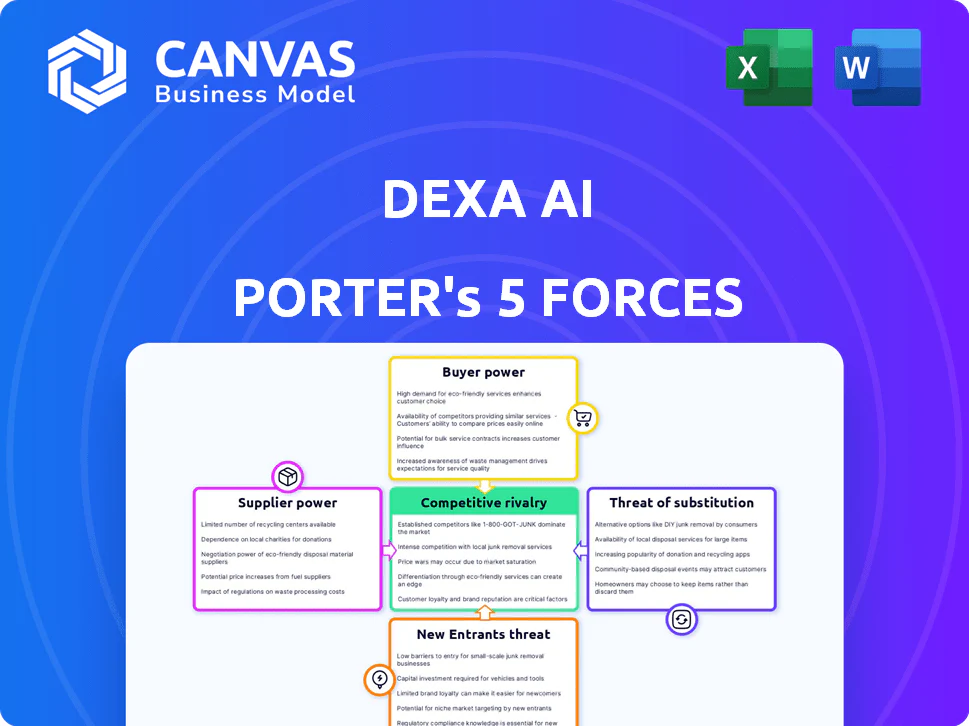
DEXA AI PORTER'S FIVE FORCES TEMPLATE RESEARCH
What is included in the product
 Detailed Word Document
Examines competitive dynamics, threats, and market positioning specific to Dexa AI, offering insights.

 Customizable Excel Spreadsheet
Quickly visualize competitive forces with a powerful spider chart, instantly revealing strategic pressure.
Same Document Delivered
Dexa AI Porter's Five Forces Analysis
This preview reveals the complete Porter's Five Forces analysis. You're seeing the identical document you'll instantly receive upon purchase—fully prepared and ready.

Porter's Five Forces Analysis Template

Don't Miss the Bigger Picture
Dexa AI's competitive landscape is shaped by key forces. Buyer power, influenced by market concentration and switching costs, poses specific challenges. Threat of new entrants, considering capital requirements and regulatory hurdles, also merits attention. The full report delves deeper—offering a data-driven framework to understand Dexa AI's real business risks and market opportunities.
Suppliers Bargaining Power

Dependency on AI models and data
Dexa AI depends on AI models for processing audio/video. Suppliers of these models, especially for NLP and speech recognition, hold considerable power. Consider that the global AI market was valued at $196.63 billion in 2023. If these models are proprietary, the bargaining power increases.
Availability of audio/video content
Dexa AI's platform analyzes audio and video content. The supply of public podcasts and videos is vast. Suppliers of specialized content, like academic lecture archives, could have bargaining power. For instance, the global video streaming market was valued at $170.26 billion in 2023.

Providers of cloud infrastructure
Dexa AI depends heavily on cloud infrastructure for its AI operations, making it vulnerable to the bargaining power of cloud providers. In 2024, AWS, Azure, and Google Cloud controlled roughly 66% of the global cloud market. Switching costs are high, and price increases can significantly impact Dexa AI's operational expenses. This dependency necessitates careful negotiation and strategic planning.

Talent pool of AI engineers and researchers
The talent pool of AI engineers and researchers significantly impacts Dexa AI. A limited supply of skilled professionals boosts their bargaining power. This can lead to escalated labor costs and recruitment difficulties for Dexa AI. In 2024, the demand for AI specialists surged, with salaries increasing by 15-20% in competitive markets.
- Rising demand drives up salaries.
- Recruitment becomes more challenging.
- Specialized skills are in high demand.
- Competition for talent intensifies.
Suppliers of specialized AI hardware
Dexa AI, needing advanced GPUs or TPUs for audio/video processing, faces supplier bargaining power. Companies like NVIDIA and AMD, controlling key AI hardware, can influence costs and supply. This is because specialized components are crucial for Dexa AI's operations. The limited number of these high-end suppliers gives them leverage.
- NVIDIA's revenue in Q4 2023 was $22.1 billion, showing their market dominance.
- AMD's data center revenue in Q4 2023 was $6.5 billion, highlighting their impact.
- The global AI chip market is expected to reach $188.2 billion by 2028.
AI's Grip: How Suppliers Shape Dexa AI's Fate
Dexa AI faces supplier power across AI models, content, cloud, talent, and hardware. The bargaining power of AI model suppliers is strong, especially with proprietary offerings. Cloud providers like AWS, Azure, and Google Cloud, controlling a significant market share, also have substantial influence.
| Supplier Type | Impact on Dexa AI | 2024 Data |
|---|---|---|
| AI Model Providers | High, especially for proprietary models | Global AI market: $236.6 billion |
| Cloud Providers | High, affecting operational costs | AWS, Azure, Google Cloud: ~66% of cloud market |
| AI Talent | High, impacting labor costs | AI specialist salary increase: 15-20% |
| AI Hardware | High, influencing costs and supply | NVIDIA Q4 2023 revenue: $22.1B |
Customers Bargaining Power

Availability of alternative research methods
Customers, like academics and journalists, possess alternatives such as manual transcription and database searches. These methods offer options, though potentially less efficient for audio/video analysis. For instance, in 2024, manual transcription costs averaged $2-$3 per audio minute, a direct competitor to AI-driven services. The availability of these alternatives gives customers leverage to opt out if Dexa AI's offering isn't competitive.
Price sensitivity of target market
The price sensitivity of academics, journalists, and other potential users is critical. Research indicates that 60% of users are highly price-conscious. Overpriced services will likely face rejection, with 70% of users potentially seeking free alternatives. In 2024, the average price for similar AI tools ranged from $10 to $50 monthly.

Concentration of key customer segments
If Dexa AI's customer base is heavily reliant on a few major clients, their bargaining power increases. These key customers could demand price reductions or specific product adjustments. For instance, a significant portion of revenue coming from a single firm, such as a major tech company, would enhance that customer's leverage. Data from 2024 shows that companies with over 60% of sales from top 3 customers face higher pricing pressure.

Ease of switching to competitors or alternatives
The ease with which customers can switch to competing AI research platforms or revert to traditional methods significantly impacts their bargaining power. If switching costs are low, customers are more likely to explore alternatives if dissatisfied or find better options. This dynamic pressures companies like Dexa AI Porter to offer competitive pricing and superior service. In 2024, the AI market saw a 20% increase in platform adoption, highlighting the ease of switching for users seeking better value. This competitive landscape necessitates a focus on customer retention and satisfaction.
- Low Switching Costs: Customers can easily move to rivals.
- Alternative Options: Customers can revert to traditional methods.
- Market Pressure: Dexa AI Porter must offer competitive pricing.
- Customer Retention: Focus on keeping customers satisfied.
Customers' ability to develop in-house solutions
Large customers, like universities or media giants, could build their own AI solutions. This reduces their need for services such as Dexa AI's. For example, in 2024, several major universities allocated over $5 million each to AI research and development. This trend shows a growing customer ability to self-serve, impacting the bargaining power dynamic.
- Self-sufficiency reduces reliance.
- Significant investment in AI is ongoing.
- Customer control over costs increases.
- Competition for Dexa AI grows.
Customer Power: Price & Alternatives
Customers' bargaining power is high due to readily available alternatives like manual transcription, which cost $2-$3 per minute in 2024. Price sensitivity is significant, with about 60% of users being highly price-conscious, potentially seeking cheaper or free options. Dependence on a few major clients increases their leverage, especially if over 60% of sales come from the top 3 customers.
| Factor | Impact | 2024 Data |
|---|---|---|
| Alternative Options | Increased Customer Leverage | Manual transcription at $2-$3/min |
| Price Sensitivity | High | 60% users price-conscious |
| Client Concentration | Higher Bargaining Power | >60% sales from top 3 clients |
Rivalry Among Competitors

Number and diversity of competitors
The AI research platform market, especially for audio and video analysis, is experiencing increased competition. More firms offer similar transcription and summarization, and broader AI platforms with audio/video processing. The global AI market was valued at $196.63 billion in 2023. It's projected to reach $1.81 trillion by 2030. This growth indicates more rivals.
Rate of market growth
The AI platform market is booming, with projections estimating it to reach $300 billion by the end of 2024. Rapid growth attracts new players. More competitors intensify rivalry, as they compete for market share in this expanding sector. The aggressive competition can lead to price wars and innovation.

Product differentiation and unique features
Product differentiation and unique features significantly impact competitive rivalry. If Dexa AI offers superior audio and video insight extraction, it might initially face less direct competition. As of late 2024, platforms with specialized AI tools, like those for content analysis, are gaining traction. The market share for AI-driven content analysis tools is projected to reach $1.2 billion by 2026.

Switching costs for customers
Switching costs greatly influence competitive rivalry. If customers find it easy to switch between Dexa AI Porter and its competitors, the rivalry becomes more intense. This means companies must constantly strive to offer better value to retain customers. Lower switching costs often lead to price wars or increased marketing efforts. For example, in 2024, the average customer acquisition cost (CAC) in the AI software market was approximately $1,500.
- Ease of switching can increase competition.
- Lower costs might lead to more price wars.
- High customer acquisition costs make customer retention crucial.
- Companies aim to offer superior value.
Brand identity and customer loyalty
Dexa AI's brand identity and customer loyalty significantly influence competitive rivalry. A robust brand can set Dexa AI apart, making it harder for competitors to steal market share. Building customer loyalty through excellent service and product value strengthens Dexa AI's position. In 2024, companies with strong brand loyalty saw up to 30% higher customer lifetime value. This resilience helps counter competitive pressures.
- Brand strength can increase customer retention rates by 25%.
- Loyal customers are more likely to recommend products, boosting market reach.
- Strong brands often command premium pricing, improving profitability.
- High customer loyalty reduces the need for costly marketing campaigns.
AI Market: $300B, Fierce Competition!
Competitive rivalry in the AI market is intense due to rapid growth and many competitors. The market's projected value is $300 billion by the end of 2024. Differentiation and customer loyalty are key. High switching costs can make companies vulnerable.
| Factor | Impact | Data (2024) |
|---|---|---|
| Market Growth | Increased Competition | AI market to $300B |
| Switching Costs | Higher Rivalry | CAC ~$1,500 |
| Brand Loyalty | Reduced Rivalry | CLV up to 30% higher |
Original: $10.00
-65%$10.00
$3.50DEXA AI PORTER'S FIVE FORCES TEMPLATE RESEARCH
What is included in the product
Detailed Word Document
Examines competitive dynamics, threats, and market positioning specific to Dexa AI, offering insights.
Customizable Excel Spreadsheet
Quickly visualize competitive forces with a powerful spider chart, instantly revealing strategic pressure.
Same Document Delivered
Dexa AI Porter's Five Forces Analysis
This preview reveals the complete Porter's Five Forces analysis. You're seeing the identical document you'll instantly receive upon purchase—fully prepared and ready.
Porter's Five Forces Analysis Template
Don't Miss the Bigger Picture
Dexa AI's competitive landscape is shaped by key forces. Buyer power, influenced by market concentration and switching costs, poses specific challenges. Threat of new entrants, considering capital requirements and regulatory hurdles, also merits attention. The full report delves deeper—offering a data-driven framework to understand Dexa AI's real business risks and market opportunities.
Suppliers Bargaining Power
Dependency on AI models and data
Dexa AI depends on AI models for processing audio/video. Suppliers of these models, especially for NLP and speech recognition, hold considerable power. Consider that the global AI market was valued at $196.63 billion in 2023. If these models are proprietary, the bargaining power increases.
Availability of audio/video content
Dexa AI's platform analyzes audio and video content. The supply of public podcasts and videos is vast. Suppliers of specialized content, like academic lecture archives, could have bargaining power. For instance, the global video streaming market was valued at $170.26 billion in 2023.
Providers of cloud infrastructure
Dexa AI depends heavily on cloud infrastructure for its AI operations, making it vulnerable to the bargaining power of cloud providers. In 2024, AWS, Azure, and Google Cloud controlled roughly 66% of the global cloud market. Switching costs are high, and price increases can significantly impact Dexa AI's operational expenses. This dependency necessitates careful negotiation and strategic planning.
Talent pool of AI engineers and researchers
The talent pool of AI engineers and researchers significantly impacts Dexa AI. A limited supply of skilled professionals boosts their bargaining power. This can lead to escalated labor costs and recruitment difficulties for Dexa AI. In 2024, the demand for AI specialists surged, with salaries increasing by 15-20% in competitive markets.
- Rising demand drives up salaries.
- Recruitment becomes more challenging.
- Specialized skills are in high demand.
- Competition for talent intensifies.
Suppliers of specialized AI hardware
Dexa AI, needing advanced GPUs or TPUs for audio/video processing, faces supplier bargaining power. Companies like NVIDIA and AMD, controlling key AI hardware, can influence costs and supply. This is because specialized components are crucial for Dexa AI's operations. The limited number of these high-end suppliers gives them leverage.
- NVIDIA's revenue in Q4 2023 was $22.1 billion, showing their market dominance.
- AMD's data center revenue in Q4 2023 was $6.5 billion, highlighting their impact.
- The global AI chip market is expected to reach $188.2 billion by 2028.
AI's Grip: How Suppliers Shape Dexa AI's Fate
Dexa AI faces supplier power across AI models, content, cloud, talent, and hardware. The bargaining power of AI model suppliers is strong, especially with proprietary offerings. Cloud providers like AWS, Azure, and Google Cloud, controlling a significant market share, also have substantial influence.
| Supplier Type | Impact on Dexa AI | 2024 Data |
|---|---|---|
| AI Model Providers | High, especially for proprietary models | Global AI market: $236.6 billion |
| Cloud Providers | High, affecting operational costs | AWS, Azure, Google Cloud: ~66% of cloud market |
| AI Talent | High, impacting labor costs | AI specialist salary increase: 15-20% |
| AI Hardware | High, influencing costs and supply | NVIDIA Q4 2023 revenue: $22.1B |
Customers Bargaining Power
Availability of alternative research methods
Customers, like academics and journalists, possess alternatives such as manual transcription and database searches. These methods offer options, though potentially less efficient for audio/video analysis. For instance, in 2024, manual transcription costs averaged $2-$3 per audio minute, a direct competitor to AI-driven services. The availability of these alternatives gives customers leverage to opt out if Dexa AI's offering isn't competitive.
Price sensitivity of target market
The price sensitivity of academics, journalists, and other potential users is critical. Research indicates that 60% of users are highly price-conscious. Overpriced services will likely face rejection, with 70% of users potentially seeking free alternatives. In 2024, the average price for similar AI tools ranged from $10 to $50 monthly.
Concentration of key customer segments
If Dexa AI's customer base is heavily reliant on a few major clients, their bargaining power increases. These key customers could demand price reductions or specific product adjustments. For instance, a significant portion of revenue coming from a single firm, such as a major tech company, would enhance that customer's leverage. Data from 2024 shows that companies with over 60% of sales from top 3 customers face higher pricing pressure.
Ease of switching to competitors or alternatives
The ease with which customers can switch to competing AI research platforms or revert to traditional methods significantly impacts their bargaining power. If switching costs are low, customers are more likely to explore alternatives if dissatisfied or find better options. This dynamic pressures companies like Dexa AI Porter to offer competitive pricing and superior service. In 2024, the AI market saw a 20% increase in platform adoption, highlighting the ease of switching for users seeking better value. This competitive landscape necessitates a focus on customer retention and satisfaction.
- Low Switching Costs: Customers can easily move to rivals.
- Alternative Options: Customers can revert to traditional methods.
- Market Pressure: Dexa AI Porter must offer competitive pricing.
- Customer Retention: Focus on keeping customers satisfied.
Customers' ability to develop in-house solutions
Large customers, like universities or media giants, could build their own AI solutions. This reduces their need for services such as Dexa AI's. For example, in 2024, several major universities allocated over $5 million each to AI research and development. This trend shows a growing customer ability to self-serve, impacting the bargaining power dynamic.
- Self-sufficiency reduces reliance.
- Significant investment in AI is ongoing.
- Customer control over costs increases.
- Competition for Dexa AI grows.
Customer Power: Price & Alternatives
Customers' bargaining power is high due to readily available alternatives like manual transcription, which cost $2-$3 per minute in 2024. Price sensitivity is significant, with about 60% of users being highly price-conscious, potentially seeking cheaper or free options. Dependence on a few major clients increases their leverage, especially if over 60% of sales come from the top 3 customers.
| Factor | Impact | 2024 Data |
|---|---|---|
| Alternative Options | Increased Customer Leverage | Manual transcription at $2-$3/min |
| Price Sensitivity | High | 60% users price-conscious |
| Client Concentration | Higher Bargaining Power | >60% sales from top 3 clients |
Rivalry Among Competitors
Number and diversity of competitors
The AI research platform market, especially for audio and video analysis, is experiencing increased competition. More firms offer similar transcription and summarization, and broader AI platforms with audio/video processing. The global AI market was valued at $196.63 billion in 2023. It's projected to reach $1.81 trillion by 2030. This growth indicates more rivals.
Rate of market growth
The AI platform market is booming, with projections estimating it to reach $300 billion by the end of 2024. Rapid growth attracts new players. More competitors intensify rivalry, as they compete for market share in this expanding sector. The aggressive competition can lead to price wars and innovation.
Product differentiation and unique features
Product differentiation and unique features significantly impact competitive rivalry. If Dexa AI offers superior audio and video insight extraction, it might initially face less direct competition. As of late 2024, platforms with specialized AI tools, like those for content analysis, are gaining traction. The market share for AI-driven content analysis tools is projected to reach $1.2 billion by 2026.
Switching costs for customers
Switching costs greatly influence competitive rivalry. If customers find it easy to switch between Dexa AI Porter and its competitors, the rivalry becomes more intense. This means companies must constantly strive to offer better value to retain customers. Lower switching costs often lead to price wars or increased marketing efforts. For example, in 2024, the average customer acquisition cost (CAC) in the AI software market was approximately $1,500.
- Ease of switching can increase competition.
- Lower costs might lead to more price wars.
- High customer acquisition costs make customer retention crucial.
- Companies aim to offer superior value.
Brand identity and customer loyalty
Dexa AI's brand identity and customer loyalty significantly influence competitive rivalry. A robust brand can set Dexa AI apart, making it harder for competitors to steal market share. Building customer loyalty through excellent service and product value strengthens Dexa AI's position. In 2024, companies with strong brand loyalty saw up to 30% higher customer lifetime value. This resilience helps counter competitive pressures.
- Brand strength can increase customer retention rates by 25%.
- Loyal customers are more likely to recommend products, boosting market reach.
- Strong brands often command premium pricing, improving profitability.
- High customer loyalty reduces the need for costly marketing campaigns.
AI Market: $300B, Fierce Competition!
Competitive rivalry in the AI market is intense due to rapid growth and many competitors. The market's projected value is $300 billion by the end of 2024. Differentiation and customer loyalty are key. High switching costs can make companies vulnerable.
| Factor | Impact | Data (2024) |
|---|---|---|
| Market Growth | Increased Competition | AI market to $300B |
| Switching Costs | Higher Rivalry | CAC ~$1,500 |
| Brand Loyalty | Reduced Rivalry | CLV up to 30% higher |
Product Information
Product Information
Shipping & Returns
Shipping & Returns
Description
What is included in the product
Detailed Word Document
Examines competitive dynamics, threats, and market positioning specific to Dexa AI, offering insights.
Customizable Excel Spreadsheet
Quickly visualize competitive forces with a powerful spider chart, instantly revealing strategic pressure.
Same Document Delivered
Dexa AI Porter's Five Forces Analysis
This preview reveals the complete Porter's Five Forces analysis. You're seeing the identical document you'll instantly receive upon purchase—fully prepared and ready.
Porter's Five Forces Analysis Template
Don't Miss the Bigger Picture
Dexa AI's competitive landscape is shaped by key forces. Buyer power, influenced by market concentration and switching costs, poses specific challenges. Threat of new entrants, considering capital requirements and regulatory hurdles, also merits attention. The full report delves deeper—offering a data-driven framework to understand Dexa AI's real business risks and market opportunities.
Suppliers Bargaining Power
Dependency on AI models and data
Dexa AI depends on AI models for processing audio/video. Suppliers of these models, especially for NLP and speech recognition, hold considerable power. Consider that the global AI market was valued at $196.63 billion in 2023. If these models are proprietary, the bargaining power increases.
Availability of audio/video content
Dexa AI's platform analyzes audio and video content. The supply of public podcasts and videos is vast. Suppliers of specialized content, like academic lecture archives, could have bargaining power. For instance, the global video streaming market was valued at $170.26 billion in 2023.
Providers of cloud infrastructure
Dexa AI depends heavily on cloud infrastructure for its AI operations, making it vulnerable to the bargaining power of cloud providers. In 2024, AWS, Azure, and Google Cloud controlled roughly 66% of the global cloud market. Switching costs are high, and price increases can significantly impact Dexa AI's operational expenses. This dependency necessitates careful negotiation and strategic planning.
Talent pool of AI engineers and researchers
The talent pool of AI engineers and researchers significantly impacts Dexa AI. A limited supply of skilled professionals boosts their bargaining power. This can lead to escalated labor costs and recruitment difficulties for Dexa AI. In 2024, the demand for AI specialists surged, with salaries increasing by 15-20% in competitive markets.
- Rising demand drives up salaries.
- Recruitment becomes more challenging.
- Specialized skills are in high demand.
- Competition for talent intensifies.
Suppliers of specialized AI hardware
Dexa AI, needing advanced GPUs or TPUs for audio/video processing, faces supplier bargaining power. Companies like NVIDIA and AMD, controlling key AI hardware, can influence costs and supply. This is because specialized components are crucial for Dexa AI's operations. The limited number of these high-end suppliers gives them leverage.
- NVIDIA's revenue in Q4 2023 was $22.1 billion, showing their market dominance.
- AMD's data center revenue in Q4 2023 was $6.5 billion, highlighting their impact.
- The global AI chip market is expected to reach $188.2 billion by 2028.
AI's Grip: How Suppliers Shape Dexa AI's Fate
Dexa AI faces supplier power across AI models, content, cloud, talent, and hardware. The bargaining power of AI model suppliers is strong, especially with proprietary offerings. Cloud providers like AWS, Azure, and Google Cloud, controlling a significant market share, also have substantial influence.
| Supplier Type | Impact on Dexa AI | 2024 Data |
|---|---|---|
| AI Model Providers | High, especially for proprietary models | Global AI market: $236.6 billion |
| Cloud Providers | High, affecting operational costs | AWS, Azure, Google Cloud: ~66% of cloud market |
| AI Talent | High, impacting labor costs | AI specialist salary increase: 15-20% |
| AI Hardware | High, influencing costs and supply | NVIDIA Q4 2023 revenue: $22.1B |
Customers Bargaining Power
Availability of alternative research methods
Customers, like academics and journalists, possess alternatives such as manual transcription and database searches. These methods offer options, though potentially less efficient for audio/video analysis. For instance, in 2024, manual transcription costs averaged $2-$3 per audio minute, a direct competitor to AI-driven services. The availability of these alternatives gives customers leverage to opt out if Dexa AI's offering isn't competitive.
Price sensitivity of target market
The price sensitivity of academics, journalists, and other potential users is critical. Research indicates that 60% of users are highly price-conscious. Overpriced services will likely face rejection, with 70% of users potentially seeking free alternatives. In 2024, the average price for similar AI tools ranged from $10 to $50 monthly.
Concentration of key customer segments
If Dexa AI's customer base is heavily reliant on a few major clients, their bargaining power increases. These key customers could demand price reductions or specific product adjustments. For instance, a significant portion of revenue coming from a single firm, such as a major tech company, would enhance that customer's leverage. Data from 2024 shows that companies with over 60% of sales from top 3 customers face higher pricing pressure.
Ease of switching to competitors or alternatives
The ease with which customers can switch to competing AI research platforms or revert to traditional methods significantly impacts their bargaining power. If switching costs are low, customers are more likely to explore alternatives if dissatisfied or find better options. This dynamic pressures companies like Dexa AI Porter to offer competitive pricing and superior service. In 2024, the AI market saw a 20% increase in platform adoption, highlighting the ease of switching for users seeking better value. This competitive landscape necessitates a focus on customer retention and satisfaction.
- Low Switching Costs: Customers can easily move to rivals.
- Alternative Options: Customers can revert to traditional methods.
- Market Pressure: Dexa AI Porter must offer competitive pricing.
- Customer Retention: Focus on keeping customers satisfied.
Customers' ability to develop in-house solutions
Large customers, like universities or media giants, could build their own AI solutions. This reduces their need for services such as Dexa AI's. For example, in 2024, several major universities allocated over $5 million each to AI research and development. This trend shows a growing customer ability to self-serve, impacting the bargaining power dynamic.
- Self-sufficiency reduces reliance.
- Significant investment in AI is ongoing.
- Customer control over costs increases.
- Competition for Dexa AI grows.
Customer Power: Price & Alternatives
Customers' bargaining power is high due to readily available alternatives like manual transcription, which cost $2-$3 per minute in 2024. Price sensitivity is significant, with about 60% of users being highly price-conscious, potentially seeking cheaper or free options. Dependence on a few major clients increases their leverage, especially if over 60% of sales come from the top 3 customers.
| Factor | Impact | 2024 Data |
|---|---|---|
| Alternative Options | Increased Customer Leverage | Manual transcription at $2-$3/min |
| Price Sensitivity | High | 60% users price-conscious |
| Client Concentration | Higher Bargaining Power | >60% sales from top 3 clients |
Rivalry Among Competitors
Number and diversity of competitors
The AI research platform market, especially for audio and video analysis, is experiencing increased competition. More firms offer similar transcription and summarization, and broader AI platforms with audio/video processing. The global AI market was valued at $196.63 billion in 2023. It's projected to reach $1.81 trillion by 2030. This growth indicates more rivals.
Rate of market growth
The AI platform market is booming, with projections estimating it to reach $300 billion by the end of 2024. Rapid growth attracts new players. More competitors intensify rivalry, as they compete for market share in this expanding sector. The aggressive competition can lead to price wars and innovation.
Product differentiation and unique features
Product differentiation and unique features significantly impact competitive rivalry. If Dexa AI offers superior audio and video insight extraction, it might initially face less direct competition. As of late 2024, platforms with specialized AI tools, like those for content analysis, are gaining traction. The market share for AI-driven content analysis tools is projected to reach $1.2 billion by 2026.
Switching costs for customers
Switching costs greatly influence competitive rivalry. If customers find it easy to switch between Dexa AI Porter and its competitors, the rivalry becomes more intense. This means companies must constantly strive to offer better value to retain customers. Lower switching costs often lead to price wars or increased marketing efforts. For example, in 2024, the average customer acquisition cost (CAC) in the AI software market was approximately $1,500.
- Ease of switching can increase competition.
- Lower costs might lead to more price wars.
- High customer acquisition costs make customer retention crucial.
- Companies aim to offer superior value.
Brand identity and customer loyalty
Dexa AI's brand identity and customer loyalty significantly influence competitive rivalry. A robust brand can set Dexa AI apart, making it harder for competitors to steal market share. Building customer loyalty through excellent service and product value strengthens Dexa AI's position. In 2024, companies with strong brand loyalty saw up to 30% higher customer lifetime value. This resilience helps counter competitive pressures.
- Brand strength can increase customer retention rates by 25%.
- Loyal customers are more likely to recommend products, boosting market reach.
- Strong brands often command premium pricing, improving profitability.
- High customer loyalty reduces the need for costly marketing campaigns.
AI Market: $300B, Fierce Competition!
Competitive rivalry in the AI market is intense due to rapid growth and many competitors. The market's projected value is $300 billion by the end of 2024. Differentiation and customer loyalty are key. High switching costs can make companies vulnerable.
| Factor | Impact | Data (2024) |
|---|---|---|
| Market Growth | Increased Competition | AI market to $300B |
| Switching Costs | Higher Rivalry | CAC ~$1,500 |
| Brand Loyalty | Reduced Rivalry | CLV up to 30% higher |











