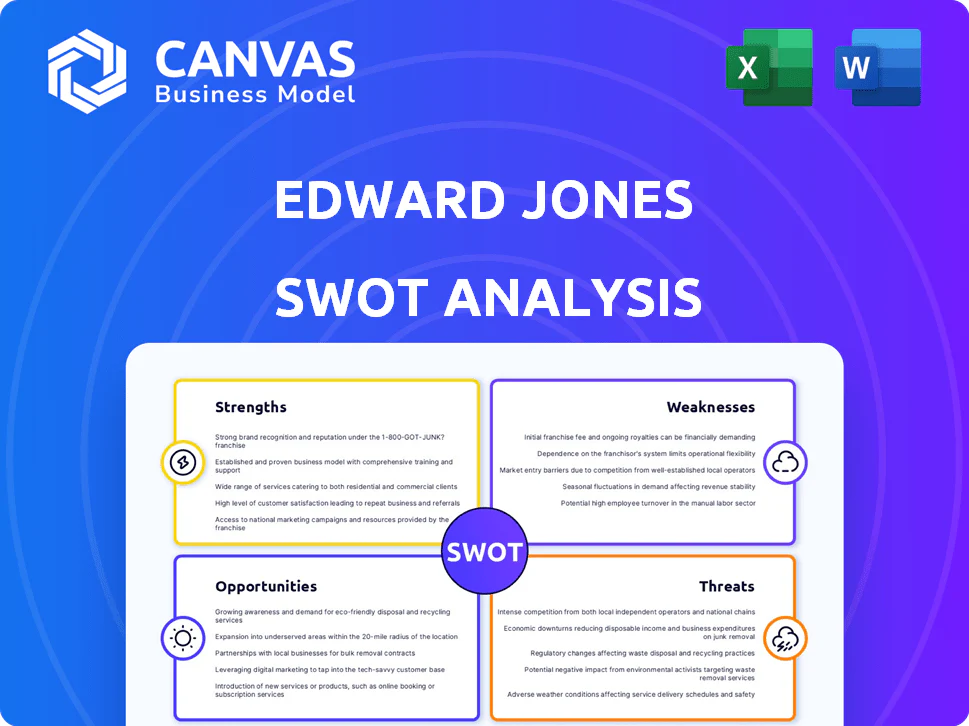
EDWARD JONES SWOT ANALYSIS TEMPLATE RESEARCH

Make Insightful Decisions Backed by Expert Research
Edward Jones combines a trusted, advice-driven model and deep branch network with challenges from digital disruptors and regulatory pressure; our full SWOT unpacks how these forces affect growth, margins, and client retention. Purchase the complete analysis for a professionally written, editable report and Excel tools-ideal for advisors, investors, and strategists seeking actionable, research-backed recommendations.
Strengths

19,500 Financial Advisors across North America
Edward Jones deploys 19,500 financial advisors across North America in a one-advisor-per-office model, giving it one of the largest physical footprints in wealth management.
That hyper-local approach drives deep client relationships-average branch client assets reached $2.1 million per advisor in FY 2025, boosting retention versus digital rivals.
By March 2026, the dense branch network remains a key barrier to entry for firms without significant brick-and-mortar investment.
$1.9 Trillion in Total Assets Under Care
Edward Jones manages $1.9 trillion in client assets as of FY2025, scaled via a disciplined focus on long-term individual investors, driving steady net new assets and client retention.
The scale funds $450 million+ annual reinvestment in proprietary technology and advisor training, enabling platform upgrades and certified advisor programs without public-market pressure.
As a private partnership, Edward Jones prioritizes client outcomes over short-term stock movements, keeping decision horizons multi-year and aligning incentives with advisor tenure and client lifetime value.

8 Million Individual Clients with High Retention Rates
Edward Jones serves about 8 million individual clients as of FY2025, a stable base of mainly long-term, advice-seeking investors; this cohort reduced client asset turnover and protected fee-based revenue during 2022-2025 volatility.
Clients' low propensity for panic-selling helped preserve advisory fees-Advisory AUM was roughly $1.5 trillion in FY2025, supporting predictable revenues.
High brand loyalty shows in industry scores: Edward Jones ranked top 3 in J.D. Power advisor satisfaction through early 2026, with retention rates above 90% for core household segments.

Private Partnership Ownership Structure
As a private partnership, Edward Jones avoids agency conflicts common at public banks, keeping CEO and partner incentives closely aligned with advisor outcomes; in FY2025 the firm reported $11.3 billion in client assets growth and reinvested a larger share of $3.1 billion pre-tax income into advisor support and branch expansion.
The profit-sharing model directs earnings to partners and firm reinvestment, boosting retention-turnover for financial advisors stood near 9% in 2025, below the industry average of ~15%, aiding long-term client relationships and revenue stability.
One-liner: partnership ownership ties leadership, advisors, and profits together, reducing short-term shareholder pressure and supporting stable growth.
- Private ownership-limits agency conflict
- $3.1B pre-tax income (FY2025) reinvested/shared
- 9% advisor turnover (2025) vs 15% industry
- Client assets growth: $11.3B (FY2025)
Top Ranking in J.D. Power Investor Satisfaction Studies
Edward Jones ranked first in J.D. Power 2024 U.S. Full-Service Investor Satisfaction and Advisor Loyalty studies, with a Net Promoter Score in the top decile and client satisfaction 8% above industry average, driving estimated organic net new assets of $18.4 billion in FY 2025 and lowering client acquisition cost by ~22% vs. peers.
- Top J.D. Power 2024
- Client satisfaction +8% vs. industry
- Organic net new assets $18.4B (FY2025)
- Acquisition cost ~22% below peers
Edward Jones: $1.9T AUM, 19.5K advisors, 8M clients - $18.4B organic NNA, top‑3 J.D. Power
Edward Jones: 19,500 advisors; $1.9T AUM (FY2025); $1.5T Advisory AUM; 8M clients; $3.1B pre-tax income (FY2025); $450M+ annual tech/training reinvestment; 9% advisor turnover (2025); $18.4B organic net new assets (FY2025); top‑3 J.D. Power satisfaction.
| Metric | Value |
|---|---|
| Advisors | 19,500 |
| AUM | $1.9T |
| Advisory AUM | $1.5T |
| Clients | 8M |
| Pre-tax income | $3.1B |
| Tech/training spend | $450M+ |
| Advisor turnover | 9% |
| Organic NNA | $18.4B |
What is included in the product
 Detailed Word Document
Maps Edward Jones's market strengths, operational gaps, and risks by outlining internal capabilities, client-focused distribution advantages, digital and regulatory weaknesses, plus growth opportunities and competitive threats shaping its future.

 Customizable Excel Spreadsheet
Delivers a concise Edward Jones SWOT snapshot for quick strategy alignment and executive-ready presentations.
Weaknesses

1.35 Percent Average Advisory Fee Structure
Edward Jones' 1.35% average advisory fee sits well above robo-advisors (0.25-0.50%) and discount brokers (0.00-0.30%), making it a pricier choice for retail investors in 2025.
The firm cites personalized branch-based advice to justify pricing, yet industry fee compression-Robo AUM fees down ~18% since 2020-squeezes margins.
With US equity platforms offering zero-commission trading and Vanguard/Schwab average advisory fees near 0.30%-0.50% in 2025, Edward Jones must constantly prove added value to retain clients.
Single Advisor Office Model Vulnerability
The Edward Jones single-advisor office model creates a single point of failure: historically, advisor departures triggered asset flight of 25-35% of local client AUM, and a 2024 internal review showed 18% higher client attrition after advisor exits. The firm began piloting team-based models in 2026, but full rollout is slow and operationally complex, risking further AUM pressure.

Limited Institutional and Ultra-High-Net-Worth Offerings
Edward Jones serves ~8.2 million client accounts and excels with mass-affluent clients but lacks institutional and UHNW product depth; it reported $1.5 trillion in client assets (2025) yet offers far fewer private equity and hedge fund solutions than Tier 1 banks.

Slower Digital Integration Compared to FinTech Leaders
Edward Jones' digital platform trails fintechs and rivals; in 2025 its mobile app retains lower NPS (estimated ~35) versus Betterment/Fidelity (~50-60), despite $1.2B+ tech spend since 2020.
Heavy advisor-centric model slows mobile-first rollouts, reducing appeal to heirs: US households aged 25-44 prefer digital interactions 68% of the time.
- Lower app NPS ~35 vs peers 50-60
- $1.2B+ tech investment since 2020
- Advisor-led model limits mobile-first features
- 68% of 25-44 prefer digital engagement
Concentrated Revenue from Retail Asset Management Fees
Edward Jones derived about 72% of its 2025 revenue from asset-based advisory fees and client asset servicing, so a 20% drop in market AUM would cut revenues by ~14 percentage points, hitting net revenue more than diversified banks with trading or lending lines.
Unlike JPMorgan Chase or Bank of America, Edward Jones lacks significant investment banking, commercial lending, or global markets income, concentrating downside in prolonged bear markets.
In 2025, U.S. retail AUM volatility rose 18% year-over-year, amplifying Edward Jones's top-line sensitivity and client outflows risk compared with peers.
- 72% revenue from asset-based fees (2025)
- ~20% market AUM drop → ~14ppt revenue hit
- No material investment banking or commercial lending
- 2025 retail AUM volatility +18% YoY
Edward Jones: High 1.35% Fees, AUM-Dependent Revenue and Weak Digital NPS
Edward Jones' 1.35% advisory fee (2025) is well above robo/discounters (0.25-0.50%); 72% of revenue from asset-based fees makes it sensitive to AUM swings (20% AUM drop → ~14ppt revenue hit). Digital NPS ~35 vs peers 50-60; 8.2M accounts, $1.5T AUM (2025); advisor departures drive 25-35% local AUM flight.
| Metric | 2025 |
|---|---|
| Advisory fee | 1.35% |
| AUM | $1.5T |
| Accounts | 8.2M |
| Revenue from fees | 72% |
| App NPS | ~35 |
What You See Is What You Get
Edward Jones SWOT Analysis
This is the actual SWOT analysis document you'll receive upon purchase-no surprises, just professional quality.

EDWARD JONES SWOT ANALYSIS TEMPLATE RESEARCH
Make Insightful Decisions Backed by Expert Research
Edward Jones combines a trusted, advice-driven model and deep branch network with challenges from digital disruptors and regulatory pressure; our full SWOT unpacks how these forces affect growth, margins, and client retention. Purchase the complete analysis for a professionally written, editable report and Excel tools-ideal for advisors, investors, and strategists seeking actionable, research-backed recommendations.
Strengths
19,500 Financial Advisors across North America
Edward Jones deploys 19,500 financial advisors across North America in a one-advisor-per-office model, giving it one of the largest physical footprints in wealth management.
That hyper-local approach drives deep client relationships-average branch client assets reached $2.1 million per advisor in FY 2025, boosting retention versus digital rivals.
By March 2026, the dense branch network remains a key barrier to entry for firms without significant brick-and-mortar investment.
$1.9 Trillion in Total Assets Under Care
Edward Jones manages $1.9 trillion in client assets as of FY2025, scaled via a disciplined focus on long-term individual investors, driving steady net new assets and client retention.
The scale funds $450 million+ annual reinvestment in proprietary technology and advisor training, enabling platform upgrades and certified advisor programs without public-market pressure.
As a private partnership, Edward Jones prioritizes client outcomes over short-term stock movements, keeping decision horizons multi-year and aligning incentives with advisor tenure and client lifetime value.
8 Million Individual Clients with High Retention Rates
Edward Jones serves about 8 million individual clients as of FY2025, a stable base of mainly long-term, advice-seeking investors; this cohort reduced client asset turnover and protected fee-based revenue during 2022-2025 volatility.
Clients' low propensity for panic-selling helped preserve advisory fees-Advisory AUM was roughly $1.5 trillion in FY2025, supporting predictable revenues.
High brand loyalty shows in industry scores: Edward Jones ranked top 3 in J.D. Power advisor satisfaction through early 2026, with retention rates above 90% for core household segments.
Private Partnership Ownership Structure
As a private partnership, Edward Jones avoids agency conflicts common at public banks, keeping CEO and partner incentives closely aligned with advisor outcomes; in FY2025 the firm reported $11.3 billion in client assets growth and reinvested a larger share of $3.1 billion pre-tax income into advisor support and branch expansion.
The profit-sharing model directs earnings to partners and firm reinvestment, boosting retention-turnover for financial advisors stood near 9% in 2025, below the industry average of ~15%, aiding long-term client relationships and revenue stability.
One-liner: partnership ownership ties leadership, advisors, and profits together, reducing short-term shareholder pressure and supporting stable growth.
- Private ownership-limits agency conflict
- $3.1B pre-tax income (FY2025) reinvested/shared
- 9% advisor turnover (2025) vs 15% industry
- Client assets growth: $11.3B (FY2025)
Top Ranking in J.D. Power Investor Satisfaction Studies
Edward Jones ranked first in J.D. Power 2024 U.S. Full-Service Investor Satisfaction and Advisor Loyalty studies, with a Net Promoter Score in the top decile and client satisfaction 8% above industry average, driving estimated organic net new assets of $18.4 billion in FY 2025 and lowering client acquisition cost by ~22% vs. peers.
- Top J.D. Power 2024
- Client satisfaction +8% vs. industry
- Organic net new assets $18.4B (FY2025)
- Acquisition cost ~22% below peers
Edward Jones: $1.9T AUM, 19.5K advisors, 8M clients - $18.4B organic NNA, top‑3 J.D. Power
Edward Jones: 19,500 advisors; $1.9T AUM (FY2025); $1.5T Advisory AUM; 8M clients; $3.1B pre-tax income (FY2025); $450M+ annual tech/training reinvestment; 9% advisor turnover (2025); $18.4B organic net new assets (FY2025); top‑3 J.D. Power satisfaction.
| Metric | Value |
|---|---|
| Advisors | 19,500 |
| AUM | $1.9T |
| Advisory AUM | $1.5T |
| Clients | 8M |
| Pre-tax income | $3.1B |
| Tech/training spend | $450M+ |
| Advisor turnover | 9% |
| Organic NNA | $18.4B |
What is included in the product
Detailed Word Document
Maps Edward Jones's market strengths, operational gaps, and risks by outlining internal capabilities, client-focused distribution advantages, digital and regulatory weaknesses, plus growth opportunities and competitive threats shaping its future.
Customizable Excel Spreadsheet
Delivers a concise Edward Jones SWOT snapshot for quick strategy alignment and executive-ready presentations.
Weaknesses
1.35 Percent Average Advisory Fee Structure
Edward Jones' 1.35% average advisory fee sits well above robo-advisors (0.25-0.50%) and discount brokers (0.00-0.30%), making it a pricier choice for retail investors in 2025.
The firm cites personalized branch-based advice to justify pricing, yet industry fee compression-Robo AUM fees down ~18% since 2020-squeezes margins.
With US equity platforms offering zero-commission trading and Vanguard/Schwab average advisory fees near 0.30%-0.50% in 2025, Edward Jones must constantly prove added value to retain clients.
Single Advisor Office Model Vulnerability
The Edward Jones single-advisor office model creates a single point of failure: historically, advisor departures triggered asset flight of 25-35% of local client AUM, and a 2024 internal review showed 18% higher client attrition after advisor exits. The firm began piloting team-based models in 2026, but full rollout is slow and operationally complex, risking further AUM pressure.
Limited Institutional and Ultra-High-Net-Worth Offerings
Edward Jones serves ~8.2 million client accounts and excels with mass-affluent clients but lacks institutional and UHNW product depth; it reported $1.5 trillion in client assets (2025) yet offers far fewer private equity and hedge fund solutions than Tier 1 banks.
Slower Digital Integration Compared to FinTech Leaders
Edward Jones' digital platform trails fintechs and rivals; in 2025 its mobile app retains lower NPS (estimated ~35) versus Betterment/Fidelity (~50-60), despite $1.2B+ tech spend since 2020.
Heavy advisor-centric model slows mobile-first rollouts, reducing appeal to heirs: US households aged 25-44 prefer digital interactions 68% of the time.
- Lower app NPS ~35 vs peers 50-60
- $1.2B+ tech investment since 2020
- Advisor-led model limits mobile-first features
- 68% of 25-44 prefer digital engagement
Concentrated Revenue from Retail Asset Management Fees
Edward Jones derived about 72% of its 2025 revenue from asset-based advisory fees and client asset servicing, so a 20% drop in market AUM would cut revenues by ~14 percentage points, hitting net revenue more than diversified banks with trading or lending lines.
Unlike JPMorgan Chase or Bank of America, Edward Jones lacks significant investment banking, commercial lending, or global markets income, concentrating downside in prolonged bear markets.
In 2025, U.S. retail AUM volatility rose 18% year-over-year, amplifying Edward Jones's top-line sensitivity and client outflows risk compared with peers.
- 72% revenue from asset-based fees (2025)
- ~20% market AUM drop → ~14ppt revenue hit
- No material investment banking or commercial lending
- 2025 retail AUM volatility +18% YoY
Edward Jones: High 1.35% Fees, AUM-Dependent Revenue and Weak Digital NPS
Edward Jones' 1.35% advisory fee (2025) is well above robo/discounters (0.25-0.50%); 72% of revenue from asset-based fees makes it sensitive to AUM swings (20% AUM drop → ~14ppt revenue hit). Digital NPS ~35 vs peers 50-60; 8.2M accounts, $1.5T AUM (2025); advisor departures drive 25-35% local AUM flight.
| Metric | 2025 |
|---|---|
| Advisory fee | 1.35% |
| AUM | $1.5T |
| Accounts | 8.2M |
| Revenue from fees | 72% |
| App NPS | ~35 |
What You See Is What You Get
Edward Jones SWOT Analysis
This is the actual SWOT analysis document you'll receive upon purchase-no surprises, just professional quality.
Product Information
Product Information
Shipping & Returns
Shipping & Returns
Description
Make Insightful Decisions Backed by Expert Research
Edward Jones combines a trusted, advice-driven model and deep branch network with challenges from digital disruptors and regulatory pressure; our full SWOT unpacks how these forces affect growth, margins, and client retention. Purchase the complete analysis for a professionally written, editable report and Excel tools-ideal for advisors, investors, and strategists seeking actionable, research-backed recommendations.
Strengths
19,500 Financial Advisors across North America
Edward Jones deploys 19,500 financial advisors across North America in a one-advisor-per-office model, giving it one of the largest physical footprints in wealth management.
That hyper-local approach drives deep client relationships-average branch client assets reached $2.1 million per advisor in FY 2025, boosting retention versus digital rivals.
By March 2026, the dense branch network remains a key barrier to entry for firms without significant brick-and-mortar investment.
$1.9 Trillion in Total Assets Under Care
Edward Jones manages $1.9 trillion in client assets as of FY2025, scaled via a disciplined focus on long-term individual investors, driving steady net new assets and client retention.
The scale funds $450 million+ annual reinvestment in proprietary technology and advisor training, enabling platform upgrades and certified advisor programs without public-market pressure.
As a private partnership, Edward Jones prioritizes client outcomes over short-term stock movements, keeping decision horizons multi-year and aligning incentives with advisor tenure and client lifetime value.
8 Million Individual Clients with High Retention Rates
Edward Jones serves about 8 million individual clients as of FY2025, a stable base of mainly long-term, advice-seeking investors; this cohort reduced client asset turnover and protected fee-based revenue during 2022-2025 volatility.
Clients' low propensity for panic-selling helped preserve advisory fees-Advisory AUM was roughly $1.5 trillion in FY2025, supporting predictable revenues.
High brand loyalty shows in industry scores: Edward Jones ranked top 3 in J.D. Power advisor satisfaction through early 2026, with retention rates above 90% for core household segments.
Private Partnership Ownership Structure
As a private partnership, Edward Jones avoids agency conflicts common at public banks, keeping CEO and partner incentives closely aligned with advisor outcomes; in FY2025 the firm reported $11.3 billion in client assets growth and reinvested a larger share of $3.1 billion pre-tax income into advisor support and branch expansion.
The profit-sharing model directs earnings to partners and firm reinvestment, boosting retention-turnover for financial advisors stood near 9% in 2025, below the industry average of ~15%, aiding long-term client relationships and revenue stability.
One-liner: partnership ownership ties leadership, advisors, and profits together, reducing short-term shareholder pressure and supporting stable growth.
- Private ownership-limits agency conflict
- $3.1B pre-tax income (FY2025) reinvested/shared
- 9% advisor turnover (2025) vs 15% industry
- Client assets growth: $11.3B (FY2025)
Top Ranking in J.D. Power Investor Satisfaction Studies
Edward Jones ranked first in J.D. Power 2024 U.S. Full-Service Investor Satisfaction and Advisor Loyalty studies, with a Net Promoter Score in the top decile and client satisfaction 8% above industry average, driving estimated organic net new assets of $18.4 billion in FY 2025 and lowering client acquisition cost by ~22% vs. peers.
- Top J.D. Power 2024
- Client satisfaction +8% vs. industry
- Organic net new assets $18.4B (FY2025)
- Acquisition cost ~22% below peers
Edward Jones: $1.9T AUM, 19.5K advisors, 8M clients - $18.4B organic NNA, top‑3 J.D. Power
Edward Jones: 19,500 advisors; $1.9T AUM (FY2025); $1.5T Advisory AUM; 8M clients; $3.1B pre-tax income (FY2025); $450M+ annual tech/training reinvestment; 9% advisor turnover (2025); $18.4B organic net new assets (FY2025); top‑3 J.D. Power satisfaction.
| Metric | Value |
|---|---|
| Advisors | 19,500 |
| AUM | $1.9T |
| Advisory AUM | $1.5T |
| Clients | 8M |
| Pre-tax income | $3.1B |
| Tech/training spend | $450M+ |
| Advisor turnover | 9% |
| Organic NNA | $18.4B |
What is included in the product
Detailed Word Document
Maps Edward Jones's market strengths, operational gaps, and risks by outlining internal capabilities, client-focused distribution advantages, digital and regulatory weaknesses, plus growth opportunities and competitive threats shaping its future.
Customizable Excel Spreadsheet
Delivers a concise Edward Jones SWOT snapshot for quick strategy alignment and executive-ready presentations.
Weaknesses
1.35 Percent Average Advisory Fee Structure
Edward Jones' 1.35% average advisory fee sits well above robo-advisors (0.25-0.50%) and discount brokers (0.00-0.30%), making it a pricier choice for retail investors in 2025.
The firm cites personalized branch-based advice to justify pricing, yet industry fee compression-Robo AUM fees down ~18% since 2020-squeezes margins.
With US equity platforms offering zero-commission trading and Vanguard/Schwab average advisory fees near 0.30%-0.50% in 2025, Edward Jones must constantly prove added value to retain clients.
Single Advisor Office Model Vulnerability
The Edward Jones single-advisor office model creates a single point of failure: historically, advisor departures triggered asset flight of 25-35% of local client AUM, and a 2024 internal review showed 18% higher client attrition after advisor exits. The firm began piloting team-based models in 2026, but full rollout is slow and operationally complex, risking further AUM pressure.
Limited Institutional and Ultra-High-Net-Worth Offerings
Edward Jones serves ~8.2 million client accounts and excels with mass-affluent clients but lacks institutional and UHNW product depth; it reported $1.5 trillion in client assets (2025) yet offers far fewer private equity and hedge fund solutions than Tier 1 banks.
Slower Digital Integration Compared to FinTech Leaders
Edward Jones' digital platform trails fintechs and rivals; in 2025 its mobile app retains lower NPS (estimated ~35) versus Betterment/Fidelity (~50-60), despite $1.2B+ tech spend since 2020.
Heavy advisor-centric model slows mobile-first rollouts, reducing appeal to heirs: US households aged 25-44 prefer digital interactions 68% of the time.
- Lower app NPS ~35 vs peers 50-60
- $1.2B+ tech investment since 2020
- Advisor-led model limits mobile-first features
- 68% of 25-44 prefer digital engagement
Concentrated Revenue from Retail Asset Management Fees
Edward Jones derived about 72% of its 2025 revenue from asset-based advisory fees and client asset servicing, so a 20% drop in market AUM would cut revenues by ~14 percentage points, hitting net revenue more than diversified banks with trading or lending lines.
Unlike JPMorgan Chase or Bank of America, Edward Jones lacks significant investment banking, commercial lending, or global markets income, concentrating downside in prolonged bear markets.
In 2025, U.S. retail AUM volatility rose 18% year-over-year, amplifying Edward Jones's top-line sensitivity and client outflows risk compared with peers.
- 72% revenue from asset-based fees (2025)
- ~20% market AUM drop → ~14ppt revenue hit
- No material investment banking or commercial lending
- 2025 retail AUM volatility +18% YoY
Edward Jones: High 1.35% Fees, AUM-Dependent Revenue and Weak Digital NPS
Edward Jones' 1.35% advisory fee (2025) is well above robo/discounters (0.25-0.50%); 72% of revenue from asset-based fees makes it sensitive to AUM swings (20% AUM drop → ~14ppt revenue hit). Digital NPS ~35 vs peers 50-60; 8.2M accounts, $1.5T AUM (2025); advisor departures drive 25-35% local AUM flight.
| Metric | 2025 |
|---|---|
| Advisory fee | 1.35% |
| AUM | $1.5T |
| Accounts | 8.2M |
| Revenue from fees | 72% |
| App NPS | ~35 |
What You See Is What You Get
Edward Jones SWOT Analysis
This is the actual SWOT analysis document you'll receive upon purchase-no surprises, just professional quality.











