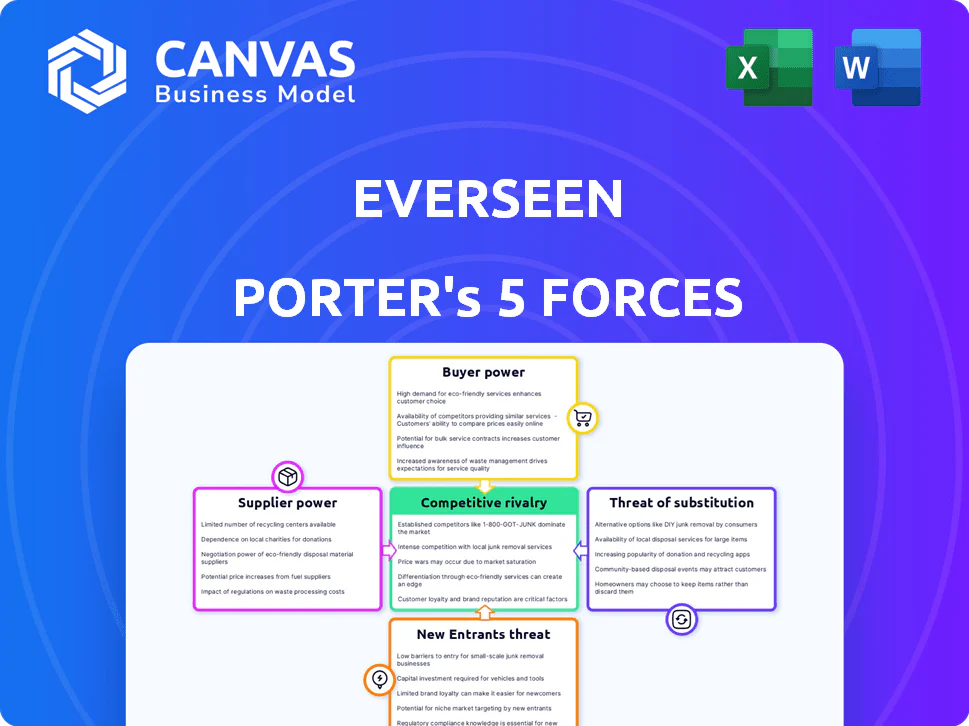
EVERSEEN PORTER'S FIVE FORCES TEMPLATE RESEARCH
What is included in the product
 Detailed Word Document
Analyzes competitive forces, assessing suppliers, buyers, and potential market disruptors for Everseen.

 Customizable Excel Spreadsheet
Customize pressure levels based on new data or evolving market trends.
Preview the Actual Deliverable
Everseen Porter's Five Forces Analysis
This is a complete, ready-to-use Porter's Five Forces analysis of Everseen. The preview you're seeing is the final, professionally written document you'll receive immediately upon purchase.

Porter's Five Forces Analysis Template

Elevate Your Analysis with the Complete Porter's Five Forces Analysis
Everseen operates in a dynamic landscape shaped by competitive forces. Supplier power, buyer power, and the threat of substitutes all influence its market position. Analyzing the threat of new entrants and competitive rivalry provides a complete picture of Everseen's environment. Understanding these forces is crucial for strategic planning. This brief snapshot only scratches the surface. Unlock the full Porter's Five Forces Analysis to explore Everseen’s competitive dynamics, market pressures, and strategic advantages in detail.
Suppliers Bargaining Power

Availability of AI and Computer Vision Technology
The accessibility of AI and computer vision significantly impacts supplier power for Everseen. If these core technologies become widely available and standardized, Everseen's dependence on particular suppliers could lessen. This shift might reduce supplier bargaining power. The global AI market was valued at $196.63 billion in 2023 and is projected to reach $1,811.80 billion by 2030, showing rapid expansion and increasing availability of AI tech.
Specialized Hardware and Infrastructure Needs
Everseen relies on specialized hardware. This includes high-res cameras and edge computing. Limited suppliers boost their power. The global edge computing market was $25.7B in 2023. It's projected to reach $65.7B by 2029. This gives suppliers leverage.

Talent Pool for AI and Retail Expertise
Everseen relies on AI scientists, engineers, and retail experts. A talent shortage increases their bargaining power. In 2024, AI salaries rose 15% due to demand. Consulting fees for retail expertise also increased. This impacts Everseen's costs.

Data Requirements for AI Model Training
Everseen's AI models depend heavily on visual data for training and refinement, affecting their relationship with data suppliers. Access to comprehensive, high-quality data is crucial for their AI's accuracy and effectiveness. Everseen's bargaining power is influenced by its ability to secure data from retail clients or other providers. The cost and availability of this data directly impact Everseen's operational costs and competitive advantage.
- Data acquisition costs can represent a significant portion of AI model development budgets, sometimes exceeding 20% of the total project cost.
- The market for high-quality, labeled visual data is competitive, with prices varying based on data type and quality.
- Everseen's ability to negotiate favorable data terms with retail clients is crucial for cost-efficiency.
- Data scarcity can hinder AI model performance; the more the data, the better the result.
Dependency on Cloud Computing Services
Everseen's dependency on cloud computing services, like Google Cloud, introduces supplier bargaining power. These providers control critical infrastructure for data processing and storage, impacting operational costs. The concentration of cloud services among a few major players strengthens their position to dictate pricing and service agreements. This reliance presents a potential vulnerability for Everseen. In 2024, the global cloud computing market was valued at over $670 billion, with significant growth projected, underscoring the increasing importance of these suppliers.
- Cloud computing market size: Over $670 billion in 2024.
- Key players: Google Cloud, Amazon Web Services, Microsoft Azure.
- Impact: Pricing and service terms influence Everseen's costs.
- Dependency: Reliance on cloud infrastructure for data processing.
Everseen's Supplier Dynamics: A Deep Dive
Everseen's supplier power varies across technology and data. Hardware and talent shortages increase supplier leverage. Data and cloud service costs also impact Everseen.
| Factor | Impact | Data |
|---|---|---|
| AI Availability | Decreased supplier power | AI market: $196.63B (2023) |
| Specialized Hardware | Increased supplier power | Edge computing: $25.7B (2023) |
| Talent Scarcity | Increased supplier power | AI salaries up 15% (2024) |
| Data Costs | Impacts costs | Data costs: up to 20% of project |
| Cloud Services | Increased supplier power | Cloud market: $670B+ (2024) |
Customers Bargaining Power

Concentration of Major Retail Clients
Everseen's reliance on major retailers, like Walmart and Amazon, creates a scenario where these clients wield considerable bargaining power. For example, in 2024, Walmart's revenue was approximately $648 billion, demonstrating its financial clout. This concentration can lead to demands for lower prices or customized services. Such a dynamic may impact Everseen's profitability and strategic direction.
Cost of Implementation and Integration
Implementing Everseen's visual AI solutions involves substantial costs and integration efforts for retailers. High upfront costs and potential operational disruptions empower customers in negotiations. Retailers, facing these challenges, may seek discounts or customized solutions. Data from 2024 shows average implementation costs could range from $50,000 to $250,000 depending on store size and complexity.

Potential for In-House Development
Large retailers, like Walmart and Amazon, possess the resources to create their own visual AI solutions. This in-house development potential enhances their bargaining power, allowing them to negotiate better terms with providers like Everseen. For instance, in 2024, Walmart's net sales were over $648 billion. This financial strength enables them to invest in alternatives. This limits Everseen's ability to set prices.

Availability of Alternative Solutions
Everseen's customers wield substantial bargaining power due to the availability of alternative solutions. While Everseen excels in its sector, competitors offer similar services. Customers can opt for traditional security or other AI providers. This competitive landscape limits Everseen's pricing power.
- The global video analytics market is projected to reach $24.3 billion by 2028.
- Many retailers are testing multiple AI solutions simultaneously.
- Traditional security systems still account for a significant portion of loss prevention spending.
- Switching costs for AI solutions are relatively low.
Impact on Customer Experience and ROI
Retailers intensely scrutinize Everseen's solutions, focusing on tangible outcomes like shrink reduction and efficiency gains. Demonstrable ROI and operational improvements solidify Everseen's standing, while a lack of clear value could empower customers. Consider that in 2024, retail shrink costs rose to nearly $112.7 billion, highlighting the stakes. Strong results are crucial to maintain a favorable position.
- Focus on measurable results, such as reduced shrink.
- Improved operational efficiency.
- Enhanced customer experience.
- Retail shrink costs reached nearly $112.7 billion in 2024.
Everseen's Retail Battle: Bargaining Power & Costs
Everseen faces strong customer bargaining power, especially from major retailers like Walmart and Amazon, which reported combined revenues exceeding $1 trillion in 2024. High implementation costs and the availability of alternative AI solutions further enhance customer leverage, even though the visual AI market is expected to grow to $24.3 billion by 2028. Retailers' intense focus on ROI and tangible benefits, such as reduced shrink (nearly $112.7 billion in 2024), emphasizes the need for Everseen to provide clear value to maintain a competitive edge.
| Factor | Impact | 2024 Data |
|---|---|---|
| Retailer Size | High bargaining power | Walmart revenue: $648B+, Amazon revenue: $575B+ |
| Implementation Costs | Customer negotiation leverage | $50,000 - $250,000 per store |
| Alternative Solutions | Limits pricing power | Growing AI market, traditional security systems |
Rivalry Among Competitors

Number and Diversity of Competitors
The retail tech market is bustling, and Everseen contends with many rivals. This includes companies like Zebra Technologies and Sensormatic Solutions. The diversity among competitors means various strategies are used. In 2024, the retail tech market reached $29.4 billion.
Technological Differentiation and Innovation
Everseen's Vision AI platform and patented tech set it apart. Continuous R&D is vital, given the rapid AI and computer vision advancements. In 2024, AI software revenue reached $62.5 billion globally. The AI market is projected to hit $200 billion by 2028. Staying ahead needs significant investment.

Market Growth Rate and Opportunity
The retail sector's push to cut losses and boost efficiency opens doors for AI. A growing market attracts more players, but fierce competition can cause price wars. In 2024, the global retail AI market was valued at $4.7 billion. Intense rivalry is expected to drive down profit margins.

Brand Reputation and Customer Trust
Everseen's established brand reputation and the trust it has earned from global retailers are major competitive advantages. A strong brand and a history of success create a significant barrier for new competitors. This makes it harder for them to gain market share. In 2024, Everseen's revenue reached $150 million, reflecting its strong market position.
- Everseen's brand recognition is high among major retailers.
- Customer trust is a key factor in long-term contracts.
- New entrants face high hurdles to build similar trust.
- Established reputation supports pricing power.
Integration and Compatibility with Existing Systems
Everseen's success hinges on smooth integration with current retail systems. This ease of integration is a powerful competitive advantage. Retailers often hesitate to adopt new technologies if they disrupt existing workflows. Compatibility directly impacts adoption rates and market penetration. Consider that in 2024, 68% of retailers prioritized system integration in their tech investments.
- Seamless integration reduces implementation costs and time, a key selling point.
- Compatibility with various CCTV systems and POS platforms broadens Everseen's market.
- Poor integration leads to higher customer churn and negative reviews.
- Strong integration capabilities can attract larger retail clients.
Retail Tech Rivals: Everseen's Competitive Landscape
Competitive rivalry in the retail tech market is intense, with numerous players like Zebra Technologies. Everseen faces pressure from competitors, impacting pricing and market share. In 2024, the retail tech market saw significant growth, but this also intensified competition, affecting profit margins.
| Factor | Impact | 2024 Data |
|---|---|---|
| Market Growth | Attracts more rivals | $29.4B Retail Tech Market |
| Competition | Price wars, margin pressure | Retail AI market at $4.7B |
| Brand Strength | Competitive advantage | Everseen Revenue $150M |
EVERSEEN PORTER'S FIVE FORCES TEMPLATE RESEARCH
What is included in the product
Detailed Word Document
Analyzes competitive forces, assessing suppliers, buyers, and potential market disruptors for Everseen.
Customizable Excel Spreadsheet
Customize pressure levels based on new data or evolving market trends.
Preview the Actual Deliverable
Everseen Porter's Five Forces Analysis
This is a complete, ready-to-use Porter's Five Forces analysis of Everseen. The preview you're seeing is the final, professionally written document you'll receive immediately upon purchase.
Porter's Five Forces Analysis Template
Elevate Your Analysis with the Complete Porter's Five Forces Analysis
Everseen operates in a dynamic landscape shaped by competitive forces. Supplier power, buyer power, and the threat of substitutes all influence its market position. Analyzing the threat of new entrants and competitive rivalry provides a complete picture of Everseen's environment. Understanding these forces is crucial for strategic planning. This brief snapshot only scratches the surface. Unlock the full Porter's Five Forces Analysis to explore Everseen’s competitive dynamics, market pressures, and strategic advantages in detail.
Suppliers Bargaining Power
Availability of AI and Computer Vision Technology
The accessibility of AI and computer vision significantly impacts supplier power for Everseen. If these core technologies become widely available and standardized, Everseen's dependence on particular suppliers could lessen. This shift might reduce supplier bargaining power. The global AI market was valued at $196.63 billion in 2023 and is projected to reach $1,811.80 billion by 2030, showing rapid expansion and increasing availability of AI tech.
Specialized Hardware and Infrastructure Needs
Everseen relies on specialized hardware. This includes high-res cameras and edge computing. Limited suppliers boost their power. The global edge computing market was $25.7B in 2023. It's projected to reach $65.7B by 2029. This gives suppliers leverage.
Talent Pool for AI and Retail Expertise
Everseen relies on AI scientists, engineers, and retail experts. A talent shortage increases their bargaining power. In 2024, AI salaries rose 15% due to demand. Consulting fees for retail expertise also increased. This impacts Everseen's costs.
Data Requirements for AI Model Training
Everseen's AI models depend heavily on visual data for training and refinement, affecting their relationship with data suppliers. Access to comprehensive, high-quality data is crucial for their AI's accuracy and effectiveness. Everseen's bargaining power is influenced by its ability to secure data from retail clients or other providers. The cost and availability of this data directly impact Everseen's operational costs and competitive advantage.
- Data acquisition costs can represent a significant portion of AI model development budgets, sometimes exceeding 20% of the total project cost.
- The market for high-quality, labeled visual data is competitive, with prices varying based on data type and quality.
- Everseen's ability to negotiate favorable data terms with retail clients is crucial for cost-efficiency.
- Data scarcity can hinder AI model performance; the more the data, the better the result.
Dependency on Cloud Computing Services
Everseen's dependency on cloud computing services, like Google Cloud, introduces supplier bargaining power. These providers control critical infrastructure for data processing and storage, impacting operational costs. The concentration of cloud services among a few major players strengthens their position to dictate pricing and service agreements. This reliance presents a potential vulnerability for Everseen. In 2024, the global cloud computing market was valued at over $670 billion, with significant growth projected, underscoring the increasing importance of these suppliers.
- Cloud computing market size: Over $670 billion in 2024.
- Key players: Google Cloud, Amazon Web Services, Microsoft Azure.
- Impact: Pricing and service terms influence Everseen's costs.
- Dependency: Reliance on cloud infrastructure for data processing.
Everseen's Supplier Dynamics: A Deep Dive
Everseen's supplier power varies across technology and data. Hardware and talent shortages increase supplier leverage. Data and cloud service costs also impact Everseen.
| Factor | Impact | Data |
|---|---|---|
| AI Availability | Decreased supplier power | AI market: $196.63B (2023) |
| Specialized Hardware | Increased supplier power | Edge computing: $25.7B (2023) |
| Talent Scarcity | Increased supplier power | AI salaries up 15% (2024) |
| Data Costs | Impacts costs | Data costs: up to 20% of project |
| Cloud Services | Increased supplier power | Cloud market: $670B+ (2024) |
Customers Bargaining Power
Concentration of Major Retail Clients
Everseen's reliance on major retailers, like Walmart and Amazon, creates a scenario where these clients wield considerable bargaining power. For example, in 2024, Walmart's revenue was approximately $648 billion, demonstrating its financial clout. This concentration can lead to demands for lower prices or customized services. Such a dynamic may impact Everseen's profitability and strategic direction.
Cost of Implementation and Integration
Implementing Everseen's visual AI solutions involves substantial costs and integration efforts for retailers. High upfront costs and potential operational disruptions empower customers in negotiations. Retailers, facing these challenges, may seek discounts or customized solutions. Data from 2024 shows average implementation costs could range from $50,000 to $250,000 depending on store size and complexity.
Potential for In-House Development
Large retailers, like Walmart and Amazon, possess the resources to create their own visual AI solutions. This in-house development potential enhances their bargaining power, allowing them to negotiate better terms with providers like Everseen. For instance, in 2024, Walmart's net sales were over $648 billion. This financial strength enables them to invest in alternatives. This limits Everseen's ability to set prices.
Availability of Alternative Solutions
Everseen's customers wield substantial bargaining power due to the availability of alternative solutions. While Everseen excels in its sector, competitors offer similar services. Customers can opt for traditional security or other AI providers. This competitive landscape limits Everseen's pricing power.
- The global video analytics market is projected to reach $24.3 billion by 2028.
- Many retailers are testing multiple AI solutions simultaneously.
- Traditional security systems still account for a significant portion of loss prevention spending.
- Switching costs for AI solutions are relatively low.
Impact on Customer Experience and ROI
Retailers intensely scrutinize Everseen's solutions, focusing on tangible outcomes like shrink reduction and efficiency gains. Demonstrable ROI and operational improvements solidify Everseen's standing, while a lack of clear value could empower customers. Consider that in 2024, retail shrink costs rose to nearly $112.7 billion, highlighting the stakes. Strong results are crucial to maintain a favorable position.
- Focus on measurable results, such as reduced shrink.
- Improved operational efficiency.
- Enhanced customer experience.
- Retail shrink costs reached nearly $112.7 billion in 2024.
Everseen's Retail Battle: Bargaining Power & Costs
Everseen faces strong customer bargaining power, especially from major retailers like Walmart and Amazon, which reported combined revenues exceeding $1 trillion in 2024. High implementation costs and the availability of alternative AI solutions further enhance customer leverage, even though the visual AI market is expected to grow to $24.3 billion by 2028. Retailers' intense focus on ROI and tangible benefits, such as reduced shrink (nearly $112.7 billion in 2024), emphasizes the need for Everseen to provide clear value to maintain a competitive edge.
| Factor | Impact | 2024 Data |
|---|---|---|
| Retailer Size | High bargaining power | Walmart revenue: $648B+, Amazon revenue: $575B+ |
| Implementation Costs | Customer negotiation leverage | $50,000 - $250,000 per store |
| Alternative Solutions | Limits pricing power | Growing AI market, traditional security systems |
Rivalry Among Competitors
Number and Diversity of Competitors
The retail tech market is bustling, and Everseen contends with many rivals. This includes companies like Zebra Technologies and Sensormatic Solutions. The diversity among competitors means various strategies are used. In 2024, the retail tech market reached $29.4 billion.
Technological Differentiation and Innovation
Everseen's Vision AI platform and patented tech set it apart. Continuous R&D is vital, given the rapid AI and computer vision advancements. In 2024, AI software revenue reached $62.5 billion globally. The AI market is projected to hit $200 billion by 2028. Staying ahead needs significant investment.
Market Growth Rate and Opportunity
The retail sector's push to cut losses and boost efficiency opens doors for AI. A growing market attracts more players, but fierce competition can cause price wars. In 2024, the global retail AI market was valued at $4.7 billion. Intense rivalry is expected to drive down profit margins.
Brand Reputation and Customer Trust
Everseen's established brand reputation and the trust it has earned from global retailers are major competitive advantages. A strong brand and a history of success create a significant barrier for new competitors. This makes it harder for them to gain market share. In 2024, Everseen's revenue reached $150 million, reflecting its strong market position.
- Everseen's brand recognition is high among major retailers.
- Customer trust is a key factor in long-term contracts.
- New entrants face high hurdles to build similar trust.
- Established reputation supports pricing power.
Integration and Compatibility with Existing Systems
Everseen's success hinges on smooth integration with current retail systems. This ease of integration is a powerful competitive advantage. Retailers often hesitate to adopt new technologies if they disrupt existing workflows. Compatibility directly impacts adoption rates and market penetration. Consider that in 2024, 68% of retailers prioritized system integration in their tech investments.
- Seamless integration reduces implementation costs and time, a key selling point.
- Compatibility with various CCTV systems and POS platforms broadens Everseen's market.
- Poor integration leads to higher customer churn and negative reviews.
- Strong integration capabilities can attract larger retail clients.
Retail Tech Rivals: Everseen's Competitive Landscape
Competitive rivalry in the retail tech market is intense, with numerous players like Zebra Technologies. Everseen faces pressure from competitors, impacting pricing and market share. In 2024, the retail tech market saw significant growth, but this also intensified competition, affecting profit margins.
| Factor | Impact | 2024 Data |
|---|---|---|
| Market Growth | Attracts more rivals | $29.4B Retail Tech Market |
| Competition | Price wars, margin pressure | Retail AI market at $4.7B |
| Brand Strength | Competitive advantage | Everseen Revenue $150M |
Product Information
Product Information
Shipping & Returns
Shipping & Returns
Description
What is included in the product
Detailed Word Document
Analyzes competitive forces, assessing suppliers, buyers, and potential market disruptors for Everseen.
Customizable Excel Spreadsheet
Customize pressure levels based on new data or evolving market trends.
Preview the Actual Deliverable
Everseen Porter's Five Forces Analysis
This is a complete, ready-to-use Porter's Five Forces analysis of Everseen. The preview you're seeing is the final, professionally written document you'll receive immediately upon purchase.
Porter's Five Forces Analysis Template
Elevate Your Analysis with the Complete Porter's Five Forces Analysis
Everseen operates in a dynamic landscape shaped by competitive forces. Supplier power, buyer power, and the threat of substitutes all influence its market position. Analyzing the threat of new entrants and competitive rivalry provides a complete picture of Everseen's environment. Understanding these forces is crucial for strategic planning. This brief snapshot only scratches the surface. Unlock the full Porter's Five Forces Analysis to explore Everseen’s competitive dynamics, market pressures, and strategic advantages in detail.
Suppliers Bargaining Power
Availability of AI and Computer Vision Technology
The accessibility of AI and computer vision significantly impacts supplier power for Everseen. If these core technologies become widely available and standardized, Everseen's dependence on particular suppliers could lessen. This shift might reduce supplier bargaining power. The global AI market was valued at $196.63 billion in 2023 and is projected to reach $1,811.80 billion by 2030, showing rapid expansion and increasing availability of AI tech.
Specialized Hardware and Infrastructure Needs
Everseen relies on specialized hardware. This includes high-res cameras and edge computing. Limited suppliers boost their power. The global edge computing market was $25.7B in 2023. It's projected to reach $65.7B by 2029. This gives suppliers leverage.
Talent Pool for AI and Retail Expertise
Everseen relies on AI scientists, engineers, and retail experts. A talent shortage increases their bargaining power. In 2024, AI salaries rose 15% due to demand. Consulting fees for retail expertise also increased. This impacts Everseen's costs.
Data Requirements for AI Model Training
Everseen's AI models depend heavily on visual data for training and refinement, affecting their relationship with data suppliers. Access to comprehensive, high-quality data is crucial for their AI's accuracy and effectiveness. Everseen's bargaining power is influenced by its ability to secure data from retail clients or other providers. The cost and availability of this data directly impact Everseen's operational costs and competitive advantage.
- Data acquisition costs can represent a significant portion of AI model development budgets, sometimes exceeding 20% of the total project cost.
- The market for high-quality, labeled visual data is competitive, with prices varying based on data type and quality.
- Everseen's ability to negotiate favorable data terms with retail clients is crucial for cost-efficiency.
- Data scarcity can hinder AI model performance; the more the data, the better the result.
Dependency on Cloud Computing Services
Everseen's dependency on cloud computing services, like Google Cloud, introduces supplier bargaining power. These providers control critical infrastructure for data processing and storage, impacting operational costs. The concentration of cloud services among a few major players strengthens their position to dictate pricing and service agreements. This reliance presents a potential vulnerability for Everseen. In 2024, the global cloud computing market was valued at over $670 billion, with significant growth projected, underscoring the increasing importance of these suppliers.
- Cloud computing market size: Over $670 billion in 2024.
- Key players: Google Cloud, Amazon Web Services, Microsoft Azure.
- Impact: Pricing and service terms influence Everseen's costs.
- Dependency: Reliance on cloud infrastructure for data processing.
Everseen's Supplier Dynamics: A Deep Dive
Everseen's supplier power varies across technology and data. Hardware and talent shortages increase supplier leverage. Data and cloud service costs also impact Everseen.
| Factor | Impact | Data |
|---|---|---|
| AI Availability | Decreased supplier power | AI market: $196.63B (2023) |
| Specialized Hardware | Increased supplier power | Edge computing: $25.7B (2023) |
| Talent Scarcity | Increased supplier power | AI salaries up 15% (2024) |
| Data Costs | Impacts costs | Data costs: up to 20% of project |
| Cloud Services | Increased supplier power | Cloud market: $670B+ (2024) |
Customers Bargaining Power
Concentration of Major Retail Clients
Everseen's reliance on major retailers, like Walmart and Amazon, creates a scenario where these clients wield considerable bargaining power. For example, in 2024, Walmart's revenue was approximately $648 billion, demonstrating its financial clout. This concentration can lead to demands for lower prices or customized services. Such a dynamic may impact Everseen's profitability and strategic direction.
Cost of Implementation and Integration
Implementing Everseen's visual AI solutions involves substantial costs and integration efforts for retailers. High upfront costs and potential operational disruptions empower customers in negotiations. Retailers, facing these challenges, may seek discounts or customized solutions. Data from 2024 shows average implementation costs could range from $50,000 to $250,000 depending on store size and complexity.
Potential for In-House Development
Large retailers, like Walmart and Amazon, possess the resources to create their own visual AI solutions. This in-house development potential enhances their bargaining power, allowing them to negotiate better terms with providers like Everseen. For instance, in 2024, Walmart's net sales were over $648 billion. This financial strength enables them to invest in alternatives. This limits Everseen's ability to set prices.
Availability of Alternative Solutions
Everseen's customers wield substantial bargaining power due to the availability of alternative solutions. While Everseen excels in its sector, competitors offer similar services. Customers can opt for traditional security or other AI providers. This competitive landscape limits Everseen's pricing power.
- The global video analytics market is projected to reach $24.3 billion by 2028.
- Many retailers are testing multiple AI solutions simultaneously.
- Traditional security systems still account for a significant portion of loss prevention spending.
- Switching costs for AI solutions are relatively low.
Impact on Customer Experience and ROI
Retailers intensely scrutinize Everseen's solutions, focusing on tangible outcomes like shrink reduction and efficiency gains. Demonstrable ROI and operational improvements solidify Everseen's standing, while a lack of clear value could empower customers. Consider that in 2024, retail shrink costs rose to nearly $112.7 billion, highlighting the stakes. Strong results are crucial to maintain a favorable position.
- Focus on measurable results, such as reduced shrink.
- Improved operational efficiency.
- Enhanced customer experience.
- Retail shrink costs reached nearly $112.7 billion in 2024.
Everseen's Retail Battle: Bargaining Power & Costs
Everseen faces strong customer bargaining power, especially from major retailers like Walmart and Amazon, which reported combined revenues exceeding $1 trillion in 2024. High implementation costs and the availability of alternative AI solutions further enhance customer leverage, even though the visual AI market is expected to grow to $24.3 billion by 2028. Retailers' intense focus on ROI and tangible benefits, such as reduced shrink (nearly $112.7 billion in 2024), emphasizes the need for Everseen to provide clear value to maintain a competitive edge.
| Factor | Impact | 2024 Data |
|---|---|---|
| Retailer Size | High bargaining power | Walmart revenue: $648B+, Amazon revenue: $575B+ |
| Implementation Costs | Customer negotiation leverage | $50,000 - $250,000 per store |
| Alternative Solutions | Limits pricing power | Growing AI market, traditional security systems |
Rivalry Among Competitors
Number and Diversity of Competitors
The retail tech market is bustling, and Everseen contends with many rivals. This includes companies like Zebra Technologies and Sensormatic Solutions. The diversity among competitors means various strategies are used. In 2024, the retail tech market reached $29.4 billion.
Technological Differentiation and Innovation
Everseen's Vision AI platform and patented tech set it apart. Continuous R&D is vital, given the rapid AI and computer vision advancements. In 2024, AI software revenue reached $62.5 billion globally. The AI market is projected to hit $200 billion by 2028. Staying ahead needs significant investment.
Market Growth Rate and Opportunity
The retail sector's push to cut losses and boost efficiency opens doors for AI. A growing market attracts more players, but fierce competition can cause price wars. In 2024, the global retail AI market was valued at $4.7 billion. Intense rivalry is expected to drive down profit margins.
Brand Reputation and Customer Trust
Everseen's established brand reputation and the trust it has earned from global retailers are major competitive advantages. A strong brand and a history of success create a significant barrier for new competitors. This makes it harder for them to gain market share. In 2024, Everseen's revenue reached $150 million, reflecting its strong market position.
- Everseen's brand recognition is high among major retailers.
- Customer trust is a key factor in long-term contracts.
- New entrants face high hurdles to build similar trust.
- Established reputation supports pricing power.
Integration and Compatibility with Existing Systems
Everseen's success hinges on smooth integration with current retail systems. This ease of integration is a powerful competitive advantage. Retailers often hesitate to adopt new technologies if they disrupt existing workflows. Compatibility directly impacts adoption rates and market penetration. Consider that in 2024, 68% of retailers prioritized system integration in their tech investments.
- Seamless integration reduces implementation costs and time, a key selling point.
- Compatibility with various CCTV systems and POS platforms broadens Everseen's market.
- Poor integration leads to higher customer churn and negative reviews.
- Strong integration capabilities can attract larger retail clients.
Retail Tech Rivals: Everseen's Competitive Landscape
Competitive rivalry in the retail tech market is intense, with numerous players like Zebra Technologies. Everseen faces pressure from competitors, impacting pricing and market share. In 2024, the retail tech market saw significant growth, but this also intensified competition, affecting profit margins.
| Factor | Impact | 2024 Data |
|---|---|---|
| Market Growth | Attracts more rivals | $29.4B Retail Tech Market |
| Competition | Price wars, margin pressure | Retail AI market at $4.7B |
| Brand Strength | Competitive advantage | Everseen Revenue $150M |











