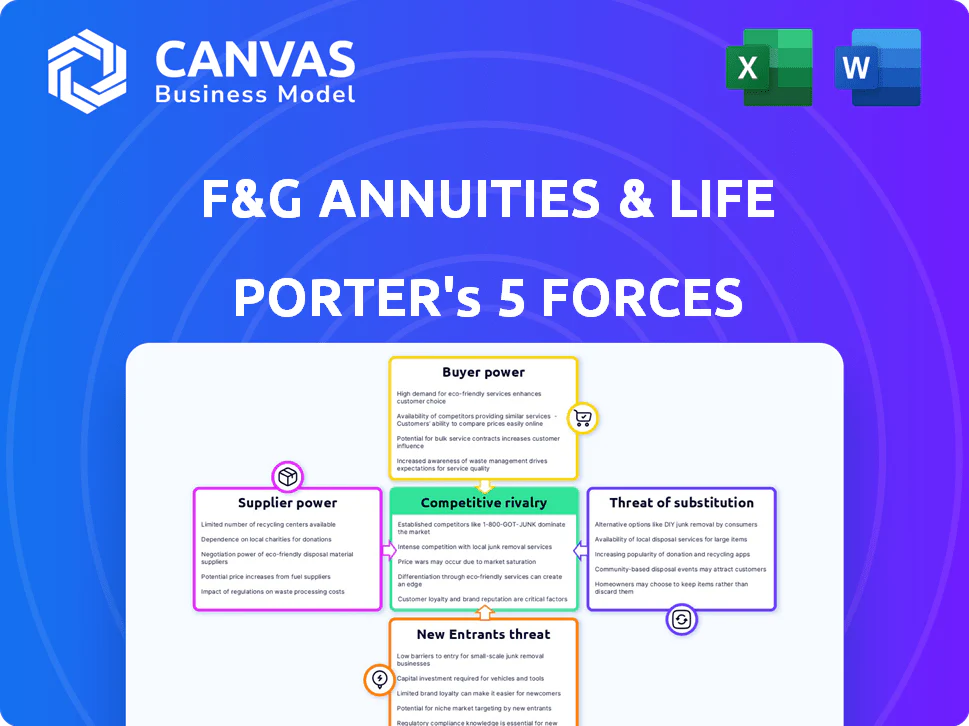
F&G ANNUITIES & LIFE PORTER'S FIVE FORCES TEMPLATE RESEARCH
What is included in the product
 Detailed Word Document
Tailored exclusively for F&G Annuities & Life, analyzing its position within its competitive landscape.

 Customizable Excel Spreadsheet
Swap in your own data, labels, and notes to reflect current business conditions.
What You See Is What You Get
F&G Annuities & Life Porter's Five Forces Analysis
This is the complete F&G Annuities & Life Porter's Five Forces analysis. The preview displays the exact document you will receive. It’s a fully formatted analysis. Prepared for immediate download after purchase. Ready for your business needs.

Porter's Five Forces Analysis Template

Elevate Your Analysis with the Complete Porter's Five Forces Analysis
F&G Annuities & Life faces moderate rivalry, with many competitors in the annuity market. Buyer power is strong, as customers have numerous product choices. Supplier power is relatively low, as F&G sources from various providers. The threat of new entrants is moderate. The threat of substitutes, such as other investment products, is also significant. This analysis provides a snapshot; the full analysis provides a complete strategic snapshot.
Suppliers Bargaining Power

Investment Management Services
F&G's reliance on Blackstone for investment management introduces supplier power dynamics. Blackstone's expertise and its impact on F&G's investment performance are key. In 2024, Blackstone managed approximately $1 trillion in assets. The specific terms of their agreement and alternative manager options affect this power balance.
Reinsurance Providers
F&G Annuities & Life uses flow reinsurance. Reinsurance terms affect risk management. In 2024, the reinsurance market saw shifts impacting insurers. High concentration among providers affects F&G's bargaining power.

Technology and Software Providers
F&G Annuities & Life depends on tech and software for its operations. Their recent collaboration with Accenture for the ALIP platform shows this. Switching costs and software uniqueness give these suppliers leverage. This could impact F&G's profitability and operational efficiency. The global IT services market was valued at $1.04 trillion in 2023.

Data and Analytics Providers
F&G Annuities & Life relies heavily on data and analytics for its operations. Suppliers of critical data, like those providing mortality rates or market analysis, can wield significant bargaining power. The more unique or essential the data, the stronger the supplier's position. For example, specialized actuarial data providers can command higher prices due to their expertise. In 2024, the market for insurance data and analytics was estimated at $4.5 billion, growing annually.
- Market size for insurance data and analytics in 2024: $4.5 billion.
- Key data includes mortality rates, market analysis, and risk assessment tools.
- Bargaining power depends on data exclusivity and necessity.
- Specialized actuarial data providers may have stronger leverage.
Marketing and Advertising Services
Marketing and advertising services are essential for F&G Annuities & Life to connect with potential customers, though their bargaining power is moderate. The differentiation among marketing firms affects their leverage; specialized expertise commands higher prices. In 2024, the advertising industry saw a 7.2% growth. F&G's dependence on effective marketing means it must manage these supplier relationships carefully.
- Advertising revenue in the U.S. reached $328.5 billion in 2023.
- Digital advertising accounted for over 70% of total ad spending in 2023.
- Specialized marketing agencies can charge premium rates.
Supplier Power Dynamics for F&G Annuities & Life
F&G Annuities & Life faces supplier power from data, tech, and marketing vendors. Key data suppliers, like those for actuarial data, have leverage, especially with specialized expertise. Marketing firms' power varies based on specialization. The U.S. advertising revenue hit $328.5 billion in 2023.
| Supplier Type | Impact on F&G | 2024 Data/Context |
|---|---|---|
| Data Providers | High, due to data uniqueness | Insurance data market: $4.5B |
| Tech & Software | Moderate, influenced by switching costs | IT services market: $1.04T (2023) |
| Marketing/Advertising | Moderate, depends on specialization | U.S. ad revenue: $328.5B (2023) |
Customers Bargaining Power

Individual Annuity and Life Insurance Customers
Individual annuity and life insurance customers possess some bargaining power, given the availability of various providers. They can compare products and rates, influencing their choices. However, the complexity of these financial products, coupled with long-term contracts, somewhat limits their leverage. In 2024, the annuity market saw over $300 billion in sales, showing customer choice. Yet, understanding contract terms remains a challenge.
Institutional Clients (Pension Risk Transfer)
Institutional clients, especially those involved in pension risk transfers, wield considerable influence due to the substantial deal sizes and their financial expertise. For instance, in 2024, F&G Annuities & Life secured a $1.4 billion pension risk transfer deal. These clients, often with extensive financial resources, can negotiate favorable terms.

Independent Agents and Financial Professionals
F&G relies on independent agents for distribution. Their power hinges on influencing customer decisions and access to competing products. As of 2024, F&G's distribution network includes over 60,000 independent agents. High agent availability reduces F&G's pricing power, especially if competitors offer similar products.

Broker-Dealers and Banks
F&G Annuities & Life relies on broker-dealers and banks to distribute its products. These channels wield bargaining power, influenced by the volume of business they generate. In 2024, the annuity market saw over $300 billion in sales, giving distributors leverage. They can switch to other insurers if terms aren't favorable.
- Market competition: The presence of numerous insurers provides alternatives.
- Volume of business: High-volume distributors have greater influence.
- Product differentiation: Standardized products reduce distributor loyalty.
- Switching costs: Low switching costs increase distributor bargaining power.
Customers Seeking Specific Product Features
Customers seeking specific product features, such as guaranteed lifetime income or downside market protection, may have less power if those features are unique or limited in availability across the market. F&G Annuities & Life, offering these features, could thus command a premium. In 2024, the demand for such products, especially those with living benefits, increased significantly. This shift empowers companies with specialized offerings.
- Living benefit riders sales increased by 15% in 2024.
- Annuity sales reached $310 billion in 2024, driven by demand for guarantees.
- Companies offering unique product features have a 20% higher profit margin.
- Customers prioritize guarantees and downside protection.
Decoding Customer Power Dynamics
Customer bargaining power varies based on the customer type and market dynamics. Individual customers have some power due to choice, yet complexity limits their leverage. Institutional clients, like those in pension risk transfers, have strong influence, especially with large deals. Distributors also wield power, influenced by market competition and product differentiation.
| Customer Type | Bargaining Power | Influence Factors |
|---|---|---|
| Individual | Moderate | Product availability, contract complexity |
| Institutional | High | Deal size, financial expertise |
| Distributors | Variable | Market competition, product differentiation |
Rivalry Among Competitors

Numerous Competitors in the Annuity and Life Insurance Market
The annuity and life insurance market is highly competitive. Many companies offer similar products, intensifying rivalry. In 2024, the top 10 life insurance companies held over 50% of market share. This includes established giants and specialized firms.
Product Differentiation
F&G Annuities & Life faces competitive rivalry through product differentiation. While annuities share similarities, competition centers on features, riders, rates, and options. For instance, in 2024, companies adjusted rates to attract clients. The focus is on offering unique value propositions. This includes specialized products and tailored services.

Distribution Channel Competition
Distribution channel competition is fierce. Securing relationships with financial advisors is key. In 2024, annuity sales hit $385.3 billion, indicating the high stakes. Independent agents and institutional partners are vital for market reach. Strong distribution networks drive market share and profitability.

Price Competition
Price competition can be intense in the annuities market, especially for products like MYGAs. This pressure can squeeze profit margins, as companies compete to offer the lowest rates. For example, in 2024, the average MYGA rates fluctuated, reflecting this price sensitivity. The market is influenced by interest rate changes and competitive offerings.
- MYGA rates are sensitive to interest rate changes.
- Competition is high due to product standardization.
- Profit margins can be compressed by price wars.
- Companies must balance rates and profitability.
Brand Reputation and Financial Strength
In the financial services industry, brand reputation and financial strength are pivotal. These factors directly impact customer and distributor trust and choices. Strong ratings from agencies like A.M. Best (F&G Annuities & Life: A- as of December 2024) signal stability. Competitors with lower ratings may struggle to attract business.
- A.M. Best rating influences customer confidence and distribution partnerships.
- Financial strength indicates the ability to meet obligations, crucial for insurance products.
- Reputation affects brand perception and market share.
- Competitive dynamics are shaped by these factors, influencing pricing and product offerings.
Annuity Market: A Battle for Billions
Competitive rivalry in the annuity market is fierce, with many companies offering similar products. In 2024, annuity sales reached $385.3 billion, highlighting the stakes. Companies compete on features, rates, and distribution, influencing market share.
| Factor | Impact | Example (2024) |
|---|---|---|
| Product Differentiation | Key to attracting clients | Adjusted rates, unique riders |
| Distribution Channels | Vital for market reach | Independent agents & institutional partners |
| Price Competition | Intense, especially for MYGAs | Fluctuating MYGA rates |
Original: $10.00
-65%$10.00
$3.50F&G ANNUITIES & LIFE PORTER'S FIVE FORCES TEMPLATE RESEARCH
What is included in the product
Detailed Word Document
Tailored exclusively for F&G Annuities & Life, analyzing its position within its competitive landscape.
Customizable Excel Spreadsheet
Swap in your own data, labels, and notes to reflect current business conditions.
What You See Is What You Get
F&G Annuities & Life Porter's Five Forces Analysis
This is the complete F&G Annuities & Life Porter's Five Forces analysis. The preview displays the exact document you will receive. It’s a fully formatted analysis. Prepared for immediate download after purchase. Ready for your business needs.
Porter's Five Forces Analysis Template
Elevate Your Analysis with the Complete Porter's Five Forces Analysis
F&G Annuities & Life faces moderate rivalry, with many competitors in the annuity market. Buyer power is strong, as customers have numerous product choices. Supplier power is relatively low, as F&G sources from various providers. The threat of new entrants is moderate. The threat of substitutes, such as other investment products, is also significant. This analysis provides a snapshot; the full analysis provides a complete strategic snapshot.
Suppliers Bargaining Power
Investment Management Services
F&G's reliance on Blackstone for investment management introduces supplier power dynamics. Blackstone's expertise and its impact on F&G's investment performance are key. In 2024, Blackstone managed approximately $1 trillion in assets. The specific terms of their agreement and alternative manager options affect this power balance.
Reinsurance Providers
F&G Annuities & Life uses flow reinsurance. Reinsurance terms affect risk management. In 2024, the reinsurance market saw shifts impacting insurers. High concentration among providers affects F&G's bargaining power.
Technology and Software Providers
F&G Annuities & Life depends on tech and software for its operations. Their recent collaboration with Accenture for the ALIP platform shows this. Switching costs and software uniqueness give these suppliers leverage. This could impact F&G's profitability and operational efficiency. The global IT services market was valued at $1.04 trillion in 2023.
Data and Analytics Providers
F&G Annuities & Life relies heavily on data and analytics for its operations. Suppliers of critical data, like those providing mortality rates or market analysis, can wield significant bargaining power. The more unique or essential the data, the stronger the supplier's position. For example, specialized actuarial data providers can command higher prices due to their expertise. In 2024, the market for insurance data and analytics was estimated at $4.5 billion, growing annually.
- Market size for insurance data and analytics in 2024: $4.5 billion.
- Key data includes mortality rates, market analysis, and risk assessment tools.
- Bargaining power depends on data exclusivity and necessity.
- Specialized actuarial data providers may have stronger leverage.
Marketing and Advertising Services
Marketing and advertising services are essential for F&G Annuities & Life to connect with potential customers, though their bargaining power is moderate. The differentiation among marketing firms affects their leverage; specialized expertise commands higher prices. In 2024, the advertising industry saw a 7.2% growth. F&G's dependence on effective marketing means it must manage these supplier relationships carefully.
- Advertising revenue in the U.S. reached $328.5 billion in 2023.
- Digital advertising accounted for over 70% of total ad spending in 2023.
- Specialized marketing agencies can charge premium rates.
Supplier Power Dynamics for F&G Annuities & Life
F&G Annuities & Life faces supplier power from data, tech, and marketing vendors. Key data suppliers, like those for actuarial data, have leverage, especially with specialized expertise. Marketing firms' power varies based on specialization. The U.S. advertising revenue hit $328.5 billion in 2023.
| Supplier Type | Impact on F&G | 2024 Data/Context |
|---|---|---|
| Data Providers | High, due to data uniqueness | Insurance data market: $4.5B |
| Tech & Software | Moderate, influenced by switching costs | IT services market: $1.04T (2023) |
| Marketing/Advertising | Moderate, depends on specialization | U.S. ad revenue: $328.5B (2023) |
Customers Bargaining Power
Individual Annuity and Life Insurance Customers
Individual annuity and life insurance customers possess some bargaining power, given the availability of various providers. They can compare products and rates, influencing their choices. However, the complexity of these financial products, coupled with long-term contracts, somewhat limits their leverage. In 2024, the annuity market saw over $300 billion in sales, showing customer choice. Yet, understanding contract terms remains a challenge.
Institutional Clients (Pension Risk Transfer)
Institutional clients, especially those involved in pension risk transfers, wield considerable influence due to the substantial deal sizes and their financial expertise. For instance, in 2024, F&G Annuities & Life secured a $1.4 billion pension risk transfer deal. These clients, often with extensive financial resources, can negotiate favorable terms.
Independent Agents and Financial Professionals
F&G relies on independent agents for distribution. Their power hinges on influencing customer decisions and access to competing products. As of 2024, F&G's distribution network includes over 60,000 independent agents. High agent availability reduces F&G's pricing power, especially if competitors offer similar products.
Broker-Dealers and Banks
F&G Annuities & Life relies on broker-dealers and banks to distribute its products. These channels wield bargaining power, influenced by the volume of business they generate. In 2024, the annuity market saw over $300 billion in sales, giving distributors leverage. They can switch to other insurers if terms aren't favorable.
- Market competition: The presence of numerous insurers provides alternatives.
- Volume of business: High-volume distributors have greater influence.
- Product differentiation: Standardized products reduce distributor loyalty.
- Switching costs: Low switching costs increase distributor bargaining power.
Customers Seeking Specific Product Features
Customers seeking specific product features, such as guaranteed lifetime income or downside market protection, may have less power if those features are unique or limited in availability across the market. F&G Annuities & Life, offering these features, could thus command a premium. In 2024, the demand for such products, especially those with living benefits, increased significantly. This shift empowers companies with specialized offerings.
- Living benefit riders sales increased by 15% in 2024.
- Annuity sales reached $310 billion in 2024, driven by demand for guarantees.
- Companies offering unique product features have a 20% higher profit margin.
- Customers prioritize guarantees and downside protection.
Decoding Customer Power Dynamics
Customer bargaining power varies based on the customer type and market dynamics. Individual customers have some power due to choice, yet complexity limits their leverage. Institutional clients, like those in pension risk transfers, have strong influence, especially with large deals. Distributors also wield power, influenced by market competition and product differentiation.
| Customer Type | Bargaining Power | Influence Factors |
|---|---|---|
| Individual | Moderate | Product availability, contract complexity |
| Institutional | High | Deal size, financial expertise |
| Distributors | Variable | Market competition, product differentiation |
Rivalry Among Competitors
Numerous Competitors in the Annuity and Life Insurance Market
The annuity and life insurance market is highly competitive. Many companies offer similar products, intensifying rivalry. In 2024, the top 10 life insurance companies held over 50% of market share. This includes established giants and specialized firms.
Product Differentiation
F&G Annuities & Life faces competitive rivalry through product differentiation. While annuities share similarities, competition centers on features, riders, rates, and options. For instance, in 2024, companies adjusted rates to attract clients. The focus is on offering unique value propositions. This includes specialized products and tailored services.
Distribution Channel Competition
Distribution channel competition is fierce. Securing relationships with financial advisors is key. In 2024, annuity sales hit $385.3 billion, indicating the high stakes. Independent agents and institutional partners are vital for market reach. Strong distribution networks drive market share and profitability.
Price Competition
Price competition can be intense in the annuities market, especially for products like MYGAs. This pressure can squeeze profit margins, as companies compete to offer the lowest rates. For example, in 2024, the average MYGA rates fluctuated, reflecting this price sensitivity. The market is influenced by interest rate changes and competitive offerings.
- MYGA rates are sensitive to interest rate changes.
- Competition is high due to product standardization.
- Profit margins can be compressed by price wars.
- Companies must balance rates and profitability.
Brand Reputation and Financial Strength
In the financial services industry, brand reputation and financial strength are pivotal. These factors directly impact customer and distributor trust and choices. Strong ratings from agencies like A.M. Best (F&G Annuities & Life: A- as of December 2024) signal stability. Competitors with lower ratings may struggle to attract business.
- A.M. Best rating influences customer confidence and distribution partnerships.
- Financial strength indicates the ability to meet obligations, crucial for insurance products.
- Reputation affects brand perception and market share.
- Competitive dynamics are shaped by these factors, influencing pricing and product offerings.
Annuity Market: A Battle for Billions
Competitive rivalry in the annuity market is fierce, with many companies offering similar products. In 2024, annuity sales reached $385.3 billion, highlighting the stakes. Companies compete on features, rates, and distribution, influencing market share.
| Factor | Impact | Example (2024) |
|---|---|---|
| Product Differentiation | Key to attracting clients | Adjusted rates, unique riders |
| Distribution Channels | Vital for market reach | Independent agents & institutional partners |
| Price Competition | Intense, especially for MYGAs | Fluctuating MYGA rates |
Product Information
Product Information
Shipping & Returns
Shipping & Returns
Description
What is included in the product
Detailed Word Document
Tailored exclusively for F&G Annuities & Life, analyzing its position within its competitive landscape.
Customizable Excel Spreadsheet
Swap in your own data, labels, and notes to reflect current business conditions.
What You See Is What You Get
F&G Annuities & Life Porter's Five Forces Analysis
This is the complete F&G Annuities & Life Porter's Five Forces analysis. The preview displays the exact document you will receive. It’s a fully formatted analysis. Prepared for immediate download after purchase. Ready for your business needs.
Porter's Five Forces Analysis Template
Elevate Your Analysis with the Complete Porter's Five Forces Analysis
F&G Annuities & Life faces moderate rivalry, with many competitors in the annuity market. Buyer power is strong, as customers have numerous product choices. Supplier power is relatively low, as F&G sources from various providers. The threat of new entrants is moderate. The threat of substitutes, such as other investment products, is also significant. This analysis provides a snapshot; the full analysis provides a complete strategic snapshot.
Suppliers Bargaining Power
Investment Management Services
F&G's reliance on Blackstone for investment management introduces supplier power dynamics. Blackstone's expertise and its impact on F&G's investment performance are key. In 2024, Blackstone managed approximately $1 trillion in assets. The specific terms of their agreement and alternative manager options affect this power balance.
Reinsurance Providers
F&G Annuities & Life uses flow reinsurance. Reinsurance terms affect risk management. In 2024, the reinsurance market saw shifts impacting insurers. High concentration among providers affects F&G's bargaining power.
Technology and Software Providers
F&G Annuities & Life depends on tech and software for its operations. Their recent collaboration with Accenture for the ALIP platform shows this. Switching costs and software uniqueness give these suppliers leverage. This could impact F&G's profitability and operational efficiency. The global IT services market was valued at $1.04 trillion in 2023.
Data and Analytics Providers
F&G Annuities & Life relies heavily on data and analytics for its operations. Suppliers of critical data, like those providing mortality rates or market analysis, can wield significant bargaining power. The more unique or essential the data, the stronger the supplier's position. For example, specialized actuarial data providers can command higher prices due to their expertise. In 2024, the market for insurance data and analytics was estimated at $4.5 billion, growing annually.
- Market size for insurance data and analytics in 2024: $4.5 billion.
- Key data includes mortality rates, market analysis, and risk assessment tools.
- Bargaining power depends on data exclusivity and necessity.
- Specialized actuarial data providers may have stronger leverage.
Marketing and Advertising Services
Marketing and advertising services are essential for F&G Annuities & Life to connect with potential customers, though their bargaining power is moderate. The differentiation among marketing firms affects their leverage; specialized expertise commands higher prices. In 2024, the advertising industry saw a 7.2% growth. F&G's dependence on effective marketing means it must manage these supplier relationships carefully.
- Advertising revenue in the U.S. reached $328.5 billion in 2023.
- Digital advertising accounted for over 70% of total ad spending in 2023.
- Specialized marketing agencies can charge premium rates.
Supplier Power Dynamics for F&G Annuities & Life
F&G Annuities & Life faces supplier power from data, tech, and marketing vendors. Key data suppliers, like those for actuarial data, have leverage, especially with specialized expertise. Marketing firms' power varies based on specialization. The U.S. advertising revenue hit $328.5 billion in 2023.
| Supplier Type | Impact on F&G | 2024 Data/Context |
|---|---|---|
| Data Providers | High, due to data uniqueness | Insurance data market: $4.5B |
| Tech & Software | Moderate, influenced by switching costs | IT services market: $1.04T (2023) |
| Marketing/Advertising | Moderate, depends on specialization | U.S. ad revenue: $328.5B (2023) |
Customers Bargaining Power
Individual Annuity and Life Insurance Customers
Individual annuity and life insurance customers possess some bargaining power, given the availability of various providers. They can compare products and rates, influencing their choices. However, the complexity of these financial products, coupled with long-term contracts, somewhat limits their leverage. In 2024, the annuity market saw over $300 billion in sales, showing customer choice. Yet, understanding contract terms remains a challenge.
Institutional Clients (Pension Risk Transfer)
Institutional clients, especially those involved in pension risk transfers, wield considerable influence due to the substantial deal sizes and their financial expertise. For instance, in 2024, F&G Annuities & Life secured a $1.4 billion pension risk transfer deal. These clients, often with extensive financial resources, can negotiate favorable terms.
Independent Agents and Financial Professionals
F&G relies on independent agents for distribution. Their power hinges on influencing customer decisions and access to competing products. As of 2024, F&G's distribution network includes over 60,000 independent agents. High agent availability reduces F&G's pricing power, especially if competitors offer similar products.
Broker-Dealers and Banks
F&G Annuities & Life relies on broker-dealers and banks to distribute its products. These channels wield bargaining power, influenced by the volume of business they generate. In 2024, the annuity market saw over $300 billion in sales, giving distributors leverage. They can switch to other insurers if terms aren't favorable.
- Market competition: The presence of numerous insurers provides alternatives.
- Volume of business: High-volume distributors have greater influence.
- Product differentiation: Standardized products reduce distributor loyalty.
- Switching costs: Low switching costs increase distributor bargaining power.
Customers Seeking Specific Product Features
Customers seeking specific product features, such as guaranteed lifetime income or downside market protection, may have less power if those features are unique or limited in availability across the market. F&G Annuities & Life, offering these features, could thus command a premium. In 2024, the demand for such products, especially those with living benefits, increased significantly. This shift empowers companies with specialized offerings.
- Living benefit riders sales increased by 15% in 2024.
- Annuity sales reached $310 billion in 2024, driven by demand for guarantees.
- Companies offering unique product features have a 20% higher profit margin.
- Customers prioritize guarantees and downside protection.
Decoding Customer Power Dynamics
Customer bargaining power varies based on the customer type and market dynamics. Individual customers have some power due to choice, yet complexity limits their leverage. Institutional clients, like those in pension risk transfers, have strong influence, especially with large deals. Distributors also wield power, influenced by market competition and product differentiation.
| Customer Type | Bargaining Power | Influence Factors |
|---|---|---|
| Individual | Moderate | Product availability, contract complexity |
| Institutional | High | Deal size, financial expertise |
| Distributors | Variable | Market competition, product differentiation |
Rivalry Among Competitors
Numerous Competitors in the Annuity and Life Insurance Market
The annuity and life insurance market is highly competitive. Many companies offer similar products, intensifying rivalry. In 2024, the top 10 life insurance companies held over 50% of market share. This includes established giants and specialized firms.
Product Differentiation
F&G Annuities & Life faces competitive rivalry through product differentiation. While annuities share similarities, competition centers on features, riders, rates, and options. For instance, in 2024, companies adjusted rates to attract clients. The focus is on offering unique value propositions. This includes specialized products and tailored services.
Distribution Channel Competition
Distribution channel competition is fierce. Securing relationships with financial advisors is key. In 2024, annuity sales hit $385.3 billion, indicating the high stakes. Independent agents and institutional partners are vital for market reach. Strong distribution networks drive market share and profitability.
Price Competition
Price competition can be intense in the annuities market, especially for products like MYGAs. This pressure can squeeze profit margins, as companies compete to offer the lowest rates. For example, in 2024, the average MYGA rates fluctuated, reflecting this price sensitivity. The market is influenced by interest rate changes and competitive offerings.
- MYGA rates are sensitive to interest rate changes.
- Competition is high due to product standardization.
- Profit margins can be compressed by price wars.
- Companies must balance rates and profitability.
Brand Reputation and Financial Strength
In the financial services industry, brand reputation and financial strength are pivotal. These factors directly impact customer and distributor trust and choices. Strong ratings from agencies like A.M. Best (F&G Annuities & Life: A- as of December 2024) signal stability. Competitors with lower ratings may struggle to attract business.
- A.M. Best rating influences customer confidence and distribution partnerships.
- Financial strength indicates the ability to meet obligations, crucial for insurance products.
- Reputation affects brand perception and market share.
- Competitive dynamics are shaped by these factors, influencing pricing and product offerings.
Annuity Market: A Battle for Billions
Competitive rivalry in the annuity market is fierce, with many companies offering similar products. In 2024, annuity sales reached $385.3 billion, highlighting the stakes. Companies compete on features, rates, and distribution, influencing market share.
| Factor | Impact | Example (2024) |
|---|---|---|
| Product Differentiation | Key to attracting clients | Adjusted rates, unique riders |
| Distribution Channels | Vital for market reach | Independent agents & institutional partners |
| Price Competition | Intense, especially for MYGAs | Fluctuating MYGA rates |











