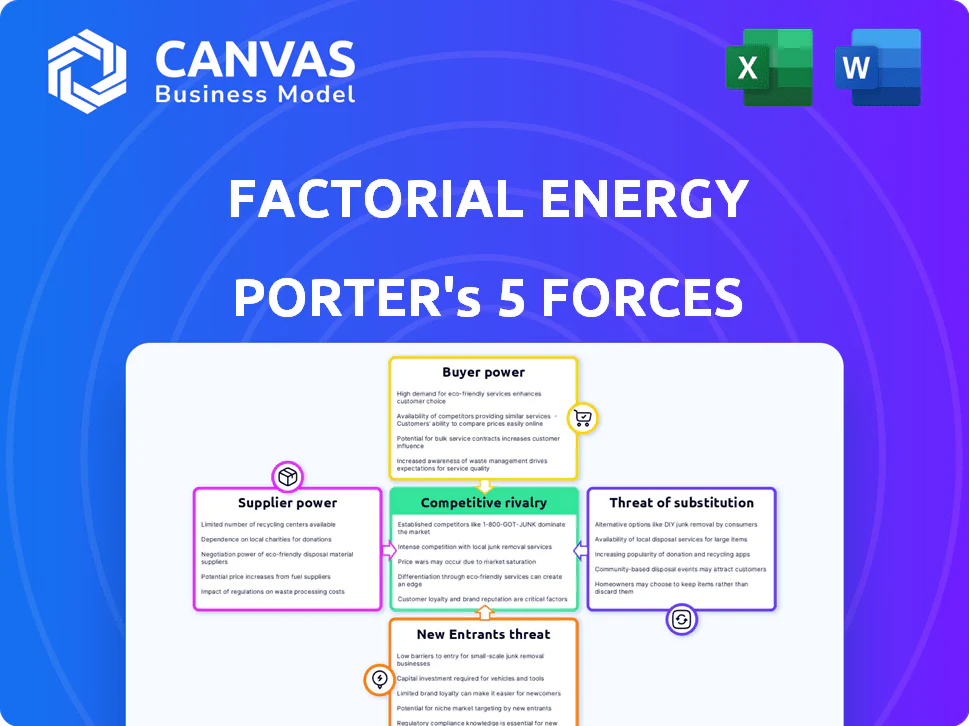
FACTORIAL ENERGY PORTER'S FIVE FORCES TEMPLATE RESEARCH
What is included in the product
 Detailed Word Document
Tailored exclusively for Factorial Energy, analyzing its position within its competitive landscape.

 Customizable Excel Spreadsheet
Customize pressure levels based on new data or evolving market trends.
What You See Is What You Get
Factorial Energy Porter's Five Forces Analysis
This preview is your Factorial Energy Porter's Five Forces analysis. The document you're viewing is the complete analysis you'll receive. There are no differences between the preview and the purchased document. Get instant access to the same professionally written file. No hidden surprises; it's ready to use immediately.

Porter's Five Forces Analysis Template

Go Beyond the Preview—Access the Full Strategic Report
Factorial Energy faces dynamic industry forces. Buyer power is moderate, driven by diverse customer needs. Threat of new entrants is high, due to rapid innovation. Supplier power is moderate, tied to material availability. Competitive rivalry is intense, due to existing battery players. Substitute threat is significant, with alternative energy storage.
The complete report reveals the real forces shaping Factorial Energy’s industry—from supplier influence to threat of new entrants. Gain actionable insights to drive smarter decision-making.
Suppliers Bargaining Power

Limited Supplier Base for Key Materials
Factorial Energy's reliance on specific materials, including lithium and solid electrolyte components, elevates supplier bargaining power. Limited alternative sources for these specialized materials, crucial for solid-state battery tech, intensify this dynamic. In 2024, lithium prices fluctuated, signaling supplier influence. Complex processing requirements further strengthen suppliers' control over Factorial Energy.
Dependency on Raw Material Costs
Factorial Energy's profitability is vulnerable to the fluctuating prices of raw materials like lithium, key to its solid-state battery tech. Lithium prices saw a significant surge in 2022, then corrected in 2023, demonstrating supplier power. These cost swings directly impact Factorial's production expenses and profit margins. The company must manage these supplier dynamics effectively.

Proprietary Technology of Suppliers
Some suppliers, particularly those with proprietary technology, can exert significant influence. Factorial's reliance on specialized components or processes from a limited number of suppliers could increase their bargaining power. This dependence could lead to higher costs or supply disruptions. For instance, if a key material has only a few providers, those providers can dictate terms. Consider the lithium market, where prices fluctuated significantly in 2024, impacting battery manufacturers.

Supplier Concentration
Supplier concentration significantly impacts Factorial Energy. If few suppliers control critical solid-state battery components, they gain pricing power. This concentration could increase production costs. For example, the battery materials market is currently evolving, with companies like Umicore and BASF investing heavily in cathode materials, but raw material supply remains a key bottleneck.
- Limited Supplier Options: Few suppliers mean less negotiation leverage for Factorial.
- Cost Implications: Higher prices for essential components increase overall battery costs.
- Supply Chain Risks: Dependency on few suppliers creates vulnerability to disruptions.
- Market Dynamics: Supplier dominance influences profitability and market competitiveness.
Importance of Quality and Consistency
The quality and consistency of materials are critical for Factorial Energy's solid-state batteries, impacting performance and safety. Reliable suppliers are thus crucial, potentially giving those with a strong track record more leverage in negotiations. For instance, securing high-purity lithium, a key component, can be a significant competitive advantage. This power dynamic influences cost structures and supply chain resilience. This is very important for the company's financial success.
- Material quality directly affects battery performance.
- Consistent supply reduces production risks.
- Supplier reputation impacts investor confidence.
- Negotiating power affects profit margins.
Supplier Power Challenges for Battery Tech
Factorial Energy faces supplier power due to reliance on specific materials, like lithium. The lithium market saw price fluctuations in 2024, impacting battery costs. Limited supplier options and proprietary tech further empower suppliers, affecting profitability.
| Factor | Impact | Data (2024) |
|---|---|---|
| Lithium Price Volatility | Higher Costs, Margin Squeeze | Prices fluctuated +/- 20% |
| Supplier Concentration | Reduced Negotiation Power | Few key electrolyte suppliers |
| Material Quality | Performance & Safety Risks | High-purity Li is crucial |
Customers Bargaining Power

Concentrated Customer Base
Factorial Energy's primary customers, including major automotive and energy storage firms, represent a concentrated customer base. A limited number of large customers possess substantial bargaining power. This power enables them to negotiate favorable prices or request customized solutions. For instance, Tesla's battery costs in 2024 were around $139/kWh, showcasing pressure on suppliers.
Customer Expertise in Battery Technology
Major automotive and energy companies possess significant internal battery tech expertise. This knowledge base strengthens their negotiating position with Factorial. For instance, in 2024, Tesla's R&D spending reached $3.5 billion. Such expertise enables informed evaluations of Factorial's offerings. This leads to more favorable terms for these customers.

Potential for Vertical Integration by Customers
Large customers, like major automakers, could vertically integrate by developing their own solid-state battery technology, reducing their reliance on suppliers like Factorial Energy. This move significantly increases their bargaining power. For instance, Tesla has invested heavily in its battery technology, showcasing this trend. In 2024, the global electric vehicle (EV) market saw Tesla's market share reach 18.4%, indicating their strong influence and ability to dictate terms.

Price Sensitivity in Target Markets
The cost of batteries is a significant part of electric vehicle and energy storage system expenses. Price-conscious customers will push Factorial Energy to provide competitive pricing. In 2024, battery costs remain a major factor, influencing consumer purchasing decisions. The pressure is heightened in markets where price is a primary driver. This necessitates Factorial to balance innovation with cost-effectiveness to stay competitive.
- Battery costs can represent up to 30-50% of an EV's total cost.
- Consumers compare EV prices against traditional gasoline vehicles.
- Energy storage system buyers evaluate ROI based on battery costs.
- Government incentives and subsidies can influence price sensitivity.
Availability of Alternative Battery Technologies
Customers possess significant bargaining power due to the availability of alternative battery technologies. While Factorial Energy focuses on solid-state batteries, the market offers established lithium-ion batteries and other emerging options. This variety empowers customers to negotiate prices and demand better features. The global lithium-ion battery market was valued at $66.3 billion in 2023, showing the dominance of existing tech.
- Lithium-ion batteries still dominate the market.
- Emerging battery technologies offer competition.
- Customer choice increases bargaining power.
- Market size of Lithium-ion in 2023 was $66.3 billion.
Battery Tech's Bargaining Battle: Who Holds the Power?
Factorial Energy faces strong customer bargaining power. Key customers like automakers can negotiate favorable terms. The availability of alternative battery tech also strengthens customer positions. In 2024, battery costs remain a significant factor.
| Aspect | Details | 2024 Data |
|---|---|---|
| Customer Concentration | Few large customers | Tesla's market share: 18.4% in EVs |
| Tech Expertise | Customer's internal knowledge | Tesla R&D spending: $3.5B |
| Vertical Integration | Customers developing own tech | EV battery cost: ~$139/kWh |
Rivalry Among Competitors

Numerous Competitors in Solid-State Battery Development
The solid-state battery market sees intense competition with numerous companies. Startups like Factorial Energy and established firms are all competing. This rivalry is heightened, as the market is still in its early stages. For instance, in 2024, over 100 companies were involved in solid-state battery development, according to market reports.
Rapid Technological Advancements
Factorial Energy faces fierce competition due to rapid tech advancements in solid-state batteries. Companies race to enhance energy density, safety, and costs, driving intense rivalry. In 2024, the solid-state battery market is projected to reach $1.3 billion, growing at over 20% annually. This creates a dynamic, competitive environment where innovation is key.

High Stakes in the EV and Energy Storage Markets
The solid-state battery market, targeting EVs and energy storage, is booming. The EV market is projected to reach $802.8 billion by 2027. This growth intensifies competition. Battery developers fiercely compete for market share, fueled by substantial profit potential.

Differentiation Based on Performance and Scalability
In the competitive landscape, companies like Factorial Energy vie for market share by differentiating their battery technology. This differentiation hinges on performance and scalability, with metrics like energy density and charging speed being key. Factorial's ability to scale up production efficiently is crucial for its competitive edge. The company's success depends on its ability to outperform rivals and meet growing market demands. As of 2024, the global battery market is projected to reach $145 billion, with significant growth expected in the next decade.
- Factorial Energy is focused on solid-state battery technology, which promises higher energy density and improved safety compared to traditional lithium-ion batteries.
- Companies like CATL and LG Chem are investing heavily in battery technology and production capacity.
- The production scale is important for cost competitiveness and market penetration.
- Factorial Energy aims to have its batteries in commercial production by 2026.
Strategic Partnerships and Investments
Strategic partnerships and investments are reshaping the competitive landscape in the solid-state battery market. Companies are teaming up with major automotive and energy players, creating advantages. These alliances intensify rivalry among those without similar backing.
- Factorial Energy has strategic partnerships with Mercedes-Benz and Stellantis.
- Solid Power has collaborations with BMW and Ford.
- QuantumScape has partnerships with Volkswagen.
- In 2024, investments in solid-state battery companies reached billions of dollars.
Solid-State Battery Race: Factorial Energy's Strategy
Competitive rivalry in the solid-state battery market is fierce, with over 100 companies in 2024. Factorial Energy battles rivals by enhancing performance and scalability. Strategic partnerships with Mercedes-Benz and Stellantis are crucial. The global battery market is set to hit $145 billion in 2024.
| Key Players | Strategic Focus | 2024 Market Share (Projected) |
|---|---|---|
| Factorial Energy | Solid-state battery tech, partnerships | Increasing with commercialization |
| CATL | Battery production capacity | Dominant, expanding |
| LG Chem | Battery tech and production | Significant, growing |
| QuantumScape | Solid-state battery tech, partnerships | Growing, with Volkswagen backing |
Original: $10.00
-65%$10.00
$3.50FACTORIAL ENERGY PORTER'S FIVE FORCES TEMPLATE RESEARCH
What is included in the product
Detailed Word Document
Tailored exclusively for Factorial Energy, analyzing its position within its competitive landscape.
Customizable Excel Spreadsheet
Customize pressure levels based on new data or evolving market trends.
What You See Is What You Get
Factorial Energy Porter's Five Forces Analysis
This preview is your Factorial Energy Porter's Five Forces analysis. The document you're viewing is the complete analysis you'll receive. There are no differences between the preview and the purchased document. Get instant access to the same professionally written file. No hidden surprises; it's ready to use immediately.
Porter's Five Forces Analysis Template
Go Beyond the Preview—Access the Full Strategic Report
Factorial Energy faces dynamic industry forces. Buyer power is moderate, driven by diverse customer needs. Threat of new entrants is high, due to rapid innovation. Supplier power is moderate, tied to material availability. Competitive rivalry is intense, due to existing battery players. Substitute threat is significant, with alternative energy storage.
The complete report reveals the real forces shaping Factorial Energy’s industry—from supplier influence to threat of new entrants. Gain actionable insights to drive smarter decision-making.
Suppliers Bargaining Power
Limited Supplier Base for Key Materials
Factorial Energy's reliance on specific materials, including lithium and solid electrolyte components, elevates supplier bargaining power. Limited alternative sources for these specialized materials, crucial for solid-state battery tech, intensify this dynamic. In 2024, lithium prices fluctuated, signaling supplier influence. Complex processing requirements further strengthen suppliers' control over Factorial Energy.
Dependency on Raw Material Costs
Factorial Energy's profitability is vulnerable to the fluctuating prices of raw materials like lithium, key to its solid-state battery tech. Lithium prices saw a significant surge in 2022, then corrected in 2023, demonstrating supplier power. These cost swings directly impact Factorial's production expenses and profit margins. The company must manage these supplier dynamics effectively.
Proprietary Technology of Suppliers
Some suppliers, particularly those with proprietary technology, can exert significant influence. Factorial's reliance on specialized components or processes from a limited number of suppliers could increase their bargaining power. This dependence could lead to higher costs or supply disruptions. For instance, if a key material has only a few providers, those providers can dictate terms. Consider the lithium market, where prices fluctuated significantly in 2024, impacting battery manufacturers.
Supplier Concentration
Supplier concentration significantly impacts Factorial Energy. If few suppliers control critical solid-state battery components, they gain pricing power. This concentration could increase production costs. For example, the battery materials market is currently evolving, with companies like Umicore and BASF investing heavily in cathode materials, but raw material supply remains a key bottleneck.
- Limited Supplier Options: Few suppliers mean less negotiation leverage for Factorial.
- Cost Implications: Higher prices for essential components increase overall battery costs.
- Supply Chain Risks: Dependency on few suppliers creates vulnerability to disruptions.
- Market Dynamics: Supplier dominance influences profitability and market competitiveness.
Importance of Quality and Consistency
The quality and consistency of materials are critical for Factorial Energy's solid-state batteries, impacting performance and safety. Reliable suppliers are thus crucial, potentially giving those with a strong track record more leverage in negotiations. For instance, securing high-purity lithium, a key component, can be a significant competitive advantage. This power dynamic influences cost structures and supply chain resilience. This is very important for the company's financial success.
- Material quality directly affects battery performance.
- Consistent supply reduces production risks.
- Supplier reputation impacts investor confidence.
- Negotiating power affects profit margins.
Supplier Power Challenges for Battery Tech
Factorial Energy faces supplier power due to reliance on specific materials, like lithium. The lithium market saw price fluctuations in 2024, impacting battery costs. Limited supplier options and proprietary tech further empower suppliers, affecting profitability.
| Factor | Impact | Data (2024) |
|---|---|---|
| Lithium Price Volatility | Higher Costs, Margin Squeeze | Prices fluctuated +/- 20% |
| Supplier Concentration | Reduced Negotiation Power | Few key electrolyte suppliers |
| Material Quality | Performance & Safety Risks | High-purity Li is crucial |
Customers Bargaining Power
Concentrated Customer Base
Factorial Energy's primary customers, including major automotive and energy storage firms, represent a concentrated customer base. A limited number of large customers possess substantial bargaining power. This power enables them to negotiate favorable prices or request customized solutions. For instance, Tesla's battery costs in 2024 were around $139/kWh, showcasing pressure on suppliers.
Customer Expertise in Battery Technology
Major automotive and energy companies possess significant internal battery tech expertise. This knowledge base strengthens their negotiating position with Factorial. For instance, in 2024, Tesla's R&D spending reached $3.5 billion. Such expertise enables informed evaluations of Factorial's offerings. This leads to more favorable terms for these customers.
Potential for Vertical Integration by Customers
Large customers, like major automakers, could vertically integrate by developing their own solid-state battery technology, reducing their reliance on suppliers like Factorial Energy. This move significantly increases their bargaining power. For instance, Tesla has invested heavily in its battery technology, showcasing this trend. In 2024, the global electric vehicle (EV) market saw Tesla's market share reach 18.4%, indicating their strong influence and ability to dictate terms.
Price Sensitivity in Target Markets
The cost of batteries is a significant part of electric vehicle and energy storage system expenses. Price-conscious customers will push Factorial Energy to provide competitive pricing. In 2024, battery costs remain a major factor, influencing consumer purchasing decisions. The pressure is heightened in markets where price is a primary driver. This necessitates Factorial to balance innovation with cost-effectiveness to stay competitive.
- Battery costs can represent up to 30-50% of an EV's total cost.
- Consumers compare EV prices against traditional gasoline vehicles.
- Energy storage system buyers evaluate ROI based on battery costs.
- Government incentives and subsidies can influence price sensitivity.
Availability of Alternative Battery Technologies
Customers possess significant bargaining power due to the availability of alternative battery technologies. While Factorial Energy focuses on solid-state batteries, the market offers established lithium-ion batteries and other emerging options. This variety empowers customers to negotiate prices and demand better features. The global lithium-ion battery market was valued at $66.3 billion in 2023, showing the dominance of existing tech.
- Lithium-ion batteries still dominate the market.
- Emerging battery technologies offer competition.
- Customer choice increases bargaining power.
- Market size of Lithium-ion in 2023 was $66.3 billion.
Battery Tech's Bargaining Battle: Who Holds the Power?
Factorial Energy faces strong customer bargaining power. Key customers like automakers can negotiate favorable terms. The availability of alternative battery tech also strengthens customer positions. In 2024, battery costs remain a significant factor.
| Aspect | Details | 2024 Data |
|---|---|---|
| Customer Concentration | Few large customers | Tesla's market share: 18.4% in EVs |
| Tech Expertise | Customer's internal knowledge | Tesla R&D spending: $3.5B |
| Vertical Integration | Customers developing own tech | EV battery cost: ~$139/kWh |
Rivalry Among Competitors
Numerous Competitors in Solid-State Battery Development
The solid-state battery market sees intense competition with numerous companies. Startups like Factorial Energy and established firms are all competing. This rivalry is heightened, as the market is still in its early stages. For instance, in 2024, over 100 companies were involved in solid-state battery development, according to market reports.
Rapid Technological Advancements
Factorial Energy faces fierce competition due to rapid tech advancements in solid-state batteries. Companies race to enhance energy density, safety, and costs, driving intense rivalry. In 2024, the solid-state battery market is projected to reach $1.3 billion, growing at over 20% annually. This creates a dynamic, competitive environment where innovation is key.
High Stakes in the EV and Energy Storage Markets
The solid-state battery market, targeting EVs and energy storage, is booming. The EV market is projected to reach $802.8 billion by 2027. This growth intensifies competition. Battery developers fiercely compete for market share, fueled by substantial profit potential.
Differentiation Based on Performance and Scalability
In the competitive landscape, companies like Factorial Energy vie for market share by differentiating their battery technology. This differentiation hinges on performance and scalability, with metrics like energy density and charging speed being key. Factorial's ability to scale up production efficiently is crucial for its competitive edge. The company's success depends on its ability to outperform rivals and meet growing market demands. As of 2024, the global battery market is projected to reach $145 billion, with significant growth expected in the next decade.
- Factorial Energy is focused on solid-state battery technology, which promises higher energy density and improved safety compared to traditional lithium-ion batteries.
- Companies like CATL and LG Chem are investing heavily in battery technology and production capacity.
- The production scale is important for cost competitiveness and market penetration.
- Factorial Energy aims to have its batteries in commercial production by 2026.
Strategic Partnerships and Investments
Strategic partnerships and investments are reshaping the competitive landscape in the solid-state battery market. Companies are teaming up with major automotive and energy players, creating advantages. These alliances intensify rivalry among those without similar backing.
- Factorial Energy has strategic partnerships with Mercedes-Benz and Stellantis.
- Solid Power has collaborations with BMW and Ford.
- QuantumScape has partnerships with Volkswagen.
- In 2024, investments in solid-state battery companies reached billions of dollars.
Solid-State Battery Race: Factorial Energy's Strategy
Competitive rivalry in the solid-state battery market is fierce, with over 100 companies in 2024. Factorial Energy battles rivals by enhancing performance and scalability. Strategic partnerships with Mercedes-Benz and Stellantis are crucial. The global battery market is set to hit $145 billion in 2024.
| Key Players | Strategic Focus | 2024 Market Share (Projected) |
|---|---|---|
| Factorial Energy | Solid-state battery tech, partnerships | Increasing with commercialization |
| CATL | Battery production capacity | Dominant, expanding |
| LG Chem | Battery tech and production | Significant, growing |
| QuantumScape | Solid-state battery tech, partnerships | Growing, with Volkswagen backing |
Product Information
Product Information
Shipping & Returns
Shipping & Returns
Description
What is included in the product
Detailed Word Document
Tailored exclusively for Factorial Energy, analyzing its position within its competitive landscape.
Customizable Excel Spreadsheet
Customize pressure levels based on new data or evolving market trends.
What You See Is What You Get
Factorial Energy Porter's Five Forces Analysis
This preview is your Factorial Energy Porter's Five Forces analysis. The document you're viewing is the complete analysis you'll receive. There are no differences between the preview and the purchased document. Get instant access to the same professionally written file. No hidden surprises; it's ready to use immediately.
Porter's Five Forces Analysis Template
Go Beyond the Preview—Access the Full Strategic Report
Factorial Energy faces dynamic industry forces. Buyer power is moderate, driven by diverse customer needs. Threat of new entrants is high, due to rapid innovation. Supplier power is moderate, tied to material availability. Competitive rivalry is intense, due to existing battery players. Substitute threat is significant, with alternative energy storage.
The complete report reveals the real forces shaping Factorial Energy’s industry—from supplier influence to threat of new entrants. Gain actionable insights to drive smarter decision-making.
Suppliers Bargaining Power
Limited Supplier Base for Key Materials
Factorial Energy's reliance on specific materials, including lithium and solid electrolyte components, elevates supplier bargaining power. Limited alternative sources for these specialized materials, crucial for solid-state battery tech, intensify this dynamic. In 2024, lithium prices fluctuated, signaling supplier influence. Complex processing requirements further strengthen suppliers' control over Factorial Energy.
Dependency on Raw Material Costs
Factorial Energy's profitability is vulnerable to the fluctuating prices of raw materials like lithium, key to its solid-state battery tech. Lithium prices saw a significant surge in 2022, then corrected in 2023, demonstrating supplier power. These cost swings directly impact Factorial's production expenses and profit margins. The company must manage these supplier dynamics effectively.
Proprietary Technology of Suppliers
Some suppliers, particularly those with proprietary technology, can exert significant influence. Factorial's reliance on specialized components or processes from a limited number of suppliers could increase their bargaining power. This dependence could lead to higher costs or supply disruptions. For instance, if a key material has only a few providers, those providers can dictate terms. Consider the lithium market, where prices fluctuated significantly in 2024, impacting battery manufacturers.
Supplier Concentration
Supplier concentration significantly impacts Factorial Energy. If few suppliers control critical solid-state battery components, they gain pricing power. This concentration could increase production costs. For example, the battery materials market is currently evolving, with companies like Umicore and BASF investing heavily in cathode materials, but raw material supply remains a key bottleneck.
- Limited Supplier Options: Few suppliers mean less negotiation leverage for Factorial.
- Cost Implications: Higher prices for essential components increase overall battery costs.
- Supply Chain Risks: Dependency on few suppliers creates vulnerability to disruptions.
- Market Dynamics: Supplier dominance influences profitability and market competitiveness.
Importance of Quality and Consistency
The quality and consistency of materials are critical for Factorial Energy's solid-state batteries, impacting performance and safety. Reliable suppliers are thus crucial, potentially giving those with a strong track record more leverage in negotiations. For instance, securing high-purity lithium, a key component, can be a significant competitive advantage. This power dynamic influences cost structures and supply chain resilience. This is very important for the company's financial success.
- Material quality directly affects battery performance.
- Consistent supply reduces production risks.
- Supplier reputation impacts investor confidence.
- Negotiating power affects profit margins.
Supplier Power Challenges for Battery Tech
Factorial Energy faces supplier power due to reliance on specific materials, like lithium. The lithium market saw price fluctuations in 2024, impacting battery costs. Limited supplier options and proprietary tech further empower suppliers, affecting profitability.
| Factor | Impact | Data (2024) |
|---|---|---|
| Lithium Price Volatility | Higher Costs, Margin Squeeze | Prices fluctuated +/- 20% |
| Supplier Concentration | Reduced Negotiation Power | Few key electrolyte suppliers |
| Material Quality | Performance & Safety Risks | High-purity Li is crucial |
Customers Bargaining Power
Concentrated Customer Base
Factorial Energy's primary customers, including major automotive and energy storage firms, represent a concentrated customer base. A limited number of large customers possess substantial bargaining power. This power enables them to negotiate favorable prices or request customized solutions. For instance, Tesla's battery costs in 2024 were around $139/kWh, showcasing pressure on suppliers.
Customer Expertise in Battery Technology
Major automotive and energy companies possess significant internal battery tech expertise. This knowledge base strengthens their negotiating position with Factorial. For instance, in 2024, Tesla's R&D spending reached $3.5 billion. Such expertise enables informed evaluations of Factorial's offerings. This leads to more favorable terms for these customers.
Potential for Vertical Integration by Customers
Large customers, like major automakers, could vertically integrate by developing their own solid-state battery technology, reducing their reliance on suppliers like Factorial Energy. This move significantly increases their bargaining power. For instance, Tesla has invested heavily in its battery technology, showcasing this trend. In 2024, the global electric vehicle (EV) market saw Tesla's market share reach 18.4%, indicating their strong influence and ability to dictate terms.
Price Sensitivity in Target Markets
The cost of batteries is a significant part of electric vehicle and energy storage system expenses. Price-conscious customers will push Factorial Energy to provide competitive pricing. In 2024, battery costs remain a major factor, influencing consumer purchasing decisions. The pressure is heightened in markets where price is a primary driver. This necessitates Factorial to balance innovation with cost-effectiveness to stay competitive.
- Battery costs can represent up to 30-50% of an EV's total cost.
- Consumers compare EV prices against traditional gasoline vehicles.
- Energy storage system buyers evaluate ROI based on battery costs.
- Government incentives and subsidies can influence price sensitivity.
Availability of Alternative Battery Technologies
Customers possess significant bargaining power due to the availability of alternative battery technologies. While Factorial Energy focuses on solid-state batteries, the market offers established lithium-ion batteries and other emerging options. This variety empowers customers to negotiate prices and demand better features. The global lithium-ion battery market was valued at $66.3 billion in 2023, showing the dominance of existing tech.
- Lithium-ion batteries still dominate the market.
- Emerging battery technologies offer competition.
- Customer choice increases bargaining power.
- Market size of Lithium-ion in 2023 was $66.3 billion.
Battery Tech's Bargaining Battle: Who Holds the Power?
Factorial Energy faces strong customer bargaining power. Key customers like automakers can negotiate favorable terms. The availability of alternative battery tech also strengthens customer positions. In 2024, battery costs remain a significant factor.
| Aspect | Details | 2024 Data |
|---|---|---|
| Customer Concentration | Few large customers | Tesla's market share: 18.4% in EVs |
| Tech Expertise | Customer's internal knowledge | Tesla R&D spending: $3.5B |
| Vertical Integration | Customers developing own tech | EV battery cost: ~$139/kWh |
Rivalry Among Competitors
Numerous Competitors in Solid-State Battery Development
The solid-state battery market sees intense competition with numerous companies. Startups like Factorial Energy and established firms are all competing. This rivalry is heightened, as the market is still in its early stages. For instance, in 2024, over 100 companies were involved in solid-state battery development, according to market reports.
Rapid Technological Advancements
Factorial Energy faces fierce competition due to rapid tech advancements in solid-state batteries. Companies race to enhance energy density, safety, and costs, driving intense rivalry. In 2024, the solid-state battery market is projected to reach $1.3 billion, growing at over 20% annually. This creates a dynamic, competitive environment where innovation is key.
High Stakes in the EV and Energy Storage Markets
The solid-state battery market, targeting EVs and energy storage, is booming. The EV market is projected to reach $802.8 billion by 2027. This growth intensifies competition. Battery developers fiercely compete for market share, fueled by substantial profit potential.
Differentiation Based on Performance and Scalability
In the competitive landscape, companies like Factorial Energy vie for market share by differentiating their battery technology. This differentiation hinges on performance and scalability, with metrics like energy density and charging speed being key. Factorial's ability to scale up production efficiently is crucial for its competitive edge. The company's success depends on its ability to outperform rivals and meet growing market demands. As of 2024, the global battery market is projected to reach $145 billion, with significant growth expected in the next decade.
- Factorial Energy is focused on solid-state battery technology, which promises higher energy density and improved safety compared to traditional lithium-ion batteries.
- Companies like CATL and LG Chem are investing heavily in battery technology and production capacity.
- The production scale is important for cost competitiveness and market penetration.
- Factorial Energy aims to have its batteries in commercial production by 2026.
Strategic Partnerships and Investments
Strategic partnerships and investments are reshaping the competitive landscape in the solid-state battery market. Companies are teaming up with major automotive and energy players, creating advantages. These alliances intensify rivalry among those without similar backing.
- Factorial Energy has strategic partnerships with Mercedes-Benz and Stellantis.
- Solid Power has collaborations with BMW and Ford.
- QuantumScape has partnerships with Volkswagen.
- In 2024, investments in solid-state battery companies reached billions of dollars.
Solid-State Battery Race: Factorial Energy's Strategy
Competitive rivalry in the solid-state battery market is fierce, with over 100 companies in 2024. Factorial Energy battles rivals by enhancing performance and scalability. Strategic partnerships with Mercedes-Benz and Stellantis are crucial. The global battery market is set to hit $145 billion in 2024.
| Key Players | Strategic Focus | 2024 Market Share (Projected) |
|---|---|---|
| Factorial Energy | Solid-state battery tech, partnerships | Increasing with commercialization |
| CATL | Battery production capacity | Dominant, expanding |
| LG Chem | Battery tech and production | Significant, growing |
| QuantumScape | Solid-state battery tech, partnerships | Growing, with Volkswagen backing |











