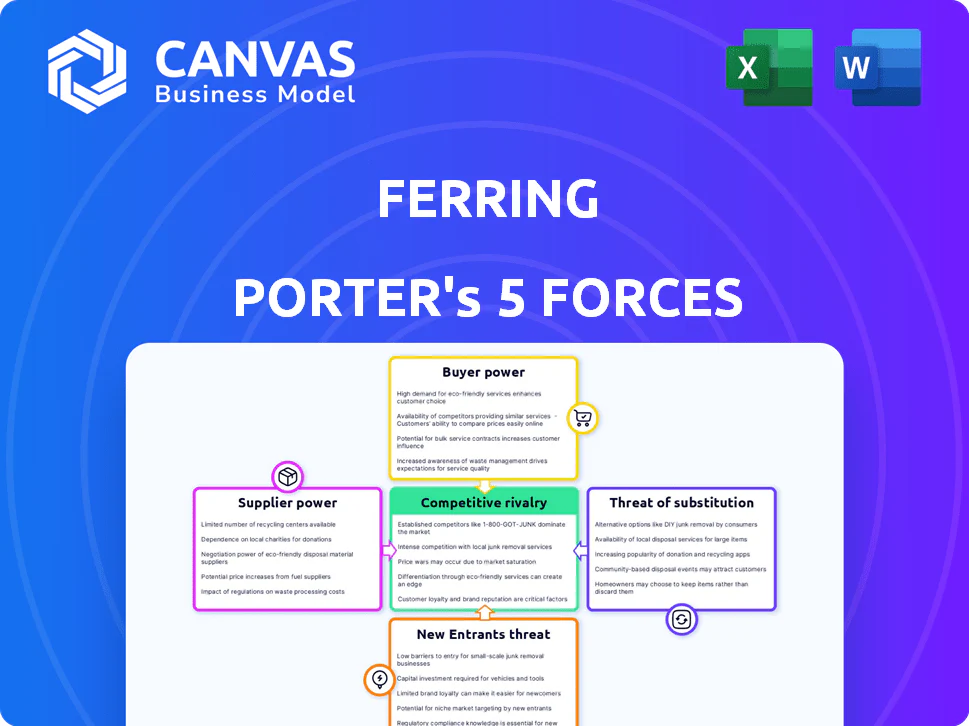
FERRING PORTER'S FIVE FORCES TEMPLATE RESEARCH
What is included in the product
 Detailed Word Document
Analyzes Ferring's competitive environment, revealing strengths, weaknesses, and strategic opportunities.

 Customizable Excel Spreadsheet
Uncover competitive vulnerabilities and opportunities for strategic advantages.
What You See Is What You Get
Ferring Porter's Five Forces Analysis
This preview showcases the complete Ferring Porter's Five Forces analysis, which you will receive instantly upon purchase. The document is fully formatted, ready for immediate use, and contains all the detailed insights. No alterations are needed; the file you see here is exactly what you will download. It's a comprehensive analysis, professionally written and prepared for your requirements. This is the final version!

Porter's Five Forces Analysis Template

A Must-Have Tool for Decision-Makers
Ferring's competitive landscape is shaped by the five forces: rivalry, supplier power, buyer power, substitutes, and new entrants. Understanding these forces is crucial for assessing its strategic position. High rivalry among competitors, like in pharmaceuticals, is a key factor. Buyer power, influenced by pricing pressures from payers, also shapes the market.
Our full Porter's Five Forces report goes deeper—offering a data-driven framework to understand Ferring's real business risks and market opportunities.
Suppliers Bargaining Power

Concentrated supply of specialized raw materials
Ferring's reliance on specific suppliers for specialized raw materials and APIs gives these suppliers significant bargaining power. A concentrated supply base for unique components, like those used in their fertility treatments, strengthens this. Supply chain disruptions, as seen in 2024, can raise production costs. For example, API price volatility increased by 15% in Q3 2024.
Availability of alternative suppliers
The availability of alternative suppliers for raw materials and APIs directly impacts supplier power. If Ferring has several sources for a specific ingredient, its negotiation power strengthens. Conversely, specialized or novel compounds may have limited alternatives, increasing supplier leverage. For instance, in 2024, the pharmaceutical industry faced challenges with API sourcing, highlighting the importance of diverse supplier networks. This scarcity can affect costs and production timelines.

Supplier's reputation and quality
In the pharmaceutical sector, Ferring relies on suppliers whose reputation and quality are paramount due to stringent regulations. Ferring must source from dependable suppliers who consistently meet rigorous quality standards. This reliance can elevate supplier bargaining power, particularly for those with a proven history; for example, in 2024, API costs rose by 7% impacting margins.

Switching costs for Ferring
Switching costs in pharmaceuticals, like for Ferring, are substantial. Validating new suppliers and processes to meet stringent regulatory standards demands significant investment. This includes rigorous testing and documentation, which can take months or even years. These high switching costs bolster existing suppliers' bargaining power.
- Regulatory compliance adds to switching costs.
- Supplier validation requires significant resources.
- These factors increase supplier leverage.
Potential for backward integration by Ferring
Ferring's ability to integrate backward into its supply chain can significantly impact supplier bargaining power. If Ferring were to produce its own active pharmaceutical ingredients (APIs), it would lessen its dependence on external suppliers. This strategic move, though, demands considerable investment in infrastructure and specialized knowledge. According to the 2024 data, the pharmaceutical industry saw a 7% rise in API production costs, making backward integration a potentially attractive cost-saving measure.
- Capital expenditure for API manufacturing plants can range from $50 million to over $200 million.
- The lead time for constructing and validating such facilities can extend from 2 to 5 years.
- Companies like Teva have seen up to 15% cost reduction by producing APIs in-house.
Supplier Power Dynamics: A Deep Dive
Ferring faces supplier power due to reliance on specific raw materials and APIs. Concentrated supply bases and supply chain disruptions, like a 15% API price increase in Q3 2024, amplify this. High switching costs and stringent regulatory compliance further strengthen supplier leverage.
Alternative supplier availability directly impacts bargaining power. Limited alternatives for specialized compounds increase supplier influence, as seen in 2024's industry sourcing challenges.
Ferring's potential backward integration could reduce supplier power. However, substantial investment, with API plant costs ranging from $50M-$200M and lead times of 2-5 years, is required. Companies like Teva saw up to 15% cost reduction by producing APIs in-house.
| Factor | Impact | 2024 Data |
|---|---|---|
| API Price Volatility | Increased Costs | Up 15% in Q3 2024 |
| API Sourcing Challenges | Production Delays | Industry-wide issues |
| API Production Cost | Margin Pressure | Up 7% |
Customers Bargaining Power

Concentration of customers
Ferring's customers are mainly healthcare pros, hospitals, and pharmacies worldwide. Customer concentration impacts their negotiating power. In 2024, major pharmacy chains controlled a significant portion of drug sales. Large buyers can demand lower prices. This pressure can affect Ferring's profitability.
Availability of alternative treatments
The availability of alternative treatments significantly influences customer power in Ferring's market. If numerous treatment options exist, customers can compare prices and demand better terms. However, for niche products, like those addressing unmet needs, customer bargaining power is reduced. For example, in 2024, the market for fertility treatments (a Ferring area) saw a shift towards personalized medicine, potentially lowering customer power due to specialized solutions. Conversely, for widely available drugs, customer power remains high.

Price sensitivity of customers
Customers, including healthcare systems and patients, significantly influence bargaining power due to price sensitivity. Increased healthcare costs and the pressure to control spending heighten this sensitivity. In 2024, the US healthcare spending reached $4.8 trillion, driving demands for lower drug prices.

Customer knowledge and information
Customer knowledge and information significantly influence bargaining power. Informed customers, like healthcare professionals, wield more power. They can make informed choices about treatments and pricing. This ability to compare options enhances their negotiation strength. For instance, in 2024, the US pharmaceutical market reached $640 billion, with informed consumers impacting pricing strategies.
- Access to clinical trial data empowers informed choices.
- Price transparency tools increase customer negotiation.
- Availability of generic alternatives reduces dependence.
- Comparative effectiveness research strengthens bargaining.
Potential for forward integration by customers
In the pharmaceutical industry, the forward integration of customers is less prevalent but still a factor. Large healthcare systems or payers possess the theoretical ability to integrate into supply or distribution, potentially boosting their bargaining power. This could manifest as increased pressure on pricing or service terms from pharmaceutical companies. However, the complexities and regulatory hurdles in drug manufacturing limit this threat. In 2024, the US pharmaceutical market reached approximately $640 billion, highlighting the industry's scale and the potential impact of such customer integration.
- Forward integration by customers, like large healthcare systems, is a potential threat.
- This could increase their bargaining power over drug pricing and service.
- Regulatory and operational complexities limit this threat in practice.
- The US pharmaceutical market was worth around $640 billion in 2024.
Buyer Power Dynamics in the Pharmaceutical Market
Customer bargaining power significantly impacts Ferring. Large buyers like pharmacies drive price demands, influencing profitability. Alternative treatments and price sensitivity also affect customer influence. In 2024, US healthcare spending hit $4.8T, increasing price pressure.
| Factor | Impact | 2024 Data |
|---|---|---|
| Buyer Concentration | Higher concentration increases power | Major pharmacy chains controlled significant drug sales |
| Availability of Alternatives | More options increase power | Fertility market shifts to personalized medicine |
| Price Sensitivity | Higher sensitivity increases power | US healthcare spending $4.8T |
Rivalry Among Competitors

Number and size of competitors
The biopharmaceutical industry features both giants and specialized firms. Ferring competes with large, diversified companies and smaller firms in reproductive medicine, gastroenterology, and urology. In 2024, the market share distribution showed significant competition, with top players holding considerable portions. For example, in the global fertility market, Merck and Ferring are key competitors.
Industry growth rate
The pharmaceutical market's growth rate impacts competitive rivalry. In 2024, the global pharmaceutical market is projected to reach $1.6 trillion. Slow growth intensifies competition for market share. Ferring operates in areas like reproductive health, where competition can be fierce.

Product differentiation
Product differentiation significantly impacts competitive rivalry. Ferring's strategy centers on specialized pharmaceuticals, aiming for unique offerings. High innovation allows for strong market positions, yet competition remains fierce. R&D investment is crucial; in 2024, the pharmaceutical industry's R&D spending hit $237 billion.

Exit barriers
High exit barriers intensify competitive rivalry. Specialized facilities and regulatory hurdles in pharma keep firms in the market. This leads to fierce competition to cover fixed costs. Companies may engage in price wars or increased marketing. This dynamic impacts profitability.
- Manufacturing facilities require massive investments.
- Regulatory hurdles, like FDA approvals, are costly and time-consuming.
- In 2024, the global pharmaceutical market reached over $1.5 trillion.
- The top 10 pharma companies spent billions on R&D, intensifying competition.
Brand identity and loyalty
Brand identity and loyalty play a role in the pharmaceutical industry, but are tempered. Generic drugs and payer influence can reduce brand strength. Ferring's focus on research and niche products supports its brand image. This helps maintain customer trust and preference.
- In 2023, the global generic drug market was valued at approximately $380 billion.
- Ferring's revenue in 2023 was estimated to be around $3 billion.
- The pharmaceutical industry spends billions annually on R&D to maintain brand loyalty.
Biopharma's Fierce Battle: Market Dynamics Unveiled!
Competitive rivalry in the biopharmaceutical industry is shaped by market dynamics and company strategies. Intense competition is evident due to the presence of both large and specialized firms. Market growth, product differentiation, and high exit barriers further intensify this rivalry. Brand identity and generic competition also influence the competitive landscape.
| Factor | Impact | 2024 Data |
|---|---|---|
| Market Growth | Slow growth boosts competition. | Global pharma market: $1.6T. |
| Differentiation | Innovation secures market position. | R&D spend: $237B. |
| Exit Barriers | High barriers intensify rivalry. | Manufacturing investment is huge. |
| Brand Loyalty | Impacted by generics. | Generic market: $380B (2023). |
Original: $10.00
-65%$10.00
$3.50FERRING PORTER'S FIVE FORCES TEMPLATE RESEARCH
What is included in the product
Detailed Word Document
Analyzes Ferring's competitive environment, revealing strengths, weaknesses, and strategic opportunities.
Customizable Excel Spreadsheet
Uncover competitive vulnerabilities and opportunities for strategic advantages.
What You See Is What You Get
Ferring Porter's Five Forces Analysis
This preview showcases the complete Ferring Porter's Five Forces analysis, which you will receive instantly upon purchase. The document is fully formatted, ready for immediate use, and contains all the detailed insights. No alterations are needed; the file you see here is exactly what you will download. It's a comprehensive analysis, professionally written and prepared for your requirements. This is the final version!
Porter's Five Forces Analysis Template
A Must-Have Tool for Decision-Makers
Ferring's competitive landscape is shaped by the five forces: rivalry, supplier power, buyer power, substitutes, and new entrants. Understanding these forces is crucial for assessing its strategic position. High rivalry among competitors, like in pharmaceuticals, is a key factor. Buyer power, influenced by pricing pressures from payers, also shapes the market.
Our full Porter's Five Forces report goes deeper—offering a data-driven framework to understand Ferring's real business risks and market opportunities.
Suppliers Bargaining Power
Concentrated supply of specialized raw materials
Ferring's reliance on specific suppliers for specialized raw materials and APIs gives these suppliers significant bargaining power. A concentrated supply base for unique components, like those used in their fertility treatments, strengthens this. Supply chain disruptions, as seen in 2024, can raise production costs. For example, API price volatility increased by 15% in Q3 2024.
Availability of alternative suppliers
The availability of alternative suppliers for raw materials and APIs directly impacts supplier power. If Ferring has several sources for a specific ingredient, its negotiation power strengthens. Conversely, specialized or novel compounds may have limited alternatives, increasing supplier leverage. For instance, in 2024, the pharmaceutical industry faced challenges with API sourcing, highlighting the importance of diverse supplier networks. This scarcity can affect costs and production timelines.
Supplier's reputation and quality
In the pharmaceutical sector, Ferring relies on suppliers whose reputation and quality are paramount due to stringent regulations. Ferring must source from dependable suppliers who consistently meet rigorous quality standards. This reliance can elevate supplier bargaining power, particularly for those with a proven history; for example, in 2024, API costs rose by 7% impacting margins.
Switching costs for Ferring
Switching costs in pharmaceuticals, like for Ferring, are substantial. Validating new suppliers and processes to meet stringent regulatory standards demands significant investment. This includes rigorous testing and documentation, which can take months or even years. These high switching costs bolster existing suppliers' bargaining power.
- Regulatory compliance adds to switching costs.
- Supplier validation requires significant resources.
- These factors increase supplier leverage.
Potential for backward integration by Ferring
Ferring's ability to integrate backward into its supply chain can significantly impact supplier bargaining power. If Ferring were to produce its own active pharmaceutical ingredients (APIs), it would lessen its dependence on external suppliers. This strategic move, though, demands considerable investment in infrastructure and specialized knowledge. According to the 2024 data, the pharmaceutical industry saw a 7% rise in API production costs, making backward integration a potentially attractive cost-saving measure.
- Capital expenditure for API manufacturing plants can range from $50 million to over $200 million.
- The lead time for constructing and validating such facilities can extend from 2 to 5 years.
- Companies like Teva have seen up to 15% cost reduction by producing APIs in-house.
Supplier Power Dynamics: A Deep Dive
Ferring faces supplier power due to reliance on specific raw materials and APIs. Concentrated supply bases and supply chain disruptions, like a 15% API price increase in Q3 2024, amplify this. High switching costs and stringent regulatory compliance further strengthen supplier leverage.
Alternative supplier availability directly impacts bargaining power. Limited alternatives for specialized compounds increase supplier influence, as seen in 2024's industry sourcing challenges.
Ferring's potential backward integration could reduce supplier power. However, substantial investment, with API plant costs ranging from $50M-$200M and lead times of 2-5 years, is required. Companies like Teva saw up to 15% cost reduction by producing APIs in-house.
| Factor | Impact | 2024 Data |
|---|---|---|
| API Price Volatility | Increased Costs | Up 15% in Q3 2024 |
| API Sourcing Challenges | Production Delays | Industry-wide issues |
| API Production Cost | Margin Pressure | Up 7% |
Customers Bargaining Power
Concentration of customers
Ferring's customers are mainly healthcare pros, hospitals, and pharmacies worldwide. Customer concentration impacts their negotiating power. In 2024, major pharmacy chains controlled a significant portion of drug sales. Large buyers can demand lower prices. This pressure can affect Ferring's profitability.
Availability of alternative treatments
The availability of alternative treatments significantly influences customer power in Ferring's market. If numerous treatment options exist, customers can compare prices and demand better terms. However, for niche products, like those addressing unmet needs, customer bargaining power is reduced. For example, in 2024, the market for fertility treatments (a Ferring area) saw a shift towards personalized medicine, potentially lowering customer power due to specialized solutions. Conversely, for widely available drugs, customer power remains high.
Price sensitivity of customers
Customers, including healthcare systems and patients, significantly influence bargaining power due to price sensitivity. Increased healthcare costs and the pressure to control spending heighten this sensitivity. In 2024, the US healthcare spending reached $4.8 trillion, driving demands for lower drug prices.
Customer knowledge and information
Customer knowledge and information significantly influence bargaining power. Informed customers, like healthcare professionals, wield more power. They can make informed choices about treatments and pricing. This ability to compare options enhances their negotiation strength. For instance, in 2024, the US pharmaceutical market reached $640 billion, with informed consumers impacting pricing strategies.
- Access to clinical trial data empowers informed choices.
- Price transparency tools increase customer negotiation.
- Availability of generic alternatives reduces dependence.
- Comparative effectiveness research strengthens bargaining.
Potential for forward integration by customers
In the pharmaceutical industry, the forward integration of customers is less prevalent but still a factor. Large healthcare systems or payers possess the theoretical ability to integrate into supply or distribution, potentially boosting their bargaining power. This could manifest as increased pressure on pricing or service terms from pharmaceutical companies. However, the complexities and regulatory hurdles in drug manufacturing limit this threat. In 2024, the US pharmaceutical market reached approximately $640 billion, highlighting the industry's scale and the potential impact of such customer integration.
- Forward integration by customers, like large healthcare systems, is a potential threat.
- This could increase their bargaining power over drug pricing and service.
- Regulatory and operational complexities limit this threat in practice.
- The US pharmaceutical market was worth around $640 billion in 2024.
Buyer Power Dynamics in the Pharmaceutical Market
Customer bargaining power significantly impacts Ferring. Large buyers like pharmacies drive price demands, influencing profitability. Alternative treatments and price sensitivity also affect customer influence. In 2024, US healthcare spending hit $4.8T, increasing price pressure.
| Factor | Impact | 2024 Data |
|---|---|---|
| Buyer Concentration | Higher concentration increases power | Major pharmacy chains controlled significant drug sales |
| Availability of Alternatives | More options increase power | Fertility market shifts to personalized medicine |
| Price Sensitivity | Higher sensitivity increases power | US healthcare spending $4.8T |
Rivalry Among Competitors
Number and size of competitors
The biopharmaceutical industry features both giants and specialized firms. Ferring competes with large, diversified companies and smaller firms in reproductive medicine, gastroenterology, and urology. In 2024, the market share distribution showed significant competition, with top players holding considerable portions. For example, in the global fertility market, Merck and Ferring are key competitors.
Industry growth rate
The pharmaceutical market's growth rate impacts competitive rivalry. In 2024, the global pharmaceutical market is projected to reach $1.6 trillion. Slow growth intensifies competition for market share. Ferring operates in areas like reproductive health, where competition can be fierce.
Product differentiation
Product differentiation significantly impacts competitive rivalry. Ferring's strategy centers on specialized pharmaceuticals, aiming for unique offerings. High innovation allows for strong market positions, yet competition remains fierce. R&D investment is crucial; in 2024, the pharmaceutical industry's R&D spending hit $237 billion.
Exit barriers
High exit barriers intensify competitive rivalry. Specialized facilities and regulatory hurdles in pharma keep firms in the market. This leads to fierce competition to cover fixed costs. Companies may engage in price wars or increased marketing. This dynamic impacts profitability.
- Manufacturing facilities require massive investments.
- Regulatory hurdles, like FDA approvals, are costly and time-consuming.
- In 2024, the global pharmaceutical market reached over $1.5 trillion.
- The top 10 pharma companies spent billions on R&D, intensifying competition.
Brand identity and loyalty
Brand identity and loyalty play a role in the pharmaceutical industry, but are tempered. Generic drugs and payer influence can reduce brand strength. Ferring's focus on research and niche products supports its brand image. This helps maintain customer trust and preference.
- In 2023, the global generic drug market was valued at approximately $380 billion.
- Ferring's revenue in 2023 was estimated to be around $3 billion.
- The pharmaceutical industry spends billions annually on R&D to maintain brand loyalty.
Biopharma's Fierce Battle: Market Dynamics Unveiled!
Competitive rivalry in the biopharmaceutical industry is shaped by market dynamics and company strategies. Intense competition is evident due to the presence of both large and specialized firms. Market growth, product differentiation, and high exit barriers further intensify this rivalry. Brand identity and generic competition also influence the competitive landscape.
| Factor | Impact | 2024 Data |
|---|---|---|
| Market Growth | Slow growth boosts competition. | Global pharma market: $1.6T. |
| Differentiation | Innovation secures market position. | R&D spend: $237B. |
| Exit Barriers | High barriers intensify rivalry. | Manufacturing investment is huge. |
| Brand Loyalty | Impacted by generics. | Generic market: $380B (2023). |
Product Information
Product Information
Shipping & Returns
Shipping & Returns
Description
What is included in the product
Detailed Word Document
Analyzes Ferring's competitive environment, revealing strengths, weaknesses, and strategic opportunities.
Customizable Excel Spreadsheet
Uncover competitive vulnerabilities and opportunities for strategic advantages.
What You See Is What You Get
Ferring Porter's Five Forces Analysis
This preview showcases the complete Ferring Porter's Five Forces analysis, which you will receive instantly upon purchase. The document is fully formatted, ready for immediate use, and contains all the detailed insights. No alterations are needed; the file you see here is exactly what you will download. It's a comprehensive analysis, professionally written and prepared for your requirements. This is the final version!
Porter's Five Forces Analysis Template
A Must-Have Tool for Decision-Makers
Ferring's competitive landscape is shaped by the five forces: rivalry, supplier power, buyer power, substitutes, and new entrants. Understanding these forces is crucial for assessing its strategic position. High rivalry among competitors, like in pharmaceuticals, is a key factor. Buyer power, influenced by pricing pressures from payers, also shapes the market.
Our full Porter's Five Forces report goes deeper—offering a data-driven framework to understand Ferring's real business risks and market opportunities.
Suppliers Bargaining Power
Concentrated supply of specialized raw materials
Ferring's reliance on specific suppliers for specialized raw materials and APIs gives these suppliers significant bargaining power. A concentrated supply base for unique components, like those used in their fertility treatments, strengthens this. Supply chain disruptions, as seen in 2024, can raise production costs. For example, API price volatility increased by 15% in Q3 2024.
Availability of alternative suppliers
The availability of alternative suppliers for raw materials and APIs directly impacts supplier power. If Ferring has several sources for a specific ingredient, its negotiation power strengthens. Conversely, specialized or novel compounds may have limited alternatives, increasing supplier leverage. For instance, in 2024, the pharmaceutical industry faced challenges with API sourcing, highlighting the importance of diverse supplier networks. This scarcity can affect costs and production timelines.
Supplier's reputation and quality
In the pharmaceutical sector, Ferring relies on suppliers whose reputation and quality are paramount due to stringent regulations. Ferring must source from dependable suppliers who consistently meet rigorous quality standards. This reliance can elevate supplier bargaining power, particularly for those with a proven history; for example, in 2024, API costs rose by 7% impacting margins.
Switching costs for Ferring
Switching costs in pharmaceuticals, like for Ferring, are substantial. Validating new suppliers and processes to meet stringent regulatory standards demands significant investment. This includes rigorous testing and documentation, which can take months or even years. These high switching costs bolster existing suppliers' bargaining power.
- Regulatory compliance adds to switching costs.
- Supplier validation requires significant resources.
- These factors increase supplier leverage.
Potential for backward integration by Ferring
Ferring's ability to integrate backward into its supply chain can significantly impact supplier bargaining power. If Ferring were to produce its own active pharmaceutical ingredients (APIs), it would lessen its dependence on external suppliers. This strategic move, though, demands considerable investment in infrastructure and specialized knowledge. According to the 2024 data, the pharmaceutical industry saw a 7% rise in API production costs, making backward integration a potentially attractive cost-saving measure.
- Capital expenditure for API manufacturing plants can range from $50 million to over $200 million.
- The lead time for constructing and validating such facilities can extend from 2 to 5 years.
- Companies like Teva have seen up to 15% cost reduction by producing APIs in-house.
Supplier Power Dynamics: A Deep Dive
Ferring faces supplier power due to reliance on specific raw materials and APIs. Concentrated supply bases and supply chain disruptions, like a 15% API price increase in Q3 2024, amplify this. High switching costs and stringent regulatory compliance further strengthen supplier leverage.
Alternative supplier availability directly impacts bargaining power. Limited alternatives for specialized compounds increase supplier influence, as seen in 2024's industry sourcing challenges.
Ferring's potential backward integration could reduce supplier power. However, substantial investment, with API plant costs ranging from $50M-$200M and lead times of 2-5 years, is required. Companies like Teva saw up to 15% cost reduction by producing APIs in-house.
| Factor | Impact | 2024 Data |
|---|---|---|
| API Price Volatility | Increased Costs | Up 15% in Q3 2024 |
| API Sourcing Challenges | Production Delays | Industry-wide issues |
| API Production Cost | Margin Pressure | Up 7% |
Customers Bargaining Power
Concentration of customers
Ferring's customers are mainly healthcare pros, hospitals, and pharmacies worldwide. Customer concentration impacts their negotiating power. In 2024, major pharmacy chains controlled a significant portion of drug sales. Large buyers can demand lower prices. This pressure can affect Ferring's profitability.
Availability of alternative treatments
The availability of alternative treatments significantly influences customer power in Ferring's market. If numerous treatment options exist, customers can compare prices and demand better terms. However, for niche products, like those addressing unmet needs, customer bargaining power is reduced. For example, in 2024, the market for fertility treatments (a Ferring area) saw a shift towards personalized medicine, potentially lowering customer power due to specialized solutions. Conversely, for widely available drugs, customer power remains high.
Price sensitivity of customers
Customers, including healthcare systems and patients, significantly influence bargaining power due to price sensitivity. Increased healthcare costs and the pressure to control spending heighten this sensitivity. In 2024, the US healthcare spending reached $4.8 trillion, driving demands for lower drug prices.
Customer knowledge and information
Customer knowledge and information significantly influence bargaining power. Informed customers, like healthcare professionals, wield more power. They can make informed choices about treatments and pricing. This ability to compare options enhances their negotiation strength. For instance, in 2024, the US pharmaceutical market reached $640 billion, with informed consumers impacting pricing strategies.
- Access to clinical trial data empowers informed choices.
- Price transparency tools increase customer negotiation.
- Availability of generic alternatives reduces dependence.
- Comparative effectiveness research strengthens bargaining.
Potential for forward integration by customers
In the pharmaceutical industry, the forward integration of customers is less prevalent but still a factor. Large healthcare systems or payers possess the theoretical ability to integrate into supply or distribution, potentially boosting their bargaining power. This could manifest as increased pressure on pricing or service terms from pharmaceutical companies. However, the complexities and regulatory hurdles in drug manufacturing limit this threat. In 2024, the US pharmaceutical market reached approximately $640 billion, highlighting the industry's scale and the potential impact of such customer integration.
- Forward integration by customers, like large healthcare systems, is a potential threat.
- This could increase their bargaining power over drug pricing and service.
- Regulatory and operational complexities limit this threat in practice.
- The US pharmaceutical market was worth around $640 billion in 2024.
Buyer Power Dynamics in the Pharmaceutical Market
Customer bargaining power significantly impacts Ferring. Large buyers like pharmacies drive price demands, influencing profitability. Alternative treatments and price sensitivity also affect customer influence. In 2024, US healthcare spending hit $4.8T, increasing price pressure.
| Factor | Impact | 2024 Data |
|---|---|---|
| Buyer Concentration | Higher concentration increases power | Major pharmacy chains controlled significant drug sales |
| Availability of Alternatives | More options increase power | Fertility market shifts to personalized medicine |
| Price Sensitivity | Higher sensitivity increases power | US healthcare spending $4.8T |
Rivalry Among Competitors
Number and size of competitors
The biopharmaceutical industry features both giants and specialized firms. Ferring competes with large, diversified companies and smaller firms in reproductive medicine, gastroenterology, and urology. In 2024, the market share distribution showed significant competition, with top players holding considerable portions. For example, in the global fertility market, Merck and Ferring are key competitors.
Industry growth rate
The pharmaceutical market's growth rate impacts competitive rivalry. In 2024, the global pharmaceutical market is projected to reach $1.6 trillion. Slow growth intensifies competition for market share. Ferring operates in areas like reproductive health, where competition can be fierce.
Product differentiation
Product differentiation significantly impacts competitive rivalry. Ferring's strategy centers on specialized pharmaceuticals, aiming for unique offerings. High innovation allows for strong market positions, yet competition remains fierce. R&D investment is crucial; in 2024, the pharmaceutical industry's R&D spending hit $237 billion.
Exit barriers
High exit barriers intensify competitive rivalry. Specialized facilities and regulatory hurdles in pharma keep firms in the market. This leads to fierce competition to cover fixed costs. Companies may engage in price wars or increased marketing. This dynamic impacts profitability.
- Manufacturing facilities require massive investments.
- Regulatory hurdles, like FDA approvals, are costly and time-consuming.
- In 2024, the global pharmaceutical market reached over $1.5 trillion.
- The top 10 pharma companies spent billions on R&D, intensifying competition.
Brand identity and loyalty
Brand identity and loyalty play a role in the pharmaceutical industry, but are tempered. Generic drugs and payer influence can reduce brand strength. Ferring's focus on research and niche products supports its brand image. This helps maintain customer trust and preference.
- In 2023, the global generic drug market was valued at approximately $380 billion.
- Ferring's revenue in 2023 was estimated to be around $3 billion.
- The pharmaceutical industry spends billions annually on R&D to maintain brand loyalty.
Biopharma's Fierce Battle: Market Dynamics Unveiled!
Competitive rivalry in the biopharmaceutical industry is shaped by market dynamics and company strategies. Intense competition is evident due to the presence of both large and specialized firms. Market growth, product differentiation, and high exit barriers further intensify this rivalry. Brand identity and generic competition also influence the competitive landscape.
| Factor | Impact | 2024 Data |
|---|---|---|
| Market Growth | Slow growth boosts competition. | Global pharma market: $1.6T. |
| Differentiation | Innovation secures market position. | R&D spend: $237B. |
| Exit Barriers | High barriers intensify rivalry. | Manufacturing investment is huge. |
| Brand Loyalty | Impacted by generics. | Generic market: $380B (2023). |











