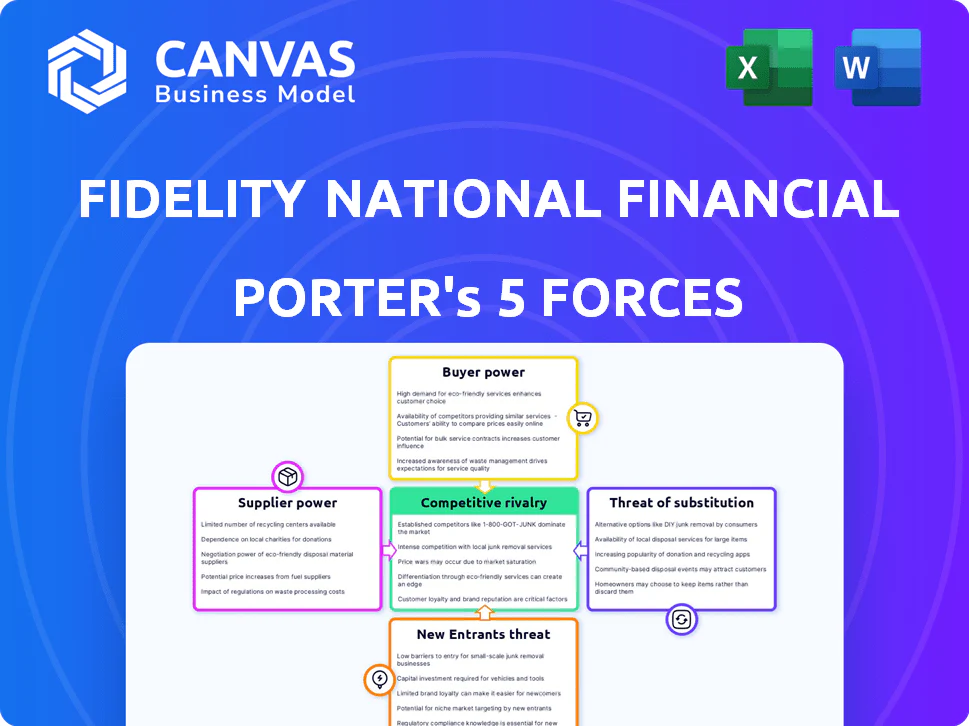
FIDELITY NATIONAL FINANCIAL PORTER'S FIVE FORCES TEMPLATE RESEARCH
What is included in the product
 Detailed Word Document
Tailored exclusively for Fidelity National Financial, analyzing its position within its competitive landscape.

 Customizable Excel Spreadsheet
Quickly identify and adapt to changing forces with dynamic visualizations.
Preview Before You Purchase
Fidelity National Financial Porter's Five Forces Analysis
This preview showcases the complete Fidelity National Financial Porter's Five Forces analysis, identical to the one you'll receive. It includes in-depth assessments of competitive rivalry, supplier power, buyer power, threats of substitutes, and threats of new entrants. You'll receive this fully formatted, comprehensive document immediately upon purchase, ready for your review and application.

Porter's Five Forces Analysis Template

Go Beyond the Preview—Access the Full Strategic Report
Fidelity National Financial (FNF) operates in a complex market influenced by various forces. Supplier power, particularly from technology providers, is a key factor. Buyer power, stemming from real estate professionals, shapes pricing dynamics. The threat of new entrants, though moderate, exists due to potential disruption. Competition is intense, with established players vying for market share. Substitute threats, like alternative insurance, are also present.
Our full Porter's Five Forces report goes deeper—offering a data-driven framework to understand Fidelity National Financial's real business risks and market opportunities.
Suppliers Bargaining Power

Limited Number of Specialized Technology Providers
Fidelity National Financial (FNF) depends on specialized tech providers. The title insurance tech market is concentrated. Limited suppliers boost their power. In 2024, this could impact costs and operations. This concentration gives suppliers leverage.
Dependence on Real Estate Data
Fidelity National Financial (FNF) heavily relies on real estate data for its title insurance and escrow services. This dependence grants data providers, like CoreLogic or First American, some bargaining power. In 2024, CoreLogic's revenue was approximately $2 billion, indicating significant market influence. Increased data costs could affect FNF's profitability, impacting its financial performance.

Switching Costs
Fidelity National Financial (FNF) faces substantial switching costs when changing technology or data suppliers. These costs include expenses related to new software, training, and data migration. High switching costs enhance suppliers' leverage, allowing them to negotiate more favorable terms. For example, in 2024, the cost of migrating data for a large financial institution could range from $5 million to $20 million, increasing supplier bargaining power.

Potential for Supplier Consolidation
Consolidation among key tech and data suppliers could limit Fidelity National Financial's (FNF) choices. This could increase supplier bargaining power down the line. For instance, if major data providers merge, FNF might face higher prices. This situation poses a risk to FNF's cost structure and profitability.
- Data and analytics market is projected to reach $132.9 billion in 2024.
- Competition among suppliers keeps prices competitive.
- FNF's ability to negotiate is key.
Specialized Services
Some suppliers of specialized services, vital to Fidelity National Financial's (FNF) operations, hold considerable bargaining power. These services, not easily substituted, can include unique technology solutions or specialized legal expertise. This dependence allows these suppliers to potentially dictate terms, influencing costs and service quality. In 2024, FNF's operating expenses reflect the impact of these specialized services. Consider that specialized technology providers could command higher fees, impacting FNF's profit margins.
- Dependency on crucial, hard-to-replace services enhances supplier influence.
- Specialized tech or legal expertise can drive up operational costs.
- FNF's operational expenses in 2024 reflect these supplier dynamics.
- Higher fees from specialized providers can squeeze profit margins.
FNF's Supplier Power Dynamics: A Quick Look
FNF's supplier power varies. Tech and data suppliers have leverage. Switching costs and consolidation affect this. Data and analytics market is projected to reach $132.9 billion in 2024.
| Supplier Type | Impact on FNF | 2024 Data Point |
|---|---|---|
| Tech Providers | High bargaining power | Market concentration in title insurance tech |
| Data Providers | Moderate influence | CoreLogic revenue approx. $2B |
| Specialized Services | Significant control | High fees impact profit margins |
Customers Bargaining Power

Diverse Customer Base
Fidelity National Financial (FNF) benefits from a broad customer base. This includes residential and commercial real estate clients, lenders, and various professionals. This diversity helps to mitigate the influence of any single customer group. In 2024, FNF processed approximately 6.5 million title and escrow transactions, demonstrating a wide customer reach, which helps to maintain balanced bargaining power.
Price Sensitivity
Customers in title insurance and mortgage services can be price-sensitive. The competitive market, with multiple providers, affects negotiation abilities. For example, in 2024, the average title insurance cost was around $1,000-$3,000, making price a key factor. Alternatives like online services also increase customer leverage.

Large Institutional Clients
Large institutional clients, crucial to Fidelity National Financial (FNF), wield substantial bargaining power. These clients, contributing significantly to FNF's revenue, can negotiate favorable terms. For example, institutional clients accounted for a considerable percentage of FNF's total revenue in 2024. This leverage allows them to potentially secure lower rates. In 2024, FNF's revenue was impacted by rate negotiations with large clients.

Availability of Alternatives
Customers have several choices for title insurance, increasing their bargaining power. They can choose from other large title insurance companies or new digital platforms. This competition gives customers leverage to negotiate better terms. For example, in 2024, the top four title insurers controlled about 70% of the market. This concentration, however, still allows for customer choice.
- Competition from companies like First American and Stewart Title offers customers options.
- Digital platforms are entering the market, providing more alternatives.
- Customers can compare prices and services, increasing their bargaining power.
- The level of competition varies by region, impacting customer options.
Impact of Real Estate Market Conditions
The real estate market's health significantly shapes customer bargaining power. In 2024, a buyer's market, marked by lower demand and higher inventory, gives customers more negotiation room. Conversely, a seller's market, with high demand and limited supply, reduces customer leverage. These dynamics directly affect pricing and service demands.
- Buyer's markets increase customer negotiation power.
- Seller's markets decrease customer negotiation power.
- Market conditions influence pricing and service terms.
FNF's Customer Dynamics: Power & Pricing
FNF's diverse customer base, including residential and commercial clients, tempers individual customer power. Price sensitivity exists due to competition; the average title cost was $1,000-$3,000 in 2024. Institutional clients hold significant bargaining power, influencing FNF's revenue, particularly in 2024. Market conditions, like a buyer's or seller's market, also affect customer leverage.
| Aspect | Impact | 2024 Data |
|---|---|---|
| Customer Base | Diversification reduces individual influence | 6.5M transactions processed |
| Price Sensitivity | Competition affects negotiation | Avg. title cost: $1,000-$3,000 |
| Institutional Clients | Significant bargaining power | Influenced revenue |
Rivalry Among Competitors

Intense Competition in Title Insurance
The title insurance market is fiercely competitive. Fidelity National Financial (FNF) contends with significant rivals. Old Republic International and First American Financial are among the top competitors. In 2024, FNF's market share was approximately 38%, highlighting the competitive landscape.
Market Concentration
The title insurance market, though competitive, is concentrated. Key players like Fidelity National Financial (FNF) hold substantial market share. FNF, with a market cap of around $11.9 billion as of late 2024, competes with others like First American Financial. This concentration affects pricing and innovation within the industry.

Technology and Service Differentiation
Technology and service differentiation fuel competition. Firms, like Fidelity National Financial, invest in digital transformation. In 2024, they allocated $150M to tech upgrades. This aids in offering superior services.

Industry Consolidation
Industry consolidation through mergers and acquisitions (M&A) significantly impacts competitive rivalry. This reshapes the landscape as companies strive for growth and market dominance. For instance, the financial services sector saw approximately $310 billion in M&A deals in 2024. Such activities often lead to increased market concentration and fiercer competition.
- M&A activity has increased by 15% in the financial sector in 2024.
- The top 10 firms now control 60% of the market share.
- Consolidation can lead to cost efficiencies and improved service offerings.
- Smaller firms face challenges in competing with larger, consolidated entities.
Competing in Related Services
Fidelity National Financial (FNF) ventures into related services like mortgage solutions and tech offerings, broadening its competitive scope. This expansion puts FNF in direct competition with firms specializing in financial and real estate tech. The competitive landscape is intense, with numerous companies vying for market share in these interconnected sectors. Competition is fierce, especially in the mortgage technology space, which is influenced by interest rate changes.
- 2024 saw a rise in FinTech funding, with over $100 billion invested globally, intensifying competition.
- The mortgage tech market is projected to reach $12 billion by 2025, attracting more players.
- Companies like Black Knight and ICE are significant competitors in the mortgage tech sector.
- FNF's revenue in Q3 2024 was $3.01 billion, reflecting its diverse business lines.
Title Insurance Rivals: A Competitive Landscape
Competition in title insurance is high, with Fidelity National Financial (FNF) facing strong rivals. FNF's market share was about 38% in 2024, highlighting the competitive environment. Technology and M&A activity further intensify rivalry.
| Aspect | Details | 2024 Data |
|---|---|---|
| Market Share (FNF) | Approximate Share | 38% |
| Financial Sector M&A | Increase | 15% rise |
| FinTech Funding | Global Investment | Over $100B |
FIDELITY NATIONAL FINANCIAL PORTER'S FIVE FORCES TEMPLATE RESEARCH
What is included in the product
Detailed Word Document
Tailored exclusively for Fidelity National Financial, analyzing its position within its competitive landscape.
Customizable Excel Spreadsheet
Quickly identify and adapt to changing forces with dynamic visualizations.
Preview Before You Purchase
Fidelity National Financial Porter's Five Forces Analysis
This preview showcases the complete Fidelity National Financial Porter's Five Forces analysis, identical to the one you'll receive. It includes in-depth assessments of competitive rivalry, supplier power, buyer power, threats of substitutes, and threats of new entrants. You'll receive this fully formatted, comprehensive document immediately upon purchase, ready for your review and application.
Porter's Five Forces Analysis Template
Go Beyond the Preview—Access the Full Strategic Report
Fidelity National Financial (FNF) operates in a complex market influenced by various forces. Supplier power, particularly from technology providers, is a key factor. Buyer power, stemming from real estate professionals, shapes pricing dynamics. The threat of new entrants, though moderate, exists due to potential disruption. Competition is intense, with established players vying for market share. Substitute threats, like alternative insurance, are also present.
Our full Porter's Five Forces report goes deeper—offering a data-driven framework to understand Fidelity National Financial's real business risks and market opportunities.
Suppliers Bargaining Power
Limited Number of Specialized Technology Providers
Fidelity National Financial (FNF) depends on specialized tech providers. The title insurance tech market is concentrated. Limited suppliers boost their power. In 2024, this could impact costs and operations. This concentration gives suppliers leverage.
Dependence on Real Estate Data
Fidelity National Financial (FNF) heavily relies on real estate data for its title insurance and escrow services. This dependence grants data providers, like CoreLogic or First American, some bargaining power. In 2024, CoreLogic's revenue was approximately $2 billion, indicating significant market influence. Increased data costs could affect FNF's profitability, impacting its financial performance.
Switching Costs
Fidelity National Financial (FNF) faces substantial switching costs when changing technology or data suppliers. These costs include expenses related to new software, training, and data migration. High switching costs enhance suppliers' leverage, allowing them to negotiate more favorable terms. For example, in 2024, the cost of migrating data for a large financial institution could range from $5 million to $20 million, increasing supplier bargaining power.
Potential for Supplier Consolidation
Consolidation among key tech and data suppliers could limit Fidelity National Financial's (FNF) choices. This could increase supplier bargaining power down the line. For instance, if major data providers merge, FNF might face higher prices. This situation poses a risk to FNF's cost structure and profitability.
- Data and analytics market is projected to reach $132.9 billion in 2024.
- Competition among suppliers keeps prices competitive.
- FNF's ability to negotiate is key.
Specialized Services
Some suppliers of specialized services, vital to Fidelity National Financial's (FNF) operations, hold considerable bargaining power. These services, not easily substituted, can include unique technology solutions or specialized legal expertise. This dependence allows these suppliers to potentially dictate terms, influencing costs and service quality. In 2024, FNF's operating expenses reflect the impact of these specialized services. Consider that specialized technology providers could command higher fees, impacting FNF's profit margins.
- Dependency on crucial, hard-to-replace services enhances supplier influence.
- Specialized tech or legal expertise can drive up operational costs.
- FNF's operational expenses in 2024 reflect these supplier dynamics.
- Higher fees from specialized providers can squeeze profit margins.
FNF's Supplier Power Dynamics: A Quick Look
FNF's supplier power varies. Tech and data suppliers have leverage. Switching costs and consolidation affect this. Data and analytics market is projected to reach $132.9 billion in 2024.
| Supplier Type | Impact on FNF | 2024 Data Point |
|---|---|---|
| Tech Providers | High bargaining power | Market concentration in title insurance tech |
| Data Providers | Moderate influence | CoreLogic revenue approx. $2B |
| Specialized Services | Significant control | High fees impact profit margins |
Customers Bargaining Power
Diverse Customer Base
Fidelity National Financial (FNF) benefits from a broad customer base. This includes residential and commercial real estate clients, lenders, and various professionals. This diversity helps to mitigate the influence of any single customer group. In 2024, FNF processed approximately 6.5 million title and escrow transactions, demonstrating a wide customer reach, which helps to maintain balanced bargaining power.
Price Sensitivity
Customers in title insurance and mortgage services can be price-sensitive. The competitive market, with multiple providers, affects negotiation abilities. For example, in 2024, the average title insurance cost was around $1,000-$3,000, making price a key factor. Alternatives like online services also increase customer leverage.
Large Institutional Clients
Large institutional clients, crucial to Fidelity National Financial (FNF), wield substantial bargaining power. These clients, contributing significantly to FNF's revenue, can negotiate favorable terms. For example, institutional clients accounted for a considerable percentage of FNF's total revenue in 2024. This leverage allows them to potentially secure lower rates. In 2024, FNF's revenue was impacted by rate negotiations with large clients.
Availability of Alternatives
Customers have several choices for title insurance, increasing their bargaining power. They can choose from other large title insurance companies or new digital platforms. This competition gives customers leverage to negotiate better terms. For example, in 2024, the top four title insurers controlled about 70% of the market. This concentration, however, still allows for customer choice.
- Competition from companies like First American and Stewart Title offers customers options.
- Digital platforms are entering the market, providing more alternatives.
- Customers can compare prices and services, increasing their bargaining power.
- The level of competition varies by region, impacting customer options.
Impact of Real Estate Market Conditions
The real estate market's health significantly shapes customer bargaining power. In 2024, a buyer's market, marked by lower demand and higher inventory, gives customers more negotiation room. Conversely, a seller's market, with high demand and limited supply, reduces customer leverage. These dynamics directly affect pricing and service demands.
- Buyer's markets increase customer negotiation power.
- Seller's markets decrease customer negotiation power.
- Market conditions influence pricing and service terms.
FNF's Customer Dynamics: Power & Pricing
FNF's diverse customer base, including residential and commercial clients, tempers individual customer power. Price sensitivity exists due to competition; the average title cost was $1,000-$3,000 in 2024. Institutional clients hold significant bargaining power, influencing FNF's revenue, particularly in 2024. Market conditions, like a buyer's or seller's market, also affect customer leverage.
| Aspect | Impact | 2024 Data |
|---|---|---|
| Customer Base | Diversification reduces individual influence | 6.5M transactions processed |
| Price Sensitivity | Competition affects negotiation | Avg. title cost: $1,000-$3,000 |
| Institutional Clients | Significant bargaining power | Influenced revenue |
Rivalry Among Competitors
Intense Competition in Title Insurance
The title insurance market is fiercely competitive. Fidelity National Financial (FNF) contends with significant rivals. Old Republic International and First American Financial are among the top competitors. In 2024, FNF's market share was approximately 38%, highlighting the competitive landscape.
Market Concentration
The title insurance market, though competitive, is concentrated. Key players like Fidelity National Financial (FNF) hold substantial market share. FNF, with a market cap of around $11.9 billion as of late 2024, competes with others like First American Financial. This concentration affects pricing and innovation within the industry.
Technology and Service Differentiation
Technology and service differentiation fuel competition. Firms, like Fidelity National Financial, invest in digital transformation. In 2024, they allocated $150M to tech upgrades. This aids in offering superior services.
Industry Consolidation
Industry consolidation through mergers and acquisitions (M&A) significantly impacts competitive rivalry. This reshapes the landscape as companies strive for growth and market dominance. For instance, the financial services sector saw approximately $310 billion in M&A deals in 2024. Such activities often lead to increased market concentration and fiercer competition.
- M&A activity has increased by 15% in the financial sector in 2024.
- The top 10 firms now control 60% of the market share.
- Consolidation can lead to cost efficiencies and improved service offerings.
- Smaller firms face challenges in competing with larger, consolidated entities.
Competing in Related Services
Fidelity National Financial (FNF) ventures into related services like mortgage solutions and tech offerings, broadening its competitive scope. This expansion puts FNF in direct competition with firms specializing in financial and real estate tech. The competitive landscape is intense, with numerous companies vying for market share in these interconnected sectors. Competition is fierce, especially in the mortgage technology space, which is influenced by interest rate changes.
- 2024 saw a rise in FinTech funding, with over $100 billion invested globally, intensifying competition.
- The mortgage tech market is projected to reach $12 billion by 2025, attracting more players.
- Companies like Black Knight and ICE are significant competitors in the mortgage tech sector.
- FNF's revenue in Q3 2024 was $3.01 billion, reflecting its diverse business lines.
Title Insurance Rivals: A Competitive Landscape
Competition in title insurance is high, with Fidelity National Financial (FNF) facing strong rivals. FNF's market share was about 38% in 2024, highlighting the competitive environment. Technology and M&A activity further intensify rivalry.
| Aspect | Details | 2024 Data |
|---|---|---|
| Market Share (FNF) | Approximate Share | 38% |
| Financial Sector M&A | Increase | 15% rise |
| FinTech Funding | Global Investment | Over $100B |
Product Information
Product Information
Shipping & Returns
Shipping & Returns
Description
What is included in the product
Detailed Word Document
Tailored exclusively for Fidelity National Financial, analyzing its position within its competitive landscape.
Customizable Excel Spreadsheet
Quickly identify and adapt to changing forces with dynamic visualizations.
Preview Before You Purchase
Fidelity National Financial Porter's Five Forces Analysis
This preview showcases the complete Fidelity National Financial Porter's Five Forces analysis, identical to the one you'll receive. It includes in-depth assessments of competitive rivalry, supplier power, buyer power, threats of substitutes, and threats of new entrants. You'll receive this fully formatted, comprehensive document immediately upon purchase, ready for your review and application.
Porter's Five Forces Analysis Template
Go Beyond the Preview—Access the Full Strategic Report
Fidelity National Financial (FNF) operates in a complex market influenced by various forces. Supplier power, particularly from technology providers, is a key factor. Buyer power, stemming from real estate professionals, shapes pricing dynamics. The threat of new entrants, though moderate, exists due to potential disruption. Competition is intense, with established players vying for market share. Substitute threats, like alternative insurance, are also present.
Our full Porter's Five Forces report goes deeper—offering a data-driven framework to understand Fidelity National Financial's real business risks and market opportunities.
Suppliers Bargaining Power
Limited Number of Specialized Technology Providers
Fidelity National Financial (FNF) depends on specialized tech providers. The title insurance tech market is concentrated. Limited suppliers boost their power. In 2024, this could impact costs and operations. This concentration gives suppliers leverage.
Dependence on Real Estate Data
Fidelity National Financial (FNF) heavily relies on real estate data for its title insurance and escrow services. This dependence grants data providers, like CoreLogic or First American, some bargaining power. In 2024, CoreLogic's revenue was approximately $2 billion, indicating significant market influence. Increased data costs could affect FNF's profitability, impacting its financial performance.
Switching Costs
Fidelity National Financial (FNF) faces substantial switching costs when changing technology or data suppliers. These costs include expenses related to new software, training, and data migration. High switching costs enhance suppliers' leverage, allowing them to negotiate more favorable terms. For example, in 2024, the cost of migrating data for a large financial institution could range from $5 million to $20 million, increasing supplier bargaining power.
Potential for Supplier Consolidation
Consolidation among key tech and data suppliers could limit Fidelity National Financial's (FNF) choices. This could increase supplier bargaining power down the line. For instance, if major data providers merge, FNF might face higher prices. This situation poses a risk to FNF's cost structure and profitability.
- Data and analytics market is projected to reach $132.9 billion in 2024.
- Competition among suppliers keeps prices competitive.
- FNF's ability to negotiate is key.
Specialized Services
Some suppliers of specialized services, vital to Fidelity National Financial's (FNF) operations, hold considerable bargaining power. These services, not easily substituted, can include unique technology solutions or specialized legal expertise. This dependence allows these suppliers to potentially dictate terms, influencing costs and service quality. In 2024, FNF's operating expenses reflect the impact of these specialized services. Consider that specialized technology providers could command higher fees, impacting FNF's profit margins.
- Dependency on crucial, hard-to-replace services enhances supplier influence.
- Specialized tech or legal expertise can drive up operational costs.
- FNF's operational expenses in 2024 reflect these supplier dynamics.
- Higher fees from specialized providers can squeeze profit margins.
FNF's Supplier Power Dynamics: A Quick Look
FNF's supplier power varies. Tech and data suppliers have leverage. Switching costs and consolidation affect this. Data and analytics market is projected to reach $132.9 billion in 2024.
| Supplier Type | Impact on FNF | 2024 Data Point |
|---|---|---|
| Tech Providers | High bargaining power | Market concentration in title insurance tech |
| Data Providers | Moderate influence | CoreLogic revenue approx. $2B |
| Specialized Services | Significant control | High fees impact profit margins |
Customers Bargaining Power
Diverse Customer Base
Fidelity National Financial (FNF) benefits from a broad customer base. This includes residential and commercial real estate clients, lenders, and various professionals. This diversity helps to mitigate the influence of any single customer group. In 2024, FNF processed approximately 6.5 million title and escrow transactions, demonstrating a wide customer reach, which helps to maintain balanced bargaining power.
Price Sensitivity
Customers in title insurance and mortgage services can be price-sensitive. The competitive market, with multiple providers, affects negotiation abilities. For example, in 2024, the average title insurance cost was around $1,000-$3,000, making price a key factor. Alternatives like online services also increase customer leverage.
Large Institutional Clients
Large institutional clients, crucial to Fidelity National Financial (FNF), wield substantial bargaining power. These clients, contributing significantly to FNF's revenue, can negotiate favorable terms. For example, institutional clients accounted for a considerable percentage of FNF's total revenue in 2024. This leverage allows them to potentially secure lower rates. In 2024, FNF's revenue was impacted by rate negotiations with large clients.
Availability of Alternatives
Customers have several choices for title insurance, increasing their bargaining power. They can choose from other large title insurance companies or new digital platforms. This competition gives customers leverage to negotiate better terms. For example, in 2024, the top four title insurers controlled about 70% of the market. This concentration, however, still allows for customer choice.
- Competition from companies like First American and Stewart Title offers customers options.
- Digital platforms are entering the market, providing more alternatives.
- Customers can compare prices and services, increasing their bargaining power.
- The level of competition varies by region, impacting customer options.
Impact of Real Estate Market Conditions
The real estate market's health significantly shapes customer bargaining power. In 2024, a buyer's market, marked by lower demand and higher inventory, gives customers more negotiation room. Conversely, a seller's market, with high demand and limited supply, reduces customer leverage. These dynamics directly affect pricing and service demands.
- Buyer's markets increase customer negotiation power.
- Seller's markets decrease customer negotiation power.
- Market conditions influence pricing and service terms.
FNF's Customer Dynamics: Power & Pricing
FNF's diverse customer base, including residential and commercial clients, tempers individual customer power. Price sensitivity exists due to competition; the average title cost was $1,000-$3,000 in 2024. Institutional clients hold significant bargaining power, influencing FNF's revenue, particularly in 2024. Market conditions, like a buyer's or seller's market, also affect customer leverage.
| Aspect | Impact | 2024 Data |
|---|---|---|
| Customer Base | Diversification reduces individual influence | 6.5M transactions processed |
| Price Sensitivity | Competition affects negotiation | Avg. title cost: $1,000-$3,000 |
| Institutional Clients | Significant bargaining power | Influenced revenue |
Rivalry Among Competitors
Intense Competition in Title Insurance
The title insurance market is fiercely competitive. Fidelity National Financial (FNF) contends with significant rivals. Old Republic International and First American Financial are among the top competitors. In 2024, FNF's market share was approximately 38%, highlighting the competitive landscape.
Market Concentration
The title insurance market, though competitive, is concentrated. Key players like Fidelity National Financial (FNF) hold substantial market share. FNF, with a market cap of around $11.9 billion as of late 2024, competes with others like First American Financial. This concentration affects pricing and innovation within the industry.
Technology and Service Differentiation
Technology and service differentiation fuel competition. Firms, like Fidelity National Financial, invest in digital transformation. In 2024, they allocated $150M to tech upgrades. This aids in offering superior services.
Industry Consolidation
Industry consolidation through mergers and acquisitions (M&A) significantly impacts competitive rivalry. This reshapes the landscape as companies strive for growth and market dominance. For instance, the financial services sector saw approximately $310 billion in M&A deals in 2024. Such activities often lead to increased market concentration and fiercer competition.
- M&A activity has increased by 15% in the financial sector in 2024.
- The top 10 firms now control 60% of the market share.
- Consolidation can lead to cost efficiencies and improved service offerings.
- Smaller firms face challenges in competing with larger, consolidated entities.
Competing in Related Services
Fidelity National Financial (FNF) ventures into related services like mortgage solutions and tech offerings, broadening its competitive scope. This expansion puts FNF in direct competition with firms specializing in financial and real estate tech. The competitive landscape is intense, with numerous companies vying for market share in these interconnected sectors. Competition is fierce, especially in the mortgage technology space, which is influenced by interest rate changes.
- 2024 saw a rise in FinTech funding, with over $100 billion invested globally, intensifying competition.
- The mortgage tech market is projected to reach $12 billion by 2025, attracting more players.
- Companies like Black Knight and ICE are significant competitors in the mortgage tech sector.
- FNF's revenue in Q3 2024 was $3.01 billion, reflecting its diverse business lines.
Title Insurance Rivals: A Competitive Landscape
Competition in title insurance is high, with Fidelity National Financial (FNF) facing strong rivals. FNF's market share was about 38% in 2024, highlighting the competitive environment. Technology and M&A activity further intensify rivalry.
| Aspect | Details | 2024 Data |
|---|---|---|
| Market Share (FNF) | Approximate Share | 38% |
| Financial Sector M&A | Increase | 15% rise |
| FinTech Funding | Global Investment | Over $100B |











