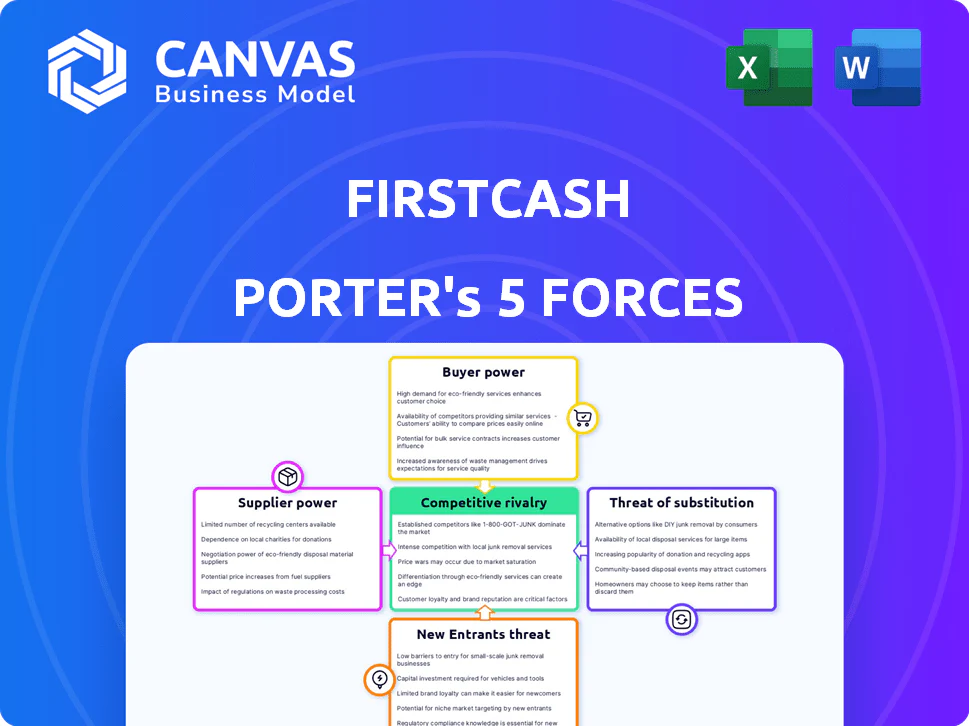
FIRSTCASH PORTER'S FIVE FORCES TEMPLATE RESEARCH
What is included in the product
 Detailed Word Document
Explores market dynamics that deter new entrants and protect incumbents like FirstCash.

 Customizable Excel Spreadsheet
Customize pressure levels based on new data or evolving market trends.
Preview Before You Purchase
FirstCash Porter's Five Forces Analysis
This preview presents FirstCash's Porter's Five Forces analysis in its entirety.
It examines competitive rivalry, supplier power, and buyer power within the pawn and financial services industry.
You'll also find assessments of the threat of new entrants and substitutes affecting FirstCash.
The document is the same comprehensive analysis you'll receive immediately after purchase.
No edits or changes; download and utilize it instantly.

Porter's Five Forces Analysis Template

Elevate Your Analysis with the Complete Porter's Five Forces Analysis
FirstCash faces moderate competition due to fragmented pawn shop and payday loan markets. Buyer power is moderate, influenced by consumer choices and economic conditions. Suppliers (lenders) hold some influence, impacting loan terms. New entrants pose a limited threat, with high startup costs and regulatory hurdles. Substitute products, like online lending, present a moderate threat.
This preview is just the beginning. The full analysis provides a complete strategic snapshot with force-by-force ratings, visuals, and business implications tailored to FirstCash.
Suppliers Bargaining Power

Limited Supplier Power in Pawn Operations
In the pawn business, FirstCash's suppliers are individuals. These suppliers, pawning or selling items, have minimal bargaining power. This is due to the fragmented supply base; no single supplier controls a large volume. For instance, in 2024, FirstCash's revenue was approximately $2.8 billion, showcasing its strong position.
Dependence on Specific Merchandise Categories
FirstCash faces moderate supplier power. While individual suppliers lack significant leverage, the fluctuating market values of key merchandise categories, like gold and electronics, are critical. In 2024, gold prices saw considerable volatility, impacting pawn loan valuations and retail sales margins. These price swings directly affect FirstCash's profitability.

Third-Party Providers for Financial Services
FirstCash leverages third-party providers for services like POS solutions. Their bargaining power hinges on service uniqueness and alternatives. Switching costs also influence supplier power. In 2024, POS system market size reached $100B, indicating supplier influence. FirstCash's vendor choice impacts operational efficiency.

Influence of Wholesale Suppliers for Retail Inventory
FirstCash relies on wholesale suppliers for retail merchandise, impacting its inventory. Suppliers' power depends on purchase volume, product uniqueness, and competition. For example, in 2024, the cost of goods sold (COGS) for retail items significantly affected FirstCash's profitability. Strong supplier relationships and diverse sourcing strategies are vital. This helps to mitigate risks and optimize margins within the retail segment.
- Purchase Volume: The more FirstCash buys, the stronger its negotiating position.
- Product Uniqueness: Unique items give suppliers more leverage.
- Supplier Competition: More competition among suppliers reduces their power.
- COGS Impact: In 2024, COGS directly affected retail profitability.
Regulatory Environment Affecting Sourcing
Regulations on sourcing, especially for precious metals and firearms, affect FirstCash. Suppliers compliant with strict rules might gain leverage. These regulations add complexity to supplier relations. FirstCash must navigate these rules. This impacts costs and availability of goods.
- Firearm sales regulations are complex, varying by state and federal laws.
- Precious metal sourcing is governed by regulations like the Patriot Act.
- Compliance costs can increase supplier prices.
- This affects FirstCash's profitability.
Supplier Dynamics and Profitability
FirstCash faces varying supplier power. Individual pawn customers have minimal leverage. However, market volatility in gold and electronics impacts profitability.
Third-party service providers' power depends on service uniqueness. Wholesale suppliers' power is affected by purchase volume. Regulations on sourcing further complicate supplier relations.
In 2024, COGS significantly impacted retail profitability. Compliance costs for regulations can increase supplier prices. This affects overall business profitability.
| Aspect | Impact | 2024 Data |
|---|---|---|
| Pawn Suppliers | Low Bargaining Power | Fragmented supply base |
| Market Volatility | Moderate Power | Gold price fluctuations |
| Service Providers | Varies | POS market size: $100B |
| Wholesale Suppliers | Moderate | COGS impact on retail |
| Regulations | Increases Costs | Compliance complexities |
Customers Bargaining Power

Individual Customers Have Low Bargaining Power
FirstCash's main customers are individuals needing fast cash via pawn loans or buying used items. These customers usually have limited credit options, seeking quick deals, which lessens their individual power to negotiate loan terms or retail prices. In 2024, FirstCash's pawn loan volume was approximately $2.5 billion, showing the high demand from customers with limited alternatives. The average pawn loan size in 2024 was about $150, further illustrating customer reliance on these services.
Price Sensitivity of Customers
Customers of pawn services, like those offered by FirstCash, are typically price-sensitive because of their financial constraints. Individual customers may have limited bargaining power. However, a widespread aversion to high prices or unfavorable terms might affect demand. In 2024, FirstCash's revenue was approximately $2.8 billion, indicating the volume of transactions.

Availability of Alternative Financial Options
The bargaining power of FirstCash customers is shaped by alternative financial options. In 2024, the payday loan market was estimated at $38.5 billion. More choices empower customers, potentially lowering FirstCash's pricing power. Competition from online lenders and fintech further amplifies this effect.

Impact of Economic Conditions on Customer Base
Economic downturns, inflation, and rising unemployment can significantly influence FirstCash's customer base. During economic hardships, the demand for short-term financial solutions tends to rise. This increased demand can shift the balance, potentially reducing customer bargaining power. For example, in 2023, the US saw inflation rates affecting consumer behavior.
- Inflation rates in the US were around 3.1% in November 2023, impacting consumer spending.
- Unemployment rates, hovering around 3.7% in late 2023, suggest a continued need for financial services.
- FirstCash's revenue in Q3 2023 was approximately $700 million, indicating strong demand.
These factors collectively shape the dynamics of customer interactions with FirstCash.
Geographic Concentration of Customers
The geographic concentration of FirstCash stores affects customer bargaining power. In regions with many FirstCash outlets and few competitors, customers have less leverage. Conversely, areas with diverse financial service options give customers more choice. The company’s market share varies; for example, in 2024, FirstCash operated over 3,500 locations globally.
- Market concentration influences customer options.
- Competitive landscapes shift customer power.
- FirstCash's store count impacts local dynamics.
- Customer choices are shaped by location-based competition.
Customer Power Dynamics: Quick Cash Needs
The bargaining power of FirstCash's customers is typically limited due to their reliance on quick financial solutions. In 2024, the average pawn loan size was about $150, highlighting their dependence on these services. However, competition from payday lenders and online platforms offers alternatives.
| Factor | Impact on Customer Power | 2024 Data |
|---|---|---|
| Loan Alternatives | Higher alternatives = More power | Payday loan market ~$38.5B |
| Customer Financial State | Tough times = Less power | US inflation ~3.1% (Nov 2023) |
| Store Presence | More local options = More power | FirstCash had over 3,500 stores |
Rivalry Among Competitors

Presence of Numerous Pawn Shop Operators
The pawn industry's competitive landscape features both major players and numerous small businesses, intensifying rivalry. FirstCash, a prominent chain, competes with many local pawn shops. This fragmentation leads to intense competition, especially in local markets. In 2024, the pawn industry's revenue was approximately $15 billion, showing the stakes involved. This environment necessitates strong strategies.
Competition from Other Alternative Financial Service Providers
FirstCash faces intense competition from various alternative financial service providers. This includes payday lenders and title loan companies. These competitors offer similar services, vying for the same customer base. In 2024, the market share competition among these providers remained high, with each trying to capture more of the $100 billion alternative financial services market.

Impact of Online Lenders and Retailers
Online lenders and retailers intensify competition for FirstCash. Platforms like Upstart and Affirm offer alternative funding sources. E-commerce sites such as eBay and Facebook Marketplace provide more choices for used goods. This boosts rivalry, compelling FirstCash to improve its offerings.

Geographic Market Concentration
FirstCash faces varying levels of competitive rivalry across its global footprint, with heightened intensity in concentrated geographic markets. For instance, in the United States, where FirstCash has a significant presence, the competition is fierce due to the high density of pawn shops and alternative financial service providers. This competition drives the need for strategic differentiation and operational efficiency to maintain market share. Intense rivalry often leads to price wars and increased marketing efforts.
- In 2024, the U.S. pawn shop industry generated approximately $15 billion in revenue, highlighting the competitive landscape.
- FirstCash operates in over 2,700 locations across the U.S. and Latin America, increasing the chances of direct competition.
- Competition often involves aggressive pricing and promotional strategies.
- Geographic concentration can lead to localized market saturation.
Differentiation through Services and Merchandise
Pawn shops differentiate themselves by offering a variety of services and merchandise. Beyond loan terms, competition focuses on the quality of goods, customer service, and additional financial offerings. This differentiation influences competitive rivalry, as businesses strive to attract customers through unique value propositions. For example, FirstCash, in 2024, emphasized its expansion of financial services to boost customer engagement.
- Merchandise variety and quality are key differentiators.
- Customer service impacts competitive positioning.
- Offering additional financial services can attract customers.
- Differentiation strategies influence rivalry intensity.
Pawn Industry's $15B Battleground: Who Wins?
Competitive rivalry in the pawn industry is fierce, involving numerous local and national players. FirstCash competes with a wide array of pawn shops and alternative financial services, intensifying the competition. In 2024, the U.S. pawn industry alone generated about $15 billion in revenue, demonstrating the high stakes. Differentiation and strategic positioning are essential for success.
| Aspect | Details |
|---|---|
| Market Size (U.S. Pawn Industry 2024) | Approximately $15 billion |
| FirstCash Locations (approx. 2024) | Over 2,700 |
| Competition Types | Pawn shops, online lenders, alternative financial services |
FIRSTCASH PORTER'S FIVE FORCES TEMPLATE RESEARCH
What is included in the product
Detailed Word Document
Explores market dynamics that deter new entrants and protect incumbents like FirstCash.
Customizable Excel Spreadsheet
Customize pressure levels based on new data or evolving market trends.
Preview Before You Purchase
FirstCash Porter's Five Forces Analysis
This preview presents FirstCash's Porter's Five Forces analysis in its entirety.
It examines competitive rivalry, supplier power, and buyer power within the pawn and financial services industry.
You'll also find assessments of the threat of new entrants and substitutes affecting FirstCash.
The document is the same comprehensive analysis you'll receive immediately after purchase.
No edits or changes; download and utilize it instantly.
Porter's Five Forces Analysis Template
Elevate Your Analysis with the Complete Porter's Five Forces Analysis
FirstCash faces moderate competition due to fragmented pawn shop and payday loan markets. Buyer power is moderate, influenced by consumer choices and economic conditions. Suppliers (lenders) hold some influence, impacting loan terms. New entrants pose a limited threat, with high startup costs and regulatory hurdles. Substitute products, like online lending, present a moderate threat.
This preview is just the beginning. The full analysis provides a complete strategic snapshot with force-by-force ratings, visuals, and business implications tailored to FirstCash.
Suppliers Bargaining Power
Limited Supplier Power in Pawn Operations
In the pawn business, FirstCash's suppliers are individuals. These suppliers, pawning or selling items, have minimal bargaining power. This is due to the fragmented supply base; no single supplier controls a large volume. For instance, in 2024, FirstCash's revenue was approximately $2.8 billion, showcasing its strong position.
Dependence on Specific Merchandise Categories
FirstCash faces moderate supplier power. While individual suppliers lack significant leverage, the fluctuating market values of key merchandise categories, like gold and electronics, are critical. In 2024, gold prices saw considerable volatility, impacting pawn loan valuations and retail sales margins. These price swings directly affect FirstCash's profitability.
Third-Party Providers for Financial Services
FirstCash leverages third-party providers for services like POS solutions. Their bargaining power hinges on service uniqueness and alternatives. Switching costs also influence supplier power. In 2024, POS system market size reached $100B, indicating supplier influence. FirstCash's vendor choice impacts operational efficiency.
Influence of Wholesale Suppliers for Retail Inventory
FirstCash relies on wholesale suppliers for retail merchandise, impacting its inventory. Suppliers' power depends on purchase volume, product uniqueness, and competition. For example, in 2024, the cost of goods sold (COGS) for retail items significantly affected FirstCash's profitability. Strong supplier relationships and diverse sourcing strategies are vital. This helps to mitigate risks and optimize margins within the retail segment.
- Purchase Volume: The more FirstCash buys, the stronger its negotiating position.
- Product Uniqueness: Unique items give suppliers more leverage.
- Supplier Competition: More competition among suppliers reduces their power.
- COGS Impact: In 2024, COGS directly affected retail profitability.
Regulatory Environment Affecting Sourcing
Regulations on sourcing, especially for precious metals and firearms, affect FirstCash. Suppliers compliant with strict rules might gain leverage. These regulations add complexity to supplier relations. FirstCash must navigate these rules. This impacts costs and availability of goods.
- Firearm sales regulations are complex, varying by state and federal laws.
- Precious metal sourcing is governed by regulations like the Patriot Act.
- Compliance costs can increase supplier prices.
- This affects FirstCash's profitability.
Supplier Dynamics and Profitability
FirstCash faces varying supplier power. Individual pawn customers have minimal leverage. However, market volatility in gold and electronics impacts profitability.
Third-party service providers' power depends on service uniqueness. Wholesale suppliers' power is affected by purchase volume. Regulations on sourcing further complicate supplier relations.
In 2024, COGS significantly impacted retail profitability. Compliance costs for regulations can increase supplier prices. This affects overall business profitability.
| Aspect | Impact | 2024 Data |
|---|---|---|
| Pawn Suppliers | Low Bargaining Power | Fragmented supply base |
| Market Volatility | Moderate Power | Gold price fluctuations |
| Service Providers | Varies | POS market size: $100B |
| Wholesale Suppliers | Moderate | COGS impact on retail |
| Regulations | Increases Costs | Compliance complexities |
Customers Bargaining Power
Individual Customers Have Low Bargaining Power
FirstCash's main customers are individuals needing fast cash via pawn loans or buying used items. These customers usually have limited credit options, seeking quick deals, which lessens their individual power to negotiate loan terms or retail prices. In 2024, FirstCash's pawn loan volume was approximately $2.5 billion, showing the high demand from customers with limited alternatives. The average pawn loan size in 2024 was about $150, further illustrating customer reliance on these services.
Price Sensitivity of Customers
Customers of pawn services, like those offered by FirstCash, are typically price-sensitive because of their financial constraints. Individual customers may have limited bargaining power. However, a widespread aversion to high prices or unfavorable terms might affect demand. In 2024, FirstCash's revenue was approximately $2.8 billion, indicating the volume of transactions.
Availability of Alternative Financial Options
The bargaining power of FirstCash customers is shaped by alternative financial options. In 2024, the payday loan market was estimated at $38.5 billion. More choices empower customers, potentially lowering FirstCash's pricing power. Competition from online lenders and fintech further amplifies this effect.
Impact of Economic Conditions on Customer Base
Economic downturns, inflation, and rising unemployment can significantly influence FirstCash's customer base. During economic hardships, the demand for short-term financial solutions tends to rise. This increased demand can shift the balance, potentially reducing customer bargaining power. For example, in 2023, the US saw inflation rates affecting consumer behavior.
- Inflation rates in the US were around 3.1% in November 2023, impacting consumer spending.
- Unemployment rates, hovering around 3.7% in late 2023, suggest a continued need for financial services.
- FirstCash's revenue in Q3 2023 was approximately $700 million, indicating strong demand.
These factors collectively shape the dynamics of customer interactions with FirstCash.
Geographic Concentration of Customers
The geographic concentration of FirstCash stores affects customer bargaining power. In regions with many FirstCash outlets and few competitors, customers have less leverage. Conversely, areas with diverse financial service options give customers more choice. The company’s market share varies; for example, in 2024, FirstCash operated over 3,500 locations globally.
- Market concentration influences customer options.
- Competitive landscapes shift customer power.
- FirstCash's store count impacts local dynamics.
- Customer choices are shaped by location-based competition.
Customer Power Dynamics: Quick Cash Needs
The bargaining power of FirstCash's customers is typically limited due to their reliance on quick financial solutions. In 2024, the average pawn loan size was about $150, highlighting their dependence on these services. However, competition from payday lenders and online platforms offers alternatives.
| Factor | Impact on Customer Power | 2024 Data |
|---|---|---|
| Loan Alternatives | Higher alternatives = More power | Payday loan market ~$38.5B |
| Customer Financial State | Tough times = Less power | US inflation ~3.1% (Nov 2023) |
| Store Presence | More local options = More power | FirstCash had over 3,500 stores |
Rivalry Among Competitors
Presence of Numerous Pawn Shop Operators
The pawn industry's competitive landscape features both major players and numerous small businesses, intensifying rivalry. FirstCash, a prominent chain, competes with many local pawn shops. This fragmentation leads to intense competition, especially in local markets. In 2024, the pawn industry's revenue was approximately $15 billion, showing the stakes involved. This environment necessitates strong strategies.
Competition from Other Alternative Financial Service Providers
FirstCash faces intense competition from various alternative financial service providers. This includes payday lenders and title loan companies. These competitors offer similar services, vying for the same customer base. In 2024, the market share competition among these providers remained high, with each trying to capture more of the $100 billion alternative financial services market.
Impact of Online Lenders and Retailers
Online lenders and retailers intensify competition for FirstCash. Platforms like Upstart and Affirm offer alternative funding sources. E-commerce sites such as eBay and Facebook Marketplace provide more choices for used goods. This boosts rivalry, compelling FirstCash to improve its offerings.
Geographic Market Concentration
FirstCash faces varying levels of competitive rivalry across its global footprint, with heightened intensity in concentrated geographic markets. For instance, in the United States, where FirstCash has a significant presence, the competition is fierce due to the high density of pawn shops and alternative financial service providers. This competition drives the need for strategic differentiation and operational efficiency to maintain market share. Intense rivalry often leads to price wars and increased marketing efforts.
- In 2024, the U.S. pawn shop industry generated approximately $15 billion in revenue, highlighting the competitive landscape.
- FirstCash operates in over 2,700 locations across the U.S. and Latin America, increasing the chances of direct competition.
- Competition often involves aggressive pricing and promotional strategies.
- Geographic concentration can lead to localized market saturation.
Differentiation through Services and Merchandise
Pawn shops differentiate themselves by offering a variety of services and merchandise. Beyond loan terms, competition focuses on the quality of goods, customer service, and additional financial offerings. This differentiation influences competitive rivalry, as businesses strive to attract customers through unique value propositions. For example, FirstCash, in 2024, emphasized its expansion of financial services to boost customer engagement.
- Merchandise variety and quality are key differentiators.
- Customer service impacts competitive positioning.
- Offering additional financial services can attract customers.
- Differentiation strategies influence rivalry intensity.
Pawn Industry's $15B Battleground: Who Wins?
Competitive rivalry in the pawn industry is fierce, involving numerous local and national players. FirstCash competes with a wide array of pawn shops and alternative financial services, intensifying the competition. In 2024, the U.S. pawn industry alone generated about $15 billion in revenue, demonstrating the high stakes. Differentiation and strategic positioning are essential for success.
| Aspect | Details |
|---|---|
| Market Size (U.S. Pawn Industry 2024) | Approximately $15 billion |
| FirstCash Locations (approx. 2024) | Over 2,700 |
| Competition Types | Pawn shops, online lenders, alternative financial services |
Product Information
Product Information
Shipping & Returns
Shipping & Returns
Description
What is included in the product
Detailed Word Document
Explores market dynamics that deter new entrants and protect incumbents like FirstCash.
Customizable Excel Spreadsheet
Customize pressure levels based on new data or evolving market trends.
Preview Before You Purchase
FirstCash Porter's Five Forces Analysis
This preview presents FirstCash's Porter's Five Forces analysis in its entirety.
It examines competitive rivalry, supplier power, and buyer power within the pawn and financial services industry.
You'll also find assessments of the threat of new entrants and substitutes affecting FirstCash.
The document is the same comprehensive analysis you'll receive immediately after purchase.
No edits or changes; download and utilize it instantly.
Porter's Five Forces Analysis Template
Elevate Your Analysis with the Complete Porter's Five Forces Analysis
FirstCash faces moderate competition due to fragmented pawn shop and payday loan markets. Buyer power is moderate, influenced by consumer choices and economic conditions. Suppliers (lenders) hold some influence, impacting loan terms. New entrants pose a limited threat, with high startup costs and regulatory hurdles. Substitute products, like online lending, present a moderate threat.
This preview is just the beginning. The full analysis provides a complete strategic snapshot with force-by-force ratings, visuals, and business implications tailored to FirstCash.
Suppliers Bargaining Power
Limited Supplier Power in Pawn Operations
In the pawn business, FirstCash's suppliers are individuals. These suppliers, pawning or selling items, have minimal bargaining power. This is due to the fragmented supply base; no single supplier controls a large volume. For instance, in 2024, FirstCash's revenue was approximately $2.8 billion, showcasing its strong position.
Dependence on Specific Merchandise Categories
FirstCash faces moderate supplier power. While individual suppliers lack significant leverage, the fluctuating market values of key merchandise categories, like gold and electronics, are critical. In 2024, gold prices saw considerable volatility, impacting pawn loan valuations and retail sales margins. These price swings directly affect FirstCash's profitability.
Third-Party Providers for Financial Services
FirstCash leverages third-party providers for services like POS solutions. Their bargaining power hinges on service uniqueness and alternatives. Switching costs also influence supplier power. In 2024, POS system market size reached $100B, indicating supplier influence. FirstCash's vendor choice impacts operational efficiency.
Influence of Wholesale Suppliers for Retail Inventory
FirstCash relies on wholesale suppliers for retail merchandise, impacting its inventory. Suppliers' power depends on purchase volume, product uniqueness, and competition. For example, in 2024, the cost of goods sold (COGS) for retail items significantly affected FirstCash's profitability. Strong supplier relationships and diverse sourcing strategies are vital. This helps to mitigate risks and optimize margins within the retail segment.
- Purchase Volume: The more FirstCash buys, the stronger its negotiating position.
- Product Uniqueness: Unique items give suppliers more leverage.
- Supplier Competition: More competition among suppliers reduces their power.
- COGS Impact: In 2024, COGS directly affected retail profitability.
Regulatory Environment Affecting Sourcing
Regulations on sourcing, especially for precious metals and firearms, affect FirstCash. Suppliers compliant with strict rules might gain leverage. These regulations add complexity to supplier relations. FirstCash must navigate these rules. This impacts costs and availability of goods.
- Firearm sales regulations are complex, varying by state and federal laws.
- Precious metal sourcing is governed by regulations like the Patriot Act.
- Compliance costs can increase supplier prices.
- This affects FirstCash's profitability.
Supplier Dynamics and Profitability
FirstCash faces varying supplier power. Individual pawn customers have minimal leverage. However, market volatility in gold and electronics impacts profitability.
Third-party service providers' power depends on service uniqueness. Wholesale suppliers' power is affected by purchase volume. Regulations on sourcing further complicate supplier relations.
In 2024, COGS significantly impacted retail profitability. Compliance costs for regulations can increase supplier prices. This affects overall business profitability.
| Aspect | Impact | 2024 Data |
|---|---|---|
| Pawn Suppliers | Low Bargaining Power | Fragmented supply base |
| Market Volatility | Moderate Power | Gold price fluctuations |
| Service Providers | Varies | POS market size: $100B |
| Wholesale Suppliers | Moderate | COGS impact on retail |
| Regulations | Increases Costs | Compliance complexities |
Customers Bargaining Power
Individual Customers Have Low Bargaining Power
FirstCash's main customers are individuals needing fast cash via pawn loans or buying used items. These customers usually have limited credit options, seeking quick deals, which lessens their individual power to negotiate loan terms or retail prices. In 2024, FirstCash's pawn loan volume was approximately $2.5 billion, showing the high demand from customers with limited alternatives. The average pawn loan size in 2024 was about $150, further illustrating customer reliance on these services.
Price Sensitivity of Customers
Customers of pawn services, like those offered by FirstCash, are typically price-sensitive because of their financial constraints. Individual customers may have limited bargaining power. However, a widespread aversion to high prices or unfavorable terms might affect demand. In 2024, FirstCash's revenue was approximately $2.8 billion, indicating the volume of transactions.
Availability of Alternative Financial Options
The bargaining power of FirstCash customers is shaped by alternative financial options. In 2024, the payday loan market was estimated at $38.5 billion. More choices empower customers, potentially lowering FirstCash's pricing power. Competition from online lenders and fintech further amplifies this effect.
Impact of Economic Conditions on Customer Base
Economic downturns, inflation, and rising unemployment can significantly influence FirstCash's customer base. During economic hardships, the demand for short-term financial solutions tends to rise. This increased demand can shift the balance, potentially reducing customer bargaining power. For example, in 2023, the US saw inflation rates affecting consumer behavior.
- Inflation rates in the US were around 3.1% in November 2023, impacting consumer spending.
- Unemployment rates, hovering around 3.7% in late 2023, suggest a continued need for financial services.
- FirstCash's revenue in Q3 2023 was approximately $700 million, indicating strong demand.
These factors collectively shape the dynamics of customer interactions with FirstCash.
Geographic Concentration of Customers
The geographic concentration of FirstCash stores affects customer bargaining power. In regions with many FirstCash outlets and few competitors, customers have less leverage. Conversely, areas with diverse financial service options give customers more choice. The company’s market share varies; for example, in 2024, FirstCash operated over 3,500 locations globally.
- Market concentration influences customer options.
- Competitive landscapes shift customer power.
- FirstCash's store count impacts local dynamics.
- Customer choices are shaped by location-based competition.
Customer Power Dynamics: Quick Cash Needs
The bargaining power of FirstCash's customers is typically limited due to their reliance on quick financial solutions. In 2024, the average pawn loan size was about $150, highlighting their dependence on these services. However, competition from payday lenders and online platforms offers alternatives.
| Factor | Impact on Customer Power | 2024 Data |
|---|---|---|
| Loan Alternatives | Higher alternatives = More power | Payday loan market ~$38.5B |
| Customer Financial State | Tough times = Less power | US inflation ~3.1% (Nov 2023) |
| Store Presence | More local options = More power | FirstCash had over 3,500 stores |
Rivalry Among Competitors
Presence of Numerous Pawn Shop Operators
The pawn industry's competitive landscape features both major players and numerous small businesses, intensifying rivalry. FirstCash, a prominent chain, competes with many local pawn shops. This fragmentation leads to intense competition, especially in local markets. In 2024, the pawn industry's revenue was approximately $15 billion, showing the stakes involved. This environment necessitates strong strategies.
Competition from Other Alternative Financial Service Providers
FirstCash faces intense competition from various alternative financial service providers. This includes payday lenders and title loan companies. These competitors offer similar services, vying for the same customer base. In 2024, the market share competition among these providers remained high, with each trying to capture more of the $100 billion alternative financial services market.
Impact of Online Lenders and Retailers
Online lenders and retailers intensify competition for FirstCash. Platforms like Upstart and Affirm offer alternative funding sources. E-commerce sites such as eBay and Facebook Marketplace provide more choices for used goods. This boosts rivalry, compelling FirstCash to improve its offerings.
Geographic Market Concentration
FirstCash faces varying levels of competitive rivalry across its global footprint, with heightened intensity in concentrated geographic markets. For instance, in the United States, where FirstCash has a significant presence, the competition is fierce due to the high density of pawn shops and alternative financial service providers. This competition drives the need for strategic differentiation and operational efficiency to maintain market share. Intense rivalry often leads to price wars and increased marketing efforts.
- In 2024, the U.S. pawn shop industry generated approximately $15 billion in revenue, highlighting the competitive landscape.
- FirstCash operates in over 2,700 locations across the U.S. and Latin America, increasing the chances of direct competition.
- Competition often involves aggressive pricing and promotional strategies.
- Geographic concentration can lead to localized market saturation.
Differentiation through Services and Merchandise
Pawn shops differentiate themselves by offering a variety of services and merchandise. Beyond loan terms, competition focuses on the quality of goods, customer service, and additional financial offerings. This differentiation influences competitive rivalry, as businesses strive to attract customers through unique value propositions. For example, FirstCash, in 2024, emphasized its expansion of financial services to boost customer engagement.
- Merchandise variety and quality are key differentiators.
- Customer service impacts competitive positioning.
- Offering additional financial services can attract customers.
- Differentiation strategies influence rivalry intensity.
Pawn Industry's $15B Battleground: Who Wins?
Competitive rivalry in the pawn industry is fierce, involving numerous local and national players. FirstCash competes with a wide array of pawn shops and alternative financial services, intensifying the competition. In 2024, the U.S. pawn industry alone generated about $15 billion in revenue, demonstrating the high stakes. Differentiation and strategic positioning are essential for success.
| Aspect | Details |
|---|---|
| Market Size (U.S. Pawn Industry 2024) | Approximately $15 billion |
| FirstCash Locations (approx. 2024) | Over 2,700 |
| Competition Types | Pawn shops, online lenders, alternative financial services |











