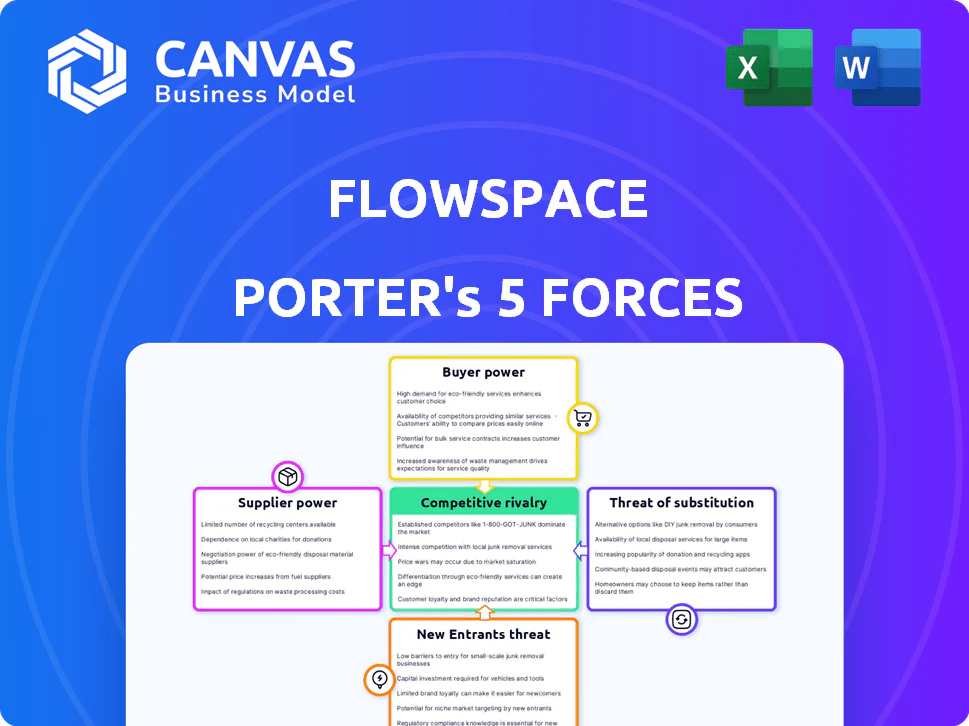
FLOWSPACE PORTER'S FIVE FORCES TEMPLATE RESEARCH
What is included in the product
 Detailed Word Document
Tailored exclusively for Flowspace, analyzing its position within its competitive landscape.

 Customizable Excel Spreadsheet
Instantly spot vulnerabilities with a vivid, color-coded threat level indicator.
Preview Before You Purchase
Flowspace Porter's Five Forces Analysis
This preview offers the complete Porter's Five Forces analysis of Flowspace. The content you're viewing is identical to the document you'll download upon purchase, offering a thorough examination. It includes insights into competitive rivalry, supplier power, and buyer power, as well as threats of new entrants and substitutes. This professionally written document ensures clarity and actionable information for you.

Porter's Five Forces Analysis Template

From Overview to Strategy Blueprint
Flowspace operates within a dynamic warehousing & logistics market, facing pressures from multiple angles. The threat of new entrants is moderate, influenced by capital requirements & market access. Buyer power is significant, as customers have choices among providers. Supplier power is moderate, depending on real estate availability. Substitute products, such as on-demand warehousing, present a threat. The intensity of rivalry is high, driven by competition & evolving customer needs.
This brief snapshot only scratches the surface. Unlock the full Porter's Five Forces Analysis to explore Flowspace’s competitive dynamics, market pressures, and strategic advantages in detail.
Suppliers Bargaining Power

Warehouse Space Providers
Flowspace's reliance on warehouse networks impacts supplier power. The concentration of facilities in strategic locations affects leverage. Limited options in key areas boost supplier bargaining power. In 2024, warehouse rental rates in major US cities varied widely, impacting negotiations. For example, Los Angeles saw rates between $0.80-$1.50 per sq ft monthly.
Technology Providers
Flowspace's dependence on technology providers for its platform indicates supplier power. The uniqueness of the tech is crucial. In 2024, software development costs rose by 15%, which impacts Flowspace. If the tech is specialized, suppliers gain leverage, affecting Flowspace's costs and control.

Labor Market
The labor market significantly impacts Flowspace's costs. In 2024, warehouse labor costs rose due to a tight market. For example, average hourly wages for warehouse workers increased by 5% in the US. Skilled labor, such as those for automated systems, commands even higher rates, increasing supplier power.

Packaging Material Suppliers
Flowspace's fulfillment services rely on packaging materials. Supplier bargaining power impacts costs and availability, especially for specialized or eco-friendly options. For instance, the global packaging market was valued at $1.1 trillion in 2023. Demand fluctuations and supplier concentration affect pricing. Eco-friendly packaging is growing, with a projected 5.7% CAGR from 2024-2030.
- Market size: $1.1 trillion in 2023.
- Eco-friendly packaging CAGR: 5.7% (2024-2030).
- Supplier concentration impacts pricing.
- Demand influences material availability.
Transportation and Shipping Carriers
Flowspace relies on transportation and shipping carriers to move goods, making them key suppliers. The bargaining power of these carriers influences Flowspace's operational costs and service offerings. In 2024, the shipping and trucking industry faced fluctuating fuel prices and labor shortages, impacting carrier rates. This dynamic requires careful management to maintain profitability and competitive pricing.
- In 2024, the average cost per mile for trucking services ranged from $2.80 to $3.20, influenced by fuel and labor.
- The top 10 trucking companies control approximately 25% of the market share, affecting pricing power.
- Labor shortages in the trucking sector increased operational costs by 10-15% in 2024.
- Flowspace needs to negotiate contracts to manage these supplier costs effectively.
Supplier Power Dynamics at Play
Flowspace faces supplier power challenges across various areas. Warehouse network concentration and tech provider uniqueness boost supplier leverage. Labor market dynamics and packaging material availability also affect costs. Transportation and shipping carriers significantly influence operational expenses.
| Supplier Type | Impact on Flowspace | 2024 Data |
|---|---|---|
| Warehouses | Rental costs, location access | LA: $0.80-$1.50/sq ft monthly |
| Tech Providers | Platform costs, tech dependency | Software dev costs up 15% |
| Labor | Wage costs, skilled labor | Warehouse wages up 5% |
| Packaging | Material costs, availability | Market: $1.1T (2023), Eco-friendly CAGR: 5.7% |
| Carriers | Shipping costs, service | Trucking: $2.80-$3.20/mile, Labor shortages: 10-15% cost increase |
Customers Bargaining Power

Small and Medium-Sized Businesses (SMBs)
Flowspace's SMB customers, including e-commerce startups, have limited individual bargaining power. However, their collective volume gives them leverage. In 2024, the e-commerce market reached $8.17 trillion globally. This collective demand impacts Flowspace. The availability of fulfillment alternatives, such as Amazon FBA, further influences the bargaining power of these customers.
E-commerce Brands
Flowspace serves diverse e-commerce brands. Bigger, rapidly expanding brands often wield greater influence. They negotiate prices and service terms more effectively. In 2024, e-commerce sales hit $1.11 trillion in the U.S., highlighting customer leverage. High-volume clients can demand better deals.

Retailers and Manufacturers
Flowspace caters to retailers and manufacturers, who may already have their own logistics or large order volumes. This can give them more power when negotiating fulfillment services. For example, in 2024, major retailers like Amazon and Walmart continued to exert strong bargaining power, influencing pricing and service terms within the logistics sector. This is supported by data from the U.S. Department of Commerce, showing a consistent focus on supply chain optimization by large retailers.

Customer Acquisition Cost
Customer acquisition cost (CAC) significantly affects customer power within Flowspace. If acquiring customers becomes costly, Flowspace might be more willing to offer favorable terms to retain existing clients. High CAC can shift the balance, giving customers greater negotiating leverage. This dynamic is crucial for Flowspace's profitability and market position. Understanding CAC helps in managing customer relationships effectively.
- In 2023, the average CAC for a logistics company was around $5,000.
- Companies with higher CAC often face increased customer bargaining power.
- Customer retention strategies become more critical with elevated acquisition costs.
- A lower CAC enhances Flowspace's ability to withstand customer demands.
Availability of Alternatives
Customers in the fulfillment space possess considerable bargaining power due to readily available alternatives. These alternatives include in-house fulfillment, outsourcing to other 3PLs, or utilizing different technology platforms. The ease of switching to competitors significantly enhances customer bargaining power, as they can quickly move to a better deal or service. This competitive landscape forces companies like Flowspace to offer competitive pricing and services to retain customers. In 2024, the 3PL market was valued at over $1.3 trillion globally, highlighting the vast array of choices available to customers and the intense competition among providers.
- Market size: The global 3PL market was valued at over $1.3 trillion in 2024.
- Switching costs: Low switching costs empower customers to seek better deals.
- Competitive pressure: High competition among 3PLs benefits customers.
- Alternative options: Customers can choose between in-house, other 3PLs, or technology platforms.
Customer Power Dynamics in E-commerce
Customers' bargaining power varies based on their size and market options. Larger e-commerce brands can negotiate better terms. The global 3PL market, valued at over $1.3 trillion in 2024, offers many alternatives, enhancing customer leverage. High acquisition costs can increase customer power.
| Factor | Impact | Data (2024) |
|---|---|---|
| E-commerce Sales | Influences bargaining power | $1.11T in US |
| 3PL Market Size | Offers alternatives | $1.3T+ globally |
| CAC | Affects negotiation power | ~ $5,000 avg. in 2023 |
Rivalry Among Competitors

Number of Competitors
The fulfillment and logistics market is highly competitive, featuring many companies. In 2024, the market included numerous 3PLs and tech-driven platforms. This extensive competition, with over 200 major players in North America, intensifies rivalry significantly. Increased competition often leads to price wars and innovation.
Market Growth
The e-commerce and on-demand warehousing sectors are currently expanding. This growth, although beneficial, intensifies competition. New businesses are drawn in, and established ones broaden their services, thus increasing rivalry. For instance, the global warehousing market was valued at $579.5 billion in 2023, and is expected to reach $787.3 billion by 2029.

Differentiation
Flowspace's tech platform and warehouse network set it apart, yet, the ability of rivals to match these integrated services shapes competition. If competitors can easily replicate Flowspace's offerings, rivalry escalates. For instance, the 3PL market, valued at $300 billion in 2024, sees intense competition as players vie for market share. This rivalry is also influenced by the rate of innovation in logistics technology.

Switching Costs
Switching costs significantly influence the intensity of competitive rivalry within the fulfillment industry. Low switching costs empower customers to readily shift between providers, intensifying competition for Flowspace. This dynamic forces companies to compete more aggressively to retain and attract clients. High switching costs, conversely, can reduce rivalry by locking in customers.
- The average contract length for fulfillment services is about 12 months.
- Approximately 20% of businesses switch fulfillment providers annually.
- Setup fees for new providers can range from $1,000 to $10,000.
- Integration costs can take 1-3 months to implement.
Industry Concentration
Industry concentration in the warehousing and logistics sector shows a mix of players, but some exert considerable influence. Large companies can dictate pricing strategies, impacting smaller firms like Flowspace. For example, in 2024, the top 10 logistics companies controlled roughly 30% of the market share globally, affecting competition. This concentration can create challenges for smaller entities trying to compete on price or service offerings.
- Market share concentration can influence pricing strategies.
- The top 10 logistics companies control around 30% of the global market.
- Smaller firms may struggle to compete with dominant players.
- Competitive intensity depends on the balance of power.
Fulfillment Market: A Competitive Landscape
Competitive rivalry in the fulfillment market is fierce due to a high number of competitors and market growth. The 3PL market, valued at $300 billion in 2024, demonstrates intense competition. Switching costs and industry concentration further shape rivalry.
| Factor | Impact | Data |
|---|---|---|
| Market Competition | High rivalry | Over 200 major players in North America. |
| Market Growth | Intensifies competition | Global warehousing market expected to reach $787.3B by 2029. |
| Switching Costs | Influence rivalry | About 20% of businesses switch providers annually. |
FLOWSPACE PORTER'S FIVE FORCES TEMPLATE RESEARCH
What is included in the product
Detailed Word Document
Tailored exclusively for Flowspace, analyzing its position within its competitive landscape.
Customizable Excel Spreadsheet
Instantly spot vulnerabilities with a vivid, color-coded threat level indicator.
Preview Before You Purchase
Flowspace Porter's Five Forces Analysis
This preview offers the complete Porter's Five Forces analysis of Flowspace. The content you're viewing is identical to the document you'll download upon purchase, offering a thorough examination. It includes insights into competitive rivalry, supplier power, and buyer power, as well as threats of new entrants and substitutes. This professionally written document ensures clarity and actionable information for you.
Porter's Five Forces Analysis Template
From Overview to Strategy Blueprint
Flowspace operates within a dynamic warehousing & logistics market, facing pressures from multiple angles. The threat of new entrants is moderate, influenced by capital requirements & market access. Buyer power is significant, as customers have choices among providers. Supplier power is moderate, depending on real estate availability. Substitute products, such as on-demand warehousing, present a threat. The intensity of rivalry is high, driven by competition & evolving customer needs.
This brief snapshot only scratches the surface. Unlock the full Porter's Five Forces Analysis to explore Flowspace’s competitive dynamics, market pressures, and strategic advantages in detail.
Suppliers Bargaining Power
Warehouse Space Providers
Flowspace's reliance on warehouse networks impacts supplier power. The concentration of facilities in strategic locations affects leverage. Limited options in key areas boost supplier bargaining power. In 2024, warehouse rental rates in major US cities varied widely, impacting negotiations. For example, Los Angeles saw rates between $0.80-$1.50 per sq ft monthly.
Technology Providers
Flowspace's dependence on technology providers for its platform indicates supplier power. The uniqueness of the tech is crucial. In 2024, software development costs rose by 15%, which impacts Flowspace. If the tech is specialized, suppliers gain leverage, affecting Flowspace's costs and control.
Labor Market
The labor market significantly impacts Flowspace's costs. In 2024, warehouse labor costs rose due to a tight market. For example, average hourly wages for warehouse workers increased by 5% in the US. Skilled labor, such as those for automated systems, commands even higher rates, increasing supplier power.
Packaging Material Suppliers
Flowspace's fulfillment services rely on packaging materials. Supplier bargaining power impacts costs and availability, especially for specialized or eco-friendly options. For instance, the global packaging market was valued at $1.1 trillion in 2023. Demand fluctuations and supplier concentration affect pricing. Eco-friendly packaging is growing, with a projected 5.7% CAGR from 2024-2030.
- Market size: $1.1 trillion in 2023.
- Eco-friendly packaging CAGR: 5.7% (2024-2030).
- Supplier concentration impacts pricing.
- Demand influences material availability.
Transportation and Shipping Carriers
Flowspace relies on transportation and shipping carriers to move goods, making them key suppliers. The bargaining power of these carriers influences Flowspace's operational costs and service offerings. In 2024, the shipping and trucking industry faced fluctuating fuel prices and labor shortages, impacting carrier rates. This dynamic requires careful management to maintain profitability and competitive pricing.
- In 2024, the average cost per mile for trucking services ranged from $2.80 to $3.20, influenced by fuel and labor.
- The top 10 trucking companies control approximately 25% of the market share, affecting pricing power.
- Labor shortages in the trucking sector increased operational costs by 10-15% in 2024.
- Flowspace needs to negotiate contracts to manage these supplier costs effectively.
Supplier Power Dynamics at Play
Flowspace faces supplier power challenges across various areas. Warehouse network concentration and tech provider uniqueness boost supplier leverage. Labor market dynamics and packaging material availability also affect costs. Transportation and shipping carriers significantly influence operational expenses.
| Supplier Type | Impact on Flowspace | 2024 Data |
|---|---|---|
| Warehouses | Rental costs, location access | LA: $0.80-$1.50/sq ft monthly |
| Tech Providers | Platform costs, tech dependency | Software dev costs up 15% |
| Labor | Wage costs, skilled labor | Warehouse wages up 5% |
| Packaging | Material costs, availability | Market: $1.1T (2023), Eco-friendly CAGR: 5.7% |
| Carriers | Shipping costs, service | Trucking: $2.80-$3.20/mile, Labor shortages: 10-15% cost increase |
Customers Bargaining Power
Small and Medium-Sized Businesses (SMBs)
Flowspace's SMB customers, including e-commerce startups, have limited individual bargaining power. However, their collective volume gives them leverage. In 2024, the e-commerce market reached $8.17 trillion globally. This collective demand impacts Flowspace. The availability of fulfillment alternatives, such as Amazon FBA, further influences the bargaining power of these customers.
E-commerce Brands
Flowspace serves diverse e-commerce brands. Bigger, rapidly expanding brands often wield greater influence. They negotiate prices and service terms more effectively. In 2024, e-commerce sales hit $1.11 trillion in the U.S., highlighting customer leverage. High-volume clients can demand better deals.
Retailers and Manufacturers
Flowspace caters to retailers and manufacturers, who may already have their own logistics or large order volumes. This can give them more power when negotiating fulfillment services. For example, in 2024, major retailers like Amazon and Walmart continued to exert strong bargaining power, influencing pricing and service terms within the logistics sector. This is supported by data from the U.S. Department of Commerce, showing a consistent focus on supply chain optimization by large retailers.
Customer Acquisition Cost
Customer acquisition cost (CAC) significantly affects customer power within Flowspace. If acquiring customers becomes costly, Flowspace might be more willing to offer favorable terms to retain existing clients. High CAC can shift the balance, giving customers greater negotiating leverage. This dynamic is crucial for Flowspace's profitability and market position. Understanding CAC helps in managing customer relationships effectively.
- In 2023, the average CAC for a logistics company was around $5,000.
- Companies with higher CAC often face increased customer bargaining power.
- Customer retention strategies become more critical with elevated acquisition costs.
- A lower CAC enhances Flowspace's ability to withstand customer demands.
Availability of Alternatives
Customers in the fulfillment space possess considerable bargaining power due to readily available alternatives. These alternatives include in-house fulfillment, outsourcing to other 3PLs, or utilizing different technology platforms. The ease of switching to competitors significantly enhances customer bargaining power, as they can quickly move to a better deal or service. This competitive landscape forces companies like Flowspace to offer competitive pricing and services to retain customers. In 2024, the 3PL market was valued at over $1.3 trillion globally, highlighting the vast array of choices available to customers and the intense competition among providers.
- Market size: The global 3PL market was valued at over $1.3 trillion in 2024.
- Switching costs: Low switching costs empower customers to seek better deals.
- Competitive pressure: High competition among 3PLs benefits customers.
- Alternative options: Customers can choose between in-house, other 3PLs, or technology platforms.
Customer Power Dynamics in E-commerce
Customers' bargaining power varies based on their size and market options. Larger e-commerce brands can negotiate better terms. The global 3PL market, valued at over $1.3 trillion in 2024, offers many alternatives, enhancing customer leverage. High acquisition costs can increase customer power.
| Factor | Impact | Data (2024) |
|---|---|---|
| E-commerce Sales | Influences bargaining power | $1.11T in US |
| 3PL Market Size | Offers alternatives | $1.3T+ globally |
| CAC | Affects negotiation power | ~ $5,000 avg. in 2023 |
Rivalry Among Competitors
Number of Competitors
The fulfillment and logistics market is highly competitive, featuring many companies. In 2024, the market included numerous 3PLs and tech-driven platforms. This extensive competition, with over 200 major players in North America, intensifies rivalry significantly. Increased competition often leads to price wars and innovation.
Market Growth
The e-commerce and on-demand warehousing sectors are currently expanding. This growth, although beneficial, intensifies competition. New businesses are drawn in, and established ones broaden their services, thus increasing rivalry. For instance, the global warehousing market was valued at $579.5 billion in 2023, and is expected to reach $787.3 billion by 2029.
Differentiation
Flowspace's tech platform and warehouse network set it apart, yet, the ability of rivals to match these integrated services shapes competition. If competitors can easily replicate Flowspace's offerings, rivalry escalates. For instance, the 3PL market, valued at $300 billion in 2024, sees intense competition as players vie for market share. This rivalry is also influenced by the rate of innovation in logistics technology.
Switching Costs
Switching costs significantly influence the intensity of competitive rivalry within the fulfillment industry. Low switching costs empower customers to readily shift between providers, intensifying competition for Flowspace. This dynamic forces companies to compete more aggressively to retain and attract clients. High switching costs, conversely, can reduce rivalry by locking in customers.
- The average contract length for fulfillment services is about 12 months.
- Approximately 20% of businesses switch fulfillment providers annually.
- Setup fees for new providers can range from $1,000 to $10,000.
- Integration costs can take 1-3 months to implement.
Industry Concentration
Industry concentration in the warehousing and logistics sector shows a mix of players, but some exert considerable influence. Large companies can dictate pricing strategies, impacting smaller firms like Flowspace. For example, in 2024, the top 10 logistics companies controlled roughly 30% of the market share globally, affecting competition. This concentration can create challenges for smaller entities trying to compete on price or service offerings.
- Market share concentration can influence pricing strategies.
- The top 10 logistics companies control around 30% of the global market.
- Smaller firms may struggle to compete with dominant players.
- Competitive intensity depends on the balance of power.
Fulfillment Market: A Competitive Landscape
Competitive rivalry in the fulfillment market is fierce due to a high number of competitors and market growth. The 3PL market, valued at $300 billion in 2024, demonstrates intense competition. Switching costs and industry concentration further shape rivalry.
| Factor | Impact | Data |
|---|---|---|
| Market Competition | High rivalry | Over 200 major players in North America. |
| Market Growth | Intensifies competition | Global warehousing market expected to reach $787.3B by 2029. |
| Switching Costs | Influence rivalry | About 20% of businesses switch providers annually. |
Product Information
Product Information
Shipping & Returns
Shipping & Returns
Description
What is included in the product
Detailed Word Document
Tailored exclusively for Flowspace, analyzing its position within its competitive landscape.
Customizable Excel Spreadsheet
Instantly spot vulnerabilities with a vivid, color-coded threat level indicator.
Preview Before You Purchase
Flowspace Porter's Five Forces Analysis
This preview offers the complete Porter's Five Forces analysis of Flowspace. The content you're viewing is identical to the document you'll download upon purchase, offering a thorough examination. It includes insights into competitive rivalry, supplier power, and buyer power, as well as threats of new entrants and substitutes. This professionally written document ensures clarity and actionable information for you.
Porter's Five Forces Analysis Template
From Overview to Strategy Blueprint
Flowspace operates within a dynamic warehousing & logistics market, facing pressures from multiple angles. The threat of new entrants is moderate, influenced by capital requirements & market access. Buyer power is significant, as customers have choices among providers. Supplier power is moderate, depending on real estate availability. Substitute products, such as on-demand warehousing, present a threat. The intensity of rivalry is high, driven by competition & evolving customer needs.
This brief snapshot only scratches the surface. Unlock the full Porter's Five Forces Analysis to explore Flowspace’s competitive dynamics, market pressures, and strategic advantages in detail.
Suppliers Bargaining Power
Warehouse Space Providers
Flowspace's reliance on warehouse networks impacts supplier power. The concentration of facilities in strategic locations affects leverage. Limited options in key areas boost supplier bargaining power. In 2024, warehouse rental rates in major US cities varied widely, impacting negotiations. For example, Los Angeles saw rates between $0.80-$1.50 per sq ft monthly.
Technology Providers
Flowspace's dependence on technology providers for its platform indicates supplier power. The uniqueness of the tech is crucial. In 2024, software development costs rose by 15%, which impacts Flowspace. If the tech is specialized, suppliers gain leverage, affecting Flowspace's costs and control.
Labor Market
The labor market significantly impacts Flowspace's costs. In 2024, warehouse labor costs rose due to a tight market. For example, average hourly wages for warehouse workers increased by 5% in the US. Skilled labor, such as those for automated systems, commands even higher rates, increasing supplier power.
Packaging Material Suppliers
Flowspace's fulfillment services rely on packaging materials. Supplier bargaining power impacts costs and availability, especially for specialized or eco-friendly options. For instance, the global packaging market was valued at $1.1 trillion in 2023. Demand fluctuations and supplier concentration affect pricing. Eco-friendly packaging is growing, with a projected 5.7% CAGR from 2024-2030.
- Market size: $1.1 trillion in 2023.
- Eco-friendly packaging CAGR: 5.7% (2024-2030).
- Supplier concentration impacts pricing.
- Demand influences material availability.
Transportation and Shipping Carriers
Flowspace relies on transportation and shipping carriers to move goods, making them key suppliers. The bargaining power of these carriers influences Flowspace's operational costs and service offerings. In 2024, the shipping and trucking industry faced fluctuating fuel prices and labor shortages, impacting carrier rates. This dynamic requires careful management to maintain profitability and competitive pricing.
- In 2024, the average cost per mile for trucking services ranged from $2.80 to $3.20, influenced by fuel and labor.
- The top 10 trucking companies control approximately 25% of the market share, affecting pricing power.
- Labor shortages in the trucking sector increased operational costs by 10-15% in 2024.
- Flowspace needs to negotiate contracts to manage these supplier costs effectively.
Supplier Power Dynamics at Play
Flowspace faces supplier power challenges across various areas. Warehouse network concentration and tech provider uniqueness boost supplier leverage. Labor market dynamics and packaging material availability also affect costs. Transportation and shipping carriers significantly influence operational expenses.
| Supplier Type | Impact on Flowspace | 2024 Data |
|---|---|---|
| Warehouses | Rental costs, location access | LA: $0.80-$1.50/sq ft monthly |
| Tech Providers | Platform costs, tech dependency | Software dev costs up 15% |
| Labor | Wage costs, skilled labor | Warehouse wages up 5% |
| Packaging | Material costs, availability | Market: $1.1T (2023), Eco-friendly CAGR: 5.7% |
| Carriers | Shipping costs, service | Trucking: $2.80-$3.20/mile, Labor shortages: 10-15% cost increase |
Customers Bargaining Power
Small and Medium-Sized Businesses (SMBs)
Flowspace's SMB customers, including e-commerce startups, have limited individual bargaining power. However, their collective volume gives them leverage. In 2024, the e-commerce market reached $8.17 trillion globally. This collective demand impacts Flowspace. The availability of fulfillment alternatives, such as Amazon FBA, further influences the bargaining power of these customers.
E-commerce Brands
Flowspace serves diverse e-commerce brands. Bigger, rapidly expanding brands often wield greater influence. They negotiate prices and service terms more effectively. In 2024, e-commerce sales hit $1.11 trillion in the U.S., highlighting customer leverage. High-volume clients can demand better deals.
Retailers and Manufacturers
Flowspace caters to retailers and manufacturers, who may already have their own logistics or large order volumes. This can give them more power when negotiating fulfillment services. For example, in 2024, major retailers like Amazon and Walmart continued to exert strong bargaining power, influencing pricing and service terms within the logistics sector. This is supported by data from the U.S. Department of Commerce, showing a consistent focus on supply chain optimization by large retailers.
Customer Acquisition Cost
Customer acquisition cost (CAC) significantly affects customer power within Flowspace. If acquiring customers becomes costly, Flowspace might be more willing to offer favorable terms to retain existing clients. High CAC can shift the balance, giving customers greater negotiating leverage. This dynamic is crucial for Flowspace's profitability and market position. Understanding CAC helps in managing customer relationships effectively.
- In 2023, the average CAC for a logistics company was around $5,000.
- Companies with higher CAC often face increased customer bargaining power.
- Customer retention strategies become more critical with elevated acquisition costs.
- A lower CAC enhances Flowspace's ability to withstand customer demands.
Availability of Alternatives
Customers in the fulfillment space possess considerable bargaining power due to readily available alternatives. These alternatives include in-house fulfillment, outsourcing to other 3PLs, or utilizing different technology platforms. The ease of switching to competitors significantly enhances customer bargaining power, as they can quickly move to a better deal or service. This competitive landscape forces companies like Flowspace to offer competitive pricing and services to retain customers. In 2024, the 3PL market was valued at over $1.3 trillion globally, highlighting the vast array of choices available to customers and the intense competition among providers.
- Market size: The global 3PL market was valued at over $1.3 trillion in 2024.
- Switching costs: Low switching costs empower customers to seek better deals.
- Competitive pressure: High competition among 3PLs benefits customers.
- Alternative options: Customers can choose between in-house, other 3PLs, or technology platforms.
Customer Power Dynamics in E-commerce
Customers' bargaining power varies based on their size and market options. Larger e-commerce brands can negotiate better terms. The global 3PL market, valued at over $1.3 trillion in 2024, offers many alternatives, enhancing customer leverage. High acquisition costs can increase customer power.
| Factor | Impact | Data (2024) |
|---|---|---|
| E-commerce Sales | Influences bargaining power | $1.11T in US |
| 3PL Market Size | Offers alternatives | $1.3T+ globally |
| CAC | Affects negotiation power | ~ $5,000 avg. in 2023 |
Rivalry Among Competitors
Number of Competitors
The fulfillment and logistics market is highly competitive, featuring many companies. In 2024, the market included numerous 3PLs and tech-driven platforms. This extensive competition, with over 200 major players in North America, intensifies rivalry significantly. Increased competition often leads to price wars and innovation.
Market Growth
The e-commerce and on-demand warehousing sectors are currently expanding. This growth, although beneficial, intensifies competition. New businesses are drawn in, and established ones broaden their services, thus increasing rivalry. For instance, the global warehousing market was valued at $579.5 billion in 2023, and is expected to reach $787.3 billion by 2029.
Differentiation
Flowspace's tech platform and warehouse network set it apart, yet, the ability of rivals to match these integrated services shapes competition. If competitors can easily replicate Flowspace's offerings, rivalry escalates. For instance, the 3PL market, valued at $300 billion in 2024, sees intense competition as players vie for market share. This rivalry is also influenced by the rate of innovation in logistics technology.
Switching Costs
Switching costs significantly influence the intensity of competitive rivalry within the fulfillment industry. Low switching costs empower customers to readily shift between providers, intensifying competition for Flowspace. This dynamic forces companies to compete more aggressively to retain and attract clients. High switching costs, conversely, can reduce rivalry by locking in customers.
- The average contract length for fulfillment services is about 12 months.
- Approximately 20% of businesses switch fulfillment providers annually.
- Setup fees for new providers can range from $1,000 to $10,000.
- Integration costs can take 1-3 months to implement.
Industry Concentration
Industry concentration in the warehousing and logistics sector shows a mix of players, but some exert considerable influence. Large companies can dictate pricing strategies, impacting smaller firms like Flowspace. For example, in 2024, the top 10 logistics companies controlled roughly 30% of the market share globally, affecting competition. This concentration can create challenges for smaller entities trying to compete on price or service offerings.
- Market share concentration can influence pricing strategies.
- The top 10 logistics companies control around 30% of the global market.
- Smaller firms may struggle to compete with dominant players.
- Competitive intensity depends on the balance of power.
Fulfillment Market: A Competitive Landscape
Competitive rivalry in the fulfillment market is fierce due to a high number of competitors and market growth. The 3PL market, valued at $300 billion in 2024, demonstrates intense competition. Switching costs and industry concentration further shape rivalry.
| Factor | Impact | Data |
|---|---|---|
| Market Competition | High rivalry | Over 200 major players in North America. |
| Market Growth | Intensifies competition | Global warehousing market expected to reach $787.3B by 2029. |
| Switching Costs | Influence rivalry | About 20% of businesses switch providers annually. |











