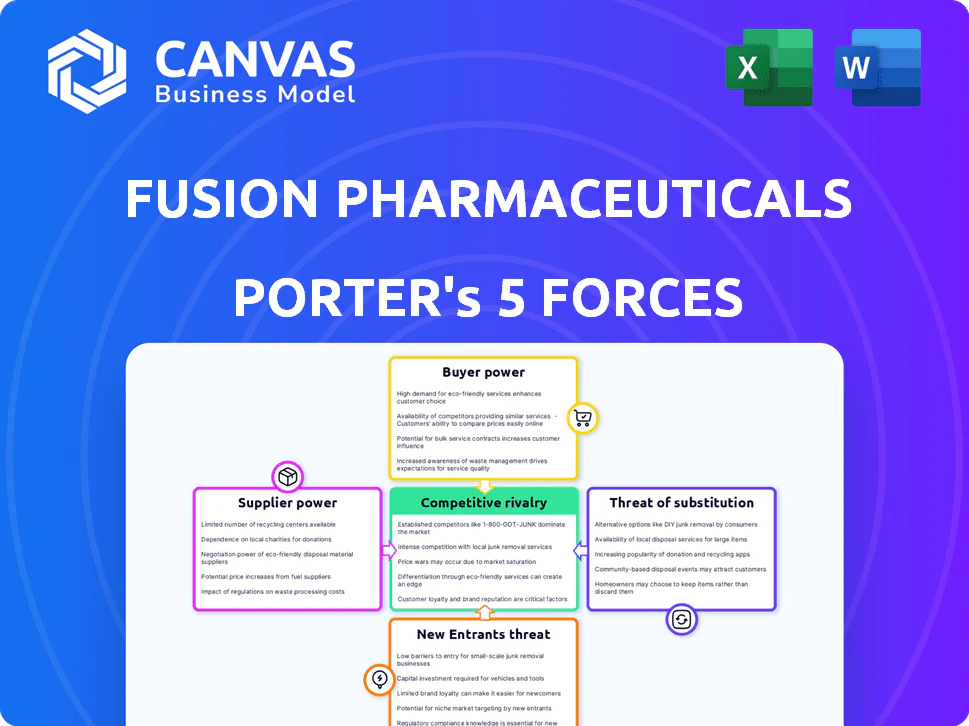
FUSION PHARMACEUTICALS PORTER'S FIVE FORCES TEMPLATE RESEARCH
What is included in the product
 Detailed Word Document
Tailored exclusively for Fusion Pharmaceuticals, analyzing its position within its competitive landscape.

 Customizable Excel Spreadsheet
Clean, simplified layout—ready to copy into pitch decks for quick strategic communication.
Preview the Actual Deliverable
Fusion Pharmaceuticals Porter's Five Forces Analysis
This preview details the Porter's Five Forces analysis for Fusion Pharmaceuticals. It examines the competitive landscape, including threat of new entrants, bargaining power of suppliers & buyers, and rivalry. The document also assesses the threat of substitutes and its impact. This is the exact analysis file you will download.

Porter's Five Forces Analysis Template

Don't Miss the Bigger Picture
Fusion Pharmaceuticals faces moderate supplier power, primarily influencing R&D costs. Buyer power is also moderate, driven by the presence of large healthcare providers. The threat of new entrants is low, due to high barriers to entry in the pharmaceutical industry. Substitute products pose a moderate threat, with alternative cancer treatments available. Finally, competitive rivalry is intense, characterized by established pharmaceutical giants.
This brief snapshot only scratches the surface. Unlock the full Porter's Five Forces Analysis to explore Fusion Pharmaceuticals’s competitive dynamics, market pressures, and strategic advantages in detail.
Suppliers Bargaining Power

Specialized Isotope Production
Fusion Pharmaceuticals faces supplier power challenges due to its reliance on a few specialized isotope providers. Actinium-225, critical for their radiopharmaceuticals, is a key example. Limited supplier options can inflate costs. In 2024, the market for medical isotopes saw prices fluctuate, highlighting supply vulnerabilities.
Proprietary Technology Components
Fusion Pharmaceuticals relies on proprietary technology components, including linkers and targeting molecules, crucial for its targeted alpha therapies. If these components are sourced from a few specialized suppliers, the suppliers could gain bargaining power. This could affect Fusion's profitability, especially if component costs increase. In 2024, the pharmaceutical industry saw a 6% increase in the cost of specialized components.

Manufacturing and Logistics Expertise
Fusion Pharmaceuticals' suppliers of manufacturing and logistics services for radiopharmaceuticals possess considerable bargaining power. The specialized nature of radiopharmaceutical production, involving short half-lives of isotopes, demands sophisticated facilities and logistics. Limited capacity and high demand further amplify supplier leverage. In 2024, the radiopharmaceutical market is valued at approximately $7 billion, highlighting the value these suppliers provide.

Reliance on Third-Party CROs
Fusion Pharmaceuticals, as a clinical-stage biotech, heavily depends on Contract Research Organizations (CROs) for clinical trials. This reliance can empower CROs with bargaining power, especially if Fusion depends on a few key providers. The concentration of clinical trial activities with specific CROs could lead to increased costs or unfavorable terms for Fusion. In 2024, the global CRO market was valued at approximately $77.8 billion, demonstrating the industry's significance.
- CROs are crucial for clinical-stage biotechs.
- Dependence on specific CROs can increase costs.
- The CRO market was valued at $77.8B in 2024.
- Bargaining power shifts to suppliers when few CROs are used.
Regulatory Hurdles for New Suppliers
Fusion Pharmaceuticals faces significant regulatory hurdles, especially concerning radioactive materials. Strict regulations limit the number of approved suppliers, bolstering their bargaining power. This scarcity allows suppliers to potentially dictate terms, impacting Fusion's operations. The FDA's rigorous approval process for radiopharmaceuticals further constrains supplier options.
- FDA approvals can take several years, impacting supplier availability.
- The specialized nature of radiopharmaceutical manufacturing increases supplier concentration.
- Compliance costs with regulatory standards can be substantial for suppliers.
- Supply chain disruptions are more likely due to fewer approved vendors.
Supplier Dynamics: Impacting Radiopharmaceutical Costs
Fusion Pharma's supplier power is significant due to reliance on specialized providers and regulatory constraints. Limited isotope and component suppliers can elevate costs, affecting profitability. The 2024 radiopharmaceutical market, valued at $7B, amplifies supplier influence.
| Supplier Type | Impact | 2024 Data |
|---|---|---|
| Isotope Providers | Cost Inflation, Supply Risk | Price Fluctuations |
| Component Suppliers | Profit Margin Pressure | 6% Cost Increase |
| CROs | Increased Costs, Unfavorable Terms | $77.8B Market Value |
Customers Bargaining Power

Targeted Patient Populations
Fusion Pharmaceuticals targets specific cancer types, making healthcare providers treating these patients their primary customers. The bargaining power of these customers is influenced by the size and concentration of the patient populations. For instance, the global cancer therapeutics market was valued at $175.7 billion in 2023, which is expected to reach $337.6 billion by 2030. This concentration can affect pricing and treatment choices.
Influence of Payers and Reimbursement
Payers, including insurance providers and government programs, wield considerable influence in the pharmaceutical sector. They negotiate prices and determine reimbursement rates, directly affecting a company's revenue. In 2024, payers' negotiations led to significant price reductions for certain drugs.

Clinical Trial Results and Treatment Options
The bargaining power of customers, including healthcare providers and patients, hinges on Fusion's clinical trial success and alternative treatments. Positive trial results and limited substitutes weaken customer power. Conversely, if competing treatments are available, like those from Novartis or Bayer, customer power increases. In 2024, the oncology market saw over $200 billion in sales, highlighting the stakes.

AstraZeneca Acquisition
Following AstraZeneca's acquisition, Fusion Pharmaceuticals' customer dynamics have transformed. AstraZeneca's extensive network and market reach will dictate how Fusion's radiopharmaceutical therapies are positioned. This shift could potentially alter pricing and access strategies for Fusion's innovations. The deal, valued at $2.4 billion in 2024, integrates Fusion's resources into AstraZeneca's portfolio.
- AstraZeneca's global sales in 2023 were approximately $45.8 billion.
- The acquisition aims to leverage AstraZeneca's existing oncology presence.
- Integration includes Fusion's pipeline, focusing on targeted radiopharmaceuticals.
- The deal enhances AstraZeneca's oncology portfolio expansion strategy.
Demand for Personalized Medicine
The rising demand for personalized medicine in oncology significantly impacts Fusion Pharmaceuticals. This shift towards tailored treatments could heighten the demand for their targeted therapies. If Fusion's treatments prove highly effective for specific patient groups, customer price sensitivity might decrease.
- Personalized medicine market is projected to reach $617.8 billion by 2030.
- Fusion's focus on targeted therapies aligns with the growing preference for precision medicine.
- Successful treatments could give Fusion more pricing power.
Fusion's Customer Bargaining Power: Key Factors
Fusion's customer bargaining power is shaped by healthcare providers, payers, and the availability of alternative treatments. The oncology market, valued at over $200 billion in 2024, is highly competitive. AstraZeneca's acquisition of Fusion, valued at $2.4 billion, further reshapes customer dynamics.
| Factor | Impact | Data |
|---|---|---|
| Healthcare Providers | Primary customers; concentration affects pricing. | Global cancer therapeutics market: $175.7B (2023), $337.6B (2030). |
| Payers | Influence pricing and reimbursement. | 2024: Significant price reductions negotiated. |
| Alternatives | Impact customer power; trial success is crucial. | Oncology sales in 2024: over $200B. |
Rivalry Among Competitors

Numerous Companies in Oncology and Radiopharmaceuticals
The oncology market, including radiopharmaceuticals, is fiercely competitive. Fusion Pharmaceuticals competes with established firms and biotechs. In 2024, the global oncology market was valued at over $200 billion. Rivalry includes companies like Novartis and Bayer.
Development of Targeted Alpha Therapies by Competitors
Several companies, including Bayer and Novartis, are developing targeted alpha therapies. The success of these therapies will intensify competition for Fusion Pharmaceuticals. For instance, Bayer's 2024 revenue from oncology was approximately $6.1 billion, reflecting strong industry interest.

Innovation and Differentiation
Competition in radiopharmaceuticals hinges on innovation. Fusion's Fast-Clear tech sets it apart, but rivals like Novartis and Bayer push boundaries. Novartis's 2023 radiopharmaceutical sales reached $2.3 billion, highlighting the fierce market. Research and development spending are crucial for differentiation and market share gains.

Strategic Partnerships and Acquisitions
The radiopharmaceutical market is heating up with strategic moves. Bigger pharma companies are forming partnerships and acquiring smaller players. This increases competition by injecting more funds and expertise into the game. For instance, in 2024, several mergers and acquisitions reshaped the oncology space. These moves can lead to faster drug development and market entry.
- Merck's acquisition of Harpoon Therapeutics for $680 million in 2024.
- Novartis's continued investment in radioligand therapy.
- Bayer's ongoing partnerships in oncology.
- Bristol Myers Squibb's deals to expand its oncology portfolio.
Clinical Trial Outcomes and Regulatory Approvals
Clinical trial outcomes and regulatory approvals are crucial for competitive rivalry in the pharmaceutical industry. Success in clinical trials and fast regulatory approvals can create a major competitive edge. For example, in 2024, the FDA approved 50 new drugs, showing the importance of swift approvals. Competitors with successful trials and approvals gain market share quickly.
- Successful clinical trials lead to significant revenue increases.
- Rapid regulatory approvals reduce time to market.
- Failure in trials can result in substantial financial losses.
- The FDA approved 50 new drugs in 2024.
Oncology Market Heats Up: Competition Intensifies!
Fusion Pharmaceuticals faces intense competition in the oncology market, with rivals like Novartis and Bayer. The oncology market was valued at over $200 billion in 2024. Successful clinical trials and regulatory approvals are critical for gaining market share.
| Company | 2024 Oncology Revenue (approx.) |
|---|---|
| Bayer | $6.1 billion |
| Novartis (Radiopharmaceuticals sales - 2023) | $2.3 billion |
| Merck (Harpoon Therapeutics Acquisition - 2024) | $680 million |
Original: $10.00
-65%$10.00
$3.50FUSION PHARMACEUTICALS PORTER'S FIVE FORCES TEMPLATE RESEARCH
What is included in the product
Detailed Word Document
Tailored exclusively for Fusion Pharmaceuticals, analyzing its position within its competitive landscape.
Customizable Excel Spreadsheet
Clean, simplified layout—ready to copy into pitch decks for quick strategic communication.
Preview the Actual Deliverable
Fusion Pharmaceuticals Porter's Five Forces Analysis
This preview details the Porter's Five Forces analysis for Fusion Pharmaceuticals. It examines the competitive landscape, including threat of new entrants, bargaining power of suppliers & buyers, and rivalry. The document also assesses the threat of substitutes and its impact. This is the exact analysis file you will download.
Porter's Five Forces Analysis Template
Don't Miss the Bigger Picture
Fusion Pharmaceuticals faces moderate supplier power, primarily influencing R&D costs. Buyer power is also moderate, driven by the presence of large healthcare providers. The threat of new entrants is low, due to high barriers to entry in the pharmaceutical industry. Substitute products pose a moderate threat, with alternative cancer treatments available. Finally, competitive rivalry is intense, characterized by established pharmaceutical giants.
This brief snapshot only scratches the surface. Unlock the full Porter's Five Forces Analysis to explore Fusion Pharmaceuticals’s competitive dynamics, market pressures, and strategic advantages in detail.
Suppliers Bargaining Power
Specialized Isotope Production
Fusion Pharmaceuticals faces supplier power challenges due to its reliance on a few specialized isotope providers. Actinium-225, critical for their radiopharmaceuticals, is a key example. Limited supplier options can inflate costs. In 2024, the market for medical isotopes saw prices fluctuate, highlighting supply vulnerabilities.
Proprietary Technology Components
Fusion Pharmaceuticals relies on proprietary technology components, including linkers and targeting molecules, crucial for its targeted alpha therapies. If these components are sourced from a few specialized suppliers, the suppliers could gain bargaining power. This could affect Fusion's profitability, especially if component costs increase. In 2024, the pharmaceutical industry saw a 6% increase in the cost of specialized components.
Manufacturing and Logistics Expertise
Fusion Pharmaceuticals' suppliers of manufacturing and logistics services for radiopharmaceuticals possess considerable bargaining power. The specialized nature of radiopharmaceutical production, involving short half-lives of isotopes, demands sophisticated facilities and logistics. Limited capacity and high demand further amplify supplier leverage. In 2024, the radiopharmaceutical market is valued at approximately $7 billion, highlighting the value these suppliers provide.
Reliance on Third-Party CROs
Fusion Pharmaceuticals, as a clinical-stage biotech, heavily depends on Contract Research Organizations (CROs) for clinical trials. This reliance can empower CROs with bargaining power, especially if Fusion depends on a few key providers. The concentration of clinical trial activities with specific CROs could lead to increased costs or unfavorable terms for Fusion. In 2024, the global CRO market was valued at approximately $77.8 billion, demonstrating the industry's significance.
- CROs are crucial for clinical-stage biotechs.
- Dependence on specific CROs can increase costs.
- The CRO market was valued at $77.8B in 2024.
- Bargaining power shifts to suppliers when few CROs are used.
Regulatory Hurdles for New Suppliers
Fusion Pharmaceuticals faces significant regulatory hurdles, especially concerning radioactive materials. Strict regulations limit the number of approved suppliers, bolstering their bargaining power. This scarcity allows suppliers to potentially dictate terms, impacting Fusion's operations. The FDA's rigorous approval process for radiopharmaceuticals further constrains supplier options.
- FDA approvals can take several years, impacting supplier availability.
- The specialized nature of radiopharmaceutical manufacturing increases supplier concentration.
- Compliance costs with regulatory standards can be substantial for suppliers.
- Supply chain disruptions are more likely due to fewer approved vendors.
Supplier Dynamics: Impacting Radiopharmaceutical Costs
Fusion Pharma's supplier power is significant due to reliance on specialized providers and regulatory constraints. Limited isotope and component suppliers can elevate costs, affecting profitability. The 2024 radiopharmaceutical market, valued at $7B, amplifies supplier influence.
| Supplier Type | Impact | 2024 Data |
|---|---|---|
| Isotope Providers | Cost Inflation, Supply Risk | Price Fluctuations |
| Component Suppliers | Profit Margin Pressure | 6% Cost Increase |
| CROs | Increased Costs, Unfavorable Terms | $77.8B Market Value |
Customers Bargaining Power
Targeted Patient Populations
Fusion Pharmaceuticals targets specific cancer types, making healthcare providers treating these patients their primary customers. The bargaining power of these customers is influenced by the size and concentration of the patient populations. For instance, the global cancer therapeutics market was valued at $175.7 billion in 2023, which is expected to reach $337.6 billion by 2030. This concentration can affect pricing and treatment choices.
Influence of Payers and Reimbursement
Payers, including insurance providers and government programs, wield considerable influence in the pharmaceutical sector. They negotiate prices and determine reimbursement rates, directly affecting a company's revenue. In 2024, payers' negotiations led to significant price reductions for certain drugs.
Clinical Trial Results and Treatment Options
The bargaining power of customers, including healthcare providers and patients, hinges on Fusion's clinical trial success and alternative treatments. Positive trial results and limited substitutes weaken customer power. Conversely, if competing treatments are available, like those from Novartis or Bayer, customer power increases. In 2024, the oncology market saw over $200 billion in sales, highlighting the stakes.
AstraZeneca Acquisition
Following AstraZeneca's acquisition, Fusion Pharmaceuticals' customer dynamics have transformed. AstraZeneca's extensive network and market reach will dictate how Fusion's radiopharmaceutical therapies are positioned. This shift could potentially alter pricing and access strategies for Fusion's innovations. The deal, valued at $2.4 billion in 2024, integrates Fusion's resources into AstraZeneca's portfolio.
- AstraZeneca's global sales in 2023 were approximately $45.8 billion.
- The acquisition aims to leverage AstraZeneca's existing oncology presence.
- Integration includes Fusion's pipeline, focusing on targeted radiopharmaceuticals.
- The deal enhances AstraZeneca's oncology portfolio expansion strategy.
Demand for Personalized Medicine
The rising demand for personalized medicine in oncology significantly impacts Fusion Pharmaceuticals. This shift towards tailored treatments could heighten the demand for their targeted therapies. If Fusion's treatments prove highly effective for specific patient groups, customer price sensitivity might decrease.
- Personalized medicine market is projected to reach $617.8 billion by 2030.
- Fusion's focus on targeted therapies aligns with the growing preference for precision medicine.
- Successful treatments could give Fusion more pricing power.
Fusion's Customer Bargaining Power: Key Factors
Fusion's customer bargaining power is shaped by healthcare providers, payers, and the availability of alternative treatments. The oncology market, valued at over $200 billion in 2024, is highly competitive. AstraZeneca's acquisition of Fusion, valued at $2.4 billion, further reshapes customer dynamics.
| Factor | Impact | Data |
|---|---|---|
| Healthcare Providers | Primary customers; concentration affects pricing. | Global cancer therapeutics market: $175.7B (2023), $337.6B (2030). |
| Payers | Influence pricing and reimbursement. | 2024: Significant price reductions negotiated. |
| Alternatives | Impact customer power; trial success is crucial. | Oncology sales in 2024: over $200B. |
Rivalry Among Competitors
Numerous Companies in Oncology and Radiopharmaceuticals
The oncology market, including radiopharmaceuticals, is fiercely competitive. Fusion Pharmaceuticals competes with established firms and biotechs. In 2024, the global oncology market was valued at over $200 billion. Rivalry includes companies like Novartis and Bayer.
Development of Targeted Alpha Therapies by Competitors
Several companies, including Bayer and Novartis, are developing targeted alpha therapies. The success of these therapies will intensify competition for Fusion Pharmaceuticals. For instance, Bayer's 2024 revenue from oncology was approximately $6.1 billion, reflecting strong industry interest.
Innovation and Differentiation
Competition in radiopharmaceuticals hinges on innovation. Fusion's Fast-Clear tech sets it apart, but rivals like Novartis and Bayer push boundaries. Novartis's 2023 radiopharmaceutical sales reached $2.3 billion, highlighting the fierce market. Research and development spending are crucial for differentiation and market share gains.
Strategic Partnerships and Acquisitions
The radiopharmaceutical market is heating up with strategic moves. Bigger pharma companies are forming partnerships and acquiring smaller players. This increases competition by injecting more funds and expertise into the game. For instance, in 2024, several mergers and acquisitions reshaped the oncology space. These moves can lead to faster drug development and market entry.
- Merck's acquisition of Harpoon Therapeutics for $680 million in 2024.
- Novartis's continued investment in radioligand therapy.
- Bayer's ongoing partnerships in oncology.
- Bristol Myers Squibb's deals to expand its oncology portfolio.
Clinical Trial Outcomes and Regulatory Approvals
Clinical trial outcomes and regulatory approvals are crucial for competitive rivalry in the pharmaceutical industry. Success in clinical trials and fast regulatory approvals can create a major competitive edge. For example, in 2024, the FDA approved 50 new drugs, showing the importance of swift approvals. Competitors with successful trials and approvals gain market share quickly.
- Successful clinical trials lead to significant revenue increases.
- Rapid regulatory approvals reduce time to market.
- Failure in trials can result in substantial financial losses.
- The FDA approved 50 new drugs in 2024.
Oncology Market Heats Up: Competition Intensifies!
Fusion Pharmaceuticals faces intense competition in the oncology market, with rivals like Novartis and Bayer. The oncology market was valued at over $200 billion in 2024. Successful clinical trials and regulatory approvals are critical for gaining market share.
| Company | 2024 Oncology Revenue (approx.) |
|---|---|
| Bayer | $6.1 billion |
| Novartis (Radiopharmaceuticals sales - 2023) | $2.3 billion |
| Merck (Harpoon Therapeutics Acquisition - 2024) | $680 million |
Product Information
Product Information
Shipping & Returns
Shipping & Returns
Description
What is included in the product
Detailed Word Document
Tailored exclusively for Fusion Pharmaceuticals, analyzing its position within its competitive landscape.
Customizable Excel Spreadsheet
Clean, simplified layout—ready to copy into pitch decks for quick strategic communication.
Preview the Actual Deliverable
Fusion Pharmaceuticals Porter's Five Forces Analysis
This preview details the Porter's Five Forces analysis for Fusion Pharmaceuticals. It examines the competitive landscape, including threat of new entrants, bargaining power of suppliers & buyers, and rivalry. The document also assesses the threat of substitutes and its impact. This is the exact analysis file you will download.
Porter's Five Forces Analysis Template
Don't Miss the Bigger Picture
Fusion Pharmaceuticals faces moderate supplier power, primarily influencing R&D costs. Buyer power is also moderate, driven by the presence of large healthcare providers. The threat of new entrants is low, due to high barriers to entry in the pharmaceutical industry. Substitute products pose a moderate threat, with alternative cancer treatments available. Finally, competitive rivalry is intense, characterized by established pharmaceutical giants.
This brief snapshot only scratches the surface. Unlock the full Porter's Five Forces Analysis to explore Fusion Pharmaceuticals’s competitive dynamics, market pressures, and strategic advantages in detail.
Suppliers Bargaining Power
Specialized Isotope Production
Fusion Pharmaceuticals faces supplier power challenges due to its reliance on a few specialized isotope providers. Actinium-225, critical for their radiopharmaceuticals, is a key example. Limited supplier options can inflate costs. In 2024, the market for medical isotopes saw prices fluctuate, highlighting supply vulnerabilities.
Proprietary Technology Components
Fusion Pharmaceuticals relies on proprietary technology components, including linkers and targeting molecules, crucial for its targeted alpha therapies. If these components are sourced from a few specialized suppliers, the suppliers could gain bargaining power. This could affect Fusion's profitability, especially if component costs increase. In 2024, the pharmaceutical industry saw a 6% increase in the cost of specialized components.
Manufacturing and Logistics Expertise
Fusion Pharmaceuticals' suppliers of manufacturing and logistics services for radiopharmaceuticals possess considerable bargaining power. The specialized nature of radiopharmaceutical production, involving short half-lives of isotopes, demands sophisticated facilities and logistics. Limited capacity and high demand further amplify supplier leverage. In 2024, the radiopharmaceutical market is valued at approximately $7 billion, highlighting the value these suppliers provide.
Reliance on Third-Party CROs
Fusion Pharmaceuticals, as a clinical-stage biotech, heavily depends on Contract Research Organizations (CROs) for clinical trials. This reliance can empower CROs with bargaining power, especially if Fusion depends on a few key providers. The concentration of clinical trial activities with specific CROs could lead to increased costs or unfavorable terms for Fusion. In 2024, the global CRO market was valued at approximately $77.8 billion, demonstrating the industry's significance.
- CROs are crucial for clinical-stage biotechs.
- Dependence on specific CROs can increase costs.
- The CRO market was valued at $77.8B in 2024.
- Bargaining power shifts to suppliers when few CROs are used.
Regulatory Hurdles for New Suppliers
Fusion Pharmaceuticals faces significant regulatory hurdles, especially concerning radioactive materials. Strict regulations limit the number of approved suppliers, bolstering their bargaining power. This scarcity allows suppliers to potentially dictate terms, impacting Fusion's operations. The FDA's rigorous approval process for radiopharmaceuticals further constrains supplier options.
- FDA approvals can take several years, impacting supplier availability.
- The specialized nature of radiopharmaceutical manufacturing increases supplier concentration.
- Compliance costs with regulatory standards can be substantial for suppliers.
- Supply chain disruptions are more likely due to fewer approved vendors.
Supplier Dynamics: Impacting Radiopharmaceutical Costs
Fusion Pharma's supplier power is significant due to reliance on specialized providers and regulatory constraints. Limited isotope and component suppliers can elevate costs, affecting profitability. The 2024 radiopharmaceutical market, valued at $7B, amplifies supplier influence.
| Supplier Type | Impact | 2024 Data |
|---|---|---|
| Isotope Providers | Cost Inflation, Supply Risk | Price Fluctuations |
| Component Suppliers | Profit Margin Pressure | 6% Cost Increase |
| CROs | Increased Costs, Unfavorable Terms | $77.8B Market Value |
Customers Bargaining Power
Targeted Patient Populations
Fusion Pharmaceuticals targets specific cancer types, making healthcare providers treating these patients their primary customers. The bargaining power of these customers is influenced by the size and concentration of the patient populations. For instance, the global cancer therapeutics market was valued at $175.7 billion in 2023, which is expected to reach $337.6 billion by 2030. This concentration can affect pricing and treatment choices.
Influence of Payers and Reimbursement
Payers, including insurance providers and government programs, wield considerable influence in the pharmaceutical sector. They negotiate prices and determine reimbursement rates, directly affecting a company's revenue. In 2024, payers' negotiations led to significant price reductions for certain drugs.
Clinical Trial Results and Treatment Options
The bargaining power of customers, including healthcare providers and patients, hinges on Fusion's clinical trial success and alternative treatments. Positive trial results and limited substitutes weaken customer power. Conversely, if competing treatments are available, like those from Novartis or Bayer, customer power increases. In 2024, the oncology market saw over $200 billion in sales, highlighting the stakes.
AstraZeneca Acquisition
Following AstraZeneca's acquisition, Fusion Pharmaceuticals' customer dynamics have transformed. AstraZeneca's extensive network and market reach will dictate how Fusion's radiopharmaceutical therapies are positioned. This shift could potentially alter pricing and access strategies for Fusion's innovations. The deal, valued at $2.4 billion in 2024, integrates Fusion's resources into AstraZeneca's portfolio.
- AstraZeneca's global sales in 2023 were approximately $45.8 billion.
- The acquisition aims to leverage AstraZeneca's existing oncology presence.
- Integration includes Fusion's pipeline, focusing on targeted radiopharmaceuticals.
- The deal enhances AstraZeneca's oncology portfolio expansion strategy.
Demand for Personalized Medicine
The rising demand for personalized medicine in oncology significantly impacts Fusion Pharmaceuticals. This shift towards tailored treatments could heighten the demand for their targeted therapies. If Fusion's treatments prove highly effective for specific patient groups, customer price sensitivity might decrease.
- Personalized medicine market is projected to reach $617.8 billion by 2030.
- Fusion's focus on targeted therapies aligns with the growing preference for precision medicine.
- Successful treatments could give Fusion more pricing power.
Fusion's Customer Bargaining Power: Key Factors
Fusion's customer bargaining power is shaped by healthcare providers, payers, and the availability of alternative treatments. The oncology market, valued at over $200 billion in 2024, is highly competitive. AstraZeneca's acquisition of Fusion, valued at $2.4 billion, further reshapes customer dynamics.
| Factor | Impact | Data |
|---|---|---|
| Healthcare Providers | Primary customers; concentration affects pricing. | Global cancer therapeutics market: $175.7B (2023), $337.6B (2030). |
| Payers | Influence pricing and reimbursement. | 2024: Significant price reductions negotiated. |
| Alternatives | Impact customer power; trial success is crucial. | Oncology sales in 2024: over $200B. |
Rivalry Among Competitors
Numerous Companies in Oncology and Radiopharmaceuticals
The oncology market, including radiopharmaceuticals, is fiercely competitive. Fusion Pharmaceuticals competes with established firms and biotechs. In 2024, the global oncology market was valued at over $200 billion. Rivalry includes companies like Novartis and Bayer.
Development of Targeted Alpha Therapies by Competitors
Several companies, including Bayer and Novartis, are developing targeted alpha therapies. The success of these therapies will intensify competition for Fusion Pharmaceuticals. For instance, Bayer's 2024 revenue from oncology was approximately $6.1 billion, reflecting strong industry interest.
Innovation and Differentiation
Competition in radiopharmaceuticals hinges on innovation. Fusion's Fast-Clear tech sets it apart, but rivals like Novartis and Bayer push boundaries. Novartis's 2023 radiopharmaceutical sales reached $2.3 billion, highlighting the fierce market. Research and development spending are crucial for differentiation and market share gains.
Strategic Partnerships and Acquisitions
The radiopharmaceutical market is heating up with strategic moves. Bigger pharma companies are forming partnerships and acquiring smaller players. This increases competition by injecting more funds and expertise into the game. For instance, in 2024, several mergers and acquisitions reshaped the oncology space. These moves can lead to faster drug development and market entry.
- Merck's acquisition of Harpoon Therapeutics for $680 million in 2024.
- Novartis's continued investment in radioligand therapy.
- Bayer's ongoing partnerships in oncology.
- Bristol Myers Squibb's deals to expand its oncology portfolio.
Clinical Trial Outcomes and Regulatory Approvals
Clinical trial outcomes and regulatory approvals are crucial for competitive rivalry in the pharmaceutical industry. Success in clinical trials and fast regulatory approvals can create a major competitive edge. For example, in 2024, the FDA approved 50 new drugs, showing the importance of swift approvals. Competitors with successful trials and approvals gain market share quickly.
- Successful clinical trials lead to significant revenue increases.
- Rapid regulatory approvals reduce time to market.
- Failure in trials can result in substantial financial losses.
- The FDA approved 50 new drugs in 2024.
Oncology Market Heats Up: Competition Intensifies!
Fusion Pharmaceuticals faces intense competition in the oncology market, with rivals like Novartis and Bayer. The oncology market was valued at over $200 billion in 2024. Successful clinical trials and regulatory approvals are critical for gaining market share.
| Company | 2024 Oncology Revenue (approx.) |
|---|---|
| Bayer | $6.1 billion |
| Novartis (Radiopharmaceuticals sales - 2023) | $2.3 billion |
| Merck (Harpoon Therapeutics Acquisition - 2024) | $680 million |











