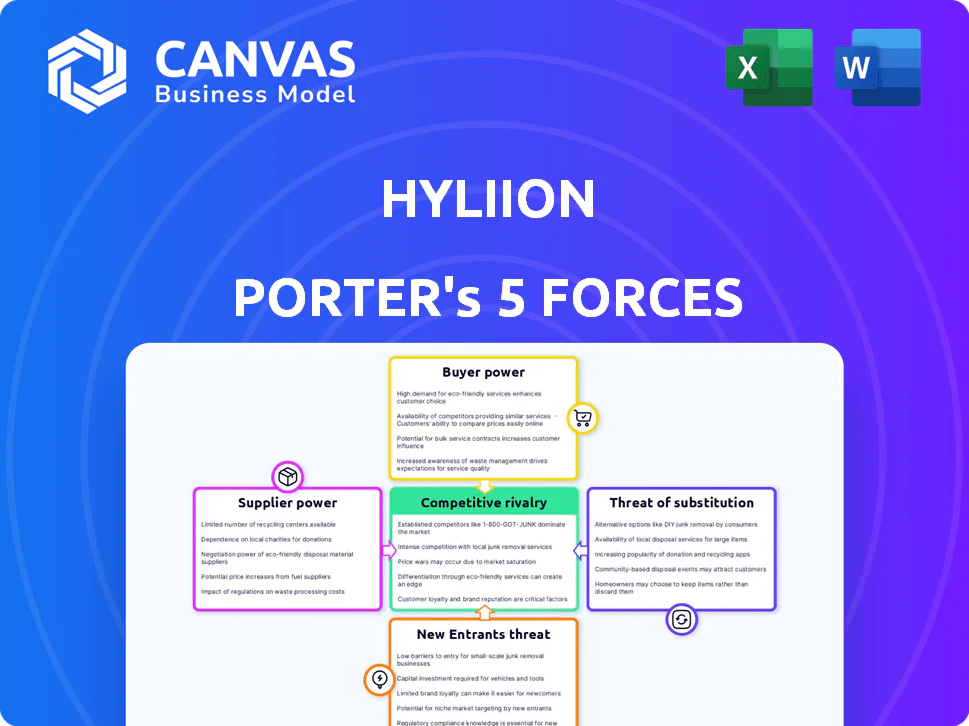
HYLIION PORTER'S FIVE FORCES TEMPLATE RESEARCH
What is included in the product
 Detailed Word Document
Analyzes Hyliion's competitive environment, highlighting supplier/buyer power & potential threats.

 Customizable Excel Spreadsheet
Customizable charts that highlight areas of vulnerability and strength.
Preview the Actual Deliverable
Hyliion Porter's Five Forces Analysis
This preview is the complete Porter's Five Forces analysis for Hyliion. It covers all aspects of competitive rivalry. The document examines the threat of new entrants, buyer power, and supplier power, as well as the threat of substitutes. You get instant access to this analysis after purchase.

Porter's Five Forces Analysis Template

A Must-Have Tool for Decision-Makers
Hyliion's electric powertrain solutions face complex industry dynamics. The threat of new entrants is moderate due to high R&D costs. Buyer power is increasing as adoption grows, creating some price sensitivity. Supplier power is influenced by battery technology and component availability. Substitute products, like hydrogen fuel cells, pose a moderate threat. Competitive rivalry intensifies with established OEMs and emerging EV startups.
Our full Porter's Five Forces report goes deeper—offering a data-driven framework to understand Hyliion's real business risks and market opportunities.
Suppliers Bargaining Power

Limited number of specialized component suppliers
Hyliion faces supplier power challenges due to its reliance on a few specialized component providers. This includes batteries, semiconductors, and software, critical for its electric powertrains. This concentration allows suppliers to influence prices and availability, affecting Hyliion's operations. In 2024, semiconductor shortages and battery price volatility continue to impact the EV industry.
High switching costs for alternative materials
Hyliion faces high switching costs when changing suppliers for essential materials. This includes expenses for integration, and performance validation, reducing flexibility. The high costs elevate suppliers' bargaining power. As of 2024, Hyliion's operational expenses include significant costs associated with material sourcing and validation processes.

Suppliers' influence on pricing for proprietary technology
Hyliion's suppliers of proprietary tech, like power electronics, hold substantial pricing power, impacting production costs. These specialized components, essential for Hyliion's hybrid and electric powertrains, constitute a significant expense. For example, in 2024, the cost of such components could represent up to 40% of the total manufacturing expenses. This reliance enables suppliers to dictate terms and prices.

Dependency on advanced battery and energy management systems
Hyliion's performance hinges on advanced battery and energy management systems. This dependency grants significant bargaining power to suppliers of these critical components. High-quality, efficient systems are essential for Hyliion's product success, increasing supplier leverage. Securing favorable terms is crucial for Hyliion's profitability.
- In 2024, the global market for advanced battery systems was valued at $150 billion.
- Energy management system costs can constitute up to 30% of a hybrid vehicle's total production expenses.
- Leading battery suppliers, like CATL and BYD, have market shares exceeding 20%.
- Hyliion's operational efficiency could be impacted by a 10-15% increase in battery costs.
Supply chain disruptions
Hyliion faces supplier bargaining power challenges, particularly with supply chain disruptions. These disruptions have caused production delays and affected product delivery schedules. This vulnerability is evident in the electric vehicle industry, where component shortages are common. In 2024, the automotive industry saw supply chain issues persist.
- Hyliion experienced delays in the past due to supplier issues.
- The automotive industry faced ongoing supply chain challenges in 2024.
- Component shortages are a common issue in the electric vehicle sector.
Supplier Power: A Challenge for Production
Hyliion's reliance on specialized suppliers, like battery and semiconductor providers, increases their bargaining power. High switching costs for essential components further strengthen suppliers' influence on pricing and availability. This dynamic is intensified by supply chain disruptions, potentially delaying production.
| Supplier Factor | Impact on Hyliion | 2024 Data Point |
|---|---|---|
| Component Scarcity | Production Delays | Semiconductor lead times averaged 20 weeks. |
| Proprietary Tech | Higher Costs | Power electronics costs up to 40% of expenses. |
| Supply Chain Issues | Operational Inefficiency | Automotive supply chain disruptions persist. |
Customers Bargaining Power

Large fleet operators
Hyliion's main customers are big commercial trucking fleet operators. These operators wield considerable power in negotiations. Because they buy in bulk, they can push for better prices and conditions. In 2024, large fleets account for over 60% of Class 8 truck sales, indicating their strong influence.
Availability of alternative solutions
Customers possess considerable bargaining power due to the availability of alternatives to Hyliion's products. They can choose from conventional diesel trucks, which still hold a significant market share, or explore other clean energy solutions. This variety limits Hyliion's ability to dictate pricing or terms. For example, in 2024, diesel truck sales continue to be substantial, with the market share of alternative fuel vehicles still growing, yet at a moderate pace, indicating a competitive landscape.

Demonstrated performance and reliability requirements
Commercial trucking customers demand proven performance and reliability, critical for their operations. Hyliion must showcase its technology's value to gain and keep customers. In 2024, the U.S. trucking industry generated over $875 billion in revenue. This high-stakes environment necessitates robust solutions.

Government incentives and regulations
Government incentives and regulations play a significant role in shaping customer choices within the clean transportation sector. These policies, such as tax credits or subsidies, can make alternative fuel vehicles, like those offered by Hyliion, more appealing to customers. Customers gain bargaining power by comparing the benefits of various technologies, including those eligible for government support, to negotiate better deals. For example, in 2024, the Inflation Reduction Act in the U.S. offers substantial tax credits for electric vehicle purchases, potentially increasing customer leverage.
- Tax credits and subsidies directly lower the cost of adopting cleaner technologies.
- Regulations, like emission standards, can create demand for Hyliion's products.
- Customers can compare incentives across different providers.
- Policy changes can rapidly shift market dynamics.
Customer adoption of new technology
Customer adoption of new technology in the commercial trucking sector can be a slow process. Hyliion faces the challenge of persuading customers to embrace their solutions, especially given the industry's traditional reluctance to change. To gain traction, Hyliion must clearly showcase the long-term financial advantages and operational benefits of their products. This involves demonstrating a strong return on investment and addressing any customer concerns about reliability or maintenance.
- The average lifespan of a commercial truck is around 7-10 years, influencing the pace of technology adoption.
- In 2024, the electric truck market share is still small, around 1-2% of total truck sales, but growing.
- Hyliion's success hinges on proving that their technology offers a lower total cost of ownership (TCO) compared to traditional diesel trucks.
- Customer hesitance often stems from concerns about charging infrastructure and the availability of service and support for new technologies.
Trucking Industry's $875B Revenue & Bargaining Power
Commercial trucking fleet operators have significant bargaining power, especially when purchasing in bulk. They can negotiate favorable terms due to the availability of various alternatives, including diesel trucks and other clean energy solutions. Government incentives also shape customer choices, offering leverage in negotiations. In 2024, the U.S. trucking industry generated over $875 billion in revenue.
| Aspect | Impact | 2024 Data |
|---|---|---|
| Fleet Size | Bulk purchasing power | Large fleets account for >60% of Class 8 truck sales |
| Alternatives | Choice of diesel or other fuel | Diesel trucks hold a significant market share |
| Incentives | Influence on adoption | Inflation Reduction Act offers tax credits |
Rivalry Among Competitors

Presence of established truck manufacturers
Established truck manufacturers present a formidable challenge. They have significant market share; for example, Daimler Trucks reported approximately $55.1 billion in revenue in 2023. They also have strong brand recognition. These companies already possess extensive customer relationships, which Hyliion must compete with to gain traction. The competitive landscape is therefore quite challenging.
Emerging electric vehicle competitors
Hyliion contends with rivals in the electric and alternative fuel powertrain market for commercial vehicles. Companies like Tesla and established truck manufacturers are investing heavily. In 2024, Tesla's Semi deliveries increased, intensifying competition. This rivalry pressures Hyliion on pricing and innovation.

Technological advancements by competitors
Hyliion faces intense competition as rivals advance in electric and alternative fuel technologies. Companies like Nikola and Cummins are also heavily investing in R&D. In 2024, Nikola's market cap was around $800 million, showing the scale of competition. This forces Hyliion to innovate quickly to maintain its market position.

Pricing pressure in the market
Hyliion faces pricing pressure due to the need to compete with diesel trucks and other alternative fuel options. The company must offer cost-effective solutions to attract customers in a market where price sensitivity is high. This pressure can impact profit margins and the overall financial performance of Hyliion. In 2024, the average cost of a new diesel truck was around $180,000, while Hyliion's hybrid solution might be priced competitively.
- Cost of Diesel Trucks: Around $180,000 in 2024.
- Competitive Pricing: Hyliion's hybrid solutions must be price-competitive.
- Profit Margin Impact: Pricing pressure can affect Hyliion's profitability.
- Market Dynamics: The alternative fuel market is rapidly evolving.
Brand recognition and customer loyalty
Brand recognition and customer loyalty are significant in the competitive landscape. Established rivals like Daimler Truck and Volvo Trucks have built strong brand recognition over decades, which translates into customer loyalty. This makes it difficult for newcomers like Hyliion to capture market share quickly. For instance, in 2024, Daimler Truck reported a global sales volume of approximately 520,000 units. This strong performance highlights the advantage of established brands.
- Established brands have a significant advantage.
- Customer loyalty is a key barrier to entry.
- New entrants face an uphill battle for market share.
- Daimler Truck's 2024 sales volume is around 520,000 units.
Commercial Vehicle Market: A Competitive Landscape
Competitive rivalry within the commercial vehicle market is intense, with established brands like Daimler Truck, which had approximately $55.1 billion in revenue in 2023, holding a significant advantage.
Hyliion faces pressure from competitors, including Tesla, whose Semi deliveries increased in 2024, and other alternative fuel powertrain providers.
Pricing is a critical factor, as Hyliion must compete with diesel trucks, which cost around $180,000 in 2024, impacting profit margins.
| Aspect | Details |
|---|---|
| Established Rivals | Daimler Truck's 2023 revenue: ~$55.1B |
| Competitive Pressure | Tesla Semi deliveries increased in 2024 |
| Pricing Dynamics | Avg. diesel truck cost ~$180,000 in 2024 |
Original: $10.00
-65%$10.00
$3.50HYLIION PORTER'S FIVE FORCES TEMPLATE RESEARCH
What is included in the product
Detailed Word Document
Analyzes Hyliion's competitive environment, highlighting supplier/buyer power & potential threats.
Customizable Excel Spreadsheet
Customizable charts that highlight areas of vulnerability and strength.
Preview the Actual Deliverable
Hyliion Porter's Five Forces Analysis
This preview is the complete Porter's Five Forces analysis for Hyliion. It covers all aspects of competitive rivalry. The document examines the threat of new entrants, buyer power, and supplier power, as well as the threat of substitutes. You get instant access to this analysis after purchase.
Porter's Five Forces Analysis Template
A Must-Have Tool for Decision-Makers
Hyliion's electric powertrain solutions face complex industry dynamics. The threat of new entrants is moderate due to high R&D costs. Buyer power is increasing as adoption grows, creating some price sensitivity. Supplier power is influenced by battery technology and component availability. Substitute products, like hydrogen fuel cells, pose a moderate threat. Competitive rivalry intensifies with established OEMs and emerging EV startups.
Our full Porter's Five Forces report goes deeper—offering a data-driven framework to understand Hyliion's real business risks and market opportunities.
Suppliers Bargaining Power
Limited number of specialized component suppliers
Hyliion faces supplier power challenges due to its reliance on a few specialized component providers. This includes batteries, semiconductors, and software, critical for its electric powertrains. This concentration allows suppliers to influence prices and availability, affecting Hyliion's operations. In 2024, semiconductor shortages and battery price volatility continue to impact the EV industry.
High switching costs for alternative materials
Hyliion faces high switching costs when changing suppliers for essential materials. This includes expenses for integration, and performance validation, reducing flexibility. The high costs elevate suppliers' bargaining power. As of 2024, Hyliion's operational expenses include significant costs associated with material sourcing and validation processes.
Suppliers' influence on pricing for proprietary technology
Hyliion's suppliers of proprietary tech, like power electronics, hold substantial pricing power, impacting production costs. These specialized components, essential for Hyliion's hybrid and electric powertrains, constitute a significant expense. For example, in 2024, the cost of such components could represent up to 40% of the total manufacturing expenses. This reliance enables suppliers to dictate terms and prices.
Dependency on advanced battery and energy management systems
Hyliion's performance hinges on advanced battery and energy management systems. This dependency grants significant bargaining power to suppliers of these critical components. High-quality, efficient systems are essential for Hyliion's product success, increasing supplier leverage. Securing favorable terms is crucial for Hyliion's profitability.
- In 2024, the global market for advanced battery systems was valued at $150 billion.
- Energy management system costs can constitute up to 30% of a hybrid vehicle's total production expenses.
- Leading battery suppliers, like CATL and BYD, have market shares exceeding 20%.
- Hyliion's operational efficiency could be impacted by a 10-15% increase in battery costs.
Supply chain disruptions
Hyliion faces supplier bargaining power challenges, particularly with supply chain disruptions. These disruptions have caused production delays and affected product delivery schedules. This vulnerability is evident in the electric vehicle industry, where component shortages are common. In 2024, the automotive industry saw supply chain issues persist.
- Hyliion experienced delays in the past due to supplier issues.
- The automotive industry faced ongoing supply chain challenges in 2024.
- Component shortages are a common issue in the electric vehicle sector.
Supplier Power: A Challenge for Production
Hyliion's reliance on specialized suppliers, like battery and semiconductor providers, increases their bargaining power. High switching costs for essential components further strengthen suppliers' influence on pricing and availability. This dynamic is intensified by supply chain disruptions, potentially delaying production.
| Supplier Factor | Impact on Hyliion | 2024 Data Point |
|---|---|---|
| Component Scarcity | Production Delays | Semiconductor lead times averaged 20 weeks. |
| Proprietary Tech | Higher Costs | Power electronics costs up to 40% of expenses. |
| Supply Chain Issues | Operational Inefficiency | Automotive supply chain disruptions persist. |
Customers Bargaining Power
Large fleet operators
Hyliion's main customers are big commercial trucking fleet operators. These operators wield considerable power in negotiations. Because they buy in bulk, they can push for better prices and conditions. In 2024, large fleets account for over 60% of Class 8 truck sales, indicating their strong influence.
Availability of alternative solutions
Customers possess considerable bargaining power due to the availability of alternatives to Hyliion's products. They can choose from conventional diesel trucks, which still hold a significant market share, or explore other clean energy solutions. This variety limits Hyliion's ability to dictate pricing or terms. For example, in 2024, diesel truck sales continue to be substantial, with the market share of alternative fuel vehicles still growing, yet at a moderate pace, indicating a competitive landscape.
Demonstrated performance and reliability requirements
Commercial trucking customers demand proven performance and reliability, critical for their operations. Hyliion must showcase its technology's value to gain and keep customers. In 2024, the U.S. trucking industry generated over $875 billion in revenue. This high-stakes environment necessitates robust solutions.
Government incentives and regulations
Government incentives and regulations play a significant role in shaping customer choices within the clean transportation sector. These policies, such as tax credits or subsidies, can make alternative fuel vehicles, like those offered by Hyliion, more appealing to customers. Customers gain bargaining power by comparing the benefits of various technologies, including those eligible for government support, to negotiate better deals. For example, in 2024, the Inflation Reduction Act in the U.S. offers substantial tax credits for electric vehicle purchases, potentially increasing customer leverage.
- Tax credits and subsidies directly lower the cost of adopting cleaner technologies.
- Regulations, like emission standards, can create demand for Hyliion's products.
- Customers can compare incentives across different providers.
- Policy changes can rapidly shift market dynamics.
Customer adoption of new technology
Customer adoption of new technology in the commercial trucking sector can be a slow process. Hyliion faces the challenge of persuading customers to embrace their solutions, especially given the industry's traditional reluctance to change. To gain traction, Hyliion must clearly showcase the long-term financial advantages and operational benefits of their products. This involves demonstrating a strong return on investment and addressing any customer concerns about reliability or maintenance.
- The average lifespan of a commercial truck is around 7-10 years, influencing the pace of technology adoption.
- In 2024, the electric truck market share is still small, around 1-2% of total truck sales, but growing.
- Hyliion's success hinges on proving that their technology offers a lower total cost of ownership (TCO) compared to traditional diesel trucks.
- Customer hesitance often stems from concerns about charging infrastructure and the availability of service and support for new technologies.
Trucking Industry's $875B Revenue & Bargaining Power
Commercial trucking fleet operators have significant bargaining power, especially when purchasing in bulk. They can negotiate favorable terms due to the availability of various alternatives, including diesel trucks and other clean energy solutions. Government incentives also shape customer choices, offering leverage in negotiations. In 2024, the U.S. trucking industry generated over $875 billion in revenue.
| Aspect | Impact | 2024 Data |
|---|---|---|
| Fleet Size | Bulk purchasing power | Large fleets account for >60% of Class 8 truck sales |
| Alternatives | Choice of diesel or other fuel | Diesel trucks hold a significant market share |
| Incentives | Influence on adoption | Inflation Reduction Act offers tax credits |
Rivalry Among Competitors
Presence of established truck manufacturers
Established truck manufacturers present a formidable challenge. They have significant market share; for example, Daimler Trucks reported approximately $55.1 billion in revenue in 2023. They also have strong brand recognition. These companies already possess extensive customer relationships, which Hyliion must compete with to gain traction. The competitive landscape is therefore quite challenging.
Emerging electric vehicle competitors
Hyliion contends with rivals in the electric and alternative fuel powertrain market for commercial vehicles. Companies like Tesla and established truck manufacturers are investing heavily. In 2024, Tesla's Semi deliveries increased, intensifying competition. This rivalry pressures Hyliion on pricing and innovation.
Technological advancements by competitors
Hyliion faces intense competition as rivals advance in electric and alternative fuel technologies. Companies like Nikola and Cummins are also heavily investing in R&D. In 2024, Nikola's market cap was around $800 million, showing the scale of competition. This forces Hyliion to innovate quickly to maintain its market position.
Pricing pressure in the market
Hyliion faces pricing pressure due to the need to compete with diesel trucks and other alternative fuel options. The company must offer cost-effective solutions to attract customers in a market where price sensitivity is high. This pressure can impact profit margins and the overall financial performance of Hyliion. In 2024, the average cost of a new diesel truck was around $180,000, while Hyliion's hybrid solution might be priced competitively.
- Cost of Diesel Trucks: Around $180,000 in 2024.
- Competitive Pricing: Hyliion's hybrid solutions must be price-competitive.
- Profit Margin Impact: Pricing pressure can affect Hyliion's profitability.
- Market Dynamics: The alternative fuel market is rapidly evolving.
Brand recognition and customer loyalty
Brand recognition and customer loyalty are significant in the competitive landscape. Established rivals like Daimler Truck and Volvo Trucks have built strong brand recognition over decades, which translates into customer loyalty. This makes it difficult for newcomers like Hyliion to capture market share quickly. For instance, in 2024, Daimler Truck reported a global sales volume of approximately 520,000 units. This strong performance highlights the advantage of established brands.
- Established brands have a significant advantage.
- Customer loyalty is a key barrier to entry.
- New entrants face an uphill battle for market share.
- Daimler Truck's 2024 sales volume is around 520,000 units.
Commercial Vehicle Market: A Competitive Landscape
Competitive rivalry within the commercial vehicle market is intense, with established brands like Daimler Truck, which had approximately $55.1 billion in revenue in 2023, holding a significant advantage.
Hyliion faces pressure from competitors, including Tesla, whose Semi deliveries increased in 2024, and other alternative fuel powertrain providers.
Pricing is a critical factor, as Hyliion must compete with diesel trucks, which cost around $180,000 in 2024, impacting profit margins.
| Aspect | Details |
|---|---|
| Established Rivals | Daimler Truck's 2023 revenue: ~$55.1B |
| Competitive Pressure | Tesla Semi deliveries increased in 2024 |
| Pricing Dynamics | Avg. diesel truck cost ~$180,000 in 2024 |
Product Information
Product Information
Shipping & Returns
Shipping & Returns
Description
What is included in the product
Detailed Word Document
Analyzes Hyliion's competitive environment, highlighting supplier/buyer power & potential threats.
Customizable Excel Spreadsheet
Customizable charts that highlight areas of vulnerability and strength.
Preview the Actual Deliverable
Hyliion Porter's Five Forces Analysis
This preview is the complete Porter's Five Forces analysis for Hyliion. It covers all aspects of competitive rivalry. The document examines the threat of new entrants, buyer power, and supplier power, as well as the threat of substitutes. You get instant access to this analysis after purchase.
Porter's Five Forces Analysis Template
A Must-Have Tool for Decision-Makers
Hyliion's electric powertrain solutions face complex industry dynamics. The threat of new entrants is moderate due to high R&D costs. Buyer power is increasing as adoption grows, creating some price sensitivity. Supplier power is influenced by battery technology and component availability. Substitute products, like hydrogen fuel cells, pose a moderate threat. Competitive rivalry intensifies with established OEMs and emerging EV startups.
Our full Porter's Five Forces report goes deeper—offering a data-driven framework to understand Hyliion's real business risks and market opportunities.
Suppliers Bargaining Power
Limited number of specialized component suppliers
Hyliion faces supplier power challenges due to its reliance on a few specialized component providers. This includes batteries, semiconductors, and software, critical for its electric powertrains. This concentration allows suppliers to influence prices and availability, affecting Hyliion's operations. In 2024, semiconductor shortages and battery price volatility continue to impact the EV industry.
High switching costs for alternative materials
Hyliion faces high switching costs when changing suppliers for essential materials. This includes expenses for integration, and performance validation, reducing flexibility. The high costs elevate suppliers' bargaining power. As of 2024, Hyliion's operational expenses include significant costs associated with material sourcing and validation processes.
Suppliers' influence on pricing for proprietary technology
Hyliion's suppliers of proprietary tech, like power electronics, hold substantial pricing power, impacting production costs. These specialized components, essential for Hyliion's hybrid and electric powertrains, constitute a significant expense. For example, in 2024, the cost of such components could represent up to 40% of the total manufacturing expenses. This reliance enables suppliers to dictate terms and prices.
Dependency on advanced battery and energy management systems
Hyliion's performance hinges on advanced battery and energy management systems. This dependency grants significant bargaining power to suppliers of these critical components. High-quality, efficient systems are essential for Hyliion's product success, increasing supplier leverage. Securing favorable terms is crucial for Hyliion's profitability.
- In 2024, the global market for advanced battery systems was valued at $150 billion.
- Energy management system costs can constitute up to 30% of a hybrid vehicle's total production expenses.
- Leading battery suppliers, like CATL and BYD, have market shares exceeding 20%.
- Hyliion's operational efficiency could be impacted by a 10-15% increase in battery costs.
Supply chain disruptions
Hyliion faces supplier bargaining power challenges, particularly with supply chain disruptions. These disruptions have caused production delays and affected product delivery schedules. This vulnerability is evident in the electric vehicle industry, where component shortages are common. In 2024, the automotive industry saw supply chain issues persist.
- Hyliion experienced delays in the past due to supplier issues.
- The automotive industry faced ongoing supply chain challenges in 2024.
- Component shortages are a common issue in the electric vehicle sector.
Supplier Power: A Challenge for Production
Hyliion's reliance on specialized suppliers, like battery and semiconductor providers, increases their bargaining power. High switching costs for essential components further strengthen suppliers' influence on pricing and availability. This dynamic is intensified by supply chain disruptions, potentially delaying production.
| Supplier Factor | Impact on Hyliion | 2024 Data Point |
|---|---|---|
| Component Scarcity | Production Delays | Semiconductor lead times averaged 20 weeks. |
| Proprietary Tech | Higher Costs | Power electronics costs up to 40% of expenses. |
| Supply Chain Issues | Operational Inefficiency | Automotive supply chain disruptions persist. |
Customers Bargaining Power
Large fleet operators
Hyliion's main customers are big commercial trucking fleet operators. These operators wield considerable power in negotiations. Because they buy in bulk, they can push for better prices and conditions. In 2024, large fleets account for over 60% of Class 8 truck sales, indicating their strong influence.
Availability of alternative solutions
Customers possess considerable bargaining power due to the availability of alternatives to Hyliion's products. They can choose from conventional diesel trucks, which still hold a significant market share, or explore other clean energy solutions. This variety limits Hyliion's ability to dictate pricing or terms. For example, in 2024, diesel truck sales continue to be substantial, with the market share of alternative fuel vehicles still growing, yet at a moderate pace, indicating a competitive landscape.
Demonstrated performance and reliability requirements
Commercial trucking customers demand proven performance and reliability, critical for their operations. Hyliion must showcase its technology's value to gain and keep customers. In 2024, the U.S. trucking industry generated over $875 billion in revenue. This high-stakes environment necessitates robust solutions.
Government incentives and regulations
Government incentives and regulations play a significant role in shaping customer choices within the clean transportation sector. These policies, such as tax credits or subsidies, can make alternative fuel vehicles, like those offered by Hyliion, more appealing to customers. Customers gain bargaining power by comparing the benefits of various technologies, including those eligible for government support, to negotiate better deals. For example, in 2024, the Inflation Reduction Act in the U.S. offers substantial tax credits for electric vehicle purchases, potentially increasing customer leverage.
- Tax credits and subsidies directly lower the cost of adopting cleaner technologies.
- Regulations, like emission standards, can create demand for Hyliion's products.
- Customers can compare incentives across different providers.
- Policy changes can rapidly shift market dynamics.
Customer adoption of new technology
Customer adoption of new technology in the commercial trucking sector can be a slow process. Hyliion faces the challenge of persuading customers to embrace their solutions, especially given the industry's traditional reluctance to change. To gain traction, Hyliion must clearly showcase the long-term financial advantages and operational benefits of their products. This involves demonstrating a strong return on investment and addressing any customer concerns about reliability or maintenance.
- The average lifespan of a commercial truck is around 7-10 years, influencing the pace of technology adoption.
- In 2024, the electric truck market share is still small, around 1-2% of total truck sales, but growing.
- Hyliion's success hinges on proving that their technology offers a lower total cost of ownership (TCO) compared to traditional diesel trucks.
- Customer hesitance often stems from concerns about charging infrastructure and the availability of service and support for new technologies.
Trucking Industry's $875B Revenue & Bargaining Power
Commercial trucking fleet operators have significant bargaining power, especially when purchasing in bulk. They can negotiate favorable terms due to the availability of various alternatives, including diesel trucks and other clean energy solutions. Government incentives also shape customer choices, offering leverage in negotiations. In 2024, the U.S. trucking industry generated over $875 billion in revenue.
| Aspect | Impact | 2024 Data |
|---|---|---|
| Fleet Size | Bulk purchasing power | Large fleets account for >60% of Class 8 truck sales |
| Alternatives | Choice of diesel or other fuel | Diesel trucks hold a significant market share |
| Incentives | Influence on adoption | Inflation Reduction Act offers tax credits |
Rivalry Among Competitors
Presence of established truck manufacturers
Established truck manufacturers present a formidable challenge. They have significant market share; for example, Daimler Trucks reported approximately $55.1 billion in revenue in 2023. They also have strong brand recognition. These companies already possess extensive customer relationships, which Hyliion must compete with to gain traction. The competitive landscape is therefore quite challenging.
Emerging electric vehicle competitors
Hyliion contends with rivals in the electric and alternative fuel powertrain market for commercial vehicles. Companies like Tesla and established truck manufacturers are investing heavily. In 2024, Tesla's Semi deliveries increased, intensifying competition. This rivalry pressures Hyliion on pricing and innovation.
Technological advancements by competitors
Hyliion faces intense competition as rivals advance in electric and alternative fuel technologies. Companies like Nikola and Cummins are also heavily investing in R&D. In 2024, Nikola's market cap was around $800 million, showing the scale of competition. This forces Hyliion to innovate quickly to maintain its market position.
Pricing pressure in the market
Hyliion faces pricing pressure due to the need to compete with diesel trucks and other alternative fuel options. The company must offer cost-effective solutions to attract customers in a market where price sensitivity is high. This pressure can impact profit margins and the overall financial performance of Hyliion. In 2024, the average cost of a new diesel truck was around $180,000, while Hyliion's hybrid solution might be priced competitively.
- Cost of Diesel Trucks: Around $180,000 in 2024.
- Competitive Pricing: Hyliion's hybrid solutions must be price-competitive.
- Profit Margin Impact: Pricing pressure can affect Hyliion's profitability.
- Market Dynamics: The alternative fuel market is rapidly evolving.
Brand recognition and customer loyalty
Brand recognition and customer loyalty are significant in the competitive landscape. Established rivals like Daimler Truck and Volvo Trucks have built strong brand recognition over decades, which translates into customer loyalty. This makes it difficult for newcomers like Hyliion to capture market share quickly. For instance, in 2024, Daimler Truck reported a global sales volume of approximately 520,000 units. This strong performance highlights the advantage of established brands.
- Established brands have a significant advantage.
- Customer loyalty is a key barrier to entry.
- New entrants face an uphill battle for market share.
- Daimler Truck's 2024 sales volume is around 520,000 units.
Commercial Vehicle Market: A Competitive Landscape
Competitive rivalry within the commercial vehicle market is intense, with established brands like Daimler Truck, which had approximately $55.1 billion in revenue in 2023, holding a significant advantage.
Hyliion faces pressure from competitors, including Tesla, whose Semi deliveries increased in 2024, and other alternative fuel powertrain providers.
Pricing is a critical factor, as Hyliion must compete with diesel trucks, which cost around $180,000 in 2024, impacting profit margins.
| Aspect | Details |
|---|---|
| Established Rivals | Daimler Truck's 2023 revenue: ~$55.1B |
| Competitive Pressure | Tesla Semi deliveries increased in 2024 |
| Pricing Dynamics | Avg. diesel truck cost ~$180,000 in 2024 |











