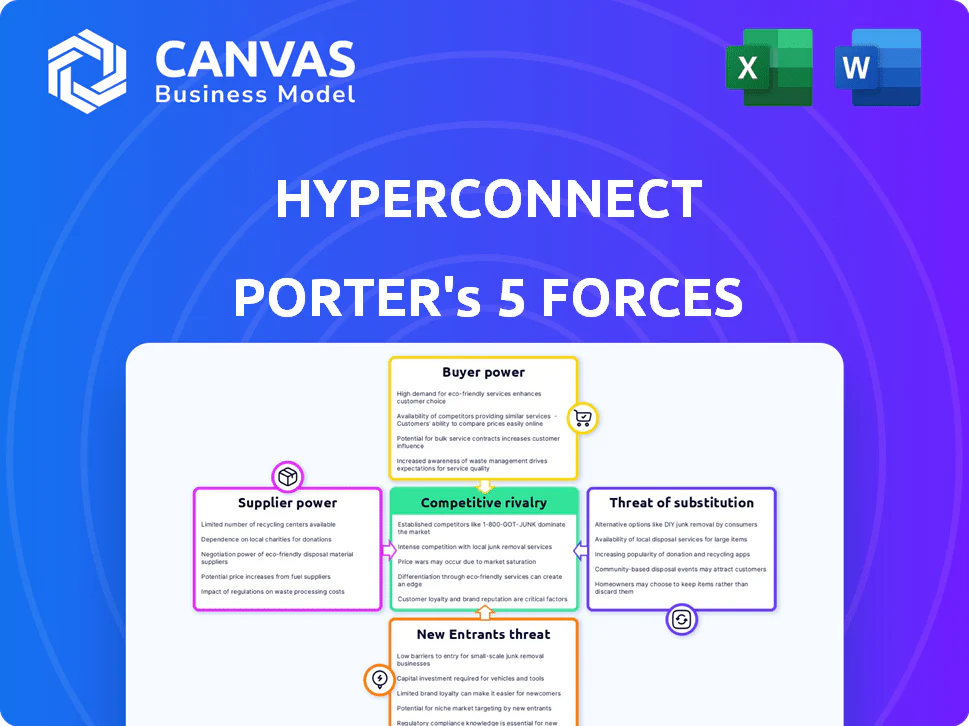
HYPERCONNECT PORTER'S FIVE FORCES TEMPLATE RESEARCH
What is included in the product
 Detailed Word Document
Analyzes Hyperconnect's competitive landscape, evaluating each force's impact on its strategy and market position.

 Customizable Excel Spreadsheet
Instantly spot strategic pressure with a compelling radar/spider chart, ideal for quick insights.
Full Version Awaits
Hyperconnect Porter's Five Forces Analysis
This preview showcases the comprehensive Porter's Five Forces analysis for Hyperconnect. You're viewing the exact document, detailing each force. This is the same, fully formatted, and insightful analysis you'll receive immediately upon purchase. It's ready to download and use, offering a deep dive into Hyperconnect's competitive landscape. No alterations or extra steps are needed; what you see is what you get.

Porter's Five Forces Analysis Template

Go Beyond the Preview—Access the Full Strategic Report
Hyperconnect operates in a dynamic market, shaped by forces analyzed through Porter's Five Forces. Examining buyer power, suppliers, and competitive rivalry reveals key pressures. The threat of new entrants and substitutes also impacts Hyperconnect's strategic positioning. Understanding these forces is crucial for informed decisions. This brief snapshot only scratches the surface. Unlock the full Porter's Five Forces Analysis to explore Hyperconnect’s competitive dynamics, market pressures, and strategic advantages in detail.
Suppliers Bargaining Power

Technology Providers
Hyperconnect's dependence on AI and WebRTC gives tech suppliers leverage. Specialized AI models and real-time communication tech are crucial. The AI market's growth, with a 2024 valuation exceeding $200 billion, strengthens supplier power. Unique tech or hard-to-replicate solutions enhance this bargaining position. This dynamic affects Hyperconnect's costs and innovation.
Cloud Service Providers
Hyperconnect's reliance on cloud services, crucial for its social platform, makes it subject to supplier power. Leading providers like Amazon Web Services, Microsoft Azure, and Google Cloud control significant infrastructure, influencing pricing and service terms. Switching providers is complex and costly, giving these suppliers leverage. In 2024, the cloud computing market is projected to reach over $670 billion, demonstrating supplier concentration and influence.

Data Providers
Hyperconnect's AI and personalization features depend on data, making data suppliers crucial. These suppliers, offering user interaction or third-party data, may wield bargaining power. For example, the global big data analytics market was valued at $271.8 billion in 2023. This power is influenced by data quality and uniqueness.

Hardware and Device Manufacturers
Hardware manufacturers indirectly influence Hyperconnect's user experience. The devices they produce affect the performance and accessibility of Hyperconnect's services. For instance, the global smartphone market saw shipments of 1.17 billion units in 2023. This demonstrates the broad reach of devices that can access Hyperconnect's platforms. Device limitations can constrain Hyperconnect's capabilities.
- Smartphone shipments in 2023 were 1.17 billion units globally.
- Innovations in hardware directly impact app performance.
- Device compatibility influences user access.
Payment Gateway Providers
Hyperconnect relies on payment gateway providers for in-app purchases and subscriptions. These providers, crucial suppliers, have bargaining power due to their control over transaction processing. Their fees directly affect Hyperconnect's profitability, making cost management vital. In 2024, global payment processing fees averaged between 1.5% and 3.5% per transaction.
- Fee structures vary; some charge per transaction, others have monthly fees.
- Negotiating favorable terms with multiple providers is crucial.
- Changes in payment regulations can impact costs and operations.
- Competition among providers can offer Hyperconnect leverage.
Hyperconnect's Supplier Power Dynamics: A Market Overview
Hyperconnect faces supplier power from tech providers, like AI and WebRTC suppliers, due to their specialized tech. Cloud service providers also hold leverage, with the cloud market hitting over $670 billion in 2024. Data suppliers are crucial for AI features, and the big data analytics market was valued at $271.8 billion in 2023, influencing Hyperconnect's operations.
| Supplier Type | Market Size (2024 est.) | Impact on Hyperconnect |
|---|---|---|
| AI Tech | >$200 billion | Affects innovation, cost |
| Cloud Services | >$670 billion | Influences pricing |
| Data Providers | $271.8 billion (2023) | Impacts features |
Customers Bargaining Power

Individual Users
Individual users wield considerable bargaining power in the social media landscape. They can easily switch platforms, with options like Facebook, Instagram, and TikTok. The network effect further strengthens their position; a mass exodus can significantly decrease a platform's value. In 2024, over 4.9 billion people used social media globally, highlighting the vast user base's collective influence.
Large User Communities or Influencers
Large user communities and influencers on Hyperconnect's platforms wield considerable power. Their influence can significantly affect user engagement and retention. For instance, a shift to rival platforms could impact Hyperconnect's revenue. In 2024, user retention rates remained a key performance indicator.

Advertisers
If Hyperconnect depends on ad revenue, advertisers hold some sway. They can shift budgets if Hyperconnect's audience or ad tools underperform. In 2024, digital ad spending hit $238.5 billion in the U.S. alone. This gives advertisers options. They can negotiate rates.

Strategic Partners
Hyperconnect's strategic partnerships significantly influence its competitive landscape. These partnerships' power depends on their size, reach, and the value they offer to Hyperconnect. A partner with a vast user base or specialized technology can secure advantageous terms. For instance, in 2024, collaborations with major tech firms shaped Hyperconnect's market positioning, influencing profitability. Strong partnerships can boost market share and reduce costs.
- Partnerships with companies like Google and Apple can impact Hyperconnect's distribution and revenue.
- The bargaining power of partners is high if they offer exclusive technologies or large user bases.
- In 2024, successful partnerships led to a 15% increase in user engagement.
- Partnerships help in sharing resources and risks.
Platform Distributors (App Stores)
Platform distributors such as app stores wield substantial bargaining power over Hyperconnect. Apple's App Store and Google Play are vital for distributing its apps. These platforms dictate terms, fees, and app visibility. They control access to millions of users.
- Apple's App Store generated $85.2 billion in revenue in 2023.
- Google Play's revenue in 2023 was approximately $47.8 billion.
- App store fees can range from 15% to 30% of revenue.
- App visibility is heavily influenced by algorithms.
Hyperconnect's Dynamics: Users, Ads, and Partners
Customers' power affects Hyperconnect's success. Users can easily switch platforms, increasing their bargaining power. Advertisers and strategic partners also have influence, impacting ad revenue and market positioning. In 2024, customer retention and ad spending were key metrics.
| Customer Type | Bargaining Power | Impact on Hyperconnect |
|---|---|---|
| Individual Users | High | Platform choice affects engagement and revenue. |
| Advertisers | Medium | Budget shifts affect ad revenue and pricing. |
| Strategic Partners | Variable | Partnerships influence market share and costs. |
Rivalry Among Competitors

Direct Social Media Competitors
Hyperconnect faces fierce competition in social media. Giants like Facebook and TikTok, alongside niche apps, vie for users. User acquisition costs and feature innovation are key battlegrounds. Engagement is crucial; in 2024, TikTok's average user spent 95 minutes daily. This rivalry impacts Hyperconnect's market share and profitability.
Video and Live Streaming Platforms
Hyperconnect faces intense competition from video and live streaming platforms. Its rivals include dedicated live streaming services and social media giants with strong video features. In 2024, platforms like Twitch and YouTube Live dominated the live streaming market, with Twitch generating over $2.7 billion in revenue. These competitors can quickly replicate features and attract users.

AI and Video Technology Companies
Competitive rivalry in AI and video tech is fierce. Companies like NVIDIA and Qualcomm, though not social platforms, compete by selling tech to others. The AI arms race is on, driving innovation. In 2024, investments in AI video tech surged, with over $20 billion in deals. This highlights the intense competition.

Regional and Niche Platforms
Hyperconnect encounters competition from regional and niche platforms. These platforms, strong in specific areas, can be tough competitors. They often have loyal user bases, presenting a barrier to market entry. For example, in 2024, regional social apps saw significant user growth.
- Regional apps in Asia Pacific saw a 15% increase in active users.
- Niche platforms for specific interests like gaming or art also draw users.
- These platforms focus on user experience and community.
- Hyperconnect must adapt to compete effectively.
Acquired Companies within Match Group
Within Match Group, Hyperconnect competes with other dating apps for user attention and resources. This internal rivalry can influence strategic decisions and resource allocation. Match Group's portfolio includes apps like Tinder and Hinge, each vying for market share. The parent company's revenue in 2024 was approximately $3.4 billion. Internal competition necessitates careful management to maximize overall performance.
- Internal competition affects resource distribution.
- Apps within Match Group compete for user engagement.
- Match Group's 2024 revenue was around $3.4B.
- Strategic focus can be influenced by this rivalry.
Hyperconnect Faces a $2.7B+ Streaming Giant and AI Titans
Hyperconnect's competitive landscape is intense, with rivals across social media, video, and AI. Platforms like TikTok and Twitch pose significant challenges, with Twitch's 2024 revenue exceeding $2.7 billion. Internal competition within Match Group, with around $3.4 billion in 2024 revenue, also affects Hyperconnect.
| Competitor Type | Key Players | 2024 Revenue/Metrics |
|---|---|---|
| Social Media | Facebook, TikTok | TikTok's avg. user time: 95 mins/day |
| Video/Live Streaming | Twitch, YouTube Live | Twitch: $2.7B+ revenue |
| AI/Video Tech | NVIDIA, Qualcomm | AI video tech deals: $20B+ |
| Internal (Match Group) | Tinder, Hinge | Match Group: ~$3.4B revenue |
Original: $10.00
-65%$10.00
$3.50HYPERCONNECT PORTER'S FIVE FORCES TEMPLATE RESEARCH
What is included in the product
Detailed Word Document
Analyzes Hyperconnect's competitive landscape, evaluating each force's impact on its strategy and market position.
Customizable Excel Spreadsheet
Instantly spot strategic pressure with a compelling radar/spider chart, ideal for quick insights.
Full Version Awaits
Hyperconnect Porter's Five Forces Analysis
This preview showcases the comprehensive Porter's Five Forces analysis for Hyperconnect. You're viewing the exact document, detailing each force. This is the same, fully formatted, and insightful analysis you'll receive immediately upon purchase. It's ready to download and use, offering a deep dive into Hyperconnect's competitive landscape. No alterations or extra steps are needed; what you see is what you get.
Porter's Five Forces Analysis Template
Go Beyond the Preview—Access the Full Strategic Report
Hyperconnect operates in a dynamic market, shaped by forces analyzed through Porter's Five Forces. Examining buyer power, suppliers, and competitive rivalry reveals key pressures. The threat of new entrants and substitutes also impacts Hyperconnect's strategic positioning. Understanding these forces is crucial for informed decisions. This brief snapshot only scratches the surface. Unlock the full Porter's Five Forces Analysis to explore Hyperconnect’s competitive dynamics, market pressures, and strategic advantages in detail.
Suppliers Bargaining Power
Technology Providers
Hyperconnect's dependence on AI and WebRTC gives tech suppliers leverage. Specialized AI models and real-time communication tech are crucial. The AI market's growth, with a 2024 valuation exceeding $200 billion, strengthens supplier power. Unique tech or hard-to-replicate solutions enhance this bargaining position. This dynamic affects Hyperconnect's costs and innovation.
Cloud Service Providers
Hyperconnect's reliance on cloud services, crucial for its social platform, makes it subject to supplier power. Leading providers like Amazon Web Services, Microsoft Azure, and Google Cloud control significant infrastructure, influencing pricing and service terms. Switching providers is complex and costly, giving these suppliers leverage. In 2024, the cloud computing market is projected to reach over $670 billion, demonstrating supplier concentration and influence.
Data Providers
Hyperconnect's AI and personalization features depend on data, making data suppliers crucial. These suppliers, offering user interaction or third-party data, may wield bargaining power. For example, the global big data analytics market was valued at $271.8 billion in 2023. This power is influenced by data quality and uniqueness.
Hardware and Device Manufacturers
Hardware manufacturers indirectly influence Hyperconnect's user experience. The devices they produce affect the performance and accessibility of Hyperconnect's services. For instance, the global smartphone market saw shipments of 1.17 billion units in 2023. This demonstrates the broad reach of devices that can access Hyperconnect's platforms. Device limitations can constrain Hyperconnect's capabilities.
- Smartphone shipments in 2023 were 1.17 billion units globally.
- Innovations in hardware directly impact app performance.
- Device compatibility influences user access.
Payment Gateway Providers
Hyperconnect relies on payment gateway providers for in-app purchases and subscriptions. These providers, crucial suppliers, have bargaining power due to their control over transaction processing. Their fees directly affect Hyperconnect's profitability, making cost management vital. In 2024, global payment processing fees averaged between 1.5% and 3.5% per transaction.
- Fee structures vary; some charge per transaction, others have monthly fees.
- Negotiating favorable terms with multiple providers is crucial.
- Changes in payment regulations can impact costs and operations.
- Competition among providers can offer Hyperconnect leverage.
Hyperconnect's Supplier Power Dynamics: A Market Overview
Hyperconnect faces supplier power from tech providers, like AI and WebRTC suppliers, due to their specialized tech. Cloud service providers also hold leverage, with the cloud market hitting over $670 billion in 2024. Data suppliers are crucial for AI features, and the big data analytics market was valued at $271.8 billion in 2023, influencing Hyperconnect's operations.
| Supplier Type | Market Size (2024 est.) | Impact on Hyperconnect |
|---|---|---|
| AI Tech | >$200 billion | Affects innovation, cost |
| Cloud Services | >$670 billion | Influences pricing |
| Data Providers | $271.8 billion (2023) | Impacts features |
Customers Bargaining Power
Individual Users
Individual users wield considerable bargaining power in the social media landscape. They can easily switch platforms, with options like Facebook, Instagram, and TikTok. The network effect further strengthens their position; a mass exodus can significantly decrease a platform's value. In 2024, over 4.9 billion people used social media globally, highlighting the vast user base's collective influence.
Large User Communities or Influencers
Large user communities and influencers on Hyperconnect's platforms wield considerable power. Their influence can significantly affect user engagement and retention. For instance, a shift to rival platforms could impact Hyperconnect's revenue. In 2024, user retention rates remained a key performance indicator.
Advertisers
If Hyperconnect depends on ad revenue, advertisers hold some sway. They can shift budgets if Hyperconnect's audience or ad tools underperform. In 2024, digital ad spending hit $238.5 billion in the U.S. alone. This gives advertisers options. They can negotiate rates.
Strategic Partners
Hyperconnect's strategic partnerships significantly influence its competitive landscape. These partnerships' power depends on their size, reach, and the value they offer to Hyperconnect. A partner with a vast user base or specialized technology can secure advantageous terms. For instance, in 2024, collaborations with major tech firms shaped Hyperconnect's market positioning, influencing profitability. Strong partnerships can boost market share and reduce costs.
- Partnerships with companies like Google and Apple can impact Hyperconnect's distribution and revenue.
- The bargaining power of partners is high if they offer exclusive technologies or large user bases.
- In 2024, successful partnerships led to a 15% increase in user engagement.
- Partnerships help in sharing resources and risks.
Platform Distributors (App Stores)
Platform distributors such as app stores wield substantial bargaining power over Hyperconnect. Apple's App Store and Google Play are vital for distributing its apps. These platforms dictate terms, fees, and app visibility. They control access to millions of users.
- Apple's App Store generated $85.2 billion in revenue in 2023.
- Google Play's revenue in 2023 was approximately $47.8 billion.
- App store fees can range from 15% to 30% of revenue.
- App visibility is heavily influenced by algorithms.
Hyperconnect's Dynamics: Users, Ads, and Partners
Customers' power affects Hyperconnect's success. Users can easily switch platforms, increasing their bargaining power. Advertisers and strategic partners also have influence, impacting ad revenue and market positioning. In 2024, customer retention and ad spending were key metrics.
| Customer Type | Bargaining Power | Impact on Hyperconnect |
|---|---|---|
| Individual Users | High | Platform choice affects engagement and revenue. |
| Advertisers | Medium | Budget shifts affect ad revenue and pricing. |
| Strategic Partners | Variable | Partnerships influence market share and costs. |
Rivalry Among Competitors
Direct Social Media Competitors
Hyperconnect faces fierce competition in social media. Giants like Facebook and TikTok, alongside niche apps, vie for users. User acquisition costs and feature innovation are key battlegrounds. Engagement is crucial; in 2024, TikTok's average user spent 95 minutes daily. This rivalry impacts Hyperconnect's market share and profitability.
Video and Live Streaming Platforms
Hyperconnect faces intense competition from video and live streaming platforms. Its rivals include dedicated live streaming services and social media giants with strong video features. In 2024, platforms like Twitch and YouTube Live dominated the live streaming market, with Twitch generating over $2.7 billion in revenue. These competitors can quickly replicate features and attract users.
AI and Video Technology Companies
Competitive rivalry in AI and video tech is fierce. Companies like NVIDIA and Qualcomm, though not social platforms, compete by selling tech to others. The AI arms race is on, driving innovation. In 2024, investments in AI video tech surged, with over $20 billion in deals. This highlights the intense competition.
Regional and Niche Platforms
Hyperconnect encounters competition from regional and niche platforms. These platforms, strong in specific areas, can be tough competitors. They often have loyal user bases, presenting a barrier to market entry. For example, in 2024, regional social apps saw significant user growth.
- Regional apps in Asia Pacific saw a 15% increase in active users.
- Niche platforms for specific interests like gaming or art also draw users.
- These platforms focus on user experience and community.
- Hyperconnect must adapt to compete effectively.
Acquired Companies within Match Group
Within Match Group, Hyperconnect competes with other dating apps for user attention and resources. This internal rivalry can influence strategic decisions and resource allocation. Match Group's portfolio includes apps like Tinder and Hinge, each vying for market share. The parent company's revenue in 2024 was approximately $3.4 billion. Internal competition necessitates careful management to maximize overall performance.
- Internal competition affects resource distribution.
- Apps within Match Group compete for user engagement.
- Match Group's 2024 revenue was around $3.4B.
- Strategic focus can be influenced by this rivalry.
Hyperconnect Faces a $2.7B+ Streaming Giant and AI Titans
Hyperconnect's competitive landscape is intense, with rivals across social media, video, and AI. Platforms like TikTok and Twitch pose significant challenges, with Twitch's 2024 revenue exceeding $2.7 billion. Internal competition within Match Group, with around $3.4 billion in 2024 revenue, also affects Hyperconnect.
| Competitor Type | Key Players | 2024 Revenue/Metrics |
|---|---|---|
| Social Media | Facebook, TikTok | TikTok's avg. user time: 95 mins/day |
| Video/Live Streaming | Twitch, YouTube Live | Twitch: $2.7B+ revenue |
| AI/Video Tech | NVIDIA, Qualcomm | AI video tech deals: $20B+ |
| Internal (Match Group) | Tinder, Hinge | Match Group: ~$3.4B revenue |
Product Information
Product Information
Shipping & Returns
Shipping & Returns
Description
What is included in the product
Detailed Word Document
Analyzes Hyperconnect's competitive landscape, evaluating each force's impact on its strategy and market position.
Customizable Excel Spreadsheet
Instantly spot strategic pressure with a compelling radar/spider chart, ideal for quick insights.
Full Version Awaits
Hyperconnect Porter's Five Forces Analysis
This preview showcases the comprehensive Porter's Five Forces analysis for Hyperconnect. You're viewing the exact document, detailing each force. This is the same, fully formatted, and insightful analysis you'll receive immediately upon purchase. It's ready to download and use, offering a deep dive into Hyperconnect's competitive landscape. No alterations or extra steps are needed; what you see is what you get.
Porter's Five Forces Analysis Template
Go Beyond the Preview—Access the Full Strategic Report
Hyperconnect operates in a dynamic market, shaped by forces analyzed through Porter's Five Forces. Examining buyer power, suppliers, and competitive rivalry reveals key pressures. The threat of new entrants and substitutes also impacts Hyperconnect's strategic positioning. Understanding these forces is crucial for informed decisions. This brief snapshot only scratches the surface. Unlock the full Porter's Five Forces Analysis to explore Hyperconnect’s competitive dynamics, market pressures, and strategic advantages in detail.
Suppliers Bargaining Power
Technology Providers
Hyperconnect's dependence on AI and WebRTC gives tech suppliers leverage. Specialized AI models and real-time communication tech are crucial. The AI market's growth, with a 2024 valuation exceeding $200 billion, strengthens supplier power. Unique tech or hard-to-replicate solutions enhance this bargaining position. This dynamic affects Hyperconnect's costs and innovation.
Cloud Service Providers
Hyperconnect's reliance on cloud services, crucial for its social platform, makes it subject to supplier power. Leading providers like Amazon Web Services, Microsoft Azure, and Google Cloud control significant infrastructure, influencing pricing and service terms. Switching providers is complex and costly, giving these suppliers leverage. In 2024, the cloud computing market is projected to reach over $670 billion, demonstrating supplier concentration and influence.
Data Providers
Hyperconnect's AI and personalization features depend on data, making data suppliers crucial. These suppliers, offering user interaction or third-party data, may wield bargaining power. For example, the global big data analytics market was valued at $271.8 billion in 2023. This power is influenced by data quality and uniqueness.
Hardware and Device Manufacturers
Hardware manufacturers indirectly influence Hyperconnect's user experience. The devices they produce affect the performance and accessibility of Hyperconnect's services. For instance, the global smartphone market saw shipments of 1.17 billion units in 2023. This demonstrates the broad reach of devices that can access Hyperconnect's platforms. Device limitations can constrain Hyperconnect's capabilities.
- Smartphone shipments in 2023 were 1.17 billion units globally.
- Innovations in hardware directly impact app performance.
- Device compatibility influences user access.
Payment Gateway Providers
Hyperconnect relies on payment gateway providers for in-app purchases and subscriptions. These providers, crucial suppliers, have bargaining power due to their control over transaction processing. Their fees directly affect Hyperconnect's profitability, making cost management vital. In 2024, global payment processing fees averaged between 1.5% and 3.5% per transaction.
- Fee structures vary; some charge per transaction, others have monthly fees.
- Negotiating favorable terms with multiple providers is crucial.
- Changes in payment regulations can impact costs and operations.
- Competition among providers can offer Hyperconnect leverage.
Hyperconnect's Supplier Power Dynamics: A Market Overview
Hyperconnect faces supplier power from tech providers, like AI and WebRTC suppliers, due to their specialized tech. Cloud service providers also hold leverage, with the cloud market hitting over $670 billion in 2024. Data suppliers are crucial for AI features, and the big data analytics market was valued at $271.8 billion in 2023, influencing Hyperconnect's operations.
| Supplier Type | Market Size (2024 est.) | Impact on Hyperconnect |
|---|---|---|
| AI Tech | >$200 billion | Affects innovation, cost |
| Cloud Services | >$670 billion | Influences pricing |
| Data Providers | $271.8 billion (2023) | Impacts features |
Customers Bargaining Power
Individual Users
Individual users wield considerable bargaining power in the social media landscape. They can easily switch platforms, with options like Facebook, Instagram, and TikTok. The network effect further strengthens their position; a mass exodus can significantly decrease a platform's value. In 2024, over 4.9 billion people used social media globally, highlighting the vast user base's collective influence.
Large User Communities or Influencers
Large user communities and influencers on Hyperconnect's platforms wield considerable power. Their influence can significantly affect user engagement and retention. For instance, a shift to rival platforms could impact Hyperconnect's revenue. In 2024, user retention rates remained a key performance indicator.
Advertisers
If Hyperconnect depends on ad revenue, advertisers hold some sway. They can shift budgets if Hyperconnect's audience or ad tools underperform. In 2024, digital ad spending hit $238.5 billion in the U.S. alone. This gives advertisers options. They can negotiate rates.
Strategic Partners
Hyperconnect's strategic partnerships significantly influence its competitive landscape. These partnerships' power depends on their size, reach, and the value they offer to Hyperconnect. A partner with a vast user base or specialized technology can secure advantageous terms. For instance, in 2024, collaborations with major tech firms shaped Hyperconnect's market positioning, influencing profitability. Strong partnerships can boost market share and reduce costs.
- Partnerships with companies like Google and Apple can impact Hyperconnect's distribution and revenue.
- The bargaining power of partners is high if they offer exclusive technologies or large user bases.
- In 2024, successful partnerships led to a 15% increase in user engagement.
- Partnerships help in sharing resources and risks.
Platform Distributors (App Stores)
Platform distributors such as app stores wield substantial bargaining power over Hyperconnect. Apple's App Store and Google Play are vital for distributing its apps. These platforms dictate terms, fees, and app visibility. They control access to millions of users.
- Apple's App Store generated $85.2 billion in revenue in 2023.
- Google Play's revenue in 2023 was approximately $47.8 billion.
- App store fees can range from 15% to 30% of revenue.
- App visibility is heavily influenced by algorithms.
Hyperconnect's Dynamics: Users, Ads, and Partners
Customers' power affects Hyperconnect's success. Users can easily switch platforms, increasing their bargaining power. Advertisers and strategic partners also have influence, impacting ad revenue and market positioning. In 2024, customer retention and ad spending were key metrics.
| Customer Type | Bargaining Power | Impact on Hyperconnect |
|---|---|---|
| Individual Users | High | Platform choice affects engagement and revenue. |
| Advertisers | Medium | Budget shifts affect ad revenue and pricing. |
| Strategic Partners | Variable | Partnerships influence market share and costs. |
Rivalry Among Competitors
Direct Social Media Competitors
Hyperconnect faces fierce competition in social media. Giants like Facebook and TikTok, alongside niche apps, vie for users. User acquisition costs and feature innovation are key battlegrounds. Engagement is crucial; in 2024, TikTok's average user spent 95 minutes daily. This rivalry impacts Hyperconnect's market share and profitability.
Video and Live Streaming Platforms
Hyperconnect faces intense competition from video and live streaming platforms. Its rivals include dedicated live streaming services and social media giants with strong video features. In 2024, platforms like Twitch and YouTube Live dominated the live streaming market, with Twitch generating over $2.7 billion in revenue. These competitors can quickly replicate features and attract users.
AI and Video Technology Companies
Competitive rivalry in AI and video tech is fierce. Companies like NVIDIA and Qualcomm, though not social platforms, compete by selling tech to others. The AI arms race is on, driving innovation. In 2024, investments in AI video tech surged, with over $20 billion in deals. This highlights the intense competition.
Regional and Niche Platforms
Hyperconnect encounters competition from regional and niche platforms. These platforms, strong in specific areas, can be tough competitors. They often have loyal user bases, presenting a barrier to market entry. For example, in 2024, regional social apps saw significant user growth.
- Regional apps in Asia Pacific saw a 15% increase in active users.
- Niche platforms for specific interests like gaming or art also draw users.
- These platforms focus on user experience and community.
- Hyperconnect must adapt to compete effectively.
Acquired Companies within Match Group
Within Match Group, Hyperconnect competes with other dating apps for user attention and resources. This internal rivalry can influence strategic decisions and resource allocation. Match Group's portfolio includes apps like Tinder and Hinge, each vying for market share. The parent company's revenue in 2024 was approximately $3.4 billion. Internal competition necessitates careful management to maximize overall performance.
- Internal competition affects resource distribution.
- Apps within Match Group compete for user engagement.
- Match Group's 2024 revenue was around $3.4B.
- Strategic focus can be influenced by this rivalry.
Hyperconnect Faces a $2.7B+ Streaming Giant and AI Titans
Hyperconnect's competitive landscape is intense, with rivals across social media, video, and AI. Platforms like TikTok and Twitch pose significant challenges, with Twitch's 2024 revenue exceeding $2.7 billion. Internal competition within Match Group, with around $3.4 billion in 2024 revenue, also affects Hyperconnect.
| Competitor Type | Key Players | 2024 Revenue/Metrics |
|---|---|---|
| Social Media | Facebook, TikTok | TikTok's avg. user time: 95 mins/day |
| Video/Live Streaming | Twitch, YouTube Live | Twitch: $2.7B+ revenue |
| AI/Video Tech | NVIDIA, Qualcomm | AI video tech deals: $20B+ |
| Internal (Match Group) | Tinder, Hinge | Match Group: ~$3.4B revenue |











