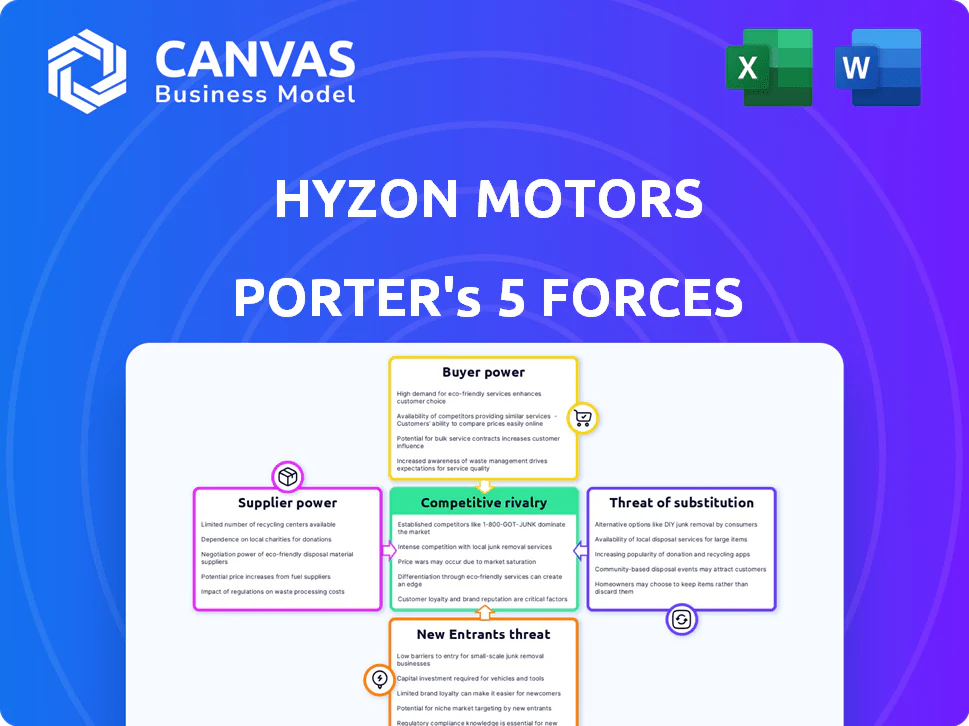
HYZON MOTORS PORTER'S FIVE FORCES TEMPLATE RESEARCH
What is included in the product
 Detailed Word Document
Analyzes Hyzon Motors' competitive position, revealing threats, and market dynamics.

 Customizable Excel Spreadsheet
Instantly understand strategic pressure with a powerful spider/radar chart.
Preview the Actual Deliverable
Hyzon Motors Porter's Five Forces Analysis
This is the complete, ready-to-use analysis file. You're previewing the Porter's Five Forces analysis for Hyzon Motors. The document examines competitive rivalry, bargaining power of buyers/suppliers, & threat of substitutes/new entrants. What you see is what you'll download immediately after purchase—professionally formatted.

Porter's Five Forces Analysis Template

A Must-Have Tool for Decision-Makers
Hyzon Motors faces moderate rivalry in the nascent hydrogen fuel cell truck market, battling established automotive players and emerging startups. Supplier power is relatively low, with some dependence on specialized component providers. Buyer power is concentrated among fleet operators, impacting pricing. The threat of new entrants is moderate, with high initial capital costs. Finally, the threat of substitutes, such as battery-electric trucks, poses a significant challenge.
This brief snapshot only scratches the surface. Unlock the full Porter's Five Forces Analysis to explore Hyzon Motors’s competitive dynamics, market pressures, and strategic advantages in detail.
Suppliers Bargaining Power

Limited Number of Specialized Suppliers
Hyzon Motors faces supplier power due to the limited number of specialized component providers in the hydrogen fuel cell sector. The small supplier base for critical items like PEMs allows suppliers to influence pricing and terms. This situation could potentially elevate Hyzon's production costs. In 2024, the global PEM market was valued at approximately $1.2 billion. The increasing demand for fuel cells may further strengthen supplier bargaining power.
Dependency on Specialized Raw Materials
Hyzon Motors' hydrogen fuel cell production relies on specialized materials like platinum and iridium. The suppliers of these precious metals wield significant power due to potential price volatility and supply constraints. In 2024, platinum prices fluctuated, impacting production costs. The demand for these materials is expected to rise, increasing supplier influence.

Potential for Vertical Integration by Suppliers
Major hydrogen fuel cell suppliers like Cummins and Ballard Power could vertically integrate. This would strengthen their control over the supply chain. Such moves could limit Hyzon's choices and raise costs. In 2024, Cummins reported over $34 billion in revenue. Ballard's revenue was around $120 million in the same year.

Technological Expertise of Suppliers
Suppliers with unique technological expertise in fuel cell components hold significant power. Hyzon Motors depends on advanced fuel cell technology, potentially giving leverage to innovation leaders. High-tech suppliers might influence Hyzon's production costs and timelines.
- Hyzon's 2024 financial reports will reveal supplier impact.
- Fuel cell technology cost fluctuations affect Hyzon.
- Proprietary tech suppliers could demand higher prices.
- This impacts Hyzon's profitability and market position.
Switching Costs for Hyzon
Switching costs significantly influence supplier bargaining power for Hyzon Motors. If changing suppliers demands substantial redesign, testing, or retooling, suppliers gain leverage. This scenario allows suppliers to potentially increase prices or dictate terms due to the high costs associated with switching. For example, in 2024, redesigning a component could cost Hyzon up to $500,000, increasing supplier power.
- High switching costs increase supplier power.
- Redesign, testing, and retooling are key cost drivers.
- Component redesigns can cost up to $500,000 (2024).
- Suppliers can then dictate terms.
Supplier Power Impacts Production Costs
Hyzon Motors faces supplier power due to a limited specialized component base. This gives suppliers leverage, influencing pricing and terms, which in turn can elevate production costs. In 2024, the PEM market was about $1.2 billion.
| Aspect | Impact on Hyzon | 2024 Data |
|---|---|---|
| Supplier Concentration | Higher costs, reduced flexibility | PEM market: $1.2B |
| Component Specialization | Price volatility risk | Platinum prices fluctuated |
| Switching Costs | Supplier leverage | Redesign costs up to $500k |
Customers Bargaining Power

Concentrated Customer Base in Certain Segments
Hyzon Motors faces customer bargaining power, especially if key clients are large fleet operators. This concentration means these buyers can pressure Hyzon on prices and contract terms. In 2024, major fleet deals could significantly impact revenue. For example, a single deal could represent a substantial portion of Hyzon's sales, affecting profit margins.
Customer Price Sensitivity
The adoption of hydrogen fuel cell vehicles (HFCVs) like those from Hyzon Motors depends on the total cost of ownership (TCO). Customers compare HFCVs with diesel vehicles and electric options. In 2024, the price of hydrogen fuel and vehicle costs influence purchasing decisions. High initial costs and fluctuating fuel prices increase customer bargaining power, potentially impacting Hyzon's market share.

Availability of Alternative Technologies
Customers can switch to battery electric vehicles (BEVs), increasing their power. In 2024, BEV sales rose, with Tesla leading. This gives customers more choices. This includes trucks, where competitors are emerging. The availability of alternatives limits Hyzon's pricing power.

Customer Knowledge and Awareness
As customers gain expertise in hydrogen fuel cell tech, their bargaining power with Hyzon increases. Informed buyers can push for better terms, pricing, and service agreements. This shift is fueled by growing public and private sector awareness. For example, in 2024, the global hydrogen fuel cell market was valued at approximately $8 billion. Increased knowledge allows customers to evaluate Hyzon's offerings critically.
- Market Growth: The hydrogen fuel cell market is projected to reach $37.8 billion by 2030.
- Government Initiatives: Supportive policies and subsidies influence customer decisions.
- Competitive Landscape: More options in the market enhance customer leverage.
- Technological Advancements: Innovations change customer expectations.
Government Incentives and Regulations Favoring Customers
Government incentives and regulations significantly influence customer bargaining power in the hydrogen fuel cell vehicle market. These policies, such as tax credits and subsidies, reduce the upfront costs of purchasing Hyzon Motors' vehicles, making them more accessible. Regulations, like emissions standards and mandates, can increase demand by compelling businesses and governments to adopt zero-emission options. This support reduces financial risk and encourages adoption, strengthening customer influence.
- In 2024, the Inflation Reduction Act in the U.S. offers substantial tax credits for clean vehicles, potentially reducing costs by thousands of dollars.
- California's regulations mandate the sale of zero-emission vehicles, boosting demand and customer leverage.
- European Union's Green Deal includes incentives supporting hydrogen infrastructure and fuel cell vehicle adoption.
Hyzon's Customer Power: Fleet Deals & Incentives
Hyzon Motors faces strong customer bargaining power, especially from large fleet operators. Customers compare Hyzon's HFCVs with BEVs and traditional vehicles, influencing pricing. In 2024, government incentives and regulations significantly impact customer decisions. This includes tax credits like the Inflation Reduction Act, which could reduce costs by thousands of dollars.
| Factor | Impact on Bargaining Power | 2024 Data |
|---|---|---|
| Fleet Concentration | High, due to large purchase volumes | Major fleet deals can represent a significant portion of Hyzon's sales. |
| TCO Comparison | High, influenced by fuel & vehicle costs | Hydrogen fuel cell market valued at $8 billion. |
| Alternative Availability | Increased by BEV options | BEV sales rose, with Tesla leading. |
Rivalry Among Competitors

Presence of Established Automotive Manufacturers
Hyzon Motors competes with established automakers like Toyota and Hyundai in the hydrogen fuel cell vehicle market. In 2024, Toyota invested $1.2 billion in its Kentucky plant for electric vehicle battery production, indicating strong commitment. These competitors boast significant resources, brand recognition, and customer networks. Hyundai's global sales in 2023 reached 4.2 million vehicles, demonstrating their market presence.
Competition from Other Hydrogen Fuel Cell Vehicle Companies
Hyzon Motors faces competition from hydrogen fuel cell vehicle companies like Nikola and ULEMCo. In 2024, Nikola delivered 42 hydrogen fuel cell electric trucks. ULEMCo focuses on hydrogen conversions for existing vehicles. These competitors vie for market share in the commercial vehicle sector.

Intensity of Competition in Target Markets
Competitive rivalry for Hyzon varies by market and vehicle type. The North American hydrogen truck market includes key players. In 2024, the global hydrogen truck market was valued at $1.2 billion. This indicates a growing, yet competitive landscape. Hyzon must compete with established and emerging firms.

Technological Advancements by Competitors
Competitors are also heavily investing in research and development, aiming to enhance fuel cell technology and vehicle performance. Rapid advancements from rivals can indeed intensify competition within the hydrogen fuel cell vehicle market. For example, companies like Nikola Corporation and Ballard Power Systems are also pushing technological boundaries. This environment forces Hyzon Motors to innovate continuously to maintain or improve its market position.
- Nikola Corporation's market capitalization as of early 2024 was around $1 billion, reflecting the competitive pressure in the sector.
- Ballard Power Systems' revenue in 2023 was approximately $115 million, indicating significant investment in the field.
- Hyzon Motors' revenue was about $8 million in 2023, showing it is a smaller player.
- The global hydrogen fuel cell market is projected to reach $47.8 billion by 2030.
Pricing Pressure in the Market
In the hydrogen fuel cell vehicle market, competitive rivalry is fierce, especially regarding pricing. Companies may lower prices to capture market share and drive adoption, which intensifies price-based competition. This strategy can squeeze profit margins, particularly for new entrants like Hyzon Motors. For example, in 2024, Hyzon Motors' stock price fluctuated, reflecting the market's sensitivity to financial performance and competitive pressures.
- Price wars can erode profitability.
- New entrants face significant pricing challenges.
- Market share gains often come at the expense of margins.
- Financial performance is crucial in a competitive market.
Hyzon Motors: Navigating a Competitive Hydrogen Truck Market
Hyzon Motors faces intense competition from established automakers and emerging hydrogen fuel cell vehicle companies. The hydrogen truck market was valued at $1.2B in 2024. Price wars and R&D investments squeeze margins. Hyzon's 2023 revenue was about $8 million.
| Aspect | Details | 2024 Data |
|---|---|---|
| Market Value | Hydrogen Truck | $1.2 Billion |
| Revenue (Hyzon) | 2023 | $8 Million |
| Nikola's Market Cap | Early 2024 | $1 Billion |
HYZON MOTORS PORTER'S FIVE FORCES TEMPLATE RESEARCH
What is included in the product
Detailed Word Document
Analyzes Hyzon Motors' competitive position, revealing threats, and market dynamics.
Customizable Excel Spreadsheet
Instantly understand strategic pressure with a powerful spider/radar chart.
Preview the Actual Deliverable
Hyzon Motors Porter's Five Forces Analysis
This is the complete, ready-to-use analysis file. You're previewing the Porter's Five Forces analysis for Hyzon Motors. The document examines competitive rivalry, bargaining power of buyers/suppliers, & threat of substitutes/new entrants. What you see is what you'll download immediately after purchase—professionally formatted.
Porter's Five Forces Analysis Template
A Must-Have Tool for Decision-Makers
Hyzon Motors faces moderate rivalry in the nascent hydrogen fuel cell truck market, battling established automotive players and emerging startups. Supplier power is relatively low, with some dependence on specialized component providers. Buyer power is concentrated among fleet operators, impacting pricing. The threat of new entrants is moderate, with high initial capital costs. Finally, the threat of substitutes, such as battery-electric trucks, poses a significant challenge.
This brief snapshot only scratches the surface. Unlock the full Porter's Five Forces Analysis to explore Hyzon Motors’s competitive dynamics, market pressures, and strategic advantages in detail.
Suppliers Bargaining Power
Limited Number of Specialized Suppliers
Hyzon Motors faces supplier power due to the limited number of specialized component providers in the hydrogen fuel cell sector. The small supplier base for critical items like PEMs allows suppliers to influence pricing and terms. This situation could potentially elevate Hyzon's production costs. In 2024, the global PEM market was valued at approximately $1.2 billion. The increasing demand for fuel cells may further strengthen supplier bargaining power.
Dependency on Specialized Raw Materials
Hyzon Motors' hydrogen fuel cell production relies on specialized materials like platinum and iridium. The suppliers of these precious metals wield significant power due to potential price volatility and supply constraints. In 2024, platinum prices fluctuated, impacting production costs. The demand for these materials is expected to rise, increasing supplier influence.
Potential for Vertical Integration by Suppliers
Major hydrogen fuel cell suppliers like Cummins and Ballard Power could vertically integrate. This would strengthen their control over the supply chain. Such moves could limit Hyzon's choices and raise costs. In 2024, Cummins reported over $34 billion in revenue. Ballard's revenue was around $120 million in the same year.
Technological Expertise of Suppliers
Suppliers with unique technological expertise in fuel cell components hold significant power. Hyzon Motors depends on advanced fuel cell technology, potentially giving leverage to innovation leaders. High-tech suppliers might influence Hyzon's production costs and timelines.
- Hyzon's 2024 financial reports will reveal supplier impact.
- Fuel cell technology cost fluctuations affect Hyzon.
- Proprietary tech suppliers could demand higher prices.
- This impacts Hyzon's profitability and market position.
Switching Costs for Hyzon
Switching costs significantly influence supplier bargaining power for Hyzon Motors. If changing suppliers demands substantial redesign, testing, or retooling, suppliers gain leverage. This scenario allows suppliers to potentially increase prices or dictate terms due to the high costs associated with switching. For example, in 2024, redesigning a component could cost Hyzon up to $500,000, increasing supplier power.
- High switching costs increase supplier power.
- Redesign, testing, and retooling are key cost drivers.
- Component redesigns can cost up to $500,000 (2024).
- Suppliers can then dictate terms.
Supplier Power Impacts Production Costs
Hyzon Motors faces supplier power due to a limited specialized component base. This gives suppliers leverage, influencing pricing and terms, which in turn can elevate production costs. In 2024, the PEM market was about $1.2 billion.
| Aspect | Impact on Hyzon | 2024 Data |
|---|---|---|
| Supplier Concentration | Higher costs, reduced flexibility | PEM market: $1.2B |
| Component Specialization | Price volatility risk | Platinum prices fluctuated |
| Switching Costs | Supplier leverage | Redesign costs up to $500k |
Customers Bargaining Power
Concentrated Customer Base in Certain Segments
Hyzon Motors faces customer bargaining power, especially if key clients are large fleet operators. This concentration means these buyers can pressure Hyzon on prices and contract terms. In 2024, major fleet deals could significantly impact revenue. For example, a single deal could represent a substantial portion of Hyzon's sales, affecting profit margins.
Customer Price Sensitivity
The adoption of hydrogen fuel cell vehicles (HFCVs) like those from Hyzon Motors depends on the total cost of ownership (TCO). Customers compare HFCVs with diesel vehicles and electric options. In 2024, the price of hydrogen fuel and vehicle costs influence purchasing decisions. High initial costs and fluctuating fuel prices increase customer bargaining power, potentially impacting Hyzon's market share.
Availability of Alternative Technologies
Customers can switch to battery electric vehicles (BEVs), increasing their power. In 2024, BEV sales rose, with Tesla leading. This gives customers more choices. This includes trucks, where competitors are emerging. The availability of alternatives limits Hyzon's pricing power.
Customer Knowledge and Awareness
As customers gain expertise in hydrogen fuel cell tech, their bargaining power with Hyzon increases. Informed buyers can push for better terms, pricing, and service agreements. This shift is fueled by growing public and private sector awareness. For example, in 2024, the global hydrogen fuel cell market was valued at approximately $8 billion. Increased knowledge allows customers to evaluate Hyzon's offerings critically.
- Market Growth: The hydrogen fuel cell market is projected to reach $37.8 billion by 2030.
- Government Initiatives: Supportive policies and subsidies influence customer decisions.
- Competitive Landscape: More options in the market enhance customer leverage.
- Technological Advancements: Innovations change customer expectations.
Government Incentives and Regulations Favoring Customers
Government incentives and regulations significantly influence customer bargaining power in the hydrogen fuel cell vehicle market. These policies, such as tax credits and subsidies, reduce the upfront costs of purchasing Hyzon Motors' vehicles, making them more accessible. Regulations, like emissions standards and mandates, can increase demand by compelling businesses and governments to adopt zero-emission options. This support reduces financial risk and encourages adoption, strengthening customer influence.
- In 2024, the Inflation Reduction Act in the U.S. offers substantial tax credits for clean vehicles, potentially reducing costs by thousands of dollars.
- California's regulations mandate the sale of zero-emission vehicles, boosting demand and customer leverage.
- European Union's Green Deal includes incentives supporting hydrogen infrastructure and fuel cell vehicle adoption.
Hyzon's Customer Power: Fleet Deals & Incentives
Hyzon Motors faces strong customer bargaining power, especially from large fleet operators. Customers compare Hyzon's HFCVs with BEVs and traditional vehicles, influencing pricing. In 2024, government incentives and regulations significantly impact customer decisions. This includes tax credits like the Inflation Reduction Act, which could reduce costs by thousands of dollars.
| Factor | Impact on Bargaining Power | 2024 Data |
|---|---|---|
| Fleet Concentration | High, due to large purchase volumes | Major fleet deals can represent a significant portion of Hyzon's sales. |
| TCO Comparison | High, influenced by fuel & vehicle costs | Hydrogen fuel cell market valued at $8 billion. |
| Alternative Availability | Increased by BEV options | BEV sales rose, with Tesla leading. |
Rivalry Among Competitors
Presence of Established Automotive Manufacturers
Hyzon Motors competes with established automakers like Toyota and Hyundai in the hydrogen fuel cell vehicle market. In 2024, Toyota invested $1.2 billion in its Kentucky plant for electric vehicle battery production, indicating strong commitment. These competitors boast significant resources, brand recognition, and customer networks. Hyundai's global sales in 2023 reached 4.2 million vehicles, demonstrating their market presence.
Competition from Other Hydrogen Fuel Cell Vehicle Companies
Hyzon Motors faces competition from hydrogen fuel cell vehicle companies like Nikola and ULEMCo. In 2024, Nikola delivered 42 hydrogen fuel cell electric trucks. ULEMCo focuses on hydrogen conversions for existing vehicles. These competitors vie for market share in the commercial vehicle sector.
Intensity of Competition in Target Markets
Competitive rivalry for Hyzon varies by market and vehicle type. The North American hydrogen truck market includes key players. In 2024, the global hydrogen truck market was valued at $1.2 billion. This indicates a growing, yet competitive landscape. Hyzon must compete with established and emerging firms.
Technological Advancements by Competitors
Competitors are also heavily investing in research and development, aiming to enhance fuel cell technology and vehicle performance. Rapid advancements from rivals can indeed intensify competition within the hydrogen fuel cell vehicle market. For example, companies like Nikola Corporation and Ballard Power Systems are also pushing technological boundaries. This environment forces Hyzon Motors to innovate continuously to maintain or improve its market position.
- Nikola Corporation's market capitalization as of early 2024 was around $1 billion, reflecting the competitive pressure in the sector.
- Ballard Power Systems' revenue in 2023 was approximately $115 million, indicating significant investment in the field.
- Hyzon Motors' revenue was about $8 million in 2023, showing it is a smaller player.
- The global hydrogen fuel cell market is projected to reach $47.8 billion by 2030.
Pricing Pressure in the Market
In the hydrogen fuel cell vehicle market, competitive rivalry is fierce, especially regarding pricing. Companies may lower prices to capture market share and drive adoption, which intensifies price-based competition. This strategy can squeeze profit margins, particularly for new entrants like Hyzon Motors. For example, in 2024, Hyzon Motors' stock price fluctuated, reflecting the market's sensitivity to financial performance and competitive pressures.
- Price wars can erode profitability.
- New entrants face significant pricing challenges.
- Market share gains often come at the expense of margins.
- Financial performance is crucial in a competitive market.
Hyzon Motors: Navigating a Competitive Hydrogen Truck Market
Hyzon Motors faces intense competition from established automakers and emerging hydrogen fuel cell vehicle companies. The hydrogen truck market was valued at $1.2B in 2024. Price wars and R&D investments squeeze margins. Hyzon's 2023 revenue was about $8 million.
| Aspect | Details | 2024 Data |
|---|---|---|
| Market Value | Hydrogen Truck | $1.2 Billion |
| Revenue (Hyzon) | 2023 | $8 Million |
| Nikola's Market Cap | Early 2024 | $1 Billion |
Product Information
Product Information
Shipping & Returns
Shipping & Returns
Description
What is included in the product
Detailed Word Document
Analyzes Hyzon Motors' competitive position, revealing threats, and market dynamics.
Customizable Excel Spreadsheet
Instantly understand strategic pressure with a powerful spider/radar chart.
Preview the Actual Deliverable
Hyzon Motors Porter's Five Forces Analysis
This is the complete, ready-to-use analysis file. You're previewing the Porter's Five Forces analysis for Hyzon Motors. The document examines competitive rivalry, bargaining power of buyers/suppliers, & threat of substitutes/new entrants. What you see is what you'll download immediately after purchase—professionally formatted.
Porter's Five Forces Analysis Template
A Must-Have Tool for Decision-Makers
Hyzon Motors faces moderate rivalry in the nascent hydrogen fuel cell truck market, battling established automotive players and emerging startups. Supplier power is relatively low, with some dependence on specialized component providers. Buyer power is concentrated among fleet operators, impacting pricing. The threat of new entrants is moderate, with high initial capital costs. Finally, the threat of substitutes, such as battery-electric trucks, poses a significant challenge.
This brief snapshot only scratches the surface. Unlock the full Porter's Five Forces Analysis to explore Hyzon Motors’s competitive dynamics, market pressures, and strategic advantages in detail.
Suppliers Bargaining Power
Limited Number of Specialized Suppliers
Hyzon Motors faces supplier power due to the limited number of specialized component providers in the hydrogen fuel cell sector. The small supplier base for critical items like PEMs allows suppliers to influence pricing and terms. This situation could potentially elevate Hyzon's production costs. In 2024, the global PEM market was valued at approximately $1.2 billion. The increasing demand for fuel cells may further strengthen supplier bargaining power.
Dependency on Specialized Raw Materials
Hyzon Motors' hydrogen fuel cell production relies on specialized materials like platinum and iridium. The suppliers of these precious metals wield significant power due to potential price volatility and supply constraints. In 2024, platinum prices fluctuated, impacting production costs. The demand for these materials is expected to rise, increasing supplier influence.
Potential for Vertical Integration by Suppliers
Major hydrogen fuel cell suppliers like Cummins and Ballard Power could vertically integrate. This would strengthen their control over the supply chain. Such moves could limit Hyzon's choices and raise costs. In 2024, Cummins reported over $34 billion in revenue. Ballard's revenue was around $120 million in the same year.
Technological Expertise of Suppliers
Suppliers with unique technological expertise in fuel cell components hold significant power. Hyzon Motors depends on advanced fuel cell technology, potentially giving leverage to innovation leaders. High-tech suppliers might influence Hyzon's production costs and timelines.
- Hyzon's 2024 financial reports will reveal supplier impact.
- Fuel cell technology cost fluctuations affect Hyzon.
- Proprietary tech suppliers could demand higher prices.
- This impacts Hyzon's profitability and market position.
Switching Costs for Hyzon
Switching costs significantly influence supplier bargaining power for Hyzon Motors. If changing suppliers demands substantial redesign, testing, or retooling, suppliers gain leverage. This scenario allows suppliers to potentially increase prices or dictate terms due to the high costs associated with switching. For example, in 2024, redesigning a component could cost Hyzon up to $500,000, increasing supplier power.
- High switching costs increase supplier power.
- Redesign, testing, and retooling are key cost drivers.
- Component redesigns can cost up to $500,000 (2024).
- Suppliers can then dictate terms.
Supplier Power Impacts Production Costs
Hyzon Motors faces supplier power due to a limited specialized component base. This gives suppliers leverage, influencing pricing and terms, which in turn can elevate production costs. In 2024, the PEM market was about $1.2 billion.
| Aspect | Impact on Hyzon | 2024 Data |
|---|---|---|
| Supplier Concentration | Higher costs, reduced flexibility | PEM market: $1.2B |
| Component Specialization | Price volatility risk | Platinum prices fluctuated |
| Switching Costs | Supplier leverage | Redesign costs up to $500k |
Customers Bargaining Power
Concentrated Customer Base in Certain Segments
Hyzon Motors faces customer bargaining power, especially if key clients are large fleet operators. This concentration means these buyers can pressure Hyzon on prices and contract terms. In 2024, major fleet deals could significantly impact revenue. For example, a single deal could represent a substantial portion of Hyzon's sales, affecting profit margins.
Customer Price Sensitivity
The adoption of hydrogen fuel cell vehicles (HFCVs) like those from Hyzon Motors depends on the total cost of ownership (TCO). Customers compare HFCVs with diesel vehicles and electric options. In 2024, the price of hydrogen fuel and vehicle costs influence purchasing decisions. High initial costs and fluctuating fuel prices increase customer bargaining power, potentially impacting Hyzon's market share.
Availability of Alternative Technologies
Customers can switch to battery electric vehicles (BEVs), increasing their power. In 2024, BEV sales rose, with Tesla leading. This gives customers more choices. This includes trucks, where competitors are emerging. The availability of alternatives limits Hyzon's pricing power.
Customer Knowledge and Awareness
As customers gain expertise in hydrogen fuel cell tech, their bargaining power with Hyzon increases. Informed buyers can push for better terms, pricing, and service agreements. This shift is fueled by growing public and private sector awareness. For example, in 2024, the global hydrogen fuel cell market was valued at approximately $8 billion. Increased knowledge allows customers to evaluate Hyzon's offerings critically.
- Market Growth: The hydrogen fuel cell market is projected to reach $37.8 billion by 2030.
- Government Initiatives: Supportive policies and subsidies influence customer decisions.
- Competitive Landscape: More options in the market enhance customer leverage.
- Technological Advancements: Innovations change customer expectations.
Government Incentives and Regulations Favoring Customers
Government incentives and regulations significantly influence customer bargaining power in the hydrogen fuel cell vehicle market. These policies, such as tax credits and subsidies, reduce the upfront costs of purchasing Hyzon Motors' vehicles, making them more accessible. Regulations, like emissions standards and mandates, can increase demand by compelling businesses and governments to adopt zero-emission options. This support reduces financial risk and encourages adoption, strengthening customer influence.
- In 2024, the Inflation Reduction Act in the U.S. offers substantial tax credits for clean vehicles, potentially reducing costs by thousands of dollars.
- California's regulations mandate the sale of zero-emission vehicles, boosting demand and customer leverage.
- European Union's Green Deal includes incentives supporting hydrogen infrastructure and fuel cell vehicle adoption.
Hyzon's Customer Power: Fleet Deals & Incentives
Hyzon Motors faces strong customer bargaining power, especially from large fleet operators. Customers compare Hyzon's HFCVs with BEVs and traditional vehicles, influencing pricing. In 2024, government incentives and regulations significantly impact customer decisions. This includes tax credits like the Inflation Reduction Act, which could reduce costs by thousands of dollars.
| Factor | Impact on Bargaining Power | 2024 Data |
|---|---|---|
| Fleet Concentration | High, due to large purchase volumes | Major fleet deals can represent a significant portion of Hyzon's sales. |
| TCO Comparison | High, influenced by fuel & vehicle costs | Hydrogen fuel cell market valued at $8 billion. |
| Alternative Availability | Increased by BEV options | BEV sales rose, with Tesla leading. |
Rivalry Among Competitors
Presence of Established Automotive Manufacturers
Hyzon Motors competes with established automakers like Toyota and Hyundai in the hydrogen fuel cell vehicle market. In 2024, Toyota invested $1.2 billion in its Kentucky plant for electric vehicle battery production, indicating strong commitment. These competitors boast significant resources, brand recognition, and customer networks. Hyundai's global sales in 2023 reached 4.2 million vehicles, demonstrating their market presence.
Competition from Other Hydrogen Fuel Cell Vehicle Companies
Hyzon Motors faces competition from hydrogen fuel cell vehicle companies like Nikola and ULEMCo. In 2024, Nikola delivered 42 hydrogen fuel cell electric trucks. ULEMCo focuses on hydrogen conversions for existing vehicles. These competitors vie for market share in the commercial vehicle sector.
Intensity of Competition in Target Markets
Competitive rivalry for Hyzon varies by market and vehicle type. The North American hydrogen truck market includes key players. In 2024, the global hydrogen truck market was valued at $1.2 billion. This indicates a growing, yet competitive landscape. Hyzon must compete with established and emerging firms.
Technological Advancements by Competitors
Competitors are also heavily investing in research and development, aiming to enhance fuel cell technology and vehicle performance. Rapid advancements from rivals can indeed intensify competition within the hydrogen fuel cell vehicle market. For example, companies like Nikola Corporation and Ballard Power Systems are also pushing technological boundaries. This environment forces Hyzon Motors to innovate continuously to maintain or improve its market position.
- Nikola Corporation's market capitalization as of early 2024 was around $1 billion, reflecting the competitive pressure in the sector.
- Ballard Power Systems' revenue in 2023 was approximately $115 million, indicating significant investment in the field.
- Hyzon Motors' revenue was about $8 million in 2023, showing it is a smaller player.
- The global hydrogen fuel cell market is projected to reach $47.8 billion by 2030.
Pricing Pressure in the Market
In the hydrogen fuel cell vehicle market, competitive rivalry is fierce, especially regarding pricing. Companies may lower prices to capture market share and drive adoption, which intensifies price-based competition. This strategy can squeeze profit margins, particularly for new entrants like Hyzon Motors. For example, in 2024, Hyzon Motors' stock price fluctuated, reflecting the market's sensitivity to financial performance and competitive pressures.
- Price wars can erode profitability.
- New entrants face significant pricing challenges.
- Market share gains often come at the expense of margins.
- Financial performance is crucial in a competitive market.
Hyzon Motors: Navigating a Competitive Hydrogen Truck Market
Hyzon Motors faces intense competition from established automakers and emerging hydrogen fuel cell vehicle companies. The hydrogen truck market was valued at $1.2B in 2024. Price wars and R&D investments squeeze margins. Hyzon's 2023 revenue was about $8 million.
| Aspect | Details | 2024 Data |
|---|---|---|
| Market Value | Hydrogen Truck | $1.2 Billion |
| Revenue (Hyzon) | 2023 | $8 Million |
| Nikola's Market Cap | Early 2024 | $1 Billion |











