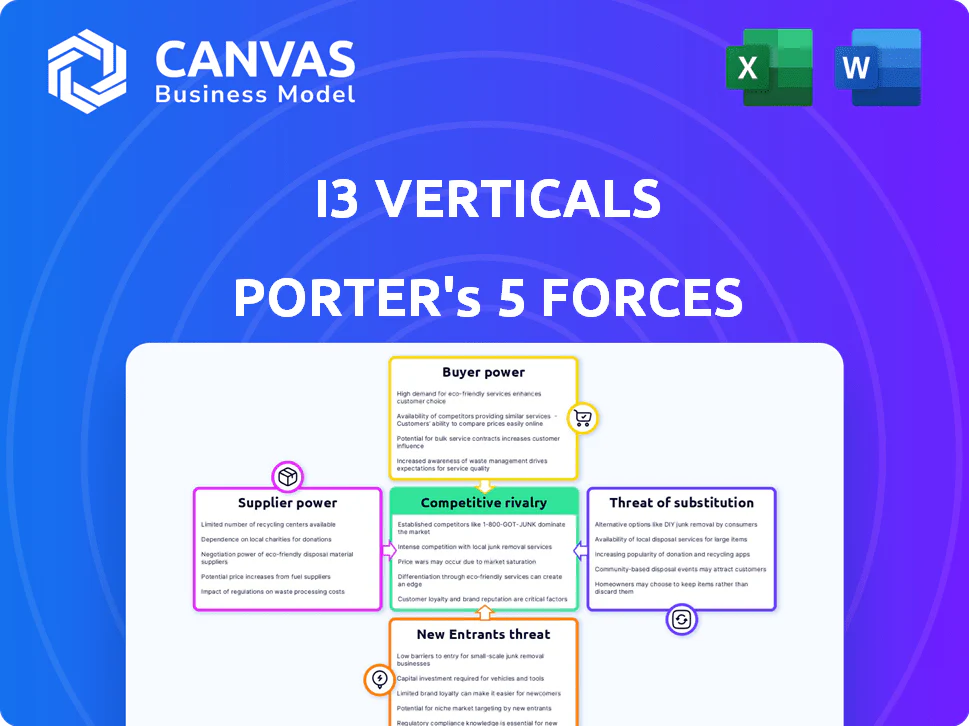
I3 VERTICALS PORTER'S FIVE FORCES TEMPLATE RESEARCH
What is included in the product
 Detailed Word Document
Analyzes competition, customer power, and entry risks for i3 Verticals.

 Customizable Excel Spreadsheet
Customize pressure levels based on new data or evolving market trends.
Same Document Delivered
i3 Verticals Porter's Five Forces Analysis
This preview offers the complete Porter's Five Forces analysis for i3 Verticals. The detailed assessment of competitive forces is exactly what you'll receive immediately after purchase, fully accessible. Expect no differences from what you see here. This document provides a ready-to-use, in-depth examination.

Porter's Five Forces Analysis Template

Go Beyond the Preview—Access the Full Strategic Report
i3 Verticals operates in a competitive payments landscape. Its supplier power may be moderate given reliance on technology providers. Buyer power varies, influenced by customer size and contract terms. The threat of new entrants is significant due to low barriers. Substitute products, like digital wallets, pose a moderate threat. Rivalry among existing competitors is intense, increasing competitive pressures.
This brief snapshot only scratches the surface. Unlock the full Porter's Five Forces Analysis to explore i3 Verticals’s competitive dynamics, market pressures, and strategic advantages in detail.
Suppliers Bargaining Power

Limited number of suppliers for specialized software components.
The software sector, including firms like i3 Verticals, often depends on a small number of suppliers for specialized software components. This can give suppliers more power. In 2024, the market for niche software components saw price hikes due to limited availability. This allows suppliers to dictate terms, impacting companies' profitability and operational costs.
High switching costs for alternative suppliers.
If i3 Verticals faces high switching costs, such as those for specialized software or hardware, suppliers gain leverage. For example, the cost to switch a payment processing platform can reach hundreds of thousands of dollars, as seen in 2024 reports. Integrating new systems and retraining staff further increases these costs.

Suppliers offering unique technology or services.
Suppliers with unique tech hold significant power over i3 Verticals. This leverage is amplified if the tech isn't easily duplicated. For instance, if a key software provider has a patented system, i3 Verticals becomes reliant. In 2024, companies with irreplaceable tech saw pricing power increase by approximately 7%, reflecting higher supplier bargaining.

Ability of suppliers to integrate vertically.
Suppliers' power rises if they can integrate forward, possibly offering solutions like i3 Verticals. This capability impacts i3 Verticals' negotiations and profitability. For example, if a key technology provider develops its own payment platform, it could become a direct competitor. The potential for suppliers to enter i3 Verticals' market significantly affects their bargaining position. This forward integration threat is a constant factor.
- Forward integration allows suppliers to capture more value.
- It increases their leverage in price negotiations.
- Could lead to a loss of market share for i3 Verticals.
- The risk is higher with unique or essential inputs.
Rising costs of raw materials and development tools.
The bargaining power of suppliers for i3 Verticals is influenced by the rising costs of resources. Increases in the cost of raw materials and software development tools allow suppliers to exert power by passing costs to i3 Verticals. This can directly impact i3 Verticals' operating expenses and, subsequently, its profitability. For example, rising labor costs in 2024 increased software development expenses by approximately 8%.
- Software development costs rose due to increased demand.
- Suppliers can dictate terms, affecting profit margins.
- i3 Verticals must manage these costs effectively.
Supplier Power Dynamics: A Look at the Business
i3 Verticals faces supplier power, especially with niche software. Switching costs, like platform integration, boost supplier leverage. Unique tech suppliers hold significant power, affecting pricing. Suppliers' forward integration poses a direct competitive threat.
| Factor | Impact on i3 Verticals | 2024 Data |
|---|---|---|
| Software Component Dependency | Higher costs, reduced margins | Niche software prices rose 5-8% |
| Switching Costs | Increased expenses, reduced flexibility | Platform switch costs up to $300K |
| Unique Technology | Reliance, pricing vulnerability | Tech pricing power increased by 7% |
| Forward Integration | Direct competition, margin pressure | Potential market share loss |
Customers Bargaining Power

Diverse client base across multiple sectors.
i3 Verticals' diverse customer base spans public sector, education, and healthcare, mitigating customer bargaining power. In 2024, no single sector contributed over 30% of revenue, demonstrating reduced customer influence. This diversification protects against sector-specific economic downturns, ensuring revenue stability. The broad client base enhances i3 Verticals' pricing flexibility and negotiation position.
Established brand loyalty among existing clients.
i3 Verticals benefits from brand loyalty within its existing customer base, particularly in software and services. Customer experience and established relationships foster loyalty, potentially reducing customer power. In 2024, the company's focus on customer retention, with rates often exceeding industry averages, is crucial. High retention rates suggest clients are less likely to seek alternatives, strengthening i3 Verticals' position.

Ability of large clients to negotiate better terms.
i3 Verticals' reliance on large clients, despite diversification efforts, means these customers wield substantial bargaining power. This is because they can negotiate better pricing and terms due to their significant contribution to i3 Verticals' revenue. In 2024, a major client could influence up to 15% of the company's annual revenue. The ability to switch vendors also enhances their power.

Switching costs for customers.
Switching costs significantly influence customer bargaining power for i3 Verticals. High switching costs, due to the complexity of integrating payment systems, make it harder for clients to switch. This reduced mobility gives i3 Verticals more leverage in pricing and service negotiations. For instance, in 2024, the average cost to switch payment processors for small businesses was around $500-$1,000, which is a barrier.
- Integration complexity increases switching costs.
- Long-term contracts reduce customer mobility.
- Custom software integrations can be expensive to replace.
- Data migration challenges create switching barriers.
Availability of integrated solutions from competitors.
The availability of integrated solutions from competitors significantly impacts customer bargaining power for i3 Verticals. If rivals offer similar payment and software solutions, customers gain more leverage. They can easily switch providers if dissatisfied, increasing the pressure on i3 Verticals to offer competitive pricing and services. This competitive landscape, where customers have multiple choices, directly affects profitability.
- Competitor offerings increase customer choice.
- Switching costs can be low, increasing customer power.
- Competition may drive down prices and margins.
- Customers can negotiate better terms.
Customer Power Dynamics: A Look at the Numbers
i3 Verticals faces varied customer bargaining power due to its diverse customer base and high switching costs. Large clients, however, can exert significant influence, affecting pricing and terms. The availability of competitor solutions also impacts customer power.
| Factor | Impact | 2024 Data |
|---|---|---|
| Customer Base | Diversification reduces power | No sector >30% revenue share |
| Switching Costs | High costs decrease power | Avg. switch cost: $500-$1,000 |
| Client Size | Large clients have more power | Major client: up to 15% revenue |
Rivalry Among Competitors

Presence of established players in the market.
i3 Verticals faces tough competition from established players in the payment and software sector. These competitors, like large tech firms and fintech specialists, have significant market presence. For instance, in 2024, the payment processing industry saw major players like Fiserv and Global Payments with substantial revenue. Competition affects pricing and market share. This rivalry influences i3 Verticals' strategies.
Competition from emerging fintech companies.
The fintech sector is rapidly evolving, with new firms consistently introducing innovative solutions. This influx of new competitors intensifies rivalry, especially in specialized areas or with advanced tech like AI. For instance, in 2024, fintech funding reached $58.9 billion globally. This increased competition can erode i3 Verticals' market share if they don't adapt.

Focus on specific vertical markets.
i3 Verticals targets specific sectors, such as public sector, education, and healthcare, setting it apart. However, these verticals face competition from firms with similar expertise. In 2024, the payment processing industry saw intense rivalry, with many players vying for market share. i3 Verticals' revenue in Q3 2024 was $116.3 million, showing its market presence.

Differentiation through customized solutions and integrated offerings.
i3 Verticals differentiates itself by offering customized software and integrated payment solutions, focusing on specific vertical markets. This strategy allows for tailored solutions that meet unique industry needs, reducing direct competition by providing niche services. In 2024, the company's revenue reached $382.6 million, reflecting its focus on specialized, high-value offerings. This approach helps i3 Verticals stand out from competitors.
- Customization allows i3 Verticals to target specific industry pain points.
- Integrated offerings bundle software and payments, enhancing customer value.
- Focus on vertical markets reduces direct competition and increases market share.
- Financial performance in 2024 shows the success of the differentiation strategy.
Strategic acquisitions by i3 Verticals and competitors.
Strategic acquisitions are key in the payment processing industry, driving growth for i3 Verticals and its rivals. Companies like Shift4 Payments have also been active, acquiring businesses to broaden their services and client base. This constant acquisition activity reshapes the competitive environment. In 2024, the payments sector saw $36.7 billion in deal value, demonstrating the importance of M&A.
- i3 Verticals completed several acquisitions in 2024 to expand its market reach.
- Competitors like Shift4 Payments have also made significant acquisitions.
- The payments industry M&A activity totaled $36.7 billion in 2024.
- Acquisitions are a primary method for market share expansion.
i3 Verticals Faces Fierce Competition in a Thriving Fintech Market
Competitive rivalry for i3 Verticals is intense, with established and emerging players vying for market share. Fintech funding reached $58.9 billion in 2024, fueling innovation and competition. i3 Verticals' Q3 2024 revenue was $116.3 million, showing its position.
| Aspect | Details | 2024 Data |
|---|---|---|
| Industry Funding | Fintech investment | $58.9 billion |
| i3 Verticals Revenue (Q3) | Company performance | $116.3 million |
| M&A Activity | Payments sector deals | $36.7 billion |
Original: $10.00
-65%$10.00
$3.50I3 VERTICALS PORTER'S FIVE FORCES TEMPLATE RESEARCH
What is included in the product
Detailed Word Document
Analyzes competition, customer power, and entry risks for i3 Verticals.
Customizable Excel Spreadsheet
Customize pressure levels based on new data or evolving market trends.
Same Document Delivered
i3 Verticals Porter's Five Forces Analysis
This preview offers the complete Porter's Five Forces analysis for i3 Verticals. The detailed assessment of competitive forces is exactly what you'll receive immediately after purchase, fully accessible. Expect no differences from what you see here. This document provides a ready-to-use, in-depth examination.
Porter's Five Forces Analysis Template
Go Beyond the Preview—Access the Full Strategic Report
i3 Verticals operates in a competitive payments landscape. Its supplier power may be moderate given reliance on technology providers. Buyer power varies, influenced by customer size and contract terms. The threat of new entrants is significant due to low barriers. Substitute products, like digital wallets, pose a moderate threat. Rivalry among existing competitors is intense, increasing competitive pressures.
This brief snapshot only scratches the surface. Unlock the full Porter's Five Forces Analysis to explore i3 Verticals’s competitive dynamics, market pressures, and strategic advantages in detail.
Suppliers Bargaining Power
Limited number of suppliers for specialized software components.
The software sector, including firms like i3 Verticals, often depends on a small number of suppliers for specialized software components. This can give suppliers more power. In 2024, the market for niche software components saw price hikes due to limited availability. This allows suppliers to dictate terms, impacting companies' profitability and operational costs.
High switching costs for alternative suppliers.
If i3 Verticals faces high switching costs, such as those for specialized software or hardware, suppliers gain leverage. For example, the cost to switch a payment processing platform can reach hundreds of thousands of dollars, as seen in 2024 reports. Integrating new systems and retraining staff further increases these costs.
Suppliers offering unique technology or services.
Suppliers with unique tech hold significant power over i3 Verticals. This leverage is amplified if the tech isn't easily duplicated. For instance, if a key software provider has a patented system, i3 Verticals becomes reliant. In 2024, companies with irreplaceable tech saw pricing power increase by approximately 7%, reflecting higher supplier bargaining.
Ability of suppliers to integrate vertically.
Suppliers' power rises if they can integrate forward, possibly offering solutions like i3 Verticals. This capability impacts i3 Verticals' negotiations and profitability. For example, if a key technology provider develops its own payment platform, it could become a direct competitor. The potential for suppliers to enter i3 Verticals' market significantly affects their bargaining position. This forward integration threat is a constant factor.
- Forward integration allows suppliers to capture more value.
- It increases their leverage in price negotiations.
- Could lead to a loss of market share for i3 Verticals.
- The risk is higher with unique or essential inputs.
Rising costs of raw materials and development tools.
The bargaining power of suppliers for i3 Verticals is influenced by the rising costs of resources. Increases in the cost of raw materials and software development tools allow suppliers to exert power by passing costs to i3 Verticals. This can directly impact i3 Verticals' operating expenses and, subsequently, its profitability. For example, rising labor costs in 2024 increased software development expenses by approximately 8%.
- Software development costs rose due to increased demand.
- Suppliers can dictate terms, affecting profit margins.
- i3 Verticals must manage these costs effectively.
Supplier Power Dynamics: A Look at the Business
i3 Verticals faces supplier power, especially with niche software. Switching costs, like platform integration, boost supplier leverage. Unique tech suppliers hold significant power, affecting pricing. Suppliers' forward integration poses a direct competitive threat.
| Factor | Impact on i3 Verticals | 2024 Data |
|---|---|---|
| Software Component Dependency | Higher costs, reduced margins | Niche software prices rose 5-8% |
| Switching Costs | Increased expenses, reduced flexibility | Platform switch costs up to $300K |
| Unique Technology | Reliance, pricing vulnerability | Tech pricing power increased by 7% |
| Forward Integration | Direct competition, margin pressure | Potential market share loss |
Customers Bargaining Power
Diverse client base across multiple sectors.
i3 Verticals' diverse customer base spans public sector, education, and healthcare, mitigating customer bargaining power. In 2024, no single sector contributed over 30% of revenue, demonstrating reduced customer influence. This diversification protects against sector-specific economic downturns, ensuring revenue stability. The broad client base enhances i3 Verticals' pricing flexibility and negotiation position.
Established brand loyalty among existing clients.
i3 Verticals benefits from brand loyalty within its existing customer base, particularly in software and services. Customer experience and established relationships foster loyalty, potentially reducing customer power. In 2024, the company's focus on customer retention, with rates often exceeding industry averages, is crucial. High retention rates suggest clients are less likely to seek alternatives, strengthening i3 Verticals' position.
Ability of large clients to negotiate better terms.
i3 Verticals' reliance on large clients, despite diversification efforts, means these customers wield substantial bargaining power. This is because they can negotiate better pricing and terms due to their significant contribution to i3 Verticals' revenue. In 2024, a major client could influence up to 15% of the company's annual revenue. The ability to switch vendors also enhances their power.
Switching costs for customers.
Switching costs significantly influence customer bargaining power for i3 Verticals. High switching costs, due to the complexity of integrating payment systems, make it harder for clients to switch. This reduced mobility gives i3 Verticals more leverage in pricing and service negotiations. For instance, in 2024, the average cost to switch payment processors for small businesses was around $500-$1,000, which is a barrier.
- Integration complexity increases switching costs.
- Long-term contracts reduce customer mobility.
- Custom software integrations can be expensive to replace.
- Data migration challenges create switching barriers.
Availability of integrated solutions from competitors.
The availability of integrated solutions from competitors significantly impacts customer bargaining power for i3 Verticals. If rivals offer similar payment and software solutions, customers gain more leverage. They can easily switch providers if dissatisfied, increasing the pressure on i3 Verticals to offer competitive pricing and services. This competitive landscape, where customers have multiple choices, directly affects profitability.
- Competitor offerings increase customer choice.
- Switching costs can be low, increasing customer power.
- Competition may drive down prices and margins.
- Customers can negotiate better terms.
Customer Power Dynamics: A Look at the Numbers
i3 Verticals faces varied customer bargaining power due to its diverse customer base and high switching costs. Large clients, however, can exert significant influence, affecting pricing and terms. The availability of competitor solutions also impacts customer power.
| Factor | Impact | 2024 Data |
|---|---|---|
| Customer Base | Diversification reduces power | No sector >30% revenue share |
| Switching Costs | High costs decrease power | Avg. switch cost: $500-$1,000 |
| Client Size | Large clients have more power | Major client: up to 15% revenue |
Rivalry Among Competitors
Presence of established players in the market.
i3 Verticals faces tough competition from established players in the payment and software sector. These competitors, like large tech firms and fintech specialists, have significant market presence. For instance, in 2024, the payment processing industry saw major players like Fiserv and Global Payments with substantial revenue. Competition affects pricing and market share. This rivalry influences i3 Verticals' strategies.
Competition from emerging fintech companies.
The fintech sector is rapidly evolving, with new firms consistently introducing innovative solutions. This influx of new competitors intensifies rivalry, especially in specialized areas or with advanced tech like AI. For instance, in 2024, fintech funding reached $58.9 billion globally. This increased competition can erode i3 Verticals' market share if they don't adapt.
Focus on specific vertical markets.
i3 Verticals targets specific sectors, such as public sector, education, and healthcare, setting it apart. However, these verticals face competition from firms with similar expertise. In 2024, the payment processing industry saw intense rivalry, with many players vying for market share. i3 Verticals' revenue in Q3 2024 was $116.3 million, showing its market presence.
Differentiation through customized solutions and integrated offerings.
i3 Verticals differentiates itself by offering customized software and integrated payment solutions, focusing on specific vertical markets. This strategy allows for tailored solutions that meet unique industry needs, reducing direct competition by providing niche services. In 2024, the company's revenue reached $382.6 million, reflecting its focus on specialized, high-value offerings. This approach helps i3 Verticals stand out from competitors.
- Customization allows i3 Verticals to target specific industry pain points.
- Integrated offerings bundle software and payments, enhancing customer value.
- Focus on vertical markets reduces direct competition and increases market share.
- Financial performance in 2024 shows the success of the differentiation strategy.
Strategic acquisitions by i3 Verticals and competitors.
Strategic acquisitions are key in the payment processing industry, driving growth for i3 Verticals and its rivals. Companies like Shift4 Payments have also been active, acquiring businesses to broaden their services and client base. This constant acquisition activity reshapes the competitive environment. In 2024, the payments sector saw $36.7 billion in deal value, demonstrating the importance of M&A.
- i3 Verticals completed several acquisitions in 2024 to expand its market reach.
- Competitors like Shift4 Payments have also made significant acquisitions.
- The payments industry M&A activity totaled $36.7 billion in 2024.
- Acquisitions are a primary method for market share expansion.
i3 Verticals Faces Fierce Competition in a Thriving Fintech Market
Competitive rivalry for i3 Verticals is intense, with established and emerging players vying for market share. Fintech funding reached $58.9 billion in 2024, fueling innovation and competition. i3 Verticals' Q3 2024 revenue was $116.3 million, showing its position.
| Aspect | Details | 2024 Data |
|---|---|---|
| Industry Funding | Fintech investment | $58.9 billion |
| i3 Verticals Revenue (Q3) | Company performance | $116.3 million |
| M&A Activity | Payments sector deals | $36.7 billion |
Product Information
Product Information
Shipping & Returns
Shipping & Returns
Description
What is included in the product
Detailed Word Document
Analyzes competition, customer power, and entry risks for i3 Verticals.
Customizable Excel Spreadsheet
Customize pressure levels based on new data or evolving market trends.
Same Document Delivered
i3 Verticals Porter's Five Forces Analysis
This preview offers the complete Porter's Five Forces analysis for i3 Verticals. The detailed assessment of competitive forces is exactly what you'll receive immediately after purchase, fully accessible. Expect no differences from what you see here. This document provides a ready-to-use, in-depth examination.
Porter's Five Forces Analysis Template
Go Beyond the Preview—Access the Full Strategic Report
i3 Verticals operates in a competitive payments landscape. Its supplier power may be moderate given reliance on technology providers. Buyer power varies, influenced by customer size and contract terms. The threat of new entrants is significant due to low barriers. Substitute products, like digital wallets, pose a moderate threat. Rivalry among existing competitors is intense, increasing competitive pressures.
This brief snapshot only scratches the surface. Unlock the full Porter's Five Forces Analysis to explore i3 Verticals’s competitive dynamics, market pressures, and strategic advantages in detail.
Suppliers Bargaining Power
Limited number of suppliers for specialized software components.
The software sector, including firms like i3 Verticals, often depends on a small number of suppliers for specialized software components. This can give suppliers more power. In 2024, the market for niche software components saw price hikes due to limited availability. This allows suppliers to dictate terms, impacting companies' profitability and operational costs.
High switching costs for alternative suppliers.
If i3 Verticals faces high switching costs, such as those for specialized software or hardware, suppliers gain leverage. For example, the cost to switch a payment processing platform can reach hundreds of thousands of dollars, as seen in 2024 reports. Integrating new systems and retraining staff further increases these costs.
Suppliers offering unique technology or services.
Suppliers with unique tech hold significant power over i3 Verticals. This leverage is amplified if the tech isn't easily duplicated. For instance, if a key software provider has a patented system, i3 Verticals becomes reliant. In 2024, companies with irreplaceable tech saw pricing power increase by approximately 7%, reflecting higher supplier bargaining.
Ability of suppliers to integrate vertically.
Suppliers' power rises if they can integrate forward, possibly offering solutions like i3 Verticals. This capability impacts i3 Verticals' negotiations and profitability. For example, if a key technology provider develops its own payment platform, it could become a direct competitor. The potential for suppliers to enter i3 Verticals' market significantly affects their bargaining position. This forward integration threat is a constant factor.
- Forward integration allows suppliers to capture more value.
- It increases their leverage in price negotiations.
- Could lead to a loss of market share for i3 Verticals.
- The risk is higher with unique or essential inputs.
Rising costs of raw materials and development tools.
The bargaining power of suppliers for i3 Verticals is influenced by the rising costs of resources. Increases in the cost of raw materials and software development tools allow suppliers to exert power by passing costs to i3 Verticals. This can directly impact i3 Verticals' operating expenses and, subsequently, its profitability. For example, rising labor costs in 2024 increased software development expenses by approximately 8%.
- Software development costs rose due to increased demand.
- Suppliers can dictate terms, affecting profit margins.
- i3 Verticals must manage these costs effectively.
Supplier Power Dynamics: A Look at the Business
i3 Verticals faces supplier power, especially with niche software. Switching costs, like platform integration, boost supplier leverage. Unique tech suppliers hold significant power, affecting pricing. Suppliers' forward integration poses a direct competitive threat.
| Factor | Impact on i3 Verticals | 2024 Data |
|---|---|---|
| Software Component Dependency | Higher costs, reduced margins | Niche software prices rose 5-8% |
| Switching Costs | Increased expenses, reduced flexibility | Platform switch costs up to $300K |
| Unique Technology | Reliance, pricing vulnerability | Tech pricing power increased by 7% |
| Forward Integration | Direct competition, margin pressure | Potential market share loss |
Customers Bargaining Power
Diverse client base across multiple sectors.
i3 Verticals' diverse customer base spans public sector, education, and healthcare, mitigating customer bargaining power. In 2024, no single sector contributed over 30% of revenue, demonstrating reduced customer influence. This diversification protects against sector-specific economic downturns, ensuring revenue stability. The broad client base enhances i3 Verticals' pricing flexibility and negotiation position.
Established brand loyalty among existing clients.
i3 Verticals benefits from brand loyalty within its existing customer base, particularly in software and services. Customer experience and established relationships foster loyalty, potentially reducing customer power. In 2024, the company's focus on customer retention, with rates often exceeding industry averages, is crucial. High retention rates suggest clients are less likely to seek alternatives, strengthening i3 Verticals' position.
Ability of large clients to negotiate better terms.
i3 Verticals' reliance on large clients, despite diversification efforts, means these customers wield substantial bargaining power. This is because they can negotiate better pricing and terms due to their significant contribution to i3 Verticals' revenue. In 2024, a major client could influence up to 15% of the company's annual revenue. The ability to switch vendors also enhances their power.
Switching costs for customers.
Switching costs significantly influence customer bargaining power for i3 Verticals. High switching costs, due to the complexity of integrating payment systems, make it harder for clients to switch. This reduced mobility gives i3 Verticals more leverage in pricing and service negotiations. For instance, in 2024, the average cost to switch payment processors for small businesses was around $500-$1,000, which is a barrier.
- Integration complexity increases switching costs.
- Long-term contracts reduce customer mobility.
- Custom software integrations can be expensive to replace.
- Data migration challenges create switching barriers.
Availability of integrated solutions from competitors.
The availability of integrated solutions from competitors significantly impacts customer bargaining power for i3 Verticals. If rivals offer similar payment and software solutions, customers gain more leverage. They can easily switch providers if dissatisfied, increasing the pressure on i3 Verticals to offer competitive pricing and services. This competitive landscape, where customers have multiple choices, directly affects profitability.
- Competitor offerings increase customer choice.
- Switching costs can be low, increasing customer power.
- Competition may drive down prices and margins.
- Customers can negotiate better terms.
Customer Power Dynamics: A Look at the Numbers
i3 Verticals faces varied customer bargaining power due to its diverse customer base and high switching costs. Large clients, however, can exert significant influence, affecting pricing and terms. The availability of competitor solutions also impacts customer power.
| Factor | Impact | 2024 Data |
|---|---|---|
| Customer Base | Diversification reduces power | No sector >30% revenue share |
| Switching Costs | High costs decrease power | Avg. switch cost: $500-$1,000 |
| Client Size | Large clients have more power | Major client: up to 15% revenue |
Rivalry Among Competitors
Presence of established players in the market.
i3 Verticals faces tough competition from established players in the payment and software sector. These competitors, like large tech firms and fintech specialists, have significant market presence. For instance, in 2024, the payment processing industry saw major players like Fiserv and Global Payments with substantial revenue. Competition affects pricing and market share. This rivalry influences i3 Verticals' strategies.
Competition from emerging fintech companies.
The fintech sector is rapidly evolving, with new firms consistently introducing innovative solutions. This influx of new competitors intensifies rivalry, especially in specialized areas or with advanced tech like AI. For instance, in 2024, fintech funding reached $58.9 billion globally. This increased competition can erode i3 Verticals' market share if they don't adapt.
Focus on specific vertical markets.
i3 Verticals targets specific sectors, such as public sector, education, and healthcare, setting it apart. However, these verticals face competition from firms with similar expertise. In 2024, the payment processing industry saw intense rivalry, with many players vying for market share. i3 Verticals' revenue in Q3 2024 was $116.3 million, showing its market presence.
Differentiation through customized solutions and integrated offerings.
i3 Verticals differentiates itself by offering customized software and integrated payment solutions, focusing on specific vertical markets. This strategy allows for tailored solutions that meet unique industry needs, reducing direct competition by providing niche services. In 2024, the company's revenue reached $382.6 million, reflecting its focus on specialized, high-value offerings. This approach helps i3 Verticals stand out from competitors.
- Customization allows i3 Verticals to target specific industry pain points.
- Integrated offerings bundle software and payments, enhancing customer value.
- Focus on vertical markets reduces direct competition and increases market share.
- Financial performance in 2024 shows the success of the differentiation strategy.
Strategic acquisitions by i3 Verticals and competitors.
Strategic acquisitions are key in the payment processing industry, driving growth for i3 Verticals and its rivals. Companies like Shift4 Payments have also been active, acquiring businesses to broaden their services and client base. This constant acquisition activity reshapes the competitive environment. In 2024, the payments sector saw $36.7 billion in deal value, demonstrating the importance of M&A.
- i3 Verticals completed several acquisitions in 2024 to expand its market reach.
- Competitors like Shift4 Payments have also made significant acquisitions.
- The payments industry M&A activity totaled $36.7 billion in 2024.
- Acquisitions are a primary method for market share expansion.
i3 Verticals Faces Fierce Competition in a Thriving Fintech Market
Competitive rivalry for i3 Verticals is intense, with established and emerging players vying for market share. Fintech funding reached $58.9 billion in 2024, fueling innovation and competition. i3 Verticals' Q3 2024 revenue was $116.3 million, showing its position.
| Aspect | Details | 2024 Data |
|---|---|---|
| Industry Funding | Fintech investment | $58.9 billion |
| i3 Verticals Revenue (Q3) | Company performance | $116.3 million |
| M&A Activity | Payments sector deals | $36.7 billion |











