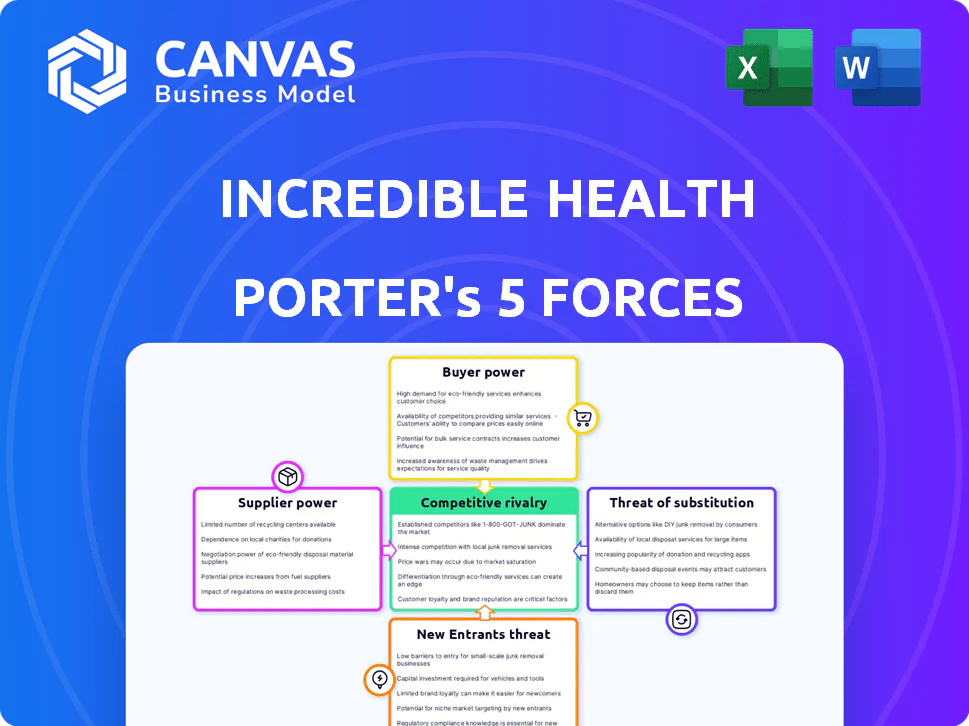
INCREDIBLE HEALTH PORTER'S FIVE FORCES TEMPLATE RESEARCH
What is included in the product
 Detailed Word Document
Detailed analysis of each competitive force, supported by industry data and strategic commentary.

 Customizable Excel Spreadsheet
Instantly visualize market pressure from five forces to inform healthcare decisions.
Preview the Actual Deliverable
Incredible Health Porter's Five Forces Analysis
This preview presents the complete Incredible Health Porter's Five Forces analysis. It's the very document you'll receive immediately after your purchase.

Porter's Five Forces Analysis Template

Don't Miss the Bigger Picture
Incredible Health faces moderate rivalry, driven by competing platforms and established healthcare staffing agencies. Buyer power is significant, as hospitals have options. Supplier power is generally low, with a fragmented healthcare worker pool. The threat of new entrants is moderate, facing barriers. The threat of substitutes, such as internal hiring, is also moderate.
Ready to move beyond the basics? Get a full strategic breakdown of Incredible Health’s market position, competitive intensity, and external threats—all in one powerful analysis.
Suppliers Bargaining Power

Dependence on Technology Providers
Incredible Health's reliance on AI and data analytics platforms gives technology providers leverage. These providers, offering proprietary or hard-to-duplicate tools, can influence pricing. For instance, the global AI market was valued at $196.63 billion in 2023, showing the providers' strength. This dynamic impacts Incredible Health's operational costs and profitability.
Availability of Nurse Data and Credentials
Suppliers of nurse data and credential verification services have some leverage. Incredible Health relies on these services to validate licenses and certifications, essential for their platform. The accessibility of this data impacts supplier power, which is critical for the business model. In 2024, the market for healthcare credentialing services was valued at approximately $1.2 billion, highlighting the significance of these suppliers.

Talent Pool of Nurses
Incredible Health's platform connects hospitals with nurses, who, in this context, are suppliers of labor. The U.S. faces a persistent nursing shortage, with projections estimating a need for over 275,000 additional nurses by 2030. This shortage grants nurses considerable bargaining power. Recent data shows that nurses' salaries have increased significantly, with the median annual salary for registered nurses reaching $81,220 in May 2022, reflecting their strong position in the market.

Competition Among Technology Providers
Competition among technology providers is intensifying in healthcare staffing. This limits their ability to dictate terms to platforms like Incredible Health. The market sees numerous AI and digital tool vendors. This competition keeps prices and service terms in check. In 2024, the digital health market is valued at over $200 billion, and growing.
- Market competition reduces individual supplier power.
- Many AI and digital tool vendors exist.
- Healthcare tech market valued over $200 billion in 2024.
- This keeps prices and terms competitive.
Reliance on Data Accuracy and Integrations
Incredible Health's success hinges on the data it receives from healthcare providers. The accuracy and timeliness of this data, sourced from hospitals and other healthcare systems, are crucial. Suppliers' influence stems from their control over this data and the ease with which Incredible Health can integrate their systems. For example, in 2024, the healthcare staffing market was valued at over $30 billion, highlighting the financial stakes involved.
- Data quality directly impacts Incredible Health's ability to match nurses with the right jobs.
- Integration challenges could lead to delays or inaccuracies.
- Stronger suppliers might demand higher prices or stricter terms.
- The cost of data integration can vary significantly.
Power Dynamics in Healthcare Staffing
Incredible Health faces supplier power from AI, data, and nurse labor markets.
Tech suppliers have leverage due to proprietary tools. The healthcare credentialing market was worth about $1.2 billion in 2024.
Nurses, in short supply, have strong bargaining power. The U.S. needs over 275,000 more nurses by 2030.
| Supplier Type | Market Value (2024) | Impact on Incredible Health |
|---|---|---|
| AI Technology | $200+ billion (digital health) | Influences pricing, operational costs |
| Credentialing Services | ~$1.2 billion | Essential for platform validation |
| Nurses | N/A (labor market) | Impacts staffing costs, service delivery |
Customers Bargaining Power

Hospitals' Need for Nurses
Hospitals, the main clients of Incredible Health, heavily rely on permanent nurses, facing a persistent shortage. This critical need gives hospitals some bargaining power. In 2024, the U.S. nursing shortage reached nearly 200,000, driving up demand. Hospitals aim for efficient, cost-effective staffing solutions, which impacts their negotiations with Incredible Health.
Availability of Alternative Staffing Methods
Hospitals aren't solely reliant on Incredible Health; they have options. Internal recruitment and staffing agencies offer alternatives. This availability enhances hospitals' negotiation leverage. For example, in 2024, the U.S. healthcare sector saw a 10% increase in utilizing diverse staffing models. This power allows them to negotiate better terms.

Cost Sensitivity of Hospitals
Healthcare labor expenses rose, putting pressure on hospitals to cut costs. Incredible Health's value proposition focuses on cutting hiring costs and time. Hospitals assess the platform's cost-effectiveness, impacting their bargaining power. Labor costs in healthcare increased by 3.5% in 2024, and this trend is expected to continue. Hospitals will carefully evaluate Incredible Health's pricing against their own hiring costs and other solutions.

Concentration of Hospital Customers
Incredible Health's bargaining power with customers, hospitals, is tied to customer concentration. While they serve many hospitals, the revenue distribution matters. If a few large hospital systems generate most revenue, those systems gain significant leverage. This can impact pricing and service terms.
- In 2024, the top 10 hospital systems in the U.S. account for a substantial portion of healthcare spending.
- These systems may use their size to negotiate favorable terms with vendors like Incredible Health.
- Customer concentration can pressure profit margins and influence service offerings.
- Diversifying the customer base mitigates this risk, strengthening Incredible Health's position.
Ability to Influence Platform Features and Pricing
Hospitals, as significant users, wield considerable influence over Incredible Health's features. Their input shapes the platform's evolution, ensuring it meets their specific needs in healthcare staffing. This feedback directly affects pricing strategies and service offerings. For example, 70% of hospitals reported wanting more AI-driven matching in 2024.
- Feature Influence: Hospitals' feedback guides platform updates.
- Pricing Impact: Customer needs shape pricing models.
- Service Customization: Tailoring services to hospital demands.
- Market Dynamics: Adapting to evolving healthcare needs.
Hospitals' Leverage: Shortages, Options, and Power Dynamics
Hospitals' bargaining power stems from shortages and alternative staffing options. In 2024, the nursing shortage was nearly 200,000 in the U.S., yet hospitals use internal and external agencies. This power is amplified by rising labor costs, pushing them to cut costs.
Customer concentration impacts Incredible Health's leverage; major hospital systems hold significant influence. The top 10 systems account for a large portion of spending. Their feedback shapes the platform, affecting pricing and service offerings.
| Factor | Impact | 2024 Data |
|---|---|---|
| Shortage | Hospitals Need Nurses | Nearly 200,000 shortage |
| Alternatives | Negotiation power | 10% increase in diverse staffing models |
| Concentration | Pricing/Services | Top 10 systems have high spending share |
Rivalry Among Competitors

Number and Diversity of Competitors
Incredible Health contends with numerous rivals in healthcare staffing. These include established agencies and tech-driven platforms. The market is fragmented, with no single entity holding dominant power. For instance, the U.S. healthcare staffing market was valued at $35.5 billion in 2024.
Differentiation of Services
Competition hinges on Incredible Health's ability to stand out. Its permanent placement focus, AI matching, and quick hiring set it apart. However, rivals offering similar speed and efficiency affect rivalry. In 2024, the healthcare staffing market was valued at over $30 billion, with rapid growth. The more competitors match these traits, the more intense the rivalry becomes.

Market Growth Rate
The healthcare staffing market is expanding due to an aging population and staffing shortages. This growth, projected to reach $35.6 billion by 2024, can ease rivalry. However, the critical need for healthcare staff maintains strong competition. Incredible Health competes with companies like AMN Healthcare.

Switching Costs for Hospitals
Switching costs significantly influence the intensity of rivalry among staffing platforms for hospitals. If hospitals find it easy to switch between platforms, competitive pressure on Incredible Health intensifies. Low switching costs allow hospitals to quickly adopt competitor services, making the market more dynamic. This environment forces platforms to continuously improve offerings to retain clients.
- Average turnover rate for nurses in hospitals is around 20-25% annually.
- The cost to replace a nurse can range from $22,000 to $64,000.
- Approximately 74% of hospitals use some form of digital staffing solutions.
- In 2024, the healthcare staffing market is valued at approximately $40 billion.
Brand Reputation and Network Effects
Incredible Health's brand reputation and network effects significantly impact competitive rivalry. The platform's established network of nurses and hospitals strengthens its position. Rivals with robust existing relationships present a more substantial threat. Competition intensifies when rivals can leverage their networks to offer similar services. This is evident in the healthcare staffing market, estimated at $30 billion in 2024.
- Market size: The U.S. healthcare staffing market was valued at $30 billion in 2024.
- Network effect: Increased user base strengthens platform value.
- Brand reputation: Positive reviews improve competitive edge.
- Rivalry: Competitors with strong networks pose threats.
Healthcare Staffing: Fierce Competition Ahead!
Competitive rivalry for Incredible Health is intense due to many players in the $40 billion healthcare staffing market in 2024. Differentiation is key. Factors like switching costs, with nurse turnover costing hospitals up to $64,000, and brand reputation affect this rivalry.
| Factor | Impact | Data (2024) |
|---|---|---|
| Market Size | High Competition | $40B market |
| Switching Costs | Influences Rivalry | Nurse turnover cost up to $64K |
| Differentiation | Key to success | 74% use digital staffing |
INCREDIBLE HEALTH PORTER'S FIVE FORCES TEMPLATE RESEARCH
What is included in the product
Detailed Word Document
Detailed analysis of each competitive force, supported by industry data and strategic commentary.
Customizable Excel Spreadsheet
Instantly visualize market pressure from five forces to inform healthcare decisions.
Preview the Actual Deliverable
Incredible Health Porter's Five Forces Analysis
This preview presents the complete Incredible Health Porter's Five Forces analysis. It's the very document you'll receive immediately after your purchase.
Porter's Five Forces Analysis Template
Don't Miss the Bigger Picture
Incredible Health faces moderate rivalry, driven by competing platforms and established healthcare staffing agencies. Buyer power is significant, as hospitals have options. Supplier power is generally low, with a fragmented healthcare worker pool. The threat of new entrants is moderate, facing barriers. The threat of substitutes, such as internal hiring, is also moderate.
Ready to move beyond the basics? Get a full strategic breakdown of Incredible Health’s market position, competitive intensity, and external threats—all in one powerful analysis.
Suppliers Bargaining Power
Dependence on Technology Providers
Incredible Health's reliance on AI and data analytics platforms gives technology providers leverage. These providers, offering proprietary or hard-to-duplicate tools, can influence pricing. For instance, the global AI market was valued at $196.63 billion in 2023, showing the providers' strength. This dynamic impacts Incredible Health's operational costs and profitability.
Availability of Nurse Data and Credentials
Suppliers of nurse data and credential verification services have some leverage. Incredible Health relies on these services to validate licenses and certifications, essential for their platform. The accessibility of this data impacts supplier power, which is critical for the business model. In 2024, the market for healthcare credentialing services was valued at approximately $1.2 billion, highlighting the significance of these suppliers.
Talent Pool of Nurses
Incredible Health's platform connects hospitals with nurses, who, in this context, are suppliers of labor. The U.S. faces a persistent nursing shortage, with projections estimating a need for over 275,000 additional nurses by 2030. This shortage grants nurses considerable bargaining power. Recent data shows that nurses' salaries have increased significantly, with the median annual salary for registered nurses reaching $81,220 in May 2022, reflecting their strong position in the market.
Competition Among Technology Providers
Competition among technology providers is intensifying in healthcare staffing. This limits their ability to dictate terms to platforms like Incredible Health. The market sees numerous AI and digital tool vendors. This competition keeps prices and service terms in check. In 2024, the digital health market is valued at over $200 billion, and growing.
- Market competition reduces individual supplier power.
- Many AI and digital tool vendors exist.
- Healthcare tech market valued over $200 billion in 2024.
- This keeps prices and terms competitive.
Reliance on Data Accuracy and Integrations
Incredible Health's success hinges on the data it receives from healthcare providers. The accuracy and timeliness of this data, sourced from hospitals and other healthcare systems, are crucial. Suppliers' influence stems from their control over this data and the ease with which Incredible Health can integrate their systems. For example, in 2024, the healthcare staffing market was valued at over $30 billion, highlighting the financial stakes involved.
- Data quality directly impacts Incredible Health's ability to match nurses with the right jobs.
- Integration challenges could lead to delays or inaccuracies.
- Stronger suppliers might demand higher prices or stricter terms.
- The cost of data integration can vary significantly.
Power Dynamics in Healthcare Staffing
Incredible Health faces supplier power from AI, data, and nurse labor markets.
Tech suppliers have leverage due to proprietary tools. The healthcare credentialing market was worth about $1.2 billion in 2024.
Nurses, in short supply, have strong bargaining power. The U.S. needs over 275,000 more nurses by 2030.
| Supplier Type | Market Value (2024) | Impact on Incredible Health |
|---|---|---|
| AI Technology | $200+ billion (digital health) | Influences pricing, operational costs |
| Credentialing Services | ~$1.2 billion | Essential for platform validation |
| Nurses | N/A (labor market) | Impacts staffing costs, service delivery |
Customers Bargaining Power
Hospitals' Need for Nurses
Hospitals, the main clients of Incredible Health, heavily rely on permanent nurses, facing a persistent shortage. This critical need gives hospitals some bargaining power. In 2024, the U.S. nursing shortage reached nearly 200,000, driving up demand. Hospitals aim for efficient, cost-effective staffing solutions, which impacts their negotiations with Incredible Health.
Availability of Alternative Staffing Methods
Hospitals aren't solely reliant on Incredible Health; they have options. Internal recruitment and staffing agencies offer alternatives. This availability enhances hospitals' negotiation leverage. For example, in 2024, the U.S. healthcare sector saw a 10% increase in utilizing diverse staffing models. This power allows them to negotiate better terms.
Cost Sensitivity of Hospitals
Healthcare labor expenses rose, putting pressure on hospitals to cut costs. Incredible Health's value proposition focuses on cutting hiring costs and time. Hospitals assess the platform's cost-effectiveness, impacting their bargaining power. Labor costs in healthcare increased by 3.5% in 2024, and this trend is expected to continue. Hospitals will carefully evaluate Incredible Health's pricing against their own hiring costs and other solutions.
Concentration of Hospital Customers
Incredible Health's bargaining power with customers, hospitals, is tied to customer concentration. While they serve many hospitals, the revenue distribution matters. If a few large hospital systems generate most revenue, those systems gain significant leverage. This can impact pricing and service terms.
- In 2024, the top 10 hospital systems in the U.S. account for a substantial portion of healthcare spending.
- These systems may use their size to negotiate favorable terms with vendors like Incredible Health.
- Customer concentration can pressure profit margins and influence service offerings.
- Diversifying the customer base mitigates this risk, strengthening Incredible Health's position.
Ability to Influence Platform Features and Pricing
Hospitals, as significant users, wield considerable influence over Incredible Health's features. Their input shapes the platform's evolution, ensuring it meets their specific needs in healthcare staffing. This feedback directly affects pricing strategies and service offerings. For example, 70% of hospitals reported wanting more AI-driven matching in 2024.
- Feature Influence: Hospitals' feedback guides platform updates.
- Pricing Impact: Customer needs shape pricing models.
- Service Customization: Tailoring services to hospital demands.
- Market Dynamics: Adapting to evolving healthcare needs.
Hospitals' Leverage: Shortages, Options, and Power Dynamics
Hospitals' bargaining power stems from shortages and alternative staffing options. In 2024, the nursing shortage was nearly 200,000 in the U.S., yet hospitals use internal and external agencies. This power is amplified by rising labor costs, pushing them to cut costs.
Customer concentration impacts Incredible Health's leverage; major hospital systems hold significant influence. The top 10 systems account for a large portion of spending. Their feedback shapes the platform, affecting pricing and service offerings.
| Factor | Impact | 2024 Data |
|---|---|---|
| Shortage | Hospitals Need Nurses | Nearly 200,000 shortage |
| Alternatives | Negotiation power | 10% increase in diverse staffing models |
| Concentration | Pricing/Services | Top 10 systems have high spending share |
Rivalry Among Competitors
Number and Diversity of Competitors
Incredible Health contends with numerous rivals in healthcare staffing. These include established agencies and tech-driven platforms. The market is fragmented, with no single entity holding dominant power. For instance, the U.S. healthcare staffing market was valued at $35.5 billion in 2024.
Differentiation of Services
Competition hinges on Incredible Health's ability to stand out. Its permanent placement focus, AI matching, and quick hiring set it apart. However, rivals offering similar speed and efficiency affect rivalry. In 2024, the healthcare staffing market was valued at over $30 billion, with rapid growth. The more competitors match these traits, the more intense the rivalry becomes.
Market Growth Rate
The healthcare staffing market is expanding due to an aging population and staffing shortages. This growth, projected to reach $35.6 billion by 2024, can ease rivalry. However, the critical need for healthcare staff maintains strong competition. Incredible Health competes with companies like AMN Healthcare.
Switching Costs for Hospitals
Switching costs significantly influence the intensity of rivalry among staffing platforms for hospitals. If hospitals find it easy to switch between platforms, competitive pressure on Incredible Health intensifies. Low switching costs allow hospitals to quickly adopt competitor services, making the market more dynamic. This environment forces platforms to continuously improve offerings to retain clients.
- Average turnover rate for nurses in hospitals is around 20-25% annually.
- The cost to replace a nurse can range from $22,000 to $64,000.
- Approximately 74% of hospitals use some form of digital staffing solutions.
- In 2024, the healthcare staffing market is valued at approximately $40 billion.
Brand Reputation and Network Effects
Incredible Health's brand reputation and network effects significantly impact competitive rivalry. The platform's established network of nurses and hospitals strengthens its position. Rivals with robust existing relationships present a more substantial threat. Competition intensifies when rivals can leverage their networks to offer similar services. This is evident in the healthcare staffing market, estimated at $30 billion in 2024.
- Market size: The U.S. healthcare staffing market was valued at $30 billion in 2024.
- Network effect: Increased user base strengthens platform value.
- Brand reputation: Positive reviews improve competitive edge.
- Rivalry: Competitors with strong networks pose threats.
Healthcare Staffing: Fierce Competition Ahead!
Competitive rivalry for Incredible Health is intense due to many players in the $40 billion healthcare staffing market in 2024. Differentiation is key. Factors like switching costs, with nurse turnover costing hospitals up to $64,000, and brand reputation affect this rivalry.
| Factor | Impact | Data (2024) |
|---|---|---|
| Market Size | High Competition | $40B market |
| Switching Costs | Influences Rivalry | Nurse turnover cost up to $64K |
| Differentiation | Key to success | 74% use digital staffing |
Product Information
Product Information
Shipping & Returns
Shipping & Returns
Description
What is included in the product
Detailed Word Document
Detailed analysis of each competitive force, supported by industry data and strategic commentary.
Customizable Excel Spreadsheet
Instantly visualize market pressure from five forces to inform healthcare decisions.
Preview the Actual Deliverable
Incredible Health Porter's Five Forces Analysis
This preview presents the complete Incredible Health Porter's Five Forces analysis. It's the very document you'll receive immediately after your purchase.
Porter's Five Forces Analysis Template
Don't Miss the Bigger Picture
Incredible Health faces moderate rivalry, driven by competing platforms and established healthcare staffing agencies. Buyer power is significant, as hospitals have options. Supplier power is generally low, with a fragmented healthcare worker pool. The threat of new entrants is moderate, facing barriers. The threat of substitutes, such as internal hiring, is also moderate.
Ready to move beyond the basics? Get a full strategic breakdown of Incredible Health’s market position, competitive intensity, and external threats—all in one powerful analysis.
Suppliers Bargaining Power
Dependence on Technology Providers
Incredible Health's reliance on AI and data analytics platforms gives technology providers leverage. These providers, offering proprietary or hard-to-duplicate tools, can influence pricing. For instance, the global AI market was valued at $196.63 billion in 2023, showing the providers' strength. This dynamic impacts Incredible Health's operational costs and profitability.
Availability of Nurse Data and Credentials
Suppliers of nurse data and credential verification services have some leverage. Incredible Health relies on these services to validate licenses and certifications, essential for their platform. The accessibility of this data impacts supplier power, which is critical for the business model. In 2024, the market for healthcare credentialing services was valued at approximately $1.2 billion, highlighting the significance of these suppliers.
Talent Pool of Nurses
Incredible Health's platform connects hospitals with nurses, who, in this context, are suppliers of labor. The U.S. faces a persistent nursing shortage, with projections estimating a need for over 275,000 additional nurses by 2030. This shortage grants nurses considerable bargaining power. Recent data shows that nurses' salaries have increased significantly, with the median annual salary for registered nurses reaching $81,220 in May 2022, reflecting their strong position in the market.
Competition Among Technology Providers
Competition among technology providers is intensifying in healthcare staffing. This limits their ability to dictate terms to platforms like Incredible Health. The market sees numerous AI and digital tool vendors. This competition keeps prices and service terms in check. In 2024, the digital health market is valued at over $200 billion, and growing.
- Market competition reduces individual supplier power.
- Many AI and digital tool vendors exist.
- Healthcare tech market valued over $200 billion in 2024.
- This keeps prices and terms competitive.
Reliance on Data Accuracy and Integrations
Incredible Health's success hinges on the data it receives from healthcare providers. The accuracy and timeliness of this data, sourced from hospitals and other healthcare systems, are crucial. Suppliers' influence stems from their control over this data and the ease with which Incredible Health can integrate their systems. For example, in 2024, the healthcare staffing market was valued at over $30 billion, highlighting the financial stakes involved.
- Data quality directly impacts Incredible Health's ability to match nurses with the right jobs.
- Integration challenges could lead to delays or inaccuracies.
- Stronger suppliers might demand higher prices or stricter terms.
- The cost of data integration can vary significantly.
Power Dynamics in Healthcare Staffing
Incredible Health faces supplier power from AI, data, and nurse labor markets.
Tech suppliers have leverage due to proprietary tools. The healthcare credentialing market was worth about $1.2 billion in 2024.
Nurses, in short supply, have strong bargaining power. The U.S. needs over 275,000 more nurses by 2030.
| Supplier Type | Market Value (2024) | Impact on Incredible Health |
|---|---|---|
| AI Technology | $200+ billion (digital health) | Influences pricing, operational costs |
| Credentialing Services | ~$1.2 billion | Essential for platform validation |
| Nurses | N/A (labor market) | Impacts staffing costs, service delivery |
Customers Bargaining Power
Hospitals' Need for Nurses
Hospitals, the main clients of Incredible Health, heavily rely on permanent nurses, facing a persistent shortage. This critical need gives hospitals some bargaining power. In 2024, the U.S. nursing shortage reached nearly 200,000, driving up demand. Hospitals aim for efficient, cost-effective staffing solutions, which impacts their negotiations with Incredible Health.
Availability of Alternative Staffing Methods
Hospitals aren't solely reliant on Incredible Health; they have options. Internal recruitment and staffing agencies offer alternatives. This availability enhances hospitals' negotiation leverage. For example, in 2024, the U.S. healthcare sector saw a 10% increase in utilizing diverse staffing models. This power allows them to negotiate better terms.
Cost Sensitivity of Hospitals
Healthcare labor expenses rose, putting pressure on hospitals to cut costs. Incredible Health's value proposition focuses on cutting hiring costs and time. Hospitals assess the platform's cost-effectiveness, impacting their bargaining power. Labor costs in healthcare increased by 3.5% in 2024, and this trend is expected to continue. Hospitals will carefully evaluate Incredible Health's pricing against their own hiring costs and other solutions.
Concentration of Hospital Customers
Incredible Health's bargaining power with customers, hospitals, is tied to customer concentration. While they serve many hospitals, the revenue distribution matters. If a few large hospital systems generate most revenue, those systems gain significant leverage. This can impact pricing and service terms.
- In 2024, the top 10 hospital systems in the U.S. account for a substantial portion of healthcare spending.
- These systems may use their size to negotiate favorable terms with vendors like Incredible Health.
- Customer concentration can pressure profit margins and influence service offerings.
- Diversifying the customer base mitigates this risk, strengthening Incredible Health's position.
Ability to Influence Platform Features and Pricing
Hospitals, as significant users, wield considerable influence over Incredible Health's features. Their input shapes the platform's evolution, ensuring it meets their specific needs in healthcare staffing. This feedback directly affects pricing strategies and service offerings. For example, 70% of hospitals reported wanting more AI-driven matching in 2024.
- Feature Influence: Hospitals' feedback guides platform updates.
- Pricing Impact: Customer needs shape pricing models.
- Service Customization: Tailoring services to hospital demands.
- Market Dynamics: Adapting to evolving healthcare needs.
Hospitals' Leverage: Shortages, Options, and Power Dynamics
Hospitals' bargaining power stems from shortages and alternative staffing options. In 2024, the nursing shortage was nearly 200,000 in the U.S., yet hospitals use internal and external agencies. This power is amplified by rising labor costs, pushing them to cut costs.
Customer concentration impacts Incredible Health's leverage; major hospital systems hold significant influence. The top 10 systems account for a large portion of spending. Their feedback shapes the platform, affecting pricing and service offerings.
| Factor | Impact | 2024 Data |
|---|---|---|
| Shortage | Hospitals Need Nurses | Nearly 200,000 shortage |
| Alternatives | Negotiation power | 10% increase in diverse staffing models |
| Concentration | Pricing/Services | Top 10 systems have high spending share |
Rivalry Among Competitors
Number and Diversity of Competitors
Incredible Health contends with numerous rivals in healthcare staffing. These include established agencies and tech-driven platforms. The market is fragmented, with no single entity holding dominant power. For instance, the U.S. healthcare staffing market was valued at $35.5 billion in 2024.
Differentiation of Services
Competition hinges on Incredible Health's ability to stand out. Its permanent placement focus, AI matching, and quick hiring set it apart. However, rivals offering similar speed and efficiency affect rivalry. In 2024, the healthcare staffing market was valued at over $30 billion, with rapid growth. The more competitors match these traits, the more intense the rivalry becomes.
Market Growth Rate
The healthcare staffing market is expanding due to an aging population and staffing shortages. This growth, projected to reach $35.6 billion by 2024, can ease rivalry. However, the critical need for healthcare staff maintains strong competition. Incredible Health competes with companies like AMN Healthcare.
Switching Costs for Hospitals
Switching costs significantly influence the intensity of rivalry among staffing platforms for hospitals. If hospitals find it easy to switch between platforms, competitive pressure on Incredible Health intensifies. Low switching costs allow hospitals to quickly adopt competitor services, making the market more dynamic. This environment forces platforms to continuously improve offerings to retain clients.
- Average turnover rate for nurses in hospitals is around 20-25% annually.
- The cost to replace a nurse can range from $22,000 to $64,000.
- Approximately 74% of hospitals use some form of digital staffing solutions.
- In 2024, the healthcare staffing market is valued at approximately $40 billion.
Brand Reputation and Network Effects
Incredible Health's brand reputation and network effects significantly impact competitive rivalry. The platform's established network of nurses and hospitals strengthens its position. Rivals with robust existing relationships present a more substantial threat. Competition intensifies when rivals can leverage their networks to offer similar services. This is evident in the healthcare staffing market, estimated at $30 billion in 2024.
- Market size: The U.S. healthcare staffing market was valued at $30 billion in 2024.
- Network effect: Increased user base strengthens platform value.
- Brand reputation: Positive reviews improve competitive edge.
- Rivalry: Competitors with strong networks pose threats.
Healthcare Staffing: Fierce Competition Ahead!
Competitive rivalry for Incredible Health is intense due to many players in the $40 billion healthcare staffing market in 2024. Differentiation is key. Factors like switching costs, with nurse turnover costing hospitals up to $64,000, and brand reputation affect this rivalry.
| Factor | Impact | Data (2024) |
|---|---|---|
| Market Size | High Competition | $40B market |
| Switching Costs | Influences Rivalry | Nurse turnover cost up to $64K |
| Differentiation | Key to success | 74% use digital staffing |











