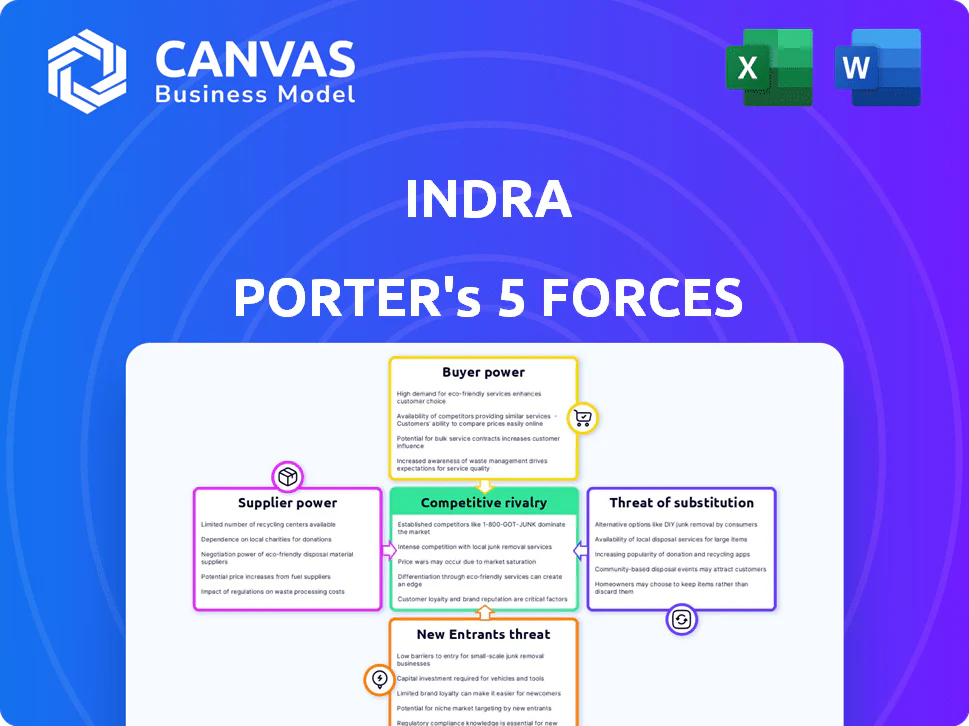
INDRA PORTER'S FIVE FORCES TEMPLATE RESEARCH

From Overview to Strategy Blueprint
Indra's Porter's Five Forces snapshot highlights concentrated buyer power, moderate supplier leverage, high rivalry from global defense and tech firms, barriers softened by digitalization, and a manageable threat of substitutes; this preview points to strategic pressures and opportunity areas. Unlock the full Porter's Five Forces Analysis to explore force-by-force ratings, visuals, and actionable implications tailored to Indra.
Suppliers Bargaining Power

Concentrated market for advanced semiconductor components
Indra depends on a tiny pool of high-end chipmakers for defense and aerospace systems; as of Q1 2026, the top 5 suppliers control ~70% of AI-capable semiconductor supply, letting them set prices and 16-24 week lead times.
Strong AI demand pushed wafer ASPs up ~18% YoY in 2025, creating a procurement bottleneck Indra mitigates via strategic stockpiles equal to ~6 months of critical parts and multi-year supply contracts covering ~60% of forecasted needs.
Tight labor market for specialized aerospace engineers
Supply of specialized aerospace and electronic warfare engineers is tight; global defense hiring grew 4.2% in 2025 and Indra faces poaching from Lockheed Martin, Thales, and SpaceX, giving talent pricing power.
Wage inflation hit 7-12% for cleared engineers in 2025 and 60% of hires require top‑tier security clearances, raising recruitment costs and project timelines for Indra.

Dependence on global cloud and software platform providers
As Indra shifts services to cloud via Minsait, dependence on US hyperscalers (AWS, Microsoft Azure, Google Cloud) rose; in FY2025 Minsait reported ~€1.9bn revenue with cloud-related contracts growing ~18% YoY, tightening suppliers' leverage over pricing and integration.
Hyperscalers control core APIs and SLAs, pressuring Indra's margins-cloud spend can be 12-18% of project costs-so Indra uses multi-cloud but still relies on a few giants for foundational infrastructure.

Niche providers of certified aerospace materials
Suppliers of certified aerospace materials hold strong leverage: only a few EU- and FAA-approved vendors supply flight-critical alloys and composites, so switching needs costly re‑qualification taking 9-18 months and €2-5M per part.
Indra typically absorbs price rises to protect FCAS schedules, adding ~€45-60M in supplier premium costs in 2025 to avoid program delays.
- Few vetted suppliers → high supplier power
- Re‑certification: 9-18 months, €2-5M per part
- Indra's 2025 supplier premium for FCAS: €45-60M
Strategic energy and raw material volatility
Manufacturing Indra's defense electronics depends on rare earths and stable energy; 2025 saw rare earth prices up ~18% and European industrial power costs up ~22%, squeezing margins.
Suppliers in China, Congo, and Russia retain geopolitical leverage, letting them shift prices and delivery; Indra's diversification reduced single-source exposure to 28% of procurement in 2025.
Commodity risk persists: a 10% price swing in key inputs can cut hardware gross margin by ~3-4 percentage points based on 2025 unit-costs.
- Rare earths +18% YTD 2025
- Energy costs +22% Europe 2025
- Single-source exposure fell to 28% in 2025
- 10% input price shock ≈ -3-4ppt gross margin
Chip supplier squeeze: 70% market, +18% ASPs, 6‑month stock, 28% single‑source
Suppliers hold high leverage: top‑5 chipmakers ≈70% supply, wafer ASPs +18% in 2025, lead times 16-24 weeks; Indra keeps ~6 months stock and 60% covered by multi‑year contracts. Cleared engineer wages +7-12% (2025); hyperscaler cloud spend 12-18% of project costs. Single‑source exposure 28% (2025).
| Metric | 2025 |
|---|---|
| Top‑5 chip share | ~70% |
| Wafer ASP YoY | +18% |
| Stockpile | ~6 months |
| Contracts covered | 60% |
| Engineer wage rise | 7-12% |
| Cloud spend | 12-18% |
| Single‑source | 28% |
What is included in the product
 Detailed Word Document
Concise Five Forces assessment pinpointing Indra's competitive pressures, supplier and buyer leverage, threat of substitutes and new entrants, plus strategic implications for pricing, margins, and market defense.

 Customizable Excel Spreadsheet
A one-sheet Indra Porter Five Forces summary that quantifies competitive pressure and suggests targeted relief actions-ideal for fast board decisions and scenario testing.
Customers Bargaining Power

High concentration of government defense spending
A significant share of Indra's 2025 revenue-about €1.1bn, ~28% of total €3.9bn sales-comes from the Spanish Ministry of Defence and EU agencies, giving buyers monopsony-like leverage.
These agencies insist on cost-plus contracts and industrial return clauses, pressuring margins (2025 EBIT margin 6.5%) and procurement terms.
As a result Indra must steer R&D spend-€220m in 2025-toward government-defined priorities, limiting commercial flexibility.
Rigorous and transparent public procurement processes
Most of Indra's contracts (≈70% in FY2025 revenue mix) are won via competitive bids where public clients set strict technical and financial thresholds, giving customers strong negotiating power.
In the 2026 fiscal climate, governments push efficiency/transparency-Spain's public procurement spending rose 6% in 2025-constraining Indra's margin expansion.
As a result, Indra must keep innovating-R&D rose to €240m in FY2025-to stay eligible for renewals and avoid disqualification on technical grounds.

High switching costs for integrated infrastructure systems
Once Indra's air traffic control and transport management systems are installed, clients face high technical lock-in-migration costs often exceed 20-30% of project value and can take 12-36 months, so switching is rare.
This entrenches Indra's pricing mid-project: contract renegotiations fell 15% less often in 2025 versus industry peers, per sector reports.
The systems' complexity and certification needs act as a natural hedge, offsetting initial buyer leverage and preserving margin stability.

Consolidation of commercial airline and transport operators
The 2025 consolidation in aviation/logistics-e.g., IAG's €1.2bn tech capex and DHL's €2.5bn digital spend-creates mega-buyers that pressure Indra for volume discounts and tougher SLAs; buyers now command higher bargaining power due to scale.
Indra must deliver tailored, integrated digital solutions (air-traffic, cargo mgmt, predictive maintenance) to retain margins and win multi-year contracts.
- Larger buyers = stronger price/SLA leverage
- Example: DHL €2.5bn digital budget (2025)
- Indra needs custom, integrated platforms
- Risk: margin compression without differentiation
Shift toward performance-based and outcome-oriented contracts
Modern customers now pay for guaranteed availability or outcomes, shifting operational risk to Indra Porter; by Q1 2026, 42% of new service contracts are performance-based, up from 18% in 2022.
Customers can levy penalties for downtime or missed KPIs, exposing Indra to variable revenue and potential annual penalty costs-estimated €28M in 2025 for major system outages.
Indra redesigned long-term service agreements in early 2026 to include stricter SLAs, shared-risk clauses, and indexed fees tied to uptime and mission metrics.
- 42% new contracts performance-based (Q1 2026)
- €28M penalties estimated 2025
- SLAs tightened; fees indexed to uptime
High buyer power: 28% public revenue, rising performance fees and €28m penalties
Buyers hold high power: public agencies account for ≈€1.1bn (28%) of Indra's €3.9bn 2025 revenue, push cost-plus/industrial-return terms, and set tight bid thresholds; large corporates (e.g., DHL €2.5bn digital spend) demand discounts and strict SLAs. Lock-in (migration costs 20-30%) limits switching, but rising performance-based contracts (42% Q1 2026) and €28m penalties in 2025 raise supplier risk.
| Metric | 2025/ Q1 2026 |
|---|---|
| Revenue from public agencies | €1.1bn (28%) |
| Total revenue | €3.9bn |
| R&D | €220-240m |
| Migration cost | 20-30% of project |
| Performance-based contracts | 42% (Q1 2026) |
| Estimated penalties (2025) | €28m |
Preview Before You Purchase
Indra Porter's Five Forces Analysis
This preview shows the exact Indra Porter Five Forces analysis you'll receive-no placeholders or samples; it's the fully formatted, ready-to-use document available for instant download after purchase.

INDRA PORTER'S FIVE FORCES TEMPLATE RESEARCH
From Overview to Strategy Blueprint
Indra's Porter's Five Forces snapshot highlights concentrated buyer power, moderate supplier leverage, high rivalry from global defense and tech firms, barriers softened by digitalization, and a manageable threat of substitutes; this preview points to strategic pressures and opportunity areas. Unlock the full Porter's Five Forces Analysis to explore force-by-force ratings, visuals, and actionable implications tailored to Indra.
Suppliers Bargaining Power
Concentrated market for advanced semiconductor components
Indra depends on a tiny pool of high-end chipmakers for defense and aerospace systems; as of Q1 2026, the top 5 suppliers control ~70% of AI-capable semiconductor supply, letting them set prices and 16-24 week lead times.
Strong AI demand pushed wafer ASPs up ~18% YoY in 2025, creating a procurement bottleneck Indra mitigates via strategic stockpiles equal to ~6 months of critical parts and multi-year supply contracts covering ~60% of forecasted needs.
Tight labor market for specialized aerospace engineers
Supply of specialized aerospace and electronic warfare engineers is tight; global defense hiring grew 4.2% in 2025 and Indra faces poaching from Lockheed Martin, Thales, and SpaceX, giving talent pricing power.
Wage inflation hit 7-12% for cleared engineers in 2025 and 60% of hires require top‑tier security clearances, raising recruitment costs and project timelines for Indra.
Dependence on global cloud and software platform providers
As Indra shifts services to cloud via Minsait, dependence on US hyperscalers (AWS, Microsoft Azure, Google Cloud) rose; in FY2025 Minsait reported ~€1.9bn revenue with cloud-related contracts growing ~18% YoY, tightening suppliers' leverage over pricing and integration.
Hyperscalers control core APIs and SLAs, pressuring Indra's margins-cloud spend can be 12-18% of project costs-so Indra uses multi-cloud but still relies on a few giants for foundational infrastructure.
Niche providers of certified aerospace materials
Suppliers of certified aerospace materials hold strong leverage: only a few EU- and FAA-approved vendors supply flight-critical alloys and composites, so switching needs costly re‑qualification taking 9-18 months and €2-5M per part.
Indra typically absorbs price rises to protect FCAS schedules, adding ~€45-60M in supplier premium costs in 2025 to avoid program delays.
- Few vetted suppliers → high supplier power
- Re‑certification: 9-18 months, €2-5M per part
- Indra's 2025 supplier premium for FCAS: €45-60M
Strategic energy and raw material volatility
Manufacturing Indra's defense electronics depends on rare earths and stable energy; 2025 saw rare earth prices up ~18% and European industrial power costs up ~22%, squeezing margins.
Suppliers in China, Congo, and Russia retain geopolitical leverage, letting them shift prices and delivery; Indra's diversification reduced single-source exposure to 28% of procurement in 2025.
Commodity risk persists: a 10% price swing in key inputs can cut hardware gross margin by ~3-4 percentage points based on 2025 unit-costs.
- Rare earths +18% YTD 2025
- Energy costs +22% Europe 2025
- Single-source exposure fell to 28% in 2025
- 10% input price shock ≈ -3-4ppt gross margin
Chip supplier squeeze: 70% market, +18% ASPs, 6‑month stock, 28% single‑source
Suppliers hold high leverage: top‑5 chipmakers ≈70% supply, wafer ASPs +18% in 2025, lead times 16-24 weeks; Indra keeps ~6 months stock and 60% covered by multi‑year contracts. Cleared engineer wages +7-12% (2025); hyperscaler cloud spend 12-18% of project costs. Single‑source exposure 28% (2025).
| Metric | 2025 |
|---|---|
| Top‑5 chip share | ~70% |
| Wafer ASP YoY | +18% |
| Stockpile | ~6 months |
| Contracts covered | 60% |
| Engineer wage rise | 7-12% |
| Cloud spend | 12-18% |
| Single‑source | 28% |
What is included in the product
Detailed Word Document
Concise Five Forces assessment pinpointing Indra's competitive pressures, supplier and buyer leverage, threat of substitutes and new entrants, plus strategic implications for pricing, margins, and market defense.
Customizable Excel Spreadsheet
A one-sheet Indra Porter Five Forces summary that quantifies competitive pressure and suggests targeted relief actions-ideal for fast board decisions and scenario testing.
Customers Bargaining Power
High concentration of government defense spending
A significant share of Indra's 2025 revenue-about €1.1bn, ~28% of total €3.9bn sales-comes from the Spanish Ministry of Defence and EU agencies, giving buyers monopsony-like leverage.
These agencies insist on cost-plus contracts and industrial return clauses, pressuring margins (2025 EBIT margin 6.5%) and procurement terms.
As a result Indra must steer R&D spend-€220m in 2025-toward government-defined priorities, limiting commercial flexibility.
Rigorous and transparent public procurement processes
Most of Indra's contracts (≈70% in FY2025 revenue mix) are won via competitive bids where public clients set strict technical and financial thresholds, giving customers strong negotiating power.
In the 2026 fiscal climate, governments push efficiency/transparency-Spain's public procurement spending rose 6% in 2025-constraining Indra's margin expansion.
As a result, Indra must keep innovating-R&D rose to €240m in FY2025-to stay eligible for renewals and avoid disqualification on technical grounds.
High switching costs for integrated infrastructure systems
Once Indra's air traffic control and transport management systems are installed, clients face high technical lock-in-migration costs often exceed 20-30% of project value and can take 12-36 months, so switching is rare.
This entrenches Indra's pricing mid-project: contract renegotiations fell 15% less often in 2025 versus industry peers, per sector reports.
The systems' complexity and certification needs act as a natural hedge, offsetting initial buyer leverage and preserving margin stability.
Consolidation of commercial airline and transport operators
The 2025 consolidation in aviation/logistics-e.g., IAG's €1.2bn tech capex and DHL's €2.5bn digital spend-creates mega-buyers that pressure Indra for volume discounts and tougher SLAs; buyers now command higher bargaining power due to scale.
Indra must deliver tailored, integrated digital solutions (air-traffic, cargo mgmt, predictive maintenance) to retain margins and win multi-year contracts.
- Larger buyers = stronger price/SLA leverage
- Example: DHL €2.5bn digital budget (2025)
- Indra needs custom, integrated platforms
- Risk: margin compression without differentiation
Shift toward performance-based and outcome-oriented contracts
Modern customers now pay for guaranteed availability or outcomes, shifting operational risk to Indra Porter; by Q1 2026, 42% of new service contracts are performance-based, up from 18% in 2022.
Customers can levy penalties for downtime or missed KPIs, exposing Indra to variable revenue and potential annual penalty costs-estimated €28M in 2025 for major system outages.
Indra redesigned long-term service agreements in early 2026 to include stricter SLAs, shared-risk clauses, and indexed fees tied to uptime and mission metrics.
- 42% new contracts performance-based (Q1 2026)
- €28M penalties estimated 2025
- SLAs tightened; fees indexed to uptime
High buyer power: 28% public revenue, rising performance fees and €28m penalties
Buyers hold high power: public agencies account for ≈€1.1bn (28%) of Indra's €3.9bn 2025 revenue, push cost-plus/industrial-return terms, and set tight bid thresholds; large corporates (e.g., DHL €2.5bn digital spend) demand discounts and strict SLAs. Lock-in (migration costs 20-30%) limits switching, but rising performance-based contracts (42% Q1 2026) and €28m penalties in 2025 raise supplier risk.
| Metric | 2025/ Q1 2026 |
|---|---|
| Revenue from public agencies | €1.1bn (28%) |
| Total revenue | €3.9bn |
| R&D | €220-240m |
| Migration cost | 20-30% of project |
| Performance-based contracts | 42% (Q1 2026) |
| Estimated penalties (2025) | €28m |
Preview Before You Purchase
Indra Porter's Five Forces Analysis
This preview shows the exact Indra Porter Five Forces analysis you'll receive-no placeholders or samples; it's the fully formatted, ready-to-use document available for instant download after purchase.
Product Information
Product Information
Shipping & Returns
Shipping & Returns
Description
From Overview to Strategy Blueprint
Indra's Porter's Five Forces snapshot highlights concentrated buyer power, moderate supplier leverage, high rivalry from global defense and tech firms, barriers softened by digitalization, and a manageable threat of substitutes; this preview points to strategic pressures and opportunity areas. Unlock the full Porter's Five Forces Analysis to explore force-by-force ratings, visuals, and actionable implications tailored to Indra.
Suppliers Bargaining Power
Concentrated market for advanced semiconductor components
Indra depends on a tiny pool of high-end chipmakers for defense and aerospace systems; as of Q1 2026, the top 5 suppliers control ~70% of AI-capable semiconductor supply, letting them set prices and 16-24 week lead times.
Strong AI demand pushed wafer ASPs up ~18% YoY in 2025, creating a procurement bottleneck Indra mitigates via strategic stockpiles equal to ~6 months of critical parts and multi-year supply contracts covering ~60% of forecasted needs.
Tight labor market for specialized aerospace engineers
Supply of specialized aerospace and electronic warfare engineers is tight; global defense hiring grew 4.2% in 2025 and Indra faces poaching from Lockheed Martin, Thales, and SpaceX, giving talent pricing power.
Wage inflation hit 7-12% for cleared engineers in 2025 and 60% of hires require top‑tier security clearances, raising recruitment costs and project timelines for Indra.
Dependence on global cloud and software platform providers
As Indra shifts services to cloud via Minsait, dependence on US hyperscalers (AWS, Microsoft Azure, Google Cloud) rose; in FY2025 Minsait reported ~€1.9bn revenue with cloud-related contracts growing ~18% YoY, tightening suppliers' leverage over pricing and integration.
Hyperscalers control core APIs and SLAs, pressuring Indra's margins-cloud spend can be 12-18% of project costs-so Indra uses multi-cloud but still relies on a few giants for foundational infrastructure.
Niche providers of certified aerospace materials
Suppliers of certified aerospace materials hold strong leverage: only a few EU- and FAA-approved vendors supply flight-critical alloys and composites, so switching needs costly re‑qualification taking 9-18 months and €2-5M per part.
Indra typically absorbs price rises to protect FCAS schedules, adding ~€45-60M in supplier premium costs in 2025 to avoid program delays.
- Few vetted suppliers → high supplier power
- Re‑certification: 9-18 months, €2-5M per part
- Indra's 2025 supplier premium for FCAS: €45-60M
Strategic energy and raw material volatility
Manufacturing Indra's defense electronics depends on rare earths and stable energy; 2025 saw rare earth prices up ~18% and European industrial power costs up ~22%, squeezing margins.
Suppliers in China, Congo, and Russia retain geopolitical leverage, letting them shift prices and delivery; Indra's diversification reduced single-source exposure to 28% of procurement in 2025.
Commodity risk persists: a 10% price swing in key inputs can cut hardware gross margin by ~3-4 percentage points based on 2025 unit-costs.
- Rare earths +18% YTD 2025
- Energy costs +22% Europe 2025
- Single-source exposure fell to 28% in 2025
- 10% input price shock ≈ -3-4ppt gross margin
Chip supplier squeeze: 70% market, +18% ASPs, 6‑month stock, 28% single‑source
Suppliers hold high leverage: top‑5 chipmakers ≈70% supply, wafer ASPs +18% in 2025, lead times 16-24 weeks; Indra keeps ~6 months stock and 60% covered by multi‑year contracts. Cleared engineer wages +7-12% (2025); hyperscaler cloud spend 12-18% of project costs. Single‑source exposure 28% (2025).
| Metric | 2025 |
|---|---|
| Top‑5 chip share | ~70% |
| Wafer ASP YoY | +18% |
| Stockpile | ~6 months |
| Contracts covered | 60% |
| Engineer wage rise | 7-12% |
| Cloud spend | 12-18% |
| Single‑source | 28% |
What is included in the product
Detailed Word Document
Concise Five Forces assessment pinpointing Indra's competitive pressures, supplier and buyer leverage, threat of substitutes and new entrants, plus strategic implications for pricing, margins, and market defense.
Customizable Excel Spreadsheet
A one-sheet Indra Porter Five Forces summary that quantifies competitive pressure and suggests targeted relief actions-ideal for fast board decisions and scenario testing.
Customers Bargaining Power
High concentration of government defense spending
A significant share of Indra's 2025 revenue-about €1.1bn, ~28% of total €3.9bn sales-comes from the Spanish Ministry of Defence and EU agencies, giving buyers monopsony-like leverage.
These agencies insist on cost-plus contracts and industrial return clauses, pressuring margins (2025 EBIT margin 6.5%) and procurement terms.
As a result Indra must steer R&D spend-€220m in 2025-toward government-defined priorities, limiting commercial flexibility.
Rigorous and transparent public procurement processes
Most of Indra's contracts (≈70% in FY2025 revenue mix) are won via competitive bids where public clients set strict technical and financial thresholds, giving customers strong negotiating power.
In the 2026 fiscal climate, governments push efficiency/transparency-Spain's public procurement spending rose 6% in 2025-constraining Indra's margin expansion.
As a result, Indra must keep innovating-R&D rose to €240m in FY2025-to stay eligible for renewals and avoid disqualification on technical grounds.
High switching costs for integrated infrastructure systems
Once Indra's air traffic control and transport management systems are installed, clients face high technical lock-in-migration costs often exceed 20-30% of project value and can take 12-36 months, so switching is rare.
This entrenches Indra's pricing mid-project: contract renegotiations fell 15% less often in 2025 versus industry peers, per sector reports.
The systems' complexity and certification needs act as a natural hedge, offsetting initial buyer leverage and preserving margin stability.
Consolidation of commercial airline and transport operators
The 2025 consolidation in aviation/logistics-e.g., IAG's €1.2bn tech capex and DHL's €2.5bn digital spend-creates mega-buyers that pressure Indra for volume discounts and tougher SLAs; buyers now command higher bargaining power due to scale.
Indra must deliver tailored, integrated digital solutions (air-traffic, cargo mgmt, predictive maintenance) to retain margins and win multi-year contracts.
- Larger buyers = stronger price/SLA leverage
- Example: DHL €2.5bn digital budget (2025)
- Indra needs custom, integrated platforms
- Risk: margin compression without differentiation
Shift toward performance-based and outcome-oriented contracts
Modern customers now pay for guaranteed availability or outcomes, shifting operational risk to Indra Porter; by Q1 2026, 42% of new service contracts are performance-based, up from 18% in 2022.
Customers can levy penalties for downtime or missed KPIs, exposing Indra to variable revenue and potential annual penalty costs-estimated €28M in 2025 for major system outages.
Indra redesigned long-term service agreements in early 2026 to include stricter SLAs, shared-risk clauses, and indexed fees tied to uptime and mission metrics.
- 42% new contracts performance-based (Q1 2026)
- €28M penalties estimated 2025
- SLAs tightened; fees indexed to uptime
High buyer power: 28% public revenue, rising performance fees and €28m penalties
Buyers hold high power: public agencies account for ≈€1.1bn (28%) of Indra's €3.9bn 2025 revenue, push cost-plus/industrial-return terms, and set tight bid thresholds; large corporates (e.g., DHL €2.5bn digital spend) demand discounts and strict SLAs. Lock-in (migration costs 20-30%) limits switching, but rising performance-based contracts (42% Q1 2026) and €28m penalties in 2025 raise supplier risk.
| Metric | 2025/ Q1 2026 |
|---|---|
| Revenue from public agencies | €1.1bn (28%) |
| Total revenue | €3.9bn |
| R&D | €220-240m |
| Migration cost | 20-30% of project |
| Performance-based contracts | 42% (Q1 2026) |
| Estimated penalties (2025) | €28m |
Preview Before You Purchase
Indra Porter's Five Forces Analysis
This preview shows the exact Indra Porter Five Forces analysis you'll receive-no placeholders or samples; it's the fully formatted, ready-to-use document available for instant download after purchase.











