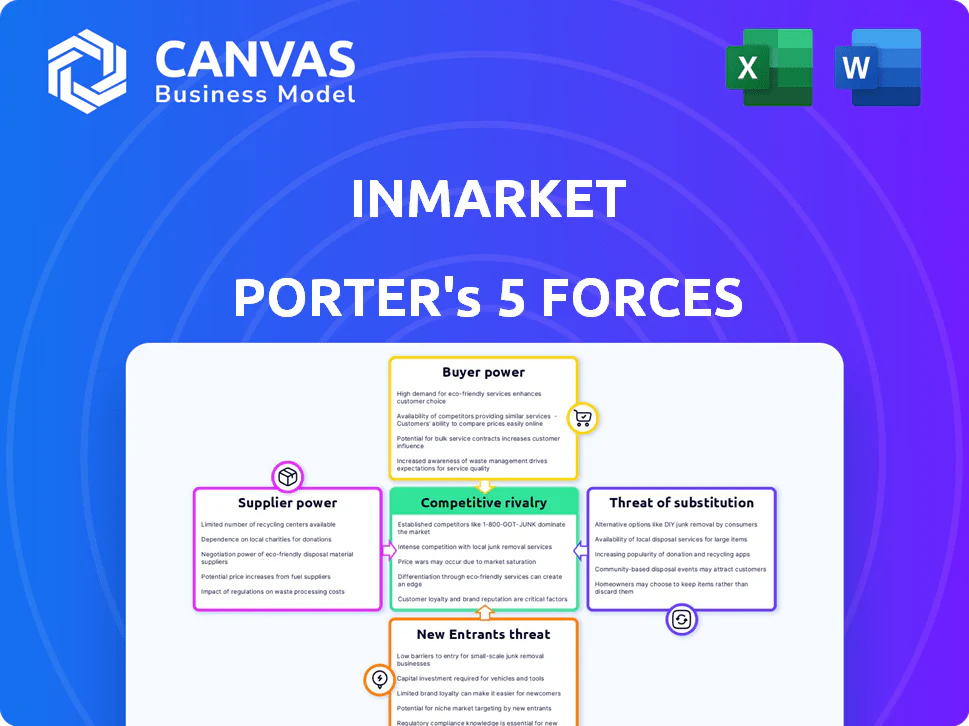
INMARKET PORTER'S FIVE FORCES TEMPLATE RESEARCH
What is included in the product
 Detailed Word Document
Tailored exclusively for InMarket, analyzing its position within its competitive landscape.

 Customizable Excel Spreadsheet
Quickly identify and visualize industry pressures using a customizable radar chart.
Preview Before You Purchase
InMarket Porter's Five Forces Analysis
You're previewing the final version—precisely the same document that will be available to you instantly after buying. This InMarket Porter's Five Forces analysis assesses industry competitiveness. It covers threats of new entrants, supplier power, and buyer power. Also, it examines competitive rivalry and the threat of substitutes.

Porter's Five Forces Analysis Template

Don't Miss the Bigger Picture
InMarket faces moderate competition within the mobile advertising and location analytics sectors, with some strong rival firms. Buyer power is substantial, given advertisers' options. Supplier influence, mainly data providers, is also notable. The threat of new entrants is moderate due to industry barriers. Substitutes, such as social media marketing, pose a threat.
Ready to move beyond the basics? Get a full strategic breakdown of InMarket’s market position, competitive intensity, and external threats—all in one powerful analysis.
Suppliers Bargaining Power

Dependence on Data Sources
InMarket depends on location data from SDKs and apps. Data supplier power is moderate, varying with agreement exclusivity and data breadth. A 2024 report showed InMarket's SDK integration in over 10,000 apps. If few suppliers dominate, their leverage increases. This could affect pricing and service terms.
Cost of Data Acquisition
The cost of obtaining and managing quality location data is substantial. Data infrastructure, processing power, and data enrichment services influence pricing and terms. In 2024, cloud computing costs, a key data processing component, increased by approximately 15% globally. This impacts InMarket's operational expenses.

Availability of Alternative Data Sources
The location intelligence market is expanding, with numerous firms gathering location data, like Near. The presence of alternative data sources potentially diminishes the bargaining power of individual suppliers. InMarket can switch providers if needed. The global location analytics market was valued at $16.3 billion in 2024.

Technology Providers
InMarket's reliance on technology for its operations means that the bargaining power of technology providers is a factor to consider. Suppliers of essential software, hardware, and cloud services could hold some sway. This is especially true if their technology is specialized or if switching to an alternative is costly or complex. For example, in 2024, cloud computing spending reached over $670 billion worldwide, highlighting the significant influence of cloud service providers.
- Cloud infrastructure costs represent a substantial operational expense for many tech-dependent businesses.
- Proprietary or highly specialized software solutions can give suppliers pricing power.
- Switching costs (time, resources) can lock in a customer to a supplier.
- The availability of alternative technology suppliers impacts bargaining power.
Regulatory Environment
The regulatory environment significantly affects InMarket's supplier relationships. Stricter data privacy laws like GDPR and CCPA increase compliance costs for data suppliers. This can reduce the number of available data sources.
- Compliance burdens may increase data costs.
- Restrictions can limit data collection, impacting data availability.
- The value of compliant data sources increases.
This can shift the bargaining power towards suppliers who meet these standards. In 2024, non-compliance penalties can reach up to 4% of annual global turnover under GDPR. This makes compliant data more valuable.
InMarket's Supplier Dynamics: Costs & Compliance
InMarket's supplier power varies. Data costs and availability are key. Cloud costs rose ~15% in 2024, impacting expenses. Regulatory compliance also affects supplier dynamics.
| Factor | Impact | 2024 Data |
|---|---|---|
| Data Source Diversity | Reduces supplier power | Location analytics market: $16.3B |
| Cloud Costs | Raises operating expenses | Cloud spending: $670B+ worldwide |
| Data Privacy Laws | Increases compliance costs | GDPR penalties: up to 4% global turnover |
Customers Bargaining Power

Concentration of Customers
InMarket's bargaining power of customers is influenced by customer concentration. Serving thousands of brands, InMarket might face challenges if a few key clients generate substantial revenue. For example, if the top 10 customers account for over 40% of sales (based on industry averages), their leverage increases. This concentration enables these major clients to negotiate more favorable terms or demand customized offerings, potentially squeezing profit margins.
Switching Costs
Switching costs, such as technology integration and data migration, can impact customer bargaining power. InMarket's platform users may face costs to switch to a competitor. Research from 2024 showed tech integration averaged $50,000-$100,000 for small businesses. High switching costs can make customers less likely to negotiate aggressively on pricing.

Customer Access to Other Location Intelligence Providers
The location intelligence market is competitive, with numerous providers like Near, Esri, and Bluedot offering similar services. This competition gives customers significant bargaining power. For instance, in 2024, the top 10 location analytics vendors generated approximately $5 billion in revenue, indicating a fragmented market where switching costs are relatively low.

Customer Understanding of Location Data Value
As businesses grow more data-focused, their grasp of location intelligence's value deepens. This enhanced understanding enables customers to seek improved terms and more advanced insights from InMarket. In 2024, the location-based marketing industry is valued at over $20 billion, reflecting this increasing sophistication. This shift empowers customers to negotiate for better deals and data quality, raising the bar for providers like InMarket.
- Increased Data Literacy: Businesses now better understand the value of location data.
- Negotiation Power: Customers can demand better terms and insights.
- Market Growth: The location-based marketing sector is expanding rapidly.
- Competitive Pressure: InMarket faces pressure to provide superior value.
Customer Ability to Build In-House Solutions
Large customers, especially those with deep pockets, could opt to build their own location intelligence solutions. This shift towards in-house development diminishes their reliance on external vendors like InMarket. Consequently, this increases their bargaining power, enabling them to negotiate better terms or pricing. For instance, in 2024, companies like Walmart invested heavily in their data analytics infrastructure, which could include location-based services.
- In 2024, Walmart's technology budget was estimated at over $14 billion, a portion of which likely went to data analytics.
- Companies with over $1 billion in annual revenue are 30% more likely to consider in-house solutions.
- The cost of building an in-house location intelligence platform can range from $5 million to $20 million, depending on complexity.
- Negotiating power increases by 15% when a customer has the option to insource.
Customer Bargaining Power: Key Market Dynamics
InMarket's customer bargaining power is influenced by factors like customer concentration and switching costs. High customer concentration, where a few clients drive revenue, gives these clients more leverage to negotiate. The competitive location intelligence market also empowers customers, as they can choose from numerous providers.
As data literacy rises, customers can demand better terms and insights. Large customers may even build their own solutions, further increasing their bargaining power.
The location-based marketing industry's 2024 value is over $20 billion.
| Factor | Impact on Bargaining Power | 2024 Data |
|---|---|---|
| Customer Concentration | High concentration increases leverage | Top 10 customers account for >40% of sales (industry average) |
| Switching Costs | High costs reduce customer power | Tech integration: $50,000-$100,000 for small businesses |
| Market Competition | Intense competition empowers customers | Top 10 vendors generated ~$5 billion in revenue |
Rivalry Among Competitors

Number and Size of Competitors
The location intelligence and digital advertising markets are competitive, hosting many players. Giants like Google and Meta compete alongside specialized firms. This variety, coupled with differing resources, shapes the rivalry. In 2024, the digital ad market is projected to hit $767.4 billion globally.
Market Growth Rate
The location intelligence market is expanding, with projections showing substantial growth. Rapid growth can lessen rivalry by offering opportunities for multiple firms. However, it also attracts new entrants, potentially increasing competition. For example, the global location intelligence market was valued at $20.7 billion in 2023 and is projected to reach $47.8 billion by 2029.

Differentiation of Offerings
InMarket distinguishes itself through its unique data, AI, and omnichannel capabilities. The extent of this differentiation impacts rivalry intensity. Competitors like Placer.ai and Near offer similar location analytics, however, InMarket's focus on in-store behavior sets it apart. In 2024, the location analytics market was valued at approximately $24 billion, with InMarket aiming for a larger share by leveraging its distinctive features to attract clients and maintain a competitive edge.

Switching Costs for Customers
Switching costs, while present, don't always heavily shield companies from competition. The ability of businesses to quickly move to new platforms, such as cloud services, intensifies rivalry. For instance, in 2024, the average cost to switch cloud providers was around $150,000 for mid-sized companies, but the benefits often outweigh this. This ease of transition forces companies to compete more aggressively to retain customers. This situation highlights the importance of competitive pricing and service quality.
- Cloud service switching costs are around $150,000 for mid-sized businesses in 2024.
- Competitive pricing and quality are key to customer retention.
- Easy platform adoption increases competition.
Industry Concentration
The location intelligence market showcases a competitive landscape, characterized by multiple firms striving for dominance. This lack of a single dominant player fuels intense rivalry among competitors. Companies aggressively pursue clients and seek to strengthen their market positions. This dynamic leads to increased competition and innovation. In 2024, the global location intelligence market was valued at $19.8 billion.
- Market fragmentation increases rivalry intensity.
- Companies compete for market share and clients.
- Innovation is driven by competitive pressures.
- The market's value in 2024 was $19.8 billion.
Market Battle: Location Intelligence & Ads
Competitive rivalry in the location intelligence and digital advertising markets is intense. Numerous players, including giants and specialists, compete for market share. The digital ad market is projected to reach $767.4 billion in 2024, fostering robust competition.
| Factor | Details | Impact |
|---|---|---|
| Market Fragmentation | Multiple competitors | High rivalry |
| Growth Rate | Location intelligence market projected to $47.8B by 2029 | Attracts new entrants |
| Switching Costs | Cloud service transition around $150,000 | Intensifies competition |
Original: $10.00
-65%$10.00
$3.50INMARKET PORTER'S FIVE FORCES TEMPLATE RESEARCH
What is included in the product
Detailed Word Document
Tailored exclusively for InMarket, analyzing its position within its competitive landscape.
Customizable Excel Spreadsheet
Quickly identify and visualize industry pressures using a customizable radar chart.
Preview Before You Purchase
InMarket Porter's Five Forces Analysis
You're previewing the final version—precisely the same document that will be available to you instantly after buying. This InMarket Porter's Five Forces analysis assesses industry competitiveness. It covers threats of new entrants, supplier power, and buyer power. Also, it examines competitive rivalry and the threat of substitutes.
Porter's Five Forces Analysis Template
Don't Miss the Bigger Picture
InMarket faces moderate competition within the mobile advertising and location analytics sectors, with some strong rival firms. Buyer power is substantial, given advertisers' options. Supplier influence, mainly data providers, is also notable. The threat of new entrants is moderate due to industry barriers. Substitutes, such as social media marketing, pose a threat.
Ready to move beyond the basics? Get a full strategic breakdown of InMarket’s market position, competitive intensity, and external threats—all in one powerful analysis.
Suppliers Bargaining Power
Dependence on Data Sources
InMarket depends on location data from SDKs and apps. Data supplier power is moderate, varying with agreement exclusivity and data breadth. A 2024 report showed InMarket's SDK integration in over 10,000 apps. If few suppliers dominate, their leverage increases. This could affect pricing and service terms.
Cost of Data Acquisition
The cost of obtaining and managing quality location data is substantial. Data infrastructure, processing power, and data enrichment services influence pricing and terms. In 2024, cloud computing costs, a key data processing component, increased by approximately 15% globally. This impacts InMarket's operational expenses.
Availability of Alternative Data Sources
The location intelligence market is expanding, with numerous firms gathering location data, like Near. The presence of alternative data sources potentially diminishes the bargaining power of individual suppliers. InMarket can switch providers if needed. The global location analytics market was valued at $16.3 billion in 2024.
Technology Providers
InMarket's reliance on technology for its operations means that the bargaining power of technology providers is a factor to consider. Suppliers of essential software, hardware, and cloud services could hold some sway. This is especially true if their technology is specialized or if switching to an alternative is costly or complex. For example, in 2024, cloud computing spending reached over $670 billion worldwide, highlighting the significant influence of cloud service providers.
- Cloud infrastructure costs represent a substantial operational expense for many tech-dependent businesses.
- Proprietary or highly specialized software solutions can give suppliers pricing power.
- Switching costs (time, resources) can lock in a customer to a supplier.
- The availability of alternative technology suppliers impacts bargaining power.
Regulatory Environment
The regulatory environment significantly affects InMarket's supplier relationships. Stricter data privacy laws like GDPR and CCPA increase compliance costs for data suppliers. This can reduce the number of available data sources.
- Compliance burdens may increase data costs.
- Restrictions can limit data collection, impacting data availability.
- The value of compliant data sources increases.
This can shift the bargaining power towards suppliers who meet these standards. In 2024, non-compliance penalties can reach up to 4% of annual global turnover under GDPR. This makes compliant data more valuable.
InMarket's Supplier Dynamics: Costs & Compliance
InMarket's supplier power varies. Data costs and availability are key. Cloud costs rose ~15% in 2024, impacting expenses. Regulatory compliance also affects supplier dynamics.
| Factor | Impact | 2024 Data |
|---|---|---|
| Data Source Diversity | Reduces supplier power | Location analytics market: $16.3B |
| Cloud Costs | Raises operating expenses | Cloud spending: $670B+ worldwide |
| Data Privacy Laws | Increases compliance costs | GDPR penalties: up to 4% global turnover |
Customers Bargaining Power
Concentration of Customers
InMarket's bargaining power of customers is influenced by customer concentration. Serving thousands of brands, InMarket might face challenges if a few key clients generate substantial revenue. For example, if the top 10 customers account for over 40% of sales (based on industry averages), their leverage increases. This concentration enables these major clients to negotiate more favorable terms or demand customized offerings, potentially squeezing profit margins.
Switching Costs
Switching costs, such as technology integration and data migration, can impact customer bargaining power. InMarket's platform users may face costs to switch to a competitor. Research from 2024 showed tech integration averaged $50,000-$100,000 for small businesses. High switching costs can make customers less likely to negotiate aggressively on pricing.
Customer Access to Other Location Intelligence Providers
The location intelligence market is competitive, with numerous providers like Near, Esri, and Bluedot offering similar services. This competition gives customers significant bargaining power. For instance, in 2024, the top 10 location analytics vendors generated approximately $5 billion in revenue, indicating a fragmented market where switching costs are relatively low.
Customer Understanding of Location Data Value
As businesses grow more data-focused, their grasp of location intelligence's value deepens. This enhanced understanding enables customers to seek improved terms and more advanced insights from InMarket. In 2024, the location-based marketing industry is valued at over $20 billion, reflecting this increasing sophistication. This shift empowers customers to negotiate for better deals and data quality, raising the bar for providers like InMarket.
- Increased Data Literacy: Businesses now better understand the value of location data.
- Negotiation Power: Customers can demand better terms and insights.
- Market Growth: The location-based marketing sector is expanding rapidly.
- Competitive Pressure: InMarket faces pressure to provide superior value.
Customer Ability to Build In-House Solutions
Large customers, especially those with deep pockets, could opt to build their own location intelligence solutions. This shift towards in-house development diminishes their reliance on external vendors like InMarket. Consequently, this increases their bargaining power, enabling them to negotiate better terms or pricing. For instance, in 2024, companies like Walmart invested heavily in their data analytics infrastructure, which could include location-based services.
- In 2024, Walmart's technology budget was estimated at over $14 billion, a portion of which likely went to data analytics.
- Companies with over $1 billion in annual revenue are 30% more likely to consider in-house solutions.
- The cost of building an in-house location intelligence platform can range from $5 million to $20 million, depending on complexity.
- Negotiating power increases by 15% when a customer has the option to insource.
Customer Bargaining Power: Key Market Dynamics
InMarket's customer bargaining power is influenced by factors like customer concentration and switching costs. High customer concentration, where a few clients drive revenue, gives these clients more leverage to negotiate. The competitive location intelligence market also empowers customers, as they can choose from numerous providers.
As data literacy rises, customers can demand better terms and insights. Large customers may even build their own solutions, further increasing their bargaining power.
The location-based marketing industry's 2024 value is over $20 billion.
| Factor | Impact on Bargaining Power | 2024 Data |
|---|---|---|
| Customer Concentration | High concentration increases leverage | Top 10 customers account for >40% of sales (industry average) |
| Switching Costs | High costs reduce customer power | Tech integration: $50,000-$100,000 for small businesses |
| Market Competition | Intense competition empowers customers | Top 10 vendors generated ~$5 billion in revenue |
Rivalry Among Competitors
Number and Size of Competitors
The location intelligence and digital advertising markets are competitive, hosting many players. Giants like Google and Meta compete alongside specialized firms. This variety, coupled with differing resources, shapes the rivalry. In 2024, the digital ad market is projected to hit $767.4 billion globally.
Market Growth Rate
The location intelligence market is expanding, with projections showing substantial growth. Rapid growth can lessen rivalry by offering opportunities for multiple firms. However, it also attracts new entrants, potentially increasing competition. For example, the global location intelligence market was valued at $20.7 billion in 2023 and is projected to reach $47.8 billion by 2029.
Differentiation of Offerings
InMarket distinguishes itself through its unique data, AI, and omnichannel capabilities. The extent of this differentiation impacts rivalry intensity. Competitors like Placer.ai and Near offer similar location analytics, however, InMarket's focus on in-store behavior sets it apart. In 2024, the location analytics market was valued at approximately $24 billion, with InMarket aiming for a larger share by leveraging its distinctive features to attract clients and maintain a competitive edge.
Switching Costs for Customers
Switching costs, while present, don't always heavily shield companies from competition. The ability of businesses to quickly move to new platforms, such as cloud services, intensifies rivalry. For instance, in 2024, the average cost to switch cloud providers was around $150,000 for mid-sized companies, but the benefits often outweigh this. This ease of transition forces companies to compete more aggressively to retain customers. This situation highlights the importance of competitive pricing and service quality.
- Cloud service switching costs are around $150,000 for mid-sized businesses in 2024.
- Competitive pricing and quality are key to customer retention.
- Easy platform adoption increases competition.
Industry Concentration
The location intelligence market showcases a competitive landscape, characterized by multiple firms striving for dominance. This lack of a single dominant player fuels intense rivalry among competitors. Companies aggressively pursue clients and seek to strengthen their market positions. This dynamic leads to increased competition and innovation. In 2024, the global location intelligence market was valued at $19.8 billion.
- Market fragmentation increases rivalry intensity.
- Companies compete for market share and clients.
- Innovation is driven by competitive pressures.
- The market's value in 2024 was $19.8 billion.
Market Battle: Location Intelligence & Ads
Competitive rivalry in the location intelligence and digital advertising markets is intense. Numerous players, including giants and specialists, compete for market share. The digital ad market is projected to reach $767.4 billion in 2024, fostering robust competition.
| Factor | Details | Impact |
|---|---|---|
| Market Fragmentation | Multiple competitors | High rivalry |
| Growth Rate | Location intelligence market projected to $47.8B by 2029 | Attracts new entrants |
| Switching Costs | Cloud service transition around $150,000 | Intensifies competition |
Product Information
Product Information
Shipping & Returns
Shipping & Returns
Description
What is included in the product
Detailed Word Document
Tailored exclusively for InMarket, analyzing its position within its competitive landscape.
Customizable Excel Spreadsheet
Quickly identify and visualize industry pressures using a customizable radar chart.
Preview Before You Purchase
InMarket Porter's Five Forces Analysis
You're previewing the final version—precisely the same document that will be available to you instantly after buying. This InMarket Porter's Five Forces analysis assesses industry competitiveness. It covers threats of new entrants, supplier power, and buyer power. Also, it examines competitive rivalry and the threat of substitutes.
Porter's Five Forces Analysis Template
Don't Miss the Bigger Picture
InMarket faces moderate competition within the mobile advertising and location analytics sectors, with some strong rival firms. Buyer power is substantial, given advertisers' options. Supplier influence, mainly data providers, is also notable. The threat of new entrants is moderate due to industry barriers. Substitutes, such as social media marketing, pose a threat.
Ready to move beyond the basics? Get a full strategic breakdown of InMarket’s market position, competitive intensity, and external threats—all in one powerful analysis.
Suppliers Bargaining Power
Dependence on Data Sources
InMarket depends on location data from SDKs and apps. Data supplier power is moderate, varying with agreement exclusivity and data breadth. A 2024 report showed InMarket's SDK integration in over 10,000 apps. If few suppliers dominate, their leverage increases. This could affect pricing and service terms.
Cost of Data Acquisition
The cost of obtaining and managing quality location data is substantial. Data infrastructure, processing power, and data enrichment services influence pricing and terms. In 2024, cloud computing costs, a key data processing component, increased by approximately 15% globally. This impacts InMarket's operational expenses.
Availability of Alternative Data Sources
The location intelligence market is expanding, with numerous firms gathering location data, like Near. The presence of alternative data sources potentially diminishes the bargaining power of individual suppliers. InMarket can switch providers if needed. The global location analytics market was valued at $16.3 billion in 2024.
Technology Providers
InMarket's reliance on technology for its operations means that the bargaining power of technology providers is a factor to consider. Suppliers of essential software, hardware, and cloud services could hold some sway. This is especially true if their technology is specialized or if switching to an alternative is costly or complex. For example, in 2024, cloud computing spending reached over $670 billion worldwide, highlighting the significant influence of cloud service providers.
- Cloud infrastructure costs represent a substantial operational expense for many tech-dependent businesses.
- Proprietary or highly specialized software solutions can give suppliers pricing power.
- Switching costs (time, resources) can lock in a customer to a supplier.
- The availability of alternative technology suppliers impacts bargaining power.
Regulatory Environment
The regulatory environment significantly affects InMarket's supplier relationships. Stricter data privacy laws like GDPR and CCPA increase compliance costs for data suppliers. This can reduce the number of available data sources.
- Compliance burdens may increase data costs.
- Restrictions can limit data collection, impacting data availability.
- The value of compliant data sources increases.
This can shift the bargaining power towards suppliers who meet these standards. In 2024, non-compliance penalties can reach up to 4% of annual global turnover under GDPR. This makes compliant data more valuable.
InMarket's Supplier Dynamics: Costs & Compliance
InMarket's supplier power varies. Data costs and availability are key. Cloud costs rose ~15% in 2024, impacting expenses. Regulatory compliance also affects supplier dynamics.
| Factor | Impact | 2024 Data |
|---|---|---|
| Data Source Diversity | Reduces supplier power | Location analytics market: $16.3B |
| Cloud Costs | Raises operating expenses | Cloud spending: $670B+ worldwide |
| Data Privacy Laws | Increases compliance costs | GDPR penalties: up to 4% global turnover |
Customers Bargaining Power
Concentration of Customers
InMarket's bargaining power of customers is influenced by customer concentration. Serving thousands of brands, InMarket might face challenges if a few key clients generate substantial revenue. For example, if the top 10 customers account for over 40% of sales (based on industry averages), their leverage increases. This concentration enables these major clients to negotiate more favorable terms or demand customized offerings, potentially squeezing profit margins.
Switching Costs
Switching costs, such as technology integration and data migration, can impact customer bargaining power. InMarket's platform users may face costs to switch to a competitor. Research from 2024 showed tech integration averaged $50,000-$100,000 for small businesses. High switching costs can make customers less likely to negotiate aggressively on pricing.
Customer Access to Other Location Intelligence Providers
The location intelligence market is competitive, with numerous providers like Near, Esri, and Bluedot offering similar services. This competition gives customers significant bargaining power. For instance, in 2024, the top 10 location analytics vendors generated approximately $5 billion in revenue, indicating a fragmented market where switching costs are relatively low.
Customer Understanding of Location Data Value
As businesses grow more data-focused, their grasp of location intelligence's value deepens. This enhanced understanding enables customers to seek improved terms and more advanced insights from InMarket. In 2024, the location-based marketing industry is valued at over $20 billion, reflecting this increasing sophistication. This shift empowers customers to negotiate for better deals and data quality, raising the bar for providers like InMarket.
- Increased Data Literacy: Businesses now better understand the value of location data.
- Negotiation Power: Customers can demand better terms and insights.
- Market Growth: The location-based marketing sector is expanding rapidly.
- Competitive Pressure: InMarket faces pressure to provide superior value.
Customer Ability to Build In-House Solutions
Large customers, especially those with deep pockets, could opt to build their own location intelligence solutions. This shift towards in-house development diminishes their reliance on external vendors like InMarket. Consequently, this increases their bargaining power, enabling them to negotiate better terms or pricing. For instance, in 2024, companies like Walmart invested heavily in their data analytics infrastructure, which could include location-based services.
- In 2024, Walmart's technology budget was estimated at over $14 billion, a portion of which likely went to data analytics.
- Companies with over $1 billion in annual revenue are 30% more likely to consider in-house solutions.
- The cost of building an in-house location intelligence platform can range from $5 million to $20 million, depending on complexity.
- Negotiating power increases by 15% when a customer has the option to insource.
Customer Bargaining Power: Key Market Dynamics
InMarket's customer bargaining power is influenced by factors like customer concentration and switching costs. High customer concentration, where a few clients drive revenue, gives these clients more leverage to negotiate. The competitive location intelligence market also empowers customers, as they can choose from numerous providers.
As data literacy rises, customers can demand better terms and insights. Large customers may even build their own solutions, further increasing their bargaining power.
The location-based marketing industry's 2024 value is over $20 billion.
| Factor | Impact on Bargaining Power | 2024 Data |
|---|---|---|
| Customer Concentration | High concentration increases leverage | Top 10 customers account for >40% of sales (industry average) |
| Switching Costs | High costs reduce customer power | Tech integration: $50,000-$100,000 for small businesses |
| Market Competition | Intense competition empowers customers | Top 10 vendors generated ~$5 billion in revenue |
Rivalry Among Competitors
Number and Size of Competitors
The location intelligence and digital advertising markets are competitive, hosting many players. Giants like Google and Meta compete alongside specialized firms. This variety, coupled with differing resources, shapes the rivalry. In 2024, the digital ad market is projected to hit $767.4 billion globally.
Market Growth Rate
The location intelligence market is expanding, with projections showing substantial growth. Rapid growth can lessen rivalry by offering opportunities for multiple firms. However, it also attracts new entrants, potentially increasing competition. For example, the global location intelligence market was valued at $20.7 billion in 2023 and is projected to reach $47.8 billion by 2029.
Differentiation of Offerings
InMarket distinguishes itself through its unique data, AI, and omnichannel capabilities. The extent of this differentiation impacts rivalry intensity. Competitors like Placer.ai and Near offer similar location analytics, however, InMarket's focus on in-store behavior sets it apart. In 2024, the location analytics market was valued at approximately $24 billion, with InMarket aiming for a larger share by leveraging its distinctive features to attract clients and maintain a competitive edge.
Switching Costs for Customers
Switching costs, while present, don't always heavily shield companies from competition. The ability of businesses to quickly move to new platforms, such as cloud services, intensifies rivalry. For instance, in 2024, the average cost to switch cloud providers was around $150,000 for mid-sized companies, but the benefits often outweigh this. This ease of transition forces companies to compete more aggressively to retain customers. This situation highlights the importance of competitive pricing and service quality.
- Cloud service switching costs are around $150,000 for mid-sized businesses in 2024.
- Competitive pricing and quality are key to customer retention.
- Easy platform adoption increases competition.
Industry Concentration
The location intelligence market showcases a competitive landscape, characterized by multiple firms striving for dominance. This lack of a single dominant player fuels intense rivalry among competitors. Companies aggressively pursue clients and seek to strengthen their market positions. This dynamic leads to increased competition and innovation. In 2024, the global location intelligence market was valued at $19.8 billion.
- Market fragmentation increases rivalry intensity.
- Companies compete for market share and clients.
- Innovation is driven by competitive pressures.
- The market's value in 2024 was $19.8 billion.
Market Battle: Location Intelligence & Ads
Competitive rivalry in the location intelligence and digital advertising markets is intense. Numerous players, including giants and specialists, compete for market share. The digital ad market is projected to reach $767.4 billion in 2024, fostering robust competition.
| Factor | Details | Impact |
|---|---|---|
| Market Fragmentation | Multiple competitors | High rivalry |
| Growth Rate | Location intelligence market projected to $47.8B by 2029 | Attracts new entrants |
| Switching Costs | Cloud service transition around $150,000 | Intensifies competition |











