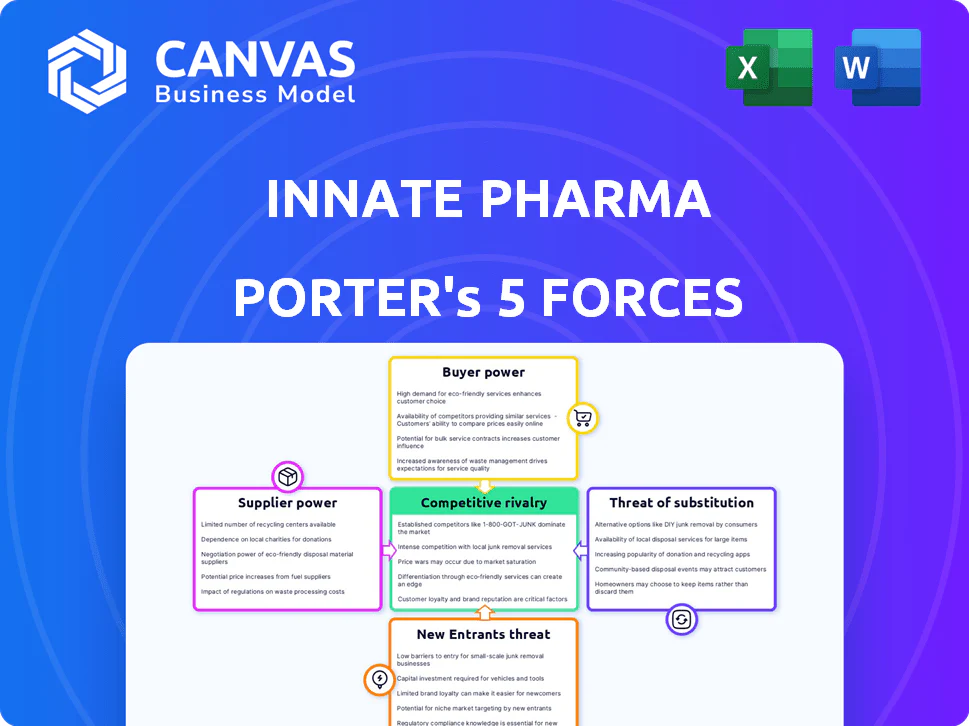
INNATE PHARMA PORTER'S FIVE FORCES TEMPLATE RESEARCH
What is included in the product
 Detailed Word Document
Analyzes Innate Pharma's competitive position, examining forces like rivals, buyers, and market entry.

 Customizable Excel Spreadsheet
Clean, simplified layout—ready to copy into pitch decks or boardroom slides.
Preview Before You Purchase
Innate Pharma Porter's Five Forces Analysis
This preview showcases Innate Pharma's Porter's Five Forces analysis in its entirety.
You'll be receiving the very same professionally researched and formatted document upon purchase.
It details the competitive landscape, including rivalry, supplier power, and more.
This ready-to-use analysis is available for immediate download after checkout.
The content you see here is exactly what you'll receive, no changes.

Porter's Five Forces Analysis Template

Elevate Your Analysis with the Complete Porter's Five Forces Analysis
Innate Pharma faces moderate rivalry, driven by competitors in immuno-oncology. Buyer power is a factor, with healthcare providers negotiating prices. Suppliers have some influence due to specialized biotech inputs. The threat of new entrants is moderate, given industry barriers. Substitute products (alternative cancer treatments) pose a moderate threat.
Our full Porter's Five Forces report goes deeper—offering a data-driven framework to understand Innate Pharma's real business risks and market opportunities.
Suppliers Bargaining Power

Limited number of specialized suppliers
Innate Pharma faces supplier power due to the biopharma industry's reliance on specialized suppliers. A few suppliers control much of the market for crucial components, like those for monoclonal antibodies. For example, in 2024, the top 3 suppliers of cell culture media held over 60% market share. This concentration allows suppliers to dictate terms, impacting Innate Pharma's costs and operations.
High switching costs for essential components
Switching suppliers in the biopharmaceutical sector is costly. Regulatory compliance and validation processes are time-consuming. These processes ensure material quality and consistency. High switching costs enhance supplier power. In 2024, the average validation process can cost up to $500,000.

Suppliers may hold patents on critical technologies
In the biopharmaceutical sector, suppliers often control critical resources via patents, enhancing their bargaining power. This is especially true for specialized raw materials and technologies. Companies like Innate Pharma may face high licensing costs, as seen with many innovative drugs. For example, in 2024, the average cost to license a patented technology was around $500,000-$1,000,000 depending on its complexity.

Potential for vertical integration by suppliers
Some suppliers in the biopharmaceutical market are indeed increasing their bargaining power through vertical integration. This strategy involves acquiring or developing their own manufacturing capabilities or forming joint ventures. Such moves give them greater control over the supply chain, potentially reducing options for companies like Innate Pharma. For instance, in 2024, the global biopharmaceutical CDMO market was valued at around $25 billion, showing the scale of supplier influence.
- Vertical integration strengthens suppliers' control.
- CDMO market's value in 2024: ~$25 billion.
- Joint ventures enhance supplier power.
- Limits options for buyers like Innate Pharma.
Dependence on human resources with specialized skills
Innate Pharma's dependence on specialized human resources, like scientists and technicians, gives these suppliers leverage. The limited availability of skilled professionals, especially those with specific expertise, strengthens their position. This concentration allows them to influence terms, impacting costs and timelines for the company. For example, in 2024, the average salary for a senior scientist in the biotech sector was $180,000.
- High demand for specialized skills increases supplier power.
- Limited talent pools concentrated bargaining power.
- Impact on costs due to salary and benefits.
- Competition for talent affects project timelines.
Supplier Dynamics: A Challenge for Innate Pharma
Innate Pharma contends with substantial supplier power due to reliance on specialized providers. Concentrated markets, like cell culture media, with top suppliers holding over 60% market share in 2024, enable suppliers to dictate terms. High switching costs, with validation processes costing up to $500,000 in 2024, amplify supplier leverage. Vertical integration and control over critical resources further bolster supplier influence, impacting Innate Pharma's operations.
| Aspect | Impact on Innate Pharma | 2024 Data |
|---|---|---|
| Market Concentration | Supplier control over pricing and terms | Top 3 cell culture media suppliers: 60%+ market share |
| Switching Costs | High barriers to changing suppliers | Avg. validation cost: up to $500,000 |
| Resource Control | High licensing and raw material costs | Avg. tech licensing cost: $500k-$1M |
Customers Bargaining Power

Nature of the products
The bargaining power of customers is often low to medium in the pharmaceutical sector. This dynamic is influenced by the unique nature of drugs. For instance, in 2024, the global pharmaceutical market was valued at approximately $1.5 trillion.
Difficulty in switching providers
Switching costs impact customer power. For critical cancer drugs, like those Innate Pharma develops, patients face high switching barriers. A 2024 study showed 70% of patients stayed with their initial oncology treatment. This reduces customer bargaining power.

Challenge of finding suitable substitutes
The availability of alternative therapies impacts customer bargaining power. Finding pharmacological substitutes with similar efficacy and safety is difficult. This limits customer power in price negotiations for specific drugs. For instance, in 2024, the pharmaceutical industry saw over $1.5 trillion in global sales, highlighting the dependence on specific treatments.

Influence of large purchasing groups
Innate Pharma's customer bargaining power is elevated when dealing with large purchasing groups. These groups, like insurance companies and government agencies, wield significant influence. They can negotiate lower prices due to the volume of their purchases. This pressure impacts Innate Pharma's profitability and pricing strategies.
- Insurance companies control a significant portion of drug sales, influencing pricing.
- Government agencies, through regulations, impact drug pricing and reimbursement.
- In 2024, the U.S. government negotiated drug prices for the first time.
- Large hospital networks can also negotiate favorable terms.
Pricing regulations and government policies
Pricing regulations and government policies heavily influence customer bargaining power in the pharmaceutical industry. These regulations directly affect the prices Innate Pharma can set for its drugs and the reimbursement rates payers offer. For example, the Inflation Reduction Act in the US allows Medicare to negotiate drug prices, potentially lowering revenues for companies. This can shift the balance of power towards payers and government agencies.
- The Inflation Reduction Act enables Medicare price negotiations.
- Reimbursement rates directly affect customer access and willingness to pay.
- Government policies can restrict pricing flexibility for companies.
- Changes in regulations can quickly alter market dynamics.
Pharma's Power Dynamics: Sales & Influence
Customer bargaining power varies in the pharmaceutical industry. High switching costs and limited alternatives, as seen in 2024 with $1.5T in sales, reduce customer influence. Large purchasers like insurers and governments increase their power, impacting pricing.
| Factor | Impact on Power | 2024 Data Point |
|---|---|---|
| Switching Costs | Lowers Customer Power | 70% patient treatment retention |
| Alternative Therapies | Lowers Customer Power | $1.5T global sales |
| Purchaser Size | Increases Customer Power | U.S. gov't price negot. |
Rivalry Among Competitors

Presence of major pharmaceutical companies
Innate Pharma faces intense competition from industry giants. These companies, like Roche and Bristol Myers Squibb, boast vast financial clout. They can invest heavily in R&D, with Roche spending $14.1 billion in 2023. This allows them to quickly develop and market new drugs, intensifying the competitive pressure.
Competition from other biotech firms
Innate Pharma competes with biotech firms in immuno-oncology. They vie for market share and partnerships. Competitors include companies like Adaptimmune and TCR2 Therapeutics. In 2024, the immuno-oncology market was valued at over $100 billion.

Intensity of R&D and innovation
Innate Pharma competes in a biopharma sector with high R&D intensity. The company invests heavily in research to stay ahead. For instance, in 2024, R&D spending was a significant portion of its revenue. This drive for innovation intensifies rivalry among industry players. The race to develop new drugs is fierce, with competitors constantly vying for breakthroughs.

Pipeline progress and clinical trial results
Innate Pharma faces intense rivalry driven by clinical trial outcomes. Successful trial results and regulatory approvals, such as Breakthrough Therapy Designations, boost a company's market standing. These milestones directly influence the competitive landscape, impacting valuation and investor confidence. The speed and efficiency of clinical trial programs are thus critical for competitive advantage.
- 2024 saw a 15% increase in oncology clinical trial enrollment globally.
- Breakthrough Therapy Designation can accelerate drug development by up to 1 year.
- Positive Phase 3 trial results can increase a company's market cap by 20-30%.
- Approximately 70% of oncology drugs fail during clinical trials.
Strategic partnerships and collaborations
Strategic partnerships and collaborations are vital in the pharmaceutical industry, offering a competitive edge. These alliances allow companies to boost their capabilities, and expand their market reach. Innate Pharma has engaged in collaborations with major players to enhance its drug development and commercialization efforts. Such partnerships can significantly impact a company's financial performance and market position.
- In 2024, Innate Pharma had collaborations with Sanofi and AstraZeneca.
- These partnerships provide access to resources and expertise.
- Collaborations often lead to increased R&D spending.
- Successful partnerships can reduce time to market.
Immuno-Oncology: A High-Stakes Battleground
Innate Pharma competes fiercely with major pharma firms and biotech companies in the immuno-oncology field. Competition is driven by R&D investments and clinical trial outcomes. Strategic partnerships are crucial for staying competitive in this dynamic market.
| Factor | Impact | Data |
|---|---|---|
| R&D Intensity | High | Roche spent $14.1B in R&D in 2023. |
| Market Value | Immense | Immuno-oncology market valued at over $100B in 2024. |
| Clinical Trials | Critical | 70% of oncology drugs fail in trials. |
Original: $10.00
-65%$10.00
$3.50INNATE PHARMA PORTER'S FIVE FORCES TEMPLATE RESEARCH
What is included in the product
Detailed Word Document
Analyzes Innate Pharma's competitive position, examining forces like rivals, buyers, and market entry.
Customizable Excel Spreadsheet
Clean, simplified layout—ready to copy into pitch decks or boardroom slides.
Preview Before You Purchase
Innate Pharma Porter's Five Forces Analysis
This preview showcases Innate Pharma's Porter's Five Forces analysis in its entirety.
You'll be receiving the very same professionally researched and formatted document upon purchase.
It details the competitive landscape, including rivalry, supplier power, and more.
This ready-to-use analysis is available for immediate download after checkout.
The content you see here is exactly what you'll receive, no changes.
Porter's Five Forces Analysis Template
Elevate Your Analysis with the Complete Porter's Five Forces Analysis
Innate Pharma faces moderate rivalry, driven by competitors in immuno-oncology. Buyer power is a factor, with healthcare providers negotiating prices. Suppliers have some influence due to specialized biotech inputs. The threat of new entrants is moderate, given industry barriers. Substitute products (alternative cancer treatments) pose a moderate threat.
Our full Porter's Five Forces report goes deeper—offering a data-driven framework to understand Innate Pharma's real business risks and market opportunities.
Suppliers Bargaining Power
Limited number of specialized suppliers
Innate Pharma faces supplier power due to the biopharma industry's reliance on specialized suppliers. A few suppliers control much of the market for crucial components, like those for monoclonal antibodies. For example, in 2024, the top 3 suppliers of cell culture media held over 60% market share. This concentration allows suppliers to dictate terms, impacting Innate Pharma's costs and operations.
High switching costs for essential components
Switching suppliers in the biopharmaceutical sector is costly. Regulatory compliance and validation processes are time-consuming. These processes ensure material quality and consistency. High switching costs enhance supplier power. In 2024, the average validation process can cost up to $500,000.
Suppliers may hold patents on critical technologies
In the biopharmaceutical sector, suppliers often control critical resources via patents, enhancing their bargaining power. This is especially true for specialized raw materials and technologies. Companies like Innate Pharma may face high licensing costs, as seen with many innovative drugs. For example, in 2024, the average cost to license a patented technology was around $500,000-$1,000,000 depending on its complexity.
Potential for vertical integration by suppliers
Some suppliers in the biopharmaceutical market are indeed increasing their bargaining power through vertical integration. This strategy involves acquiring or developing their own manufacturing capabilities or forming joint ventures. Such moves give them greater control over the supply chain, potentially reducing options for companies like Innate Pharma. For instance, in 2024, the global biopharmaceutical CDMO market was valued at around $25 billion, showing the scale of supplier influence.
- Vertical integration strengthens suppliers' control.
- CDMO market's value in 2024: ~$25 billion.
- Joint ventures enhance supplier power.
- Limits options for buyers like Innate Pharma.
Dependence on human resources with specialized skills
Innate Pharma's dependence on specialized human resources, like scientists and technicians, gives these suppliers leverage. The limited availability of skilled professionals, especially those with specific expertise, strengthens their position. This concentration allows them to influence terms, impacting costs and timelines for the company. For example, in 2024, the average salary for a senior scientist in the biotech sector was $180,000.
- High demand for specialized skills increases supplier power.
- Limited talent pools concentrated bargaining power.
- Impact on costs due to salary and benefits.
- Competition for talent affects project timelines.
Supplier Dynamics: A Challenge for Innate Pharma
Innate Pharma contends with substantial supplier power due to reliance on specialized providers. Concentrated markets, like cell culture media, with top suppliers holding over 60% market share in 2024, enable suppliers to dictate terms. High switching costs, with validation processes costing up to $500,000 in 2024, amplify supplier leverage. Vertical integration and control over critical resources further bolster supplier influence, impacting Innate Pharma's operations.
| Aspect | Impact on Innate Pharma | 2024 Data |
|---|---|---|
| Market Concentration | Supplier control over pricing and terms | Top 3 cell culture media suppliers: 60%+ market share |
| Switching Costs | High barriers to changing suppliers | Avg. validation cost: up to $500,000 |
| Resource Control | High licensing and raw material costs | Avg. tech licensing cost: $500k-$1M |
Customers Bargaining Power
Nature of the products
The bargaining power of customers is often low to medium in the pharmaceutical sector. This dynamic is influenced by the unique nature of drugs. For instance, in 2024, the global pharmaceutical market was valued at approximately $1.5 trillion.
Difficulty in switching providers
Switching costs impact customer power. For critical cancer drugs, like those Innate Pharma develops, patients face high switching barriers. A 2024 study showed 70% of patients stayed with their initial oncology treatment. This reduces customer bargaining power.
Challenge of finding suitable substitutes
The availability of alternative therapies impacts customer bargaining power. Finding pharmacological substitutes with similar efficacy and safety is difficult. This limits customer power in price negotiations for specific drugs. For instance, in 2024, the pharmaceutical industry saw over $1.5 trillion in global sales, highlighting the dependence on specific treatments.
Influence of large purchasing groups
Innate Pharma's customer bargaining power is elevated when dealing with large purchasing groups. These groups, like insurance companies and government agencies, wield significant influence. They can negotiate lower prices due to the volume of their purchases. This pressure impacts Innate Pharma's profitability and pricing strategies.
- Insurance companies control a significant portion of drug sales, influencing pricing.
- Government agencies, through regulations, impact drug pricing and reimbursement.
- In 2024, the U.S. government negotiated drug prices for the first time.
- Large hospital networks can also negotiate favorable terms.
Pricing regulations and government policies
Pricing regulations and government policies heavily influence customer bargaining power in the pharmaceutical industry. These regulations directly affect the prices Innate Pharma can set for its drugs and the reimbursement rates payers offer. For example, the Inflation Reduction Act in the US allows Medicare to negotiate drug prices, potentially lowering revenues for companies. This can shift the balance of power towards payers and government agencies.
- The Inflation Reduction Act enables Medicare price negotiations.
- Reimbursement rates directly affect customer access and willingness to pay.
- Government policies can restrict pricing flexibility for companies.
- Changes in regulations can quickly alter market dynamics.
Pharma's Power Dynamics: Sales & Influence
Customer bargaining power varies in the pharmaceutical industry. High switching costs and limited alternatives, as seen in 2024 with $1.5T in sales, reduce customer influence. Large purchasers like insurers and governments increase their power, impacting pricing.
| Factor | Impact on Power | 2024 Data Point |
|---|---|---|
| Switching Costs | Lowers Customer Power | 70% patient treatment retention |
| Alternative Therapies | Lowers Customer Power | $1.5T global sales |
| Purchaser Size | Increases Customer Power | U.S. gov't price negot. |
Rivalry Among Competitors
Presence of major pharmaceutical companies
Innate Pharma faces intense competition from industry giants. These companies, like Roche and Bristol Myers Squibb, boast vast financial clout. They can invest heavily in R&D, with Roche spending $14.1 billion in 2023. This allows them to quickly develop and market new drugs, intensifying the competitive pressure.
Competition from other biotech firms
Innate Pharma competes with biotech firms in immuno-oncology. They vie for market share and partnerships. Competitors include companies like Adaptimmune and TCR2 Therapeutics. In 2024, the immuno-oncology market was valued at over $100 billion.
Intensity of R&D and innovation
Innate Pharma competes in a biopharma sector with high R&D intensity. The company invests heavily in research to stay ahead. For instance, in 2024, R&D spending was a significant portion of its revenue. This drive for innovation intensifies rivalry among industry players. The race to develop new drugs is fierce, with competitors constantly vying for breakthroughs.
Pipeline progress and clinical trial results
Innate Pharma faces intense rivalry driven by clinical trial outcomes. Successful trial results and regulatory approvals, such as Breakthrough Therapy Designations, boost a company's market standing. These milestones directly influence the competitive landscape, impacting valuation and investor confidence. The speed and efficiency of clinical trial programs are thus critical for competitive advantage.
- 2024 saw a 15% increase in oncology clinical trial enrollment globally.
- Breakthrough Therapy Designation can accelerate drug development by up to 1 year.
- Positive Phase 3 trial results can increase a company's market cap by 20-30%.
- Approximately 70% of oncology drugs fail during clinical trials.
Strategic partnerships and collaborations
Strategic partnerships and collaborations are vital in the pharmaceutical industry, offering a competitive edge. These alliances allow companies to boost their capabilities, and expand their market reach. Innate Pharma has engaged in collaborations with major players to enhance its drug development and commercialization efforts. Such partnerships can significantly impact a company's financial performance and market position.
- In 2024, Innate Pharma had collaborations with Sanofi and AstraZeneca.
- These partnerships provide access to resources and expertise.
- Collaborations often lead to increased R&D spending.
- Successful partnerships can reduce time to market.
Immuno-Oncology: A High-Stakes Battleground
Innate Pharma competes fiercely with major pharma firms and biotech companies in the immuno-oncology field. Competition is driven by R&D investments and clinical trial outcomes. Strategic partnerships are crucial for staying competitive in this dynamic market.
| Factor | Impact | Data |
|---|---|---|
| R&D Intensity | High | Roche spent $14.1B in R&D in 2023. |
| Market Value | Immense | Immuno-oncology market valued at over $100B in 2024. |
| Clinical Trials | Critical | 70% of oncology drugs fail in trials. |
Product Information
Product Information
Shipping & Returns
Shipping & Returns
Description
What is included in the product
Detailed Word Document
Analyzes Innate Pharma's competitive position, examining forces like rivals, buyers, and market entry.
Customizable Excel Spreadsheet
Clean, simplified layout—ready to copy into pitch decks or boardroom slides.
Preview Before You Purchase
Innate Pharma Porter's Five Forces Analysis
This preview showcases Innate Pharma's Porter's Five Forces analysis in its entirety.
You'll be receiving the very same professionally researched and formatted document upon purchase.
It details the competitive landscape, including rivalry, supplier power, and more.
This ready-to-use analysis is available for immediate download after checkout.
The content you see here is exactly what you'll receive, no changes.
Porter's Five Forces Analysis Template
Elevate Your Analysis with the Complete Porter's Five Forces Analysis
Innate Pharma faces moderate rivalry, driven by competitors in immuno-oncology. Buyer power is a factor, with healthcare providers negotiating prices. Suppliers have some influence due to specialized biotech inputs. The threat of new entrants is moderate, given industry barriers. Substitute products (alternative cancer treatments) pose a moderate threat.
Our full Porter's Five Forces report goes deeper—offering a data-driven framework to understand Innate Pharma's real business risks and market opportunities.
Suppliers Bargaining Power
Limited number of specialized suppliers
Innate Pharma faces supplier power due to the biopharma industry's reliance on specialized suppliers. A few suppliers control much of the market for crucial components, like those for monoclonal antibodies. For example, in 2024, the top 3 suppliers of cell culture media held over 60% market share. This concentration allows suppliers to dictate terms, impacting Innate Pharma's costs and operations.
High switching costs for essential components
Switching suppliers in the biopharmaceutical sector is costly. Regulatory compliance and validation processes are time-consuming. These processes ensure material quality and consistency. High switching costs enhance supplier power. In 2024, the average validation process can cost up to $500,000.
Suppliers may hold patents on critical technologies
In the biopharmaceutical sector, suppliers often control critical resources via patents, enhancing their bargaining power. This is especially true for specialized raw materials and technologies. Companies like Innate Pharma may face high licensing costs, as seen with many innovative drugs. For example, in 2024, the average cost to license a patented technology was around $500,000-$1,000,000 depending on its complexity.
Potential for vertical integration by suppliers
Some suppliers in the biopharmaceutical market are indeed increasing their bargaining power through vertical integration. This strategy involves acquiring or developing their own manufacturing capabilities or forming joint ventures. Such moves give them greater control over the supply chain, potentially reducing options for companies like Innate Pharma. For instance, in 2024, the global biopharmaceutical CDMO market was valued at around $25 billion, showing the scale of supplier influence.
- Vertical integration strengthens suppliers' control.
- CDMO market's value in 2024: ~$25 billion.
- Joint ventures enhance supplier power.
- Limits options for buyers like Innate Pharma.
Dependence on human resources with specialized skills
Innate Pharma's dependence on specialized human resources, like scientists and technicians, gives these suppliers leverage. The limited availability of skilled professionals, especially those with specific expertise, strengthens their position. This concentration allows them to influence terms, impacting costs and timelines for the company. For example, in 2024, the average salary for a senior scientist in the biotech sector was $180,000.
- High demand for specialized skills increases supplier power.
- Limited talent pools concentrated bargaining power.
- Impact on costs due to salary and benefits.
- Competition for talent affects project timelines.
Supplier Dynamics: A Challenge for Innate Pharma
Innate Pharma contends with substantial supplier power due to reliance on specialized providers. Concentrated markets, like cell culture media, with top suppliers holding over 60% market share in 2024, enable suppliers to dictate terms. High switching costs, with validation processes costing up to $500,000 in 2024, amplify supplier leverage. Vertical integration and control over critical resources further bolster supplier influence, impacting Innate Pharma's operations.
| Aspect | Impact on Innate Pharma | 2024 Data |
|---|---|---|
| Market Concentration | Supplier control over pricing and terms | Top 3 cell culture media suppliers: 60%+ market share |
| Switching Costs | High barriers to changing suppliers | Avg. validation cost: up to $500,000 |
| Resource Control | High licensing and raw material costs | Avg. tech licensing cost: $500k-$1M |
Customers Bargaining Power
Nature of the products
The bargaining power of customers is often low to medium in the pharmaceutical sector. This dynamic is influenced by the unique nature of drugs. For instance, in 2024, the global pharmaceutical market was valued at approximately $1.5 trillion.
Difficulty in switching providers
Switching costs impact customer power. For critical cancer drugs, like those Innate Pharma develops, patients face high switching barriers. A 2024 study showed 70% of patients stayed with their initial oncology treatment. This reduces customer bargaining power.
Challenge of finding suitable substitutes
The availability of alternative therapies impacts customer bargaining power. Finding pharmacological substitutes with similar efficacy and safety is difficult. This limits customer power in price negotiations for specific drugs. For instance, in 2024, the pharmaceutical industry saw over $1.5 trillion in global sales, highlighting the dependence on specific treatments.
Influence of large purchasing groups
Innate Pharma's customer bargaining power is elevated when dealing with large purchasing groups. These groups, like insurance companies and government agencies, wield significant influence. They can negotiate lower prices due to the volume of their purchases. This pressure impacts Innate Pharma's profitability and pricing strategies.
- Insurance companies control a significant portion of drug sales, influencing pricing.
- Government agencies, through regulations, impact drug pricing and reimbursement.
- In 2024, the U.S. government negotiated drug prices for the first time.
- Large hospital networks can also negotiate favorable terms.
Pricing regulations and government policies
Pricing regulations and government policies heavily influence customer bargaining power in the pharmaceutical industry. These regulations directly affect the prices Innate Pharma can set for its drugs and the reimbursement rates payers offer. For example, the Inflation Reduction Act in the US allows Medicare to negotiate drug prices, potentially lowering revenues for companies. This can shift the balance of power towards payers and government agencies.
- The Inflation Reduction Act enables Medicare price negotiations.
- Reimbursement rates directly affect customer access and willingness to pay.
- Government policies can restrict pricing flexibility for companies.
- Changes in regulations can quickly alter market dynamics.
Pharma's Power Dynamics: Sales & Influence
Customer bargaining power varies in the pharmaceutical industry. High switching costs and limited alternatives, as seen in 2024 with $1.5T in sales, reduce customer influence. Large purchasers like insurers and governments increase their power, impacting pricing.
| Factor | Impact on Power | 2024 Data Point |
|---|---|---|
| Switching Costs | Lowers Customer Power | 70% patient treatment retention |
| Alternative Therapies | Lowers Customer Power | $1.5T global sales |
| Purchaser Size | Increases Customer Power | U.S. gov't price negot. |
Rivalry Among Competitors
Presence of major pharmaceutical companies
Innate Pharma faces intense competition from industry giants. These companies, like Roche and Bristol Myers Squibb, boast vast financial clout. They can invest heavily in R&D, with Roche spending $14.1 billion in 2023. This allows them to quickly develop and market new drugs, intensifying the competitive pressure.
Competition from other biotech firms
Innate Pharma competes with biotech firms in immuno-oncology. They vie for market share and partnerships. Competitors include companies like Adaptimmune and TCR2 Therapeutics. In 2024, the immuno-oncology market was valued at over $100 billion.
Intensity of R&D and innovation
Innate Pharma competes in a biopharma sector with high R&D intensity. The company invests heavily in research to stay ahead. For instance, in 2024, R&D spending was a significant portion of its revenue. This drive for innovation intensifies rivalry among industry players. The race to develop new drugs is fierce, with competitors constantly vying for breakthroughs.
Pipeline progress and clinical trial results
Innate Pharma faces intense rivalry driven by clinical trial outcomes. Successful trial results and regulatory approvals, such as Breakthrough Therapy Designations, boost a company's market standing. These milestones directly influence the competitive landscape, impacting valuation and investor confidence. The speed and efficiency of clinical trial programs are thus critical for competitive advantage.
- 2024 saw a 15% increase in oncology clinical trial enrollment globally.
- Breakthrough Therapy Designation can accelerate drug development by up to 1 year.
- Positive Phase 3 trial results can increase a company's market cap by 20-30%.
- Approximately 70% of oncology drugs fail during clinical trials.
Strategic partnerships and collaborations
Strategic partnerships and collaborations are vital in the pharmaceutical industry, offering a competitive edge. These alliances allow companies to boost their capabilities, and expand their market reach. Innate Pharma has engaged in collaborations with major players to enhance its drug development and commercialization efforts. Such partnerships can significantly impact a company's financial performance and market position.
- In 2024, Innate Pharma had collaborations with Sanofi and AstraZeneca.
- These partnerships provide access to resources and expertise.
- Collaborations often lead to increased R&D spending.
- Successful partnerships can reduce time to market.
Immuno-Oncology: A High-Stakes Battleground
Innate Pharma competes fiercely with major pharma firms and biotech companies in the immuno-oncology field. Competition is driven by R&D investments and clinical trial outcomes. Strategic partnerships are crucial for staying competitive in this dynamic market.
| Factor | Impact | Data |
|---|---|---|
| R&D Intensity | High | Roche spent $14.1B in R&D in 2023. |
| Market Value | Immense | Immuno-oncology market valued at over $100B in 2024. |
| Clinical Trials | Critical | 70% of oncology drugs fail in trials. |











