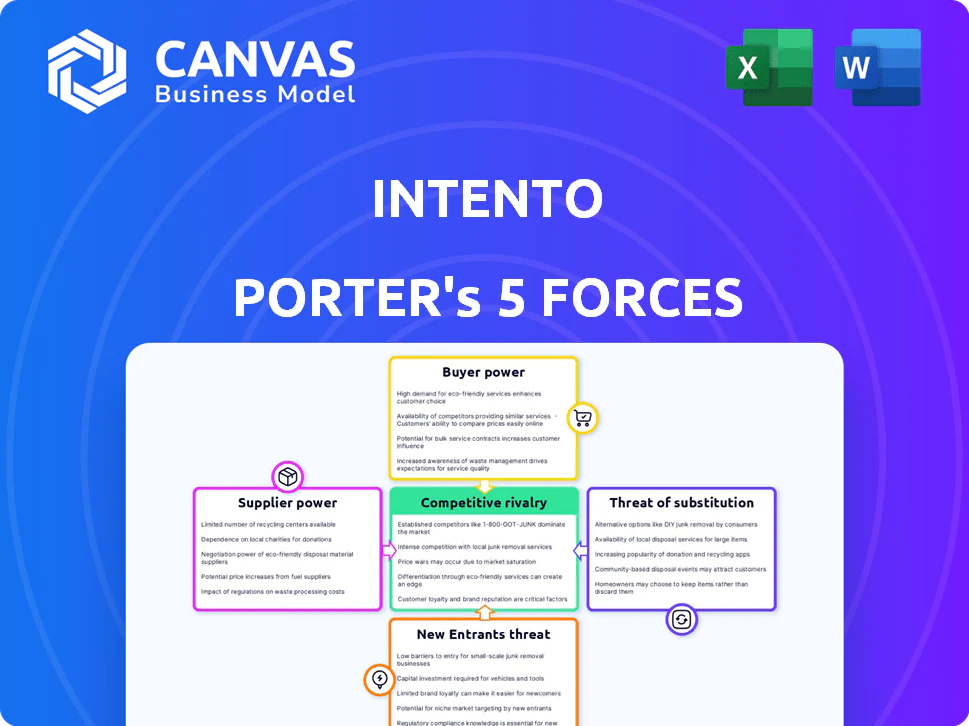
INTENTO PORTER'S FIVE FORCES TEMPLATE RESEARCH
What is included in the product
 Detailed Word Document
Analyzes competitive dynamics, supplier/buyer power, & barriers to entry specific to Intento's market position.

 Customizable Excel Spreadsheet
Customize the analysis with dynamic pressure levels, instantly reacting to market shifts.
Preview Before You Purchase
Intento Porter's Five Forces Analysis
This is a comprehensive Porter's Five Forces analysis. It examines competitive rivalry, supplier power, buyer power, threat of substitution, and threat of new entrants. The insights are clearly presented, providing a complete market evaluation. The preview is the exact document you will receive immediately after purchase.

Porter's Five Forces Analysis Template

From Overview to Strategy Blueprint
Intento's competitive landscape is shaped by five key forces: supplier power, buyer power, threat of new entrants, threat of substitutes, and competitive rivalry. Assessing these forces reveals the industry's attractiveness and profit potential. Initial analysis suggests moderate supplier and buyer power impacting Intento. The threat of substitutes appears low, while rivalry is intensifying. Understanding these dynamics is crucial for strategic planning.
The complete report reveals the real forces shaping Intento’s industry—from supplier influence to threat of new entrants. Gain actionable insights to drive smarter decision-making.
Suppliers Bargaining Power

Availability of Machine Translation Engines and LLMs
Intento's platform benefits from diverse machine translation and LLM suppliers, reducing supplier bargaining power. With options like Google Translate and others, Intento isn't tied to one provider. The market offers many choices, including open-source models. The machine translation market was valued at $640 million in 2023, and is projected to reach $1.2 billion by 2030, which gives Intento flexibility.
Advancements in AI and MT Technology
Rapid advancements in AI, especially in Neural Machine Translation (NMT) and LLMs, are constantly improving models. This provides Intento with access to increasingly sophisticated tools. The AI market, valued at $196.7 billion in 2023, is projected to reach $1.81 trillion by 2030. This could increase their leverage with suppliers as newer, better options emerge.

Proprietary Technology and Optimization
Intento's tools for machine translation optimization suggest proprietary tech, potentially lowering supplier dependence. This control allows them to negotiate better terms. The global language services market was valued at $65.8 billion in 2023. Reduced supplier power can boost profitability.

Data and Customization
Intento's ability to customize machine translation workflows and integrate with existing systems provides significant value beyond basic translation. This customization, including domain adaptation, reduces the reliance on suppliers' raw translation technology. For example, in 2024, the market for customized AI solutions grew by 18%, highlighting the importance of tailored services. This approach diminishes suppliers' bargaining power.
- Custom AI solutions market grew 18% in 2024.
- Domain adaptation increases value beyond raw translation.
- Integration with existing systems adds competitive advantage.
- Intento's expertise decreases supplier influence.
Supplier Concentration
In the machine translation (MT) landscape, supplier concentration is a key factor. While numerous MT providers exist, a few major tech companies, like Google, Microsoft, and Amazon, dominate with substantial resources. This concentration of advanced AI and MT development gives these large entities bargaining power, especially for cutting-edge models. This can influence pricing and service terms for Intento.
- Google's AI revenue in 2024 reached $28 billion, showing its dominance.
- Microsoft invested $13 billion in OpenAI, strengthening its position in AI.
- Amazon's AWS offers extensive MT services, integrating them into its cloud offerings.
Supplier Power: Weak in Translation Tech
Intento's supplier power is low, thanks to many translation and LLM options. The machine translation market, at $640 million in 2023, offers choices, reducing supplier control. Customization and integration further decrease supplier influence.
| Aspect | Impact | Data |
|---|---|---|
| Supplier Diversity | Lowers bargaining power | Many MT providers |
| Market Growth | More options emerge | MT market to $1.2B by 2030 |
| Customization | Reduces supplier dependence | Custom AI solutions grew by 18% in 2024 |
Customers Bargaining Power

Availability of Alternative Solutions
Customers in the translation and multilingual content space possess substantial bargaining power due to the availability of alternatives. They can opt for traditional translation agencies, build in-house teams, or utilize individual MT engines, including generative AI tools. The global language services market reached approximately $65.9 billion in 2023. This wide array of choices allows customers to select solutions that align with their specific requirements and financial constraints, boosting their influence.
Cost Sensitivity
Cost sensitivity is crucial in the customer's bargaining power. Machine translation and generative AI can cut costs significantly, potentially reducing translation expenses by 80-90%. For instance, in 2024, the average cost per word for human translation was $0.10-$0.20, while machine translation costs are a fraction of that, about $0.01-$0.03 per word. Customers will likely prefer the most cost-effective solutions.

Demand for Integration and Customization
Enterprise clients frequently seek solutions that smoothly integrate with their current operations and systems, and adapt to specific fields and content types. Intento, capable of strong integration and customization, might gain some advantage. Yet, customers still hold sway by requesting tailored solutions. In 2024, the demand for customized AI solutions in the enterprise market grew by 20%, reflecting customer influence.

Importance of Quality and Accuracy
The bargaining power of customers significantly influences translation services. Customers prioritize quality and accuracy, especially for specialized or customer-facing content, over mere speed and cost. They assess providers based on translation accuracy and fluency, wielding power to demand high-quality output. This impacts pricing and service delivery strategies.
- In 2024, the global language services market was valued at approximately $67.8 billion, with a strong emphasis on quality.
- Accuracy is paramount: Errors can lead to misinterpretations, which in turn can cost companies millions.
- The ability of customers to switch providers based on quality is a key factor.
- Customer reviews and ratings significantly influence buying decisions within the translation sector.
Customer Size and Volume
Intento works with global businesses, meaning it deals with large accounts that need a lot of translation. These big customers usually have more power. They can influence prices and terms because of the substantial revenue they bring. For example, in 2024, the translation and localization market was valued at over $60 billion, highlighting the financial stakes involved.
- Large customers can demand lower prices.
- They may dictate specific service levels.
- Their feedback can significantly impact product development.
- High customer concentration increases bargaining power.
Translation Services: Customer Power Dynamics
Customers in translation services have strong bargaining power due to diverse options. Cost-effectiveness is key; machine translation significantly reduces expenses. Enterprise clients demand customized, integrated solutions, further enhancing their influence.
| Aspect | Impact | 2024 Data |
|---|---|---|
| Market Size | Customer Choice | $67.8B global language services market |
| Cost Sensitivity | Price Negotiation | Human translation: $0.10-$0.20/word; MT: $0.01-$0.03/word |
| Customization Demand | Solution Tailoring | 20% growth in customized AI solutions |
Rivalry Among Competitors

Number and Diversity of Competitors
The machine translation and generative AI market is crowded. Major tech firms, like Google and Microsoft, compete with specialized language service providers and startups. In 2024, the market saw over 500 active companies. This diversity increases rivalry, especially among platform-based solutions.
Technological Advancements and Innovation
The AI-driven translation market sees fierce competition due to rapid tech advancements. Companies must constantly innovate in AI, NMT, and LLMs to improve quality and speed. This necessitates hefty R&D investments, with spending projected to reach $200 billion globally by 2024.

Pricing Pressure
The abundance of MT options, including open-source models, intensifies pricing pressure. Competitors might slash prices to gain market share. In 2024, the MT market saw average price drops of 10-15% due to this competition.

Differentiation and Specialization
Competitive rivalry in the MT landscape is intense, with companies striving to differentiate. Differentiation strategies include the number and quality of MT engines, generative AI features, and customization. Intento distinguishes itself by providing a platform to manage multiple engines and AI. This approach allows businesses to select the best tools for their needs. The market size for AI in translation was valued at $880 million in 2023.
- Market competition drives innovation and pricing pressure.
- Intento's platform offers centralized engine management.
- Customization and industry specialization are key differentiators.
- The integration of generative AI further enhances capabilities.
Market Growth
The machine translation and language services market is expanding rapidly. This growth, fueled by globalization, provides opportunities for multiple companies. Increased demand for multilingual content supports market expansion. The rising market often reduces rivalry's intensity, allowing firms to thrive. Overall, the market's growth is a key factor.
- The global language services market was valued at $65.8 billion in 2023.
- It is projected to reach $88.4 billion by 2028.
- The compound annual growth rate (CAGR) is expected to be 6.1% from 2023 to 2028.
- Growth is driven by rising demand for multilingual content.
MT Market: Fierce Competition & Growth
Competitive rivalry in the MT market is high, fueled by innovation and pricing wars. Differentiation is key, with companies focusing on AI features and customization. Market expansion mitigates rivalry, with the global language services market at $65.8B in 2023.
| Aspect | Details | 2024 Data |
|---|---|---|
| Market Participants | Major Tech, Specialized Providers, Startups | Over 500 companies |
| Pricing Pressure | Intense, due to competition | Avg. price drops 10-15% |
| R&D Investment | High, for AI, NMT, LLMs | Projected $200B globally |
INTENTO PORTER'S FIVE FORCES TEMPLATE RESEARCH
What is included in the product
Detailed Word Document
Analyzes competitive dynamics, supplier/buyer power, & barriers to entry specific to Intento's market position.
Customizable Excel Spreadsheet
Customize the analysis with dynamic pressure levels, instantly reacting to market shifts.
Preview Before You Purchase
Intento Porter's Five Forces Analysis
This is a comprehensive Porter's Five Forces analysis. It examines competitive rivalry, supplier power, buyer power, threat of substitution, and threat of new entrants. The insights are clearly presented, providing a complete market evaluation. The preview is the exact document you will receive immediately after purchase.
Porter's Five Forces Analysis Template
From Overview to Strategy Blueprint
Intento's competitive landscape is shaped by five key forces: supplier power, buyer power, threat of new entrants, threat of substitutes, and competitive rivalry. Assessing these forces reveals the industry's attractiveness and profit potential. Initial analysis suggests moderate supplier and buyer power impacting Intento. The threat of substitutes appears low, while rivalry is intensifying. Understanding these dynamics is crucial for strategic planning.
The complete report reveals the real forces shaping Intento’s industry—from supplier influence to threat of new entrants. Gain actionable insights to drive smarter decision-making.
Suppliers Bargaining Power
Availability of Machine Translation Engines and LLMs
Intento's platform benefits from diverse machine translation and LLM suppliers, reducing supplier bargaining power. With options like Google Translate and others, Intento isn't tied to one provider. The market offers many choices, including open-source models. The machine translation market was valued at $640 million in 2023, and is projected to reach $1.2 billion by 2030, which gives Intento flexibility.
Advancements in AI and MT Technology
Rapid advancements in AI, especially in Neural Machine Translation (NMT) and LLMs, are constantly improving models. This provides Intento with access to increasingly sophisticated tools. The AI market, valued at $196.7 billion in 2023, is projected to reach $1.81 trillion by 2030. This could increase their leverage with suppliers as newer, better options emerge.
Proprietary Technology and Optimization
Intento's tools for machine translation optimization suggest proprietary tech, potentially lowering supplier dependence. This control allows them to negotiate better terms. The global language services market was valued at $65.8 billion in 2023. Reduced supplier power can boost profitability.
Data and Customization
Intento's ability to customize machine translation workflows and integrate with existing systems provides significant value beyond basic translation. This customization, including domain adaptation, reduces the reliance on suppliers' raw translation technology. For example, in 2024, the market for customized AI solutions grew by 18%, highlighting the importance of tailored services. This approach diminishes suppliers' bargaining power.
- Custom AI solutions market grew 18% in 2024.
- Domain adaptation increases value beyond raw translation.
- Integration with existing systems adds competitive advantage.
- Intento's expertise decreases supplier influence.
Supplier Concentration
In the machine translation (MT) landscape, supplier concentration is a key factor. While numerous MT providers exist, a few major tech companies, like Google, Microsoft, and Amazon, dominate with substantial resources. This concentration of advanced AI and MT development gives these large entities bargaining power, especially for cutting-edge models. This can influence pricing and service terms for Intento.
- Google's AI revenue in 2024 reached $28 billion, showing its dominance.
- Microsoft invested $13 billion in OpenAI, strengthening its position in AI.
- Amazon's AWS offers extensive MT services, integrating them into its cloud offerings.
Supplier Power: Weak in Translation Tech
Intento's supplier power is low, thanks to many translation and LLM options. The machine translation market, at $640 million in 2023, offers choices, reducing supplier control. Customization and integration further decrease supplier influence.
| Aspect | Impact | Data |
|---|---|---|
| Supplier Diversity | Lowers bargaining power | Many MT providers |
| Market Growth | More options emerge | MT market to $1.2B by 2030 |
| Customization | Reduces supplier dependence | Custom AI solutions grew by 18% in 2024 |
Customers Bargaining Power
Availability of Alternative Solutions
Customers in the translation and multilingual content space possess substantial bargaining power due to the availability of alternatives. They can opt for traditional translation agencies, build in-house teams, or utilize individual MT engines, including generative AI tools. The global language services market reached approximately $65.9 billion in 2023. This wide array of choices allows customers to select solutions that align with their specific requirements and financial constraints, boosting their influence.
Cost Sensitivity
Cost sensitivity is crucial in the customer's bargaining power. Machine translation and generative AI can cut costs significantly, potentially reducing translation expenses by 80-90%. For instance, in 2024, the average cost per word for human translation was $0.10-$0.20, while machine translation costs are a fraction of that, about $0.01-$0.03 per word. Customers will likely prefer the most cost-effective solutions.
Demand for Integration and Customization
Enterprise clients frequently seek solutions that smoothly integrate with their current operations and systems, and adapt to specific fields and content types. Intento, capable of strong integration and customization, might gain some advantage. Yet, customers still hold sway by requesting tailored solutions. In 2024, the demand for customized AI solutions in the enterprise market grew by 20%, reflecting customer influence.
Importance of Quality and Accuracy
The bargaining power of customers significantly influences translation services. Customers prioritize quality and accuracy, especially for specialized or customer-facing content, over mere speed and cost. They assess providers based on translation accuracy and fluency, wielding power to demand high-quality output. This impacts pricing and service delivery strategies.
- In 2024, the global language services market was valued at approximately $67.8 billion, with a strong emphasis on quality.
- Accuracy is paramount: Errors can lead to misinterpretations, which in turn can cost companies millions.
- The ability of customers to switch providers based on quality is a key factor.
- Customer reviews and ratings significantly influence buying decisions within the translation sector.
Customer Size and Volume
Intento works with global businesses, meaning it deals with large accounts that need a lot of translation. These big customers usually have more power. They can influence prices and terms because of the substantial revenue they bring. For example, in 2024, the translation and localization market was valued at over $60 billion, highlighting the financial stakes involved.
- Large customers can demand lower prices.
- They may dictate specific service levels.
- Their feedback can significantly impact product development.
- High customer concentration increases bargaining power.
Translation Services: Customer Power Dynamics
Customers in translation services have strong bargaining power due to diverse options. Cost-effectiveness is key; machine translation significantly reduces expenses. Enterprise clients demand customized, integrated solutions, further enhancing their influence.
| Aspect | Impact | 2024 Data |
|---|---|---|
| Market Size | Customer Choice | $67.8B global language services market |
| Cost Sensitivity | Price Negotiation | Human translation: $0.10-$0.20/word; MT: $0.01-$0.03/word |
| Customization Demand | Solution Tailoring | 20% growth in customized AI solutions |
Rivalry Among Competitors
Number and Diversity of Competitors
The machine translation and generative AI market is crowded. Major tech firms, like Google and Microsoft, compete with specialized language service providers and startups. In 2024, the market saw over 500 active companies. This diversity increases rivalry, especially among platform-based solutions.
Technological Advancements and Innovation
The AI-driven translation market sees fierce competition due to rapid tech advancements. Companies must constantly innovate in AI, NMT, and LLMs to improve quality and speed. This necessitates hefty R&D investments, with spending projected to reach $200 billion globally by 2024.
Pricing Pressure
The abundance of MT options, including open-source models, intensifies pricing pressure. Competitors might slash prices to gain market share. In 2024, the MT market saw average price drops of 10-15% due to this competition.
Differentiation and Specialization
Competitive rivalry in the MT landscape is intense, with companies striving to differentiate. Differentiation strategies include the number and quality of MT engines, generative AI features, and customization. Intento distinguishes itself by providing a platform to manage multiple engines and AI. This approach allows businesses to select the best tools for their needs. The market size for AI in translation was valued at $880 million in 2023.
- Market competition drives innovation and pricing pressure.
- Intento's platform offers centralized engine management.
- Customization and industry specialization are key differentiators.
- The integration of generative AI further enhances capabilities.
Market Growth
The machine translation and language services market is expanding rapidly. This growth, fueled by globalization, provides opportunities for multiple companies. Increased demand for multilingual content supports market expansion. The rising market often reduces rivalry's intensity, allowing firms to thrive. Overall, the market's growth is a key factor.
- The global language services market was valued at $65.8 billion in 2023.
- It is projected to reach $88.4 billion by 2028.
- The compound annual growth rate (CAGR) is expected to be 6.1% from 2023 to 2028.
- Growth is driven by rising demand for multilingual content.
MT Market: Fierce Competition & Growth
Competitive rivalry in the MT market is high, fueled by innovation and pricing wars. Differentiation is key, with companies focusing on AI features and customization. Market expansion mitigates rivalry, with the global language services market at $65.8B in 2023.
| Aspect | Details | 2024 Data |
|---|---|---|
| Market Participants | Major Tech, Specialized Providers, Startups | Over 500 companies |
| Pricing Pressure | Intense, due to competition | Avg. price drops 10-15% |
| R&D Investment | High, for AI, NMT, LLMs | Projected $200B globally |
Product Information
Product Information
Shipping & Returns
Shipping & Returns
Description
What is included in the product
Detailed Word Document
Analyzes competitive dynamics, supplier/buyer power, & barriers to entry specific to Intento's market position.
Customizable Excel Spreadsheet
Customize the analysis with dynamic pressure levels, instantly reacting to market shifts.
Preview Before You Purchase
Intento Porter's Five Forces Analysis
This is a comprehensive Porter's Five Forces analysis. It examines competitive rivalry, supplier power, buyer power, threat of substitution, and threat of new entrants. The insights are clearly presented, providing a complete market evaluation. The preview is the exact document you will receive immediately after purchase.
Porter's Five Forces Analysis Template
From Overview to Strategy Blueprint
Intento's competitive landscape is shaped by five key forces: supplier power, buyer power, threat of new entrants, threat of substitutes, and competitive rivalry. Assessing these forces reveals the industry's attractiveness and profit potential. Initial analysis suggests moderate supplier and buyer power impacting Intento. The threat of substitutes appears low, while rivalry is intensifying. Understanding these dynamics is crucial for strategic planning.
The complete report reveals the real forces shaping Intento’s industry—from supplier influence to threat of new entrants. Gain actionable insights to drive smarter decision-making.
Suppliers Bargaining Power
Availability of Machine Translation Engines and LLMs
Intento's platform benefits from diverse machine translation and LLM suppliers, reducing supplier bargaining power. With options like Google Translate and others, Intento isn't tied to one provider. The market offers many choices, including open-source models. The machine translation market was valued at $640 million in 2023, and is projected to reach $1.2 billion by 2030, which gives Intento flexibility.
Advancements in AI and MT Technology
Rapid advancements in AI, especially in Neural Machine Translation (NMT) and LLMs, are constantly improving models. This provides Intento with access to increasingly sophisticated tools. The AI market, valued at $196.7 billion in 2023, is projected to reach $1.81 trillion by 2030. This could increase their leverage with suppliers as newer, better options emerge.
Proprietary Technology and Optimization
Intento's tools for machine translation optimization suggest proprietary tech, potentially lowering supplier dependence. This control allows them to negotiate better terms. The global language services market was valued at $65.8 billion in 2023. Reduced supplier power can boost profitability.
Data and Customization
Intento's ability to customize machine translation workflows and integrate with existing systems provides significant value beyond basic translation. This customization, including domain adaptation, reduces the reliance on suppliers' raw translation technology. For example, in 2024, the market for customized AI solutions grew by 18%, highlighting the importance of tailored services. This approach diminishes suppliers' bargaining power.
- Custom AI solutions market grew 18% in 2024.
- Domain adaptation increases value beyond raw translation.
- Integration with existing systems adds competitive advantage.
- Intento's expertise decreases supplier influence.
Supplier Concentration
In the machine translation (MT) landscape, supplier concentration is a key factor. While numerous MT providers exist, a few major tech companies, like Google, Microsoft, and Amazon, dominate with substantial resources. This concentration of advanced AI and MT development gives these large entities bargaining power, especially for cutting-edge models. This can influence pricing and service terms for Intento.
- Google's AI revenue in 2024 reached $28 billion, showing its dominance.
- Microsoft invested $13 billion in OpenAI, strengthening its position in AI.
- Amazon's AWS offers extensive MT services, integrating them into its cloud offerings.
Supplier Power: Weak in Translation Tech
Intento's supplier power is low, thanks to many translation and LLM options. The machine translation market, at $640 million in 2023, offers choices, reducing supplier control. Customization and integration further decrease supplier influence.
| Aspect | Impact | Data |
|---|---|---|
| Supplier Diversity | Lowers bargaining power | Many MT providers |
| Market Growth | More options emerge | MT market to $1.2B by 2030 |
| Customization | Reduces supplier dependence | Custom AI solutions grew by 18% in 2024 |
Customers Bargaining Power
Availability of Alternative Solutions
Customers in the translation and multilingual content space possess substantial bargaining power due to the availability of alternatives. They can opt for traditional translation agencies, build in-house teams, or utilize individual MT engines, including generative AI tools. The global language services market reached approximately $65.9 billion in 2023. This wide array of choices allows customers to select solutions that align with their specific requirements and financial constraints, boosting their influence.
Cost Sensitivity
Cost sensitivity is crucial in the customer's bargaining power. Machine translation and generative AI can cut costs significantly, potentially reducing translation expenses by 80-90%. For instance, in 2024, the average cost per word for human translation was $0.10-$0.20, while machine translation costs are a fraction of that, about $0.01-$0.03 per word. Customers will likely prefer the most cost-effective solutions.
Demand for Integration and Customization
Enterprise clients frequently seek solutions that smoothly integrate with their current operations and systems, and adapt to specific fields and content types. Intento, capable of strong integration and customization, might gain some advantage. Yet, customers still hold sway by requesting tailored solutions. In 2024, the demand for customized AI solutions in the enterprise market grew by 20%, reflecting customer influence.
Importance of Quality and Accuracy
The bargaining power of customers significantly influences translation services. Customers prioritize quality and accuracy, especially for specialized or customer-facing content, over mere speed and cost. They assess providers based on translation accuracy and fluency, wielding power to demand high-quality output. This impacts pricing and service delivery strategies.
- In 2024, the global language services market was valued at approximately $67.8 billion, with a strong emphasis on quality.
- Accuracy is paramount: Errors can lead to misinterpretations, which in turn can cost companies millions.
- The ability of customers to switch providers based on quality is a key factor.
- Customer reviews and ratings significantly influence buying decisions within the translation sector.
Customer Size and Volume
Intento works with global businesses, meaning it deals with large accounts that need a lot of translation. These big customers usually have more power. They can influence prices and terms because of the substantial revenue they bring. For example, in 2024, the translation and localization market was valued at over $60 billion, highlighting the financial stakes involved.
- Large customers can demand lower prices.
- They may dictate specific service levels.
- Their feedback can significantly impact product development.
- High customer concentration increases bargaining power.
Translation Services: Customer Power Dynamics
Customers in translation services have strong bargaining power due to diverse options. Cost-effectiveness is key; machine translation significantly reduces expenses. Enterprise clients demand customized, integrated solutions, further enhancing their influence.
| Aspect | Impact | 2024 Data |
|---|---|---|
| Market Size | Customer Choice | $67.8B global language services market |
| Cost Sensitivity | Price Negotiation | Human translation: $0.10-$0.20/word; MT: $0.01-$0.03/word |
| Customization Demand | Solution Tailoring | 20% growth in customized AI solutions |
Rivalry Among Competitors
Number and Diversity of Competitors
The machine translation and generative AI market is crowded. Major tech firms, like Google and Microsoft, compete with specialized language service providers and startups. In 2024, the market saw over 500 active companies. This diversity increases rivalry, especially among platform-based solutions.
Technological Advancements and Innovation
The AI-driven translation market sees fierce competition due to rapid tech advancements. Companies must constantly innovate in AI, NMT, and LLMs to improve quality and speed. This necessitates hefty R&D investments, with spending projected to reach $200 billion globally by 2024.
Pricing Pressure
The abundance of MT options, including open-source models, intensifies pricing pressure. Competitors might slash prices to gain market share. In 2024, the MT market saw average price drops of 10-15% due to this competition.
Differentiation and Specialization
Competitive rivalry in the MT landscape is intense, with companies striving to differentiate. Differentiation strategies include the number and quality of MT engines, generative AI features, and customization. Intento distinguishes itself by providing a platform to manage multiple engines and AI. This approach allows businesses to select the best tools for their needs. The market size for AI in translation was valued at $880 million in 2023.
- Market competition drives innovation and pricing pressure.
- Intento's platform offers centralized engine management.
- Customization and industry specialization are key differentiators.
- The integration of generative AI further enhances capabilities.
Market Growth
The machine translation and language services market is expanding rapidly. This growth, fueled by globalization, provides opportunities for multiple companies. Increased demand for multilingual content supports market expansion. The rising market often reduces rivalry's intensity, allowing firms to thrive. Overall, the market's growth is a key factor.
- The global language services market was valued at $65.8 billion in 2023.
- It is projected to reach $88.4 billion by 2028.
- The compound annual growth rate (CAGR) is expected to be 6.1% from 2023 to 2028.
- Growth is driven by rising demand for multilingual content.
MT Market: Fierce Competition & Growth
Competitive rivalry in the MT market is high, fueled by innovation and pricing wars. Differentiation is key, with companies focusing on AI features and customization. Market expansion mitigates rivalry, with the global language services market at $65.8B in 2023.
| Aspect | Details | 2024 Data |
|---|---|---|
| Market Participants | Major Tech, Specialized Providers, Startups | Over 500 companies |
| Pricing Pressure | Intense, due to competition | Avg. price drops 10-15% |
| R&D Investment | High, for AI, NMT, LLMs | Projected $200B globally |











