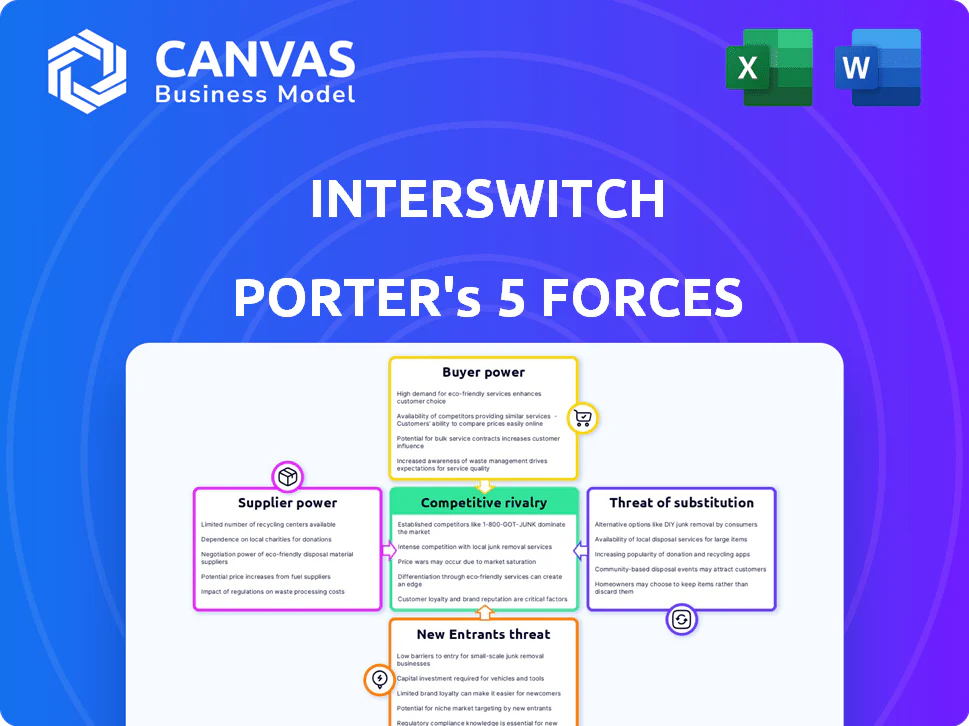
INTERSWITCH PORTER'S FIVE FORCES TEMPLATE RESEARCH

A Must-Have Tool for Decision-Makers
Interswitch faces intense platform competition, rising substitute payments, and regulatory scrutiny that shape margin and growth outlooks; supplier and buyer leverage vary across markets, while barriers to entry are mixed due to tech scale. This brief snapshot only scratches the surface-unlock the full Porter's Five Forces Analysis to explore Interswitch's competitive dynamics, market pressures, and strategic advantages in detail.
Suppliers Bargaining Power

Concentration of global cloud and hardware providers
Interswitch depends on AWS, Microsoft Azure, and specialized hardware vendors for core processing and data-center capacity; in FY2025 cloud and infrastructure spend rose ~18% to an estimated $72m, per company filings and industry benchmarks.
The company's regional dominance gives limited pricing power versus these global providers, so contract terms stay supplier-favored and largely dollar-denominated.
A 10% USD cloud-price rise would cut operating margins by roughly 120-180bps, based on 2025 cost structure and a $400m revenue base.
Dependency on international card schemes
Interswitch's Verve co-exists with Visa and Mastercard, so to keep global acceptance and premium services Interswitch follows their technical standards and pays network fees; in 2025 Interswitch reported ₦98.3bn revenue and cross-border volumes grew 22%, forcing compliance with Visa/Mastercard rules that exert moderate-high bargaining power over African processors' technical roadmaps.

Scarcity of specialized fintech engineering talent
The scarcity of senior fintech engineers and cybersecurity experts in Nigeria-exacerbated by a 2024-25 brain drain where an estimated 15-20% of tech talent moved abroad-raises supplier power; Interswitch reportedly pays senior engineers USD 70-120k equivalent annually to match global offers, making human capital one of its costliest, most influential suppliers.

Relationship with commercial bank partners
Interswitch's bank partners are both customers and suppliers of settlement rails; Nigeria's top 5 Tier-1 banks (e.g., Access Bank, Zenith) processed ~65% of POS and settlement volumes in 2025, giving them leverage to demand integration terms or build internal switches.
This dual role raises supplier bargaining power because Interswitch faces high switching costs and limited replacement options if banks withdraw or insource clearing functions.
- Top-5 banks ≈65% of 2025 transaction volume
- High switching costs for Interswitch
- Threat of bank insourcing increases negotiation pressure
- Foundational relationships hard to replace
Regulatory compliance and licensing bodies
The Central Bank of Nigeria (CBN) functions as a supplier of market access for Interswitch by granting licenses and setting rules; its 2024 payment systems guidelines and 2025 proposed transaction fee caps directly constrain revenue and pricing.
Mandated capital requirements-CBN data shows minimum capital for payment service providers rose to NGN 2.5 billion in 2024-are non-negotiable and raise Interswitch's funding costs.
In Africa, regulators hold dominant supplier power: a sudden CBN policy change (e.g., 2025 fee cap or interchange adjustment) can immediately lift transaction costs or cut net margins for Interswitch.
- CBN sets licenses and fee rules; Interswitch must comply
- NGN 2.5bn minimum capital (2024) increases funding needs
- 2025 fee-cap proposals can compress transaction revenue
- Regulatory shifts can instantaneously change cost structure
Suppliers & regs threaten margins: $72M cloud spend, 65% bank concentration, FX risk
Suppliers exert moderate-high power: FY2025 cloud/hardware spend ≈ $72m (+18%), USD pricing risk could trim margins 120-180bps on $400m revenue; Visa/Mastercard rules and ₦98.3bn 2025 revenue tie technical fees; top-5 banks handle ~65% volumes; CBN regs (NGN2.5bn capital, 2025 fee caps) can instantly alter margins.
| Metric | 2025 |
|---|---|
| Cloud/infra spend | $72m |
| Revenue | $400m / ₦98.3bn |
| Top-5 banks share | ≈65% |
| Margin sensitivity | 120-180bps per 10% USD rise |
What is included in the product
 Detailed Word Document
Tailored exclusively for Interswitch, this Porter's Five Forces overview uncovers competitive drivers, buyer/supplier power, entry barriers, substitutes, and disruptive threats shaping its profitability and strategic positioning.

 Customizable Excel Spreadsheet
Compact Porter's Five Forces for Interswitch-one-sheet clarity to pinpoint competitive pressures and prioritize strategic moves.
Customers Bargaining Power

Consolidation of major retail banking clients
A large share of Interswitch Plc's 2025 revenue-about 42%, per company disclosures-comes from a handful of major Nigerian and pan‑African banks, concentrating bargaining power; those banks process millions of transactions monthly and can demand bespoke integrations or steeper volume discounts.
Bank consolidation-examples: Access Bank's 2025 group transaction volume rose 18% after prior mergers-increases client scale and gives buyers leverage to push down Interswitch's per‑transaction fees, squeezing reported EBITDA margin (Interswitch's 2025 EBITDA margin was ~24%).
Low switching costs for tech-savvy merchants
Modern merchants easily integrate multiple gateways-Flutterwave, Paystack, and Interswitch's Quickteller-so multi-homing lets merchants route to the cheapest or most stable provider; Nigeria's e‑commerce volume grew 28% in FY2025 to ₦4.2 trillion, intensifying price sensitivity and reducing Interswitch's early lock‑in.

Price sensitivity of the retail consumer base
Individual Quickteller users show high price sensitivity: surveys in 2025 report 62% of Nigerian mobile-pay users switch apps over fees, and average monthly churn rises 1.8% when convenience fees exceed ₦100 ($0.13).
Zero-fee neo-banks (e.g., Kuda, Moniepoint promos) pressured Interswitch to cut consumer fees by 15% in 2024-25 to retain volume.
African consumers' platform mobility is high: studies show 48% of users moved providers for marginal savings under ₦50 in 2025, forcing Interswitch to balance margin and retention.

Sophistication of corporate enterprise clients
Sophisticated corporate clients now demand integrated analytics and ERP connectivity, not just payments; 62% of surveyed African enterprises prioritized API/ERP integration in 2025, raising customer bargaining power.
These buyers run global RFPs versus Stripe and Adyen; Interswitch reported FY2025 R&D spend of ₦38.2 billion (≈$31m) to defend wallet share.
- Clients demand analytics + ERP
- 62% prioritize API/ERP (2025)
- Global RFPs vs Stripe/Adyen
- FY2025 R&D ₦38.2bn (~$31m)
Influence of government and public sector entities
Interswitch processes over $15bn annualized payment volume for Nigerian government and utilities (2025), making public contracts critical but vulnerable to political shifts and re-tendering where price dominates selection.
Government mandates for national switching platforms give regulators high leverage to set fees or favor local providers, raising customer bargaining power and pressuring margins.
- 2025 govt/utilities volume: ~$15bn
- Contracts often re-tendered; price-led wins
- Regulatory mandates can force platform adoption
Interswitch 2025: Banks = 42% revenue, EBITDA ~24%, e‑commerce ₦4.2tn (+28%)
Major banks drive ~42% of Interswitch's 2025 revenue, boosting buyer leverage; FY2025 EBITDA margin ~24% faces pressure from bank consolidation, merchant multi‑homing (₦4.2tn e‑commerce, +28% 2025) and price‑sensitive consumers (62% switch over fees). FY2025 R&D ₦38.2bn; govt/utilities volume ≈$15bn.
| Metric | 2025 |
|---|---|
| Revenue from major banks | 42% |
| EBITDA margin | ~24% |
| E‑commerce volume | ₦4.2tn (+28%) |
| R&D spend | ₦38.2bn (~$31m) |
| Govt/utilities volume | ≈$15bn |
Full Version Awaits
Interswitch Porter's Five Forces Analysis
This preview shows the exact Interswitch Porter's Five Forces analysis you'll receive immediately after purchase-no placeholders or samples-fully formatted and ready for use. The document displayed here is the same professionally written file available for instant download after payment, so what you see is precisely what you'll get.

Original: $10.00
-65%$10.00
$3.50INTERSWITCH PORTER'S FIVE FORCES TEMPLATE RESEARCH
A Must-Have Tool for Decision-Makers
Interswitch faces intense platform competition, rising substitute payments, and regulatory scrutiny that shape margin and growth outlooks; supplier and buyer leverage vary across markets, while barriers to entry are mixed due to tech scale. This brief snapshot only scratches the surface-unlock the full Porter's Five Forces Analysis to explore Interswitch's competitive dynamics, market pressures, and strategic advantages in detail.
Suppliers Bargaining Power
Concentration of global cloud and hardware providers
Interswitch depends on AWS, Microsoft Azure, and specialized hardware vendors for core processing and data-center capacity; in FY2025 cloud and infrastructure spend rose ~18% to an estimated $72m, per company filings and industry benchmarks.
The company's regional dominance gives limited pricing power versus these global providers, so contract terms stay supplier-favored and largely dollar-denominated.
A 10% USD cloud-price rise would cut operating margins by roughly 120-180bps, based on 2025 cost structure and a $400m revenue base.
Dependency on international card schemes
Interswitch's Verve co-exists with Visa and Mastercard, so to keep global acceptance and premium services Interswitch follows their technical standards and pays network fees; in 2025 Interswitch reported ₦98.3bn revenue and cross-border volumes grew 22%, forcing compliance with Visa/Mastercard rules that exert moderate-high bargaining power over African processors' technical roadmaps.
Scarcity of specialized fintech engineering talent
The scarcity of senior fintech engineers and cybersecurity experts in Nigeria-exacerbated by a 2024-25 brain drain where an estimated 15-20% of tech talent moved abroad-raises supplier power; Interswitch reportedly pays senior engineers USD 70-120k equivalent annually to match global offers, making human capital one of its costliest, most influential suppliers.
Relationship with commercial bank partners
Interswitch's bank partners are both customers and suppliers of settlement rails; Nigeria's top 5 Tier-1 banks (e.g., Access Bank, Zenith) processed ~65% of POS and settlement volumes in 2025, giving them leverage to demand integration terms or build internal switches.
This dual role raises supplier bargaining power because Interswitch faces high switching costs and limited replacement options if banks withdraw or insource clearing functions.
- Top-5 banks ≈65% of 2025 transaction volume
- High switching costs for Interswitch
- Threat of bank insourcing increases negotiation pressure
- Foundational relationships hard to replace
Regulatory compliance and licensing bodies
The Central Bank of Nigeria (CBN) functions as a supplier of market access for Interswitch by granting licenses and setting rules; its 2024 payment systems guidelines and 2025 proposed transaction fee caps directly constrain revenue and pricing.
Mandated capital requirements-CBN data shows minimum capital for payment service providers rose to NGN 2.5 billion in 2024-are non-negotiable and raise Interswitch's funding costs.
In Africa, regulators hold dominant supplier power: a sudden CBN policy change (e.g., 2025 fee cap or interchange adjustment) can immediately lift transaction costs or cut net margins for Interswitch.
- CBN sets licenses and fee rules; Interswitch must comply
- NGN 2.5bn minimum capital (2024) increases funding needs
- 2025 fee-cap proposals can compress transaction revenue
- Regulatory shifts can instantaneously change cost structure
Suppliers & regs threaten margins: $72M cloud spend, 65% bank concentration, FX risk
Suppliers exert moderate-high power: FY2025 cloud/hardware spend ≈ $72m (+18%), USD pricing risk could trim margins 120-180bps on $400m revenue; Visa/Mastercard rules and ₦98.3bn 2025 revenue tie technical fees; top-5 banks handle ~65% volumes; CBN regs (NGN2.5bn capital, 2025 fee caps) can instantly alter margins.
| Metric | 2025 |
|---|---|
| Cloud/infra spend | $72m |
| Revenue | $400m / ₦98.3bn |
| Top-5 banks share | ≈65% |
| Margin sensitivity | 120-180bps per 10% USD rise |
What is included in the product
Detailed Word Document
Tailored exclusively for Interswitch, this Porter's Five Forces overview uncovers competitive drivers, buyer/supplier power, entry barriers, substitutes, and disruptive threats shaping its profitability and strategic positioning.
Customizable Excel Spreadsheet
Compact Porter's Five Forces for Interswitch-one-sheet clarity to pinpoint competitive pressures and prioritize strategic moves.
Customers Bargaining Power
Consolidation of major retail banking clients
A large share of Interswitch Plc's 2025 revenue-about 42%, per company disclosures-comes from a handful of major Nigerian and pan‑African banks, concentrating bargaining power; those banks process millions of transactions monthly and can demand bespoke integrations or steeper volume discounts.
Bank consolidation-examples: Access Bank's 2025 group transaction volume rose 18% after prior mergers-increases client scale and gives buyers leverage to push down Interswitch's per‑transaction fees, squeezing reported EBITDA margin (Interswitch's 2025 EBITDA margin was ~24%).
Low switching costs for tech-savvy merchants
Modern merchants easily integrate multiple gateways-Flutterwave, Paystack, and Interswitch's Quickteller-so multi-homing lets merchants route to the cheapest or most stable provider; Nigeria's e‑commerce volume grew 28% in FY2025 to ₦4.2 trillion, intensifying price sensitivity and reducing Interswitch's early lock‑in.
Price sensitivity of the retail consumer base
Individual Quickteller users show high price sensitivity: surveys in 2025 report 62% of Nigerian mobile-pay users switch apps over fees, and average monthly churn rises 1.8% when convenience fees exceed ₦100 ($0.13).
Zero-fee neo-banks (e.g., Kuda, Moniepoint promos) pressured Interswitch to cut consumer fees by 15% in 2024-25 to retain volume.
African consumers' platform mobility is high: studies show 48% of users moved providers for marginal savings under ₦50 in 2025, forcing Interswitch to balance margin and retention.
Sophistication of corporate enterprise clients
Sophisticated corporate clients now demand integrated analytics and ERP connectivity, not just payments; 62% of surveyed African enterprises prioritized API/ERP integration in 2025, raising customer bargaining power.
These buyers run global RFPs versus Stripe and Adyen; Interswitch reported FY2025 R&D spend of ₦38.2 billion (≈$31m) to defend wallet share.
- Clients demand analytics + ERP
- 62% prioritize API/ERP (2025)
- Global RFPs vs Stripe/Adyen
- FY2025 R&D ₦38.2bn (~$31m)
Influence of government and public sector entities
Interswitch processes over $15bn annualized payment volume for Nigerian government and utilities (2025), making public contracts critical but vulnerable to political shifts and re-tendering where price dominates selection.
Government mandates for national switching platforms give regulators high leverage to set fees or favor local providers, raising customer bargaining power and pressuring margins.
- 2025 govt/utilities volume: ~$15bn
- Contracts often re-tendered; price-led wins
- Regulatory mandates can force platform adoption
Interswitch 2025: Banks = 42% revenue, EBITDA ~24%, e‑commerce ₦4.2tn (+28%)
Major banks drive ~42% of Interswitch's 2025 revenue, boosting buyer leverage; FY2025 EBITDA margin ~24% faces pressure from bank consolidation, merchant multi‑homing (₦4.2tn e‑commerce, +28% 2025) and price‑sensitive consumers (62% switch over fees). FY2025 R&D ₦38.2bn; govt/utilities volume ≈$15bn.
| Metric | 2025 |
|---|---|
| Revenue from major banks | 42% |
| EBITDA margin | ~24% |
| E‑commerce volume | ₦4.2tn (+28%) |
| R&D spend | ₦38.2bn (~$31m) |
| Govt/utilities volume | ≈$15bn |
Full Version Awaits
Interswitch Porter's Five Forces Analysis
This preview shows the exact Interswitch Porter's Five Forces analysis you'll receive immediately after purchase-no placeholders or samples-fully formatted and ready for use. The document displayed here is the same professionally written file available for instant download after payment, so what you see is precisely what you'll get.
Product Information
Product Information
Shipping & Returns
Shipping & Returns
Description
A Must-Have Tool for Decision-Makers
Interswitch faces intense platform competition, rising substitute payments, and regulatory scrutiny that shape margin and growth outlooks; supplier and buyer leverage vary across markets, while barriers to entry are mixed due to tech scale. This brief snapshot only scratches the surface-unlock the full Porter's Five Forces Analysis to explore Interswitch's competitive dynamics, market pressures, and strategic advantages in detail.
Suppliers Bargaining Power
Concentration of global cloud and hardware providers
Interswitch depends on AWS, Microsoft Azure, and specialized hardware vendors for core processing and data-center capacity; in FY2025 cloud and infrastructure spend rose ~18% to an estimated $72m, per company filings and industry benchmarks.
The company's regional dominance gives limited pricing power versus these global providers, so contract terms stay supplier-favored and largely dollar-denominated.
A 10% USD cloud-price rise would cut operating margins by roughly 120-180bps, based on 2025 cost structure and a $400m revenue base.
Dependency on international card schemes
Interswitch's Verve co-exists with Visa and Mastercard, so to keep global acceptance and premium services Interswitch follows their technical standards and pays network fees; in 2025 Interswitch reported ₦98.3bn revenue and cross-border volumes grew 22%, forcing compliance with Visa/Mastercard rules that exert moderate-high bargaining power over African processors' technical roadmaps.
Scarcity of specialized fintech engineering talent
The scarcity of senior fintech engineers and cybersecurity experts in Nigeria-exacerbated by a 2024-25 brain drain where an estimated 15-20% of tech talent moved abroad-raises supplier power; Interswitch reportedly pays senior engineers USD 70-120k equivalent annually to match global offers, making human capital one of its costliest, most influential suppliers.
Relationship with commercial bank partners
Interswitch's bank partners are both customers and suppliers of settlement rails; Nigeria's top 5 Tier-1 banks (e.g., Access Bank, Zenith) processed ~65% of POS and settlement volumes in 2025, giving them leverage to demand integration terms or build internal switches.
This dual role raises supplier bargaining power because Interswitch faces high switching costs and limited replacement options if banks withdraw or insource clearing functions.
- Top-5 banks ≈65% of 2025 transaction volume
- High switching costs for Interswitch
- Threat of bank insourcing increases negotiation pressure
- Foundational relationships hard to replace
Regulatory compliance and licensing bodies
The Central Bank of Nigeria (CBN) functions as a supplier of market access for Interswitch by granting licenses and setting rules; its 2024 payment systems guidelines and 2025 proposed transaction fee caps directly constrain revenue and pricing.
Mandated capital requirements-CBN data shows minimum capital for payment service providers rose to NGN 2.5 billion in 2024-are non-negotiable and raise Interswitch's funding costs.
In Africa, regulators hold dominant supplier power: a sudden CBN policy change (e.g., 2025 fee cap or interchange adjustment) can immediately lift transaction costs or cut net margins for Interswitch.
- CBN sets licenses and fee rules; Interswitch must comply
- NGN 2.5bn minimum capital (2024) increases funding needs
- 2025 fee-cap proposals can compress transaction revenue
- Regulatory shifts can instantaneously change cost structure
Suppliers & regs threaten margins: $72M cloud spend, 65% bank concentration, FX risk
Suppliers exert moderate-high power: FY2025 cloud/hardware spend ≈ $72m (+18%), USD pricing risk could trim margins 120-180bps on $400m revenue; Visa/Mastercard rules and ₦98.3bn 2025 revenue tie technical fees; top-5 banks handle ~65% volumes; CBN regs (NGN2.5bn capital, 2025 fee caps) can instantly alter margins.
| Metric | 2025 |
|---|---|
| Cloud/infra spend | $72m |
| Revenue | $400m / ₦98.3bn |
| Top-5 banks share | ≈65% |
| Margin sensitivity | 120-180bps per 10% USD rise |
What is included in the product
Detailed Word Document
Tailored exclusively for Interswitch, this Porter's Five Forces overview uncovers competitive drivers, buyer/supplier power, entry barriers, substitutes, and disruptive threats shaping its profitability and strategic positioning.
Customizable Excel Spreadsheet
Compact Porter's Five Forces for Interswitch-one-sheet clarity to pinpoint competitive pressures and prioritize strategic moves.
Customers Bargaining Power
Consolidation of major retail banking clients
A large share of Interswitch Plc's 2025 revenue-about 42%, per company disclosures-comes from a handful of major Nigerian and pan‑African banks, concentrating bargaining power; those banks process millions of transactions monthly and can demand bespoke integrations or steeper volume discounts.
Bank consolidation-examples: Access Bank's 2025 group transaction volume rose 18% after prior mergers-increases client scale and gives buyers leverage to push down Interswitch's per‑transaction fees, squeezing reported EBITDA margin (Interswitch's 2025 EBITDA margin was ~24%).
Low switching costs for tech-savvy merchants
Modern merchants easily integrate multiple gateways-Flutterwave, Paystack, and Interswitch's Quickteller-so multi-homing lets merchants route to the cheapest or most stable provider; Nigeria's e‑commerce volume grew 28% in FY2025 to ₦4.2 trillion, intensifying price sensitivity and reducing Interswitch's early lock‑in.
Price sensitivity of the retail consumer base
Individual Quickteller users show high price sensitivity: surveys in 2025 report 62% of Nigerian mobile-pay users switch apps over fees, and average monthly churn rises 1.8% when convenience fees exceed ₦100 ($0.13).
Zero-fee neo-banks (e.g., Kuda, Moniepoint promos) pressured Interswitch to cut consumer fees by 15% in 2024-25 to retain volume.
African consumers' platform mobility is high: studies show 48% of users moved providers for marginal savings under ₦50 in 2025, forcing Interswitch to balance margin and retention.
Sophistication of corporate enterprise clients
Sophisticated corporate clients now demand integrated analytics and ERP connectivity, not just payments; 62% of surveyed African enterprises prioritized API/ERP integration in 2025, raising customer bargaining power.
These buyers run global RFPs versus Stripe and Adyen; Interswitch reported FY2025 R&D spend of ₦38.2 billion (≈$31m) to defend wallet share.
- Clients demand analytics + ERP
- 62% prioritize API/ERP (2025)
- Global RFPs vs Stripe/Adyen
- FY2025 R&D ₦38.2bn (~$31m)
Influence of government and public sector entities
Interswitch processes over $15bn annualized payment volume for Nigerian government and utilities (2025), making public contracts critical but vulnerable to political shifts and re-tendering where price dominates selection.
Government mandates for national switching platforms give regulators high leverage to set fees or favor local providers, raising customer bargaining power and pressuring margins.
- 2025 govt/utilities volume: ~$15bn
- Contracts often re-tendered; price-led wins
- Regulatory mandates can force platform adoption
Interswitch 2025: Banks = 42% revenue, EBITDA ~24%, e‑commerce ₦4.2tn (+28%)
Major banks drive ~42% of Interswitch's 2025 revenue, boosting buyer leverage; FY2025 EBITDA margin ~24% faces pressure from bank consolidation, merchant multi‑homing (₦4.2tn e‑commerce, +28% 2025) and price‑sensitive consumers (62% switch over fees). FY2025 R&D ₦38.2bn; govt/utilities volume ≈$15bn.
| Metric | 2025 |
|---|---|
| Revenue from major banks | 42% |
| EBITDA margin | ~24% |
| E‑commerce volume | ₦4.2tn (+28%) |
| R&D spend | ₦38.2bn (~$31m) |
| Govt/utilities volume | ≈$15bn |
Full Version Awaits
Interswitch Porter's Five Forces Analysis
This preview shows the exact Interswitch Porter's Five Forces analysis you'll receive immediately after purchase-no placeholders or samples-fully formatted and ready for use. The document displayed here is the same professionally written file available for instant download after payment, so what you see is precisely what you'll get.











