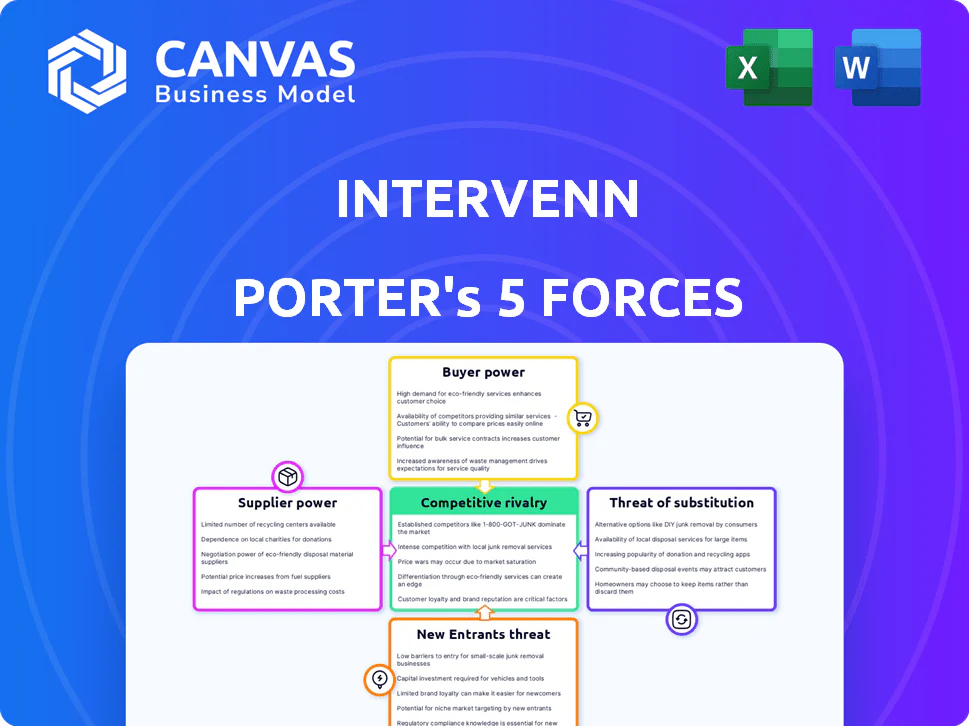
INTERVENN PORTER'S FIVE FORCES TEMPLATE RESEARCH
What is included in the product
 Detailed Word Document
Analyzes InterVenn's position, assessing competition, buyer power, and market entry risks.

 Customizable Excel Spreadsheet
Instantly visualize competitive dynamics with a dynamic score system for quick insights.
Full Version Awaits
InterVenn Porter's Five Forces Analysis
This InterVenn Porter's Five Forces analysis preview mirrors the complete document. The same detailed examination of industry forces awaits you. Upon purchase, this precise, ready-to-use file is immediately accessible. Expect thorough analysis of InterVenn's competitive landscape. Download and benefit from this comprehensive assessment instantly.

Porter's Five Forces Analysis Template

A Must-Have Tool for Decision-Makers
InterVenn's competitive landscape is shaped by forces like buyer power and the threat of substitutes. Analyzing these forces is key to understanding its market positioning. A look at supplier influence and new entrants provides crucial context for strategic planning. This snapshot reveals how InterVenn navigates its industry's pressures. Strategic advantages and challenges are unveiled through this framework. Actionable insights await to inform strategic decisions.
Ready to move beyond the basics? Get a full strategic breakdown of InterVenn’s market position, competitive intensity, and external threats—all in one powerful analysis.
Suppliers Bargaining Power

Specialized Technology and Reagents
InterVenn's AI-driven glycoproteomics relies on specialized tech. Suppliers of this tech, like mass spectrometers, hold power. High switching costs and few alternatives boost supplier leverage. In 2024, the market for mass spectrometry was valued at over $5.5 billion.
Availability of Expertise
InterVenn's reliance on expert talent, including glycoproteomics and bioinformatics specialists, strengthens the bargaining power of these individuals. The demand for these skills is high, with a 2024 average salary for bioinformaticians reaching $100,000-$150,000 annually, reflecting their value. This limited talent pool allows these "human suppliers" to negotiate better terms. The competition for such expertise is fierce, increasing their leverage.

Data and Biological Samples
InterVenn's reliance on suppliers of biological samples and data significantly impacts its operations. The bargaining power of these suppliers, including research institutions and biobanks, is considerable. This power is amplified by the uniqueness and exclusivity of the data. In 2024, the market for biological samples was valued at $1.9 billion, showing the significance of these resources. The more unique the data, the greater the supplier's leverage.

Software and AI Model Suppliers
InterVenn's reliance on software and AI model suppliers, even with its GlycoVision platform, introduces supplier power dynamics. The bargaining power of these suppliers hinges on factors like the uniqueness of their offerings and the availability of alternative solutions. For instance, the global cloud computing market, a key supplier area, was valued at $670.6 billion in 2024. Switching costs and the proprietary nature of certain AI algorithms can increase supplier power.
- Cloud computing market size in 2024: $670.6 billion.
- Proprietary algorithms can limit switching options.
- Availability of alternatives affects supplier power.
Dependency on Specific Service Providers
InterVenn's reliance on specialized service providers, like contract research organizations (CROs), significantly impacts its supplier bargaining power. These providers are critical for research, trials, and lab processes. If these providers have unique expertise or if the partnerships are deeply integrated, their leverage increases. For instance, the global CRO market was valued at $70.8 billion in 2023, and is projected to reach $107.3 billion by 2028, showing their growing influence. This dependence could lead to higher costs or less flexibility for InterVenn.
- CRO market size projected to reach $107.3 billion by 2028.
- InterVenn relies on specialized providers for key processes.
- Unique provider capabilities increase bargaining power.
- Deeply integrated partnerships can affect costs and flexibility.
Supplier Power Dynamics: A Deep Dive
InterVenn faces supplier power across tech, talent, data, software, and services. Specialized tech suppliers, like mass spectrometry vendors, hold leverage. The market for mass spectrometry was valued at over $5.5 billion in 2024.
Expert talent, including bioinformaticians, also wields power due to high demand. In 2024, bioinformatician salaries averaged $100,000-$150,000, showing their value. Biological sample and data suppliers further enhance this dynamic.
Software and AI model suppliers have power, too, particularly with proprietary tech. The cloud computing market was worth $670.6 billion in 2024. CROs also impact supplier power, projected at $107.3 billion by 2028.
| Supplier Type | Impact on InterVenn | 2024 Market Data |
|---|---|---|
| Mass Spectrometry | High switching costs | $5.5 billion |
| Bioinformaticians | Limited talent pool | $100,000-$150,000 (avg. salary) |
| Cloud Computing | Proprietary algorithms | $670.6 billion |
Customers Bargaining Power

Nature of Customers
InterVenn's customers span pharma, biotech, and healthcare. Their bargaining power differs; large pharma firms may wield more influence. For example, in 2024, the global pharmaceutical market reached approximately $1.5 trillion. Healthcare providers also influence pricing.
Impact on Customer Costs and Outcomes
InterVenn's technology strives to enhance diagnostics and treatment, aiming to lower healthcare costs through personalized medicine. If InterVenn's solutions prove effective in improving patient outcomes and reducing expenses, this could boost InterVenn's standing. This, in turn, might diminish the bargaining power of customers. In 2024, the personalized medicine market was valued at $169.2 billion, showing significant growth potential.

Availability of Alternative Solutions
Customers evaluate InterVenn's offerings against alternatives like traditional methods. The prevalence of these, such as ELISA and IHC, impacts customer choice. For example, in 2024, the global in-vitro diagnostics market reached $90.5 billion, offering many options. Effective alternatives increase customer bargaining power.

Customer Concentration
If a few major pharmaceutical companies or healthcare systems constitute a significant portion of InterVenn's revenue, these customers wield considerable bargaining power. This concentration allows them to negotiate favorable pricing and terms. For instance, in 2024, the top 5 pharmaceutical companies controlled over 30% of the global pharmaceutical market.
- Concentrated customer base increases customer power.
- Large customers can demand lower prices.
- Customer importance influences InterVenn's strategies.
- Loss of major customers significantly impacts revenue.
Switching Costs for Customers
The ease with which customers can switch to or from InterVenn's services significantly impacts their bargaining power. High switching costs, whether financial, technical, or related to staff training, will decrease customer power. Conversely, low switching costs empower customers, allowing them to easily move to competitors.
- InterVenn's technology adoption could involve substantial upfront investment in specialized equipment and software, increasing switching costs.
- Customers may need to allocate resources to train their staff on InterVenn's platforms.
- If competitors offer similar solutions with lower adoption hurdles, customer bargaining power increases.
- Data migration complexities can also elevate switching costs.
InterVenn's Customer Power: A Market Analysis
Customer bargaining power at InterVenn varies based on customer type and market dynamics. Large pharma companies and healthcare systems can exert significant influence, especially if they represent a substantial portion of InterVenn's revenue. The ease of switching to competitors also affects power dynamics. In 2024, the global healthcare market was over $10 trillion.
| Factor | Impact | 2024 Data |
|---|---|---|
| Customer Concentration | High concentration increases power. | Top 5 pharma firms control >30% of market. |
| Switching Costs | High costs decrease customer power. | IVD market was at $90.5 billion. |
| Alternative Solutions | Availability of alternatives increases power. | Personalized medicine market at $169.2B. |
Rivalry Among Competitors

Number and Capability of Competitors
InterVenn faces competition from diagnostics, personalized medicine, glycoproteomics, and AI in healthcare firms. The rivalry's intensity hinges on competitor numbers and capabilities, like their tech and market reach. The diagnostics market, for example, is projected to reach $108.5 billion by 2024. This indicates a robust, competitive environment.
Market Growth Rate
The personalized medicine and AI diagnostics markets are booming. The global AI in healthcare market was valued at $11.6 billion in 2023. Growth can lessen rivalry by creating space for many companies. However, rapid expansion may also draw more competitors, intensifying the battle for market share.

Differentiation of Offerings
InterVenn's focus on glycoproteomics and its AI platform differentiates it. The defensibility of this differentiation shapes rivalry intensity. If competitors offer similar solutions, rivalry intensifies. In 2024, the glycoproteomics market was valued at approximately $1.2 billion, reflecting potential competition.

Exit Barriers
High exit barriers in biotechnology and diagnostics, due to massive R&D investments and specialized infrastructure, intensify competition. Companies might fiercely compete even in tough times, boosting rivalry. For instance, in 2024, the average R&D spend for biotech firms was 20-30% of revenue. This commitment makes exiting costly.
- R&D costs typically range from $1 billion to $2 billion to bring a drug to market.
- Specialized equipment costs can be in the millions.
- Regulatory hurdles add to the high costs of exiting the market.
Industry Concentration
Industry concentration assesses the market's competitive landscape. A concentrated market, with a few dominant firms, might see less price competition. Conversely, a fragmented market with numerous smaller companies can intensify price wars. In 2024, the in-vitro diagnostics market, relevant to InterVenn, shows a mix, with larger players and emerging competitors. This balance influences rivalry dynamics significantly.
- Market concentration affects rivalry.
- Fragmented markets may see price wars.
- In-vitro diagnostics have a mixed landscape.
- Rivalry dynamics are impacted.
Diagnostics Market: Fierce Competition Ahead!
Competitive rivalry for InterVenn is shaped by market size and competition. The diagnostics market, worth $108.5B in 2024, shows strong competition. High R&D costs and specialized equipment, with R&D spending at 20-30% of revenue, intensify rivalry.
| Factor | Description | Impact on Rivalry |
|---|---|---|
| Market Size | Diagnostics market at $108.5B (2024) | High competition |
| R&D Costs | 20-30% of revenue spent on R&D | Intensifies competition |
| Market Concentration | Mixed, with big and emerging players | Influences price wars |
Original: $10.00
-65%$10.00
$3.50INTERVENN PORTER'S FIVE FORCES TEMPLATE RESEARCH
What is included in the product
Detailed Word Document
Analyzes InterVenn's position, assessing competition, buyer power, and market entry risks.
Customizable Excel Spreadsheet
Instantly visualize competitive dynamics with a dynamic score system for quick insights.
Full Version Awaits
InterVenn Porter's Five Forces Analysis
This InterVenn Porter's Five Forces analysis preview mirrors the complete document. The same detailed examination of industry forces awaits you. Upon purchase, this precise, ready-to-use file is immediately accessible. Expect thorough analysis of InterVenn's competitive landscape. Download and benefit from this comprehensive assessment instantly.
Porter's Five Forces Analysis Template
A Must-Have Tool for Decision-Makers
InterVenn's competitive landscape is shaped by forces like buyer power and the threat of substitutes. Analyzing these forces is key to understanding its market positioning. A look at supplier influence and new entrants provides crucial context for strategic planning. This snapshot reveals how InterVenn navigates its industry's pressures. Strategic advantages and challenges are unveiled through this framework. Actionable insights await to inform strategic decisions.
Ready to move beyond the basics? Get a full strategic breakdown of InterVenn’s market position, competitive intensity, and external threats—all in one powerful analysis.
Suppliers Bargaining Power
Specialized Technology and Reagents
InterVenn's AI-driven glycoproteomics relies on specialized tech. Suppliers of this tech, like mass spectrometers, hold power. High switching costs and few alternatives boost supplier leverage. In 2024, the market for mass spectrometry was valued at over $5.5 billion.
Availability of Expertise
InterVenn's reliance on expert talent, including glycoproteomics and bioinformatics specialists, strengthens the bargaining power of these individuals. The demand for these skills is high, with a 2024 average salary for bioinformaticians reaching $100,000-$150,000 annually, reflecting their value. This limited talent pool allows these "human suppliers" to negotiate better terms. The competition for such expertise is fierce, increasing their leverage.
Data and Biological Samples
InterVenn's reliance on suppliers of biological samples and data significantly impacts its operations. The bargaining power of these suppliers, including research institutions and biobanks, is considerable. This power is amplified by the uniqueness and exclusivity of the data. In 2024, the market for biological samples was valued at $1.9 billion, showing the significance of these resources. The more unique the data, the greater the supplier's leverage.
Software and AI Model Suppliers
InterVenn's reliance on software and AI model suppliers, even with its GlycoVision platform, introduces supplier power dynamics. The bargaining power of these suppliers hinges on factors like the uniqueness of their offerings and the availability of alternative solutions. For instance, the global cloud computing market, a key supplier area, was valued at $670.6 billion in 2024. Switching costs and the proprietary nature of certain AI algorithms can increase supplier power.
- Cloud computing market size in 2024: $670.6 billion.
- Proprietary algorithms can limit switching options.
- Availability of alternatives affects supplier power.
Dependency on Specific Service Providers
InterVenn's reliance on specialized service providers, like contract research organizations (CROs), significantly impacts its supplier bargaining power. These providers are critical for research, trials, and lab processes. If these providers have unique expertise or if the partnerships are deeply integrated, their leverage increases. For instance, the global CRO market was valued at $70.8 billion in 2023, and is projected to reach $107.3 billion by 2028, showing their growing influence. This dependence could lead to higher costs or less flexibility for InterVenn.
- CRO market size projected to reach $107.3 billion by 2028.
- InterVenn relies on specialized providers for key processes.
- Unique provider capabilities increase bargaining power.
- Deeply integrated partnerships can affect costs and flexibility.
Supplier Power Dynamics: A Deep Dive
InterVenn faces supplier power across tech, talent, data, software, and services. Specialized tech suppliers, like mass spectrometry vendors, hold leverage. The market for mass spectrometry was valued at over $5.5 billion in 2024.
Expert talent, including bioinformaticians, also wields power due to high demand. In 2024, bioinformatician salaries averaged $100,000-$150,000, showing their value. Biological sample and data suppliers further enhance this dynamic.
Software and AI model suppliers have power, too, particularly with proprietary tech. The cloud computing market was worth $670.6 billion in 2024. CROs also impact supplier power, projected at $107.3 billion by 2028.
| Supplier Type | Impact on InterVenn | 2024 Market Data |
|---|---|---|
| Mass Spectrometry | High switching costs | $5.5 billion |
| Bioinformaticians | Limited talent pool | $100,000-$150,000 (avg. salary) |
| Cloud Computing | Proprietary algorithms | $670.6 billion |
Customers Bargaining Power
Nature of Customers
InterVenn's customers span pharma, biotech, and healthcare. Their bargaining power differs; large pharma firms may wield more influence. For example, in 2024, the global pharmaceutical market reached approximately $1.5 trillion. Healthcare providers also influence pricing.
Impact on Customer Costs and Outcomes
InterVenn's technology strives to enhance diagnostics and treatment, aiming to lower healthcare costs through personalized medicine. If InterVenn's solutions prove effective in improving patient outcomes and reducing expenses, this could boost InterVenn's standing. This, in turn, might diminish the bargaining power of customers. In 2024, the personalized medicine market was valued at $169.2 billion, showing significant growth potential.
Availability of Alternative Solutions
Customers evaluate InterVenn's offerings against alternatives like traditional methods. The prevalence of these, such as ELISA and IHC, impacts customer choice. For example, in 2024, the global in-vitro diagnostics market reached $90.5 billion, offering many options. Effective alternatives increase customer bargaining power.
Customer Concentration
If a few major pharmaceutical companies or healthcare systems constitute a significant portion of InterVenn's revenue, these customers wield considerable bargaining power. This concentration allows them to negotiate favorable pricing and terms. For instance, in 2024, the top 5 pharmaceutical companies controlled over 30% of the global pharmaceutical market.
- Concentrated customer base increases customer power.
- Large customers can demand lower prices.
- Customer importance influences InterVenn's strategies.
- Loss of major customers significantly impacts revenue.
Switching Costs for Customers
The ease with which customers can switch to or from InterVenn's services significantly impacts their bargaining power. High switching costs, whether financial, technical, or related to staff training, will decrease customer power. Conversely, low switching costs empower customers, allowing them to easily move to competitors.
- InterVenn's technology adoption could involve substantial upfront investment in specialized equipment and software, increasing switching costs.
- Customers may need to allocate resources to train their staff on InterVenn's platforms.
- If competitors offer similar solutions with lower adoption hurdles, customer bargaining power increases.
- Data migration complexities can also elevate switching costs.
InterVenn's Customer Power: A Market Analysis
Customer bargaining power at InterVenn varies based on customer type and market dynamics. Large pharma companies and healthcare systems can exert significant influence, especially if they represent a substantial portion of InterVenn's revenue. The ease of switching to competitors also affects power dynamics. In 2024, the global healthcare market was over $10 trillion.
| Factor | Impact | 2024 Data |
|---|---|---|
| Customer Concentration | High concentration increases power. | Top 5 pharma firms control >30% of market. |
| Switching Costs | High costs decrease customer power. | IVD market was at $90.5 billion. |
| Alternative Solutions | Availability of alternatives increases power. | Personalized medicine market at $169.2B. |
Rivalry Among Competitors
Number and Capability of Competitors
InterVenn faces competition from diagnostics, personalized medicine, glycoproteomics, and AI in healthcare firms. The rivalry's intensity hinges on competitor numbers and capabilities, like their tech and market reach. The diagnostics market, for example, is projected to reach $108.5 billion by 2024. This indicates a robust, competitive environment.
Market Growth Rate
The personalized medicine and AI diagnostics markets are booming. The global AI in healthcare market was valued at $11.6 billion in 2023. Growth can lessen rivalry by creating space for many companies. However, rapid expansion may also draw more competitors, intensifying the battle for market share.
Differentiation of Offerings
InterVenn's focus on glycoproteomics and its AI platform differentiates it. The defensibility of this differentiation shapes rivalry intensity. If competitors offer similar solutions, rivalry intensifies. In 2024, the glycoproteomics market was valued at approximately $1.2 billion, reflecting potential competition.
Exit Barriers
High exit barriers in biotechnology and diagnostics, due to massive R&D investments and specialized infrastructure, intensify competition. Companies might fiercely compete even in tough times, boosting rivalry. For instance, in 2024, the average R&D spend for biotech firms was 20-30% of revenue. This commitment makes exiting costly.
- R&D costs typically range from $1 billion to $2 billion to bring a drug to market.
- Specialized equipment costs can be in the millions.
- Regulatory hurdles add to the high costs of exiting the market.
Industry Concentration
Industry concentration assesses the market's competitive landscape. A concentrated market, with a few dominant firms, might see less price competition. Conversely, a fragmented market with numerous smaller companies can intensify price wars. In 2024, the in-vitro diagnostics market, relevant to InterVenn, shows a mix, with larger players and emerging competitors. This balance influences rivalry dynamics significantly.
- Market concentration affects rivalry.
- Fragmented markets may see price wars.
- In-vitro diagnostics have a mixed landscape.
- Rivalry dynamics are impacted.
Diagnostics Market: Fierce Competition Ahead!
Competitive rivalry for InterVenn is shaped by market size and competition. The diagnostics market, worth $108.5B in 2024, shows strong competition. High R&D costs and specialized equipment, with R&D spending at 20-30% of revenue, intensify rivalry.
| Factor | Description | Impact on Rivalry |
|---|---|---|
| Market Size | Diagnostics market at $108.5B (2024) | High competition |
| R&D Costs | 20-30% of revenue spent on R&D | Intensifies competition |
| Market Concentration | Mixed, with big and emerging players | Influences price wars |
Product Information
Product Information
Shipping & Returns
Shipping & Returns
Description
What is included in the product
Detailed Word Document
Analyzes InterVenn's position, assessing competition, buyer power, and market entry risks.
Customizable Excel Spreadsheet
Instantly visualize competitive dynamics with a dynamic score system for quick insights.
Full Version Awaits
InterVenn Porter's Five Forces Analysis
This InterVenn Porter's Five Forces analysis preview mirrors the complete document. The same detailed examination of industry forces awaits you. Upon purchase, this precise, ready-to-use file is immediately accessible. Expect thorough analysis of InterVenn's competitive landscape. Download and benefit from this comprehensive assessment instantly.
Porter's Five Forces Analysis Template
A Must-Have Tool for Decision-Makers
InterVenn's competitive landscape is shaped by forces like buyer power and the threat of substitutes. Analyzing these forces is key to understanding its market positioning. A look at supplier influence and new entrants provides crucial context for strategic planning. This snapshot reveals how InterVenn navigates its industry's pressures. Strategic advantages and challenges are unveiled through this framework. Actionable insights await to inform strategic decisions.
Ready to move beyond the basics? Get a full strategic breakdown of InterVenn’s market position, competitive intensity, and external threats—all in one powerful analysis.
Suppliers Bargaining Power
Specialized Technology and Reagents
InterVenn's AI-driven glycoproteomics relies on specialized tech. Suppliers of this tech, like mass spectrometers, hold power. High switching costs and few alternatives boost supplier leverage. In 2024, the market for mass spectrometry was valued at over $5.5 billion.
Availability of Expertise
InterVenn's reliance on expert talent, including glycoproteomics and bioinformatics specialists, strengthens the bargaining power of these individuals. The demand for these skills is high, with a 2024 average salary for bioinformaticians reaching $100,000-$150,000 annually, reflecting their value. This limited talent pool allows these "human suppliers" to negotiate better terms. The competition for such expertise is fierce, increasing their leverage.
Data and Biological Samples
InterVenn's reliance on suppliers of biological samples and data significantly impacts its operations. The bargaining power of these suppliers, including research institutions and biobanks, is considerable. This power is amplified by the uniqueness and exclusivity of the data. In 2024, the market for biological samples was valued at $1.9 billion, showing the significance of these resources. The more unique the data, the greater the supplier's leverage.
Software and AI Model Suppliers
InterVenn's reliance on software and AI model suppliers, even with its GlycoVision platform, introduces supplier power dynamics. The bargaining power of these suppliers hinges on factors like the uniqueness of their offerings and the availability of alternative solutions. For instance, the global cloud computing market, a key supplier area, was valued at $670.6 billion in 2024. Switching costs and the proprietary nature of certain AI algorithms can increase supplier power.
- Cloud computing market size in 2024: $670.6 billion.
- Proprietary algorithms can limit switching options.
- Availability of alternatives affects supplier power.
Dependency on Specific Service Providers
InterVenn's reliance on specialized service providers, like contract research organizations (CROs), significantly impacts its supplier bargaining power. These providers are critical for research, trials, and lab processes. If these providers have unique expertise or if the partnerships are deeply integrated, their leverage increases. For instance, the global CRO market was valued at $70.8 billion in 2023, and is projected to reach $107.3 billion by 2028, showing their growing influence. This dependence could lead to higher costs or less flexibility for InterVenn.
- CRO market size projected to reach $107.3 billion by 2028.
- InterVenn relies on specialized providers for key processes.
- Unique provider capabilities increase bargaining power.
- Deeply integrated partnerships can affect costs and flexibility.
Supplier Power Dynamics: A Deep Dive
InterVenn faces supplier power across tech, talent, data, software, and services. Specialized tech suppliers, like mass spectrometry vendors, hold leverage. The market for mass spectrometry was valued at over $5.5 billion in 2024.
Expert talent, including bioinformaticians, also wields power due to high demand. In 2024, bioinformatician salaries averaged $100,000-$150,000, showing their value. Biological sample and data suppliers further enhance this dynamic.
Software and AI model suppliers have power, too, particularly with proprietary tech. The cloud computing market was worth $670.6 billion in 2024. CROs also impact supplier power, projected at $107.3 billion by 2028.
| Supplier Type | Impact on InterVenn | 2024 Market Data |
|---|---|---|
| Mass Spectrometry | High switching costs | $5.5 billion |
| Bioinformaticians | Limited talent pool | $100,000-$150,000 (avg. salary) |
| Cloud Computing | Proprietary algorithms | $670.6 billion |
Customers Bargaining Power
Nature of Customers
InterVenn's customers span pharma, biotech, and healthcare. Their bargaining power differs; large pharma firms may wield more influence. For example, in 2024, the global pharmaceutical market reached approximately $1.5 trillion. Healthcare providers also influence pricing.
Impact on Customer Costs and Outcomes
InterVenn's technology strives to enhance diagnostics and treatment, aiming to lower healthcare costs through personalized medicine. If InterVenn's solutions prove effective in improving patient outcomes and reducing expenses, this could boost InterVenn's standing. This, in turn, might diminish the bargaining power of customers. In 2024, the personalized medicine market was valued at $169.2 billion, showing significant growth potential.
Availability of Alternative Solutions
Customers evaluate InterVenn's offerings against alternatives like traditional methods. The prevalence of these, such as ELISA and IHC, impacts customer choice. For example, in 2024, the global in-vitro diagnostics market reached $90.5 billion, offering many options. Effective alternatives increase customer bargaining power.
Customer Concentration
If a few major pharmaceutical companies or healthcare systems constitute a significant portion of InterVenn's revenue, these customers wield considerable bargaining power. This concentration allows them to negotiate favorable pricing and terms. For instance, in 2024, the top 5 pharmaceutical companies controlled over 30% of the global pharmaceutical market.
- Concentrated customer base increases customer power.
- Large customers can demand lower prices.
- Customer importance influences InterVenn's strategies.
- Loss of major customers significantly impacts revenue.
Switching Costs for Customers
The ease with which customers can switch to or from InterVenn's services significantly impacts their bargaining power. High switching costs, whether financial, technical, or related to staff training, will decrease customer power. Conversely, low switching costs empower customers, allowing them to easily move to competitors.
- InterVenn's technology adoption could involve substantial upfront investment in specialized equipment and software, increasing switching costs.
- Customers may need to allocate resources to train their staff on InterVenn's platforms.
- If competitors offer similar solutions with lower adoption hurdles, customer bargaining power increases.
- Data migration complexities can also elevate switching costs.
InterVenn's Customer Power: A Market Analysis
Customer bargaining power at InterVenn varies based on customer type and market dynamics. Large pharma companies and healthcare systems can exert significant influence, especially if they represent a substantial portion of InterVenn's revenue. The ease of switching to competitors also affects power dynamics. In 2024, the global healthcare market was over $10 trillion.
| Factor | Impact | 2024 Data |
|---|---|---|
| Customer Concentration | High concentration increases power. | Top 5 pharma firms control >30% of market. |
| Switching Costs | High costs decrease customer power. | IVD market was at $90.5 billion. |
| Alternative Solutions | Availability of alternatives increases power. | Personalized medicine market at $169.2B. |
Rivalry Among Competitors
Number and Capability of Competitors
InterVenn faces competition from diagnostics, personalized medicine, glycoproteomics, and AI in healthcare firms. The rivalry's intensity hinges on competitor numbers and capabilities, like their tech and market reach. The diagnostics market, for example, is projected to reach $108.5 billion by 2024. This indicates a robust, competitive environment.
Market Growth Rate
The personalized medicine and AI diagnostics markets are booming. The global AI in healthcare market was valued at $11.6 billion in 2023. Growth can lessen rivalry by creating space for many companies. However, rapid expansion may also draw more competitors, intensifying the battle for market share.
Differentiation of Offerings
InterVenn's focus on glycoproteomics and its AI platform differentiates it. The defensibility of this differentiation shapes rivalry intensity. If competitors offer similar solutions, rivalry intensifies. In 2024, the glycoproteomics market was valued at approximately $1.2 billion, reflecting potential competition.
Exit Barriers
High exit barriers in biotechnology and diagnostics, due to massive R&D investments and specialized infrastructure, intensify competition. Companies might fiercely compete even in tough times, boosting rivalry. For instance, in 2024, the average R&D spend for biotech firms was 20-30% of revenue. This commitment makes exiting costly.
- R&D costs typically range from $1 billion to $2 billion to bring a drug to market.
- Specialized equipment costs can be in the millions.
- Regulatory hurdles add to the high costs of exiting the market.
Industry Concentration
Industry concentration assesses the market's competitive landscape. A concentrated market, with a few dominant firms, might see less price competition. Conversely, a fragmented market with numerous smaller companies can intensify price wars. In 2024, the in-vitro diagnostics market, relevant to InterVenn, shows a mix, with larger players and emerging competitors. This balance influences rivalry dynamics significantly.
- Market concentration affects rivalry.
- Fragmented markets may see price wars.
- In-vitro diagnostics have a mixed landscape.
- Rivalry dynamics are impacted.
Diagnostics Market: Fierce Competition Ahead!
Competitive rivalry for InterVenn is shaped by market size and competition. The diagnostics market, worth $108.5B in 2024, shows strong competition. High R&D costs and specialized equipment, with R&D spending at 20-30% of revenue, intensify rivalry.
| Factor | Description | Impact on Rivalry |
|---|---|---|
| Market Size | Diagnostics market at $108.5B (2024) | High competition |
| R&D Costs | 20-30% of revenue spent on R&D | Intensifies competition |
| Market Concentration | Mixed, with big and emerging players | Influences price wars |











