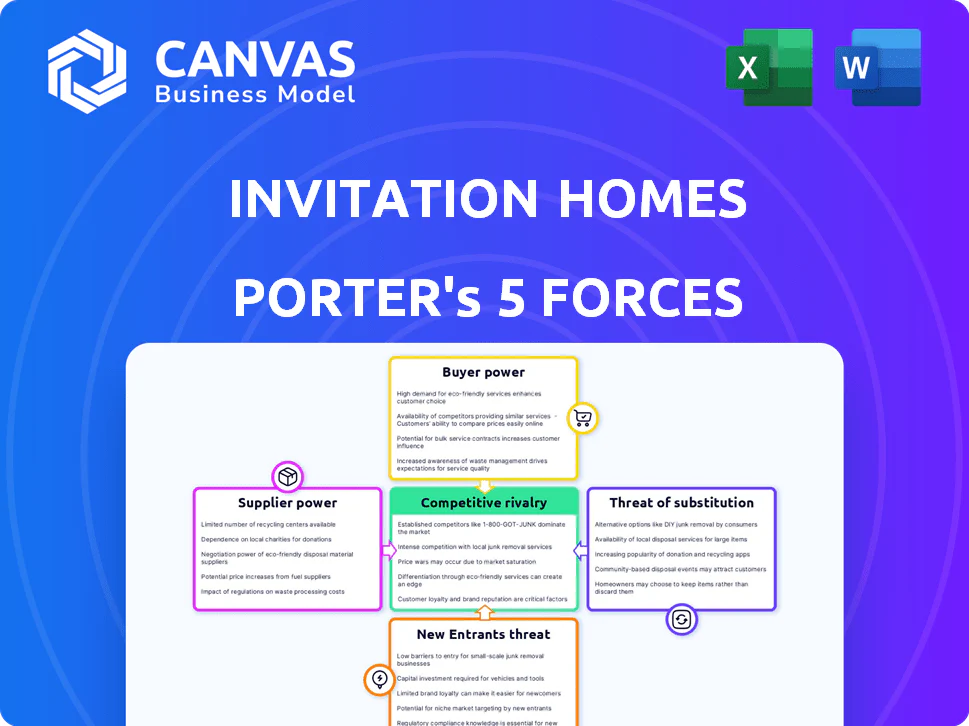
INVITATION HOMES PORTER'S FIVE FORCES TEMPLATE RESEARCH
What is included in the product
 Detailed Word Document
Analyzes Invitation Homes' position by exploring market dynamics that deter new entrants.

 Customizable Excel Spreadsheet
Instantly spot competitive threats with a dynamic force level assessment.
Full Version Awaits
Invitation Homes Porter's Five Forces Analysis
This preview presents Invitation Homes' Porter's Five Forces Analysis. The document showcases a comprehensive examination of industry competition. It delves into bargaining power, threats, and rivalry within the sector. You’ll receive this complete, ready-to-use file after purchase.

Porter's Five Forces Analysis Template

Go Beyond the Preview—Access the Full Strategic Report
Invitation Homes operates in a market defined by specific competitive forces. Buyer power stems from the availability of alternative rentals and shifting tenant preferences. The threat of new entrants is moderate due to capital requirements and market consolidation. Competitive rivalry is high among established single-family rental companies. Substitute threats are present from homeownership and other housing options. Supplier power, primarily from property maintenance providers, is relatively low.
The complete report reveals the real forces shaping Invitation Homes’s industry—from supplier influence to threat of new entrants. Gain actionable insights to drive smarter decision-making.
Suppliers Bargaining Power

Limited number of major suppliers for renovation materials.
Invitation Homes depends on suppliers for renovation and maintenance materials. The building materials market is concentrated, with Home Depot and Lowe's as major players. This concentration gives suppliers some power over pricing and terms. In 2024, Home Depot's revenue was about $152 billion, indicating significant market influence.
Labor shortages in skilled trades.
Labor shortages in skilled trades pose a challenge for Invitation Homes. The availability and cost of skilled labor, crucial for renovations and maintenance, directly affect Invitation Homes' expenses. A scarcity of skilled workers strengthens their bargaining power. For example, the U.S. construction industry faced a skilled labor shortage in 2024, potentially increasing labor costs. This could impact Invitation Homes' profit margins.

Availability and cost of properties for acquisition.
Invitation Homes primarily sources properties from the single-family home market. Competition with other investors and homebuyers affects acquisition costs. In 2024, the median existing-home sales price was around $387,600, indicating market dynamics. Property availability fluctuates with economic cycles and housing market trends.

Relationships with homebuilders.
Invitation Homes' strategy includes acquiring homes directly from builders. This approach leverages strong relationships with numerous homebuilders, reducing dependence on any single entity. Such diversification is crucial in managing supplier power. This strategy is reflected in Invitation Homes' financial performance.
- In 2024, Invitation Homes acquired a substantial number of homes directly from builders.
- These acquisitions helped Invitation Homes maintain a diverse portfolio.
- The company's relationships with top-tier builders are key assets.
Technology and software providers.
Invitation Homes depends on technology and software for its operations. This includes property management systems, resident screening tools, and various operational platforms. Although the market features many technology providers, the firm's reliance on specific platforms could give these suppliers some bargaining power. For example, in 2024, the property technology market reached $18.2 billion, showing the industry's significance.
- Property management systems are crucial for daily operations.
- Resident screening tools are used to assess potential tenants.
- Operational platforms support maintenance and other services.
- The PropTech market is valued at billions, showing its importance.
Real Estate's Cost Crossroads: Suppliers & Tech
Invitation Homes faces supplier power from concentrated building materials and skilled labor shortages. Home Depot's $152B revenue in 2024 highlights supplier influence. Labor scarcity and reliance on PropTech, valued at $18.2B in 2024, also affect costs.
| Supplier Type | Impact | 2024 Data |
|---|---|---|
| Building Materials | Moderate | Home Depot Revenue: $152B |
| Skilled Labor | High | Construction Labor Shortages |
| Technology | Moderate | PropTech Market: $18.2B |
Customers Bargaining Power

Availability of alternative housing options.
Invitation Homes' tenants can choose from many alternatives, like apartments and other rentals. This competition keeps a lid on how much Invitation Homes can charge for rent. In 2024, the U.S. rental vacancy rate was around 6.3%, showing plenty of options. This high availability of alternatives gives renters leverage.
Relatively low switching costs for renters.
Switching costs for renters are generally low. Tenants can often move with limited financial hurdles. This gives renters leverage if they are unhappy with their current situation. In 2024, the average renter turnover rate in the U.S. was approximately 40%. This indicates a significant degree of mobility and choice for renters.

Fragmented customer base.
Invitation Homes' vast customer base, comprising individual renters like families and young professionals, is highly fragmented. This dispersion diminishes the ability of any single renter or group of renters to significantly influence pricing or terms. For example, in 2024, Invitation Homes managed over 80,000 properties across 16 markets, each with numerous individual lease agreements, effectively preventing a unified customer front.

Importance of location and specific property features.
Tenants' bargaining power can hinge on location and property features. A desirable location or unique features can reduce a tenant's ability to negotiate. For instance, if a property is near top-rated schools, demand and tenant power dynamics shift. Invitation Homes can leverage this by highlighting these aspects. In 2024, properties near high-performing schools or in prime urban areas often command higher rents.
- Location Premium: Properties in highly desirable locations (e.g., near top schools or in vibrant urban centers) often command higher rents and have lower vacancy rates.
- Feature-Specific Demand: Homes with unique or highly sought-after features (e.g., updated kitchens, private yards, or smart home tech) may experience higher tenant demand.
- Supply and Demand: The balance of available rental properties in specific areas directly impacts tenant bargaining power, with lower supply often leading to less negotiation room.
- Market Data: According to 2024 reports, properties in desirable locations can see rent premiums of 10-20% compared to similar homes in less-sought-after areas.
Information availability to tenants.
Tenants now have more leverage thanks to readily available online resources. Platforms like Zillow and Apartments.com offer detailed insights into rental prices and property availability across various locations. This increased transparency allows tenants to easily compare options and negotiate more effectively. In 2024, the average rent increased by 3% in the United States, making informed decisions even more critical for renters.
- Online platforms provide extensive market data.
- Tenants can compare prices and amenities.
- Increased awareness enhances negotiation power.
- Renters can find better deals.
Tenant Power: Navigating the Rental Market
Tenants have considerable bargaining power due to rental alternatives and low switching costs. The U.S. rental vacancy rate in 2024 was 6.3%, offering many choices. Online resources enhance tenants' ability to compare and negotiate.
| Factor | Impact | 2024 Data |
|---|---|---|
| Vacancy Rate | Availability of Alternatives | 6.3% |
| Turnover Rate | Tenant Mobility | 40% |
| Rent Increase | Market Pressure | 3% |
Rivalry Among Competitors

Presence of other large single-family rental companies.
Invitation Homes faces intense competition from other major single-family rental companies. American Homes 4 Rent is a key competitor. These large entities vie for properties and tenants, driving up costs. The market share is highly competitive. In 2024, the top 5 single-family rental REITs controlled a significant portion of the market.
Competition from smaller landlords and property owners.
The single-family rental market faces competition from numerous smaller landlords and individual property owners. This fragmented sector intensifies competitive dynamics. These landlords, managing fewer properties, can offer more personalized services. In 2024, this segment controlled a significant portion of the market share, fostering robust rivalry. The presence of these smaller players impacts pricing and operational strategies.

Competition for property acquisitions.
Invitation Homes faces stiff competition from institutional investors and individual buyers in acquiring single-family homes. This rivalry intensifies in high-demand markets, pushing prices upward. In 2024, the median existing home price in the U.S. reached $387,600, reflecting this competitive pressure. Increased competition can reduce Invitation Homes' profit margins. The competition includes companies like American Homes 4 Rent.

Differentiation through services and technology.
Competitive rivalry in the single-family rental market sees companies like Invitation Homes differentiating themselves through services and technology. They compete on property quality, maintenance, and resident experience. Technological integration, such as online portals for rent payment and maintenance requests, improves the resident experience. This focus helps attract and retain tenants, particularly in a market where the national average rent for single-family homes was around $2,200 in late 2024.
- Technology-driven services enhance resident satisfaction.
- Property quality and maintenance are key differentiators.
- Online platforms streamline tenant interactions.
- Competition includes companies like American Homes 4 Rent.
Market concentration in specific geographic areas.
Competitive rivalry within Invitation Homes is influenced by market concentration, especially in specific geographic areas. While national competition exists, the intensity varies by metropolitan area, dictated by the presence and size of other single-family rental owners. For instance, in 2024, Invitation Homes held a significant market share in several Sun Belt cities. However, this share is lower in areas with robust local competitors. This local competition affects pricing and occupancy rates.
- Market concentration varies geographically, impacting competition intensity.
- Invitation Homes faces localized competition in many metropolitan areas.
- Competition influences pricing strategies and occupancy levels.
- The Sun Belt region experienced high competition in 2024.
Single-Family Rentals: Market Dynamics in 2024
Competition in the single-family rental market is fierce, with major players like Invitation Homes battling for market share. These companies differentiate themselves through technology and services, impacting resident satisfaction. Smaller landlords also intensify the competition. In 2024, the top 5 REITs controlled a significant portion of the market.
| Aspect | Details | 2024 Data |
|---|---|---|
| Market Share | Top REITs | Significant |
| Median Home Price | U.S. | $387,600 |
| Avg. Rent (Single-family) | National | $2,200 |
Original: $10.00
-65%$10.00
$3.50INVITATION HOMES PORTER'S FIVE FORCES TEMPLATE RESEARCH
What is included in the product
Detailed Word Document
Analyzes Invitation Homes' position by exploring market dynamics that deter new entrants.
Customizable Excel Spreadsheet
Instantly spot competitive threats with a dynamic force level assessment.
Full Version Awaits
Invitation Homes Porter's Five Forces Analysis
This preview presents Invitation Homes' Porter's Five Forces Analysis. The document showcases a comprehensive examination of industry competition. It delves into bargaining power, threats, and rivalry within the sector. You’ll receive this complete, ready-to-use file after purchase.
Porter's Five Forces Analysis Template
Go Beyond the Preview—Access the Full Strategic Report
Invitation Homes operates in a market defined by specific competitive forces. Buyer power stems from the availability of alternative rentals and shifting tenant preferences. The threat of new entrants is moderate due to capital requirements and market consolidation. Competitive rivalry is high among established single-family rental companies. Substitute threats are present from homeownership and other housing options. Supplier power, primarily from property maintenance providers, is relatively low.
The complete report reveals the real forces shaping Invitation Homes’s industry—from supplier influence to threat of new entrants. Gain actionable insights to drive smarter decision-making.
Suppliers Bargaining Power
Limited number of major suppliers for renovation materials.
Invitation Homes depends on suppliers for renovation and maintenance materials. The building materials market is concentrated, with Home Depot and Lowe's as major players. This concentration gives suppliers some power over pricing and terms. In 2024, Home Depot's revenue was about $152 billion, indicating significant market influence.
Labor shortages in skilled trades.
Labor shortages in skilled trades pose a challenge for Invitation Homes. The availability and cost of skilled labor, crucial for renovations and maintenance, directly affect Invitation Homes' expenses. A scarcity of skilled workers strengthens their bargaining power. For example, the U.S. construction industry faced a skilled labor shortage in 2024, potentially increasing labor costs. This could impact Invitation Homes' profit margins.
Availability and cost of properties for acquisition.
Invitation Homes primarily sources properties from the single-family home market. Competition with other investors and homebuyers affects acquisition costs. In 2024, the median existing-home sales price was around $387,600, indicating market dynamics. Property availability fluctuates with economic cycles and housing market trends.
Relationships with homebuilders.
Invitation Homes' strategy includes acquiring homes directly from builders. This approach leverages strong relationships with numerous homebuilders, reducing dependence on any single entity. Such diversification is crucial in managing supplier power. This strategy is reflected in Invitation Homes' financial performance.
- In 2024, Invitation Homes acquired a substantial number of homes directly from builders.
- These acquisitions helped Invitation Homes maintain a diverse portfolio.
- The company's relationships with top-tier builders are key assets.
Technology and software providers.
Invitation Homes depends on technology and software for its operations. This includes property management systems, resident screening tools, and various operational platforms. Although the market features many technology providers, the firm's reliance on specific platforms could give these suppliers some bargaining power. For example, in 2024, the property technology market reached $18.2 billion, showing the industry's significance.
- Property management systems are crucial for daily operations.
- Resident screening tools are used to assess potential tenants.
- Operational platforms support maintenance and other services.
- The PropTech market is valued at billions, showing its importance.
Real Estate's Cost Crossroads: Suppliers & Tech
Invitation Homes faces supplier power from concentrated building materials and skilled labor shortages. Home Depot's $152B revenue in 2024 highlights supplier influence. Labor scarcity and reliance on PropTech, valued at $18.2B in 2024, also affect costs.
| Supplier Type | Impact | 2024 Data |
|---|---|---|
| Building Materials | Moderate | Home Depot Revenue: $152B |
| Skilled Labor | High | Construction Labor Shortages |
| Technology | Moderate | PropTech Market: $18.2B |
Customers Bargaining Power
Availability of alternative housing options.
Invitation Homes' tenants can choose from many alternatives, like apartments and other rentals. This competition keeps a lid on how much Invitation Homes can charge for rent. In 2024, the U.S. rental vacancy rate was around 6.3%, showing plenty of options. This high availability of alternatives gives renters leverage.
Relatively low switching costs for renters.
Switching costs for renters are generally low. Tenants can often move with limited financial hurdles. This gives renters leverage if they are unhappy with their current situation. In 2024, the average renter turnover rate in the U.S. was approximately 40%. This indicates a significant degree of mobility and choice for renters.
Fragmented customer base.
Invitation Homes' vast customer base, comprising individual renters like families and young professionals, is highly fragmented. This dispersion diminishes the ability of any single renter or group of renters to significantly influence pricing or terms. For example, in 2024, Invitation Homes managed over 80,000 properties across 16 markets, each with numerous individual lease agreements, effectively preventing a unified customer front.
Importance of location and specific property features.
Tenants' bargaining power can hinge on location and property features. A desirable location or unique features can reduce a tenant's ability to negotiate. For instance, if a property is near top-rated schools, demand and tenant power dynamics shift. Invitation Homes can leverage this by highlighting these aspects. In 2024, properties near high-performing schools or in prime urban areas often command higher rents.
- Location Premium: Properties in highly desirable locations (e.g., near top schools or in vibrant urban centers) often command higher rents and have lower vacancy rates.
- Feature-Specific Demand: Homes with unique or highly sought-after features (e.g., updated kitchens, private yards, or smart home tech) may experience higher tenant demand.
- Supply and Demand: The balance of available rental properties in specific areas directly impacts tenant bargaining power, with lower supply often leading to less negotiation room.
- Market Data: According to 2024 reports, properties in desirable locations can see rent premiums of 10-20% compared to similar homes in less-sought-after areas.
Information availability to tenants.
Tenants now have more leverage thanks to readily available online resources. Platforms like Zillow and Apartments.com offer detailed insights into rental prices and property availability across various locations. This increased transparency allows tenants to easily compare options and negotiate more effectively. In 2024, the average rent increased by 3% in the United States, making informed decisions even more critical for renters.
- Online platforms provide extensive market data.
- Tenants can compare prices and amenities.
- Increased awareness enhances negotiation power.
- Renters can find better deals.
Tenant Power: Navigating the Rental Market
Tenants have considerable bargaining power due to rental alternatives and low switching costs. The U.S. rental vacancy rate in 2024 was 6.3%, offering many choices. Online resources enhance tenants' ability to compare and negotiate.
| Factor | Impact | 2024 Data |
|---|---|---|
| Vacancy Rate | Availability of Alternatives | 6.3% |
| Turnover Rate | Tenant Mobility | 40% |
| Rent Increase | Market Pressure | 3% |
Rivalry Among Competitors
Presence of other large single-family rental companies.
Invitation Homes faces intense competition from other major single-family rental companies. American Homes 4 Rent is a key competitor. These large entities vie for properties and tenants, driving up costs. The market share is highly competitive. In 2024, the top 5 single-family rental REITs controlled a significant portion of the market.
Competition from smaller landlords and property owners.
The single-family rental market faces competition from numerous smaller landlords and individual property owners. This fragmented sector intensifies competitive dynamics. These landlords, managing fewer properties, can offer more personalized services. In 2024, this segment controlled a significant portion of the market share, fostering robust rivalry. The presence of these smaller players impacts pricing and operational strategies.
Competition for property acquisitions.
Invitation Homes faces stiff competition from institutional investors and individual buyers in acquiring single-family homes. This rivalry intensifies in high-demand markets, pushing prices upward. In 2024, the median existing home price in the U.S. reached $387,600, reflecting this competitive pressure. Increased competition can reduce Invitation Homes' profit margins. The competition includes companies like American Homes 4 Rent.
Differentiation through services and technology.
Competitive rivalry in the single-family rental market sees companies like Invitation Homes differentiating themselves through services and technology. They compete on property quality, maintenance, and resident experience. Technological integration, such as online portals for rent payment and maintenance requests, improves the resident experience. This focus helps attract and retain tenants, particularly in a market where the national average rent for single-family homes was around $2,200 in late 2024.
- Technology-driven services enhance resident satisfaction.
- Property quality and maintenance are key differentiators.
- Online platforms streamline tenant interactions.
- Competition includes companies like American Homes 4 Rent.
Market concentration in specific geographic areas.
Competitive rivalry within Invitation Homes is influenced by market concentration, especially in specific geographic areas. While national competition exists, the intensity varies by metropolitan area, dictated by the presence and size of other single-family rental owners. For instance, in 2024, Invitation Homes held a significant market share in several Sun Belt cities. However, this share is lower in areas with robust local competitors. This local competition affects pricing and occupancy rates.
- Market concentration varies geographically, impacting competition intensity.
- Invitation Homes faces localized competition in many metropolitan areas.
- Competition influences pricing strategies and occupancy levels.
- The Sun Belt region experienced high competition in 2024.
Single-Family Rentals: Market Dynamics in 2024
Competition in the single-family rental market is fierce, with major players like Invitation Homes battling for market share. These companies differentiate themselves through technology and services, impacting resident satisfaction. Smaller landlords also intensify the competition. In 2024, the top 5 REITs controlled a significant portion of the market.
| Aspect | Details | 2024 Data |
|---|---|---|
| Market Share | Top REITs | Significant |
| Median Home Price | U.S. | $387,600 |
| Avg. Rent (Single-family) | National | $2,200 |
Product Information
Product Information
Shipping & Returns
Shipping & Returns
Description
What is included in the product
Detailed Word Document
Analyzes Invitation Homes' position by exploring market dynamics that deter new entrants.
Customizable Excel Spreadsheet
Instantly spot competitive threats with a dynamic force level assessment.
Full Version Awaits
Invitation Homes Porter's Five Forces Analysis
This preview presents Invitation Homes' Porter's Five Forces Analysis. The document showcases a comprehensive examination of industry competition. It delves into bargaining power, threats, and rivalry within the sector. You’ll receive this complete, ready-to-use file after purchase.
Porter's Five Forces Analysis Template
Go Beyond the Preview—Access the Full Strategic Report
Invitation Homes operates in a market defined by specific competitive forces. Buyer power stems from the availability of alternative rentals and shifting tenant preferences. The threat of new entrants is moderate due to capital requirements and market consolidation. Competitive rivalry is high among established single-family rental companies. Substitute threats are present from homeownership and other housing options. Supplier power, primarily from property maintenance providers, is relatively low.
The complete report reveals the real forces shaping Invitation Homes’s industry—from supplier influence to threat of new entrants. Gain actionable insights to drive smarter decision-making.
Suppliers Bargaining Power
Limited number of major suppliers for renovation materials.
Invitation Homes depends on suppliers for renovation and maintenance materials. The building materials market is concentrated, with Home Depot and Lowe's as major players. This concentration gives suppliers some power over pricing and terms. In 2024, Home Depot's revenue was about $152 billion, indicating significant market influence.
Labor shortages in skilled trades.
Labor shortages in skilled trades pose a challenge for Invitation Homes. The availability and cost of skilled labor, crucial for renovations and maintenance, directly affect Invitation Homes' expenses. A scarcity of skilled workers strengthens their bargaining power. For example, the U.S. construction industry faced a skilled labor shortage in 2024, potentially increasing labor costs. This could impact Invitation Homes' profit margins.
Availability and cost of properties for acquisition.
Invitation Homes primarily sources properties from the single-family home market. Competition with other investors and homebuyers affects acquisition costs. In 2024, the median existing-home sales price was around $387,600, indicating market dynamics. Property availability fluctuates with economic cycles and housing market trends.
Relationships with homebuilders.
Invitation Homes' strategy includes acquiring homes directly from builders. This approach leverages strong relationships with numerous homebuilders, reducing dependence on any single entity. Such diversification is crucial in managing supplier power. This strategy is reflected in Invitation Homes' financial performance.
- In 2024, Invitation Homes acquired a substantial number of homes directly from builders.
- These acquisitions helped Invitation Homes maintain a diverse portfolio.
- The company's relationships with top-tier builders are key assets.
Technology and software providers.
Invitation Homes depends on technology and software for its operations. This includes property management systems, resident screening tools, and various operational platforms. Although the market features many technology providers, the firm's reliance on specific platforms could give these suppliers some bargaining power. For example, in 2024, the property technology market reached $18.2 billion, showing the industry's significance.
- Property management systems are crucial for daily operations.
- Resident screening tools are used to assess potential tenants.
- Operational platforms support maintenance and other services.
- The PropTech market is valued at billions, showing its importance.
Real Estate's Cost Crossroads: Suppliers & Tech
Invitation Homes faces supplier power from concentrated building materials and skilled labor shortages. Home Depot's $152B revenue in 2024 highlights supplier influence. Labor scarcity and reliance on PropTech, valued at $18.2B in 2024, also affect costs.
| Supplier Type | Impact | 2024 Data |
|---|---|---|
| Building Materials | Moderate | Home Depot Revenue: $152B |
| Skilled Labor | High | Construction Labor Shortages |
| Technology | Moderate | PropTech Market: $18.2B |
Customers Bargaining Power
Availability of alternative housing options.
Invitation Homes' tenants can choose from many alternatives, like apartments and other rentals. This competition keeps a lid on how much Invitation Homes can charge for rent. In 2024, the U.S. rental vacancy rate was around 6.3%, showing plenty of options. This high availability of alternatives gives renters leverage.
Relatively low switching costs for renters.
Switching costs for renters are generally low. Tenants can often move with limited financial hurdles. This gives renters leverage if they are unhappy with their current situation. In 2024, the average renter turnover rate in the U.S. was approximately 40%. This indicates a significant degree of mobility and choice for renters.
Fragmented customer base.
Invitation Homes' vast customer base, comprising individual renters like families and young professionals, is highly fragmented. This dispersion diminishes the ability of any single renter or group of renters to significantly influence pricing or terms. For example, in 2024, Invitation Homes managed over 80,000 properties across 16 markets, each with numerous individual lease agreements, effectively preventing a unified customer front.
Importance of location and specific property features.
Tenants' bargaining power can hinge on location and property features. A desirable location or unique features can reduce a tenant's ability to negotiate. For instance, if a property is near top-rated schools, demand and tenant power dynamics shift. Invitation Homes can leverage this by highlighting these aspects. In 2024, properties near high-performing schools or in prime urban areas often command higher rents.
- Location Premium: Properties in highly desirable locations (e.g., near top schools or in vibrant urban centers) often command higher rents and have lower vacancy rates.
- Feature-Specific Demand: Homes with unique or highly sought-after features (e.g., updated kitchens, private yards, or smart home tech) may experience higher tenant demand.
- Supply and Demand: The balance of available rental properties in specific areas directly impacts tenant bargaining power, with lower supply often leading to less negotiation room.
- Market Data: According to 2024 reports, properties in desirable locations can see rent premiums of 10-20% compared to similar homes in less-sought-after areas.
Information availability to tenants.
Tenants now have more leverage thanks to readily available online resources. Platforms like Zillow and Apartments.com offer detailed insights into rental prices and property availability across various locations. This increased transparency allows tenants to easily compare options and negotiate more effectively. In 2024, the average rent increased by 3% in the United States, making informed decisions even more critical for renters.
- Online platforms provide extensive market data.
- Tenants can compare prices and amenities.
- Increased awareness enhances negotiation power.
- Renters can find better deals.
Tenant Power: Navigating the Rental Market
Tenants have considerable bargaining power due to rental alternatives and low switching costs. The U.S. rental vacancy rate in 2024 was 6.3%, offering many choices. Online resources enhance tenants' ability to compare and negotiate.
| Factor | Impact | 2024 Data |
|---|---|---|
| Vacancy Rate | Availability of Alternatives | 6.3% |
| Turnover Rate | Tenant Mobility | 40% |
| Rent Increase | Market Pressure | 3% |
Rivalry Among Competitors
Presence of other large single-family rental companies.
Invitation Homes faces intense competition from other major single-family rental companies. American Homes 4 Rent is a key competitor. These large entities vie for properties and tenants, driving up costs. The market share is highly competitive. In 2024, the top 5 single-family rental REITs controlled a significant portion of the market.
Competition from smaller landlords and property owners.
The single-family rental market faces competition from numerous smaller landlords and individual property owners. This fragmented sector intensifies competitive dynamics. These landlords, managing fewer properties, can offer more personalized services. In 2024, this segment controlled a significant portion of the market share, fostering robust rivalry. The presence of these smaller players impacts pricing and operational strategies.
Competition for property acquisitions.
Invitation Homes faces stiff competition from institutional investors and individual buyers in acquiring single-family homes. This rivalry intensifies in high-demand markets, pushing prices upward. In 2024, the median existing home price in the U.S. reached $387,600, reflecting this competitive pressure. Increased competition can reduce Invitation Homes' profit margins. The competition includes companies like American Homes 4 Rent.
Differentiation through services and technology.
Competitive rivalry in the single-family rental market sees companies like Invitation Homes differentiating themselves through services and technology. They compete on property quality, maintenance, and resident experience. Technological integration, such as online portals for rent payment and maintenance requests, improves the resident experience. This focus helps attract and retain tenants, particularly in a market where the national average rent for single-family homes was around $2,200 in late 2024.
- Technology-driven services enhance resident satisfaction.
- Property quality and maintenance are key differentiators.
- Online platforms streamline tenant interactions.
- Competition includes companies like American Homes 4 Rent.
Market concentration in specific geographic areas.
Competitive rivalry within Invitation Homes is influenced by market concentration, especially in specific geographic areas. While national competition exists, the intensity varies by metropolitan area, dictated by the presence and size of other single-family rental owners. For instance, in 2024, Invitation Homes held a significant market share in several Sun Belt cities. However, this share is lower in areas with robust local competitors. This local competition affects pricing and occupancy rates.
- Market concentration varies geographically, impacting competition intensity.
- Invitation Homes faces localized competition in many metropolitan areas.
- Competition influences pricing strategies and occupancy levels.
- The Sun Belt region experienced high competition in 2024.
Single-Family Rentals: Market Dynamics in 2024
Competition in the single-family rental market is fierce, with major players like Invitation Homes battling for market share. These companies differentiate themselves through technology and services, impacting resident satisfaction. Smaller landlords also intensify the competition. In 2024, the top 5 REITs controlled a significant portion of the market.
| Aspect | Details | 2024 Data |
|---|---|---|
| Market Share | Top REITs | Significant |
| Median Home Price | U.S. | $387,600 |
| Avg. Rent (Single-family) | National | $2,200 |











