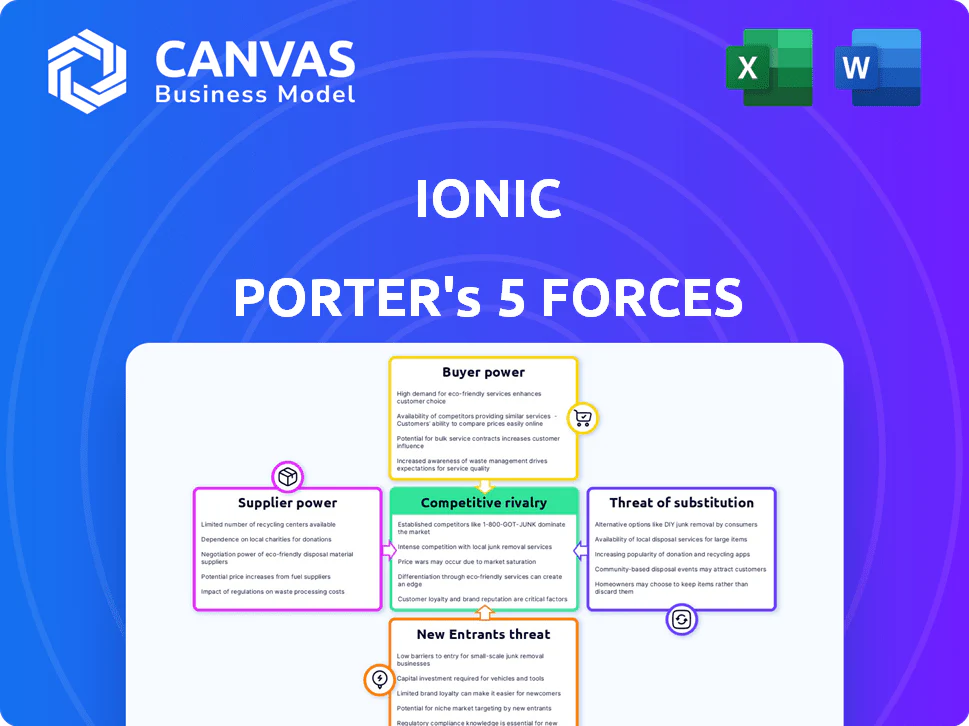
IONIC PORTER'S FIVE FORCES TEMPLATE RESEARCH
What is included in the product
 Detailed Word Document
Analyzes Ionic's position, competitive forces, and market entry risks in its landscape.

 Customizable Excel Spreadsheet
A tailored view of the forces lets you instantly identify competitive threats.
Preview the Actual Deliverable
Ionic Porter's Five Forces Analysis
This preview presents the complete Porter's Five Forces analysis for Ionic. You'll receive this identical, professionally written document instantly after purchase. It's fully formatted and ready for your immediate use without further editing. What you see is what you get, offering a comprehensive understanding of Ionic's competitive landscape. No alterations or additional steps needed after buying.

Porter's Five Forces Analysis Template

A Must-Have Tool for Decision-Makers
Understanding Ionic's market requires a deep dive into its competitive landscape. Porter's Five Forces analyzes industry rivalry, supplier power, buyer power, the threat of substitutes, and the threat of new entrants. These forces shape profitability and strategic decisions for Ionic. This framework helps assess Ionic's competitive position and potential. Key takeaways provide a nuanced understanding of market dynamics.
Ready to move beyond the basics? Get a full strategic breakdown of Ionic’s market position, competitive intensity, and external threats—all in one powerful analysis.
Suppliers Bargaining Power

Availability of web technologies
Ionic's use of common web technologies like HTML, CSS, and JavaScript significantly impacts supplier power. Since these technologies are broadly accessible and not tied to a single vendor, Ionic has a strong bargaining position. This widespread availability fosters competition among providers, reducing the ability of any one supplier to dictate terms. The global web development market was valued at $56.8 billion in 2023, showing the vastness and competitiveness of the tech supply ecosystem.
Open-source nature
Ionic's open-source nature significantly impacts supplier power. The extensive community reduces reliance on any single supplier. This collaborative environment fosters innovation and support. It also ensures ongoing development and maintenance, demonstrated by the 2024 updates. This distributed approach diminishes supplier leverage.

Integration with other frameworks
Ionic's integration with Angular and React impacts supplier bargaining power. By supporting multiple frameworks, Ionic reduces dependency on specific tools. This flexibility can shift the balance of power, potentially lowering costs. For example, in 2024, Angular and React had strong market shares, offering developers choices. This diversification is a key factor.

Reliance on third-party plugins and native features
Ionic Porter's reliance on third-party plugins and native platforms influences the bargaining power of suppliers. Plugin developers and platform owners (Apple, Google) possess some leverage. This dependency can affect costs and development flexibility.
- Plugin market size reached $2.6 billion in 2024.
- Apple and Google control over 99% of mobile OS market share.
- Plugin costs can range from free to thousands of dollars.
Backend service integrations
Ionic Porter's backend service integrations involve various suppliers whose bargaining power fluctuates. This power depends on the specific service and Ionic's reliance. For instance, if Ionic heavily uses a unique database, that supplier has more leverage. Conversely, if alternatives are readily available, the supplier's power diminishes. Understanding this dynamic is key to managing costs and ensuring service availability.
- Cloud computing market: In 2024, it's valued at over $670 billion.
- Database services: The global database market is projected to reach $106.6 billion by 2026.
- API providers: The API market is estimated to be worth over $4 billion in 2024.
- Reliance on specific services: If Ionic uses a niche service, the supplier's power increases.
Supplier Power Dynamics: A Breakdown
Ionic's bargaining power with suppliers varies. The open-source nature and use of common technologies reduce supplier leverage. However, reliance on third-party plugins and specific backend services like databases increases supplier influence. The plugin market was $2.6 billion in 2024.
| Supplier Type | Impact on Power | 2024 Market Data |
|---|---|---|
| Web Tech Providers | Low. Competition is high. | Web dev market: $56.8B |
| Plugin Developers | Moderate. Some leverage. | Plugin market: $2.6B |
| Backend Service | Variable. Depends on service. | Cloud: $670B+, Database: $106.6B (2026) |
Customers Bargaining Power

Availability of alternative frameworks
Customers wield substantial power due to the availability of alternative frameworks. They can easily shift to competitors like React Native, Flutter, or .NET MAUI. In 2024, React Native held around 42% of the market share, indicating significant customer choice. This competitive landscape forces Ionic to offer competitive pricing and features.
Open-source option
Ionic's open-source model gives customers significant bargaining power. The free version presents a cost-effective alternative, influencing pricing. This leverage can lead to price sensitivity among users.

Cost-effectiveness of cross-platform development
Cross-platform development's cost-effectiveness significantly impacts customer bargaining power. Generally, businesses choose it to save money, influencing their ability to negotiate. The global cross-platform market was valued at $27.76 billion in 2023, highlighting its prevalence. This cost-consciousness empowers customers to seek better deals or switch providers. It also forces Ionic Porter to offer competitive pricing.

Customer base size and diversity
Ionic boasts a vast and varied customer base, spanning individual developers to major corporations. This broad reach suggests substantial market acceptance. However, this diversity also implies that different customer groups wield varying degrees of influence over Ionic's strategies.
- Ionic has over 5 million developers worldwide.
- Enterprise clients include major companies like Disney and Microsoft.
- This diversity impacts pricing and feature prioritization.
- Customer concentration varies by segment, affecting bargaining power.
Ease of use and learning curve
Ionic's user-friendly nature, especially for web developers, significantly impacts customer bargaining power. This ease of adoption reduces switching costs, making it simpler for customers to move to alternative frameworks if they're unhappy. The low learning curve allows developers to quickly become proficient, increasing their ability to negotiate better terms or seek competitive pricing. According to a 2024 survey, 70% of developers find Ionic easy to learn, which boosts their bargaining position.
- Ease of learning enhances customer mobility.
- Reduced switching costs strengthen customer leverage.
- Developers can more easily evaluate alternatives.
- Increased bargaining power.
Ionic Framework: Customer Power Dynamics
Customers' bargaining power in the Ionic framework market is considerable due to accessible alternatives like React Native and Flutter. The cross-platform market's $27.76 billion value in 2023 underscores cost-consciousness, influencing customer negotiation. Ionic's open-source model and user-friendly nature further enhance customer leverage in pricing and feature demands.
| Factor | Impact | Data |
|---|---|---|
| Alternative Frameworks | High bargaining power | React Native holds ~42% market share in 2024 |
| Open-Source Model | Influences pricing | Free version available |
| Ease of Use | Enhances mobility | 70% of developers find Ionic easy to learn (2024 survey) |
Rivalry Among Competitors

Numerous cross-platform frameworks
The cross-platform development landscape is highly competitive. Frameworks like Flutter and React Native directly challenge Ionic. This rivalry forces Ionic to continually improve and offer compelling features. The global cross-platform market was valued at $28.34 billion in 2023, highlighting the stakes.
Differentiation strategies
Differentiation in the mobile app market involves offering unique value. Competitors use performance, features, and tech. Ionic uses web tech for a native-like feel. In 2024, the mobile app market generated over $700 billion in revenue, with differentiation driving success.

Market share and adoption rates
Ionic faces stiff competition, with Flutter and React Native often leading in market share. For instance, in 2024, Flutter's adoption among developers was around 46%, while React Native held about 42%. This competition pressures Ionic to innovate and retain its user base. A 2024 report showed that Ionic was used by approximately 20% of mobile app developers.

Pace of innovation
The cross-platform development arena is dynamic, with rapid innovation. Ionic must adapt to stay competitive, facing pressures to integrate new features. The company needs to invest in R&D to remain ahead of the curve. In 2024, the global app development market was valued at over $100 billion.
- Rapid technological advancements require continuous adaptation.
- Ionic must invest in R&D to remain competitive in the market.
- The app development market is highly competitive.
- Failure to innovate can lead to loss of market share.
Community and ecosystem strength
The vibrancy of a framework's community and the resources it offers significantly influence competitive dynamics. Ionic benefits from a robust community, fostering active development and support. However, rivals also boast thriving ecosystems, intensifying the competition for developer mindshare and project adoption. This rivalry pressures Ionic to continually innovate and support its user base effectively. The competitive landscape is further shaped by the availability of third-party tools and integrations.
- Ionic's GitHub repository has over 16,000 stars, signaling strong community interest.
- React Native, a competitor, has a larger community, with over 115,000 stars on its GitHub repository.
- Flutter's community is rapidly growing, with over 160,000 stars on its GitHub repository.
Ionic's Fight: Market Share vs. Rivals
Ionic faces intense competition in cross-platform development. Rivals like Flutter and React Native constantly innovate. The global app development market's value exceeded $100 billion in 2024, intensifying the rivalry. Continuous innovation and community support are crucial for Ionic's survival.
| Feature | Ionic | Competitors |
|---|---|---|
| Market Share (2024) | ~20% | Flutter (~46%), React Native (~42%) |
| GitHub Stars | ~16,000 | React Native (~115,000), Flutter (~160,000) |
| 2024 Revenue (Mobile App Market) | Significant share of $700B+ | Significant share of $700B+ |
Original: $10.00
-65%$10.00
$3.50IONIC PORTER'S FIVE FORCES TEMPLATE RESEARCH
What is included in the product
Detailed Word Document
Analyzes Ionic's position, competitive forces, and market entry risks in its landscape.
Customizable Excel Spreadsheet
A tailored view of the forces lets you instantly identify competitive threats.
Preview the Actual Deliverable
Ionic Porter's Five Forces Analysis
This preview presents the complete Porter's Five Forces analysis for Ionic. You'll receive this identical, professionally written document instantly after purchase. It's fully formatted and ready for your immediate use without further editing. What you see is what you get, offering a comprehensive understanding of Ionic's competitive landscape. No alterations or additional steps needed after buying.
Porter's Five Forces Analysis Template
A Must-Have Tool for Decision-Makers
Understanding Ionic's market requires a deep dive into its competitive landscape. Porter's Five Forces analyzes industry rivalry, supplier power, buyer power, the threat of substitutes, and the threat of new entrants. These forces shape profitability and strategic decisions for Ionic. This framework helps assess Ionic's competitive position and potential. Key takeaways provide a nuanced understanding of market dynamics.
Ready to move beyond the basics? Get a full strategic breakdown of Ionic’s market position, competitive intensity, and external threats—all in one powerful analysis.
Suppliers Bargaining Power
Availability of web technologies
Ionic's use of common web technologies like HTML, CSS, and JavaScript significantly impacts supplier power. Since these technologies are broadly accessible and not tied to a single vendor, Ionic has a strong bargaining position. This widespread availability fosters competition among providers, reducing the ability of any one supplier to dictate terms. The global web development market was valued at $56.8 billion in 2023, showing the vastness and competitiveness of the tech supply ecosystem.
Open-source nature
Ionic's open-source nature significantly impacts supplier power. The extensive community reduces reliance on any single supplier. This collaborative environment fosters innovation and support. It also ensures ongoing development and maintenance, demonstrated by the 2024 updates. This distributed approach diminishes supplier leverage.
Integration with other frameworks
Ionic's integration with Angular and React impacts supplier bargaining power. By supporting multiple frameworks, Ionic reduces dependency on specific tools. This flexibility can shift the balance of power, potentially lowering costs. For example, in 2024, Angular and React had strong market shares, offering developers choices. This diversification is a key factor.
Reliance on third-party plugins and native features
Ionic Porter's reliance on third-party plugins and native platforms influences the bargaining power of suppliers. Plugin developers and platform owners (Apple, Google) possess some leverage. This dependency can affect costs and development flexibility.
- Plugin market size reached $2.6 billion in 2024.
- Apple and Google control over 99% of mobile OS market share.
- Plugin costs can range from free to thousands of dollars.
Backend service integrations
Ionic Porter's backend service integrations involve various suppliers whose bargaining power fluctuates. This power depends on the specific service and Ionic's reliance. For instance, if Ionic heavily uses a unique database, that supplier has more leverage. Conversely, if alternatives are readily available, the supplier's power diminishes. Understanding this dynamic is key to managing costs and ensuring service availability.
- Cloud computing market: In 2024, it's valued at over $670 billion.
- Database services: The global database market is projected to reach $106.6 billion by 2026.
- API providers: The API market is estimated to be worth over $4 billion in 2024.
- Reliance on specific services: If Ionic uses a niche service, the supplier's power increases.
Supplier Power Dynamics: A Breakdown
Ionic's bargaining power with suppliers varies. The open-source nature and use of common technologies reduce supplier leverage. However, reliance on third-party plugins and specific backend services like databases increases supplier influence. The plugin market was $2.6 billion in 2024.
| Supplier Type | Impact on Power | 2024 Market Data |
|---|---|---|
| Web Tech Providers | Low. Competition is high. | Web dev market: $56.8B |
| Plugin Developers | Moderate. Some leverage. | Plugin market: $2.6B |
| Backend Service | Variable. Depends on service. | Cloud: $670B+, Database: $106.6B (2026) |
Customers Bargaining Power
Availability of alternative frameworks
Customers wield substantial power due to the availability of alternative frameworks. They can easily shift to competitors like React Native, Flutter, or .NET MAUI. In 2024, React Native held around 42% of the market share, indicating significant customer choice. This competitive landscape forces Ionic to offer competitive pricing and features.
Open-source option
Ionic's open-source model gives customers significant bargaining power. The free version presents a cost-effective alternative, influencing pricing. This leverage can lead to price sensitivity among users.
Cost-effectiveness of cross-platform development
Cross-platform development's cost-effectiveness significantly impacts customer bargaining power. Generally, businesses choose it to save money, influencing their ability to negotiate. The global cross-platform market was valued at $27.76 billion in 2023, highlighting its prevalence. This cost-consciousness empowers customers to seek better deals or switch providers. It also forces Ionic Porter to offer competitive pricing.
Customer base size and diversity
Ionic boasts a vast and varied customer base, spanning individual developers to major corporations. This broad reach suggests substantial market acceptance. However, this diversity also implies that different customer groups wield varying degrees of influence over Ionic's strategies.
- Ionic has over 5 million developers worldwide.
- Enterprise clients include major companies like Disney and Microsoft.
- This diversity impacts pricing and feature prioritization.
- Customer concentration varies by segment, affecting bargaining power.
Ease of use and learning curve
Ionic's user-friendly nature, especially for web developers, significantly impacts customer bargaining power. This ease of adoption reduces switching costs, making it simpler for customers to move to alternative frameworks if they're unhappy. The low learning curve allows developers to quickly become proficient, increasing their ability to negotiate better terms or seek competitive pricing. According to a 2024 survey, 70% of developers find Ionic easy to learn, which boosts their bargaining position.
- Ease of learning enhances customer mobility.
- Reduced switching costs strengthen customer leverage.
- Developers can more easily evaluate alternatives.
- Increased bargaining power.
Ionic Framework: Customer Power Dynamics
Customers' bargaining power in the Ionic framework market is considerable due to accessible alternatives like React Native and Flutter. The cross-platform market's $27.76 billion value in 2023 underscores cost-consciousness, influencing customer negotiation. Ionic's open-source model and user-friendly nature further enhance customer leverage in pricing and feature demands.
| Factor | Impact | Data |
|---|---|---|
| Alternative Frameworks | High bargaining power | React Native holds ~42% market share in 2024 |
| Open-Source Model | Influences pricing | Free version available |
| Ease of Use | Enhances mobility | 70% of developers find Ionic easy to learn (2024 survey) |
Rivalry Among Competitors
Numerous cross-platform frameworks
The cross-platform development landscape is highly competitive. Frameworks like Flutter and React Native directly challenge Ionic. This rivalry forces Ionic to continually improve and offer compelling features. The global cross-platform market was valued at $28.34 billion in 2023, highlighting the stakes.
Differentiation strategies
Differentiation in the mobile app market involves offering unique value. Competitors use performance, features, and tech. Ionic uses web tech for a native-like feel. In 2024, the mobile app market generated over $700 billion in revenue, with differentiation driving success.
Market share and adoption rates
Ionic faces stiff competition, with Flutter and React Native often leading in market share. For instance, in 2024, Flutter's adoption among developers was around 46%, while React Native held about 42%. This competition pressures Ionic to innovate and retain its user base. A 2024 report showed that Ionic was used by approximately 20% of mobile app developers.
Pace of innovation
The cross-platform development arena is dynamic, with rapid innovation. Ionic must adapt to stay competitive, facing pressures to integrate new features. The company needs to invest in R&D to remain ahead of the curve. In 2024, the global app development market was valued at over $100 billion.
- Rapid technological advancements require continuous adaptation.
- Ionic must invest in R&D to remain competitive in the market.
- The app development market is highly competitive.
- Failure to innovate can lead to loss of market share.
Community and ecosystem strength
The vibrancy of a framework's community and the resources it offers significantly influence competitive dynamics. Ionic benefits from a robust community, fostering active development and support. However, rivals also boast thriving ecosystems, intensifying the competition for developer mindshare and project adoption. This rivalry pressures Ionic to continually innovate and support its user base effectively. The competitive landscape is further shaped by the availability of third-party tools and integrations.
- Ionic's GitHub repository has over 16,000 stars, signaling strong community interest.
- React Native, a competitor, has a larger community, with over 115,000 stars on its GitHub repository.
- Flutter's community is rapidly growing, with over 160,000 stars on its GitHub repository.
Ionic's Fight: Market Share vs. Rivals
Ionic faces intense competition in cross-platform development. Rivals like Flutter and React Native constantly innovate. The global app development market's value exceeded $100 billion in 2024, intensifying the rivalry. Continuous innovation and community support are crucial for Ionic's survival.
| Feature | Ionic | Competitors |
|---|---|---|
| Market Share (2024) | ~20% | Flutter (~46%), React Native (~42%) |
| GitHub Stars | ~16,000 | React Native (~115,000), Flutter (~160,000) |
| 2024 Revenue (Mobile App Market) | Significant share of $700B+ | Significant share of $700B+ |
Product Information
Product Information
Shipping & Returns
Shipping & Returns
Description
What is included in the product
Detailed Word Document
Analyzes Ionic's position, competitive forces, and market entry risks in its landscape.
Customizable Excel Spreadsheet
A tailored view of the forces lets you instantly identify competitive threats.
Preview the Actual Deliverable
Ionic Porter's Five Forces Analysis
This preview presents the complete Porter's Five Forces analysis for Ionic. You'll receive this identical, professionally written document instantly after purchase. It's fully formatted and ready for your immediate use without further editing. What you see is what you get, offering a comprehensive understanding of Ionic's competitive landscape. No alterations or additional steps needed after buying.
Porter's Five Forces Analysis Template
A Must-Have Tool for Decision-Makers
Understanding Ionic's market requires a deep dive into its competitive landscape. Porter's Five Forces analyzes industry rivalry, supplier power, buyer power, the threat of substitutes, and the threat of new entrants. These forces shape profitability and strategic decisions for Ionic. This framework helps assess Ionic's competitive position and potential. Key takeaways provide a nuanced understanding of market dynamics.
Ready to move beyond the basics? Get a full strategic breakdown of Ionic’s market position, competitive intensity, and external threats—all in one powerful analysis.
Suppliers Bargaining Power
Availability of web technologies
Ionic's use of common web technologies like HTML, CSS, and JavaScript significantly impacts supplier power. Since these technologies are broadly accessible and not tied to a single vendor, Ionic has a strong bargaining position. This widespread availability fosters competition among providers, reducing the ability of any one supplier to dictate terms. The global web development market was valued at $56.8 billion in 2023, showing the vastness and competitiveness of the tech supply ecosystem.
Open-source nature
Ionic's open-source nature significantly impacts supplier power. The extensive community reduces reliance on any single supplier. This collaborative environment fosters innovation and support. It also ensures ongoing development and maintenance, demonstrated by the 2024 updates. This distributed approach diminishes supplier leverage.
Integration with other frameworks
Ionic's integration with Angular and React impacts supplier bargaining power. By supporting multiple frameworks, Ionic reduces dependency on specific tools. This flexibility can shift the balance of power, potentially lowering costs. For example, in 2024, Angular and React had strong market shares, offering developers choices. This diversification is a key factor.
Reliance on third-party plugins and native features
Ionic Porter's reliance on third-party plugins and native platforms influences the bargaining power of suppliers. Plugin developers and platform owners (Apple, Google) possess some leverage. This dependency can affect costs and development flexibility.
- Plugin market size reached $2.6 billion in 2024.
- Apple and Google control over 99% of mobile OS market share.
- Plugin costs can range from free to thousands of dollars.
Backend service integrations
Ionic Porter's backend service integrations involve various suppliers whose bargaining power fluctuates. This power depends on the specific service and Ionic's reliance. For instance, if Ionic heavily uses a unique database, that supplier has more leverage. Conversely, if alternatives are readily available, the supplier's power diminishes. Understanding this dynamic is key to managing costs and ensuring service availability.
- Cloud computing market: In 2024, it's valued at over $670 billion.
- Database services: The global database market is projected to reach $106.6 billion by 2026.
- API providers: The API market is estimated to be worth over $4 billion in 2024.
- Reliance on specific services: If Ionic uses a niche service, the supplier's power increases.
Supplier Power Dynamics: A Breakdown
Ionic's bargaining power with suppliers varies. The open-source nature and use of common technologies reduce supplier leverage. However, reliance on third-party plugins and specific backend services like databases increases supplier influence. The plugin market was $2.6 billion in 2024.
| Supplier Type | Impact on Power | 2024 Market Data |
|---|---|---|
| Web Tech Providers | Low. Competition is high. | Web dev market: $56.8B |
| Plugin Developers | Moderate. Some leverage. | Plugin market: $2.6B |
| Backend Service | Variable. Depends on service. | Cloud: $670B+, Database: $106.6B (2026) |
Customers Bargaining Power
Availability of alternative frameworks
Customers wield substantial power due to the availability of alternative frameworks. They can easily shift to competitors like React Native, Flutter, or .NET MAUI. In 2024, React Native held around 42% of the market share, indicating significant customer choice. This competitive landscape forces Ionic to offer competitive pricing and features.
Open-source option
Ionic's open-source model gives customers significant bargaining power. The free version presents a cost-effective alternative, influencing pricing. This leverage can lead to price sensitivity among users.
Cost-effectiveness of cross-platform development
Cross-platform development's cost-effectiveness significantly impacts customer bargaining power. Generally, businesses choose it to save money, influencing their ability to negotiate. The global cross-platform market was valued at $27.76 billion in 2023, highlighting its prevalence. This cost-consciousness empowers customers to seek better deals or switch providers. It also forces Ionic Porter to offer competitive pricing.
Customer base size and diversity
Ionic boasts a vast and varied customer base, spanning individual developers to major corporations. This broad reach suggests substantial market acceptance. However, this diversity also implies that different customer groups wield varying degrees of influence over Ionic's strategies.
- Ionic has over 5 million developers worldwide.
- Enterprise clients include major companies like Disney and Microsoft.
- This diversity impacts pricing and feature prioritization.
- Customer concentration varies by segment, affecting bargaining power.
Ease of use and learning curve
Ionic's user-friendly nature, especially for web developers, significantly impacts customer bargaining power. This ease of adoption reduces switching costs, making it simpler for customers to move to alternative frameworks if they're unhappy. The low learning curve allows developers to quickly become proficient, increasing their ability to negotiate better terms or seek competitive pricing. According to a 2024 survey, 70% of developers find Ionic easy to learn, which boosts their bargaining position.
- Ease of learning enhances customer mobility.
- Reduced switching costs strengthen customer leverage.
- Developers can more easily evaluate alternatives.
- Increased bargaining power.
Ionic Framework: Customer Power Dynamics
Customers' bargaining power in the Ionic framework market is considerable due to accessible alternatives like React Native and Flutter. The cross-platform market's $27.76 billion value in 2023 underscores cost-consciousness, influencing customer negotiation. Ionic's open-source model and user-friendly nature further enhance customer leverage in pricing and feature demands.
| Factor | Impact | Data |
|---|---|---|
| Alternative Frameworks | High bargaining power | React Native holds ~42% market share in 2024 |
| Open-Source Model | Influences pricing | Free version available |
| Ease of Use | Enhances mobility | 70% of developers find Ionic easy to learn (2024 survey) |
Rivalry Among Competitors
Numerous cross-platform frameworks
The cross-platform development landscape is highly competitive. Frameworks like Flutter and React Native directly challenge Ionic. This rivalry forces Ionic to continually improve and offer compelling features. The global cross-platform market was valued at $28.34 billion in 2023, highlighting the stakes.
Differentiation strategies
Differentiation in the mobile app market involves offering unique value. Competitors use performance, features, and tech. Ionic uses web tech for a native-like feel. In 2024, the mobile app market generated over $700 billion in revenue, with differentiation driving success.
Market share and adoption rates
Ionic faces stiff competition, with Flutter and React Native often leading in market share. For instance, in 2024, Flutter's adoption among developers was around 46%, while React Native held about 42%. This competition pressures Ionic to innovate and retain its user base. A 2024 report showed that Ionic was used by approximately 20% of mobile app developers.
Pace of innovation
The cross-platform development arena is dynamic, with rapid innovation. Ionic must adapt to stay competitive, facing pressures to integrate new features. The company needs to invest in R&D to remain ahead of the curve. In 2024, the global app development market was valued at over $100 billion.
- Rapid technological advancements require continuous adaptation.
- Ionic must invest in R&D to remain competitive in the market.
- The app development market is highly competitive.
- Failure to innovate can lead to loss of market share.
Community and ecosystem strength
The vibrancy of a framework's community and the resources it offers significantly influence competitive dynamics. Ionic benefits from a robust community, fostering active development and support. However, rivals also boast thriving ecosystems, intensifying the competition for developer mindshare and project adoption. This rivalry pressures Ionic to continually innovate and support its user base effectively. The competitive landscape is further shaped by the availability of third-party tools and integrations.
- Ionic's GitHub repository has over 16,000 stars, signaling strong community interest.
- React Native, a competitor, has a larger community, with over 115,000 stars on its GitHub repository.
- Flutter's community is rapidly growing, with over 160,000 stars on its GitHub repository.
Ionic's Fight: Market Share vs. Rivals
Ionic faces intense competition in cross-platform development. Rivals like Flutter and React Native constantly innovate. The global app development market's value exceeded $100 billion in 2024, intensifying the rivalry. Continuous innovation and community support are crucial for Ionic's survival.
| Feature | Ionic | Competitors |
|---|---|---|
| Market Share (2024) | ~20% | Flutter (~46%), React Native (~42%) |
| GitHub Stars | ~16,000 | React Native (~115,000), Flutter (~160,000) |
| 2024 Revenue (Mobile App Market) | Significant share of $700B+ | Significant share of $700B+ |











