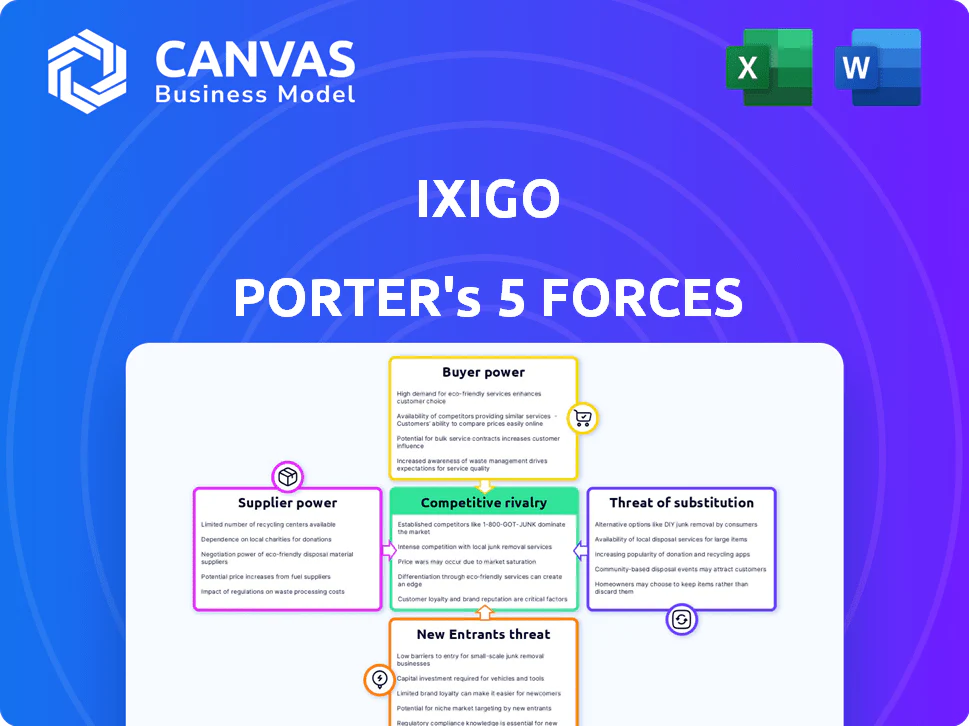
IXIGO PORTER'S FIVE FORCES TEMPLATE RESEARCH

Don't Miss the Bigger Picture
ixigo faces moderate supplier and buyer power, intense rivalry from big travel platforms, and evolving substitute risks from direct bookings and emerging aggregators-this snapshot highlights key pressures but omits force-by-force depth. Unlock the full Porter's Five Forces Analysis to get ratings, visuals, and actionable strategy tailored to ixigo.
Suppliers Bargaining Power

Concentrated Rail Inventory Control
The Indian Railways, via IRCTC, is the sole train inventory provider, giving it absolute leverage over aggregators like ixigo; ixigo held a 51% share of the train OTA market in early 2026 and reported FY2025 train ticket GMV of ₹4,200 crore, but remains subject to IRCTC licensing and fees.
Policy moves by the Ministry of Railways hit ixigo directly-eg, the 2025 cut in advance reservation window reduced ixigo's train booking volumes by ~9% QoQ and trimmed FY2025 fee revenue from rail services to ₹120 crore, showing high supplier bargaining power.
Aviation Capacity and Slot Constraints
Major carriers IndiGo (InterGlobe Aviation) and Air India controlled ~70% of India's domestic seats in 2025, and aircraft delivery delays plus a pilot shortfall of ~3,000 pilots in late 2025 tightened capacity; this boosted carriers' leverage over aggregators like ixigo.
When capacity tightens, carriers favor direct bookings to save on 10-18% aggregator commission, reducing ixigo's available inventory and margin flexibility.
ixigo's flight GTV rose ~24% YoY in FY2025, yet supplier-side slot and fleet limits cap pricing power and inventory depth, forcing promotional spend to defend conversion.

Consolidated Bus Operator Networks
Through the 2024 acquisition of AbhiBus, ixigo improved access to ~45,000 private bus operators and boosted bus bookings revenue to INR 620 mn in FY2025, yet supplier base stays fragmented and wields regional influence.
State Transport Corporations dominate Bharat markets where ixigo drove 58% of bus GMV growth in FY2025; STCs set fixed fares and contract terms, limiting aggregator margins to single-digit percentages.
ixigo reported onboarding 12 new STCs by Dec 2025, expanding reach but facing low tolerance for commissions above ~5-7%, pressuring unit economics in Tier II/III corridors.

Dependence on Global Distribution Systems
ixigo depends on Global Distribution Systems (GDS) such as Amadeus and Sabre for international flight and hotel inventory; these GDSs command industry-standard fees-Amadeus reported €5.7bn revenue in FY2025 and Sabre $2.9bn-so fee hikes or API changes directly raise ixigo's cost-per-booking and reduce margins as it scales in SE Asia and Europe in 2026.
Increased reliance raises supplier bargaining power: a 5-10% fee uptick could cut ixigo's gross booking margins by ~120-240 bps given FY2025 gross booking revenue mix; tech shifts or distribution protocol changes risk downtime and higher integration costs.
- Amadeus FY2025 revenue €5.7bn; Sabre FY2025 revenue $2.9bn
- GDS fee shock (5-10%) → ~120-240 bps margin hit
- Expansion into SE Asia/Europe 2026 increases GDS dependence
- API/protocol changes risk integration costs and downtime
Cloud and AI Infrastructure Providers
ixigo's AI-first model makes it highly dependent on AWS and Google Cloud for real-time processing and the TARA assistant, giving these providers strong supplier bargaining power.
Specialized GPUs and TPUs for LLMs and predictive analytics concentrate power with cloud vendors, raising switching costs and pricing sensitivity.
After its 2025 capital raise ixigo earmarked about $36.5 million for AI, so infrastructure pricing materially affects operating margins and cash burn.
- Dependence: AWS/Google Cloud power TARA and real-time systems
- Specialized hardware: GPUs/TPUs raise switching costs
- Financial impact: $36.5M AI budget links costs to vendor pricing
Supplier clout (IRCTC, airlines, GDS, cloud) threatens ixigo margins with fee & cloud shocks
Suppliers-IRCTC, major airlines (IndiGo/Air India ~70% domestic seats 2025), Amadeus (€5.7bn FY2025)/Sabre ($2.9bn FY2025), AWS/Google-hold high bargaining power; policy moves cut ixigo's FY2025 rail fee revenue to ₹120 crore and a 5-10% GDS fee shock would shave ~120-240 bps off margins; ixigo's $36.5M AI budget raises cloud cost sensitivity.
| Supplier | Key 2025 figure | Impact |
|---|---|---|
| IRCTC | Train GMV ₹4,200cr (FY2025) | Licensing/fees, high leverage |
| Airlines | IndiGo+Air India ~70% seats | Capacity favors direct sales |
| GDS | Amadeus €5.7bn / Sabre $2.9bn | 5-10% fee ↑ → -120-240bps |
| Cloud | $36.5M AI budget | Vendor pricing → margin risk |
What is included in the product
 Detailed Word Document
Tailored Porter's Five Forces for ixigo: pinpoints competitive intensity, buyer/supplier power, entry barriers, substitutes, and emerging disruptors to inform strategy and valuation.

 Customizable Excel Spreadsheet
Quickly assess ixigo's competitive landscape with a one-sheet Porter's Five Forces that highlights traveler bargaining power and OTA rivalry-ideal for fast strategic choices or slide-ready summaries.
Customers Bargaining Power

High Price Sensitivity in Bharat Markets
ixigo's core users-next billion customers in Tier II/III-show high price sensitivity: 2025 GMV from these segments was ~INR 4,200 crore, so even a 5-10% rise in convenience fees risks churn as users compare cents via metasearch.
In 2025, ixigo reported ~18% YoY user growth but low ARPU ~INR 230, forcing frequent discounts; small fee hikes push users toward carrier sites or rivals like EaseMyTrip, which had 2025 gross bookings of ~INR 6,800 crore.
Low Switching Costs Across OTA Platforms
Low switching costs mean travelers often keep MakeMyTrip, Cleartrip and ixigo apps simultaneously; as of FY2025 ixigo reported 35.8 million MAUs and faces price-checking across platforms, pushing competition toward services not inventory.
Real-time price transparency-Google Travel and OTAs showing sub-1% fare differences on many routes-forces ixigo to sell value-added features rather than rates alone.
ixigo's ixigo Assured (launched expanded benefits in FY2024) offered free cancellations and instant refunds, contributing to a 12% rise in repeat bookings in FY2025 and effectively buying customer stickiness.

Information Symmetry and Comparison Tools
With Google Flights and metasearch engines giving near-perfect price transparency, ixigo (2025 FY revenue ₹1,120 crore) faces limited scope to extract premiums as users spot price gaps instantly.
By 2026, AI travel assistants reduced search time and found lowest fares 34% more often, further empowering buyers and pressuring ixigo's margins and commission pricing.

Demand for Multi-Modal Flexibility
Modern Indian travelers demand door-to-door options and can switch among trains, buses, and flights based on real-time availability, raising buyer power over platforms like ixigo.
If a train is waitlisted, customers expect instant bus or flight alternatives; ixigo's Travel Guarantee (launched 2023) seeks to capture spend when primary choices fail.
In FY2025 ixigo reported ~18% growth in transactions and Travel Guarantee conversions accounting for ~6% of paid bookings, showing this feature mitigates churn.
- Door-to-door demand ↑ drives platform switching
- Instant alternatives expected for waitlisted trains
- Travel Guarantee launched 2023; converts ~6% FY2025 bookings
- Transactions growth ~18% in FY2025, lowering lost sales
Influence of Social Proof and App Ratings
Customer reviews and app ratings drive acquisition and retention; ixigo's apps averaged 4.6+ on app stores in 2026, directly shaping feature priorities and roadmap decisions.
Negative posts about refund delays or support spread quickly, creating reputational risk that forces faster operational fixes and raises customer bargaining leverage.
- 4.6+ average app rating (2026)
- Negative viral complaints increase churn risk and support costs
- User feedback directly influences roadmap and feature rollouts
Ixigo: Tier II/III users drive ₹4,200cr GMV-low ARPU makes fee hikes risky
Buyers hold strong power: price-sensitive Tier II/III users drove ~INR 4,200 crore GMV in 2025, ixigo FY2025 revenue ₹1,120 crore, MAUs 35.8M; low ARPU ~₹230 and 18% transactions growth mean small fee hikes cause churn; Travel Guarantee converted ~6% paid bookings in FY2025, while 4.6+ app rating (2026) amplifies reviews' impact.
| Metric | 2025/2026 |
|---|---|
| Tier II/III GMV | ₹4,200 crore (2025) |
| Revenue | ₹1,120 crore (FY2025) |
| MAUs | 35.8M (FY2025) |
| ARPU | ~₹230 (2025) |
| Transactions growth | ~18% (FY2025) |
| Travel Guarantee conversion | ~6% paid bookings (FY2025) |
| App rating | 4.6+ (2026) |
Full Version Awaits
ixigo Porter's Five Forces Analysis
This preview shows the exact ixigo Porter's Five Forces analysis you'll receive immediately after purchase-no placeholders or samples; the full, professionally formatted document will be available for instant download and ready to use.

Original: $10.00
-65%$10.00
$3.50IXIGO PORTER'S FIVE FORCES TEMPLATE RESEARCH
Don't Miss the Bigger Picture
ixigo faces moderate supplier and buyer power, intense rivalry from big travel platforms, and evolving substitute risks from direct bookings and emerging aggregators-this snapshot highlights key pressures but omits force-by-force depth. Unlock the full Porter's Five Forces Analysis to get ratings, visuals, and actionable strategy tailored to ixigo.
Suppliers Bargaining Power
Concentrated Rail Inventory Control
The Indian Railways, via IRCTC, is the sole train inventory provider, giving it absolute leverage over aggregators like ixigo; ixigo held a 51% share of the train OTA market in early 2026 and reported FY2025 train ticket GMV of ₹4,200 crore, but remains subject to IRCTC licensing and fees.
Policy moves by the Ministry of Railways hit ixigo directly-eg, the 2025 cut in advance reservation window reduced ixigo's train booking volumes by ~9% QoQ and trimmed FY2025 fee revenue from rail services to ₹120 crore, showing high supplier bargaining power.
Aviation Capacity and Slot Constraints
Major carriers IndiGo (InterGlobe Aviation) and Air India controlled ~70% of India's domestic seats in 2025, and aircraft delivery delays plus a pilot shortfall of ~3,000 pilots in late 2025 tightened capacity; this boosted carriers' leverage over aggregators like ixigo.
When capacity tightens, carriers favor direct bookings to save on 10-18% aggregator commission, reducing ixigo's available inventory and margin flexibility.
ixigo's flight GTV rose ~24% YoY in FY2025, yet supplier-side slot and fleet limits cap pricing power and inventory depth, forcing promotional spend to defend conversion.
Consolidated Bus Operator Networks
Through the 2024 acquisition of AbhiBus, ixigo improved access to ~45,000 private bus operators and boosted bus bookings revenue to INR 620 mn in FY2025, yet supplier base stays fragmented and wields regional influence.
State Transport Corporations dominate Bharat markets where ixigo drove 58% of bus GMV growth in FY2025; STCs set fixed fares and contract terms, limiting aggregator margins to single-digit percentages.
ixigo reported onboarding 12 new STCs by Dec 2025, expanding reach but facing low tolerance for commissions above ~5-7%, pressuring unit economics in Tier II/III corridors.
Dependence on Global Distribution Systems
ixigo depends on Global Distribution Systems (GDS) such as Amadeus and Sabre for international flight and hotel inventory; these GDSs command industry-standard fees-Amadeus reported €5.7bn revenue in FY2025 and Sabre $2.9bn-so fee hikes or API changes directly raise ixigo's cost-per-booking and reduce margins as it scales in SE Asia and Europe in 2026.
Increased reliance raises supplier bargaining power: a 5-10% fee uptick could cut ixigo's gross booking margins by ~120-240 bps given FY2025 gross booking revenue mix; tech shifts or distribution protocol changes risk downtime and higher integration costs.
- Amadeus FY2025 revenue €5.7bn; Sabre FY2025 revenue $2.9bn
- GDS fee shock (5-10%) → ~120-240 bps margin hit
- Expansion into SE Asia/Europe 2026 increases GDS dependence
- API/protocol changes risk integration costs and downtime
Cloud and AI Infrastructure Providers
ixigo's AI-first model makes it highly dependent on AWS and Google Cloud for real-time processing and the TARA assistant, giving these providers strong supplier bargaining power.
Specialized GPUs and TPUs for LLMs and predictive analytics concentrate power with cloud vendors, raising switching costs and pricing sensitivity.
After its 2025 capital raise ixigo earmarked about $36.5 million for AI, so infrastructure pricing materially affects operating margins and cash burn.
- Dependence: AWS/Google Cloud power TARA and real-time systems
- Specialized hardware: GPUs/TPUs raise switching costs
- Financial impact: $36.5M AI budget links costs to vendor pricing
Supplier clout (IRCTC, airlines, GDS, cloud) threatens ixigo margins with fee & cloud shocks
Suppliers-IRCTC, major airlines (IndiGo/Air India ~70% domestic seats 2025), Amadeus (€5.7bn FY2025)/Sabre ($2.9bn FY2025), AWS/Google-hold high bargaining power; policy moves cut ixigo's FY2025 rail fee revenue to ₹120 crore and a 5-10% GDS fee shock would shave ~120-240 bps off margins; ixigo's $36.5M AI budget raises cloud cost sensitivity.
| Supplier | Key 2025 figure | Impact |
|---|---|---|
| IRCTC | Train GMV ₹4,200cr (FY2025) | Licensing/fees, high leverage |
| Airlines | IndiGo+Air India ~70% seats | Capacity favors direct sales |
| GDS | Amadeus €5.7bn / Sabre $2.9bn | 5-10% fee ↑ → -120-240bps |
| Cloud | $36.5M AI budget | Vendor pricing → margin risk |
What is included in the product
Detailed Word Document
Tailored Porter's Five Forces for ixigo: pinpoints competitive intensity, buyer/supplier power, entry barriers, substitutes, and emerging disruptors to inform strategy and valuation.
Customizable Excel Spreadsheet
Quickly assess ixigo's competitive landscape with a one-sheet Porter's Five Forces that highlights traveler bargaining power and OTA rivalry-ideal for fast strategic choices or slide-ready summaries.
Customers Bargaining Power
High Price Sensitivity in Bharat Markets
ixigo's core users-next billion customers in Tier II/III-show high price sensitivity: 2025 GMV from these segments was ~INR 4,200 crore, so even a 5-10% rise in convenience fees risks churn as users compare cents via metasearch.
In 2025, ixigo reported ~18% YoY user growth but low ARPU ~INR 230, forcing frequent discounts; small fee hikes push users toward carrier sites or rivals like EaseMyTrip, which had 2025 gross bookings of ~INR 6,800 crore.
Low Switching Costs Across OTA Platforms
Low switching costs mean travelers often keep MakeMyTrip, Cleartrip and ixigo apps simultaneously; as of FY2025 ixigo reported 35.8 million MAUs and faces price-checking across platforms, pushing competition toward services not inventory.
Real-time price transparency-Google Travel and OTAs showing sub-1% fare differences on many routes-forces ixigo to sell value-added features rather than rates alone.
ixigo's ixigo Assured (launched expanded benefits in FY2024) offered free cancellations and instant refunds, contributing to a 12% rise in repeat bookings in FY2025 and effectively buying customer stickiness.
Information Symmetry and Comparison Tools
With Google Flights and metasearch engines giving near-perfect price transparency, ixigo (2025 FY revenue ₹1,120 crore) faces limited scope to extract premiums as users spot price gaps instantly.
By 2026, AI travel assistants reduced search time and found lowest fares 34% more often, further empowering buyers and pressuring ixigo's margins and commission pricing.
Demand for Multi-Modal Flexibility
Modern Indian travelers demand door-to-door options and can switch among trains, buses, and flights based on real-time availability, raising buyer power over platforms like ixigo.
If a train is waitlisted, customers expect instant bus or flight alternatives; ixigo's Travel Guarantee (launched 2023) seeks to capture spend when primary choices fail.
In FY2025 ixigo reported ~18% growth in transactions and Travel Guarantee conversions accounting for ~6% of paid bookings, showing this feature mitigates churn.
- Door-to-door demand ↑ drives platform switching
- Instant alternatives expected for waitlisted trains
- Travel Guarantee launched 2023; converts ~6% FY2025 bookings
- Transactions growth ~18% in FY2025, lowering lost sales
Influence of Social Proof and App Ratings
Customer reviews and app ratings drive acquisition and retention; ixigo's apps averaged 4.6+ on app stores in 2026, directly shaping feature priorities and roadmap decisions.
Negative posts about refund delays or support spread quickly, creating reputational risk that forces faster operational fixes and raises customer bargaining leverage.
- 4.6+ average app rating (2026)
- Negative viral complaints increase churn risk and support costs
- User feedback directly influences roadmap and feature rollouts
Ixigo: Tier II/III users drive ₹4,200cr GMV-low ARPU makes fee hikes risky
Buyers hold strong power: price-sensitive Tier II/III users drove ~INR 4,200 crore GMV in 2025, ixigo FY2025 revenue ₹1,120 crore, MAUs 35.8M; low ARPU ~₹230 and 18% transactions growth mean small fee hikes cause churn; Travel Guarantee converted ~6% paid bookings in FY2025, while 4.6+ app rating (2026) amplifies reviews' impact.
| Metric | 2025/2026 |
|---|---|
| Tier II/III GMV | ₹4,200 crore (2025) |
| Revenue | ₹1,120 crore (FY2025) |
| MAUs | 35.8M (FY2025) |
| ARPU | ~₹230 (2025) |
| Transactions growth | ~18% (FY2025) |
| Travel Guarantee conversion | ~6% paid bookings (FY2025) |
| App rating | 4.6+ (2026) |
Full Version Awaits
ixigo Porter's Five Forces Analysis
This preview shows the exact ixigo Porter's Five Forces analysis you'll receive immediately after purchase-no placeholders or samples; the full, professionally formatted document will be available for instant download and ready to use.
Product Information
Product Information
Shipping & Returns
Shipping & Returns
Description
Don't Miss the Bigger Picture
ixigo faces moderate supplier and buyer power, intense rivalry from big travel platforms, and evolving substitute risks from direct bookings and emerging aggregators-this snapshot highlights key pressures but omits force-by-force depth. Unlock the full Porter's Five Forces Analysis to get ratings, visuals, and actionable strategy tailored to ixigo.
Suppliers Bargaining Power
Concentrated Rail Inventory Control
The Indian Railways, via IRCTC, is the sole train inventory provider, giving it absolute leverage over aggregators like ixigo; ixigo held a 51% share of the train OTA market in early 2026 and reported FY2025 train ticket GMV of ₹4,200 crore, but remains subject to IRCTC licensing and fees.
Policy moves by the Ministry of Railways hit ixigo directly-eg, the 2025 cut in advance reservation window reduced ixigo's train booking volumes by ~9% QoQ and trimmed FY2025 fee revenue from rail services to ₹120 crore, showing high supplier bargaining power.
Aviation Capacity and Slot Constraints
Major carriers IndiGo (InterGlobe Aviation) and Air India controlled ~70% of India's domestic seats in 2025, and aircraft delivery delays plus a pilot shortfall of ~3,000 pilots in late 2025 tightened capacity; this boosted carriers' leverage over aggregators like ixigo.
When capacity tightens, carriers favor direct bookings to save on 10-18% aggregator commission, reducing ixigo's available inventory and margin flexibility.
ixigo's flight GTV rose ~24% YoY in FY2025, yet supplier-side slot and fleet limits cap pricing power and inventory depth, forcing promotional spend to defend conversion.
Consolidated Bus Operator Networks
Through the 2024 acquisition of AbhiBus, ixigo improved access to ~45,000 private bus operators and boosted bus bookings revenue to INR 620 mn in FY2025, yet supplier base stays fragmented and wields regional influence.
State Transport Corporations dominate Bharat markets where ixigo drove 58% of bus GMV growth in FY2025; STCs set fixed fares and contract terms, limiting aggregator margins to single-digit percentages.
ixigo reported onboarding 12 new STCs by Dec 2025, expanding reach but facing low tolerance for commissions above ~5-7%, pressuring unit economics in Tier II/III corridors.
Dependence on Global Distribution Systems
ixigo depends on Global Distribution Systems (GDS) such as Amadeus and Sabre for international flight and hotel inventory; these GDSs command industry-standard fees-Amadeus reported €5.7bn revenue in FY2025 and Sabre $2.9bn-so fee hikes or API changes directly raise ixigo's cost-per-booking and reduce margins as it scales in SE Asia and Europe in 2026.
Increased reliance raises supplier bargaining power: a 5-10% fee uptick could cut ixigo's gross booking margins by ~120-240 bps given FY2025 gross booking revenue mix; tech shifts or distribution protocol changes risk downtime and higher integration costs.
- Amadeus FY2025 revenue €5.7bn; Sabre FY2025 revenue $2.9bn
- GDS fee shock (5-10%) → ~120-240 bps margin hit
- Expansion into SE Asia/Europe 2026 increases GDS dependence
- API/protocol changes risk integration costs and downtime
Cloud and AI Infrastructure Providers
ixigo's AI-first model makes it highly dependent on AWS and Google Cloud for real-time processing and the TARA assistant, giving these providers strong supplier bargaining power.
Specialized GPUs and TPUs for LLMs and predictive analytics concentrate power with cloud vendors, raising switching costs and pricing sensitivity.
After its 2025 capital raise ixigo earmarked about $36.5 million for AI, so infrastructure pricing materially affects operating margins and cash burn.
- Dependence: AWS/Google Cloud power TARA and real-time systems
- Specialized hardware: GPUs/TPUs raise switching costs
- Financial impact: $36.5M AI budget links costs to vendor pricing
Supplier clout (IRCTC, airlines, GDS, cloud) threatens ixigo margins with fee & cloud shocks
Suppliers-IRCTC, major airlines (IndiGo/Air India ~70% domestic seats 2025), Amadeus (€5.7bn FY2025)/Sabre ($2.9bn FY2025), AWS/Google-hold high bargaining power; policy moves cut ixigo's FY2025 rail fee revenue to ₹120 crore and a 5-10% GDS fee shock would shave ~120-240 bps off margins; ixigo's $36.5M AI budget raises cloud cost sensitivity.
| Supplier | Key 2025 figure | Impact |
|---|---|---|
| IRCTC | Train GMV ₹4,200cr (FY2025) | Licensing/fees, high leverage |
| Airlines | IndiGo+Air India ~70% seats | Capacity favors direct sales |
| GDS | Amadeus €5.7bn / Sabre $2.9bn | 5-10% fee ↑ → -120-240bps |
| Cloud | $36.5M AI budget | Vendor pricing → margin risk |
What is included in the product
Detailed Word Document
Tailored Porter's Five Forces for ixigo: pinpoints competitive intensity, buyer/supplier power, entry barriers, substitutes, and emerging disruptors to inform strategy and valuation.
Customizable Excel Spreadsheet
Quickly assess ixigo's competitive landscape with a one-sheet Porter's Five Forces that highlights traveler bargaining power and OTA rivalry-ideal for fast strategic choices or slide-ready summaries.
Customers Bargaining Power
High Price Sensitivity in Bharat Markets
ixigo's core users-next billion customers in Tier II/III-show high price sensitivity: 2025 GMV from these segments was ~INR 4,200 crore, so even a 5-10% rise in convenience fees risks churn as users compare cents via metasearch.
In 2025, ixigo reported ~18% YoY user growth but low ARPU ~INR 230, forcing frequent discounts; small fee hikes push users toward carrier sites or rivals like EaseMyTrip, which had 2025 gross bookings of ~INR 6,800 crore.
Low Switching Costs Across OTA Platforms
Low switching costs mean travelers often keep MakeMyTrip, Cleartrip and ixigo apps simultaneously; as of FY2025 ixigo reported 35.8 million MAUs and faces price-checking across platforms, pushing competition toward services not inventory.
Real-time price transparency-Google Travel and OTAs showing sub-1% fare differences on many routes-forces ixigo to sell value-added features rather than rates alone.
ixigo's ixigo Assured (launched expanded benefits in FY2024) offered free cancellations and instant refunds, contributing to a 12% rise in repeat bookings in FY2025 and effectively buying customer stickiness.
Information Symmetry and Comparison Tools
With Google Flights and metasearch engines giving near-perfect price transparency, ixigo (2025 FY revenue ₹1,120 crore) faces limited scope to extract premiums as users spot price gaps instantly.
By 2026, AI travel assistants reduced search time and found lowest fares 34% more often, further empowering buyers and pressuring ixigo's margins and commission pricing.
Demand for Multi-Modal Flexibility
Modern Indian travelers demand door-to-door options and can switch among trains, buses, and flights based on real-time availability, raising buyer power over platforms like ixigo.
If a train is waitlisted, customers expect instant bus or flight alternatives; ixigo's Travel Guarantee (launched 2023) seeks to capture spend when primary choices fail.
In FY2025 ixigo reported ~18% growth in transactions and Travel Guarantee conversions accounting for ~6% of paid bookings, showing this feature mitigates churn.
- Door-to-door demand ↑ drives platform switching
- Instant alternatives expected for waitlisted trains
- Travel Guarantee launched 2023; converts ~6% FY2025 bookings
- Transactions growth ~18% in FY2025, lowering lost sales
Influence of Social Proof and App Ratings
Customer reviews and app ratings drive acquisition and retention; ixigo's apps averaged 4.6+ on app stores in 2026, directly shaping feature priorities and roadmap decisions.
Negative posts about refund delays or support spread quickly, creating reputational risk that forces faster operational fixes and raises customer bargaining leverage.
- 4.6+ average app rating (2026)
- Negative viral complaints increase churn risk and support costs
- User feedback directly influences roadmap and feature rollouts
Ixigo: Tier II/III users drive ₹4,200cr GMV-low ARPU makes fee hikes risky
Buyers hold strong power: price-sensitive Tier II/III users drove ~INR 4,200 crore GMV in 2025, ixigo FY2025 revenue ₹1,120 crore, MAUs 35.8M; low ARPU ~₹230 and 18% transactions growth mean small fee hikes cause churn; Travel Guarantee converted ~6% paid bookings in FY2025, while 4.6+ app rating (2026) amplifies reviews' impact.
| Metric | 2025/2026 |
|---|---|
| Tier II/III GMV | ₹4,200 crore (2025) |
| Revenue | ₹1,120 crore (FY2025) |
| MAUs | 35.8M (FY2025) |
| ARPU | ~₹230 (2025) |
| Transactions growth | ~18% (FY2025) |
| Travel Guarantee conversion | ~6% paid bookings (FY2025) |
| App rating | 4.6+ (2026) |
Full Version Awaits
ixigo Porter's Five Forces Analysis
This preview shows the exact ixigo Porter's Five Forces analysis you'll receive immediately after purchase-no placeholders or samples; the full, professionally formatted document will be available for instant download and ready to use.











