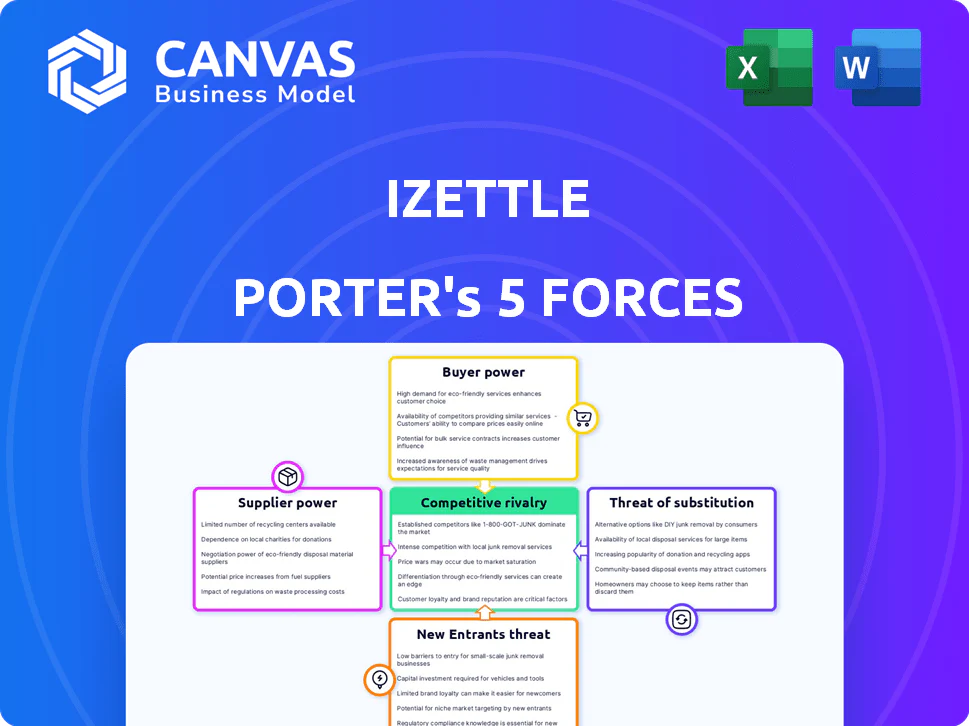
IZETTLE PORTER'S FIVE FORCES TEMPLATE RESEARCH
What is included in the product
 Detailed Word Document
Analyzes iZettle's competitive position through Porter's Five Forces, evaluating threats and opportunities.

 Customizable Excel Spreadsheet
Analyze industry forces swiftly, generating data-driven insights for better strategy.
Preview the Actual Deliverable
iZettle Porter's Five Forces Analysis
This preview presents the complete Porter's Five Forces analysis of iZettle. It covers all five forces, offering a thorough market assessment. The document you see mirrors the one you'll receive immediately after purchase, including all data and insights. This is the full, ready-to-use analysis file—precisely what you'll download. No modifications needed; it’s prepared for your use.

Porter's Five Forces Analysis Template

Don't Miss the Bigger Picture
iZettle operates in a dynamic payments landscape, shaped by diverse competitive forces. The threat of new entrants, like fintech startups, is moderate. Bargaining power of buyers, including merchants, is significant due to numerous payment options. Supplier power, mainly from card networks, holds considerable influence. The risk from substitute products, such as cash, remains a factor. Rivalry among existing competitors, including established players, is high.
This preview is just the starting point. Dive into a complete, consultant-grade breakdown of iZettle’s industry competitiveness—ready for immediate use.
Suppliers Bargaining Power

Hardware Manufacturers
iZettle depends on hardware suppliers for card readers and POS devices. The bargaining power of these suppliers is moderate. This is affected by the availability of other manufacturers. If a supplier has unique tech, their power rises. For example, in 2024, the global POS terminal market was valued at $85 billion.
Payment Networks
iZettle's access to payment networks like Visa, Mastercard, and American Express is essential for processing transactions. These networks wield considerable bargaining power due to their extensive acceptance and infrastructure. iZettle must comply with their regulations and pay processing fees. For example, in 2024, Visa and Mastercard controlled around 60% of the U.S. debit and credit card purchase volume, showing their dominance.

Software and Technology Providers
iZettle depends on software and tech providers. Their power hinges on the software's importance and switching costs. If alternatives are scarce or offer unique features, suppliers hold more sway. For example, in 2024, cloud computing spending is projected to reach over $670 billion, highlighting supplier influence.

Financial Institutions
iZettle relies on financial institutions for transaction processing and fund transfers, making them essential suppliers. These institutions, including banks and payment processors, wield significant bargaining power due to their critical role in the payment ecosystem. Their established relationships with businesses further strengthen their influence. For example, in 2024, the global payment processing market was valued at over $70 billion, with major players controlling substantial market share.
- High Dependency: iZettle's operations are directly dependent on these institutions.
- Market Concentration: A few key players dominate the payment processing industry.
- Pricing Power: Financial institutions can dictate fees and terms.
- Switching Costs: Changing providers can be complex and costly for iZettle.
Telecommunication Providers
iZettle relies heavily on telecom providers for reliable internet and mobile network access, crucial for its mobile POS systems. The bargaining power of these providers fluctuates based on regional competition. In areas with few providers, iZettle might face higher costs and less favorable terms. For example, in 2024, the average cost of mobile data in the US was $5.62 per GB, while in India, it was around $0.17 per GB, showing the variability.
- Dependence on network reliability.
- Regional price and service differences.
- Impact of data costs on operational expenses.
- Availability of alternatives and their impact.
iZettle's Supplier Dynamics: Power Plays
iZettle's suppliers span hardware, payment networks, software, financial institutions, and telecom providers. The bargaining power varies among these. For instance, financial institutions and payment networks have strong influence. The telecom market's fragmentation affects supplier power.
| Supplier Type | Bargaining Power | Example |
|---|---|---|
| Payment Networks | High | Visa & Mastercard control ~60% of US card volume in 2024 |
| Financial Institutions | High | Global payment processing market valued at $70B+ in 2024 |
| Telecom Providers | Variable | Data cost US ~$5.62/GB vs India $0.17/GB in 2024 |
Customers Bargaining Power

Small Businesses
iZettle's main clients are small businesses, giving them a good amount of bargaining power. They can choose from many POS and payment options. Switching costs are low, and small businesses are often price-sensitive. In 2024, the global POS market was worth over $100 billion.
Price Sensitivity
Small businesses are frequently price-sensitive, seeking affordable options. iZettle's transaction fees directly impact customer costs. Competitors like Square offer similar services, influencing iZettle's pricing. In 2024, the market saw intense competition, forcing providers to adjust fees. Customers compare payment processing costs, affecting iZettle's market share.

Availability of Alternatives
Customers have many POS options. Competitors like Square and SumUp offer alternatives. This abundance of choices strengthens customer bargaining power. For example, Square processed $208 billion in 2023, showing its market presence. This allows customers to negotiate or switch easily.

Low Switching Costs
Customer bargaining power is amplified by low switching costs in the mobile POS sector. Cloud-based systems simplify transitions between providers, increasing customer leverage. This ease of movement forces iZettle to compete fiercely on price and service. In 2024, the average churn rate for POS systems was around 15%, indicating customer flexibility.
- Low switching costs mean customers can easily move to competitors.
- Cloud-based solutions facilitate easier transitions.
- iZettle must offer competitive pricing and service.
- The POS industry's churn rate highlights customer mobility.
Access to Information
Customers wield significant power due to readily available information on POS solutions. Online reviews, comparison sites, and social media provide transparency, enabling informed decisions. This knowledge base strengthens their negotiating position, allowing them to seek better terms.
- 68% of consumers check online reviews before making a purchase, influencing their POS choice.
- The global POS market is projected to reach $107.7 billion by 2024, increasing customer options.
- Comparison websites offer side-by-side analysis, empowering customers to find the best deals.
- Social media discussions provide real-time insights on POS performance and customer service.
iZettle's 2024 Challenges: Price Wars & Customer Churn
Small businesses, iZettle's main customers, have strong bargaining power. They can easily switch between POS systems and are price-sensitive. In 2024, the POS market was highly competitive.
| Aspect | Impact on iZettle | 2024 Data |
|---|---|---|
| Price Sensitivity | Forces competitive pricing. | Market fees adjustments |
| Switching Costs | Low switching costs. | Churn rate around 15% |
| Information Availability | Informed customer decisions. | POS market size $107.7B |
Rivalry Among Competitors

Numerous Competitors
The POS and mobile payment solutions market is fiercely competitive. iZettle faces rivals like Square and SumUp. This rivalry spurs innovation. It can also squeeze prices and profits. For example, Square's revenue in 2023 was approximately $20.8 billion.
Feature Differentiation
Competitors consistently roll out new features. They differentiate with inventory, loyalty programs, and e-commerce. iZettle must innovate to stay ahead. In 2024, the POS market grew, with feature-rich systems gaining traction. The global POS market was valued at $89.3 billion in 2024.

Pricing Strategies
Pricing is a major battleground in the iZettle market. Competitors like Square and SumUp offer different fee structures, from flat rates to subscription tiers. These pricing models are easily compared, intensifying the price war. For example, Square's transaction fee is 2.6% + $0.10, while iZettle's can vary. In 2024, price competition is fierce.

Focus on Small Businesses
Competition is fierce in the small business sector, iZettle's main target. Numerous competitors offer similar point-of-sale (POS) and payment processing services tailored for small businesses. This direct competition in their primary market segment significantly impacts iZettle. According to a 2024 report, the POS market is projected to reach $100 billion globally, with small businesses representing a large share.
- Square, a key competitor, reported over $2 billion in hardware revenue in 2024, indicating strong competition.
- The increasing number of POS providers creates price pressure.
- Customer acquisition costs rise due to the need to stand out.
- Innovation in features and services is crucial to remain competitive.
Technological Advancements
Technological advancements significantly impact competition in the payment processing sector. The quick shift towards contactless payments, mobile wallets, and integrated systems forces companies to innovate. Those that lag behind risk losing market share, intensifying rivalry. For example, the global contactless payments market was valued at $4.7 trillion in 2023.
- Rapid innovation in payment solutions.
- Need for continuous adaptation.
- Increased competition.
- Contactless payments market growth.
POS Market Heats Up: Rivals Challenge iZettle
iZettle faces intense rivalry in the POS market. Competitors like Square and SumUp drive innovation. Price wars and feature competition are significant. In 2024, the POS market was worth $89.3B.
| Aspect | Impact | 2024 Data |
|---|---|---|
| Key Rivals | Square, SumUp | Square's hardware revenue: $2B+ |
| Competition | Pricing, Features | POS market value: $89.3B |
| Innovation | Essential for survival | Contactless payments: $4.7T (2023) |
Original: $10.00
-65%$10.00
$3.50IZETTLE PORTER'S FIVE FORCES TEMPLATE RESEARCH
What is included in the product
Detailed Word Document
Analyzes iZettle's competitive position through Porter's Five Forces, evaluating threats and opportunities.
Customizable Excel Spreadsheet
Analyze industry forces swiftly, generating data-driven insights for better strategy.
Preview the Actual Deliverable
iZettle Porter's Five Forces Analysis
This preview presents the complete Porter's Five Forces analysis of iZettle. It covers all five forces, offering a thorough market assessment. The document you see mirrors the one you'll receive immediately after purchase, including all data and insights. This is the full, ready-to-use analysis file—precisely what you'll download. No modifications needed; it’s prepared for your use.
Porter's Five Forces Analysis Template
Don't Miss the Bigger Picture
iZettle operates in a dynamic payments landscape, shaped by diverse competitive forces. The threat of new entrants, like fintech startups, is moderate. Bargaining power of buyers, including merchants, is significant due to numerous payment options. Supplier power, mainly from card networks, holds considerable influence. The risk from substitute products, such as cash, remains a factor. Rivalry among existing competitors, including established players, is high.
This preview is just the starting point. Dive into a complete, consultant-grade breakdown of iZettle’s industry competitiveness—ready for immediate use.
Suppliers Bargaining Power
Hardware Manufacturers
iZettle depends on hardware suppliers for card readers and POS devices. The bargaining power of these suppliers is moderate. This is affected by the availability of other manufacturers. If a supplier has unique tech, their power rises. For example, in 2024, the global POS terminal market was valued at $85 billion.
Payment Networks
iZettle's access to payment networks like Visa, Mastercard, and American Express is essential for processing transactions. These networks wield considerable bargaining power due to their extensive acceptance and infrastructure. iZettle must comply with their regulations and pay processing fees. For example, in 2024, Visa and Mastercard controlled around 60% of the U.S. debit and credit card purchase volume, showing their dominance.
Software and Technology Providers
iZettle depends on software and tech providers. Their power hinges on the software's importance and switching costs. If alternatives are scarce or offer unique features, suppliers hold more sway. For example, in 2024, cloud computing spending is projected to reach over $670 billion, highlighting supplier influence.
Financial Institutions
iZettle relies on financial institutions for transaction processing and fund transfers, making them essential suppliers. These institutions, including banks and payment processors, wield significant bargaining power due to their critical role in the payment ecosystem. Their established relationships with businesses further strengthen their influence. For example, in 2024, the global payment processing market was valued at over $70 billion, with major players controlling substantial market share.
- High Dependency: iZettle's operations are directly dependent on these institutions.
- Market Concentration: A few key players dominate the payment processing industry.
- Pricing Power: Financial institutions can dictate fees and terms.
- Switching Costs: Changing providers can be complex and costly for iZettle.
Telecommunication Providers
iZettle relies heavily on telecom providers for reliable internet and mobile network access, crucial for its mobile POS systems. The bargaining power of these providers fluctuates based on regional competition. In areas with few providers, iZettle might face higher costs and less favorable terms. For example, in 2024, the average cost of mobile data in the US was $5.62 per GB, while in India, it was around $0.17 per GB, showing the variability.
- Dependence on network reliability.
- Regional price and service differences.
- Impact of data costs on operational expenses.
- Availability of alternatives and their impact.
iZettle's Supplier Dynamics: Power Plays
iZettle's suppliers span hardware, payment networks, software, financial institutions, and telecom providers. The bargaining power varies among these. For instance, financial institutions and payment networks have strong influence. The telecom market's fragmentation affects supplier power.
| Supplier Type | Bargaining Power | Example |
|---|---|---|
| Payment Networks | High | Visa & Mastercard control ~60% of US card volume in 2024 |
| Financial Institutions | High | Global payment processing market valued at $70B+ in 2024 |
| Telecom Providers | Variable | Data cost US ~$5.62/GB vs India $0.17/GB in 2024 |
Customers Bargaining Power
Small Businesses
iZettle's main clients are small businesses, giving them a good amount of bargaining power. They can choose from many POS and payment options. Switching costs are low, and small businesses are often price-sensitive. In 2024, the global POS market was worth over $100 billion.
Price Sensitivity
Small businesses are frequently price-sensitive, seeking affordable options. iZettle's transaction fees directly impact customer costs. Competitors like Square offer similar services, influencing iZettle's pricing. In 2024, the market saw intense competition, forcing providers to adjust fees. Customers compare payment processing costs, affecting iZettle's market share.
Availability of Alternatives
Customers have many POS options. Competitors like Square and SumUp offer alternatives. This abundance of choices strengthens customer bargaining power. For example, Square processed $208 billion in 2023, showing its market presence. This allows customers to negotiate or switch easily.
Low Switching Costs
Customer bargaining power is amplified by low switching costs in the mobile POS sector. Cloud-based systems simplify transitions between providers, increasing customer leverage. This ease of movement forces iZettle to compete fiercely on price and service. In 2024, the average churn rate for POS systems was around 15%, indicating customer flexibility.
- Low switching costs mean customers can easily move to competitors.
- Cloud-based solutions facilitate easier transitions.
- iZettle must offer competitive pricing and service.
- The POS industry's churn rate highlights customer mobility.
Access to Information
Customers wield significant power due to readily available information on POS solutions. Online reviews, comparison sites, and social media provide transparency, enabling informed decisions. This knowledge base strengthens their negotiating position, allowing them to seek better terms.
- 68% of consumers check online reviews before making a purchase, influencing their POS choice.
- The global POS market is projected to reach $107.7 billion by 2024, increasing customer options.
- Comparison websites offer side-by-side analysis, empowering customers to find the best deals.
- Social media discussions provide real-time insights on POS performance and customer service.
iZettle's 2024 Challenges: Price Wars & Customer Churn
Small businesses, iZettle's main customers, have strong bargaining power. They can easily switch between POS systems and are price-sensitive. In 2024, the POS market was highly competitive.
| Aspect | Impact on iZettle | 2024 Data |
|---|---|---|
| Price Sensitivity | Forces competitive pricing. | Market fees adjustments |
| Switching Costs | Low switching costs. | Churn rate around 15% |
| Information Availability | Informed customer decisions. | POS market size $107.7B |
Rivalry Among Competitors
Numerous Competitors
The POS and mobile payment solutions market is fiercely competitive. iZettle faces rivals like Square and SumUp. This rivalry spurs innovation. It can also squeeze prices and profits. For example, Square's revenue in 2023 was approximately $20.8 billion.
Feature Differentiation
Competitors consistently roll out new features. They differentiate with inventory, loyalty programs, and e-commerce. iZettle must innovate to stay ahead. In 2024, the POS market grew, with feature-rich systems gaining traction. The global POS market was valued at $89.3 billion in 2024.
Pricing Strategies
Pricing is a major battleground in the iZettle market. Competitors like Square and SumUp offer different fee structures, from flat rates to subscription tiers. These pricing models are easily compared, intensifying the price war. For example, Square's transaction fee is 2.6% + $0.10, while iZettle's can vary. In 2024, price competition is fierce.
Focus on Small Businesses
Competition is fierce in the small business sector, iZettle's main target. Numerous competitors offer similar point-of-sale (POS) and payment processing services tailored for small businesses. This direct competition in their primary market segment significantly impacts iZettle. According to a 2024 report, the POS market is projected to reach $100 billion globally, with small businesses representing a large share.
- Square, a key competitor, reported over $2 billion in hardware revenue in 2024, indicating strong competition.
- The increasing number of POS providers creates price pressure.
- Customer acquisition costs rise due to the need to stand out.
- Innovation in features and services is crucial to remain competitive.
Technological Advancements
Technological advancements significantly impact competition in the payment processing sector. The quick shift towards contactless payments, mobile wallets, and integrated systems forces companies to innovate. Those that lag behind risk losing market share, intensifying rivalry. For example, the global contactless payments market was valued at $4.7 trillion in 2023.
- Rapid innovation in payment solutions.
- Need for continuous adaptation.
- Increased competition.
- Contactless payments market growth.
POS Market Heats Up: Rivals Challenge iZettle
iZettle faces intense rivalry in the POS market. Competitors like Square and SumUp drive innovation. Price wars and feature competition are significant. In 2024, the POS market was worth $89.3B.
| Aspect | Impact | 2024 Data |
|---|---|---|
| Key Rivals | Square, SumUp | Square's hardware revenue: $2B+ |
| Competition | Pricing, Features | POS market value: $89.3B |
| Innovation | Essential for survival | Contactless payments: $4.7T (2023) |
Product Information
Product Information
Shipping & Returns
Shipping & Returns
Description
What is included in the product
Detailed Word Document
Analyzes iZettle's competitive position through Porter's Five Forces, evaluating threats and opportunities.
Customizable Excel Spreadsheet
Analyze industry forces swiftly, generating data-driven insights for better strategy.
Preview the Actual Deliverable
iZettle Porter's Five Forces Analysis
This preview presents the complete Porter's Five Forces analysis of iZettle. It covers all five forces, offering a thorough market assessment. The document you see mirrors the one you'll receive immediately after purchase, including all data and insights. This is the full, ready-to-use analysis file—precisely what you'll download. No modifications needed; it’s prepared for your use.
Porter's Five Forces Analysis Template
Don't Miss the Bigger Picture
iZettle operates in a dynamic payments landscape, shaped by diverse competitive forces. The threat of new entrants, like fintech startups, is moderate. Bargaining power of buyers, including merchants, is significant due to numerous payment options. Supplier power, mainly from card networks, holds considerable influence. The risk from substitute products, such as cash, remains a factor. Rivalry among existing competitors, including established players, is high.
This preview is just the starting point. Dive into a complete, consultant-grade breakdown of iZettle’s industry competitiveness—ready for immediate use.
Suppliers Bargaining Power
Hardware Manufacturers
iZettle depends on hardware suppliers for card readers and POS devices. The bargaining power of these suppliers is moderate. This is affected by the availability of other manufacturers. If a supplier has unique tech, their power rises. For example, in 2024, the global POS terminal market was valued at $85 billion.
Payment Networks
iZettle's access to payment networks like Visa, Mastercard, and American Express is essential for processing transactions. These networks wield considerable bargaining power due to their extensive acceptance and infrastructure. iZettle must comply with their regulations and pay processing fees. For example, in 2024, Visa and Mastercard controlled around 60% of the U.S. debit and credit card purchase volume, showing their dominance.
Software and Technology Providers
iZettle depends on software and tech providers. Their power hinges on the software's importance and switching costs. If alternatives are scarce or offer unique features, suppliers hold more sway. For example, in 2024, cloud computing spending is projected to reach over $670 billion, highlighting supplier influence.
Financial Institutions
iZettle relies on financial institutions for transaction processing and fund transfers, making them essential suppliers. These institutions, including banks and payment processors, wield significant bargaining power due to their critical role in the payment ecosystem. Their established relationships with businesses further strengthen their influence. For example, in 2024, the global payment processing market was valued at over $70 billion, with major players controlling substantial market share.
- High Dependency: iZettle's operations are directly dependent on these institutions.
- Market Concentration: A few key players dominate the payment processing industry.
- Pricing Power: Financial institutions can dictate fees and terms.
- Switching Costs: Changing providers can be complex and costly for iZettle.
Telecommunication Providers
iZettle relies heavily on telecom providers for reliable internet and mobile network access, crucial for its mobile POS systems. The bargaining power of these providers fluctuates based on regional competition. In areas with few providers, iZettle might face higher costs and less favorable terms. For example, in 2024, the average cost of mobile data in the US was $5.62 per GB, while in India, it was around $0.17 per GB, showing the variability.
- Dependence on network reliability.
- Regional price and service differences.
- Impact of data costs on operational expenses.
- Availability of alternatives and their impact.
iZettle's Supplier Dynamics: Power Plays
iZettle's suppliers span hardware, payment networks, software, financial institutions, and telecom providers. The bargaining power varies among these. For instance, financial institutions and payment networks have strong influence. The telecom market's fragmentation affects supplier power.
| Supplier Type | Bargaining Power | Example |
|---|---|---|
| Payment Networks | High | Visa & Mastercard control ~60% of US card volume in 2024 |
| Financial Institutions | High | Global payment processing market valued at $70B+ in 2024 |
| Telecom Providers | Variable | Data cost US ~$5.62/GB vs India $0.17/GB in 2024 |
Customers Bargaining Power
Small Businesses
iZettle's main clients are small businesses, giving them a good amount of bargaining power. They can choose from many POS and payment options. Switching costs are low, and small businesses are often price-sensitive. In 2024, the global POS market was worth over $100 billion.
Price Sensitivity
Small businesses are frequently price-sensitive, seeking affordable options. iZettle's transaction fees directly impact customer costs. Competitors like Square offer similar services, influencing iZettle's pricing. In 2024, the market saw intense competition, forcing providers to adjust fees. Customers compare payment processing costs, affecting iZettle's market share.
Availability of Alternatives
Customers have many POS options. Competitors like Square and SumUp offer alternatives. This abundance of choices strengthens customer bargaining power. For example, Square processed $208 billion in 2023, showing its market presence. This allows customers to negotiate or switch easily.
Low Switching Costs
Customer bargaining power is amplified by low switching costs in the mobile POS sector. Cloud-based systems simplify transitions between providers, increasing customer leverage. This ease of movement forces iZettle to compete fiercely on price and service. In 2024, the average churn rate for POS systems was around 15%, indicating customer flexibility.
- Low switching costs mean customers can easily move to competitors.
- Cloud-based solutions facilitate easier transitions.
- iZettle must offer competitive pricing and service.
- The POS industry's churn rate highlights customer mobility.
Access to Information
Customers wield significant power due to readily available information on POS solutions. Online reviews, comparison sites, and social media provide transparency, enabling informed decisions. This knowledge base strengthens their negotiating position, allowing them to seek better terms.
- 68% of consumers check online reviews before making a purchase, influencing their POS choice.
- The global POS market is projected to reach $107.7 billion by 2024, increasing customer options.
- Comparison websites offer side-by-side analysis, empowering customers to find the best deals.
- Social media discussions provide real-time insights on POS performance and customer service.
iZettle's 2024 Challenges: Price Wars & Customer Churn
Small businesses, iZettle's main customers, have strong bargaining power. They can easily switch between POS systems and are price-sensitive. In 2024, the POS market was highly competitive.
| Aspect | Impact on iZettle | 2024 Data |
|---|---|---|
| Price Sensitivity | Forces competitive pricing. | Market fees adjustments |
| Switching Costs | Low switching costs. | Churn rate around 15% |
| Information Availability | Informed customer decisions. | POS market size $107.7B |
Rivalry Among Competitors
Numerous Competitors
The POS and mobile payment solutions market is fiercely competitive. iZettle faces rivals like Square and SumUp. This rivalry spurs innovation. It can also squeeze prices and profits. For example, Square's revenue in 2023 was approximately $20.8 billion.
Feature Differentiation
Competitors consistently roll out new features. They differentiate with inventory, loyalty programs, and e-commerce. iZettle must innovate to stay ahead. In 2024, the POS market grew, with feature-rich systems gaining traction. The global POS market was valued at $89.3 billion in 2024.
Pricing Strategies
Pricing is a major battleground in the iZettle market. Competitors like Square and SumUp offer different fee structures, from flat rates to subscription tiers. These pricing models are easily compared, intensifying the price war. For example, Square's transaction fee is 2.6% + $0.10, while iZettle's can vary. In 2024, price competition is fierce.
Focus on Small Businesses
Competition is fierce in the small business sector, iZettle's main target. Numerous competitors offer similar point-of-sale (POS) and payment processing services tailored for small businesses. This direct competition in their primary market segment significantly impacts iZettle. According to a 2024 report, the POS market is projected to reach $100 billion globally, with small businesses representing a large share.
- Square, a key competitor, reported over $2 billion in hardware revenue in 2024, indicating strong competition.
- The increasing number of POS providers creates price pressure.
- Customer acquisition costs rise due to the need to stand out.
- Innovation in features and services is crucial to remain competitive.
Technological Advancements
Technological advancements significantly impact competition in the payment processing sector. The quick shift towards contactless payments, mobile wallets, and integrated systems forces companies to innovate. Those that lag behind risk losing market share, intensifying rivalry. For example, the global contactless payments market was valued at $4.7 trillion in 2023.
- Rapid innovation in payment solutions.
- Need for continuous adaptation.
- Increased competition.
- Contactless payments market growth.
POS Market Heats Up: Rivals Challenge iZettle
iZettle faces intense rivalry in the POS market. Competitors like Square and SumUp drive innovation. Price wars and feature competition are significant. In 2024, the POS market was worth $89.3B.
| Aspect | Impact | 2024 Data |
|---|---|---|
| Key Rivals | Square, SumUp | Square's hardware revenue: $2B+ |
| Competition | Pricing, Features | POS market value: $89.3B |
| Innovation | Essential for survival | Contactless payments: $4.7T (2023) |











