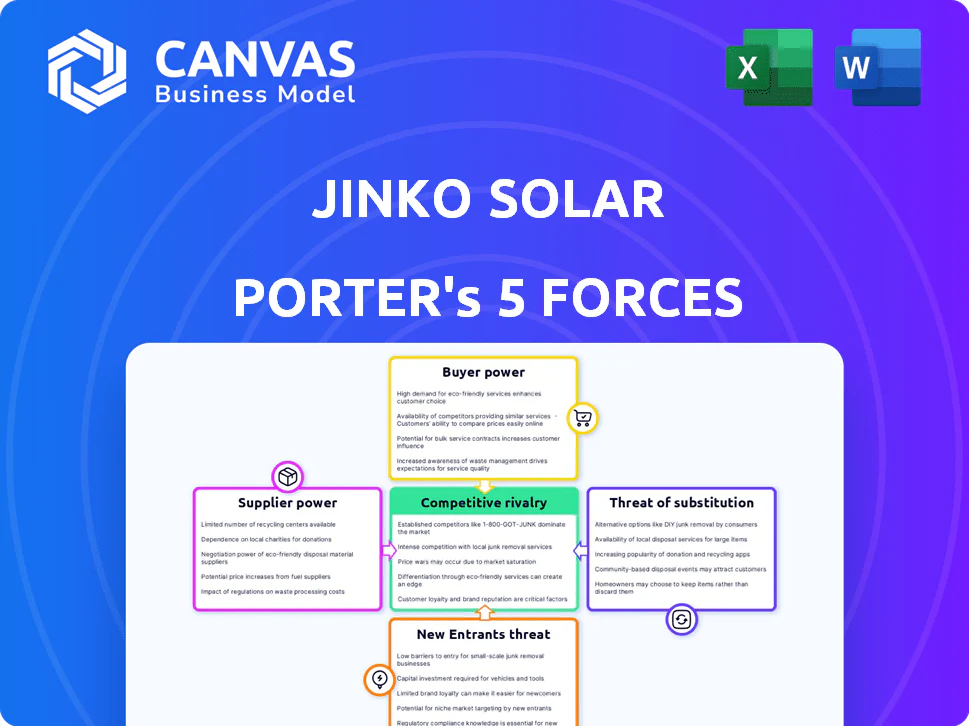
JINKO SOLAR PORTER'S FIVE FORCES TEMPLATE RESEARCH

Don't Miss the Bigger Picture
Jinko Solar faces intense rivalry from scale-driven rivals, moderate supplier leverage for polysilicon and wafers, rising buyer price sensitivity, growing threats from alternative energy/storage, and substantial barriers for new entrants due to capital and tech intensity; this snapshot skims the surface-unlock the full Porter's Five Forces Analysis to explore detailed ratings, visuals, and strategic implications for investment or planning.
Suppliers Bargaining Power

Polysilicon Oversupply Neutralizes Upstream Leverage
Polysilicon Oversupply Neutralizes Upstream Leverage: despite a 9% price rebound in early 2026 following China's capacity controls, polysilicon remains structurally oversupplied with global capacity at ~1.2 million MT vs. demand ~850k MT in 2025, keeping prices depressed and giving JinkoSolar a buyer's market.
Suppliers now compete on volume not terms; JinkoSolar secured spot contracts at ~$8.50/kg in Q1 2026 versus peaks of $12/kg in 2024, cutting input cost risk.
As of Q1 2026, over 60 polysilicon producers operate globally, fragmenting supply and reducing individual supplier bargaining power, letting JinkoSolar negotiate favorable lead times and payment terms.
Vertical Integration as a Strategic Ceiling
JinkoSolar reached 120 GW wafer and 95 GW cell capacity by end-2025, making it its own main supplier for most inputs; this vertical integration cut COGS per W by ~8% in FY2025 and limits suppliers' pricing power.

Critical Commodity Pressure from Silver and Aluminum
Non-silicon suppliers-chiefly silver paste and aluminum-frame makers-wielded rising power in 2025 as silver paste costs surged 62% YoY, reaching about $0.12/cm2, overtaking wafer costs (~$0.10/cm2) for high-efficiency cells late 2025; aluminum extrusion prices rose ~28% YoY, pressuring margins.
To limit volatility, JinkoSolar signed multi-year fixed-volume deals covering ~65% of its 2026 silver paste needs and locked aluminum supplies for 55% of frame volume, reducing short-term exposure but increasing contractual rigidity and capex planning risk.

Secured Long-term Premium Partnerships
JinkoSolar secures long-term supply with Wacker Chemie for 70,000 metric tons of polysilicon through Dec 2026, using market-indexed pricing that avoids lock-in to high fixed costs while ensuring high-purity feedstock availability.
This blend of volume certainty and price linkage preserves JinkoSolar's buying leverage, lowering supply risk and supporting competitive module margins in 2025.
- 70,000 MT polysilicon deal (Wacker, thru Dec 2026)
- Market-indexed pricing - shields vs. fixed-price spikes
- High-purity supply supports >20% module efficiency yields
- Reduces procurement risk, strengthens margin control in 2025
Shift Toward Localized Supply Chains
JinkoSolar is signing multi-year deals with U.S. regional suppliers like NextPower for U.S.-made steel frames to meet U.S. Made and reduce geopolitical risk; the firm secured a 5-year supply pact in 2025 covering ~1.2 GW of modules.
These specialized local suppliers command higher bargaining power than commodity vendors due to limited domestic manufacturing; U.S. solar module frame capacity stood at ~1.8 GW in 2025, making suppliers scarce.
Still, JinkoSolar's scale-~25 GW global module shipments in FY2025-makes it an anchor tenant suppliers can't afford to lose, preserving Jinko's leverage on price and priority.
- 5-year NextPower deal ~1.2 GW (2025)
- U.S. frame capacity ~1.8 GW (2025)
- JinkoSolar shipments ~25 GW (FY2025)
Polysilicon glut trims supplier power; Jinko verticalization cuts leverage, US frames tight
Suppliers' bargaining power is low overall: polysilicon oversupply (1.2M MT capacity vs 850k MT demand in 2025) plus JinkoSolar verticalization (120 GW wafer/95 GW cell capacity, 25 GW shipments FY2025) and a 70,000 MT Wacker deal cut supplier leverage; localized U.S. frame scarcity (1.8 GW) raises power selectively.
| Metric | 2025 |
|---|---|
| Polysilicon capacity | 1.2M MT |
| Demand | 850k MT |
| Jinko wafer/cell cap. | 120/95 GW |
| Jinko shipments | 25 GW |
| Wacker deal | 70,000 MT |
| US frame cap. | 1.8 GW |
What is included in the product
 Detailed Word Document
Tailored exclusively for Jinko Solar, this Porter's Five Forces overview pinpoints competitive intensity, supplier and buyer leverage, new-entrant barriers, and substitute threats-highlighting disruptive tech and pricing pressures that shape its profitability.

 Customizable Excel Spreadsheet
Concise Porter's Five Forces snapshot for JinkoSolar-quickly surface competitive pressures and strategic levers to inform investment or corporate responses.
Customers Bargaining Power

Utility-Scale Buyers Demand Price Transparency
Utility-scale buyers-primarily large developers-wield strong leverage over JinkoSolar due to order sizes often exceeding 100 MW, enabling aggressive price negotiation.
They use real-time market data and reverse auctions to compress margins; in 2025 average global module ASP fell to about $0.19/W, heightening pressure on manufacturers.
Even in 2026 with stabilizing ASPs near $0.20/W, utilities pit top makers against each other to lower LCOE, forcing JinkoSolar to match competitive bids.
Technological Differentiation Creates 'Sticky' Demand
JinkoSolar shifted mix to N-type TOPCon; Tiger Neo made up ~38% of 2025 shipments and management targets >60% by 2026, creating product stickiness.
With conversion up to 24.8% and lower annual degradation (~0.3% vs 0.5%), buyers chasing ROI face high switching costs.
JinkoSolar extracts a 1-2 US cents/W premium, helping offset buyer leverage; FY2025 module ASPs averaged about $0.22/W, so premium adds ~0.45-0.9% to revenue.

Low Switching Costs for Standardized Products
Despite JinkoSolar's brand strength, the global solar module market is highly commoditized for mid-to-low tier residential and commercial projects; switching costs are effectively zero as most Tier 1 modules match on form factor and installation, so buyers freely shift to lowest price.

Growing Leverage from Energy Storage Integration
Bundling JinkoSolar modules with its proprietary BESS raised customer stickiness as solar-plus-storage demand surged; Jinko reported 2025 system sales of $3.1bn, with storage-linked contracts up 42% YoY, making module-only swaps harder.
By 2026, AI data centers and grid projects favor integrated solutions; industry data show 58% of new commercial projects specify storage, cutting buyer switching power.
- 2025 system revenue $3.1bn
- Storage-linked contracts +42% YoY (2025)
- 58% of 2026 commercial projects require storage
- System sales reduce easy swapping vs module-only rivals
Geopolitical Restrictions Limit Buyer Choice
Geopolitical trade barriers and strict ESG sourcing rules in the U.S. and EU shrink the pool of bankable solar suppliers, raising switching costs for large developers.
JinkoSolar's 2025 footprint-U.S. cell/module lines in Florida (initial capacity ~3 GW) plus SE Asia plants-positions it as one of few compliant, bankable vendors.
This narrows buyer options and lowers customer bargaining power, supporting firmer pricing and longer-term contracts.
- U.S./EU ESG rules limit bankable suppliers
- JinkoSolar ~3 GW U.S. capacity (2025)
- Fewer compliant vendors → reduced buyer leverage
JinkoSolar's premium ASPs vs market pressure-Tiger Neo, storage growth boost stickiness
Buyers hold strong price leverage on JinkoSolar-2025 module ASPs ~$0.22/W vs market ~$0.19/W-yet Jinko's Tiger Neo (38% of 2025 shipments) and $3.1bn system sales (storage-linked +42% YoY) raise switching costs; U.S. ~3 GW local capacity and ESG rules narrow bankable suppliers, softening buyer power.
| Metric | 2025 |
|---|---|
| Module ASP (Company) | $0.22/W |
| Market ASP | $0.19/W |
| Tiger Neo share | 38% |
| System revenue | $3.1bn |
| Storage-linked growth | +42% YoY |
| U.S. capacity | ~3 GW |
Same Document Delivered
Jinko Solar Porter's Five Forces Analysis
This preview shows the exact Jinko Solar Porter's Five Forces analysis you'll receive immediately after purchase-no surprises, no placeholders. The report assesses supplier power, buyer power, competitive rivalry, threat of new entrants, and threat of substitutes with data-driven insights and implications for strategy. It's fully formatted and ready for download.

Original: $10.00
-65%$10.00
$3.50JINKO SOLAR PORTER'S FIVE FORCES TEMPLATE RESEARCH
Don't Miss the Bigger Picture
Jinko Solar faces intense rivalry from scale-driven rivals, moderate supplier leverage for polysilicon and wafers, rising buyer price sensitivity, growing threats from alternative energy/storage, and substantial barriers for new entrants due to capital and tech intensity; this snapshot skims the surface-unlock the full Porter's Five Forces Analysis to explore detailed ratings, visuals, and strategic implications for investment or planning.
Suppliers Bargaining Power
Polysilicon Oversupply Neutralizes Upstream Leverage
Polysilicon Oversupply Neutralizes Upstream Leverage: despite a 9% price rebound in early 2026 following China's capacity controls, polysilicon remains structurally oversupplied with global capacity at ~1.2 million MT vs. demand ~850k MT in 2025, keeping prices depressed and giving JinkoSolar a buyer's market.
Suppliers now compete on volume not terms; JinkoSolar secured spot contracts at ~$8.50/kg in Q1 2026 versus peaks of $12/kg in 2024, cutting input cost risk.
As of Q1 2026, over 60 polysilicon producers operate globally, fragmenting supply and reducing individual supplier bargaining power, letting JinkoSolar negotiate favorable lead times and payment terms.
Vertical Integration as a Strategic Ceiling
JinkoSolar reached 120 GW wafer and 95 GW cell capacity by end-2025, making it its own main supplier for most inputs; this vertical integration cut COGS per W by ~8% in FY2025 and limits suppliers' pricing power.
Critical Commodity Pressure from Silver and Aluminum
Non-silicon suppliers-chiefly silver paste and aluminum-frame makers-wielded rising power in 2025 as silver paste costs surged 62% YoY, reaching about $0.12/cm2, overtaking wafer costs (~$0.10/cm2) for high-efficiency cells late 2025; aluminum extrusion prices rose ~28% YoY, pressuring margins.
To limit volatility, JinkoSolar signed multi-year fixed-volume deals covering ~65% of its 2026 silver paste needs and locked aluminum supplies for 55% of frame volume, reducing short-term exposure but increasing contractual rigidity and capex planning risk.
Secured Long-term Premium Partnerships
JinkoSolar secures long-term supply with Wacker Chemie for 70,000 metric tons of polysilicon through Dec 2026, using market-indexed pricing that avoids lock-in to high fixed costs while ensuring high-purity feedstock availability.
This blend of volume certainty and price linkage preserves JinkoSolar's buying leverage, lowering supply risk and supporting competitive module margins in 2025.
- 70,000 MT polysilicon deal (Wacker, thru Dec 2026)
- Market-indexed pricing - shields vs. fixed-price spikes
- High-purity supply supports >20% module efficiency yields
- Reduces procurement risk, strengthens margin control in 2025
Shift Toward Localized Supply Chains
JinkoSolar is signing multi-year deals with U.S. regional suppliers like NextPower for U.S.-made steel frames to meet U.S. Made and reduce geopolitical risk; the firm secured a 5-year supply pact in 2025 covering ~1.2 GW of modules.
These specialized local suppliers command higher bargaining power than commodity vendors due to limited domestic manufacturing; U.S. solar module frame capacity stood at ~1.8 GW in 2025, making suppliers scarce.
Still, JinkoSolar's scale-~25 GW global module shipments in FY2025-makes it an anchor tenant suppliers can't afford to lose, preserving Jinko's leverage on price and priority.
- 5-year NextPower deal ~1.2 GW (2025)
- U.S. frame capacity ~1.8 GW (2025)
- JinkoSolar shipments ~25 GW (FY2025)
Polysilicon glut trims supplier power; Jinko verticalization cuts leverage, US frames tight
Suppliers' bargaining power is low overall: polysilicon oversupply (1.2M MT capacity vs 850k MT demand in 2025) plus JinkoSolar verticalization (120 GW wafer/95 GW cell capacity, 25 GW shipments FY2025) and a 70,000 MT Wacker deal cut supplier leverage; localized U.S. frame scarcity (1.8 GW) raises power selectively.
| Metric | 2025 |
|---|---|
| Polysilicon capacity | 1.2M MT |
| Demand | 850k MT |
| Jinko wafer/cell cap. | 120/95 GW |
| Jinko shipments | 25 GW |
| Wacker deal | 70,000 MT |
| US frame cap. | 1.8 GW |
What is included in the product
Detailed Word Document
Tailored exclusively for Jinko Solar, this Porter's Five Forces overview pinpoints competitive intensity, supplier and buyer leverage, new-entrant barriers, and substitute threats-highlighting disruptive tech and pricing pressures that shape its profitability.
Customizable Excel Spreadsheet
Concise Porter's Five Forces snapshot for JinkoSolar-quickly surface competitive pressures and strategic levers to inform investment or corporate responses.
Customers Bargaining Power
Utility-Scale Buyers Demand Price Transparency
Utility-scale buyers-primarily large developers-wield strong leverage over JinkoSolar due to order sizes often exceeding 100 MW, enabling aggressive price negotiation.
They use real-time market data and reverse auctions to compress margins; in 2025 average global module ASP fell to about $0.19/W, heightening pressure on manufacturers.
Even in 2026 with stabilizing ASPs near $0.20/W, utilities pit top makers against each other to lower LCOE, forcing JinkoSolar to match competitive bids.
Technological Differentiation Creates 'Sticky' Demand
JinkoSolar shifted mix to N-type TOPCon; Tiger Neo made up ~38% of 2025 shipments and management targets >60% by 2026, creating product stickiness.
With conversion up to 24.8% and lower annual degradation (~0.3% vs 0.5%), buyers chasing ROI face high switching costs.
JinkoSolar extracts a 1-2 US cents/W premium, helping offset buyer leverage; FY2025 module ASPs averaged about $0.22/W, so premium adds ~0.45-0.9% to revenue.
Low Switching Costs for Standardized Products
Despite JinkoSolar's brand strength, the global solar module market is highly commoditized for mid-to-low tier residential and commercial projects; switching costs are effectively zero as most Tier 1 modules match on form factor and installation, so buyers freely shift to lowest price.
Growing Leverage from Energy Storage Integration
Bundling JinkoSolar modules with its proprietary BESS raised customer stickiness as solar-plus-storage demand surged; Jinko reported 2025 system sales of $3.1bn, with storage-linked contracts up 42% YoY, making module-only swaps harder.
By 2026, AI data centers and grid projects favor integrated solutions; industry data show 58% of new commercial projects specify storage, cutting buyer switching power.
- 2025 system revenue $3.1bn
- Storage-linked contracts +42% YoY (2025)
- 58% of 2026 commercial projects require storage
- System sales reduce easy swapping vs module-only rivals
Geopolitical Restrictions Limit Buyer Choice
Geopolitical trade barriers and strict ESG sourcing rules in the U.S. and EU shrink the pool of bankable solar suppliers, raising switching costs for large developers.
JinkoSolar's 2025 footprint-U.S. cell/module lines in Florida (initial capacity ~3 GW) plus SE Asia plants-positions it as one of few compliant, bankable vendors.
This narrows buyer options and lowers customer bargaining power, supporting firmer pricing and longer-term contracts.
- U.S./EU ESG rules limit bankable suppliers
- JinkoSolar ~3 GW U.S. capacity (2025)
- Fewer compliant vendors → reduced buyer leverage
JinkoSolar's premium ASPs vs market pressure-Tiger Neo, storage growth boost stickiness
Buyers hold strong price leverage on JinkoSolar-2025 module ASPs ~$0.22/W vs market ~$0.19/W-yet Jinko's Tiger Neo (38% of 2025 shipments) and $3.1bn system sales (storage-linked +42% YoY) raise switching costs; U.S. ~3 GW local capacity and ESG rules narrow bankable suppliers, softening buyer power.
| Metric | 2025 |
|---|---|
| Module ASP (Company) | $0.22/W |
| Market ASP | $0.19/W |
| Tiger Neo share | 38% |
| System revenue | $3.1bn |
| Storage-linked growth | +42% YoY |
| U.S. capacity | ~3 GW |
Same Document Delivered
Jinko Solar Porter's Five Forces Analysis
This preview shows the exact Jinko Solar Porter's Five Forces analysis you'll receive immediately after purchase-no surprises, no placeholders. The report assesses supplier power, buyer power, competitive rivalry, threat of new entrants, and threat of substitutes with data-driven insights and implications for strategy. It's fully formatted and ready for download.
Product Information
Product Information
Shipping & Returns
Shipping & Returns
Description
Don't Miss the Bigger Picture
Jinko Solar faces intense rivalry from scale-driven rivals, moderate supplier leverage for polysilicon and wafers, rising buyer price sensitivity, growing threats from alternative energy/storage, and substantial barriers for new entrants due to capital and tech intensity; this snapshot skims the surface-unlock the full Porter's Five Forces Analysis to explore detailed ratings, visuals, and strategic implications for investment or planning.
Suppliers Bargaining Power
Polysilicon Oversupply Neutralizes Upstream Leverage
Polysilicon Oversupply Neutralizes Upstream Leverage: despite a 9% price rebound in early 2026 following China's capacity controls, polysilicon remains structurally oversupplied with global capacity at ~1.2 million MT vs. demand ~850k MT in 2025, keeping prices depressed and giving JinkoSolar a buyer's market.
Suppliers now compete on volume not terms; JinkoSolar secured spot contracts at ~$8.50/kg in Q1 2026 versus peaks of $12/kg in 2024, cutting input cost risk.
As of Q1 2026, over 60 polysilicon producers operate globally, fragmenting supply and reducing individual supplier bargaining power, letting JinkoSolar negotiate favorable lead times and payment terms.
Vertical Integration as a Strategic Ceiling
JinkoSolar reached 120 GW wafer and 95 GW cell capacity by end-2025, making it its own main supplier for most inputs; this vertical integration cut COGS per W by ~8% in FY2025 and limits suppliers' pricing power.
Critical Commodity Pressure from Silver and Aluminum
Non-silicon suppliers-chiefly silver paste and aluminum-frame makers-wielded rising power in 2025 as silver paste costs surged 62% YoY, reaching about $0.12/cm2, overtaking wafer costs (~$0.10/cm2) for high-efficiency cells late 2025; aluminum extrusion prices rose ~28% YoY, pressuring margins.
To limit volatility, JinkoSolar signed multi-year fixed-volume deals covering ~65% of its 2026 silver paste needs and locked aluminum supplies for 55% of frame volume, reducing short-term exposure but increasing contractual rigidity and capex planning risk.
Secured Long-term Premium Partnerships
JinkoSolar secures long-term supply with Wacker Chemie for 70,000 metric tons of polysilicon through Dec 2026, using market-indexed pricing that avoids lock-in to high fixed costs while ensuring high-purity feedstock availability.
This blend of volume certainty and price linkage preserves JinkoSolar's buying leverage, lowering supply risk and supporting competitive module margins in 2025.
- 70,000 MT polysilicon deal (Wacker, thru Dec 2026)
- Market-indexed pricing - shields vs. fixed-price spikes
- High-purity supply supports >20% module efficiency yields
- Reduces procurement risk, strengthens margin control in 2025
Shift Toward Localized Supply Chains
JinkoSolar is signing multi-year deals with U.S. regional suppliers like NextPower for U.S.-made steel frames to meet U.S. Made and reduce geopolitical risk; the firm secured a 5-year supply pact in 2025 covering ~1.2 GW of modules.
These specialized local suppliers command higher bargaining power than commodity vendors due to limited domestic manufacturing; U.S. solar module frame capacity stood at ~1.8 GW in 2025, making suppliers scarce.
Still, JinkoSolar's scale-~25 GW global module shipments in FY2025-makes it an anchor tenant suppliers can't afford to lose, preserving Jinko's leverage on price and priority.
- 5-year NextPower deal ~1.2 GW (2025)
- U.S. frame capacity ~1.8 GW (2025)
- JinkoSolar shipments ~25 GW (FY2025)
Polysilicon glut trims supplier power; Jinko verticalization cuts leverage, US frames tight
Suppliers' bargaining power is low overall: polysilicon oversupply (1.2M MT capacity vs 850k MT demand in 2025) plus JinkoSolar verticalization (120 GW wafer/95 GW cell capacity, 25 GW shipments FY2025) and a 70,000 MT Wacker deal cut supplier leverage; localized U.S. frame scarcity (1.8 GW) raises power selectively.
| Metric | 2025 |
|---|---|
| Polysilicon capacity | 1.2M MT |
| Demand | 850k MT |
| Jinko wafer/cell cap. | 120/95 GW |
| Jinko shipments | 25 GW |
| Wacker deal | 70,000 MT |
| US frame cap. | 1.8 GW |
What is included in the product
Detailed Word Document
Tailored exclusively for Jinko Solar, this Porter's Five Forces overview pinpoints competitive intensity, supplier and buyer leverage, new-entrant barriers, and substitute threats-highlighting disruptive tech and pricing pressures that shape its profitability.
Customizable Excel Spreadsheet
Concise Porter's Five Forces snapshot for JinkoSolar-quickly surface competitive pressures and strategic levers to inform investment or corporate responses.
Customers Bargaining Power
Utility-Scale Buyers Demand Price Transparency
Utility-scale buyers-primarily large developers-wield strong leverage over JinkoSolar due to order sizes often exceeding 100 MW, enabling aggressive price negotiation.
They use real-time market data and reverse auctions to compress margins; in 2025 average global module ASP fell to about $0.19/W, heightening pressure on manufacturers.
Even in 2026 with stabilizing ASPs near $0.20/W, utilities pit top makers against each other to lower LCOE, forcing JinkoSolar to match competitive bids.
Technological Differentiation Creates 'Sticky' Demand
JinkoSolar shifted mix to N-type TOPCon; Tiger Neo made up ~38% of 2025 shipments and management targets >60% by 2026, creating product stickiness.
With conversion up to 24.8% and lower annual degradation (~0.3% vs 0.5%), buyers chasing ROI face high switching costs.
JinkoSolar extracts a 1-2 US cents/W premium, helping offset buyer leverage; FY2025 module ASPs averaged about $0.22/W, so premium adds ~0.45-0.9% to revenue.
Low Switching Costs for Standardized Products
Despite JinkoSolar's brand strength, the global solar module market is highly commoditized for mid-to-low tier residential and commercial projects; switching costs are effectively zero as most Tier 1 modules match on form factor and installation, so buyers freely shift to lowest price.
Growing Leverage from Energy Storage Integration
Bundling JinkoSolar modules with its proprietary BESS raised customer stickiness as solar-plus-storage demand surged; Jinko reported 2025 system sales of $3.1bn, with storage-linked contracts up 42% YoY, making module-only swaps harder.
By 2026, AI data centers and grid projects favor integrated solutions; industry data show 58% of new commercial projects specify storage, cutting buyer switching power.
- 2025 system revenue $3.1bn
- Storage-linked contracts +42% YoY (2025)
- 58% of 2026 commercial projects require storage
- System sales reduce easy swapping vs module-only rivals
Geopolitical Restrictions Limit Buyer Choice
Geopolitical trade barriers and strict ESG sourcing rules in the U.S. and EU shrink the pool of bankable solar suppliers, raising switching costs for large developers.
JinkoSolar's 2025 footprint-U.S. cell/module lines in Florida (initial capacity ~3 GW) plus SE Asia plants-positions it as one of few compliant, bankable vendors.
This narrows buyer options and lowers customer bargaining power, supporting firmer pricing and longer-term contracts.
- U.S./EU ESG rules limit bankable suppliers
- JinkoSolar ~3 GW U.S. capacity (2025)
- Fewer compliant vendors → reduced buyer leverage
JinkoSolar's premium ASPs vs market pressure-Tiger Neo, storage growth boost stickiness
Buyers hold strong price leverage on JinkoSolar-2025 module ASPs ~$0.22/W vs market ~$0.19/W-yet Jinko's Tiger Neo (38% of 2025 shipments) and $3.1bn system sales (storage-linked +42% YoY) raise switching costs; U.S. ~3 GW local capacity and ESG rules narrow bankable suppliers, softening buyer power.
| Metric | 2025 |
|---|---|
| Module ASP (Company) | $0.22/W |
| Market ASP | $0.19/W |
| Tiger Neo share | 38% |
| System revenue | $3.1bn |
| Storage-linked growth | +42% YoY |
| U.S. capacity | ~3 GW |
Same Document Delivered
Jinko Solar Porter's Five Forces Analysis
This preview shows the exact Jinko Solar Porter's Five Forces analysis you'll receive immediately after purchase-no surprises, no placeholders. The report assesses supplier power, buyer power, competitive rivalry, threat of new entrants, and threat of substitutes with data-driven insights and implications for strategy. It's fully formatted and ready for download.











