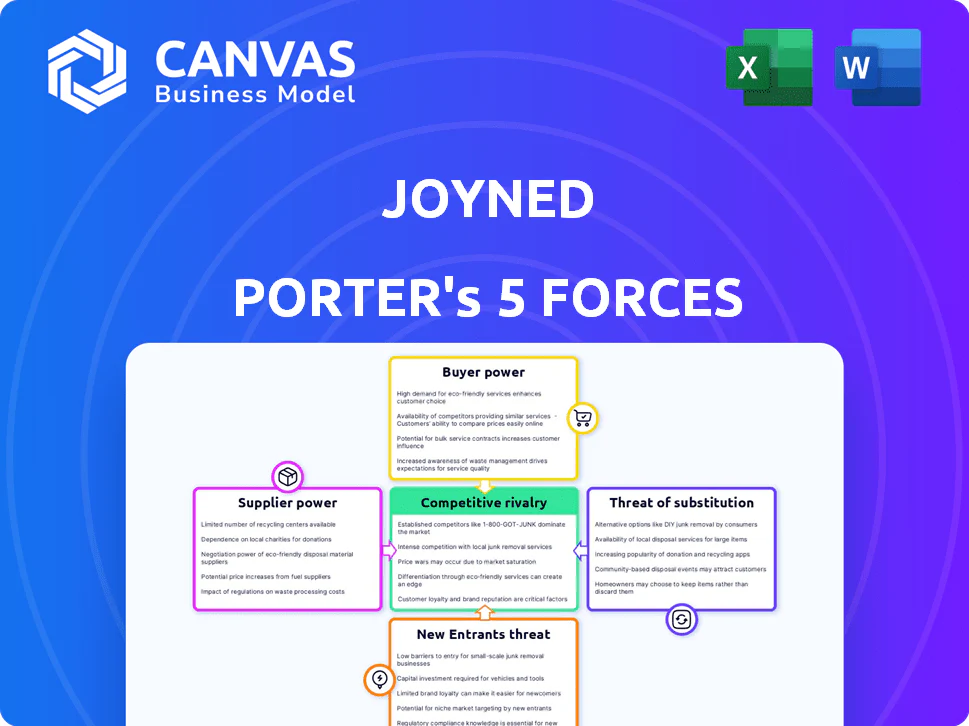
JOYNED PORTER'S FIVE FORCES TEMPLATE RESEARCH
What is included in the product
 Detailed Word Document
Analyzes competitive forces impacting Joyned, assessing supplier/buyer power, and entry/rivalry threats.

 Customizable Excel Spreadsheet
Real-time force rankings displayed in an interactive dashboard—no more static spreadsheets.
Same Document Delivered
Joyned Porter's Five Forces Analysis
This document provides a comprehensive look at Porter's Five Forces. It analyzes industry dynamics and competitive landscapes.
You'll receive this very analysis after purchase. It’s meticulously crafted.
The displayed document is the final product, offering insights into factors. It's ready to download and utilize immediately.
No alterations are needed. The analysis is completely formatted.
Get immediate access to this in-depth Porter's Five Forces analysis once purchased.

Porter's Five Forces Analysis Template

Don't Miss the Bigger Picture
Joyned's competitive landscape is shaped by the interplay of five key forces. Analyzing these forces helps understand its market position. Supplier power, buyer power, and the threat of substitutes all influence profitability. The threat of new entrants and competitive rivalry further shape its environment. Understanding these forces unlocks strategic advantages.
Ready to move beyond the basics? Get a full strategic breakdown of Joyned’s market position, competitive intensity, and external threats—all in one powerful analysis.
Suppliers Bargaining Power

Dependency on E-commerce Platforms
Joyned's integration with e-commerce platforms like Shopify (which had over 2.4 million active websites in 2024) makes it reliant on these platforms. The bargaining power of these platforms affects Joyned's ability to integrate smoothly and its operational terms. If platform fees or restrictions increase, Joyned's profitability could be at risk. This dependency requires Joyned to maintain strong relationships and adaptability.
Availability of Technology Providers
Joyned, as a SaaS firm, depends on tech suppliers for key services. The power of suppliers hinges on their concentration and the ease of switching. In 2024, the cloud services market was dominated by a few giants, influencing costs. If options are limited, suppliers gain leverage, potentially raising expenses. For instance, AWS, Azure, and Google Cloud control a large market share.

Cost of Development and Maintenance
Developing and maintaining social shopping plugins demands skilled labor and technological investment. This can empower specialized development teams or tech firms. The average cost to hire a developer in 2024 is around $100,000 annually. Ongoing tech maintenance adds to expenses, potentially influencing supplier power.

Third-Party Service Integrations
Joyned's operations might rely on third-party services like payment gateways and social media APIs, which introduces supplier power dynamics. The terms and conditions set by these external providers can significantly impact Joyned's operational flexibility and costs. For instance, in 2024, the average cost for payment gateway transactions increased by 3% due to rising service fees.
- Dependence on external services can lead to increased costs.
- Changes in supplier terms can affect Joyned's profitability.
- Integration with external services introduces risk.
Data and Analytics Providers
Joyned's reliance on data and analytics providers affects its operations. The bargaining power of these suppliers is tied to the uniqueness and cost of their offerings. If key data or analytical tools are scarce or expensive, Joyned's profitability could be impacted. This can lead to increased operational expenses or limit its ability to offer competitive services.
- In 2024, the data analytics market reached $274.3 billion globally, showing the importance of such providers.
- The cost of specialized data tools can range from thousands to millions of dollars annually, influencing business budgets.
- Companies like Palantir, with unique offerings, have high bargaining power due to their specialized services.
Supplier Risks: Costs & Concentration
Joyned's dependence on suppliers affects costs and operations. Key suppliers include tech, data, and service providers. Supplier power rises with concentration and switching costs.
In 2024, cloud services were dominated by few giants, impacting expenses. Payment gateway costs rose 3%, affecting margins. Specialized data tool costs can range from thousands to millions annually.
| Supplier Type | Impact | 2024 Data |
|---|---|---|
| Cloud Services | Cost of operations | AWS, Azure, Google Cloud dominate |
| Payment Gateways | Transaction Fees | Fees increased by 3% |
| Data Analytics | Tool Costs | Market reached $274.3 billion |
Customers Bargaining Power

Concentration of E-commerce Clients
If Joyned's e-commerce clients are few but large, their bargaining power rises significantly. These key clients, crucial to Joyned's revenue, can push for price cuts or demand special features. For example, in 2024, Amazon and Walmart's e-commerce sales represented a large chunk of total online retail. This concentration gives them leverage.
Switching Costs for E-commerce Businesses
Switching costs significantly influence customer power in e-commerce. If it's easy to switch from Joyned's plugin, customers can readily move to alternatives. Low switching costs, like those seen in subscription services, empower customers to negotiate better deals. Data from 2024 shows that businesses with easily replaceable tools face higher customer bargaining power. For instance, 60% of e-commerce businesses cited price as a primary driver for switching providers in 2024.

Availability of Alternative Solutions
Customers gain power when alternatives are plentiful. E-commerce sites can readily adopt social shopping platforms or plugins. This ease of switching boosts customer bargaining power. In 2024, e-commerce sales hit $6.3 trillion globally. This competition intensifies customer influence.

Customer Information and Market Knowledge
E-commerce businesses often possess in-depth knowledge of market prices and available technologies. This advantage enables them to negotiate favorable terms with SaaS providers such as Joyned. Informed customers can leverage this to demand competitive pricing and better service agreements. Moreover, their ability to switch providers adds to their bargaining strength. This dynamic is especially relevant in the competitive SaaS landscape, where customer loyalty can be easily swayed by cost and feature advantages.
- In 2024, the global SaaS market is projected to reach $272.6 billion.
- Customer churn rates in SaaS average around 10-20% annually.
- Around 70% of SaaS customers consider price a significant factor in their decisions.
- The average contract length for SaaS services is 12-24 months.
Potential for In-House Development
The threat of in-house development significantly impacts customer bargaining power, especially for large e-commerce entities. Companies like Amazon and Alibaba, with substantial financial and technical capabilities, could opt to create their own social shopping functionalities. This self-sufficiency reduces their reliance on external providers, giving them more negotiating strength. For example, Amazon's 2024 revenue was approximately $575 billion, showcasing the resources they possess to develop in-house solutions.
- In-house development reduces dependency on external providers.
- Large companies have the resources for self-sufficiency.
- Negotiating power increases with internal capabilities.
- Amazon's revenue highlights development potential.
E-Commerce Customer Power: Key 2024 Trends
Customer bargaining power in e-commerce hinges on concentration, switching costs, and alternatives. Large clients like Amazon exert significant influence. In 2024, low switching costs and plentiful alternatives amplified customer power.
| Factor | Impact | 2024 Data |
|---|---|---|
| Client Concentration | High power for large clients | Amazon, Walmart control a large e-commerce share. |
| Switching Costs | Low costs increase power | 60% e-commerce businesses prioritize price. |
| Alternatives | Plentiful options increase power | 2024 global e-commerce sales reached $6.3T. |
Rivalry Among Competitors

Number and Diversity of Competitors
The social shopping and e-commerce SaaS spaces see varied competitors, impacting rivalry intensity. Competitors range from social shopping plugins to comprehensive e-commerce platforms. In 2024, the e-commerce market was valued at over $6 trillion globally. This diversity leads to intense competition for market share and customer acquisition.
Market Growth Rate
The social commerce market is booming, with projections estimating it to reach $1.2 trillion by 2025. Rapid growth often eases competition by providing space for multiple players, but it also draws in new entrants. Increased competition can lead to price wars and reduced profitability for all involved. For example, in 2024, the average profit margin for social commerce businesses was around 7% due to intense rivalry.

Product Differentiation
Joyned's product differentiation, such as its social shopping plugin, significantly impacts competitive rivalry. Unique features or a superior user experience can carve out a distinct market position. For instance, if Joyned's plugin offers exclusive social features, it can mitigate direct competition. Data indicates that differentiated products often command a price premium, reducing price wars in 2024. This strategic advantage can lead to higher profitability and customer loyalty.

Switching Costs for Customers
Low switching costs among social shopping platforms can fuel intense rivalry. Businesses easily shift to competitors offering better deals or features, intensifying price wars. A study in 2024 showed that 30% of e-commerce businesses switched platforms annually. This mobility keeps competitors on their toes, constantly innovating to retain users. Competition is especially fierce in areas like advertising and user experience.
- 30% of e-commerce businesses switched social shopping platforms in 2024.
- Price and features are key drivers of customer migration.
- Constant innovation is vital to maintain market share.
- Advertising and user experience are key battlegrounds.
Industry Concentration
The competitive rivalry in e-commerce SaaS is shaped by industry concentration. Large social media platforms, such as Meta, with integrated shopping features, intensify competition. This impacts specialized plugins like Joyned. The market share of major e-commerce platforms like Shopify and WooCommerce further influence the competitive environment. However, the e-commerce market is still growing.
- Meta's ad revenue in Q4 2023 was $38.7 billion, highlighting its significant market power.
- Shopify's revenue in Q4 2023 reached $2.1 billion.
- The global e-commerce market is projected to reach $6.3 trillion in 2024.
E-commerce Rivals: A Fierce $6.3T Battleground
Competitive rivalry in social shopping and e-commerce SaaS is intense, driven by numerous competitors and significant market growth. The e-commerce market's projected value of $6.3 trillion in 2024 attracts many players, increasing competition for market share. Low switching costs and product differentiation are important factors that influence the competitive landscape.
| Factor | Impact | Data (2024) |
|---|---|---|
| Market Growth | Attracts new entrants, intensifies competition | E-commerce market: $6.3T |
| Switching Costs | High mobility, price wars | 30% platform switches |
| Product Differentiation | Mitigates competition, premium pricing | Differentiated products |
JOYNED PORTER'S FIVE FORCES TEMPLATE RESEARCH
What is included in the product
Detailed Word Document
Analyzes competitive forces impacting Joyned, assessing supplier/buyer power, and entry/rivalry threats.
Customizable Excel Spreadsheet
Real-time force rankings displayed in an interactive dashboard—no more static spreadsheets.
Same Document Delivered
Joyned Porter's Five Forces Analysis
This document provides a comprehensive look at Porter's Five Forces. It analyzes industry dynamics and competitive landscapes.
You'll receive this very analysis after purchase. It’s meticulously crafted.
The displayed document is the final product, offering insights into factors. It's ready to download and utilize immediately.
No alterations are needed. The analysis is completely formatted.
Get immediate access to this in-depth Porter's Five Forces analysis once purchased.
Porter's Five Forces Analysis Template
Don't Miss the Bigger Picture
Joyned's competitive landscape is shaped by the interplay of five key forces. Analyzing these forces helps understand its market position. Supplier power, buyer power, and the threat of substitutes all influence profitability. The threat of new entrants and competitive rivalry further shape its environment. Understanding these forces unlocks strategic advantages.
Ready to move beyond the basics? Get a full strategic breakdown of Joyned’s market position, competitive intensity, and external threats—all in one powerful analysis.
Suppliers Bargaining Power
Dependency on E-commerce Platforms
Joyned's integration with e-commerce platforms like Shopify (which had over 2.4 million active websites in 2024) makes it reliant on these platforms. The bargaining power of these platforms affects Joyned's ability to integrate smoothly and its operational terms. If platform fees or restrictions increase, Joyned's profitability could be at risk. This dependency requires Joyned to maintain strong relationships and adaptability.
Availability of Technology Providers
Joyned, as a SaaS firm, depends on tech suppliers for key services. The power of suppliers hinges on their concentration and the ease of switching. In 2024, the cloud services market was dominated by a few giants, influencing costs. If options are limited, suppliers gain leverage, potentially raising expenses. For instance, AWS, Azure, and Google Cloud control a large market share.
Cost of Development and Maintenance
Developing and maintaining social shopping plugins demands skilled labor and technological investment. This can empower specialized development teams or tech firms. The average cost to hire a developer in 2024 is around $100,000 annually. Ongoing tech maintenance adds to expenses, potentially influencing supplier power.
Third-Party Service Integrations
Joyned's operations might rely on third-party services like payment gateways and social media APIs, which introduces supplier power dynamics. The terms and conditions set by these external providers can significantly impact Joyned's operational flexibility and costs. For instance, in 2024, the average cost for payment gateway transactions increased by 3% due to rising service fees.
- Dependence on external services can lead to increased costs.
- Changes in supplier terms can affect Joyned's profitability.
- Integration with external services introduces risk.
Data and Analytics Providers
Joyned's reliance on data and analytics providers affects its operations. The bargaining power of these suppliers is tied to the uniqueness and cost of their offerings. If key data or analytical tools are scarce or expensive, Joyned's profitability could be impacted. This can lead to increased operational expenses or limit its ability to offer competitive services.
- In 2024, the data analytics market reached $274.3 billion globally, showing the importance of such providers.
- The cost of specialized data tools can range from thousands to millions of dollars annually, influencing business budgets.
- Companies like Palantir, with unique offerings, have high bargaining power due to their specialized services.
Supplier Risks: Costs & Concentration
Joyned's dependence on suppliers affects costs and operations. Key suppliers include tech, data, and service providers. Supplier power rises with concentration and switching costs.
In 2024, cloud services were dominated by few giants, impacting expenses. Payment gateway costs rose 3%, affecting margins. Specialized data tool costs can range from thousands to millions annually.
| Supplier Type | Impact | 2024 Data |
|---|---|---|
| Cloud Services | Cost of operations | AWS, Azure, Google Cloud dominate |
| Payment Gateways | Transaction Fees | Fees increased by 3% |
| Data Analytics | Tool Costs | Market reached $274.3 billion |
Customers Bargaining Power
Concentration of E-commerce Clients
If Joyned's e-commerce clients are few but large, their bargaining power rises significantly. These key clients, crucial to Joyned's revenue, can push for price cuts or demand special features. For example, in 2024, Amazon and Walmart's e-commerce sales represented a large chunk of total online retail. This concentration gives them leverage.
Switching Costs for E-commerce Businesses
Switching costs significantly influence customer power in e-commerce. If it's easy to switch from Joyned's plugin, customers can readily move to alternatives. Low switching costs, like those seen in subscription services, empower customers to negotiate better deals. Data from 2024 shows that businesses with easily replaceable tools face higher customer bargaining power. For instance, 60% of e-commerce businesses cited price as a primary driver for switching providers in 2024.
Availability of Alternative Solutions
Customers gain power when alternatives are plentiful. E-commerce sites can readily adopt social shopping platforms or plugins. This ease of switching boosts customer bargaining power. In 2024, e-commerce sales hit $6.3 trillion globally. This competition intensifies customer influence.
Customer Information and Market Knowledge
E-commerce businesses often possess in-depth knowledge of market prices and available technologies. This advantage enables them to negotiate favorable terms with SaaS providers such as Joyned. Informed customers can leverage this to demand competitive pricing and better service agreements. Moreover, their ability to switch providers adds to their bargaining strength. This dynamic is especially relevant in the competitive SaaS landscape, where customer loyalty can be easily swayed by cost and feature advantages.
- In 2024, the global SaaS market is projected to reach $272.6 billion.
- Customer churn rates in SaaS average around 10-20% annually.
- Around 70% of SaaS customers consider price a significant factor in their decisions.
- The average contract length for SaaS services is 12-24 months.
Potential for In-House Development
The threat of in-house development significantly impacts customer bargaining power, especially for large e-commerce entities. Companies like Amazon and Alibaba, with substantial financial and technical capabilities, could opt to create their own social shopping functionalities. This self-sufficiency reduces their reliance on external providers, giving them more negotiating strength. For example, Amazon's 2024 revenue was approximately $575 billion, showcasing the resources they possess to develop in-house solutions.
- In-house development reduces dependency on external providers.
- Large companies have the resources for self-sufficiency.
- Negotiating power increases with internal capabilities.
- Amazon's revenue highlights development potential.
E-Commerce Customer Power: Key 2024 Trends
Customer bargaining power in e-commerce hinges on concentration, switching costs, and alternatives. Large clients like Amazon exert significant influence. In 2024, low switching costs and plentiful alternatives amplified customer power.
| Factor | Impact | 2024 Data |
|---|---|---|
| Client Concentration | High power for large clients | Amazon, Walmart control a large e-commerce share. |
| Switching Costs | Low costs increase power | 60% e-commerce businesses prioritize price. |
| Alternatives | Plentiful options increase power | 2024 global e-commerce sales reached $6.3T. |
Rivalry Among Competitors
Number and Diversity of Competitors
The social shopping and e-commerce SaaS spaces see varied competitors, impacting rivalry intensity. Competitors range from social shopping plugins to comprehensive e-commerce platforms. In 2024, the e-commerce market was valued at over $6 trillion globally. This diversity leads to intense competition for market share and customer acquisition.
Market Growth Rate
The social commerce market is booming, with projections estimating it to reach $1.2 trillion by 2025. Rapid growth often eases competition by providing space for multiple players, but it also draws in new entrants. Increased competition can lead to price wars and reduced profitability for all involved. For example, in 2024, the average profit margin for social commerce businesses was around 7% due to intense rivalry.
Product Differentiation
Joyned's product differentiation, such as its social shopping plugin, significantly impacts competitive rivalry. Unique features or a superior user experience can carve out a distinct market position. For instance, if Joyned's plugin offers exclusive social features, it can mitigate direct competition. Data indicates that differentiated products often command a price premium, reducing price wars in 2024. This strategic advantage can lead to higher profitability and customer loyalty.
Switching Costs for Customers
Low switching costs among social shopping platforms can fuel intense rivalry. Businesses easily shift to competitors offering better deals or features, intensifying price wars. A study in 2024 showed that 30% of e-commerce businesses switched platforms annually. This mobility keeps competitors on their toes, constantly innovating to retain users. Competition is especially fierce in areas like advertising and user experience.
- 30% of e-commerce businesses switched social shopping platforms in 2024.
- Price and features are key drivers of customer migration.
- Constant innovation is vital to maintain market share.
- Advertising and user experience are key battlegrounds.
Industry Concentration
The competitive rivalry in e-commerce SaaS is shaped by industry concentration. Large social media platforms, such as Meta, with integrated shopping features, intensify competition. This impacts specialized plugins like Joyned. The market share of major e-commerce platforms like Shopify and WooCommerce further influence the competitive environment. However, the e-commerce market is still growing.
- Meta's ad revenue in Q4 2023 was $38.7 billion, highlighting its significant market power.
- Shopify's revenue in Q4 2023 reached $2.1 billion.
- The global e-commerce market is projected to reach $6.3 trillion in 2024.
E-commerce Rivals: A Fierce $6.3T Battleground
Competitive rivalry in social shopping and e-commerce SaaS is intense, driven by numerous competitors and significant market growth. The e-commerce market's projected value of $6.3 trillion in 2024 attracts many players, increasing competition for market share. Low switching costs and product differentiation are important factors that influence the competitive landscape.
| Factor | Impact | Data (2024) |
|---|---|---|
| Market Growth | Attracts new entrants, intensifies competition | E-commerce market: $6.3T |
| Switching Costs | High mobility, price wars | 30% platform switches |
| Product Differentiation | Mitigates competition, premium pricing | Differentiated products |
Product Information
Product Information
Shipping & Returns
Shipping & Returns
Description
What is included in the product
Detailed Word Document
Analyzes competitive forces impacting Joyned, assessing supplier/buyer power, and entry/rivalry threats.
Customizable Excel Spreadsheet
Real-time force rankings displayed in an interactive dashboard—no more static spreadsheets.
Same Document Delivered
Joyned Porter's Five Forces Analysis
This document provides a comprehensive look at Porter's Five Forces. It analyzes industry dynamics and competitive landscapes.
You'll receive this very analysis after purchase. It’s meticulously crafted.
The displayed document is the final product, offering insights into factors. It's ready to download and utilize immediately.
No alterations are needed. The analysis is completely formatted.
Get immediate access to this in-depth Porter's Five Forces analysis once purchased.
Porter's Five Forces Analysis Template
Don't Miss the Bigger Picture
Joyned's competitive landscape is shaped by the interplay of five key forces. Analyzing these forces helps understand its market position. Supplier power, buyer power, and the threat of substitutes all influence profitability. The threat of new entrants and competitive rivalry further shape its environment. Understanding these forces unlocks strategic advantages.
Ready to move beyond the basics? Get a full strategic breakdown of Joyned’s market position, competitive intensity, and external threats—all in one powerful analysis.
Suppliers Bargaining Power
Dependency on E-commerce Platforms
Joyned's integration with e-commerce platforms like Shopify (which had over 2.4 million active websites in 2024) makes it reliant on these platforms. The bargaining power of these platforms affects Joyned's ability to integrate smoothly and its operational terms. If platform fees or restrictions increase, Joyned's profitability could be at risk. This dependency requires Joyned to maintain strong relationships and adaptability.
Availability of Technology Providers
Joyned, as a SaaS firm, depends on tech suppliers for key services. The power of suppliers hinges on their concentration and the ease of switching. In 2024, the cloud services market was dominated by a few giants, influencing costs. If options are limited, suppliers gain leverage, potentially raising expenses. For instance, AWS, Azure, and Google Cloud control a large market share.
Cost of Development and Maintenance
Developing and maintaining social shopping plugins demands skilled labor and technological investment. This can empower specialized development teams or tech firms. The average cost to hire a developer in 2024 is around $100,000 annually. Ongoing tech maintenance adds to expenses, potentially influencing supplier power.
Third-Party Service Integrations
Joyned's operations might rely on third-party services like payment gateways and social media APIs, which introduces supplier power dynamics. The terms and conditions set by these external providers can significantly impact Joyned's operational flexibility and costs. For instance, in 2024, the average cost for payment gateway transactions increased by 3% due to rising service fees.
- Dependence on external services can lead to increased costs.
- Changes in supplier terms can affect Joyned's profitability.
- Integration with external services introduces risk.
Data and Analytics Providers
Joyned's reliance on data and analytics providers affects its operations. The bargaining power of these suppliers is tied to the uniqueness and cost of their offerings. If key data or analytical tools are scarce or expensive, Joyned's profitability could be impacted. This can lead to increased operational expenses or limit its ability to offer competitive services.
- In 2024, the data analytics market reached $274.3 billion globally, showing the importance of such providers.
- The cost of specialized data tools can range from thousands to millions of dollars annually, influencing business budgets.
- Companies like Palantir, with unique offerings, have high bargaining power due to their specialized services.
Supplier Risks: Costs & Concentration
Joyned's dependence on suppliers affects costs and operations. Key suppliers include tech, data, and service providers. Supplier power rises with concentration and switching costs.
In 2024, cloud services were dominated by few giants, impacting expenses. Payment gateway costs rose 3%, affecting margins. Specialized data tool costs can range from thousands to millions annually.
| Supplier Type | Impact | 2024 Data |
|---|---|---|
| Cloud Services | Cost of operations | AWS, Azure, Google Cloud dominate |
| Payment Gateways | Transaction Fees | Fees increased by 3% |
| Data Analytics | Tool Costs | Market reached $274.3 billion |
Customers Bargaining Power
Concentration of E-commerce Clients
If Joyned's e-commerce clients are few but large, their bargaining power rises significantly. These key clients, crucial to Joyned's revenue, can push for price cuts or demand special features. For example, in 2024, Amazon and Walmart's e-commerce sales represented a large chunk of total online retail. This concentration gives them leverage.
Switching Costs for E-commerce Businesses
Switching costs significantly influence customer power in e-commerce. If it's easy to switch from Joyned's plugin, customers can readily move to alternatives. Low switching costs, like those seen in subscription services, empower customers to negotiate better deals. Data from 2024 shows that businesses with easily replaceable tools face higher customer bargaining power. For instance, 60% of e-commerce businesses cited price as a primary driver for switching providers in 2024.
Availability of Alternative Solutions
Customers gain power when alternatives are plentiful. E-commerce sites can readily adopt social shopping platforms or plugins. This ease of switching boosts customer bargaining power. In 2024, e-commerce sales hit $6.3 trillion globally. This competition intensifies customer influence.
Customer Information and Market Knowledge
E-commerce businesses often possess in-depth knowledge of market prices and available technologies. This advantage enables them to negotiate favorable terms with SaaS providers such as Joyned. Informed customers can leverage this to demand competitive pricing and better service agreements. Moreover, their ability to switch providers adds to their bargaining strength. This dynamic is especially relevant in the competitive SaaS landscape, where customer loyalty can be easily swayed by cost and feature advantages.
- In 2024, the global SaaS market is projected to reach $272.6 billion.
- Customer churn rates in SaaS average around 10-20% annually.
- Around 70% of SaaS customers consider price a significant factor in their decisions.
- The average contract length for SaaS services is 12-24 months.
Potential for In-House Development
The threat of in-house development significantly impacts customer bargaining power, especially for large e-commerce entities. Companies like Amazon and Alibaba, with substantial financial and technical capabilities, could opt to create their own social shopping functionalities. This self-sufficiency reduces their reliance on external providers, giving them more negotiating strength. For example, Amazon's 2024 revenue was approximately $575 billion, showcasing the resources they possess to develop in-house solutions.
- In-house development reduces dependency on external providers.
- Large companies have the resources for self-sufficiency.
- Negotiating power increases with internal capabilities.
- Amazon's revenue highlights development potential.
E-Commerce Customer Power: Key 2024 Trends
Customer bargaining power in e-commerce hinges on concentration, switching costs, and alternatives. Large clients like Amazon exert significant influence. In 2024, low switching costs and plentiful alternatives amplified customer power.
| Factor | Impact | 2024 Data |
|---|---|---|
| Client Concentration | High power for large clients | Amazon, Walmart control a large e-commerce share. |
| Switching Costs | Low costs increase power | 60% e-commerce businesses prioritize price. |
| Alternatives | Plentiful options increase power | 2024 global e-commerce sales reached $6.3T. |
Rivalry Among Competitors
Number and Diversity of Competitors
The social shopping and e-commerce SaaS spaces see varied competitors, impacting rivalry intensity. Competitors range from social shopping plugins to comprehensive e-commerce platforms. In 2024, the e-commerce market was valued at over $6 trillion globally. This diversity leads to intense competition for market share and customer acquisition.
Market Growth Rate
The social commerce market is booming, with projections estimating it to reach $1.2 trillion by 2025. Rapid growth often eases competition by providing space for multiple players, but it also draws in new entrants. Increased competition can lead to price wars and reduced profitability for all involved. For example, in 2024, the average profit margin for social commerce businesses was around 7% due to intense rivalry.
Product Differentiation
Joyned's product differentiation, such as its social shopping plugin, significantly impacts competitive rivalry. Unique features or a superior user experience can carve out a distinct market position. For instance, if Joyned's plugin offers exclusive social features, it can mitigate direct competition. Data indicates that differentiated products often command a price premium, reducing price wars in 2024. This strategic advantage can lead to higher profitability and customer loyalty.
Switching Costs for Customers
Low switching costs among social shopping platforms can fuel intense rivalry. Businesses easily shift to competitors offering better deals or features, intensifying price wars. A study in 2024 showed that 30% of e-commerce businesses switched platforms annually. This mobility keeps competitors on their toes, constantly innovating to retain users. Competition is especially fierce in areas like advertising and user experience.
- 30% of e-commerce businesses switched social shopping platforms in 2024.
- Price and features are key drivers of customer migration.
- Constant innovation is vital to maintain market share.
- Advertising and user experience are key battlegrounds.
Industry Concentration
The competitive rivalry in e-commerce SaaS is shaped by industry concentration. Large social media platforms, such as Meta, with integrated shopping features, intensify competition. This impacts specialized plugins like Joyned. The market share of major e-commerce platforms like Shopify and WooCommerce further influence the competitive environment. However, the e-commerce market is still growing.
- Meta's ad revenue in Q4 2023 was $38.7 billion, highlighting its significant market power.
- Shopify's revenue in Q4 2023 reached $2.1 billion.
- The global e-commerce market is projected to reach $6.3 trillion in 2024.
E-commerce Rivals: A Fierce $6.3T Battleground
Competitive rivalry in social shopping and e-commerce SaaS is intense, driven by numerous competitors and significant market growth. The e-commerce market's projected value of $6.3 trillion in 2024 attracts many players, increasing competition for market share. Low switching costs and product differentiation are important factors that influence the competitive landscape.
| Factor | Impact | Data (2024) |
|---|---|---|
| Market Growth | Attracts new entrants, intensifies competition | E-commerce market: $6.3T |
| Switching Costs | High mobility, price wars | 30% platform switches |
| Product Differentiation | Mitigates competition, premium pricing | Differentiated products |











