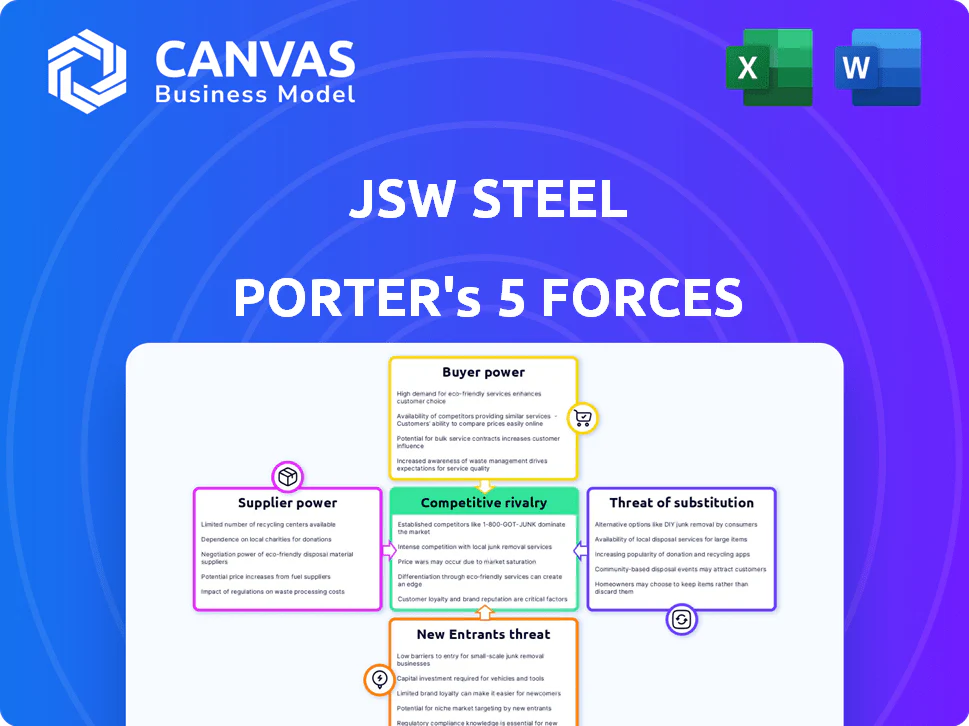
JSW STEEL PORTER'S FIVE FORCES TEMPLATE RESEARCH

Don't Miss the Bigger Picture
JSW Steel faces intense rivalry from domestic and global producers, strong buyer negotiating power, and raw-material supplier concentration that squeezes margins-yet scale, integration, and cost leadership offer defendable advantages; this brief snapshot only scratches the surface. Unlock the full Porter's Five Forces Analysis to explore JSW Steel's competitive dynamics, market pressures, and strategic advantages in detail.
Suppliers Bargaining Power

Backward Integration in Iron Ore
JSW Steel cut supplier leverage by acquiring iron-ore mines in Odisha and Karnataka; as of FY2025 captive ore output hit ~35 million tonnes, covering about 60% of feedstock needs versus ~30% in FY2022.
By early 2026 captive sufficiency reached record ~70% of pellet/ore needs, shielding margins from merchant-price swings (ore price volatility down 40% YoY for JSW's basket).
Coking Coal Import Dependency
Despite strong domestic iron-ore assets, JSW Steel depends on ~55-60% imported coking coal in FY2025, mainly from Australia, Canada, and the US, giving majors like BHP and Rio Tinto pricing leverage; seaborne coking coal prices averaged ~$240/tonne in 2024-25, pressuring margins. JSW cuts risk by diversifying suppliers and buying minority stakes in Australia and Mozambique projects, lowering import cost volatility.

Energy and Power Costs
JSW Steel's supplier power on energy is moderate: in FY2025 the company generated ~45% of its power from captive plants and renewables, cutting grid dependence and external coal purchases by ~18% year-on-year.
By 2026, investments in solar and green hydrogen aim to raise self-generation toward 55%, locking long-term rates ~10-15% below spot industrial tariffs, squeezing smaller peers.

Logistics and Freight Infrastructure
JSW Steel's ownership of Jaigarh Port and stakes in dedicated freight corridors cuts supplier power in logistics, lowering third-party shipping/rail leverage and trimming freight per tonne; in FY2025 JSW Ports handled ~58 Mt cargo, supporting JSW Steel's lower logistics cost intensity (~₹1,200/tonne estimated).
Integrated logistics preserves margins in a low-margin steel business by securing capacity during congestion and locking in throughput rates, reducing volatility vs. spot freight markets.
- Jaigarh Port: key node lowering external shipper leverage
- JSW Ports FY2025 handling ~58 Mt cargo
- Estimated logistics cost ~₹1,200/tonne in FY2025
- Dedicated corridor stakes reduce rail bottleneck risk
Technological Equipment Suppliers
Technological equipment suppliers hold strong leverage over JSW Steel for specialized machinery and Green Steel tech-vendors like SMS Group and Primetals Technologies charge premiums for proprietary emission-reduction systems as JSW targets 2026 decarbonization; single-source large electric arc furnaces (EAFs) tighten supply and push equipment margins up about 15-25% on contracts in 2024-25.
- SMS/Primetals: primary vendors for Green Steel systems
- Premium pricing: ~15-25% higher margins on proprietary EAF/DRI tech
- Scarcity: few global suppliers for large EAFs-limits JSW leverage
- 2026 decarb push increases capex reliance on these suppliers
Moderate supplier power: rising captive inputs cut costs; coal imports and vendor premiums persist
Supplier power is moderate: captive iron-ore rose to ~35 Mt (60% FY2025) and ~70% by 2026, but coking coal imports remained ~55-60% (seaborne ~$240/t in 2024-25). Captive power ~45% (FY2025) aiming 55% by 2026; JSW Ports handled ~58 Mt, cutting logistics cost to ~₹1,200/t; EAF/DRI vendors charge 15-25% premiums.
| Metric | FY2025/2026 |
|---|---|
| Captive iron-ore | ~35 Mt (60% FY2025; ~70% 2026) |
| Coking coal import | ~55-60% (seaborne ~$240/t) |
| Captive power | ~45% (target 55% 2026) |
| Ports handled | ~58 Mt (JSW Ports) |
| Logistics cost | ~₹1,200/t |
| EAF/DRI vendor premium | ~15-25% |
What is included in the product
 Detailed Word Document
Tailored Porter's Five Forces analysis for JSW Steel, revealing competitive intensity, buyer and supplier power, threat of substitutes and new entrants, and strategic levers to protect margins and market share.

 Customizable Excel Spreadsheet
A concise Porter's Five Forces snapshot for JSW Steel-clearly mapping supplier, buyer, rivalry, threat of substitutes, and entry pressures so executives can act fast and prioritize strategic moves.
Customers Bargaining Power

Fragmented Retail Consumer Base
A large share of JSW Steel's FY2025 domestic sales-about 18% of revenue (~INR 70 billion of FY2025 consolidated revenue of INR 390 billion)-comes from a fragmented retail network serving rural and individual home-builder segments, where buyers purchase small volumes via distributors and have almost zero bargaining power.
These customers buy at prevailing market rates, limiting negotiation; JSW's distributor-led model keeps transaction sizes small, so buyer leverage is minimal.
JSW Neosteel brand strength (estimated 12% premium retention in select markets in 2025) reinforces pricing power and helps sustain margins in this segment.
Concentrated Automotive and OEM Demand
Large OEMs in auto and white goods buy >40% of JSW Steel's flat products, giving them high bargaining power; long-term contracts with fixed pricing formulas curbed JSW's passthrough when 2025 coal and coking costs rose 18%.

Availability of Global Imports
The threat of cheaper imports from China, Vietnam, and South Korea gives buyers leverage: landed import costs fell to about $520-$560/ton in 2025 vs JSW Steel domestic CRC at ~₹62,000/ton (~$740/ton), so large buyers can switch if JSW's prices rise.
But India's 2025-26 anti-dumping duties and expanded Made in India procurement (affecting ~35% of public projects) narrowed that gap, cutting import competitiveness and reducing buyer switching risk.

Switching Costs for Specialty Steel
High technical specs and certifications in infrastructure and defense raise switching costs for specialty steel; JSW Steel's qualifying lead times (typical certification 6-12 months) and project integration mean mid-project switches are rare.
For example, JSW supplied 1.2 Mt to Indian infrastructure projects in FY2025, creating durable revenue and a moat versus price-sensitive buyers.
- Certification lag 6-12 months
- JSW FY2025 project sales ~1.2 million tonnes
- Technical lock-in reduces mid-project churn
Government as a Key Influencer
The Indian government, via Gati Shakti and INR 111 lakh crore (USD ~1.35tn) infrastructure push for 2024-25, acts as a primary indirect customer shaping steel demand; policy-driven capex swings drove India's steel consumption growth to ~12% YoY in 2024. JSW Steel must sync capacity expansions (consolidated crude steel 25.4 Mtpa in 2024) to these plans to maintain high utilization.
- Gati Shakti: INR 111 lakh crore national plan
- India steel demand: ~12% YoY growth 2024
- JSW Steel crude capacity: ~25.4 Mtpa (2024)
- Alignment needed to sustain utilization and pricing
JSW CRC premium vs imports, OEM leverage, and rising switching costs (FY25)
Buyers split: small retail (~18% revenue, ~INR70bn FY2025) have minimal leverage; large OEMs (>40% flat products) exert strong bargaining power but long-term contracts limited passthrough amid 18% coal cost rise; imports $520-$560/t vs JSW CRC ~₹62,000/t (~$740/t) in 2025; certifications (6-12m) and FY2025 project sales ~1.2 Mt raise switching costs.
| Metric | Value (FY2025) |
|---|---|
| Retail revenue share | 18% (~INR70bn) |
| OEM share (flat) | >40% |
| Imports landed | $520-$560/t |
| JSW CRC price | ~₹62,000/t (~$740/t) |
| Project sales | ~1.2 Mt |
| Certification lag | 6-12 months |
Full Version Awaits
JSW Steel Porter's Five Forces Analysis
This preview shows the exact Porter's Five Forces analysis of JSW Steel you'll receive immediately after purchase-no placeholders, no mockups.
The document is fully formatted and ready to use, covering competitive rivalry, supplier and buyer power, threats of entry and substitution, and practical implications for strategy and valuation.

JSW STEEL PORTER'S FIVE FORCES TEMPLATE RESEARCH
Don't Miss the Bigger Picture
JSW Steel faces intense rivalry from domestic and global producers, strong buyer negotiating power, and raw-material supplier concentration that squeezes margins-yet scale, integration, and cost leadership offer defendable advantages; this brief snapshot only scratches the surface. Unlock the full Porter's Five Forces Analysis to explore JSW Steel's competitive dynamics, market pressures, and strategic advantages in detail.
Suppliers Bargaining Power
Backward Integration in Iron Ore
JSW Steel cut supplier leverage by acquiring iron-ore mines in Odisha and Karnataka; as of FY2025 captive ore output hit ~35 million tonnes, covering about 60% of feedstock needs versus ~30% in FY2022.
By early 2026 captive sufficiency reached record ~70% of pellet/ore needs, shielding margins from merchant-price swings (ore price volatility down 40% YoY for JSW's basket).
Coking Coal Import Dependency
Despite strong domestic iron-ore assets, JSW Steel depends on ~55-60% imported coking coal in FY2025, mainly from Australia, Canada, and the US, giving majors like BHP and Rio Tinto pricing leverage; seaborne coking coal prices averaged ~$240/tonne in 2024-25, pressuring margins. JSW cuts risk by diversifying suppliers and buying minority stakes in Australia and Mozambique projects, lowering import cost volatility.
Energy and Power Costs
JSW Steel's supplier power on energy is moderate: in FY2025 the company generated ~45% of its power from captive plants and renewables, cutting grid dependence and external coal purchases by ~18% year-on-year.
By 2026, investments in solar and green hydrogen aim to raise self-generation toward 55%, locking long-term rates ~10-15% below spot industrial tariffs, squeezing smaller peers.
Logistics and Freight Infrastructure
JSW Steel's ownership of Jaigarh Port and stakes in dedicated freight corridors cuts supplier power in logistics, lowering third-party shipping/rail leverage and trimming freight per tonne; in FY2025 JSW Ports handled ~58 Mt cargo, supporting JSW Steel's lower logistics cost intensity (~₹1,200/tonne estimated).
Integrated logistics preserves margins in a low-margin steel business by securing capacity during congestion and locking in throughput rates, reducing volatility vs. spot freight markets.
- Jaigarh Port: key node lowering external shipper leverage
- JSW Ports FY2025 handling ~58 Mt cargo
- Estimated logistics cost ~₹1,200/tonne in FY2025
- Dedicated corridor stakes reduce rail bottleneck risk
Technological Equipment Suppliers
Technological equipment suppliers hold strong leverage over JSW Steel for specialized machinery and Green Steel tech-vendors like SMS Group and Primetals Technologies charge premiums for proprietary emission-reduction systems as JSW targets 2026 decarbonization; single-source large electric arc furnaces (EAFs) tighten supply and push equipment margins up about 15-25% on contracts in 2024-25.
- SMS/Primetals: primary vendors for Green Steel systems
- Premium pricing: ~15-25% higher margins on proprietary EAF/DRI tech
- Scarcity: few global suppliers for large EAFs-limits JSW leverage
- 2026 decarb push increases capex reliance on these suppliers
Moderate supplier power: rising captive inputs cut costs; coal imports and vendor premiums persist
Supplier power is moderate: captive iron-ore rose to ~35 Mt (60% FY2025) and ~70% by 2026, but coking coal imports remained ~55-60% (seaborne ~$240/t in 2024-25). Captive power ~45% (FY2025) aiming 55% by 2026; JSW Ports handled ~58 Mt, cutting logistics cost to ~₹1,200/t; EAF/DRI vendors charge 15-25% premiums.
| Metric | FY2025/2026 |
|---|---|
| Captive iron-ore | ~35 Mt (60% FY2025; ~70% 2026) |
| Coking coal import | ~55-60% (seaborne ~$240/t) |
| Captive power | ~45% (target 55% 2026) |
| Ports handled | ~58 Mt (JSW Ports) |
| Logistics cost | ~₹1,200/t |
| EAF/DRI vendor premium | ~15-25% |
What is included in the product
Detailed Word Document
Tailored Porter's Five Forces analysis for JSW Steel, revealing competitive intensity, buyer and supplier power, threat of substitutes and new entrants, and strategic levers to protect margins and market share.
Customizable Excel Spreadsheet
A concise Porter's Five Forces snapshot for JSW Steel-clearly mapping supplier, buyer, rivalry, threat of substitutes, and entry pressures so executives can act fast and prioritize strategic moves.
Customers Bargaining Power
Fragmented Retail Consumer Base
A large share of JSW Steel's FY2025 domestic sales-about 18% of revenue (~INR 70 billion of FY2025 consolidated revenue of INR 390 billion)-comes from a fragmented retail network serving rural and individual home-builder segments, where buyers purchase small volumes via distributors and have almost zero bargaining power.
These customers buy at prevailing market rates, limiting negotiation; JSW's distributor-led model keeps transaction sizes small, so buyer leverage is minimal.
JSW Neosteel brand strength (estimated 12% premium retention in select markets in 2025) reinforces pricing power and helps sustain margins in this segment.
Concentrated Automotive and OEM Demand
Large OEMs in auto and white goods buy >40% of JSW Steel's flat products, giving them high bargaining power; long-term contracts with fixed pricing formulas curbed JSW's passthrough when 2025 coal and coking costs rose 18%.
Availability of Global Imports
The threat of cheaper imports from China, Vietnam, and South Korea gives buyers leverage: landed import costs fell to about $520-$560/ton in 2025 vs JSW Steel domestic CRC at ~₹62,000/ton (~$740/ton), so large buyers can switch if JSW's prices rise.
But India's 2025-26 anti-dumping duties and expanded Made in India procurement (affecting ~35% of public projects) narrowed that gap, cutting import competitiveness and reducing buyer switching risk.
Switching Costs for Specialty Steel
High technical specs and certifications in infrastructure and defense raise switching costs for specialty steel; JSW Steel's qualifying lead times (typical certification 6-12 months) and project integration mean mid-project switches are rare.
For example, JSW supplied 1.2 Mt to Indian infrastructure projects in FY2025, creating durable revenue and a moat versus price-sensitive buyers.
- Certification lag 6-12 months
- JSW FY2025 project sales ~1.2 million tonnes
- Technical lock-in reduces mid-project churn
Government as a Key Influencer
The Indian government, via Gati Shakti and INR 111 lakh crore (USD ~1.35tn) infrastructure push for 2024-25, acts as a primary indirect customer shaping steel demand; policy-driven capex swings drove India's steel consumption growth to ~12% YoY in 2024. JSW Steel must sync capacity expansions (consolidated crude steel 25.4 Mtpa in 2024) to these plans to maintain high utilization.
- Gati Shakti: INR 111 lakh crore national plan
- India steel demand: ~12% YoY growth 2024
- JSW Steel crude capacity: ~25.4 Mtpa (2024)
- Alignment needed to sustain utilization and pricing
JSW CRC premium vs imports, OEM leverage, and rising switching costs (FY25)
Buyers split: small retail (~18% revenue, ~INR70bn FY2025) have minimal leverage; large OEMs (>40% flat products) exert strong bargaining power but long-term contracts limited passthrough amid 18% coal cost rise; imports $520-$560/t vs JSW CRC ~₹62,000/t (~$740/t) in 2025; certifications (6-12m) and FY2025 project sales ~1.2 Mt raise switching costs.
| Metric | Value (FY2025) |
|---|---|
| Retail revenue share | 18% (~INR70bn) |
| OEM share (flat) | >40% |
| Imports landed | $520-$560/t |
| JSW CRC price | ~₹62,000/t (~$740/t) |
| Project sales | ~1.2 Mt |
| Certification lag | 6-12 months |
Full Version Awaits
JSW Steel Porter's Five Forces Analysis
This preview shows the exact Porter's Five Forces analysis of JSW Steel you'll receive immediately after purchase-no placeholders, no mockups.
The document is fully formatted and ready to use, covering competitive rivalry, supplier and buyer power, threats of entry and substitution, and practical implications for strategy and valuation.
Product Information
Product Information
Shipping & Returns
Shipping & Returns
Description
Don't Miss the Bigger Picture
JSW Steel faces intense rivalry from domestic and global producers, strong buyer negotiating power, and raw-material supplier concentration that squeezes margins-yet scale, integration, and cost leadership offer defendable advantages; this brief snapshot only scratches the surface. Unlock the full Porter's Five Forces Analysis to explore JSW Steel's competitive dynamics, market pressures, and strategic advantages in detail.
Suppliers Bargaining Power
Backward Integration in Iron Ore
JSW Steel cut supplier leverage by acquiring iron-ore mines in Odisha and Karnataka; as of FY2025 captive ore output hit ~35 million tonnes, covering about 60% of feedstock needs versus ~30% in FY2022.
By early 2026 captive sufficiency reached record ~70% of pellet/ore needs, shielding margins from merchant-price swings (ore price volatility down 40% YoY for JSW's basket).
Coking Coal Import Dependency
Despite strong domestic iron-ore assets, JSW Steel depends on ~55-60% imported coking coal in FY2025, mainly from Australia, Canada, and the US, giving majors like BHP and Rio Tinto pricing leverage; seaborne coking coal prices averaged ~$240/tonne in 2024-25, pressuring margins. JSW cuts risk by diversifying suppliers and buying minority stakes in Australia and Mozambique projects, lowering import cost volatility.
Energy and Power Costs
JSW Steel's supplier power on energy is moderate: in FY2025 the company generated ~45% of its power from captive plants and renewables, cutting grid dependence and external coal purchases by ~18% year-on-year.
By 2026, investments in solar and green hydrogen aim to raise self-generation toward 55%, locking long-term rates ~10-15% below spot industrial tariffs, squeezing smaller peers.
Logistics and Freight Infrastructure
JSW Steel's ownership of Jaigarh Port and stakes in dedicated freight corridors cuts supplier power in logistics, lowering third-party shipping/rail leverage and trimming freight per tonne; in FY2025 JSW Ports handled ~58 Mt cargo, supporting JSW Steel's lower logistics cost intensity (~₹1,200/tonne estimated).
Integrated logistics preserves margins in a low-margin steel business by securing capacity during congestion and locking in throughput rates, reducing volatility vs. spot freight markets.
- Jaigarh Port: key node lowering external shipper leverage
- JSW Ports FY2025 handling ~58 Mt cargo
- Estimated logistics cost ~₹1,200/tonne in FY2025
- Dedicated corridor stakes reduce rail bottleneck risk
Technological Equipment Suppliers
Technological equipment suppliers hold strong leverage over JSW Steel for specialized machinery and Green Steel tech-vendors like SMS Group and Primetals Technologies charge premiums for proprietary emission-reduction systems as JSW targets 2026 decarbonization; single-source large electric arc furnaces (EAFs) tighten supply and push equipment margins up about 15-25% on contracts in 2024-25.
- SMS/Primetals: primary vendors for Green Steel systems
- Premium pricing: ~15-25% higher margins on proprietary EAF/DRI tech
- Scarcity: few global suppliers for large EAFs-limits JSW leverage
- 2026 decarb push increases capex reliance on these suppliers
Moderate supplier power: rising captive inputs cut costs; coal imports and vendor premiums persist
Supplier power is moderate: captive iron-ore rose to ~35 Mt (60% FY2025) and ~70% by 2026, but coking coal imports remained ~55-60% (seaborne ~$240/t in 2024-25). Captive power ~45% (FY2025) aiming 55% by 2026; JSW Ports handled ~58 Mt, cutting logistics cost to ~₹1,200/t; EAF/DRI vendors charge 15-25% premiums.
| Metric | FY2025/2026 |
|---|---|
| Captive iron-ore | ~35 Mt (60% FY2025; ~70% 2026) |
| Coking coal import | ~55-60% (seaborne ~$240/t) |
| Captive power | ~45% (target 55% 2026) |
| Ports handled | ~58 Mt (JSW Ports) |
| Logistics cost | ~₹1,200/t |
| EAF/DRI vendor premium | ~15-25% |
What is included in the product
Detailed Word Document
Tailored Porter's Five Forces analysis for JSW Steel, revealing competitive intensity, buyer and supplier power, threat of substitutes and new entrants, and strategic levers to protect margins and market share.
Customizable Excel Spreadsheet
A concise Porter's Five Forces snapshot for JSW Steel-clearly mapping supplier, buyer, rivalry, threat of substitutes, and entry pressures so executives can act fast and prioritize strategic moves.
Customers Bargaining Power
Fragmented Retail Consumer Base
A large share of JSW Steel's FY2025 domestic sales-about 18% of revenue (~INR 70 billion of FY2025 consolidated revenue of INR 390 billion)-comes from a fragmented retail network serving rural and individual home-builder segments, where buyers purchase small volumes via distributors and have almost zero bargaining power.
These customers buy at prevailing market rates, limiting negotiation; JSW's distributor-led model keeps transaction sizes small, so buyer leverage is minimal.
JSW Neosteel brand strength (estimated 12% premium retention in select markets in 2025) reinforces pricing power and helps sustain margins in this segment.
Concentrated Automotive and OEM Demand
Large OEMs in auto and white goods buy >40% of JSW Steel's flat products, giving them high bargaining power; long-term contracts with fixed pricing formulas curbed JSW's passthrough when 2025 coal and coking costs rose 18%.
Availability of Global Imports
The threat of cheaper imports from China, Vietnam, and South Korea gives buyers leverage: landed import costs fell to about $520-$560/ton in 2025 vs JSW Steel domestic CRC at ~₹62,000/ton (~$740/ton), so large buyers can switch if JSW's prices rise.
But India's 2025-26 anti-dumping duties and expanded Made in India procurement (affecting ~35% of public projects) narrowed that gap, cutting import competitiveness and reducing buyer switching risk.
Switching Costs for Specialty Steel
High technical specs and certifications in infrastructure and defense raise switching costs for specialty steel; JSW Steel's qualifying lead times (typical certification 6-12 months) and project integration mean mid-project switches are rare.
For example, JSW supplied 1.2 Mt to Indian infrastructure projects in FY2025, creating durable revenue and a moat versus price-sensitive buyers.
- Certification lag 6-12 months
- JSW FY2025 project sales ~1.2 million tonnes
- Technical lock-in reduces mid-project churn
Government as a Key Influencer
The Indian government, via Gati Shakti and INR 111 lakh crore (USD ~1.35tn) infrastructure push for 2024-25, acts as a primary indirect customer shaping steel demand; policy-driven capex swings drove India's steel consumption growth to ~12% YoY in 2024. JSW Steel must sync capacity expansions (consolidated crude steel 25.4 Mtpa in 2024) to these plans to maintain high utilization.
- Gati Shakti: INR 111 lakh crore national plan
- India steel demand: ~12% YoY growth 2024
- JSW Steel crude capacity: ~25.4 Mtpa (2024)
- Alignment needed to sustain utilization and pricing
JSW CRC premium vs imports, OEM leverage, and rising switching costs (FY25)
Buyers split: small retail (~18% revenue, ~INR70bn FY2025) have minimal leverage; large OEMs (>40% flat products) exert strong bargaining power but long-term contracts limited passthrough amid 18% coal cost rise; imports $520-$560/t vs JSW CRC ~₹62,000/t (~$740/t) in 2025; certifications (6-12m) and FY2025 project sales ~1.2 Mt raise switching costs.
| Metric | Value (FY2025) |
|---|---|
| Retail revenue share | 18% (~INR70bn) |
| OEM share (flat) | >40% |
| Imports landed | $520-$560/t |
| JSW CRC price | ~₹62,000/t (~$740/t) |
| Project sales | ~1.2 Mt |
| Certification lag | 6-12 months |
Full Version Awaits
JSW Steel Porter's Five Forces Analysis
This preview shows the exact Porter's Five Forces analysis of JSW Steel you'll receive immediately after purchase-no placeholders, no mockups.
The document is fully formatted and ready to use, covering competitive rivalry, supplier and buyer power, threats of entry and substitution, and practical implications for strategy and valuation.











