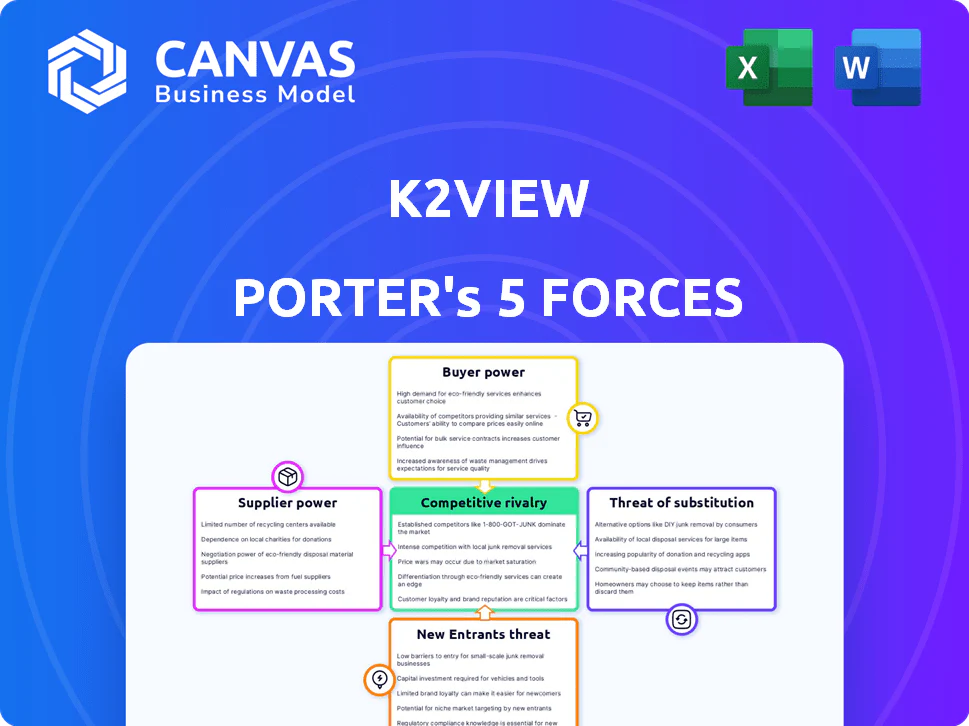
K2VIEW PORTER'S FIVE FORCES TEMPLATE RESEARCH
What is included in the product
 Detailed Word Document
Tailored exclusively for K2View, analyzing its position within its competitive landscape.

 Customizable Excel Spreadsheet
K2View Porter's Five Forces Analysis dynamically visualizes pressure, enabling fast strategic adjustments.
Full Version Awaits
K2View Porter's Five Forces Analysis
This is the K2View Porter's Five Forces Analysis you'll receive. The preview accurately reflects the complete, professionally crafted document.

Porter's Five Forces Analysis Template

A Must-Have Tool for Decision-Makers
K2View's market position faces varied forces. Competition intensity shapes its landscape significantly. Buyer power, due to specific client relationships, is moderate. Supplier influence is manageable, with diverse tech vendors available. The threat of new entrants appears moderate, based on existing market barriers. Substitute threats are present, but manageable.
This preview is just the starting point. Dive into a complete, consultant-grade breakdown of K2View’s industry competitiveness—ready for immediate use.
Suppliers Bargaining Power

Concentration of Suppliers
The data management tools market features concentration, with giants like IBM, Oracle, Microsoft, and AWS dominating. These large suppliers wield considerable power in pricing and setting terms. For instance, in 2024, AWS held around 32% of the cloud infrastructure market. This concentration impacts K2View's access to essential components.
Specialized Technology
The data management tech sector demands specialization, especially in data modeling and governance. Suppliers with cutting-edge tech and hefty R&D budgets can set higher prices. In 2024, R&D spending in this sector hit record highs, impacting costs. For K2View, this means potentially higher expenses.

Proprietary Software
Suppliers of proprietary software hold significant bargaining power, especially concerning their licensing terms. Recent data shows that software prices increased for many businesses. For example, in 2024, companies like Microsoft and Oracle have adjusted their pricing models, impacting their customers.

Importance of Supplier Inputs
K2View's reliance on suppliers for essential inputs like database tech and cloud infrastructure significantly impacts its operations. The more crucial these inputs are, the greater the suppliers' leverage becomes. This dependence can lead to higher costs and potential disruptions if suppliers have strong bargaining power. Understanding this dynamic is key for K2View's strategic planning.
- In 2024, cloud infrastructure spending grew by approximately 20% globally.
- Database software revenue is projected to reach over $80 billion by the end of 2024.
- Supply chain disruptions increased operational costs for tech firms by 15-20% in 2023.
Switching Costs for K2View
Switching costs significantly impact K2View's supplier power. If K2View faces high switching costs, such as complex data migration or vendor-specific integration requirements, suppliers gain leverage. This dependence limits K2View's ability to negotiate better terms or switch to more affordable alternatives. For example, the average cost to switch enterprise software vendors can range from $50,000 to over $1 million, depending on the complexity.
- High switching costs increase supplier power.
- Complex data migration and integration are key factors.
- Vendor-specific requirements limit alternatives.
- Negotiation leverage is reduced for K2View.
K2View's Supplier Power: A Costly Reality
Suppliers' bargaining power significantly impacts K2View due to market concentration and tech specialization. Giants like AWS, with 32% of cloud infrastructure in 2024, set terms. Proprietary software suppliers also wield power, influencing costs. High switching costs further empower suppliers, limiting K2View's negotiation leverage.
| Factor | Impact on K2View | 2024 Data |
|---|---|---|
| Market Concentration | Higher costs, limited options | AWS held ~32% cloud market. |
| Tech Specialization | Increased R&D costs | R&D spending hit record highs. |
| Switching Costs | Reduced negotiation power | Switching costs range $50k-$1M+. |
Customers Bargaining Power

Availability of Alternatives
Customers in the data management space have multiple options. Major tech firms and data integration specialists offer competing solutions. This competition gives customers leverage, allowing them to negotiate terms. For example, the data integration market was valued at $14.7 billion in 2024, showing ample choice.
Customer Dissatisfaction with Existing Providers
Customer dissatisfaction is a key factor. Recent surveys show over 60% of companies are unhappy with their data management solutions. This high level of discontent fuels customer bargaining power. They're more likely to seek alternatives, giving them leverage in negotiations with K2View.

Customer's Ability to Integrate and Deploy
Customers' ability to integrate and deploy solutions significantly influences their bargaining power. K2View's ease of integration is often a competitive advantage. However, customers can still leverage this aspect to negotiate for features that perfectly align with their systems. In 2024, seamless integration remains a critical factor, with 60% of businesses prioritizing it.

Demand for Specific Use Cases
Customers' demand for specific use cases, like customer 360 and data governance, is rising. K2View's platform directly addresses these needs, impacting customer satisfaction and investment. This targeted approach can enhance customer loyalty and drive further adoption. In 2024, the data governance market is valued at $6.5 billion, showing strong demand.
- Focus on specific use cases, such as customer 360, test data management, and data governance.
- K2View's platform impacts customer satisfaction.
- The data governance market was valued at $6.5 billion in 2024.
Price Sensitivity and ROI
Customers carefully assess the price and ROI of data management solutions, including K2View's offerings. Their purchasing decisions hinge on the perceived value and benefits relative to the cost. In 2024, the data management market saw a 12% increase in customer scrutiny of ROI metrics. Customers often compare different solutions.
- Price sensitivity impacts buying decisions.
- Customers want clear ROI metrics.
- Value must justify the cost.
- Comparison of solutions is common.
Customer Power: Competition, Dissatisfaction, and ROI
Customers have significant bargaining power due to market competition and dissatisfaction with existing solutions. Their ability to integrate solutions and demand for specific use cases further influence their leverage. Price sensitivity and ROI considerations are central to their purchasing decisions.
| Factor | Impact | 2024 Data |
|---|---|---|
| Market Competition | Increases customer choices | Data integration market: $14.7B |
| Customer Dissatisfaction | Boosts negotiation power | 60%+ unhappy with solutions |
| Integration & Use Cases | Influences purchasing decisions | Data governance market: $6.5B |
Rivalry Among Competitors

Numerous Competitors
The data management market is bustling. It's filled with competitors, from tech giants to niche players, all vying for a piece of the pie. This intense competition drives companies to innovate and offer competitive pricing. In 2024, the data fabric market was valued at over $2.5 billion, reflecting the high stakes.
Broad Range of Alternatives
K2View faces intense competition due to a broad range of alternatives. Competitors like Microsoft, AWS, and Oracle offer similar data management solutions. This extensive choice intensifies rivalry among vendors. In 2024, the data management market was valued at over $80 billion, highlighting the competitive landscape.

Competition in Specific Data Management Areas
K2View faces competition in data integration, governance, and synthetic data. The data integration market, valued at $14.3 billion in 2023, is highly competitive. Data governance software, projected at $5.5 billion in 2024, sees many vendors. The test data management market is also crowded.

Marketing and Investment by Competitors
K2View faces intense competition as rivals invest heavily in marketing and platform enhancements. This aggressive strategy necessitates continuous innovation and effective promotion from K2View. For example, the data integration market is projected to reach $24.6 billion by 2024, with strong growth expected. This competitive landscape demands strategic investments.
- Market growth fuels rivalry.
- Competitors' spending increases pressure.
- K2View must innovate and market.
- Data integration market is booming.
Price Competition
Price competition is fierce in the data management market, squeezing profit margins for companies like K2View. This pressure necessitates a careful balance between offering competitive prices and investing in innovation. The market is highly competitive, with numerous vendors vying for market share. K2View must strategize to maintain profitability while staying competitive.
- Data management market's compound annual growth rate (CAGR) from 2024-2030 is projected at 12.5%.
- In 2024, the data integration market was valued at $14.9 billion.
- The global data warehousing market was estimated at $37.1 billion in 2024.
- Price sensitivity is high among enterprise buyers.
Data Management Market: Key Trends Emerge
The data management market sees fierce competition, pushing firms to innovate. Rivals invest heavily in marketing and platform enhancements, intensifying the battle. Price competition squeezes profit margins, demanding strategic financial planning. The data fabric market was valued at over $2.5 billion in 2024.
| Metric | Value (2024) | Growth Projection (CAGR 2024-2030) |
|---|---|---|
| Data Integration Market | $14.9 billion | 12.5% |
| Data Governance Software Market | $5.5 billion | N/A |
| Data Warehousing Market | $37.1 billion | N/A |
Original: $10.00
-65%$10.00
$3.50K2VIEW PORTER'S FIVE FORCES TEMPLATE RESEARCH
What is included in the product
Detailed Word Document
Tailored exclusively for K2View, analyzing its position within its competitive landscape.
Customizable Excel Spreadsheet
K2View Porter's Five Forces Analysis dynamically visualizes pressure, enabling fast strategic adjustments.
Full Version Awaits
K2View Porter's Five Forces Analysis
This is the K2View Porter's Five Forces Analysis you'll receive. The preview accurately reflects the complete, professionally crafted document.
Porter's Five Forces Analysis Template
A Must-Have Tool for Decision-Makers
K2View's market position faces varied forces. Competition intensity shapes its landscape significantly. Buyer power, due to specific client relationships, is moderate. Supplier influence is manageable, with diverse tech vendors available. The threat of new entrants appears moderate, based on existing market barriers. Substitute threats are present, but manageable.
This preview is just the starting point. Dive into a complete, consultant-grade breakdown of K2View’s industry competitiveness—ready for immediate use.
Suppliers Bargaining Power
Concentration of Suppliers
The data management tools market features concentration, with giants like IBM, Oracle, Microsoft, and AWS dominating. These large suppliers wield considerable power in pricing and setting terms. For instance, in 2024, AWS held around 32% of the cloud infrastructure market. This concentration impacts K2View's access to essential components.
Specialized Technology
The data management tech sector demands specialization, especially in data modeling and governance. Suppliers with cutting-edge tech and hefty R&D budgets can set higher prices. In 2024, R&D spending in this sector hit record highs, impacting costs. For K2View, this means potentially higher expenses.
Proprietary Software
Suppliers of proprietary software hold significant bargaining power, especially concerning their licensing terms. Recent data shows that software prices increased for many businesses. For example, in 2024, companies like Microsoft and Oracle have adjusted their pricing models, impacting their customers.
Importance of Supplier Inputs
K2View's reliance on suppliers for essential inputs like database tech and cloud infrastructure significantly impacts its operations. The more crucial these inputs are, the greater the suppliers' leverage becomes. This dependence can lead to higher costs and potential disruptions if suppliers have strong bargaining power. Understanding this dynamic is key for K2View's strategic planning.
- In 2024, cloud infrastructure spending grew by approximately 20% globally.
- Database software revenue is projected to reach over $80 billion by the end of 2024.
- Supply chain disruptions increased operational costs for tech firms by 15-20% in 2023.
Switching Costs for K2View
Switching costs significantly impact K2View's supplier power. If K2View faces high switching costs, such as complex data migration or vendor-specific integration requirements, suppliers gain leverage. This dependence limits K2View's ability to negotiate better terms or switch to more affordable alternatives. For example, the average cost to switch enterprise software vendors can range from $50,000 to over $1 million, depending on the complexity.
- High switching costs increase supplier power.
- Complex data migration and integration are key factors.
- Vendor-specific requirements limit alternatives.
- Negotiation leverage is reduced for K2View.
K2View's Supplier Power: A Costly Reality
Suppliers' bargaining power significantly impacts K2View due to market concentration and tech specialization. Giants like AWS, with 32% of cloud infrastructure in 2024, set terms. Proprietary software suppliers also wield power, influencing costs. High switching costs further empower suppliers, limiting K2View's negotiation leverage.
| Factor | Impact on K2View | 2024 Data |
|---|---|---|
| Market Concentration | Higher costs, limited options | AWS held ~32% cloud market. |
| Tech Specialization | Increased R&D costs | R&D spending hit record highs. |
| Switching Costs | Reduced negotiation power | Switching costs range $50k-$1M+. |
Customers Bargaining Power
Availability of Alternatives
Customers in the data management space have multiple options. Major tech firms and data integration specialists offer competing solutions. This competition gives customers leverage, allowing them to negotiate terms. For example, the data integration market was valued at $14.7 billion in 2024, showing ample choice.
Customer Dissatisfaction with Existing Providers
Customer dissatisfaction is a key factor. Recent surveys show over 60% of companies are unhappy with their data management solutions. This high level of discontent fuels customer bargaining power. They're more likely to seek alternatives, giving them leverage in negotiations with K2View.
Customer's Ability to Integrate and Deploy
Customers' ability to integrate and deploy solutions significantly influences their bargaining power. K2View's ease of integration is often a competitive advantage. However, customers can still leverage this aspect to negotiate for features that perfectly align with their systems. In 2024, seamless integration remains a critical factor, with 60% of businesses prioritizing it.
Demand for Specific Use Cases
Customers' demand for specific use cases, like customer 360 and data governance, is rising. K2View's platform directly addresses these needs, impacting customer satisfaction and investment. This targeted approach can enhance customer loyalty and drive further adoption. In 2024, the data governance market is valued at $6.5 billion, showing strong demand.
- Focus on specific use cases, such as customer 360, test data management, and data governance.
- K2View's platform impacts customer satisfaction.
- The data governance market was valued at $6.5 billion in 2024.
Price Sensitivity and ROI
Customers carefully assess the price and ROI of data management solutions, including K2View's offerings. Their purchasing decisions hinge on the perceived value and benefits relative to the cost. In 2024, the data management market saw a 12% increase in customer scrutiny of ROI metrics. Customers often compare different solutions.
- Price sensitivity impacts buying decisions.
- Customers want clear ROI metrics.
- Value must justify the cost.
- Comparison of solutions is common.
Customer Power: Competition, Dissatisfaction, and ROI
Customers have significant bargaining power due to market competition and dissatisfaction with existing solutions. Their ability to integrate solutions and demand for specific use cases further influence their leverage. Price sensitivity and ROI considerations are central to their purchasing decisions.
| Factor | Impact | 2024 Data |
|---|---|---|
| Market Competition | Increases customer choices | Data integration market: $14.7B |
| Customer Dissatisfaction | Boosts negotiation power | 60%+ unhappy with solutions |
| Integration & Use Cases | Influences purchasing decisions | Data governance market: $6.5B |
Rivalry Among Competitors
Numerous Competitors
The data management market is bustling. It's filled with competitors, from tech giants to niche players, all vying for a piece of the pie. This intense competition drives companies to innovate and offer competitive pricing. In 2024, the data fabric market was valued at over $2.5 billion, reflecting the high stakes.
Broad Range of Alternatives
K2View faces intense competition due to a broad range of alternatives. Competitors like Microsoft, AWS, and Oracle offer similar data management solutions. This extensive choice intensifies rivalry among vendors. In 2024, the data management market was valued at over $80 billion, highlighting the competitive landscape.
Competition in Specific Data Management Areas
K2View faces competition in data integration, governance, and synthetic data. The data integration market, valued at $14.3 billion in 2023, is highly competitive. Data governance software, projected at $5.5 billion in 2024, sees many vendors. The test data management market is also crowded.
Marketing and Investment by Competitors
K2View faces intense competition as rivals invest heavily in marketing and platform enhancements. This aggressive strategy necessitates continuous innovation and effective promotion from K2View. For example, the data integration market is projected to reach $24.6 billion by 2024, with strong growth expected. This competitive landscape demands strategic investments.
- Market growth fuels rivalry.
- Competitors' spending increases pressure.
- K2View must innovate and market.
- Data integration market is booming.
Price Competition
Price competition is fierce in the data management market, squeezing profit margins for companies like K2View. This pressure necessitates a careful balance between offering competitive prices and investing in innovation. The market is highly competitive, with numerous vendors vying for market share. K2View must strategize to maintain profitability while staying competitive.
- Data management market's compound annual growth rate (CAGR) from 2024-2030 is projected at 12.5%.
- In 2024, the data integration market was valued at $14.9 billion.
- The global data warehousing market was estimated at $37.1 billion in 2024.
- Price sensitivity is high among enterprise buyers.
Data Management Market: Key Trends Emerge
The data management market sees fierce competition, pushing firms to innovate. Rivals invest heavily in marketing and platform enhancements, intensifying the battle. Price competition squeezes profit margins, demanding strategic financial planning. The data fabric market was valued at over $2.5 billion in 2024.
| Metric | Value (2024) | Growth Projection (CAGR 2024-2030) |
|---|---|---|
| Data Integration Market | $14.9 billion | 12.5% |
| Data Governance Software Market | $5.5 billion | N/A |
| Data Warehousing Market | $37.1 billion | N/A |
Product Information
Product Information
Shipping & Returns
Shipping & Returns
Description
What is included in the product
Detailed Word Document
Tailored exclusively for K2View, analyzing its position within its competitive landscape.
Customizable Excel Spreadsheet
K2View Porter's Five Forces Analysis dynamically visualizes pressure, enabling fast strategic adjustments.
Full Version Awaits
K2View Porter's Five Forces Analysis
This is the K2View Porter's Five Forces Analysis you'll receive. The preview accurately reflects the complete, professionally crafted document.
Porter's Five Forces Analysis Template
A Must-Have Tool for Decision-Makers
K2View's market position faces varied forces. Competition intensity shapes its landscape significantly. Buyer power, due to specific client relationships, is moderate. Supplier influence is manageable, with diverse tech vendors available. The threat of new entrants appears moderate, based on existing market barriers. Substitute threats are present, but manageable.
This preview is just the starting point. Dive into a complete, consultant-grade breakdown of K2View’s industry competitiveness—ready for immediate use.
Suppliers Bargaining Power
Concentration of Suppliers
The data management tools market features concentration, with giants like IBM, Oracle, Microsoft, and AWS dominating. These large suppliers wield considerable power in pricing and setting terms. For instance, in 2024, AWS held around 32% of the cloud infrastructure market. This concentration impacts K2View's access to essential components.
Specialized Technology
The data management tech sector demands specialization, especially in data modeling and governance. Suppliers with cutting-edge tech and hefty R&D budgets can set higher prices. In 2024, R&D spending in this sector hit record highs, impacting costs. For K2View, this means potentially higher expenses.
Proprietary Software
Suppliers of proprietary software hold significant bargaining power, especially concerning their licensing terms. Recent data shows that software prices increased for many businesses. For example, in 2024, companies like Microsoft and Oracle have adjusted their pricing models, impacting their customers.
Importance of Supplier Inputs
K2View's reliance on suppliers for essential inputs like database tech and cloud infrastructure significantly impacts its operations. The more crucial these inputs are, the greater the suppliers' leverage becomes. This dependence can lead to higher costs and potential disruptions if suppliers have strong bargaining power. Understanding this dynamic is key for K2View's strategic planning.
- In 2024, cloud infrastructure spending grew by approximately 20% globally.
- Database software revenue is projected to reach over $80 billion by the end of 2024.
- Supply chain disruptions increased operational costs for tech firms by 15-20% in 2023.
Switching Costs for K2View
Switching costs significantly impact K2View's supplier power. If K2View faces high switching costs, such as complex data migration or vendor-specific integration requirements, suppliers gain leverage. This dependence limits K2View's ability to negotiate better terms or switch to more affordable alternatives. For example, the average cost to switch enterprise software vendors can range from $50,000 to over $1 million, depending on the complexity.
- High switching costs increase supplier power.
- Complex data migration and integration are key factors.
- Vendor-specific requirements limit alternatives.
- Negotiation leverage is reduced for K2View.
K2View's Supplier Power: A Costly Reality
Suppliers' bargaining power significantly impacts K2View due to market concentration and tech specialization. Giants like AWS, with 32% of cloud infrastructure in 2024, set terms. Proprietary software suppliers also wield power, influencing costs. High switching costs further empower suppliers, limiting K2View's negotiation leverage.
| Factor | Impact on K2View | 2024 Data |
|---|---|---|
| Market Concentration | Higher costs, limited options | AWS held ~32% cloud market. |
| Tech Specialization | Increased R&D costs | R&D spending hit record highs. |
| Switching Costs | Reduced negotiation power | Switching costs range $50k-$1M+. |
Customers Bargaining Power
Availability of Alternatives
Customers in the data management space have multiple options. Major tech firms and data integration specialists offer competing solutions. This competition gives customers leverage, allowing them to negotiate terms. For example, the data integration market was valued at $14.7 billion in 2024, showing ample choice.
Customer Dissatisfaction with Existing Providers
Customer dissatisfaction is a key factor. Recent surveys show over 60% of companies are unhappy with their data management solutions. This high level of discontent fuels customer bargaining power. They're more likely to seek alternatives, giving them leverage in negotiations with K2View.
Customer's Ability to Integrate and Deploy
Customers' ability to integrate and deploy solutions significantly influences their bargaining power. K2View's ease of integration is often a competitive advantage. However, customers can still leverage this aspect to negotiate for features that perfectly align with their systems. In 2024, seamless integration remains a critical factor, with 60% of businesses prioritizing it.
Demand for Specific Use Cases
Customers' demand for specific use cases, like customer 360 and data governance, is rising. K2View's platform directly addresses these needs, impacting customer satisfaction and investment. This targeted approach can enhance customer loyalty and drive further adoption. In 2024, the data governance market is valued at $6.5 billion, showing strong demand.
- Focus on specific use cases, such as customer 360, test data management, and data governance.
- K2View's platform impacts customer satisfaction.
- The data governance market was valued at $6.5 billion in 2024.
Price Sensitivity and ROI
Customers carefully assess the price and ROI of data management solutions, including K2View's offerings. Their purchasing decisions hinge on the perceived value and benefits relative to the cost. In 2024, the data management market saw a 12% increase in customer scrutiny of ROI metrics. Customers often compare different solutions.
- Price sensitivity impacts buying decisions.
- Customers want clear ROI metrics.
- Value must justify the cost.
- Comparison of solutions is common.
Customer Power: Competition, Dissatisfaction, and ROI
Customers have significant bargaining power due to market competition and dissatisfaction with existing solutions. Their ability to integrate solutions and demand for specific use cases further influence their leverage. Price sensitivity and ROI considerations are central to their purchasing decisions.
| Factor | Impact | 2024 Data |
|---|---|---|
| Market Competition | Increases customer choices | Data integration market: $14.7B |
| Customer Dissatisfaction | Boosts negotiation power | 60%+ unhappy with solutions |
| Integration & Use Cases | Influences purchasing decisions | Data governance market: $6.5B |
Rivalry Among Competitors
Numerous Competitors
The data management market is bustling. It's filled with competitors, from tech giants to niche players, all vying for a piece of the pie. This intense competition drives companies to innovate and offer competitive pricing. In 2024, the data fabric market was valued at over $2.5 billion, reflecting the high stakes.
Broad Range of Alternatives
K2View faces intense competition due to a broad range of alternatives. Competitors like Microsoft, AWS, and Oracle offer similar data management solutions. This extensive choice intensifies rivalry among vendors. In 2024, the data management market was valued at over $80 billion, highlighting the competitive landscape.
Competition in Specific Data Management Areas
K2View faces competition in data integration, governance, and synthetic data. The data integration market, valued at $14.3 billion in 2023, is highly competitive. Data governance software, projected at $5.5 billion in 2024, sees many vendors. The test data management market is also crowded.
Marketing and Investment by Competitors
K2View faces intense competition as rivals invest heavily in marketing and platform enhancements. This aggressive strategy necessitates continuous innovation and effective promotion from K2View. For example, the data integration market is projected to reach $24.6 billion by 2024, with strong growth expected. This competitive landscape demands strategic investments.
- Market growth fuels rivalry.
- Competitors' spending increases pressure.
- K2View must innovate and market.
- Data integration market is booming.
Price Competition
Price competition is fierce in the data management market, squeezing profit margins for companies like K2View. This pressure necessitates a careful balance between offering competitive prices and investing in innovation. The market is highly competitive, with numerous vendors vying for market share. K2View must strategize to maintain profitability while staying competitive.
- Data management market's compound annual growth rate (CAGR) from 2024-2030 is projected at 12.5%.
- In 2024, the data integration market was valued at $14.9 billion.
- The global data warehousing market was estimated at $37.1 billion in 2024.
- Price sensitivity is high among enterprise buyers.
Data Management Market: Key Trends Emerge
The data management market sees fierce competition, pushing firms to innovate. Rivals invest heavily in marketing and platform enhancements, intensifying the battle. Price competition squeezes profit margins, demanding strategic financial planning. The data fabric market was valued at over $2.5 billion in 2024.
| Metric | Value (2024) | Growth Projection (CAGR 2024-2030) |
|---|---|---|
| Data Integration Market | $14.9 billion | 12.5% |
| Data Governance Software Market | $5.5 billion | N/A |
| Data Warehousing Market | $37.1 billion | N/A |











