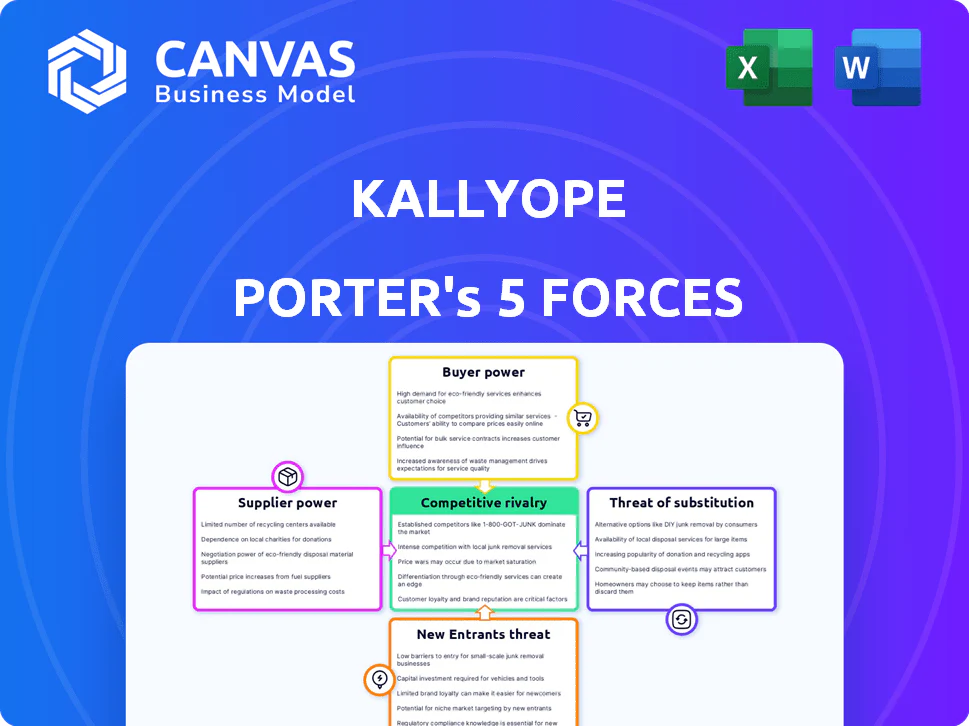
KALLYOPE PORTER'S FIVE FORCES TEMPLATE RESEARCH
What is included in the product
 Detailed Word Document
Analyzes Kallyope's position, competitive forces, & potential disruptive threats in its market.

 Customizable Excel Spreadsheet
A clear, one-sheet summary of all five forces—perfect for quick decision-making.
Full Version Awaits
Kallyope Porter's Five Forces Analysis
This preview provides the complete Kallyope Porter's Five Forces analysis you'll receive. It's the same fully formatted document ready for immediate download. The analysis examines industry competition, supplier power, and buyer power. Also, it assesses the threat of new entrants and substitute products. This is the actual file—ready to use.

Porter's Five Forces Analysis Template

Don't Miss the Bigger Picture
Kallyope's competitive landscape is shaped by distinct forces. Buyer power, influenced by potential partners, is moderate. Supplier power, tied to research resources, is significant. New entrants face high barriers. Substitute threats from alternative therapies are a concern. Competitive rivalry among established players is fierce.
This brief snapshot only scratches the surface. Unlock the full Porter's Five Forces Analysis to explore Kallyope’s competitive dynamics, market pressures, and strategic advantages in detail.
Suppliers Bargaining Power

Specialized Reagents and Materials
Kallyope faces supplier bargaining power due to its reliance on specialized reagents. The biotech industry saw a 7.2% increase in reagent costs in 2024. Limited suppliers for niche products, like those Kallyope needs, can drive up expenses and delay projects. This directly impacts Kallyope's operational budget, potentially affecting its R&D timelines.
Advanced Equipment and Technology Providers
Kallyope relies on advanced equipment and technology for its platform, including sequencing and imaging tools. Suppliers of these specialized instruments and their maintenance services can have significant bargaining power. The high cost of these technologies, with some instruments costing over $1 million each, further concentrates supplier power. Limited competition among cutting-edge technology providers, particularly in rapidly evolving fields like genomics, strengthens their influence.

Access to Biological Samples and Data
Kallyope's gut-brain research hinges on biological samples and data. Access to unique samples gives suppliers bargaining power. Biobanks and clinical trial participants are key resource controllers. In 2024, the biobanking market was valued at $7.5 billion, showcasing the value of these resources. The bargaining power varies with sample uniqueness and demand.

Contract Research Organizations (CROs)
Kallyope, as a clinical-stage firm, depends on Contract Research Organizations (CROs) for clinical trials. The specialized expertise and availability of CROs focusing on neurological and gastrointestinal disorders impact development costs and timelines. Established CROs may hold some bargaining power, especially those with unique capabilities. The global CRO market was valued at $77.15 billion in 2023, with expected growth.
- Market size: The global CRO market size was valued at $77.15 billion in 2023.
- Growth forecast: The CRO market is projected to reach $120.75 billion by 2030.
- Key players: Large CROs include IQVIA, Labcorp, and Parexel.
- Kallyope's focus: Kallyope's reliance on CROs is crucial for its research.
Highly Skilled Personnel
Kallyope's success depends on attracting top scientists. The competition for skilled personnel in biotechnology is fierce, especially in areas like neuroscience. This can lead to increased labor costs, impacting R&D timelines. The average salary for a Principal Scientist in biotech was around $200,000 in 2024.
- Highly skilled scientists are crucial for biotech success.
- Competition for talent drives up labor costs.
- R&D timelines can be affected by staffing.
- Average Principal Scientist salary: ~$200,000 (2024).
Supplier Power: Cost & Timeline Risks
Kallyope's reliance on suppliers grants them substantial bargaining power, impacting costs and timelines. Specialized reagents saw a 7.2% cost increase in 2024, affecting budgets. The $77.15 billion CRO market in 2023 highlights the influence of key suppliers.
| Supplier Type | Impact on Kallyope | 2024 Data |
|---|---|---|
| Reagents | Cost increases, project delays | 7.2% reagent cost increase |
| Specialized equipment | High costs, limited competition | Instruments cost over $1M each |
| CROs | Development costs, timelines | CRO market at $77.15B (2023) |
Customers Bargaining Power

Pharmaceutical and Biotech Partners
Kallyope's reliance on pharmaceutical and biotech partnerships exposes it to customer bargaining power. Larger firms like Novo Nordisk, with their market dominance and deep pockets, can dictate more favorable terms. Deals, such as the one with Novo Nordisk, highlight this dynamic, as Kallyope must cede some control. In 2024, the top 10 pharma companies' combined revenue was over $700 billion, showcasing their leverage.
Healthcare Providers and Institutions
Healthcare providers, prescribing Kallyope's therapeutics, wield substantial bargaining power. Their decisions hinge on drug efficacy, safety, and pricing relative to alternatives. In 2024, the pharmaceutical industry faced increased scrutiny on drug pricing. The Centers for Medicare & Medicaid Services (CMS) implemented new negotiation powers, impacting profitability.

Patients and Patient Advocacy Groups
Patients and advocacy groups aren't direct customers, but they hold sway. They highlight unmet medical needs, influencing demand for treatments. In 2024, patient advocacy significantly shaped drug development. For instance, groups like the ALS Association raised $115 million for research.

Payors and Insurance Companies
Payors and insurance companies hold considerable sway over Kallyope's market prospects. Their willingness to cover Kallyope's therapeutics directly affects access and commercial success. They negotiate drug prices based on perceived value and cost-effectiveness. This bargaining power is crucial for Kallyope. In 2024, the average discount on branded drugs negotiated by pharmacy benefit managers (PBMs) was around 35%.
- Payors' decisions significantly influence drug adoption rates.
- Negotiations impact Kallyope's revenue streams.
- Cost-effectiveness data is vital for formulary inclusion.
- PBMs' leverage affects pricing strategies.
Government and Regulatory Bodies
Government and regulatory bodies, like the FDA, significantly influence Kallyope's market access. Stringent requirements for clinical trials and safety data directly impact the development timeline. These regulations can delay or prevent therapy approvals, affecting Kallyope's revenue streams. The FDA's 2024 budget for drug regulation was approximately $2.2 billion.
- FDA approvals are critical for market entry.
- Regulatory hurdles can increase development costs.
- Compliance with guidelines is essential.
- Delays can impact profitability.
Kallyope's Customer Power Dynamics: A Breakdown
Kallyope faces customer bargaining power from pharma partners, healthcare providers, patients, and payors. Pharma giants like Novo Nordisk, with $700B+ in revenue (2024), dictate terms. Payors influence access; PBMs negotiated ~35% discounts (2024).
| Customer Type | Bargaining Power | Impact on Kallyope |
|---|---|---|
| Pharma Partners | High | Dictate deal terms, revenue share |
| Healthcare Providers | Medium | Influence drug adoption, pricing |
| Payors/Insurers | High | Control access, affect pricing |
| Patients/Advocacy | Medium | Shape demand, influence development |
Rivalry Among Competitors

Established Pharmaceutical Companies
Kallyope faces intense competition from established pharmaceutical giants in neuro and GI disorders. These firms boast substantial resources, approved drugs, and dominant market positions. For example, in 2024, the global neuroscience market was valued at over $35 billion. They possess robust R&D and commercial infrastructures. This makes it hard for Kallyope to compete.
Other Biotechnology Companies
The biotech sector is intensely competitive. Kallyope faces rivals developing therapies for similar conditions. Competitors like Voyager Therapeutics and Intellia Therapeutics, with market caps exceeding $500 million, may have advanced pipelines. This competition pressures Kallyope on innovation and market share.

Companies Focused on the Gut-Brain Axis
Kallyope, focusing on the gut-brain axis, competes with firms targeting similar therapeutic areas. The competitive landscape is intensifying due to rising interest in the microbiome. In 2024, the global microbiome market was valued at $6.7 billion. This area is expected to reach $15.5 billion by 2029. This growth indicates increased rivalry.

Therapies for Obesity and Metabolic Disorders
Kallyope's focus on obesity and metabolic disorders places it in a highly competitive market. Major pharmaceutical players and biotech firms are aggressively pursuing new treatments, intensifying rivalry. Oral obesity candidates from Kallyope will compete directly with established and innovative therapies, particularly GLP-1 agonists. The obesity treatment market is projected to reach $54 billion by 2030, making competition fierce.
- Novo Nordisk's Wegovy and Eli Lilly's Zepbound are leading GLP-1 agonists, with combined sales exceeding $10 billion in 2024.
- The FDA approved multiple weight-loss drugs in recent years, increasing options for patients and competition among companies.
- Clinical trial data is crucial, with companies like Kallyope needing to demonstrate superior efficacy and safety to gain market share.
- Pricing strategies and insurance coverage will significantly impact the adoption and market penetration of new obesity treatments.
Therapies for Neurological Disorders
Kallyope's pursuit of neurological disorder therapies, such as treatments for migraine, places it in a highly competitive market. This sector is already saturated with numerous approved drugs and a multitude of companies actively developing new treatments. The global market for neurological disorder treatments was valued at approximately $329.8 billion in 2023.
- Market size: The global neurological disorder treatment market was valued at roughly $329.8 billion in 2023.
- Competition: Numerous approved drugs and companies are in development.
- Focus: Kallyope targets disorders like migraine.
- Growth: The market is projected to grow.
Competitive Landscape: Neuroscience & Obesity Markets
Kallyope faces stiff competition from established pharma giants and biotech firms. The neuroscience market, valued at over $35 billion in 2024, sees intense rivalry. The obesity treatment market, projected to reach $54 billion by 2030, heightens competition.
| Factor | Details |
|---|---|
| Market Size | Neuroscience: $35B (2024), Obesity: $54B (2030) |
| Key Players | Novo Nordisk, Eli Lilly, Voyager Therapeutics |
| Competitive Pressure | High due to numerous approved drugs and development pipelines |
Original: $10.00
-65%$10.00
$3.50KALLYOPE PORTER'S FIVE FORCES TEMPLATE RESEARCH
What is included in the product
Detailed Word Document
Analyzes Kallyope's position, competitive forces, & potential disruptive threats in its market.
Customizable Excel Spreadsheet
A clear, one-sheet summary of all five forces—perfect for quick decision-making.
Full Version Awaits
Kallyope Porter's Five Forces Analysis
This preview provides the complete Kallyope Porter's Five Forces analysis you'll receive. It's the same fully formatted document ready for immediate download. The analysis examines industry competition, supplier power, and buyer power. Also, it assesses the threat of new entrants and substitute products. This is the actual file—ready to use.
Porter's Five Forces Analysis Template
Don't Miss the Bigger Picture
Kallyope's competitive landscape is shaped by distinct forces. Buyer power, influenced by potential partners, is moderate. Supplier power, tied to research resources, is significant. New entrants face high barriers. Substitute threats from alternative therapies are a concern. Competitive rivalry among established players is fierce.
This brief snapshot only scratches the surface. Unlock the full Porter's Five Forces Analysis to explore Kallyope’s competitive dynamics, market pressures, and strategic advantages in detail.
Suppliers Bargaining Power
Specialized Reagents and Materials
Kallyope faces supplier bargaining power due to its reliance on specialized reagents. The biotech industry saw a 7.2% increase in reagent costs in 2024. Limited suppliers for niche products, like those Kallyope needs, can drive up expenses and delay projects. This directly impacts Kallyope's operational budget, potentially affecting its R&D timelines.
Advanced Equipment and Technology Providers
Kallyope relies on advanced equipment and technology for its platform, including sequencing and imaging tools. Suppliers of these specialized instruments and their maintenance services can have significant bargaining power. The high cost of these technologies, with some instruments costing over $1 million each, further concentrates supplier power. Limited competition among cutting-edge technology providers, particularly in rapidly evolving fields like genomics, strengthens their influence.
Access to Biological Samples and Data
Kallyope's gut-brain research hinges on biological samples and data. Access to unique samples gives suppliers bargaining power. Biobanks and clinical trial participants are key resource controllers. In 2024, the biobanking market was valued at $7.5 billion, showcasing the value of these resources. The bargaining power varies with sample uniqueness and demand.
Contract Research Organizations (CROs)
Kallyope, as a clinical-stage firm, depends on Contract Research Organizations (CROs) for clinical trials. The specialized expertise and availability of CROs focusing on neurological and gastrointestinal disorders impact development costs and timelines. Established CROs may hold some bargaining power, especially those with unique capabilities. The global CRO market was valued at $77.15 billion in 2023, with expected growth.
- Market size: The global CRO market size was valued at $77.15 billion in 2023.
- Growth forecast: The CRO market is projected to reach $120.75 billion by 2030.
- Key players: Large CROs include IQVIA, Labcorp, and Parexel.
- Kallyope's focus: Kallyope's reliance on CROs is crucial for its research.
Highly Skilled Personnel
Kallyope's success depends on attracting top scientists. The competition for skilled personnel in biotechnology is fierce, especially in areas like neuroscience. This can lead to increased labor costs, impacting R&D timelines. The average salary for a Principal Scientist in biotech was around $200,000 in 2024.
- Highly skilled scientists are crucial for biotech success.
- Competition for talent drives up labor costs.
- R&D timelines can be affected by staffing.
- Average Principal Scientist salary: ~$200,000 (2024).
Supplier Power: Cost & Timeline Risks
Kallyope's reliance on suppliers grants them substantial bargaining power, impacting costs and timelines. Specialized reagents saw a 7.2% cost increase in 2024, affecting budgets. The $77.15 billion CRO market in 2023 highlights the influence of key suppliers.
| Supplier Type | Impact on Kallyope | 2024 Data |
|---|---|---|
| Reagents | Cost increases, project delays | 7.2% reagent cost increase |
| Specialized equipment | High costs, limited competition | Instruments cost over $1M each |
| CROs | Development costs, timelines | CRO market at $77.15B (2023) |
Customers Bargaining Power
Pharmaceutical and Biotech Partners
Kallyope's reliance on pharmaceutical and biotech partnerships exposes it to customer bargaining power. Larger firms like Novo Nordisk, with their market dominance and deep pockets, can dictate more favorable terms. Deals, such as the one with Novo Nordisk, highlight this dynamic, as Kallyope must cede some control. In 2024, the top 10 pharma companies' combined revenue was over $700 billion, showcasing their leverage.
Healthcare Providers and Institutions
Healthcare providers, prescribing Kallyope's therapeutics, wield substantial bargaining power. Their decisions hinge on drug efficacy, safety, and pricing relative to alternatives. In 2024, the pharmaceutical industry faced increased scrutiny on drug pricing. The Centers for Medicare & Medicaid Services (CMS) implemented new negotiation powers, impacting profitability.
Patients and Patient Advocacy Groups
Patients and advocacy groups aren't direct customers, but they hold sway. They highlight unmet medical needs, influencing demand for treatments. In 2024, patient advocacy significantly shaped drug development. For instance, groups like the ALS Association raised $115 million for research.
Payors and Insurance Companies
Payors and insurance companies hold considerable sway over Kallyope's market prospects. Their willingness to cover Kallyope's therapeutics directly affects access and commercial success. They negotiate drug prices based on perceived value and cost-effectiveness. This bargaining power is crucial for Kallyope. In 2024, the average discount on branded drugs negotiated by pharmacy benefit managers (PBMs) was around 35%.
- Payors' decisions significantly influence drug adoption rates.
- Negotiations impact Kallyope's revenue streams.
- Cost-effectiveness data is vital for formulary inclusion.
- PBMs' leverage affects pricing strategies.
Government and Regulatory Bodies
Government and regulatory bodies, like the FDA, significantly influence Kallyope's market access. Stringent requirements for clinical trials and safety data directly impact the development timeline. These regulations can delay or prevent therapy approvals, affecting Kallyope's revenue streams. The FDA's 2024 budget for drug regulation was approximately $2.2 billion.
- FDA approvals are critical for market entry.
- Regulatory hurdles can increase development costs.
- Compliance with guidelines is essential.
- Delays can impact profitability.
Kallyope's Customer Power Dynamics: A Breakdown
Kallyope faces customer bargaining power from pharma partners, healthcare providers, patients, and payors. Pharma giants like Novo Nordisk, with $700B+ in revenue (2024), dictate terms. Payors influence access; PBMs negotiated ~35% discounts (2024).
| Customer Type | Bargaining Power | Impact on Kallyope |
|---|---|---|
| Pharma Partners | High | Dictate deal terms, revenue share |
| Healthcare Providers | Medium | Influence drug adoption, pricing |
| Payors/Insurers | High | Control access, affect pricing |
| Patients/Advocacy | Medium | Shape demand, influence development |
Rivalry Among Competitors
Established Pharmaceutical Companies
Kallyope faces intense competition from established pharmaceutical giants in neuro and GI disorders. These firms boast substantial resources, approved drugs, and dominant market positions. For example, in 2024, the global neuroscience market was valued at over $35 billion. They possess robust R&D and commercial infrastructures. This makes it hard for Kallyope to compete.
Other Biotechnology Companies
The biotech sector is intensely competitive. Kallyope faces rivals developing therapies for similar conditions. Competitors like Voyager Therapeutics and Intellia Therapeutics, with market caps exceeding $500 million, may have advanced pipelines. This competition pressures Kallyope on innovation and market share.
Companies Focused on the Gut-Brain Axis
Kallyope, focusing on the gut-brain axis, competes with firms targeting similar therapeutic areas. The competitive landscape is intensifying due to rising interest in the microbiome. In 2024, the global microbiome market was valued at $6.7 billion. This area is expected to reach $15.5 billion by 2029. This growth indicates increased rivalry.
Therapies for Obesity and Metabolic Disorders
Kallyope's focus on obesity and metabolic disorders places it in a highly competitive market. Major pharmaceutical players and biotech firms are aggressively pursuing new treatments, intensifying rivalry. Oral obesity candidates from Kallyope will compete directly with established and innovative therapies, particularly GLP-1 agonists. The obesity treatment market is projected to reach $54 billion by 2030, making competition fierce.
- Novo Nordisk's Wegovy and Eli Lilly's Zepbound are leading GLP-1 agonists, with combined sales exceeding $10 billion in 2024.
- The FDA approved multiple weight-loss drugs in recent years, increasing options for patients and competition among companies.
- Clinical trial data is crucial, with companies like Kallyope needing to demonstrate superior efficacy and safety to gain market share.
- Pricing strategies and insurance coverage will significantly impact the adoption and market penetration of new obesity treatments.
Therapies for Neurological Disorders
Kallyope's pursuit of neurological disorder therapies, such as treatments for migraine, places it in a highly competitive market. This sector is already saturated with numerous approved drugs and a multitude of companies actively developing new treatments. The global market for neurological disorder treatments was valued at approximately $329.8 billion in 2023.
- Market size: The global neurological disorder treatment market was valued at roughly $329.8 billion in 2023.
- Competition: Numerous approved drugs and companies are in development.
- Focus: Kallyope targets disorders like migraine.
- Growth: The market is projected to grow.
Competitive Landscape: Neuroscience & Obesity Markets
Kallyope faces stiff competition from established pharma giants and biotech firms. The neuroscience market, valued at over $35 billion in 2024, sees intense rivalry. The obesity treatment market, projected to reach $54 billion by 2030, heightens competition.
| Factor | Details |
|---|---|
| Market Size | Neuroscience: $35B (2024), Obesity: $54B (2030) |
| Key Players | Novo Nordisk, Eli Lilly, Voyager Therapeutics |
| Competitive Pressure | High due to numerous approved drugs and development pipelines |
Product Information
Product Information
Shipping & Returns
Shipping & Returns
Description
What is included in the product
Detailed Word Document
Analyzes Kallyope's position, competitive forces, & potential disruptive threats in its market.
Customizable Excel Spreadsheet
A clear, one-sheet summary of all five forces—perfect for quick decision-making.
Full Version Awaits
Kallyope Porter's Five Forces Analysis
This preview provides the complete Kallyope Porter's Five Forces analysis you'll receive. It's the same fully formatted document ready for immediate download. The analysis examines industry competition, supplier power, and buyer power. Also, it assesses the threat of new entrants and substitute products. This is the actual file—ready to use.
Porter's Five Forces Analysis Template
Don't Miss the Bigger Picture
Kallyope's competitive landscape is shaped by distinct forces. Buyer power, influenced by potential partners, is moderate. Supplier power, tied to research resources, is significant. New entrants face high barriers. Substitute threats from alternative therapies are a concern. Competitive rivalry among established players is fierce.
This brief snapshot only scratches the surface. Unlock the full Porter's Five Forces Analysis to explore Kallyope’s competitive dynamics, market pressures, and strategic advantages in detail.
Suppliers Bargaining Power
Specialized Reagents and Materials
Kallyope faces supplier bargaining power due to its reliance on specialized reagents. The biotech industry saw a 7.2% increase in reagent costs in 2024. Limited suppliers for niche products, like those Kallyope needs, can drive up expenses and delay projects. This directly impacts Kallyope's operational budget, potentially affecting its R&D timelines.
Advanced Equipment and Technology Providers
Kallyope relies on advanced equipment and technology for its platform, including sequencing and imaging tools. Suppliers of these specialized instruments and their maintenance services can have significant bargaining power. The high cost of these technologies, with some instruments costing over $1 million each, further concentrates supplier power. Limited competition among cutting-edge technology providers, particularly in rapidly evolving fields like genomics, strengthens their influence.
Access to Biological Samples and Data
Kallyope's gut-brain research hinges on biological samples and data. Access to unique samples gives suppliers bargaining power. Biobanks and clinical trial participants are key resource controllers. In 2024, the biobanking market was valued at $7.5 billion, showcasing the value of these resources. The bargaining power varies with sample uniqueness and demand.
Contract Research Organizations (CROs)
Kallyope, as a clinical-stage firm, depends on Contract Research Organizations (CROs) for clinical trials. The specialized expertise and availability of CROs focusing on neurological and gastrointestinal disorders impact development costs and timelines. Established CROs may hold some bargaining power, especially those with unique capabilities. The global CRO market was valued at $77.15 billion in 2023, with expected growth.
- Market size: The global CRO market size was valued at $77.15 billion in 2023.
- Growth forecast: The CRO market is projected to reach $120.75 billion by 2030.
- Key players: Large CROs include IQVIA, Labcorp, and Parexel.
- Kallyope's focus: Kallyope's reliance on CROs is crucial for its research.
Highly Skilled Personnel
Kallyope's success depends on attracting top scientists. The competition for skilled personnel in biotechnology is fierce, especially in areas like neuroscience. This can lead to increased labor costs, impacting R&D timelines. The average salary for a Principal Scientist in biotech was around $200,000 in 2024.
- Highly skilled scientists are crucial for biotech success.
- Competition for talent drives up labor costs.
- R&D timelines can be affected by staffing.
- Average Principal Scientist salary: ~$200,000 (2024).
Supplier Power: Cost & Timeline Risks
Kallyope's reliance on suppliers grants them substantial bargaining power, impacting costs and timelines. Specialized reagents saw a 7.2% cost increase in 2024, affecting budgets. The $77.15 billion CRO market in 2023 highlights the influence of key suppliers.
| Supplier Type | Impact on Kallyope | 2024 Data |
|---|---|---|
| Reagents | Cost increases, project delays | 7.2% reagent cost increase |
| Specialized equipment | High costs, limited competition | Instruments cost over $1M each |
| CROs | Development costs, timelines | CRO market at $77.15B (2023) |
Customers Bargaining Power
Pharmaceutical and Biotech Partners
Kallyope's reliance on pharmaceutical and biotech partnerships exposes it to customer bargaining power. Larger firms like Novo Nordisk, with their market dominance and deep pockets, can dictate more favorable terms. Deals, such as the one with Novo Nordisk, highlight this dynamic, as Kallyope must cede some control. In 2024, the top 10 pharma companies' combined revenue was over $700 billion, showcasing their leverage.
Healthcare Providers and Institutions
Healthcare providers, prescribing Kallyope's therapeutics, wield substantial bargaining power. Their decisions hinge on drug efficacy, safety, and pricing relative to alternatives. In 2024, the pharmaceutical industry faced increased scrutiny on drug pricing. The Centers for Medicare & Medicaid Services (CMS) implemented new negotiation powers, impacting profitability.
Patients and Patient Advocacy Groups
Patients and advocacy groups aren't direct customers, but they hold sway. They highlight unmet medical needs, influencing demand for treatments. In 2024, patient advocacy significantly shaped drug development. For instance, groups like the ALS Association raised $115 million for research.
Payors and Insurance Companies
Payors and insurance companies hold considerable sway over Kallyope's market prospects. Their willingness to cover Kallyope's therapeutics directly affects access and commercial success. They negotiate drug prices based on perceived value and cost-effectiveness. This bargaining power is crucial for Kallyope. In 2024, the average discount on branded drugs negotiated by pharmacy benefit managers (PBMs) was around 35%.
- Payors' decisions significantly influence drug adoption rates.
- Negotiations impact Kallyope's revenue streams.
- Cost-effectiveness data is vital for formulary inclusion.
- PBMs' leverage affects pricing strategies.
Government and Regulatory Bodies
Government and regulatory bodies, like the FDA, significantly influence Kallyope's market access. Stringent requirements for clinical trials and safety data directly impact the development timeline. These regulations can delay or prevent therapy approvals, affecting Kallyope's revenue streams. The FDA's 2024 budget for drug regulation was approximately $2.2 billion.
- FDA approvals are critical for market entry.
- Regulatory hurdles can increase development costs.
- Compliance with guidelines is essential.
- Delays can impact profitability.
Kallyope's Customer Power Dynamics: A Breakdown
Kallyope faces customer bargaining power from pharma partners, healthcare providers, patients, and payors. Pharma giants like Novo Nordisk, with $700B+ in revenue (2024), dictate terms. Payors influence access; PBMs negotiated ~35% discounts (2024).
| Customer Type | Bargaining Power | Impact on Kallyope |
|---|---|---|
| Pharma Partners | High | Dictate deal terms, revenue share |
| Healthcare Providers | Medium | Influence drug adoption, pricing |
| Payors/Insurers | High | Control access, affect pricing |
| Patients/Advocacy | Medium | Shape demand, influence development |
Rivalry Among Competitors
Established Pharmaceutical Companies
Kallyope faces intense competition from established pharmaceutical giants in neuro and GI disorders. These firms boast substantial resources, approved drugs, and dominant market positions. For example, in 2024, the global neuroscience market was valued at over $35 billion. They possess robust R&D and commercial infrastructures. This makes it hard for Kallyope to compete.
Other Biotechnology Companies
The biotech sector is intensely competitive. Kallyope faces rivals developing therapies for similar conditions. Competitors like Voyager Therapeutics and Intellia Therapeutics, with market caps exceeding $500 million, may have advanced pipelines. This competition pressures Kallyope on innovation and market share.
Companies Focused on the Gut-Brain Axis
Kallyope, focusing on the gut-brain axis, competes with firms targeting similar therapeutic areas. The competitive landscape is intensifying due to rising interest in the microbiome. In 2024, the global microbiome market was valued at $6.7 billion. This area is expected to reach $15.5 billion by 2029. This growth indicates increased rivalry.
Therapies for Obesity and Metabolic Disorders
Kallyope's focus on obesity and metabolic disorders places it in a highly competitive market. Major pharmaceutical players and biotech firms are aggressively pursuing new treatments, intensifying rivalry. Oral obesity candidates from Kallyope will compete directly with established and innovative therapies, particularly GLP-1 agonists. The obesity treatment market is projected to reach $54 billion by 2030, making competition fierce.
- Novo Nordisk's Wegovy and Eli Lilly's Zepbound are leading GLP-1 agonists, with combined sales exceeding $10 billion in 2024.
- The FDA approved multiple weight-loss drugs in recent years, increasing options for patients and competition among companies.
- Clinical trial data is crucial, with companies like Kallyope needing to demonstrate superior efficacy and safety to gain market share.
- Pricing strategies and insurance coverage will significantly impact the adoption and market penetration of new obesity treatments.
Therapies for Neurological Disorders
Kallyope's pursuit of neurological disorder therapies, such as treatments for migraine, places it in a highly competitive market. This sector is already saturated with numerous approved drugs and a multitude of companies actively developing new treatments. The global market for neurological disorder treatments was valued at approximately $329.8 billion in 2023.
- Market size: The global neurological disorder treatment market was valued at roughly $329.8 billion in 2023.
- Competition: Numerous approved drugs and companies are in development.
- Focus: Kallyope targets disorders like migraine.
- Growth: The market is projected to grow.
Competitive Landscape: Neuroscience & Obesity Markets
Kallyope faces stiff competition from established pharma giants and biotech firms. The neuroscience market, valued at over $35 billion in 2024, sees intense rivalry. The obesity treatment market, projected to reach $54 billion by 2030, heightens competition.
| Factor | Details |
|---|---|
| Market Size | Neuroscience: $35B (2024), Obesity: $54B (2030) |
| Key Players | Novo Nordisk, Eli Lilly, Voyager Therapeutics |
| Competitive Pressure | High due to numerous approved drugs and development pipelines |











