KALRAY PORTER'S FIVE FORCES TEMPLATE RESEARCH
What is included in the product
 Detailed Word Document
Tailored exclusively for Kalray, analyzing its position within its competitive landscape.

 Customizable Excel Spreadsheet
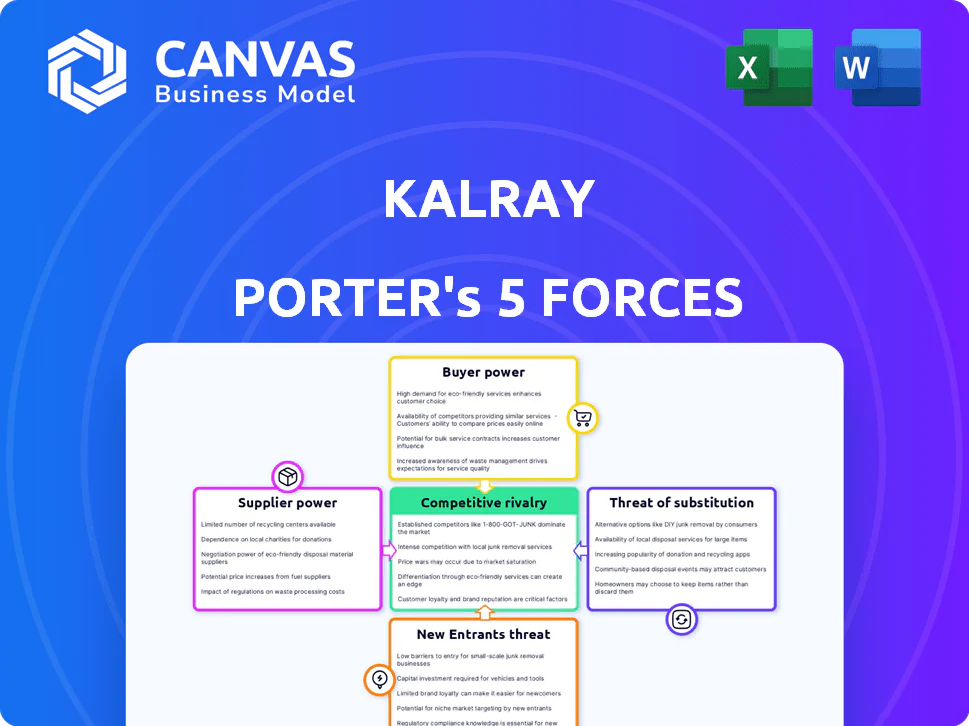
Instantly see the strategic landscape with an interactive force diagram.
Preview the Actual Deliverable
Kalray Porter's Five Forces Analysis
This preview showcases the complete Porter's Five Forces analysis for Kalray. The document you're viewing is the exact, fully realized report you'll receive immediately upon purchase. It includes detailed insights into the competitive landscape. No alterations, just instant access to this comprehensive analysis. Your purchased document is exactly as presented here, ready for immediate use.

Porter's Five Forces Analysis Template

Go Beyond the Preview—Access the Full Strategic Report
Kalray's position is shaped by the competitive forces within its industry. Rivalry among existing firms, including competitors leveraging various technologies, presents ongoing challenges. The bargaining power of both suppliers and buyers, particularly in the semiconductor market, significantly influences Kalray's profitability. New entrants, coupled with the threat of substitute products, add further complexity to the competitive landscape.
The complete report reveals the real forces shaping Kalray’s industry—from supplier influence to threat of new entrants. Gain actionable insights to drive smarter decision-making.
Suppliers Bargaining Power

Key Semiconductor Component Suppliers
Kalray, being fabless, depends on foundries for its DPUs. The semiconductor manufacturing landscape is concentrated. Top foundries wield significant bargaining power. In 2024, TSMC and Samsung controlled most advanced node production. This concentration impacts Kalray's costs and supply.
Dependency on Specialized Technology
Kalray's MPPA® architecture, while innovative, depends on specialized IP and tools from external suppliers. These suppliers, providing crucial technology, wield bargaining power through licensing and pricing. In 2024, the semiconductor IP market was valued at approximately $5.7 billion, highlighting the industry's reliance on external technology. This dependency can influence Kalray's cost structure and project timelines.

Geopolitical Factors and Supply Chain Resilience
Geopolitical factors significantly influence the semiconductor supply chain, a critical aspect for Kalray. Trade restrictions and tensions can disrupt the flow of components and increase costs. In 2024, the semiconductor industry saw a 15% rise in supply chain disruptions due to geopolitical issues. Kalray must strategize to mitigate these risks.

Talent Pool for Specialized Skills
The semiconductor industry's talent pool, especially for engineers and researchers, significantly impacts supplier bargaining power. This is driven by a shortage of specialized skills, particularly in areas like DPU development, increasing the power of skilled employees. Companies compete fiercely for this limited talent, which can drive up labor costs and influence project timelines. This dynamic affects the industry's overall cost structure and operational efficiency.
- The global semiconductor market was valued at $526.88 billion in 2023.
- The demand for AI-related semiconductor skills has increased by 30% in 2024.
- Average salaries for DPU engineers increased by 15% in 2024.
- The attrition rate for specialized engineers is 10% higher than the industry average.
Access to Raw Materials
Kalray, as a fabless semiconductor company, relies on foundries that source raw materials, indirectly exposing them to supplier power. If the cost of these raw materials increases, it could affect manufacturing costs. This can impact Kalray's profitability, as the foundries might pass on these costs. For instance, the price of silicon wafers, essential for chip manufacturing, saw a 10-20% price increase in 2023.
- Raw material price hikes impact manufacturing costs.
- Silicon wafer price increase was 10-20% in 2023.
- Kalray's profitability depends on manufacturing partners.
- Supplier disruptions can indirectly affect Kalray.
Kalray's Supplier Power Dynamics: A Deep Dive
Supplier bargaining power significantly affects Kalray's operations. Foundries, key suppliers, have strong leverage, especially TSMC and Samsung. Specialized IP and tools from other suppliers also give them power. The semiconductor IP market was worth $5.7 billion in 2024.
| Aspect | Impact on Kalray | Data (2024) |
|---|---|---|
| Foundries' Dominance | Influences costs, supply | TSMC & Samsung control advanced nodes |
| IP Supplier Power | Affects cost, timelines | IP market: $5.7B |
| Raw Materials | Indirectly affects cost | Silicon wafer prices up 10-20% (2023) |
Customers Bargaining Power

Concentration of Key Customers
In markets like data centers, a few large cloud providers heavily influence DPU/SmartNIC sales. This concentration gives them significant bargaining power. For instance, Amazon, Microsoft, and Google collectively control over 60% of the global cloud infrastructure market as of early 2024. These key customers can demand better pricing and terms.
Technical Expertise of Customers
Kalray's clients, especially in AI and data centers, often have advanced technical knowledge. This expertise enables them to thoroughly assess Kalray's Data Processing Unit (DPU) offerings. They can compare performance against competitors, such as NVIDIA, which saw a 265% revenue increase in Q4 2023. This sophistication gives customers significant bargaining power, as they can demand better terms or explore alternative solutions.

Price Sensitivity in Competitive Markets
Kalray faces customer bargaining power due to price sensitivity in competitive markets. Despite its performance focus, pricing pressure remains, especially for large orders. For example, in 2024, the average selling price (ASP) of AI chips saw a 10% decline. This highlights the customer's ability to influence prices. This situation necessitates Kalray's strategic price management.

Availability of Alternative Solutions
Customers have several alternatives to Kalray's DPUs, such as GPUs and ASICs, for handling data-intensive tasks. This variety boosts customer power, allowing them to choose solutions that offer better value. The global GPU market, for instance, was valued at $49.8 billion in 2023. This competitive landscape gives customers leverage in negotiations. These alternatives can impact Kalray's pricing and market share.
- GPU market reached $49.8B in 2023.
- ASICs offer specialized performance.
- Customers can switch if Kalray's offerings are not competitive.
- Alternative solutions increase customer bargaining power.
Customer's Ability to Insource
The bargaining power of customers is significantly influenced by their ability to insource. Large tech companies and cloud providers possess the resources to develop their own custom silicon solutions, potentially reducing their reliance on external suppliers like Kalray. This vertical integration capability constrains Kalray’s pricing strategies and overall market power. According to recent reports, the cloud computing market continues to grow, with an estimated value of $670.6 billion in 2024.
- Cloud providers can develop their own DPUs.
- Vertical integration limits Kalray's pricing.
- Customer dependence on external providers decreases.
- The cloud computing market is worth $670.6 billion in 2024.
Customer Power: Shaping Market Dynamics
Customer bargaining power significantly impacts Kalray's market position. Key cloud providers, controlling over 60% of the cloud infrastructure market, can dictate terms. The availability of alternatives like GPUs, a $49.8B market in 2023, further empowers customers, influencing pricing and market share.
| Aspect | Impact | Data Point (2024) |
|---|---|---|
| Cloud Provider Dominance | Pricing Pressure | >60% Cloud Market Share |
| Alternative Solutions | Negotiating Leverage | $49.8B GPU Market (2023) |
| Customer Sophistication | Informed Choices | 10% AI chip ASP decline |
Rivalry Among Competitors

Presence of Established Semiconductor Companies
Kalray faces intense competition from established semiconductor giants. These companies, such as Intel and NVIDIA, boast substantial market share and customer loyalty. For instance, NVIDIA's revenue in Q3 2024 reached $18.12 billion, dwarfing Kalray's resources. These competitors offer diverse processor solutions, intensifying the rivalry in Kalray's target markets.
Competition from Other DPU and Accelerator Providers
The DPU and accelerator market is intensifying. Competitors offer diverse technologies, including DPUs, GPUs, and ASICs. NVIDIA, with $26.97 billion in data center revenue in fiscal year 2024, is a major player. These competitors drive innovation and price competition. This dynamic impacts Kalray's market position.

Rapid Technological Advancements
The semiconductor and AI sectors are experiencing rapid technological advancements. Competitors consistently introduce superior processors and solutions, intensifying the pressure on Kalray. This necessitates substantial ongoing R&D investments to maintain a competitive edge. In 2024, the global semiconductor market is valued at approximately $527 billion, highlighting the scale of competition.

Price Competition
Price competition is expected to increase in the DPU market. Kalray must highlight its DPU's value to justify its price. Competition from companies like NVIDIA and Intel, who offer alternative solutions, puts pressure on pricing. Kalray's success hinges on showing superior performance to command a premium.
- NVIDIA's data center revenue in Q4 2023 was $18.4 billion, showing their strong market position.
- Intel's data center revenue in Q4 2023 was $4 billion, indicating a significant market share.
- Kalray's ability to secure contracts and demonstrate its DPU's benefits is crucial.
Market Growth and Niche Focus
Kalray's competitive landscape is shaped by market growth and its niche focus. While the AI, edge computing, and data center markets are expanding, Kalray concentrates on specific segments. Rivalry intensity fluctuates based on the targeted application and industry. For example, the global edge computing market was valued at $67.2 billion in 2024.
- Kalray targets specific niches within growing markets.
- Rivalry intensity varies by application and segment.
- The edge computing market was worth $67.2B in 2024.
- Competition depends on the targeted industry.
Market Showdown: Rivals and Revenue
Kalray faces tough rivals like NVIDIA and Intel, which have a strong hold on the market. NVIDIA's Q3 2024 revenue was $18.12 billion, showing its massive scale. They compete by offering various processor solutions. This increases price competition in the DPU market.
| Competitor | Q4 2023 Data Center Revenue (USD) | Market Position |
|---|---|---|
| NVIDIA | $18.4 billion | Strong |
| Intel | $4 billion | Significant |
| Global Semiconductor Market (2024) | $527 billion | Vast |
Original: $10.00
-65%$10.00
$3.50KALRAY PORTER'S FIVE FORCES TEMPLATE RESEARCH
What is included in the product
Detailed Word Document
Tailored exclusively for Kalray, analyzing its position within its competitive landscape.
Customizable Excel Spreadsheet
Instantly see the strategic landscape with an interactive force diagram.
Preview the Actual Deliverable
Kalray Porter's Five Forces Analysis
This preview showcases the complete Porter's Five Forces analysis for Kalray. The document you're viewing is the exact, fully realized report you'll receive immediately upon purchase. It includes detailed insights into the competitive landscape. No alterations, just instant access to this comprehensive analysis. Your purchased document is exactly as presented here, ready for immediate use.
Porter's Five Forces Analysis Template
Go Beyond the Preview—Access the Full Strategic Report
Kalray's position is shaped by the competitive forces within its industry. Rivalry among existing firms, including competitors leveraging various technologies, presents ongoing challenges. The bargaining power of both suppliers and buyers, particularly in the semiconductor market, significantly influences Kalray's profitability. New entrants, coupled with the threat of substitute products, add further complexity to the competitive landscape.
The complete report reveals the real forces shaping Kalray’s industry—from supplier influence to threat of new entrants. Gain actionable insights to drive smarter decision-making.
Suppliers Bargaining Power
Key Semiconductor Component Suppliers
Kalray, being fabless, depends on foundries for its DPUs. The semiconductor manufacturing landscape is concentrated. Top foundries wield significant bargaining power. In 2024, TSMC and Samsung controlled most advanced node production. This concentration impacts Kalray's costs and supply.
Dependency on Specialized Technology
Kalray's MPPA® architecture, while innovative, depends on specialized IP and tools from external suppliers. These suppliers, providing crucial technology, wield bargaining power through licensing and pricing. In 2024, the semiconductor IP market was valued at approximately $5.7 billion, highlighting the industry's reliance on external technology. This dependency can influence Kalray's cost structure and project timelines.
Geopolitical Factors and Supply Chain Resilience
Geopolitical factors significantly influence the semiconductor supply chain, a critical aspect for Kalray. Trade restrictions and tensions can disrupt the flow of components and increase costs. In 2024, the semiconductor industry saw a 15% rise in supply chain disruptions due to geopolitical issues. Kalray must strategize to mitigate these risks.
Talent Pool for Specialized Skills
The semiconductor industry's talent pool, especially for engineers and researchers, significantly impacts supplier bargaining power. This is driven by a shortage of specialized skills, particularly in areas like DPU development, increasing the power of skilled employees. Companies compete fiercely for this limited talent, which can drive up labor costs and influence project timelines. This dynamic affects the industry's overall cost structure and operational efficiency.
- The global semiconductor market was valued at $526.88 billion in 2023.
- The demand for AI-related semiconductor skills has increased by 30% in 2024.
- Average salaries for DPU engineers increased by 15% in 2024.
- The attrition rate for specialized engineers is 10% higher than the industry average.
Access to Raw Materials
Kalray, as a fabless semiconductor company, relies on foundries that source raw materials, indirectly exposing them to supplier power. If the cost of these raw materials increases, it could affect manufacturing costs. This can impact Kalray's profitability, as the foundries might pass on these costs. For instance, the price of silicon wafers, essential for chip manufacturing, saw a 10-20% price increase in 2023.
- Raw material price hikes impact manufacturing costs.
- Silicon wafer price increase was 10-20% in 2023.
- Kalray's profitability depends on manufacturing partners.
- Supplier disruptions can indirectly affect Kalray.
Kalray's Supplier Power Dynamics: A Deep Dive
Supplier bargaining power significantly affects Kalray's operations. Foundries, key suppliers, have strong leverage, especially TSMC and Samsung. Specialized IP and tools from other suppliers also give them power. The semiconductor IP market was worth $5.7 billion in 2024.
| Aspect | Impact on Kalray | Data (2024) |
|---|---|---|
| Foundries' Dominance | Influences costs, supply | TSMC & Samsung control advanced nodes |
| IP Supplier Power | Affects cost, timelines | IP market: $5.7B |
| Raw Materials | Indirectly affects cost | Silicon wafer prices up 10-20% (2023) |
Customers Bargaining Power
Concentration of Key Customers
In markets like data centers, a few large cloud providers heavily influence DPU/SmartNIC sales. This concentration gives them significant bargaining power. For instance, Amazon, Microsoft, and Google collectively control over 60% of the global cloud infrastructure market as of early 2024. These key customers can demand better pricing and terms.
Technical Expertise of Customers
Kalray's clients, especially in AI and data centers, often have advanced technical knowledge. This expertise enables them to thoroughly assess Kalray's Data Processing Unit (DPU) offerings. They can compare performance against competitors, such as NVIDIA, which saw a 265% revenue increase in Q4 2023. This sophistication gives customers significant bargaining power, as they can demand better terms or explore alternative solutions.
Price Sensitivity in Competitive Markets
Kalray faces customer bargaining power due to price sensitivity in competitive markets. Despite its performance focus, pricing pressure remains, especially for large orders. For example, in 2024, the average selling price (ASP) of AI chips saw a 10% decline. This highlights the customer's ability to influence prices. This situation necessitates Kalray's strategic price management.
Availability of Alternative Solutions
Customers have several alternatives to Kalray's DPUs, such as GPUs and ASICs, for handling data-intensive tasks. This variety boosts customer power, allowing them to choose solutions that offer better value. The global GPU market, for instance, was valued at $49.8 billion in 2023. This competitive landscape gives customers leverage in negotiations. These alternatives can impact Kalray's pricing and market share.
- GPU market reached $49.8B in 2023.
- ASICs offer specialized performance.
- Customers can switch if Kalray's offerings are not competitive.
- Alternative solutions increase customer bargaining power.
Customer's Ability to Insource
The bargaining power of customers is significantly influenced by their ability to insource. Large tech companies and cloud providers possess the resources to develop their own custom silicon solutions, potentially reducing their reliance on external suppliers like Kalray. This vertical integration capability constrains Kalray’s pricing strategies and overall market power. According to recent reports, the cloud computing market continues to grow, with an estimated value of $670.6 billion in 2024.
- Cloud providers can develop their own DPUs.
- Vertical integration limits Kalray's pricing.
- Customer dependence on external providers decreases.
- The cloud computing market is worth $670.6 billion in 2024.
Customer Power: Shaping Market Dynamics
Customer bargaining power significantly impacts Kalray's market position. Key cloud providers, controlling over 60% of the cloud infrastructure market, can dictate terms. The availability of alternatives like GPUs, a $49.8B market in 2023, further empowers customers, influencing pricing and market share.
| Aspect | Impact | Data Point (2024) |
|---|---|---|
| Cloud Provider Dominance | Pricing Pressure | >60% Cloud Market Share |
| Alternative Solutions | Negotiating Leverage | $49.8B GPU Market (2023) |
| Customer Sophistication | Informed Choices | 10% AI chip ASP decline |
Rivalry Among Competitors
Presence of Established Semiconductor Companies
Kalray faces intense competition from established semiconductor giants. These companies, such as Intel and NVIDIA, boast substantial market share and customer loyalty. For instance, NVIDIA's revenue in Q3 2024 reached $18.12 billion, dwarfing Kalray's resources. These competitors offer diverse processor solutions, intensifying the rivalry in Kalray's target markets.
Competition from Other DPU and Accelerator Providers
The DPU and accelerator market is intensifying. Competitors offer diverse technologies, including DPUs, GPUs, and ASICs. NVIDIA, with $26.97 billion in data center revenue in fiscal year 2024, is a major player. These competitors drive innovation and price competition. This dynamic impacts Kalray's market position.
Rapid Technological Advancements
The semiconductor and AI sectors are experiencing rapid technological advancements. Competitors consistently introduce superior processors and solutions, intensifying the pressure on Kalray. This necessitates substantial ongoing R&D investments to maintain a competitive edge. In 2024, the global semiconductor market is valued at approximately $527 billion, highlighting the scale of competition.
Price Competition
Price competition is expected to increase in the DPU market. Kalray must highlight its DPU's value to justify its price. Competition from companies like NVIDIA and Intel, who offer alternative solutions, puts pressure on pricing. Kalray's success hinges on showing superior performance to command a premium.
- NVIDIA's data center revenue in Q4 2023 was $18.4 billion, showing their strong market position.
- Intel's data center revenue in Q4 2023 was $4 billion, indicating a significant market share.
- Kalray's ability to secure contracts and demonstrate its DPU's benefits is crucial.
Market Growth and Niche Focus
Kalray's competitive landscape is shaped by market growth and its niche focus. While the AI, edge computing, and data center markets are expanding, Kalray concentrates on specific segments. Rivalry intensity fluctuates based on the targeted application and industry. For example, the global edge computing market was valued at $67.2 billion in 2024.
- Kalray targets specific niches within growing markets.
- Rivalry intensity varies by application and segment.
- The edge computing market was worth $67.2B in 2024.
- Competition depends on the targeted industry.
Market Showdown: Rivals and Revenue
Kalray faces tough rivals like NVIDIA and Intel, which have a strong hold on the market. NVIDIA's Q3 2024 revenue was $18.12 billion, showing its massive scale. They compete by offering various processor solutions. This increases price competition in the DPU market.
| Competitor | Q4 2023 Data Center Revenue (USD) | Market Position |
|---|---|---|
| NVIDIA | $18.4 billion | Strong |
| Intel | $4 billion | Significant |
| Global Semiconductor Market (2024) | $527 billion | Vast |
Product Information
Product Information
Shipping & Returns
Shipping & Returns
Description
What is included in the product
Detailed Word Document
Tailored exclusively for Kalray, analyzing its position within its competitive landscape.
Customizable Excel Spreadsheet
Instantly see the strategic landscape with an interactive force diagram.
Preview the Actual Deliverable
Kalray Porter's Five Forces Analysis
This preview showcases the complete Porter's Five Forces analysis for Kalray. The document you're viewing is the exact, fully realized report you'll receive immediately upon purchase. It includes detailed insights into the competitive landscape. No alterations, just instant access to this comprehensive analysis. Your purchased document is exactly as presented here, ready for immediate use.
Porter's Five Forces Analysis Template
Go Beyond the Preview—Access the Full Strategic Report
Kalray's position is shaped by the competitive forces within its industry. Rivalry among existing firms, including competitors leveraging various technologies, presents ongoing challenges. The bargaining power of both suppliers and buyers, particularly in the semiconductor market, significantly influences Kalray's profitability. New entrants, coupled with the threat of substitute products, add further complexity to the competitive landscape.
The complete report reveals the real forces shaping Kalray’s industry—from supplier influence to threat of new entrants. Gain actionable insights to drive smarter decision-making.
Suppliers Bargaining Power
Key Semiconductor Component Suppliers
Kalray, being fabless, depends on foundries for its DPUs. The semiconductor manufacturing landscape is concentrated. Top foundries wield significant bargaining power. In 2024, TSMC and Samsung controlled most advanced node production. This concentration impacts Kalray's costs and supply.
Dependency on Specialized Technology
Kalray's MPPA® architecture, while innovative, depends on specialized IP and tools from external suppliers. These suppliers, providing crucial technology, wield bargaining power through licensing and pricing. In 2024, the semiconductor IP market was valued at approximately $5.7 billion, highlighting the industry's reliance on external technology. This dependency can influence Kalray's cost structure and project timelines.
Geopolitical Factors and Supply Chain Resilience
Geopolitical factors significantly influence the semiconductor supply chain, a critical aspect for Kalray. Trade restrictions and tensions can disrupt the flow of components and increase costs. In 2024, the semiconductor industry saw a 15% rise in supply chain disruptions due to geopolitical issues. Kalray must strategize to mitigate these risks.
Talent Pool for Specialized Skills
The semiconductor industry's talent pool, especially for engineers and researchers, significantly impacts supplier bargaining power. This is driven by a shortage of specialized skills, particularly in areas like DPU development, increasing the power of skilled employees. Companies compete fiercely for this limited talent, which can drive up labor costs and influence project timelines. This dynamic affects the industry's overall cost structure and operational efficiency.
- The global semiconductor market was valued at $526.88 billion in 2023.
- The demand for AI-related semiconductor skills has increased by 30% in 2024.
- Average salaries for DPU engineers increased by 15% in 2024.
- The attrition rate for specialized engineers is 10% higher than the industry average.
Access to Raw Materials
Kalray, as a fabless semiconductor company, relies on foundries that source raw materials, indirectly exposing them to supplier power. If the cost of these raw materials increases, it could affect manufacturing costs. This can impact Kalray's profitability, as the foundries might pass on these costs. For instance, the price of silicon wafers, essential for chip manufacturing, saw a 10-20% price increase in 2023.
- Raw material price hikes impact manufacturing costs.
- Silicon wafer price increase was 10-20% in 2023.
- Kalray's profitability depends on manufacturing partners.
- Supplier disruptions can indirectly affect Kalray.
Kalray's Supplier Power Dynamics: A Deep Dive
Supplier bargaining power significantly affects Kalray's operations. Foundries, key suppliers, have strong leverage, especially TSMC and Samsung. Specialized IP and tools from other suppliers also give them power. The semiconductor IP market was worth $5.7 billion in 2024.
| Aspect | Impact on Kalray | Data (2024) |
|---|---|---|
| Foundries' Dominance | Influences costs, supply | TSMC & Samsung control advanced nodes |
| IP Supplier Power | Affects cost, timelines | IP market: $5.7B |
| Raw Materials | Indirectly affects cost | Silicon wafer prices up 10-20% (2023) |
Customers Bargaining Power
Concentration of Key Customers
In markets like data centers, a few large cloud providers heavily influence DPU/SmartNIC sales. This concentration gives them significant bargaining power. For instance, Amazon, Microsoft, and Google collectively control over 60% of the global cloud infrastructure market as of early 2024. These key customers can demand better pricing and terms.
Technical Expertise of Customers
Kalray's clients, especially in AI and data centers, often have advanced technical knowledge. This expertise enables them to thoroughly assess Kalray's Data Processing Unit (DPU) offerings. They can compare performance against competitors, such as NVIDIA, which saw a 265% revenue increase in Q4 2023. This sophistication gives customers significant bargaining power, as they can demand better terms or explore alternative solutions.
Price Sensitivity in Competitive Markets
Kalray faces customer bargaining power due to price sensitivity in competitive markets. Despite its performance focus, pricing pressure remains, especially for large orders. For example, in 2024, the average selling price (ASP) of AI chips saw a 10% decline. This highlights the customer's ability to influence prices. This situation necessitates Kalray's strategic price management.
Availability of Alternative Solutions
Customers have several alternatives to Kalray's DPUs, such as GPUs and ASICs, for handling data-intensive tasks. This variety boosts customer power, allowing them to choose solutions that offer better value. The global GPU market, for instance, was valued at $49.8 billion in 2023. This competitive landscape gives customers leverage in negotiations. These alternatives can impact Kalray's pricing and market share.
- GPU market reached $49.8B in 2023.
- ASICs offer specialized performance.
- Customers can switch if Kalray's offerings are not competitive.
- Alternative solutions increase customer bargaining power.
Customer's Ability to Insource
The bargaining power of customers is significantly influenced by their ability to insource. Large tech companies and cloud providers possess the resources to develop their own custom silicon solutions, potentially reducing their reliance on external suppliers like Kalray. This vertical integration capability constrains Kalray’s pricing strategies and overall market power. According to recent reports, the cloud computing market continues to grow, with an estimated value of $670.6 billion in 2024.
- Cloud providers can develop their own DPUs.
- Vertical integration limits Kalray's pricing.
- Customer dependence on external providers decreases.
- The cloud computing market is worth $670.6 billion in 2024.
Customer Power: Shaping Market Dynamics
Customer bargaining power significantly impacts Kalray's market position. Key cloud providers, controlling over 60% of the cloud infrastructure market, can dictate terms. The availability of alternatives like GPUs, a $49.8B market in 2023, further empowers customers, influencing pricing and market share.
| Aspect | Impact | Data Point (2024) |
|---|---|---|
| Cloud Provider Dominance | Pricing Pressure | >60% Cloud Market Share |
| Alternative Solutions | Negotiating Leverage | $49.8B GPU Market (2023) |
| Customer Sophistication | Informed Choices | 10% AI chip ASP decline |
Rivalry Among Competitors
Presence of Established Semiconductor Companies
Kalray faces intense competition from established semiconductor giants. These companies, such as Intel and NVIDIA, boast substantial market share and customer loyalty. For instance, NVIDIA's revenue in Q3 2024 reached $18.12 billion, dwarfing Kalray's resources. These competitors offer diverse processor solutions, intensifying the rivalry in Kalray's target markets.
Competition from Other DPU and Accelerator Providers
The DPU and accelerator market is intensifying. Competitors offer diverse technologies, including DPUs, GPUs, and ASICs. NVIDIA, with $26.97 billion in data center revenue in fiscal year 2024, is a major player. These competitors drive innovation and price competition. This dynamic impacts Kalray's market position.
Rapid Technological Advancements
The semiconductor and AI sectors are experiencing rapid technological advancements. Competitors consistently introduce superior processors and solutions, intensifying the pressure on Kalray. This necessitates substantial ongoing R&D investments to maintain a competitive edge. In 2024, the global semiconductor market is valued at approximately $527 billion, highlighting the scale of competition.
Price Competition
Price competition is expected to increase in the DPU market. Kalray must highlight its DPU's value to justify its price. Competition from companies like NVIDIA and Intel, who offer alternative solutions, puts pressure on pricing. Kalray's success hinges on showing superior performance to command a premium.
- NVIDIA's data center revenue in Q4 2023 was $18.4 billion, showing their strong market position.
- Intel's data center revenue in Q4 2023 was $4 billion, indicating a significant market share.
- Kalray's ability to secure contracts and demonstrate its DPU's benefits is crucial.
Market Growth and Niche Focus
Kalray's competitive landscape is shaped by market growth and its niche focus. While the AI, edge computing, and data center markets are expanding, Kalray concentrates on specific segments. Rivalry intensity fluctuates based on the targeted application and industry. For example, the global edge computing market was valued at $67.2 billion in 2024.
- Kalray targets specific niches within growing markets.
- Rivalry intensity varies by application and segment.
- The edge computing market was worth $67.2B in 2024.
- Competition depends on the targeted industry.
Market Showdown: Rivals and Revenue
Kalray faces tough rivals like NVIDIA and Intel, which have a strong hold on the market. NVIDIA's Q3 2024 revenue was $18.12 billion, showing its massive scale. They compete by offering various processor solutions. This increases price competition in the DPU market.
| Competitor | Q4 2023 Data Center Revenue (USD) | Market Position |
|---|---|---|
| NVIDIA | $18.4 billion | Strong |
| Intel | $4 billion | Significant |
| Global Semiconductor Market (2024) | $527 billion | Vast |











