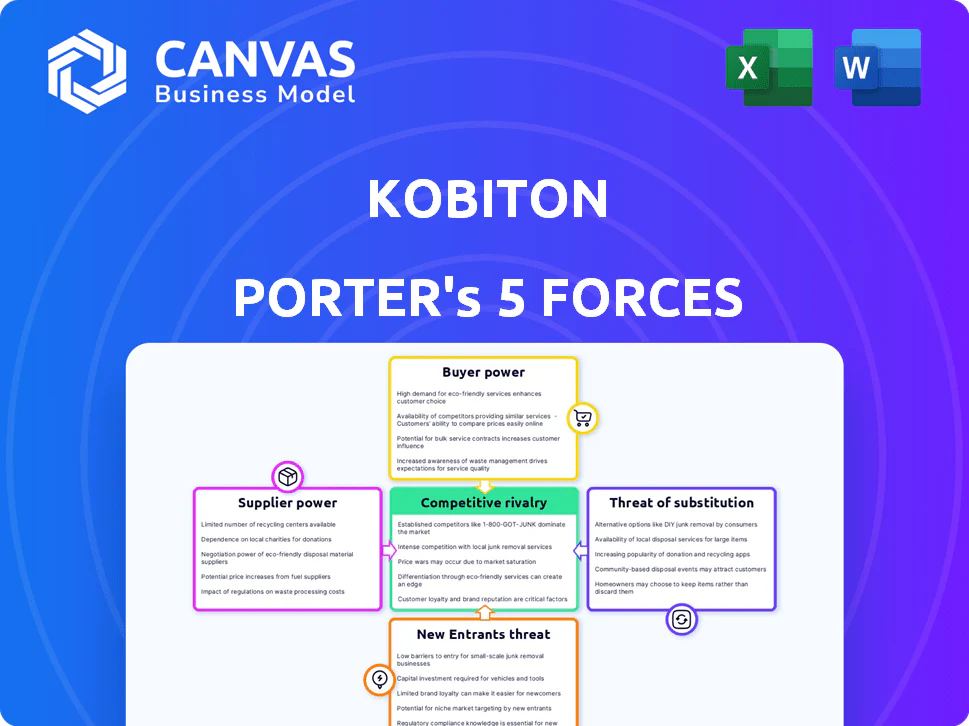
KOBITON PORTER'S FIVE FORCES TEMPLATE RESEARCH
What is included in the product
 Detailed Word Document
Analyzes Kobiton's competitive landscape, assessing threats and opportunities in the market.

 Customizable Excel Spreadsheet
Dynamically visualize your industry's competitive forces with a shareable, responsive dashboard.
Preview Before You Purchase
Kobiton Porter's Five Forces Analysis
This preview is the complete Kobiton Porter's Five Forces analysis. It's the same professionally written document you'll receive immediately after your purchase.

Porter's Five Forces Analysis Template

From Overview to Strategy Blueprint
Kobiton operates in a competitive mobile testing market, facing pressures from established players and emerging rivals. Buyer power is moderate, with some customer leverage due to alternative solutions. Supplier power is generally low, while the threat of new entrants is high. Substitute products, such as cloud testing, pose a constant challenge. Competition within the industry is intense, driven by innovation and pricing. This brief snapshot only scratches the surface. Unlock the full Porter's Five Forces Analysis to explore Kobiton’s competitive dynamics, market pressures, and strategic advantages in detail.
Suppliers Bargaining Power

Device Manufacturers and OS Providers
Kobiton's service depends on devices and OS availability. Apple and Google's control over iOS and Android impacts Kobiton. Apple's Q1 2024 revenue was $90.8 billion, showing its market strength. Google's Android dominates the OS market, affecting Kobiton's costs and access.
Cloud Infrastructure Providers
Kobiton relies on cloud providers like AWS for its infrastructure, impacting operational costs and service delivery. AWS, in Q4 2023, reported $24.2 billion in net sales. Supplier bargaining power is high; Kobiton's costs are affected by provider pricing and reliability. Changes in AWS pricing or service disruptions directly affect Kobiton's ability to serve customers.

Providers of Automation Frameworks and Tools
Kobiton relies on automation frameworks like Appium and Selenium, which affects its supplier power. While open-source, commercial tools integrated within these frameworks can influence costs. In 2024, the global test automation market was valued at approximately $16.7 billion. The market is projected to reach $40.6 billion by 2029, with a CAGR of 19.4% from 2024-2029.

AI and Machine Learning Technology Providers
Kobiton integrates AI and machine learning, notably for features like scriptless automation and self-healing tests. The bargaining power of AI and ML technology providers is relevant. These providers, if external, could influence Kobiton based on the uniqueness of their technology. The global AI market size was valued at USD 196.71 billion in 2023.
- Market size of AI: USD 196.71 billion (2023).
- Kobiton's reliance on external AI/ML tech.
- Impact on pricing and innovation.
- Provider's tech uniqueness matters.
Talent Pool
Kobiton's success hinges on attracting skilled tech professionals. The bargaining power of suppliers, like software developers, impacts labor costs. Limited talent availability can drive up salaries, affecting profitability. In 2024, the tech industry saw a 5% increase in average software developer salaries. This could strain Kobiton's resources.
- High demand for specialized skills.
- Potential for increased operational expenses.
- Impact on innovation and service delivery.
- Need for competitive compensation packages.
Kobiton's Supplier Power: A Costly Landscape
Kobiton faces significant supplier bargaining power across several fronts. Reliance on AWS and cloud providers affects operational costs and service reliability. The need for skilled tech professionals increases labor costs, impacting profitability. External AI/ML tech providers also influence Kobiton.
| Supplier Type | Impact on Kobiton | 2024 Data |
|---|---|---|
| Cloud Providers (AWS) | Operational costs, service delivery | AWS Q4 2023 net sales: $24.2B |
| Automation Frameworks | Integration costs, tool expenses | Test Automation market: $16.7B |
| AI/ML Providers | Pricing, tech uniqueness | Global AI market: $196.71B (2023) |
| Tech Professionals | Labor costs, profitability | Software dev salaries up 5% (2024) |
Customers Bargaining Power

Large Enterprise Clients
Large enterprises, with their substantial testing demands and budgets, wield considerable bargaining power when dealing with Kobiton. Their ability to commit to large-scale usage allows them to negotiate advantageous pricing and contract terms. For instance, companies spending over $100,000 annually on mobile testing services can often secure significant discounts. This leverage is amplified by the availability of alternative testing platforms; Kobiton's profitability is sensitive to large client negotiations.
Small and Medium Businesses (SMBs)
SMBs generally have less individual bargaining power than large clients. However, the sheer volume of SMBs collectively forms a vital customer base for Kobiton. In 2024, SMBs constituted around 60% of software industry revenue. Kobiton's pricing, including tiered and pay-as-you-go models, influences their power.

Developers and QA Teams
Developers and QA teams, as direct users, wield significant bargaining power. They select testing tools based on ease of use, features, and overall effectiveness, directly impacting Kobiton's market position. The adoption rate of Kobiton is influenced by user feedback, which dictates product development. In 2024, user satisfaction scores for mobile testing platforms like Kobiton averaged around 4.2 out of 5, highlighting the importance of meeting user expectations.

Need for Comprehensive Testing
Customers' power stems from their demand for extensive testing across many devices and operating systems. This need is crucial for ensuring app quality and user satisfaction. The pressure is on platforms to handle device fragmentation and diverse user environments effectively. In 2024, the mobile app testing market was valued at $6.8 billion, with a projected growth to $15.7 billion by 2030.
- Users expect apps to function flawlessly on various devices.
- Platforms must offer broad device coverage to meet customer needs.
- The market's expansion highlights the importance of comprehensive testing.
Availability of Alternatives
Customers wield significant power due to the plethora of mobile testing options. Competitors like BrowserStack and Sauce Labs provide cloud-based testing, while others offer on-premises solutions. Open-source tools also present viable alternatives, boosting customer leverage. This competitive landscape enables customers to negotiate better terms or switch providers easily.
- Market research from 2024 indicates a 15% annual growth in the mobile testing market.
- BrowserStack's 2024 revenue reached $200 million, illustrating strong competition.
- Open-source testing tools are used by approximately 30% of developers.
- Switching costs are low, with many tools offering free trials and easy onboarding.
Kobiton's Customer Dynamics: Bargaining Power & Market Value
Customers of Kobiton possess considerable bargaining power, influenced by factors like testing demands and available alternatives. Large enterprises leverage their spending to negotiate favorable terms, while SMBs collectively form a key customer base. In 2024, the mobile testing market's value was $6.8 billion.
Developers and QA teams also wield influence through their tool selections, driving product development based on user feedback. The competitive landscape, including platforms like BrowserStack, further enhances customer leverage.
| Customer Segment | Bargaining Power | Factors |
|---|---|---|
| Large Enterprises | High | Spending, contract terms |
| SMBs | Medium | Volume, pricing models |
| Developers/QA | High | Tool choice, user feedback |
Rivalry Among Competitors

Number and Diversity of Competitors
The mobile testing market is crowded with numerous competitors, including giants like Google and smaller firms like Perfecto Mobile. This diversity leads to intense rivalry. In 2024, the mobile testing market was valued at approximately $5.6 billion, showing strong competition. The presence of both broad and niche players increases competitive pressures.
Feature Differentiation
Kobiton's rivals distinguish themselves via AI features, testing framework support, and device coverage. Cloud and on-premises deployment options also play a key role. The mobile testing market, valued at $3.5 billion in 2024, sees innovation driving competition. Growth is projected at 15% annually.

Pricing and Business Models
Pricing strategies significantly shape competitive rivalry in the mobile testing market. Subscription models, like those offered by Sauce Labs, are common, but pay-as-you-go options are also available. In 2024, the mobile testing market saw increased competition, with companies like Kobiton and BrowserStack adjusting prices to stay competitive. This has led to value-added services, such as enhanced security features, becoming key differentiators.

Market Growth Rate
The mobile application testing solutions market is expanding, which influences competitive dynamics. Increased growth often fuels rivalry as companies compete for a larger share of the market, as seen in 2024 with a projected market size of $5.7 billion. However, this expansion also offers chances for various players to thrive. The market's compound annual growth rate (CAGR) is expected to be around 15% from 2024 to 2030.
- Market size in 2024: Approximately $5.7 billion.
- Projected CAGR (2024-2030): About 15%.
- Increased rivalry due to market expansion.
- Opportunities for multiple companies to succeed.
Acquisitions and Partnerships
Mergers, acquisitions, and strategic partnerships are critical in competitive dynamics. These moves reshape the market, often consolidating power and intensifying rivalry. For instance, in 2024, the tech industry saw numerous acquisitions, like Google's purchase of Looker for $2.6 billion, altering competitive positions. Such actions can lead to stronger alliances, increasing the pressure on smaller firms. This constant reshuffling of players creates a dynamic environment where strategies must continuously adapt.
- Google acquired Looker for $2.6 billion in 2024.
- Mergers and acquisitions are common strategies to boost market share.
- Strategic partnerships can create stronger market alliances.
- These activities intensify the competitive landscape.
Mobile Testing Market: A $5.7B Battleground
Competitive rivalry in the mobile testing market is fierce, with numerous players vying for market share. The market, valued at $5.7 billion in 2024, experiences intense competition. Strategic moves like acquisitions and partnerships reshape the landscape, increasing the pressure.
| Factor | Details | Impact |
|---|---|---|
| Market Size (2024) | $5.7 Billion | High competition |
| CAGR (2024-2030) | ~15% | Increased rivalry |
| Key Strategies | M&A, Partnerships | Market reshaping |
KOBITON PORTER'S FIVE FORCES TEMPLATE RESEARCH
What is included in the product
Detailed Word Document
Analyzes Kobiton's competitive landscape, assessing threats and opportunities in the market.
Customizable Excel Spreadsheet
Dynamically visualize your industry's competitive forces with a shareable, responsive dashboard.
Preview Before You Purchase
Kobiton Porter's Five Forces Analysis
This preview is the complete Kobiton Porter's Five Forces analysis. It's the same professionally written document you'll receive immediately after your purchase.
Porter's Five Forces Analysis Template
From Overview to Strategy Blueprint
Kobiton operates in a competitive mobile testing market, facing pressures from established players and emerging rivals. Buyer power is moderate, with some customer leverage due to alternative solutions. Supplier power is generally low, while the threat of new entrants is high. Substitute products, such as cloud testing, pose a constant challenge. Competition within the industry is intense, driven by innovation and pricing. This brief snapshot only scratches the surface. Unlock the full Porter's Five Forces Analysis to explore Kobiton’s competitive dynamics, market pressures, and strategic advantages in detail.
Suppliers Bargaining Power
Device Manufacturers and OS Providers
Kobiton's service depends on devices and OS availability. Apple and Google's control over iOS and Android impacts Kobiton. Apple's Q1 2024 revenue was $90.8 billion, showing its market strength. Google's Android dominates the OS market, affecting Kobiton's costs and access.
Cloud Infrastructure Providers
Kobiton relies on cloud providers like AWS for its infrastructure, impacting operational costs and service delivery. AWS, in Q4 2023, reported $24.2 billion in net sales. Supplier bargaining power is high; Kobiton's costs are affected by provider pricing and reliability. Changes in AWS pricing or service disruptions directly affect Kobiton's ability to serve customers.
Providers of Automation Frameworks and Tools
Kobiton relies on automation frameworks like Appium and Selenium, which affects its supplier power. While open-source, commercial tools integrated within these frameworks can influence costs. In 2024, the global test automation market was valued at approximately $16.7 billion. The market is projected to reach $40.6 billion by 2029, with a CAGR of 19.4% from 2024-2029.
AI and Machine Learning Technology Providers
Kobiton integrates AI and machine learning, notably for features like scriptless automation and self-healing tests. The bargaining power of AI and ML technology providers is relevant. These providers, if external, could influence Kobiton based on the uniqueness of their technology. The global AI market size was valued at USD 196.71 billion in 2023.
- Market size of AI: USD 196.71 billion (2023).
- Kobiton's reliance on external AI/ML tech.
- Impact on pricing and innovation.
- Provider's tech uniqueness matters.
Talent Pool
Kobiton's success hinges on attracting skilled tech professionals. The bargaining power of suppliers, like software developers, impacts labor costs. Limited talent availability can drive up salaries, affecting profitability. In 2024, the tech industry saw a 5% increase in average software developer salaries. This could strain Kobiton's resources.
- High demand for specialized skills.
- Potential for increased operational expenses.
- Impact on innovation and service delivery.
- Need for competitive compensation packages.
Kobiton's Supplier Power: A Costly Landscape
Kobiton faces significant supplier bargaining power across several fronts. Reliance on AWS and cloud providers affects operational costs and service reliability. The need for skilled tech professionals increases labor costs, impacting profitability. External AI/ML tech providers also influence Kobiton.
| Supplier Type | Impact on Kobiton | 2024 Data |
|---|---|---|
| Cloud Providers (AWS) | Operational costs, service delivery | AWS Q4 2023 net sales: $24.2B |
| Automation Frameworks | Integration costs, tool expenses | Test Automation market: $16.7B |
| AI/ML Providers | Pricing, tech uniqueness | Global AI market: $196.71B (2023) |
| Tech Professionals | Labor costs, profitability | Software dev salaries up 5% (2024) |
Customers Bargaining Power
Large Enterprise Clients
Large enterprises, with their substantial testing demands and budgets, wield considerable bargaining power when dealing with Kobiton. Their ability to commit to large-scale usage allows them to negotiate advantageous pricing and contract terms. For instance, companies spending over $100,000 annually on mobile testing services can often secure significant discounts. This leverage is amplified by the availability of alternative testing platforms; Kobiton's profitability is sensitive to large client negotiations.
Small and Medium Businesses (SMBs)
SMBs generally have less individual bargaining power than large clients. However, the sheer volume of SMBs collectively forms a vital customer base for Kobiton. In 2024, SMBs constituted around 60% of software industry revenue. Kobiton's pricing, including tiered and pay-as-you-go models, influences their power.
Developers and QA Teams
Developers and QA teams, as direct users, wield significant bargaining power. They select testing tools based on ease of use, features, and overall effectiveness, directly impacting Kobiton's market position. The adoption rate of Kobiton is influenced by user feedback, which dictates product development. In 2024, user satisfaction scores for mobile testing platforms like Kobiton averaged around 4.2 out of 5, highlighting the importance of meeting user expectations.
Need for Comprehensive Testing
Customers' power stems from their demand for extensive testing across many devices and operating systems. This need is crucial for ensuring app quality and user satisfaction. The pressure is on platforms to handle device fragmentation and diverse user environments effectively. In 2024, the mobile app testing market was valued at $6.8 billion, with a projected growth to $15.7 billion by 2030.
- Users expect apps to function flawlessly on various devices.
- Platforms must offer broad device coverage to meet customer needs.
- The market's expansion highlights the importance of comprehensive testing.
Availability of Alternatives
Customers wield significant power due to the plethora of mobile testing options. Competitors like BrowserStack and Sauce Labs provide cloud-based testing, while others offer on-premises solutions. Open-source tools also present viable alternatives, boosting customer leverage. This competitive landscape enables customers to negotiate better terms or switch providers easily.
- Market research from 2024 indicates a 15% annual growth in the mobile testing market.
- BrowserStack's 2024 revenue reached $200 million, illustrating strong competition.
- Open-source testing tools are used by approximately 30% of developers.
- Switching costs are low, with many tools offering free trials and easy onboarding.
Kobiton's Customer Dynamics: Bargaining Power & Market Value
Customers of Kobiton possess considerable bargaining power, influenced by factors like testing demands and available alternatives. Large enterprises leverage their spending to negotiate favorable terms, while SMBs collectively form a key customer base. In 2024, the mobile testing market's value was $6.8 billion.
Developers and QA teams also wield influence through their tool selections, driving product development based on user feedback. The competitive landscape, including platforms like BrowserStack, further enhances customer leverage.
| Customer Segment | Bargaining Power | Factors |
|---|---|---|
| Large Enterprises | High | Spending, contract terms |
| SMBs | Medium | Volume, pricing models |
| Developers/QA | High | Tool choice, user feedback |
Rivalry Among Competitors
Number and Diversity of Competitors
The mobile testing market is crowded with numerous competitors, including giants like Google and smaller firms like Perfecto Mobile. This diversity leads to intense rivalry. In 2024, the mobile testing market was valued at approximately $5.6 billion, showing strong competition. The presence of both broad and niche players increases competitive pressures.
Feature Differentiation
Kobiton's rivals distinguish themselves via AI features, testing framework support, and device coverage. Cloud and on-premises deployment options also play a key role. The mobile testing market, valued at $3.5 billion in 2024, sees innovation driving competition. Growth is projected at 15% annually.
Pricing and Business Models
Pricing strategies significantly shape competitive rivalry in the mobile testing market. Subscription models, like those offered by Sauce Labs, are common, but pay-as-you-go options are also available. In 2024, the mobile testing market saw increased competition, with companies like Kobiton and BrowserStack adjusting prices to stay competitive. This has led to value-added services, such as enhanced security features, becoming key differentiators.
Market Growth Rate
The mobile application testing solutions market is expanding, which influences competitive dynamics. Increased growth often fuels rivalry as companies compete for a larger share of the market, as seen in 2024 with a projected market size of $5.7 billion. However, this expansion also offers chances for various players to thrive. The market's compound annual growth rate (CAGR) is expected to be around 15% from 2024 to 2030.
- Market size in 2024: Approximately $5.7 billion.
- Projected CAGR (2024-2030): About 15%.
- Increased rivalry due to market expansion.
- Opportunities for multiple companies to succeed.
Acquisitions and Partnerships
Mergers, acquisitions, and strategic partnerships are critical in competitive dynamics. These moves reshape the market, often consolidating power and intensifying rivalry. For instance, in 2024, the tech industry saw numerous acquisitions, like Google's purchase of Looker for $2.6 billion, altering competitive positions. Such actions can lead to stronger alliances, increasing the pressure on smaller firms. This constant reshuffling of players creates a dynamic environment where strategies must continuously adapt.
- Google acquired Looker for $2.6 billion in 2024.
- Mergers and acquisitions are common strategies to boost market share.
- Strategic partnerships can create stronger market alliances.
- These activities intensify the competitive landscape.
Mobile Testing Market: A $5.7B Battleground
Competitive rivalry in the mobile testing market is fierce, with numerous players vying for market share. The market, valued at $5.7 billion in 2024, experiences intense competition. Strategic moves like acquisitions and partnerships reshape the landscape, increasing the pressure.
| Factor | Details | Impact |
|---|---|---|
| Market Size (2024) | $5.7 Billion | High competition |
| CAGR (2024-2030) | ~15% | Increased rivalry |
| Key Strategies | M&A, Partnerships | Market reshaping |
Product Information
Product Information
Shipping & Returns
Shipping & Returns
Description
What is included in the product
Detailed Word Document
Analyzes Kobiton's competitive landscape, assessing threats and opportunities in the market.
Customizable Excel Spreadsheet
Dynamically visualize your industry's competitive forces with a shareable, responsive dashboard.
Preview Before You Purchase
Kobiton Porter's Five Forces Analysis
This preview is the complete Kobiton Porter's Five Forces analysis. It's the same professionally written document you'll receive immediately after your purchase.
Porter's Five Forces Analysis Template
From Overview to Strategy Blueprint
Kobiton operates in a competitive mobile testing market, facing pressures from established players and emerging rivals. Buyer power is moderate, with some customer leverage due to alternative solutions. Supplier power is generally low, while the threat of new entrants is high. Substitute products, such as cloud testing, pose a constant challenge. Competition within the industry is intense, driven by innovation and pricing. This brief snapshot only scratches the surface. Unlock the full Porter's Five Forces Analysis to explore Kobiton’s competitive dynamics, market pressures, and strategic advantages in detail.
Suppliers Bargaining Power
Device Manufacturers and OS Providers
Kobiton's service depends on devices and OS availability. Apple and Google's control over iOS and Android impacts Kobiton. Apple's Q1 2024 revenue was $90.8 billion, showing its market strength. Google's Android dominates the OS market, affecting Kobiton's costs and access.
Cloud Infrastructure Providers
Kobiton relies on cloud providers like AWS for its infrastructure, impacting operational costs and service delivery. AWS, in Q4 2023, reported $24.2 billion in net sales. Supplier bargaining power is high; Kobiton's costs are affected by provider pricing and reliability. Changes in AWS pricing or service disruptions directly affect Kobiton's ability to serve customers.
Providers of Automation Frameworks and Tools
Kobiton relies on automation frameworks like Appium and Selenium, which affects its supplier power. While open-source, commercial tools integrated within these frameworks can influence costs. In 2024, the global test automation market was valued at approximately $16.7 billion. The market is projected to reach $40.6 billion by 2029, with a CAGR of 19.4% from 2024-2029.
AI and Machine Learning Technology Providers
Kobiton integrates AI and machine learning, notably for features like scriptless automation and self-healing tests. The bargaining power of AI and ML technology providers is relevant. These providers, if external, could influence Kobiton based on the uniqueness of their technology. The global AI market size was valued at USD 196.71 billion in 2023.
- Market size of AI: USD 196.71 billion (2023).
- Kobiton's reliance on external AI/ML tech.
- Impact on pricing and innovation.
- Provider's tech uniqueness matters.
Talent Pool
Kobiton's success hinges on attracting skilled tech professionals. The bargaining power of suppliers, like software developers, impacts labor costs. Limited talent availability can drive up salaries, affecting profitability. In 2024, the tech industry saw a 5% increase in average software developer salaries. This could strain Kobiton's resources.
- High demand for specialized skills.
- Potential for increased operational expenses.
- Impact on innovation and service delivery.
- Need for competitive compensation packages.
Kobiton's Supplier Power: A Costly Landscape
Kobiton faces significant supplier bargaining power across several fronts. Reliance on AWS and cloud providers affects operational costs and service reliability. The need for skilled tech professionals increases labor costs, impacting profitability. External AI/ML tech providers also influence Kobiton.
| Supplier Type | Impact on Kobiton | 2024 Data |
|---|---|---|
| Cloud Providers (AWS) | Operational costs, service delivery | AWS Q4 2023 net sales: $24.2B |
| Automation Frameworks | Integration costs, tool expenses | Test Automation market: $16.7B |
| AI/ML Providers | Pricing, tech uniqueness | Global AI market: $196.71B (2023) |
| Tech Professionals | Labor costs, profitability | Software dev salaries up 5% (2024) |
Customers Bargaining Power
Large Enterprise Clients
Large enterprises, with their substantial testing demands and budgets, wield considerable bargaining power when dealing with Kobiton. Their ability to commit to large-scale usage allows them to negotiate advantageous pricing and contract terms. For instance, companies spending over $100,000 annually on mobile testing services can often secure significant discounts. This leverage is amplified by the availability of alternative testing platforms; Kobiton's profitability is sensitive to large client negotiations.
Small and Medium Businesses (SMBs)
SMBs generally have less individual bargaining power than large clients. However, the sheer volume of SMBs collectively forms a vital customer base for Kobiton. In 2024, SMBs constituted around 60% of software industry revenue. Kobiton's pricing, including tiered and pay-as-you-go models, influences their power.
Developers and QA Teams
Developers and QA teams, as direct users, wield significant bargaining power. They select testing tools based on ease of use, features, and overall effectiveness, directly impacting Kobiton's market position. The adoption rate of Kobiton is influenced by user feedback, which dictates product development. In 2024, user satisfaction scores for mobile testing platforms like Kobiton averaged around 4.2 out of 5, highlighting the importance of meeting user expectations.
Need for Comprehensive Testing
Customers' power stems from their demand for extensive testing across many devices and operating systems. This need is crucial for ensuring app quality and user satisfaction. The pressure is on platforms to handle device fragmentation and diverse user environments effectively. In 2024, the mobile app testing market was valued at $6.8 billion, with a projected growth to $15.7 billion by 2030.
- Users expect apps to function flawlessly on various devices.
- Platforms must offer broad device coverage to meet customer needs.
- The market's expansion highlights the importance of comprehensive testing.
Availability of Alternatives
Customers wield significant power due to the plethora of mobile testing options. Competitors like BrowserStack and Sauce Labs provide cloud-based testing, while others offer on-premises solutions. Open-source tools also present viable alternatives, boosting customer leverage. This competitive landscape enables customers to negotiate better terms or switch providers easily.
- Market research from 2024 indicates a 15% annual growth in the mobile testing market.
- BrowserStack's 2024 revenue reached $200 million, illustrating strong competition.
- Open-source testing tools are used by approximately 30% of developers.
- Switching costs are low, with many tools offering free trials and easy onboarding.
Kobiton's Customer Dynamics: Bargaining Power & Market Value
Customers of Kobiton possess considerable bargaining power, influenced by factors like testing demands and available alternatives. Large enterprises leverage their spending to negotiate favorable terms, while SMBs collectively form a key customer base. In 2024, the mobile testing market's value was $6.8 billion.
Developers and QA teams also wield influence through their tool selections, driving product development based on user feedback. The competitive landscape, including platforms like BrowserStack, further enhances customer leverage.
| Customer Segment | Bargaining Power | Factors |
|---|---|---|
| Large Enterprises | High | Spending, contract terms |
| SMBs | Medium | Volume, pricing models |
| Developers/QA | High | Tool choice, user feedback |
Rivalry Among Competitors
Number and Diversity of Competitors
The mobile testing market is crowded with numerous competitors, including giants like Google and smaller firms like Perfecto Mobile. This diversity leads to intense rivalry. In 2024, the mobile testing market was valued at approximately $5.6 billion, showing strong competition. The presence of both broad and niche players increases competitive pressures.
Feature Differentiation
Kobiton's rivals distinguish themselves via AI features, testing framework support, and device coverage. Cloud and on-premises deployment options also play a key role. The mobile testing market, valued at $3.5 billion in 2024, sees innovation driving competition. Growth is projected at 15% annually.
Pricing and Business Models
Pricing strategies significantly shape competitive rivalry in the mobile testing market. Subscription models, like those offered by Sauce Labs, are common, but pay-as-you-go options are also available. In 2024, the mobile testing market saw increased competition, with companies like Kobiton and BrowserStack adjusting prices to stay competitive. This has led to value-added services, such as enhanced security features, becoming key differentiators.
Market Growth Rate
The mobile application testing solutions market is expanding, which influences competitive dynamics. Increased growth often fuels rivalry as companies compete for a larger share of the market, as seen in 2024 with a projected market size of $5.7 billion. However, this expansion also offers chances for various players to thrive. The market's compound annual growth rate (CAGR) is expected to be around 15% from 2024 to 2030.
- Market size in 2024: Approximately $5.7 billion.
- Projected CAGR (2024-2030): About 15%.
- Increased rivalry due to market expansion.
- Opportunities for multiple companies to succeed.
Acquisitions and Partnerships
Mergers, acquisitions, and strategic partnerships are critical in competitive dynamics. These moves reshape the market, often consolidating power and intensifying rivalry. For instance, in 2024, the tech industry saw numerous acquisitions, like Google's purchase of Looker for $2.6 billion, altering competitive positions. Such actions can lead to stronger alliances, increasing the pressure on smaller firms. This constant reshuffling of players creates a dynamic environment where strategies must continuously adapt.
- Google acquired Looker for $2.6 billion in 2024.
- Mergers and acquisitions are common strategies to boost market share.
- Strategic partnerships can create stronger market alliances.
- These activities intensify the competitive landscape.
Mobile Testing Market: A $5.7B Battleground
Competitive rivalry in the mobile testing market is fierce, with numerous players vying for market share. The market, valued at $5.7 billion in 2024, experiences intense competition. Strategic moves like acquisitions and partnerships reshape the landscape, increasing the pressure.
| Factor | Details | Impact |
|---|---|---|
| Market Size (2024) | $5.7 Billion | High competition |
| CAGR (2024-2030) | ~15% | Increased rivalry |
| Key Strategies | M&A, Partnerships | Market reshaping |











