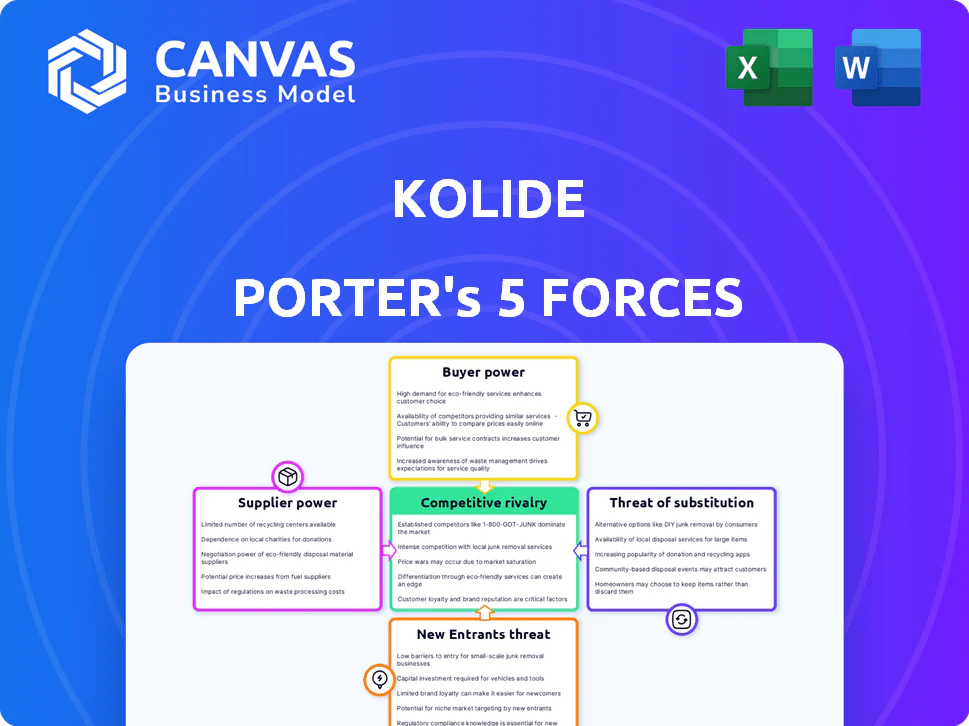
KOLIDE PORTER'S FIVE FORCES TEMPLATE RESEARCH
What is included in the product
 Detailed Word Document
Analyzes Kolide's competitive position by examining industry forces like rivalry and threat of substitutes.

 Customizable Excel Spreadsheet
Get dynamic data visualizations to instantly reveal market pressures, making strategic adjustments easy.
What You See Is What You Get
Kolide Porter's Five Forces Analysis
This Kolide Porter's Five Forces Analysis preview is the complete, ready-to-use document. You're seeing the exact analysis you'll receive immediately after your purchase. It's fully formatted and designed for your immediate use. There are no revisions or added steps to this file.

Porter's Five Forces Analysis Template

Elevate Your Analysis with the Complete Porter's Five Forces Analysis
Kolide operates within a cybersecurity landscape marked by intense competition. Buyer power is moderate, with organizations wielding some leverage due to vendor options. Supplier power is relatively low, benefiting Kolide. The threat of new entrants is moderate, balanced by established players. Substitutes pose a notable risk, especially from bundled security solutions. The competitive rivalry is high, intensifying the pressure to innovate.
This brief snapshot only scratches the surface. Unlock the full Porter's Five Forces Analysis to explore Kolide’s competitive dynamics, market pressures, and strategic advantages in detail.
Suppliers Bargaining Power

Reliance on Core Technologies
Kolide's reliance on core technologies like Osquery influences supplier power. Osquery's open-source nature reduces supplier concentration. However, the specialized skills needed for product development could increase the bargaining power of expert developers. The global cybersecurity market was valued at $200.89 billion in 2024.
Cloud Infrastructure Providers
Kolide, as a SaaS company, depends on cloud providers for infrastructure. Major players like AWS, Azure, and Google Cloud hold substantial market power. In 2024, these providers collectively controlled over 60% of the cloud infrastructure market. Kolide uses managed services, such as Google Kubernetes Engine, potentially lessening direct supplier influence.

Third-Party Integrations
Kolide's integrations with Slack and Google Workspace are essential for its user experience. This dependence gives these third-party providers bargaining power. For example, in 2024, Slack's revenue was $1.4 billion, showing its market influence.

Talent Pool
Kolide's operational costs are significantly influenced by the bargaining power of suppliers, particularly within the "Talent Pool" force. The cybersecurity field demands highly skilled professionals. Limited availability of experienced cybersecurity and software development talent gives these specialists more leverage. This can drive up operational costs, affecting profitability and potentially influencing project timelines.
- Cybersecurity workforce shortage: a 2023 study by (ISC)² estimated a global shortage of 4 million cybersecurity professionals.
- Increased labor costs: According to the 2024 Cyber Security Salary Survey, demand has pushed cybersecurity salaries up, with experienced professionals commanding high rates.
- Contractor dependency: Companies often rely on specialized contractors, whose hourly rates can be significantly higher than salaried employees.
Hardware Manufacturers
Kolide, as a software provider, faces indirect influence from hardware manufacturers and operating system providers due to its need to support diverse endpoint devices like Macs, Windows, and Linux systems. The reliance on these hardware platforms, where the global PC market reached $246 billion in 2023, can indirectly impact Kolide’s operations. While Kolide leverages the open-source Osquery for broad compatibility, it still needs to adapt to hardware changes and updates. This dependence can affect Kolide's costs and development timelines.
- Market Size: The global PC market was valued at $246 billion in 2023.
- Operating System Influence: Major OS providers' updates can affect Kolide's compatibility efforts.
- Hardware Compatibility: Kolide must ensure its software runs smoothly on various hardware.
- Osquery Base: Kolide uses Osquery for broad compatibility across devices.
Cybersecurity Talent Shortage: A Business Challenge
The bargaining power of suppliers significantly impacts Kolide's operations, particularly in talent acquisition. Limited availability of skilled cybersecurity professionals, a global shortage of 4 million in 2023, increases labor costs. This impacts profitability and project timelines.
| Force | Impact | Data Point (2024) |
|---|---|---|
| Talent Pool | High | Cybersecurity salaries up due to demand. |
| Cloud Providers | Medium | AWS, Azure, and Google Cloud control over 60% of cloud infrastructure market. |
| Integrations | Medium | Slack's 2024 revenue was $1.4 billion. |
Customers Bargaining Power

Availability of Alternatives
The endpoint security market is highly competitive, featuring many vendors like CrowdStrike and SentinelOne, providing EPP and EDR platforms. This competitive landscape offers customers numerous alternatives, enhancing their bargaining power. For example, in 2024, the global endpoint security market was valued at approximately $20 billion, with diverse solutions available. This allows customers to compare features and negotiate for better pricing and service terms.
Switching Costs
Switching costs for security solutions like Kolide can vary. While integrating new systems can be costly, the presence of alternative products can lower these costs. Kolide's Slack-centric approach could also affect switching, as it might disrupt existing workflows if a customer moves to a different platform. According to a 2024 report, the average cost to switch security vendors is about $15,000 for small businesses.

Customer Size and Concentration
Large customers, especially those with substantial purchasing volumes, wield significant bargaining power. Kolide's revenue concentration among a few major clients, if any, could amplify their influence. For example, if 30% of Kolide's revenue comes from a single enterprise client, that client's bargaining power is notably high. This can lead to price pressure and demands for customized services.

Price Sensitivity
Price sensitivity significantly shapes customer power in cybersecurity. SMEs, in particular, often face budget constraints, making them highly conscious of implementation and subscription costs. This sensitivity boosts their ability to negotiate and demand better pricing from vendors. Recent data indicates that cybersecurity spending by SMEs grew by only 8% in 2024, compared to 12% in 2023, suggesting increased price scrutiny.
- SME cybersecurity spending growth slowed in 2024, indicating price sensitivity.
- Implementation and subscription costs are key factors in customer decisions.
- Customers can demand competitive pricing because of these factors.
- Price sensitivity is a significant factor in the cybersecurity market.
Access to Information and Awareness
Customers are becoming more informed about cybersecurity threats and available solutions. This increased awareness, combined with easy access to reviews and comparisons, boosts their ability to make smart decisions and negotiate better deals. This trend is evident in the cybersecurity market. For example, in 2024, over 70% of businesses reported using multiple cybersecurity vendors, showcasing the power of choice and comparison.
- 70% of businesses used multiple cybersecurity vendors in 2024.
- Increased awareness of cybersecurity threats is empowering customers.
- Easy access to reviews and comparisons enables informed decisions.
- Customers can negotiate better terms.
Endpoint Security: Customer Power Dynamics
Customer bargaining power in the endpoint security market is considerable due to vendor competition and readily available alternatives. In 2024, the market was estimated at $20 billion, giving customers leverage. Price sensitivity, especially among SMEs, further enhances their negotiation strength.
| Factor | Impact | Data (2024) |
|---|---|---|
| Competition | Increased Choice | Over 100 EPP/EDR vendors |
| Price Sensitivity | Higher Negotiation | SME spending growth slowed to 8% |
| Information | Informed Decisions | 70% of businesses use multiple vendors |
Rivalry Among Competitors

Numerous Competitors
The endpoint security market is highly competitive, featuring many companies vying for market share. This intense competition drives down prices and increases the pressure to innovate. In 2024, the market saw over 50 major vendors, including Microsoft, CrowdStrike, and SentinelOne, each with varying market shares. This fragmentation leads to vigorous rivalry.
Diverse Offerings
Kolide faces intense competition. Rivals provide various endpoint security options. These include antivirus, EPP, and EDR solutions. Kolide's user focus sets it apart. However, it still battles for market share. The endpoint security market was valued at $22.96 billion in 2023. It is expected to reach $39.97 billion by 2029.

Innovation and Technological Advancement
The cybersecurity field sees rapid innovation due to emerging threats. Firms compete intensely through features and effectiveness. In 2024, cybersecurity spending is projected to reach $214 billion globally. This drives constant technological progress. Companies like CrowdStrike and Palo Alto Networks compete fiercely.

Market Growth Rate
The endpoint security market is booming, creating fierce rivalry. This expansion pulls in new competitors and drives aggressive tactics to grab market share. Increased market attractiveness often leads to more intense competition, potentially squeezing profit margins. Recent reports indicate the endpoint security market was valued at $20.3 billion in 2023.
- Market growth fuels competition.
- Aggressive strategies escalate.
- Profit margins face pressure.
- Endpoint security market was valued at $20.3 billion in 2023.
Switching Costs for Customers
Switching costs in the endpoint security market, while not always prohibitive, can influence competition. The time and resources needed to implement a new solution can make companies hesitant to switch. This dynamic can intensify rivalry, with vendors vying for customer acquisition and retention. The average contract length for cybersecurity services is around 2-3 years.
- Implementation challenges may lead to customer inertia.
- Vendors could offer competitive pricing and enhanced support.
- Switching costs are lower for cloud-based solutions.
- Customer loyalty programs could strengthen retention.
Endpoint Security: A $20.3 Billion Battleground
Competitive rivalry in endpoint security is fierce, fueled by market growth and numerous vendors. This leads to aggressive strategies and pressure on profit margins, impacting pricing and innovation. The endpoint security market was valued at $20.3 billion in 2023, intensifying the competition.
| Aspect | Details |
|---|---|
| Market Size (2023) | $20.3 billion |
| Vendors | Over 50 major vendors |
| Projected Cybersecurity Spending (2024) | $214 billion |
KOLIDE PORTER'S FIVE FORCES TEMPLATE RESEARCH
What is included in the product
Detailed Word Document
Analyzes Kolide's competitive position by examining industry forces like rivalry and threat of substitutes.
Customizable Excel Spreadsheet
Get dynamic data visualizations to instantly reveal market pressures, making strategic adjustments easy.
What You See Is What You Get
Kolide Porter's Five Forces Analysis
This Kolide Porter's Five Forces Analysis preview is the complete, ready-to-use document. You're seeing the exact analysis you'll receive immediately after your purchase. It's fully formatted and designed for your immediate use. There are no revisions or added steps to this file.
Porter's Five Forces Analysis Template
Elevate Your Analysis with the Complete Porter's Five Forces Analysis
Kolide operates within a cybersecurity landscape marked by intense competition. Buyer power is moderate, with organizations wielding some leverage due to vendor options. Supplier power is relatively low, benefiting Kolide. The threat of new entrants is moderate, balanced by established players. Substitutes pose a notable risk, especially from bundled security solutions. The competitive rivalry is high, intensifying the pressure to innovate.
This brief snapshot only scratches the surface. Unlock the full Porter's Five Forces Analysis to explore Kolide’s competitive dynamics, market pressures, and strategic advantages in detail.
Suppliers Bargaining Power
Reliance on Core Technologies
Kolide's reliance on core technologies like Osquery influences supplier power. Osquery's open-source nature reduces supplier concentration. However, the specialized skills needed for product development could increase the bargaining power of expert developers. The global cybersecurity market was valued at $200.89 billion in 2024.
Cloud Infrastructure Providers
Kolide, as a SaaS company, depends on cloud providers for infrastructure. Major players like AWS, Azure, and Google Cloud hold substantial market power. In 2024, these providers collectively controlled over 60% of the cloud infrastructure market. Kolide uses managed services, such as Google Kubernetes Engine, potentially lessening direct supplier influence.
Third-Party Integrations
Kolide's integrations with Slack and Google Workspace are essential for its user experience. This dependence gives these third-party providers bargaining power. For example, in 2024, Slack's revenue was $1.4 billion, showing its market influence.
Talent Pool
Kolide's operational costs are significantly influenced by the bargaining power of suppliers, particularly within the "Talent Pool" force. The cybersecurity field demands highly skilled professionals. Limited availability of experienced cybersecurity and software development talent gives these specialists more leverage. This can drive up operational costs, affecting profitability and potentially influencing project timelines.
- Cybersecurity workforce shortage: a 2023 study by (ISC)² estimated a global shortage of 4 million cybersecurity professionals.
- Increased labor costs: According to the 2024 Cyber Security Salary Survey, demand has pushed cybersecurity salaries up, with experienced professionals commanding high rates.
- Contractor dependency: Companies often rely on specialized contractors, whose hourly rates can be significantly higher than salaried employees.
Hardware Manufacturers
Kolide, as a software provider, faces indirect influence from hardware manufacturers and operating system providers due to its need to support diverse endpoint devices like Macs, Windows, and Linux systems. The reliance on these hardware platforms, where the global PC market reached $246 billion in 2023, can indirectly impact Kolide’s operations. While Kolide leverages the open-source Osquery for broad compatibility, it still needs to adapt to hardware changes and updates. This dependence can affect Kolide's costs and development timelines.
- Market Size: The global PC market was valued at $246 billion in 2023.
- Operating System Influence: Major OS providers' updates can affect Kolide's compatibility efforts.
- Hardware Compatibility: Kolide must ensure its software runs smoothly on various hardware.
- Osquery Base: Kolide uses Osquery for broad compatibility across devices.
Cybersecurity Talent Shortage: A Business Challenge
The bargaining power of suppliers significantly impacts Kolide's operations, particularly in talent acquisition. Limited availability of skilled cybersecurity professionals, a global shortage of 4 million in 2023, increases labor costs. This impacts profitability and project timelines.
| Force | Impact | Data Point (2024) |
|---|---|---|
| Talent Pool | High | Cybersecurity salaries up due to demand. |
| Cloud Providers | Medium | AWS, Azure, and Google Cloud control over 60% of cloud infrastructure market. |
| Integrations | Medium | Slack's 2024 revenue was $1.4 billion. |
Customers Bargaining Power
Availability of Alternatives
The endpoint security market is highly competitive, featuring many vendors like CrowdStrike and SentinelOne, providing EPP and EDR platforms. This competitive landscape offers customers numerous alternatives, enhancing their bargaining power. For example, in 2024, the global endpoint security market was valued at approximately $20 billion, with diverse solutions available. This allows customers to compare features and negotiate for better pricing and service terms.
Switching Costs
Switching costs for security solutions like Kolide can vary. While integrating new systems can be costly, the presence of alternative products can lower these costs. Kolide's Slack-centric approach could also affect switching, as it might disrupt existing workflows if a customer moves to a different platform. According to a 2024 report, the average cost to switch security vendors is about $15,000 for small businesses.
Customer Size and Concentration
Large customers, especially those with substantial purchasing volumes, wield significant bargaining power. Kolide's revenue concentration among a few major clients, if any, could amplify their influence. For example, if 30% of Kolide's revenue comes from a single enterprise client, that client's bargaining power is notably high. This can lead to price pressure and demands for customized services.
Price Sensitivity
Price sensitivity significantly shapes customer power in cybersecurity. SMEs, in particular, often face budget constraints, making them highly conscious of implementation and subscription costs. This sensitivity boosts their ability to negotiate and demand better pricing from vendors. Recent data indicates that cybersecurity spending by SMEs grew by only 8% in 2024, compared to 12% in 2023, suggesting increased price scrutiny.
- SME cybersecurity spending growth slowed in 2024, indicating price sensitivity.
- Implementation and subscription costs are key factors in customer decisions.
- Customers can demand competitive pricing because of these factors.
- Price sensitivity is a significant factor in the cybersecurity market.
Access to Information and Awareness
Customers are becoming more informed about cybersecurity threats and available solutions. This increased awareness, combined with easy access to reviews and comparisons, boosts their ability to make smart decisions and negotiate better deals. This trend is evident in the cybersecurity market. For example, in 2024, over 70% of businesses reported using multiple cybersecurity vendors, showcasing the power of choice and comparison.
- 70% of businesses used multiple cybersecurity vendors in 2024.
- Increased awareness of cybersecurity threats is empowering customers.
- Easy access to reviews and comparisons enables informed decisions.
- Customers can negotiate better terms.
Endpoint Security: Customer Power Dynamics
Customer bargaining power in the endpoint security market is considerable due to vendor competition and readily available alternatives. In 2024, the market was estimated at $20 billion, giving customers leverage. Price sensitivity, especially among SMEs, further enhances their negotiation strength.
| Factor | Impact | Data (2024) |
|---|---|---|
| Competition | Increased Choice | Over 100 EPP/EDR vendors |
| Price Sensitivity | Higher Negotiation | SME spending growth slowed to 8% |
| Information | Informed Decisions | 70% of businesses use multiple vendors |
Rivalry Among Competitors
Numerous Competitors
The endpoint security market is highly competitive, featuring many companies vying for market share. This intense competition drives down prices and increases the pressure to innovate. In 2024, the market saw over 50 major vendors, including Microsoft, CrowdStrike, and SentinelOne, each with varying market shares. This fragmentation leads to vigorous rivalry.
Diverse Offerings
Kolide faces intense competition. Rivals provide various endpoint security options. These include antivirus, EPP, and EDR solutions. Kolide's user focus sets it apart. However, it still battles for market share. The endpoint security market was valued at $22.96 billion in 2023. It is expected to reach $39.97 billion by 2029.
Innovation and Technological Advancement
The cybersecurity field sees rapid innovation due to emerging threats. Firms compete intensely through features and effectiveness. In 2024, cybersecurity spending is projected to reach $214 billion globally. This drives constant technological progress. Companies like CrowdStrike and Palo Alto Networks compete fiercely.
Market Growth Rate
The endpoint security market is booming, creating fierce rivalry. This expansion pulls in new competitors and drives aggressive tactics to grab market share. Increased market attractiveness often leads to more intense competition, potentially squeezing profit margins. Recent reports indicate the endpoint security market was valued at $20.3 billion in 2023.
- Market growth fuels competition.
- Aggressive strategies escalate.
- Profit margins face pressure.
- Endpoint security market was valued at $20.3 billion in 2023.
Switching Costs for Customers
Switching costs in the endpoint security market, while not always prohibitive, can influence competition. The time and resources needed to implement a new solution can make companies hesitant to switch. This dynamic can intensify rivalry, with vendors vying for customer acquisition and retention. The average contract length for cybersecurity services is around 2-3 years.
- Implementation challenges may lead to customer inertia.
- Vendors could offer competitive pricing and enhanced support.
- Switching costs are lower for cloud-based solutions.
- Customer loyalty programs could strengthen retention.
Endpoint Security: A $20.3 Billion Battleground
Competitive rivalry in endpoint security is fierce, fueled by market growth and numerous vendors. This leads to aggressive strategies and pressure on profit margins, impacting pricing and innovation. The endpoint security market was valued at $20.3 billion in 2023, intensifying the competition.
| Aspect | Details |
|---|---|
| Market Size (2023) | $20.3 billion |
| Vendors | Over 50 major vendors |
| Projected Cybersecurity Spending (2024) | $214 billion |
Product Information
Product Information
Shipping & Returns
Shipping & Returns
Description
What is included in the product
Detailed Word Document
Analyzes Kolide's competitive position by examining industry forces like rivalry and threat of substitutes.
Customizable Excel Spreadsheet
Get dynamic data visualizations to instantly reveal market pressures, making strategic adjustments easy.
What You See Is What You Get
Kolide Porter's Five Forces Analysis
This Kolide Porter's Five Forces Analysis preview is the complete, ready-to-use document. You're seeing the exact analysis you'll receive immediately after your purchase. It's fully formatted and designed for your immediate use. There are no revisions or added steps to this file.
Porter's Five Forces Analysis Template
Elevate Your Analysis with the Complete Porter's Five Forces Analysis
Kolide operates within a cybersecurity landscape marked by intense competition. Buyer power is moderate, with organizations wielding some leverage due to vendor options. Supplier power is relatively low, benefiting Kolide. The threat of new entrants is moderate, balanced by established players. Substitutes pose a notable risk, especially from bundled security solutions. The competitive rivalry is high, intensifying the pressure to innovate.
This brief snapshot only scratches the surface. Unlock the full Porter's Five Forces Analysis to explore Kolide’s competitive dynamics, market pressures, and strategic advantages in detail.
Suppliers Bargaining Power
Reliance on Core Technologies
Kolide's reliance on core technologies like Osquery influences supplier power. Osquery's open-source nature reduces supplier concentration. However, the specialized skills needed for product development could increase the bargaining power of expert developers. The global cybersecurity market was valued at $200.89 billion in 2024.
Cloud Infrastructure Providers
Kolide, as a SaaS company, depends on cloud providers for infrastructure. Major players like AWS, Azure, and Google Cloud hold substantial market power. In 2024, these providers collectively controlled over 60% of the cloud infrastructure market. Kolide uses managed services, such as Google Kubernetes Engine, potentially lessening direct supplier influence.
Third-Party Integrations
Kolide's integrations with Slack and Google Workspace are essential for its user experience. This dependence gives these third-party providers bargaining power. For example, in 2024, Slack's revenue was $1.4 billion, showing its market influence.
Talent Pool
Kolide's operational costs are significantly influenced by the bargaining power of suppliers, particularly within the "Talent Pool" force. The cybersecurity field demands highly skilled professionals. Limited availability of experienced cybersecurity and software development talent gives these specialists more leverage. This can drive up operational costs, affecting profitability and potentially influencing project timelines.
- Cybersecurity workforce shortage: a 2023 study by (ISC)² estimated a global shortage of 4 million cybersecurity professionals.
- Increased labor costs: According to the 2024 Cyber Security Salary Survey, demand has pushed cybersecurity salaries up, with experienced professionals commanding high rates.
- Contractor dependency: Companies often rely on specialized contractors, whose hourly rates can be significantly higher than salaried employees.
Hardware Manufacturers
Kolide, as a software provider, faces indirect influence from hardware manufacturers and operating system providers due to its need to support diverse endpoint devices like Macs, Windows, and Linux systems. The reliance on these hardware platforms, where the global PC market reached $246 billion in 2023, can indirectly impact Kolide’s operations. While Kolide leverages the open-source Osquery for broad compatibility, it still needs to adapt to hardware changes and updates. This dependence can affect Kolide's costs and development timelines.
- Market Size: The global PC market was valued at $246 billion in 2023.
- Operating System Influence: Major OS providers' updates can affect Kolide's compatibility efforts.
- Hardware Compatibility: Kolide must ensure its software runs smoothly on various hardware.
- Osquery Base: Kolide uses Osquery for broad compatibility across devices.
Cybersecurity Talent Shortage: A Business Challenge
The bargaining power of suppliers significantly impacts Kolide's operations, particularly in talent acquisition. Limited availability of skilled cybersecurity professionals, a global shortage of 4 million in 2023, increases labor costs. This impacts profitability and project timelines.
| Force | Impact | Data Point (2024) |
|---|---|---|
| Talent Pool | High | Cybersecurity salaries up due to demand. |
| Cloud Providers | Medium | AWS, Azure, and Google Cloud control over 60% of cloud infrastructure market. |
| Integrations | Medium | Slack's 2024 revenue was $1.4 billion. |
Customers Bargaining Power
Availability of Alternatives
The endpoint security market is highly competitive, featuring many vendors like CrowdStrike and SentinelOne, providing EPP and EDR platforms. This competitive landscape offers customers numerous alternatives, enhancing their bargaining power. For example, in 2024, the global endpoint security market was valued at approximately $20 billion, with diverse solutions available. This allows customers to compare features and negotiate for better pricing and service terms.
Switching Costs
Switching costs for security solutions like Kolide can vary. While integrating new systems can be costly, the presence of alternative products can lower these costs. Kolide's Slack-centric approach could also affect switching, as it might disrupt existing workflows if a customer moves to a different platform. According to a 2024 report, the average cost to switch security vendors is about $15,000 for small businesses.
Customer Size and Concentration
Large customers, especially those with substantial purchasing volumes, wield significant bargaining power. Kolide's revenue concentration among a few major clients, if any, could amplify their influence. For example, if 30% of Kolide's revenue comes from a single enterprise client, that client's bargaining power is notably high. This can lead to price pressure and demands for customized services.
Price Sensitivity
Price sensitivity significantly shapes customer power in cybersecurity. SMEs, in particular, often face budget constraints, making them highly conscious of implementation and subscription costs. This sensitivity boosts their ability to negotiate and demand better pricing from vendors. Recent data indicates that cybersecurity spending by SMEs grew by only 8% in 2024, compared to 12% in 2023, suggesting increased price scrutiny.
- SME cybersecurity spending growth slowed in 2024, indicating price sensitivity.
- Implementation and subscription costs are key factors in customer decisions.
- Customers can demand competitive pricing because of these factors.
- Price sensitivity is a significant factor in the cybersecurity market.
Access to Information and Awareness
Customers are becoming more informed about cybersecurity threats and available solutions. This increased awareness, combined with easy access to reviews and comparisons, boosts their ability to make smart decisions and negotiate better deals. This trend is evident in the cybersecurity market. For example, in 2024, over 70% of businesses reported using multiple cybersecurity vendors, showcasing the power of choice and comparison.
- 70% of businesses used multiple cybersecurity vendors in 2024.
- Increased awareness of cybersecurity threats is empowering customers.
- Easy access to reviews and comparisons enables informed decisions.
- Customers can negotiate better terms.
Endpoint Security: Customer Power Dynamics
Customer bargaining power in the endpoint security market is considerable due to vendor competition and readily available alternatives. In 2024, the market was estimated at $20 billion, giving customers leverage. Price sensitivity, especially among SMEs, further enhances their negotiation strength.
| Factor | Impact | Data (2024) |
|---|---|---|
| Competition | Increased Choice | Over 100 EPP/EDR vendors |
| Price Sensitivity | Higher Negotiation | SME spending growth slowed to 8% |
| Information | Informed Decisions | 70% of businesses use multiple vendors |
Rivalry Among Competitors
Numerous Competitors
The endpoint security market is highly competitive, featuring many companies vying for market share. This intense competition drives down prices and increases the pressure to innovate. In 2024, the market saw over 50 major vendors, including Microsoft, CrowdStrike, and SentinelOne, each with varying market shares. This fragmentation leads to vigorous rivalry.
Diverse Offerings
Kolide faces intense competition. Rivals provide various endpoint security options. These include antivirus, EPP, and EDR solutions. Kolide's user focus sets it apart. However, it still battles for market share. The endpoint security market was valued at $22.96 billion in 2023. It is expected to reach $39.97 billion by 2029.
Innovation and Technological Advancement
The cybersecurity field sees rapid innovation due to emerging threats. Firms compete intensely through features and effectiveness. In 2024, cybersecurity spending is projected to reach $214 billion globally. This drives constant technological progress. Companies like CrowdStrike and Palo Alto Networks compete fiercely.
Market Growth Rate
The endpoint security market is booming, creating fierce rivalry. This expansion pulls in new competitors and drives aggressive tactics to grab market share. Increased market attractiveness often leads to more intense competition, potentially squeezing profit margins. Recent reports indicate the endpoint security market was valued at $20.3 billion in 2023.
- Market growth fuels competition.
- Aggressive strategies escalate.
- Profit margins face pressure.
- Endpoint security market was valued at $20.3 billion in 2023.
Switching Costs for Customers
Switching costs in the endpoint security market, while not always prohibitive, can influence competition. The time and resources needed to implement a new solution can make companies hesitant to switch. This dynamic can intensify rivalry, with vendors vying for customer acquisition and retention. The average contract length for cybersecurity services is around 2-3 years.
- Implementation challenges may lead to customer inertia.
- Vendors could offer competitive pricing and enhanced support.
- Switching costs are lower for cloud-based solutions.
- Customer loyalty programs could strengthen retention.
Endpoint Security: A $20.3 Billion Battleground
Competitive rivalry in endpoint security is fierce, fueled by market growth and numerous vendors. This leads to aggressive strategies and pressure on profit margins, impacting pricing and innovation. The endpoint security market was valued at $20.3 billion in 2023, intensifying the competition.
| Aspect | Details |
|---|---|
| Market Size (2023) | $20.3 billion |
| Vendors | Over 50 major vendors |
| Projected Cybersecurity Spending (2024) | $214 billion |











