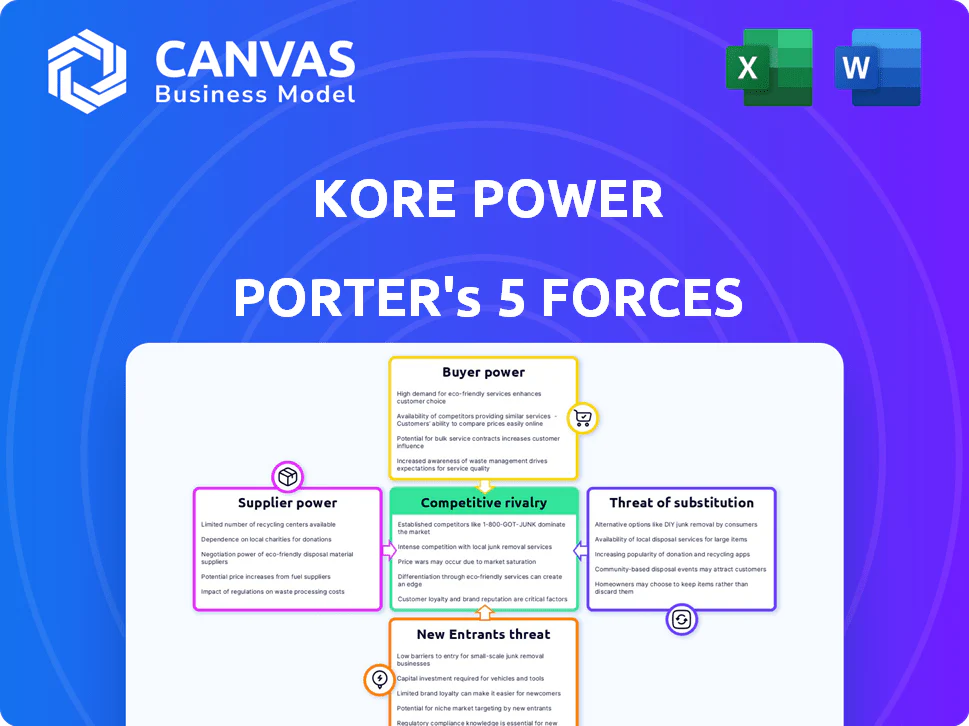
KORE POWER PORTER'S FIVE FORCES TEMPLATE RESEARCH
What is included in the product
 Detailed Word Document
Tailored exclusively for KORE Power, analyzing its position within its competitive landscape.

 Customizable Excel Spreadsheet
Instantly pinpoint competitive threats via concise force summaries and clear visualizations.
Preview Before You Purchase
KORE Power Porter's Five Forces Analysis
You're previewing the actual, complete KORE Power Porter's Five Forces analysis. This is the very document you will receive instantly after purchase, fully formatted and ready for immediate use.

Porter's Five Forces Analysis Template

Don't Miss the Bigger Picture
KORE Power faces moderate rivalry, intensified by competition in the battery market. Bargaining power of suppliers could be a factor due to material costs. Buyer power varies, influenced by demand from different sectors. Threat of substitutes remains a consideration, with alternative energy storage tech. The threat of new entrants is also present, reflecting market growth.
This preview is just the starting point. Dive into a complete, consultant-grade breakdown of KORE Power’s industry competitiveness—ready for immediate use.
Suppliers Bargaining Power

Limited number of specialized suppliers for key materials
The battery manufacturing industry, especially lithium-ion batteries, depends on few suppliers for vital materials like lithium, cobalt, nickel, and graphite. This concentration boosts supplier power over pricing and availability, affecting KORE Power's costs and schedules. For instance, in 2024, lithium prices fluctuated wildly, impacting battery makers. This situation makes it crucial for KORE Power to secure stable supply chains.
Dependency on specific component manufacturers
KORE Power's dependency on specific component manufacturers, beyond raw materials, can be a vulnerability. If these specialized suppliers are limited, they gain bargaining power. This could affect KORE's operational efficiency and costs. For example, in 2024, the battery market saw price fluctuations due to supply chain issues.

Potential for supply chain disruptions
KORE Power faces supply chain risks; disruptions increase supplier bargaining power. Geopolitical events and trade policies can cause shortages. Lithium prices spiked in 2022, reflecting supplier leverage. Delays and price increases impact production, affecting profitability. KORE must secure diverse supply chains.

Importance of securing domestic supply chain
KORE Power's strategy to build a U.S. domestic supply chain is crucial for managing supplier power. This approach aims to reduce dependency on international suppliers, fostering a more stable and secure supply chain. This move could diminish the influence of foreign suppliers, giving KORE Power more control over costs and availability. By establishing local partnerships, they can negotiate better terms and reduce risks.
- In 2024, the U.S. government announced a $20 billion investment to boost domestic battery production, which supports KORE Power's strategy.
- KORE Power aims to source 70% of its materials domestically by 2026.
- The Inflation Reduction Act of 2022 offers significant tax credits for domestic battery manufacturing, encouraging local supply chains.
- Building a domestic supply chain reduces the risk of supply disruptions from geopolitical events, as seen during the 2022-2023 global supply chain crisis.
Supplier's ability to forward integrate
If KORE Power's suppliers can manufacture battery cells or systems, their bargaining power rises. They might favor their own operations, limiting supply to KORE Power. This shift could pressure KORE Power's profitability and market position. For example, in 2024, the battery market saw major suppliers like CATL expanding their manufacturing capacities.
- Supplier forward integration threatens KORE Power.
- Limited supply could raise KORE Power's costs.
- Market dynamics in 2024 favored large suppliers.
Supplier Power Dynamics: A Battery Maker's Challenge
KORE Power faces supplier power challenges due to concentrated raw material and component suppliers. Supply chain disruptions, like those seen in 2024, heighten supplier leverage, impacting costs and schedules. KORE's domestic sourcing strategy, supported by government initiatives, aims to mitigate these risks.
| Aspect | Impact | Data |
|---|---|---|
| Raw Material Dependence | High supplier power | Lithium prices fluctuated significantly in 2024. |
| Component Supplier Concentration | Vulnerability in supply | Market saw price fluctuations due to supply chain issues in 2024. |
| Domestic Sourcing Strategy | Mitigated Supplier Power | U.S. government invested $20B to boost domestic battery production in 2024. |
Customers Bargaining Power

Diverse customer base across multiple sectors
KORE Power's diverse customer base spans energy storage, e-mobility, utility, industrial, and defense sectors. This broad market reach, rather than focusing on a single customer type, reduces the risk of customer concentration. In 2024, KORE Power secured a $750 million contract with Siemens Energy, showcasing its ability to serve multiple industries and maintain strong customer relationships. This diversification helps balance customer power.
Large-scale project developers and utilities as major customers
Major customers like utilities and large project developers wield substantial bargaining power. In 2024, the energy storage market saw significant deals, with some customers securing advantageous pricing. Large orders allow them to negotiate better terms. For instance, contracts for over 1 GWh of storage often involve detailed price discussions.

Customer demand driven by clean energy transition
The clean energy transition, fueled by the EV boom, significantly boosts customer demand for battery tech. This trend empowers companies like KORE Power. For instance, the global EV market is projected to reach $823.75 billion by 2030. This strong demand enhances KORE Power's bargaining position.

Availability of alternative suppliers
Customers of KORE Power have multiple battery suppliers to consider, including major firms and new entrants. This choice boosts customer bargaining power, letting them seek better deals. For example, in 2024, the global battery market saw significant growth, with several manufacturers competing fiercely. This competition allows customers to negotiate favorable terms.
- Market competition intensifies, increasing customer options.
- Switching costs and supplier differentiation impact customer decisions.
- Pricing, quality, and service become critical differentiators.
- Customer bargaining power is generally high.
Influence of government incentives and regulations
Government incentives and regulations significantly impact customer choices in the clean energy sector. Policies favoring renewable energy, such as tax credits and subsidies, can make products from companies like KORE Power more attractive to customers. For instance, the Inflation Reduction Act of 2022 provides substantial incentives for battery manufacturing and deployment. These measures can reduce costs for consumers and increase demand for KORE Power's products.
- The Inflation Reduction Act (IRA) allocated approximately $370 billion to climate and clean energy initiatives.
- The U.S. battery market is projected to reach $70 billion by 2030, driven by government support.
- Federal tax credits can reduce the cost of energy storage systems by up to 30%.
- State-level renewable energy mandates further boost demand for clean energy solutions.
Battery Market Dynamics: Customer Power Play
Customer bargaining power in the battery market is influenced by various factors. Strong competition among suppliers empowers customers to negotiate favorable terms. Government incentives like the IRA boost demand, yet customers still have choices.
| Factor | Impact | Data |
|---|---|---|
| Supplier Competition | Increases customer choices | Global battery market growth in 2024 |
| Government Incentives | Boosts demand and reduces costs | IRA allocated $370B for clean energy |
| Customer Demand | Influences bargaining power | EV market projected to $823.75B by 2030 |
Rivalry Among Competitors

Presence of established domestic and international competitors
The battery tech and energy storage sector is intensely competitive. KORE Power competes with both domestic and international rivals. Companies like CATL and BYD, dominate with significant market shares. In 2024, the global energy storage market was valued at over $100 billion, underscoring the fierce rivalry.
Rapid technological advancements
The battery industry sees swift tech advancements. Firms invest heavily in R&D for new chemistries and designs. This constant innovation fuels competitive rivalry. In 2024, R&D spending rose significantly. For example, Tesla's R&D budget reached $3.5 billion.

Price sensitivity in certain market segments
Price sensitivity is significant in some energy storage sectors, especially large-scale utility projects. This can trigger fierce price wars among battery makers, squeezing profit margins. For example, in 2024, the average price of lithium-ion battery packs dropped to around $139/kWh. This decline intensifies competition.

Differentiation through technology and manufacturing capabilities
Competitive rivalry in the battery sector is intense, with companies vying on battery performance, safety, and cost. KORE Power differentiates itself through U.S.-based manufacturing, aiming to reduce supply chain risks. This strategy is crucial, given the projected growth of the global lithium-ion battery market, expected to reach $116.6 billion by 2030. KORE Power's focus on integrated solutions further sets it apart.
- Market growth: The global lithium-ion battery market is projected to reach $116.6 billion by 2030.
- Manufacturing: KORE Power focuses on U.S.-based manufacturing.
- Differentiation: Integrated solutions are a key differentiator.
- Competitive Factors: Battery performance, safety, and cost are key competitive areas.
Industry consolidation and partnerships
Industry consolidation, mergers, acquisitions, and partnerships significantly influence the competitive landscape. These activities reshape market dynamics, often creating stronger competitors. For example, in 2024, the battery industry saw several strategic alliances to enhance production capabilities. Such moves can increase market concentration and intensify rivalry.
- 2024 witnessed increased M&A activity in the battery sector.
- Strategic partnerships aimed at boosting production capacity.
- Consolidation leads to more formidable competitors.
- These changes impact market concentration levels.
Battery Sector Battles: A Competitive Overview
Competitive rivalry in the battery sector is fierce, driven by rapid tech changes and price sensitivity. This leads to intense competition on battery performance, safety, and cost. Market consolidation and strategic alliances further reshape the competitive landscape. KORE Power differentiates through U.S.-based manufacturing and integrated solutions.
| Factor | Impact | Example (2024 Data) |
|---|---|---|
| Market Growth | Intensifies competition | Global lithium-ion market projected to $116.6B by 2030 |
| Price Wars | Erode profit margins | Avg. Li-ion battery price ~$139/kWh |
| R&D Spending | Drives innovation | Tesla's R&D budget: $3.5B |
KORE POWER PORTER'S FIVE FORCES TEMPLATE RESEARCH
What is included in the product
Detailed Word Document
Tailored exclusively for KORE Power, analyzing its position within its competitive landscape.
Customizable Excel Spreadsheet
Instantly pinpoint competitive threats via concise force summaries and clear visualizations.
Preview Before You Purchase
KORE Power Porter's Five Forces Analysis
You're previewing the actual, complete KORE Power Porter's Five Forces analysis. This is the very document you will receive instantly after purchase, fully formatted and ready for immediate use.
Porter's Five Forces Analysis Template
Don't Miss the Bigger Picture
KORE Power faces moderate rivalry, intensified by competition in the battery market. Bargaining power of suppliers could be a factor due to material costs. Buyer power varies, influenced by demand from different sectors. Threat of substitutes remains a consideration, with alternative energy storage tech. The threat of new entrants is also present, reflecting market growth.
This preview is just the starting point. Dive into a complete, consultant-grade breakdown of KORE Power’s industry competitiveness—ready for immediate use.
Suppliers Bargaining Power
Limited number of specialized suppliers for key materials
The battery manufacturing industry, especially lithium-ion batteries, depends on few suppliers for vital materials like lithium, cobalt, nickel, and graphite. This concentration boosts supplier power over pricing and availability, affecting KORE Power's costs and schedules. For instance, in 2024, lithium prices fluctuated wildly, impacting battery makers. This situation makes it crucial for KORE Power to secure stable supply chains.
Dependency on specific component manufacturers
KORE Power's dependency on specific component manufacturers, beyond raw materials, can be a vulnerability. If these specialized suppliers are limited, they gain bargaining power. This could affect KORE's operational efficiency and costs. For example, in 2024, the battery market saw price fluctuations due to supply chain issues.
Potential for supply chain disruptions
KORE Power faces supply chain risks; disruptions increase supplier bargaining power. Geopolitical events and trade policies can cause shortages. Lithium prices spiked in 2022, reflecting supplier leverage. Delays and price increases impact production, affecting profitability. KORE must secure diverse supply chains.
Importance of securing domestic supply chain
KORE Power's strategy to build a U.S. domestic supply chain is crucial for managing supplier power. This approach aims to reduce dependency on international suppliers, fostering a more stable and secure supply chain. This move could diminish the influence of foreign suppliers, giving KORE Power more control over costs and availability. By establishing local partnerships, they can negotiate better terms and reduce risks.
- In 2024, the U.S. government announced a $20 billion investment to boost domestic battery production, which supports KORE Power's strategy.
- KORE Power aims to source 70% of its materials domestically by 2026.
- The Inflation Reduction Act of 2022 offers significant tax credits for domestic battery manufacturing, encouraging local supply chains.
- Building a domestic supply chain reduces the risk of supply disruptions from geopolitical events, as seen during the 2022-2023 global supply chain crisis.
Supplier's ability to forward integrate
If KORE Power's suppliers can manufacture battery cells or systems, their bargaining power rises. They might favor their own operations, limiting supply to KORE Power. This shift could pressure KORE Power's profitability and market position. For example, in 2024, the battery market saw major suppliers like CATL expanding their manufacturing capacities.
- Supplier forward integration threatens KORE Power.
- Limited supply could raise KORE Power's costs.
- Market dynamics in 2024 favored large suppliers.
Supplier Power Dynamics: A Battery Maker's Challenge
KORE Power faces supplier power challenges due to concentrated raw material and component suppliers. Supply chain disruptions, like those seen in 2024, heighten supplier leverage, impacting costs and schedules. KORE's domestic sourcing strategy, supported by government initiatives, aims to mitigate these risks.
| Aspect | Impact | Data |
|---|---|---|
| Raw Material Dependence | High supplier power | Lithium prices fluctuated significantly in 2024. |
| Component Supplier Concentration | Vulnerability in supply | Market saw price fluctuations due to supply chain issues in 2024. |
| Domestic Sourcing Strategy | Mitigated Supplier Power | U.S. government invested $20B to boost domestic battery production in 2024. |
Customers Bargaining Power
Diverse customer base across multiple sectors
KORE Power's diverse customer base spans energy storage, e-mobility, utility, industrial, and defense sectors. This broad market reach, rather than focusing on a single customer type, reduces the risk of customer concentration. In 2024, KORE Power secured a $750 million contract with Siemens Energy, showcasing its ability to serve multiple industries and maintain strong customer relationships. This diversification helps balance customer power.
Large-scale project developers and utilities as major customers
Major customers like utilities and large project developers wield substantial bargaining power. In 2024, the energy storage market saw significant deals, with some customers securing advantageous pricing. Large orders allow them to negotiate better terms. For instance, contracts for over 1 GWh of storage often involve detailed price discussions.
Customer demand driven by clean energy transition
The clean energy transition, fueled by the EV boom, significantly boosts customer demand for battery tech. This trend empowers companies like KORE Power. For instance, the global EV market is projected to reach $823.75 billion by 2030. This strong demand enhances KORE Power's bargaining position.
Availability of alternative suppliers
Customers of KORE Power have multiple battery suppliers to consider, including major firms and new entrants. This choice boosts customer bargaining power, letting them seek better deals. For example, in 2024, the global battery market saw significant growth, with several manufacturers competing fiercely. This competition allows customers to negotiate favorable terms.
- Market competition intensifies, increasing customer options.
- Switching costs and supplier differentiation impact customer decisions.
- Pricing, quality, and service become critical differentiators.
- Customer bargaining power is generally high.
Influence of government incentives and regulations
Government incentives and regulations significantly impact customer choices in the clean energy sector. Policies favoring renewable energy, such as tax credits and subsidies, can make products from companies like KORE Power more attractive to customers. For instance, the Inflation Reduction Act of 2022 provides substantial incentives for battery manufacturing and deployment. These measures can reduce costs for consumers and increase demand for KORE Power's products.
- The Inflation Reduction Act (IRA) allocated approximately $370 billion to climate and clean energy initiatives.
- The U.S. battery market is projected to reach $70 billion by 2030, driven by government support.
- Federal tax credits can reduce the cost of energy storage systems by up to 30%.
- State-level renewable energy mandates further boost demand for clean energy solutions.
Battery Market Dynamics: Customer Power Play
Customer bargaining power in the battery market is influenced by various factors. Strong competition among suppliers empowers customers to negotiate favorable terms. Government incentives like the IRA boost demand, yet customers still have choices.
| Factor | Impact | Data |
|---|---|---|
| Supplier Competition | Increases customer choices | Global battery market growth in 2024 |
| Government Incentives | Boosts demand and reduces costs | IRA allocated $370B for clean energy |
| Customer Demand | Influences bargaining power | EV market projected to $823.75B by 2030 |
Rivalry Among Competitors
Presence of established domestic and international competitors
The battery tech and energy storage sector is intensely competitive. KORE Power competes with both domestic and international rivals. Companies like CATL and BYD, dominate with significant market shares. In 2024, the global energy storage market was valued at over $100 billion, underscoring the fierce rivalry.
Rapid technological advancements
The battery industry sees swift tech advancements. Firms invest heavily in R&D for new chemistries and designs. This constant innovation fuels competitive rivalry. In 2024, R&D spending rose significantly. For example, Tesla's R&D budget reached $3.5 billion.
Price sensitivity in certain market segments
Price sensitivity is significant in some energy storage sectors, especially large-scale utility projects. This can trigger fierce price wars among battery makers, squeezing profit margins. For example, in 2024, the average price of lithium-ion battery packs dropped to around $139/kWh. This decline intensifies competition.
Differentiation through technology and manufacturing capabilities
Competitive rivalry in the battery sector is intense, with companies vying on battery performance, safety, and cost. KORE Power differentiates itself through U.S.-based manufacturing, aiming to reduce supply chain risks. This strategy is crucial, given the projected growth of the global lithium-ion battery market, expected to reach $116.6 billion by 2030. KORE Power's focus on integrated solutions further sets it apart.
- Market growth: The global lithium-ion battery market is projected to reach $116.6 billion by 2030.
- Manufacturing: KORE Power focuses on U.S.-based manufacturing.
- Differentiation: Integrated solutions are a key differentiator.
- Competitive Factors: Battery performance, safety, and cost are key competitive areas.
Industry consolidation and partnerships
Industry consolidation, mergers, acquisitions, and partnerships significantly influence the competitive landscape. These activities reshape market dynamics, often creating stronger competitors. For example, in 2024, the battery industry saw several strategic alliances to enhance production capabilities. Such moves can increase market concentration and intensify rivalry.
- 2024 witnessed increased M&A activity in the battery sector.
- Strategic partnerships aimed at boosting production capacity.
- Consolidation leads to more formidable competitors.
- These changes impact market concentration levels.
Battery Sector Battles: A Competitive Overview
Competitive rivalry in the battery sector is fierce, driven by rapid tech changes and price sensitivity. This leads to intense competition on battery performance, safety, and cost. Market consolidation and strategic alliances further reshape the competitive landscape. KORE Power differentiates through U.S.-based manufacturing and integrated solutions.
| Factor | Impact | Example (2024 Data) |
|---|---|---|
| Market Growth | Intensifies competition | Global lithium-ion market projected to $116.6B by 2030 |
| Price Wars | Erode profit margins | Avg. Li-ion battery price ~$139/kWh |
| R&D Spending | Drives innovation | Tesla's R&D budget: $3.5B |
Product Information
Product Information
Shipping & Returns
Shipping & Returns
Description
What is included in the product
Detailed Word Document
Tailored exclusively for KORE Power, analyzing its position within its competitive landscape.
Customizable Excel Spreadsheet
Instantly pinpoint competitive threats via concise force summaries and clear visualizations.
Preview Before You Purchase
KORE Power Porter's Five Forces Analysis
You're previewing the actual, complete KORE Power Porter's Five Forces analysis. This is the very document you will receive instantly after purchase, fully formatted and ready for immediate use.
Porter's Five Forces Analysis Template
Don't Miss the Bigger Picture
KORE Power faces moderate rivalry, intensified by competition in the battery market. Bargaining power of suppliers could be a factor due to material costs. Buyer power varies, influenced by demand from different sectors. Threat of substitutes remains a consideration, with alternative energy storage tech. The threat of new entrants is also present, reflecting market growth.
This preview is just the starting point. Dive into a complete, consultant-grade breakdown of KORE Power’s industry competitiveness—ready for immediate use.
Suppliers Bargaining Power
Limited number of specialized suppliers for key materials
The battery manufacturing industry, especially lithium-ion batteries, depends on few suppliers for vital materials like lithium, cobalt, nickel, and graphite. This concentration boosts supplier power over pricing and availability, affecting KORE Power's costs and schedules. For instance, in 2024, lithium prices fluctuated wildly, impacting battery makers. This situation makes it crucial for KORE Power to secure stable supply chains.
Dependency on specific component manufacturers
KORE Power's dependency on specific component manufacturers, beyond raw materials, can be a vulnerability. If these specialized suppliers are limited, they gain bargaining power. This could affect KORE's operational efficiency and costs. For example, in 2024, the battery market saw price fluctuations due to supply chain issues.
Potential for supply chain disruptions
KORE Power faces supply chain risks; disruptions increase supplier bargaining power. Geopolitical events and trade policies can cause shortages. Lithium prices spiked in 2022, reflecting supplier leverage. Delays and price increases impact production, affecting profitability. KORE must secure diverse supply chains.
Importance of securing domestic supply chain
KORE Power's strategy to build a U.S. domestic supply chain is crucial for managing supplier power. This approach aims to reduce dependency on international suppliers, fostering a more stable and secure supply chain. This move could diminish the influence of foreign suppliers, giving KORE Power more control over costs and availability. By establishing local partnerships, they can negotiate better terms and reduce risks.
- In 2024, the U.S. government announced a $20 billion investment to boost domestic battery production, which supports KORE Power's strategy.
- KORE Power aims to source 70% of its materials domestically by 2026.
- The Inflation Reduction Act of 2022 offers significant tax credits for domestic battery manufacturing, encouraging local supply chains.
- Building a domestic supply chain reduces the risk of supply disruptions from geopolitical events, as seen during the 2022-2023 global supply chain crisis.
Supplier's ability to forward integrate
If KORE Power's suppliers can manufacture battery cells or systems, their bargaining power rises. They might favor their own operations, limiting supply to KORE Power. This shift could pressure KORE Power's profitability and market position. For example, in 2024, the battery market saw major suppliers like CATL expanding their manufacturing capacities.
- Supplier forward integration threatens KORE Power.
- Limited supply could raise KORE Power's costs.
- Market dynamics in 2024 favored large suppliers.
Supplier Power Dynamics: A Battery Maker's Challenge
KORE Power faces supplier power challenges due to concentrated raw material and component suppliers. Supply chain disruptions, like those seen in 2024, heighten supplier leverage, impacting costs and schedules. KORE's domestic sourcing strategy, supported by government initiatives, aims to mitigate these risks.
| Aspect | Impact | Data |
|---|---|---|
| Raw Material Dependence | High supplier power | Lithium prices fluctuated significantly in 2024. |
| Component Supplier Concentration | Vulnerability in supply | Market saw price fluctuations due to supply chain issues in 2024. |
| Domestic Sourcing Strategy | Mitigated Supplier Power | U.S. government invested $20B to boost domestic battery production in 2024. |
Customers Bargaining Power
Diverse customer base across multiple sectors
KORE Power's diverse customer base spans energy storage, e-mobility, utility, industrial, and defense sectors. This broad market reach, rather than focusing on a single customer type, reduces the risk of customer concentration. In 2024, KORE Power secured a $750 million contract with Siemens Energy, showcasing its ability to serve multiple industries and maintain strong customer relationships. This diversification helps balance customer power.
Large-scale project developers and utilities as major customers
Major customers like utilities and large project developers wield substantial bargaining power. In 2024, the energy storage market saw significant deals, with some customers securing advantageous pricing. Large orders allow them to negotiate better terms. For instance, contracts for over 1 GWh of storage often involve detailed price discussions.
Customer demand driven by clean energy transition
The clean energy transition, fueled by the EV boom, significantly boosts customer demand for battery tech. This trend empowers companies like KORE Power. For instance, the global EV market is projected to reach $823.75 billion by 2030. This strong demand enhances KORE Power's bargaining position.
Availability of alternative suppliers
Customers of KORE Power have multiple battery suppliers to consider, including major firms and new entrants. This choice boosts customer bargaining power, letting them seek better deals. For example, in 2024, the global battery market saw significant growth, with several manufacturers competing fiercely. This competition allows customers to negotiate favorable terms.
- Market competition intensifies, increasing customer options.
- Switching costs and supplier differentiation impact customer decisions.
- Pricing, quality, and service become critical differentiators.
- Customer bargaining power is generally high.
Influence of government incentives and regulations
Government incentives and regulations significantly impact customer choices in the clean energy sector. Policies favoring renewable energy, such as tax credits and subsidies, can make products from companies like KORE Power more attractive to customers. For instance, the Inflation Reduction Act of 2022 provides substantial incentives for battery manufacturing and deployment. These measures can reduce costs for consumers and increase demand for KORE Power's products.
- The Inflation Reduction Act (IRA) allocated approximately $370 billion to climate and clean energy initiatives.
- The U.S. battery market is projected to reach $70 billion by 2030, driven by government support.
- Federal tax credits can reduce the cost of energy storage systems by up to 30%.
- State-level renewable energy mandates further boost demand for clean energy solutions.
Battery Market Dynamics: Customer Power Play
Customer bargaining power in the battery market is influenced by various factors. Strong competition among suppliers empowers customers to negotiate favorable terms. Government incentives like the IRA boost demand, yet customers still have choices.
| Factor | Impact | Data |
|---|---|---|
| Supplier Competition | Increases customer choices | Global battery market growth in 2024 |
| Government Incentives | Boosts demand and reduces costs | IRA allocated $370B for clean energy |
| Customer Demand | Influences bargaining power | EV market projected to $823.75B by 2030 |
Rivalry Among Competitors
Presence of established domestic and international competitors
The battery tech and energy storage sector is intensely competitive. KORE Power competes with both domestic and international rivals. Companies like CATL and BYD, dominate with significant market shares. In 2024, the global energy storage market was valued at over $100 billion, underscoring the fierce rivalry.
Rapid technological advancements
The battery industry sees swift tech advancements. Firms invest heavily in R&D for new chemistries and designs. This constant innovation fuels competitive rivalry. In 2024, R&D spending rose significantly. For example, Tesla's R&D budget reached $3.5 billion.
Price sensitivity in certain market segments
Price sensitivity is significant in some energy storage sectors, especially large-scale utility projects. This can trigger fierce price wars among battery makers, squeezing profit margins. For example, in 2024, the average price of lithium-ion battery packs dropped to around $139/kWh. This decline intensifies competition.
Differentiation through technology and manufacturing capabilities
Competitive rivalry in the battery sector is intense, with companies vying on battery performance, safety, and cost. KORE Power differentiates itself through U.S.-based manufacturing, aiming to reduce supply chain risks. This strategy is crucial, given the projected growth of the global lithium-ion battery market, expected to reach $116.6 billion by 2030. KORE Power's focus on integrated solutions further sets it apart.
- Market growth: The global lithium-ion battery market is projected to reach $116.6 billion by 2030.
- Manufacturing: KORE Power focuses on U.S.-based manufacturing.
- Differentiation: Integrated solutions are a key differentiator.
- Competitive Factors: Battery performance, safety, and cost are key competitive areas.
Industry consolidation and partnerships
Industry consolidation, mergers, acquisitions, and partnerships significantly influence the competitive landscape. These activities reshape market dynamics, often creating stronger competitors. For example, in 2024, the battery industry saw several strategic alliances to enhance production capabilities. Such moves can increase market concentration and intensify rivalry.
- 2024 witnessed increased M&A activity in the battery sector.
- Strategic partnerships aimed at boosting production capacity.
- Consolidation leads to more formidable competitors.
- These changes impact market concentration levels.
Battery Sector Battles: A Competitive Overview
Competitive rivalry in the battery sector is fierce, driven by rapid tech changes and price sensitivity. This leads to intense competition on battery performance, safety, and cost. Market consolidation and strategic alliances further reshape the competitive landscape. KORE Power differentiates through U.S.-based manufacturing and integrated solutions.
| Factor | Impact | Example (2024 Data) |
|---|---|---|
| Market Growth | Intensifies competition | Global lithium-ion market projected to $116.6B by 2030 |
| Price Wars | Erode profit margins | Avg. Li-ion battery price ~$139/kWh |
| R&D Spending | Drives innovation | Tesla's R&D budget: $3.5B |











