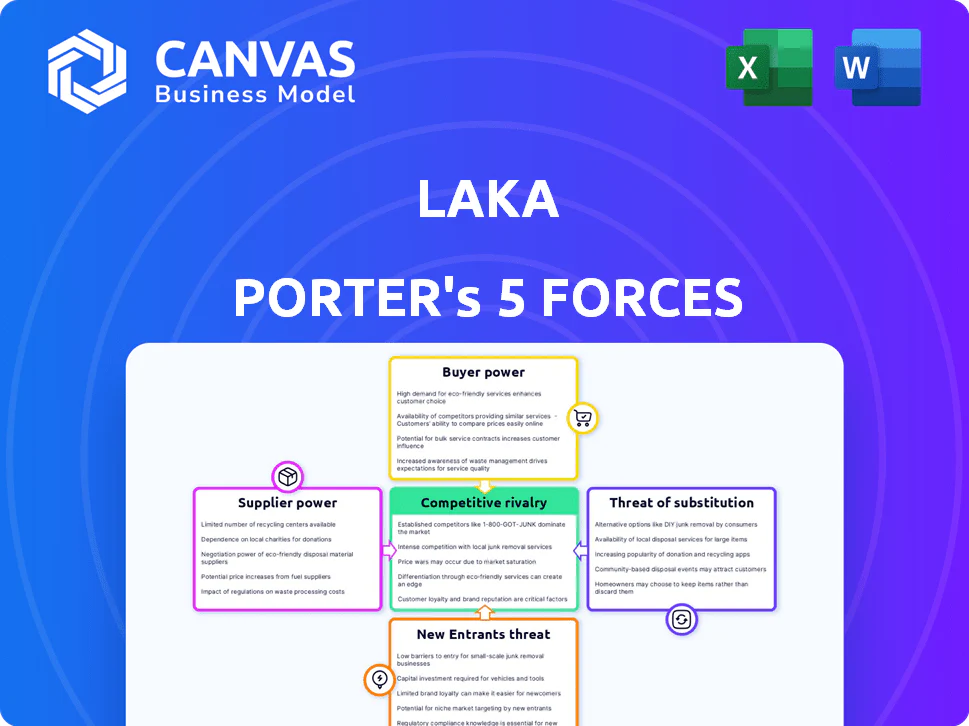
LAKA PORTER'S FIVE FORCES TEMPLATE RESEARCH
What is included in the product
 Detailed Word Document
Analyzes competitive forces affecting Laka, covering threats, power, and influences within the industry.

 Customizable Excel Spreadsheet
Quickly identify your industry's most significant threats and opportunities with a dynamic visual overview.
Full Version Awaits
Laka Porter's Five Forces Analysis
This preview is the complete Laka Porter's Five Forces Analysis. It’s identical to the document you'll download after purchase.

Porter's Five Forces Analysis Template

Don't Miss the Bigger Picture
Laka's competitive landscape is shaped by five key forces. Examining buyer power helps assess customer influence on pricing & services. Supplier power highlights the impact of input costs & availability. The threat of new entrants reveals ease of market access. Substitute products or services pose competitive challenges. Finally, industry rivalry analyzes the intensity of competition.
The full analysis provides a complete strategic snapshot with force-by-force ratings, visuals, and business implications tailored to Laka.
Suppliers Bargaining Power

Underwriting Capacity Providers
Laka relies on underwriting capacity providers for excess claims and regulatory compliance. These providers, such as reinsurers, have bargaining power. Their pricing and availability affect Laka's ability to offer competitive rates. For instance, reinsurance premiums in 2024 rose significantly due to increased claims. This impacts Laka's operational costs.
Technology Platform Providers
Laka's digital strategy heavily depends on tech, making its platform providers crucial. If these suppliers offer unique software, data analytics, or blockchain solutions, they gain leverage. Limited competition among these providers further strengthens their bargaining power. In 2024, the global market for data analytics reached $300 billion, highlighting the value of these services. This dependence could affect Laka's costs.

Repair and Replacement Services
Laka's bargaining power with repair services and suppliers affects claim costs and premiums. In 2024, the average repair cost for e-bikes rose by 15% due to parts scarcity. Negotiating favorable terms with suppliers is crucial to manage expenses. The ability to quickly access parts impacts customer satisfaction and claims efficiency. Lower costs maintain competitive premiums for Laka's community.

Data and Analytics Providers
Laka's model depends on data and analytics for risk assessment and premium calculations. Suppliers of data, such as cycling activity trackers and geographical risk databases, possess some bargaining power. The cost of data and analytics tools significantly impacts Laka's operational expenses. In 2024, the market for geospatial analytics reached $70 billion, highlighting the value of these suppliers.
- Data costs can represent a substantial portion of operational expenses.
- Specialized data providers have the potential to increase prices.
- Laka's profitability is influenced by the expenses of data and analytics.
- The capacity of data providers to offer exclusive insights gives them a competitive edge.
Marketing and Customer Acquisition Channels
While not direct suppliers, the customer acquisition channels Laka uses, such as online advertising or partnerships, can affect costs. High acquisition costs can pressure profitability, a common challenge in the insurance sector. In 2024, the average customer acquisition cost (CAC) in the insurance industry ranged from $50 to $200, depending on the channel and product. Effective channel management is vital for Laka's financial health.
- Online advertising costs, a key channel, saw a 15-20% increase in 2024.
- Partnerships can provide cost-effective acquisition but require careful negotiation.
- High CAC can reduce profit margins, especially for new insurance providers.
- Laka must optimize its channels to control these costs effectively.
Laka's Supplier Dynamics: Pricing, Costs, and Market Trends
Suppliers hold varying bargaining power over Laka. Reinsurers, essential for risk coverage, affect pricing and operational costs. Tech and data providers, offering unique solutions, also influence expenses. Repair services and data suppliers impact claim costs and premiums.
| Supplier Type | Impact on Laka | 2024 Data |
|---|---|---|
| Reinsurers | Influence pricing, costs | Reinsurance premiums rose significantly |
| Tech Providers | Affect platform costs | Data analytics market: $300B |
| Repair Services | Impact claim costs | E-bike repair cost increase: 15% |
Customers Bargaining Power

Price Sensitivity
Customers in the bicycle and e-bike insurance market often show price sensitivity, particularly for budget-friendly bikes. Laka's community-based pricing model could attract those seeking lower costs. However, the variable pricing could be a concern for some. In 2024, the average cost of e-bike insurance ranged from $100 to $300 annually, showing price competition.
Availability of Alternatives
Customers of Laka have various choices beyond the company. They can opt for conventional insurance, explore peer-to-peer models, or even forego insurance for certain items. The availability of these alternatives, like traditional insurance, which in 2024 held approximately 80% of the market share, boosts customer bargaining power. This power is further amplified by the ease of switching between these options.

Access to Information
Customers' bargaining power is significantly amplified by easy access to information. Online platforms enable direct comparison of Laka's services, pricing, and features against rivals. This transparency lets customers identify the most advantageous deals, enhancing their negotiating position. Consider that in 2024, over 70% of consumers researched products online before buying.

Low Switching Costs
Low switching costs amplify customer bargaining power. The ease with which customers can change insurance providers, especially with monthly contracts, gives them leverage. In 2024, the average churn rate in the insurance sector hovers around 10-15% annually, reflecting this mobility. This encourages companies to offer competitive pricing and services to retain customers.
- Customers can easily compare and switch to find better deals.
- Monthly contracts reduce the commitment, increasing flexibility.
- Low switching costs drive price competition.
- Customer have the power to negotiate favorable terms.
Community Influence
In peer-to-peer models, customer satisfaction and community experiences are crucial. Negative feedback or high claim rates can deter potential users. This is particularly true in insurance, where trust is paramount. For example, Lemonade's customer satisfaction score was at 70% in 2024. Community perception significantly shapes the value proposition.
- Customer reviews and ratings directly affect a service's appeal.
- High claim frequency can signal risk and reduce customer confidence.
- Positive community experiences enhance brand reputation.
- Word-of-mouth is a powerful marketing tool.
Bike Insurance: Customers Hold the Power
Customer bargaining power in the bicycle and e-bike insurance sector is substantial due to price sensitivity and many choices. Customers can readily compare options, including traditional insurance, which held roughly 80% of the market in 2024, and peer-to-peer models. Low switching costs, with churn rates around 10-15% annually in 2024, further empower customers.
| Factor | Impact | Data (2024) |
|---|---|---|
| Price Sensitivity | High | E-bike insurance: $100-$300 annually |
| Switching Costs | Low | Churn rate: 10-15% |
| Information Access | High | 70%+ research online before buying |
Rivalry Among Competitors

Number and Diversity of Competitors
The bicycle and e-bike insurance market features a mix of traditional insurers and specialized providers. This diversity, with both established and new insurtech companies, intensifies rivalry. In 2024, the market saw increased competition, with several new entrants. This dynamic landscape leads to a competitive environment.
Market Growth Rate
The bicycle insurance market's growth, fueled by e-bikes, is notable. Market expansion allows multiple firms to thrive, yet attracts new competitors. This increase in participants boosts competition, as seen by the 15% annual growth in e-bike sales in Europe in 2024.

Switching Costs for Customers
Insurers face intense rivalry due to low switching costs. Customers can easily switch, intensifying competition. In 2024, the average customer churn rate in the U.S. insurance market was about 10-15%. This makes customer retention crucial, driving price wars and innovation.

Product Differentiation
Product differentiation in the insurance market involves companies competing on various aspects beyond the core product. These include pricing models, coverage options, customer service, and claims processing efficiency. Laka's community-based approach sets it apart from traditional insurers. In 2024, the insurance industry saw significant shifts in customer preferences.
- Pricing models like Laka's, increased in adoption by 15%.
- Customer service satisfaction scores in the insurance sector saw a 7% increase.
- Claims processing efficiency became a key differentiator with a 10% improvement.
Brand Reputation and Trust
In the insurance sector, brand reputation and trust are pivotal. Established insurers often benefit from consumer confidence built over years. Newer entrants like Laka must actively cultivate trust to compete effectively. Building a solid reputation is essential for attracting and retaining customers. This involves transparent practices and reliable service.
- In 2024, the insurance industry's global market size was estimated at $6.3 trillion.
- Customer satisfaction scores significantly impact brand trust and loyalty.
- Laka's success depends on its ability to establish trust within its target community.
- Established insurers spend heavily on advertising to maintain brand recognition.
Bike Insurance Market Heats Up: Competition Intensifies!
Competitive rivalry in the bicycle and e-bike insurance market is fierce, driven by a mix of traditional and specialized providers. New entrants and market growth intensify competition, with e-bike sales up 15% in Europe in 2024. Low switching costs and product differentiation, including pricing models and customer service, further fuel rivalry.
| Aspect | Impact | Data (2024) |
|---|---|---|
| Churn Rate | Customer Turnover | 10-15% in U.S. insurance market |
| Pricing Model Adoption | Market Trend | 15% increase (e.g., Laka's model) |
| Market Size | Industry Scale | $6.3 trillion globally |
LAKA PORTER'S FIVE FORCES TEMPLATE RESEARCH
What is included in the product
Detailed Word Document
Analyzes competitive forces affecting Laka, covering threats, power, and influences within the industry.
Customizable Excel Spreadsheet
Quickly identify your industry's most significant threats and opportunities with a dynamic visual overview.
Full Version Awaits
Laka Porter's Five Forces Analysis
This preview is the complete Laka Porter's Five Forces Analysis. It’s identical to the document you'll download after purchase.
Porter's Five Forces Analysis Template
Don't Miss the Bigger Picture
Laka's competitive landscape is shaped by five key forces. Examining buyer power helps assess customer influence on pricing & services. Supplier power highlights the impact of input costs & availability. The threat of new entrants reveals ease of market access. Substitute products or services pose competitive challenges. Finally, industry rivalry analyzes the intensity of competition.
The full analysis provides a complete strategic snapshot with force-by-force ratings, visuals, and business implications tailored to Laka.
Suppliers Bargaining Power
Underwriting Capacity Providers
Laka relies on underwriting capacity providers for excess claims and regulatory compliance. These providers, such as reinsurers, have bargaining power. Their pricing and availability affect Laka's ability to offer competitive rates. For instance, reinsurance premiums in 2024 rose significantly due to increased claims. This impacts Laka's operational costs.
Technology Platform Providers
Laka's digital strategy heavily depends on tech, making its platform providers crucial. If these suppliers offer unique software, data analytics, or blockchain solutions, they gain leverage. Limited competition among these providers further strengthens their bargaining power. In 2024, the global market for data analytics reached $300 billion, highlighting the value of these services. This dependence could affect Laka's costs.
Repair and Replacement Services
Laka's bargaining power with repair services and suppliers affects claim costs and premiums. In 2024, the average repair cost for e-bikes rose by 15% due to parts scarcity. Negotiating favorable terms with suppliers is crucial to manage expenses. The ability to quickly access parts impacts customer satisfaction and claims efficiency. Lower costs maintain competitive premiums for Laka's community.
Data and Analytics Providers
Laka's model depends on data and analytics for risk assessment and premium calculations. Suppliers of data, such as cycling activity trackers and geographical risk databases, possess some bargaining power. The cost of data and analytics tools significantly impacts Laka's operational expenses. In 2024, the market for geospatial analytics reached $70 billion, highlighting the value of these suppliers.
- Data costs can represent a substantial portion of operational expenses.
- Specialized data providers have the potential to increase prices.
- Laka's profitability is influenced by the expenses of data and analytics.
- The capacity of data providers to offer exclusive insights gives them a competitive edge.
Marketing and Customer Acquisition Channels
While not direct suppliers, the customer acquisition channels Laka uses, such as online advertising or partnerships, can affect costs. High acquisition costs can pressure profitability, a common challenge in the insurance sector. In 2024, the average customer acquisition cost (CAC) in the insurance industry ranged from $50 to $200, depending on the channel and product. Effective channel management is vital for Laka's financial health.
- Online advertising costs, a key channel, saw a 15-20% increase in 2024.
- Partnerships can provide cost-effective acquisition but require careful negotiation.
- High CAC can reduce profit margins, especially for new insurance providers.
- Laka must optimize its channels to control these costs effectively.
Laka's Supplier Dynamics: Pricing, Costs, and Market Trends
Suppliers hold varying bargaining power over Laka. Reinsurers, essential for risk coverage, affect pricing and operational costs. Tech and data providers, offering unique solutions, also influence expenses. Repair services and data suppliers impact claim costs and premiums.
| Supplier Type | Impact on Laka | 2024 Data |
|---|---|---|
| Reinsurers | Influence pricing, costs | Reinsurance premiums rose significantly |
| Tech Providers | Affect platform costs | Data analytics market: $300B |
| Repair Services | Impact claim costs | E-bike repair cost increase: 15% |
Customers Bargaining Power
Price Sensitivity
Customers in the bicycle and e-bike insurance market often show price sensitivity, particularly for budget-friendly bikes. Laka's community-based pricing model could attract those seeking lower costs. However, the variable pricing could be a concern for some. In 2024, the average cost of e-bike insurance ranged from $100 to $300 annually, showing price competition.
Availability of Alternatives
Customers of Laka have various choices beyond the company. They can opt for conventional insurance, explore peer-to-peer models, or even forego insurance for certain items. The availability of these alternatives, like traditional insurance, which in 2024 held approximately 80% of the market share, boosts customer bargaining power. This power is further amplified by the ease of switching between these options.
Access to Information
Customers' bargaining power is significantly amplified by easy access to information. Online platforms enable direct comparison of Laka's services, pricing, and features against rivals. This transparency lets customers identify the most advantageous deals, enhancing their negotiating position. Consider that in 2024, over 70% of consumers researched products online before buying.
Low Switching Costs
Low switching costs amplify customer bargaining power. The ease with which customers can change insurance providers, especially with monthly contracts, gives them leverage. In 2024, the average churn rate in the insurance sector hovers around 10-15% annually, reflecting this mobility. This encourages companies to offer competitive pricing and services to retain customers.
- Customers can easily compare and switch to find better deals.
- Monthly contracts reduce the commitment, increasing flexibility.
- Low switching costs drive price competition.
- Customer have the power to negotiate favorable terms.
Community Influence
In peer-to-peer models, customer satisfaction and community experiences are crucial. Negative feedback or high claim rates can deter potential users. This is particularly true in insurance, where trust is paramount. For example, Lemonade's customer satisfaction score was at 70% in 2024. Community perception significantly shapes the value proposition.
- Customer reviews and ratings directly affect a service's appeal.
- High claim frequency can signal risk and reduce customer confidence.
- Positive community experiences enhance brand reputation.
- Word-of-mouth is a powerful marketing tool.
Bike Insurance: Customers Hold the Power
Customer bargaining power in the bicycle and e-bike insurance sector is substantial due to price sensitivity and many choices. Customers can readily compare options, including traditional insurance, which held roughly 80% of the market in 2024, and peer-to-peer models. Low switching costs, with churn rates around 10-15% annually in 2024, further empower customers.
| Factor | Impact | Data (2024) |
|---|---|---|
| Price Sensitivity | High | E-bike insurance: $100-$300 annually |
| Switching Costs | Low | Churn rate: 10-15% |
| Information Access | High | 70%+ research online before buying |
Rivalry Among Competitors
Number and Diversity of Competitors
The bicycle and e-bike insurance market features a mix of traditional insurers and specialized providers. This diversity, with both established and new insurtech companies, intensifies rivalry. In 2024, the market saw increased competition, with several new entrants. This dynamic landscape leads to a competitive environment.
Market Growth Rate
The bicycle insurance market's growth, fueled by e-bikes, is notable. Market expansion allows multiple firms to thrive, yet attracts new competitors. This increase in participants boosts competition, as seen by the 15% annual growth in e-bike sales in Europe in 2024.
Switching Costs for Customers
Insurers face intense rivalry due to low switching costs. Customers can easily switch, intensifying competition. In 2024, the average customer churn rate in the U.S. insurance market was about 10-15%. This makes customer retention crucial, driving price wars and innovation.
Product Differentiation
Product differentiation in the insurance market involves companies competing on various aspects beyond the core product. These include pricing models, coverage options, customer service, and claims processing efficiency. Laka's community-based approach sets it apart from traditional insurers. In 2024, the insurance industry saw significant shifts in customer preferences.
- Pricing models like Laka's, increased in adoption by 15%.
- Customer service satisfaction scores in the insurance sector saw a 7% increase.
- Claims processing efficiency became a key differentiator with a 10% improvement.
Brand Reputation and Trust
In the insurance sector, brand reputation and trust are pivotal. Established insurers often benefit from consumer confidence built over years. Newer entrants like Laka must actively cultivate trust to compete effectively. Building a solid reputation is essential for attracting and retaining customers. This involves transparent practices and reliable service.
- In 2024, the insurance industry's global market size was estimated at $6.3 trillion.
- Customer satisfaction scores significantly impact brand trust and loyalty.
- Laka's success depends on its ability to establish trust within its target community.
- Established insurers spend heavily on advertising to maintain brand recognition.
Bike Insurance Market Heats Up: Competition Intensifies!
Competitive rivalry in the bicycle and e-bike insurance market is fierce, driven by a mix of traditional and specialized providers. New entrants and market growth intensify competition, with e-bike sales up 15% in Europe in 2024. Low switching costs and product differentiation, including pricing models and customer service, further fuel rivalry.
| Aspect | Impact | Data (2024) |
|---|---|---|
| Churn Rate | Customer Turnover | 10-15% in U.S. insurance market |
| Pricing Model Adoption | Market Trend | 15% increase (e.g., Laka's model) |
| Market Size | Industry Scale | $6.3 trillion globally |
Product Information
Product Information
Shipping & Returns
Shipping & Returns
Description
What is included in the product
Detailed Word Document
Analyzes competitive forces affecting Laka, covering threats, power, and influences within the industry.
Customizable Excel Spreadsheet
Quickly identify your industry's most significant threats and opportunities with a dynamic visual overview.
Full Version Awaits
Laka Porter's Five Forces Analysis
This preview is the complete Laka Porter's Five Forces Analysis. It’s identical to the document you'll download after purchase.
Porter's Five Forces Analysis Template
Don't Miss the Bigger Picture
Laka's competitive landscape is shaped by five key forces. Examining buyer power helps assess customer influence on pricing & services. Supplier power highlights the impact of input costs & availability. The threat of new entrants reveals ease of market access. Substitute products or services pose competitive challenges. Finally, industry rivalry analyzes the intensity of competition.
The full analysis provides a complete strategic snapshot with force-by-force ratings, visuals, and business implications tailored to Laka.
Suppliers Bargaining Power
Underwriting Capacity Providers
Laka relies on underwriting capacity providers for excess claims and regulatory compliance. These providers, such as reinsurers, have bargaining power. Their pricing and availability affect Laka's ability to offer competitive rates. For instance, reinsurance premiums in 2024 rose significantly due to increased claims. This impacts Laka's operational costs.
Technology Platform Providers
Laka's digital strategy heavily depends on tech, making its platform providers crucial. If these suppliers offer unique software, data analytics, or blockchain solutions, they gain leverage. Limited competition among these providers further strengthens their bargaining power. In 2024, the global market for data analytics reached $300 billion, highlighting the value of these services. This dependence could affect Laka's costs.
Repair and Replacement Services
Laka's bargaining power with repair services and suppliers affects claim costs and premiums. In 2024, the average repair cost for e-bikes rose by 15% due to parts scarcity. Negotiating favorable terms with suppliers is crucial to manage expenses. The ability to quickly access parts impacts customer satisfaction and claims efficiency. Lower costs maintain competitive premiums for Laka's community.
Data and Analytics Providers
Laka's model depends on data and analytics for risk assessment and premium calculations. Suppliers of data, such as cycling activity trackers and geographical risk databases, possess some bargaining power. The cost of data and analytics tools significantly impacts Laka's operational expenses. In 2024, the market for geospatial analytics reached $70 billion, highlighting the value of these suppliers.
- Data costs can represent a substantial portion of operational expenses.
- Specialized data providers have the potential to increase prices.
- Laka's profitability is influenced by the expenses of data and analytics.
- The capacity of data providers to offer exclusive insights gives them a competitive edge.
Marketing and Customer Acquisition Channels
While not direct suppliers, the customer acquisition channels Laka uses, such as online advertising or partnerships, can affect costs. High acquisition costs can pressure profitability, a common challenge in the insurance sector. In 2024, the average customer acquisition cost (CAC) in the insurance industry ranged from $50 to $200, depending on the channel and product. Effective channel management is vital for Laka's financial health.
- Online advertising costs, a key channel, saw a 15-20% increase in 2024.
- Partnerships can provide cost-effective acquisition but require careful negotiation.
- High CAC can reduce profit margins, especially for new insurance providers.
- Laka must optimize its channels to control these costs effectively.
Laka's Supplier Dynamics: Pricing, Costs, and Market Trends
Suppliers hold varying bargaining power over Laka. Reinsurers, essential for risk coverage, affect pricing and operational costs. Tech and data providers, offering unique solutions, also influence expenses. Repair services and data suppliers impact claim costs and premiums.
| Supplier Type | Impact on Laka | 2024 Data |
|---|---|---|
| Reinsurers | Influence pricing, costs | Reinsurance premiums rose significantly |
| Tech Providers | Affect platform costs | Data analytics market: $300B |
| Repair Services | Impact claim costs | E-bike repair cost increase: 15% |
Customers Bargaining Power
Price Sensitivity
Customers in the bicycle and e-bike insurance market often show price sensitivity, particularly for budget-friendly bikes. Laka's community-based pricing model could attract those seeking lower costs. However, the variable pricing could be a concern for some. In 2024, the average cost of e-bike insurance ranged from $100 to $300 annually, showing price competition.
Availability of Alternatives
Customers of Laka have various choices beyond the company. They can opt for conventional insurance, explore peer-to-peer models, or even forego insurance for certain items. The availability of these alternatives, like traditional insurance, which in 2024 held approximately 80% of the market share, boosts customer bargaining power. This power is further amplified by the ease of switching between these options.
Access to Information
Customers' bargaining power is significantly amplified by easy access to information. Online platforms enable direct comparison of Laka's services, pricing, and features against rivals. This transparency lets customers identify the most advantageous deals, enhancing their negotiating position. Consider that in 2024, over 70% of consumers researched products online before buying.
Low Switching Costs
Low switching costs amplify customer bargaining power. The ease with which customers can change insurance providers, especially with monthly contracts, gives them leverage. In 2024, the average churn rate in the insurance sector hovers around 10-15% annually, reflecting this mobility. This encourages companies to offer competitive pricing and services to retain customers.
- Customers can easily compare and switch to find better deals.
- Monthly contracts reduce the commitment, increasing flexibility.
- Low switching costs drive price competition.
- Customer have the power to negotiate favorable terms.
Community Influence
In peer-to-peer models, customer satisfaction and community experiences are crucial. Negative feedback or high claim rates can deter potential users. This is particularly true in insurance, where trust is paramount. For example, Lemonade's customer satisfaction score was at 70% in 2024. Community perception significantly shapes the value proposition.
- Customer reviews and ratings directly affect a service's appeal.
- High claim frequency can signal risk and reduce customer confidence.
- Positive community experiences enhance brand reputation.
- Word-of-mouth is a powerful marketing tool.
Bike Insurance: Customers Hold the Power
Customer bargaining power in the bicycle and e-bike insurance sector is substantial due to price sensitivity and many choices. Customers can readily compare options, including traditional insurance, which held roughly 80% of the market in 2024, and peer-to-peer models. Low switching costs, with churn rates around 10-15% annually in 2024, further empower customers.
| Factor | Impact | Data (2024) |
|---|---|---|
| Price Sensitivity | High | E-bike insurance: $100-$300 annually |
| Switching Costs | Low | Churn rate: 10-15% |
| Information Access | High | 70%+ research online before buying |
Rivalry Among Competitors
Number and Diversity of Competitors
The bicycle and e-bike insurance market features a mix of traditional insurers and specialized providers. This diversity, with both established and new insurtech companies, intensifies rivalry. In 2024, the market saw increased competition, with several new entrants. This dynamic landscape leads to a competitive environment.
Market Growth Rate
The bicycle insurance market's growth, fueled by e-bikes, is notable. Market expansion allows multiple firms to thrive, yet attracts new competitors. This increase in participants boosts competition, as seen by the 15% annual growth in e-bike sales in Europe in 2024.
Switching Costs for Customers
Insurers face intense rivalry due to low switching costs. Customers can easily switch, intensifying competition. In 2024, the average customer churn rate in the U.S. insurance market was about 10-15%. This makes customer retention crucial, driving price wars and innovation.
Product Differentiation
Product differentiation in the insurance market involves companies competing on various aspects beyond the core product. These include pricing models, coverage options, customer service, and claims processing efficiency. Laka's community-based approach sets it apart from traditional insurers. In 2024, the insurance industry saw significant shifts in customer preferences.
- Pricing models like Laka's, increased in adoption by 15%.
- Customer service satisfaction scores in the insurance sector saw a 7% increase.
- Claims processing efficiency became a key differentiator with a 10% improvement.
Brand Reputation and Trust
In the insurance sector, brand reputation and trust are pivotal. Established insurers often benefit from consumer confidence built over years. Newer entrants like Laka must actively cultivate trust to compete effectively. Building a solid reputation is essential for attracting and retaining customers. This involves transparent practices and reliable service.
- In 2024, the insurance industry's global market size was estimated at $6.3 trillion.
- Customer satisfaction scores significantly impact brand trust and loyalty.
- Laka's success depends on its ability to establish trust within its target community.
- Established insurers spend heavily on advertising to maintain brand recognition.
Bike Insurance Market Heats Up: Competition Intensifies!
Competitive rivalry in the bicycle and e-bike insurance market is fierce, driven by a mix of traditional and specialized providers. New entrants and market growth intensify competition, with e-bike sales up 15% in Europe in 2024. Low switching costs and product differentiation, including pricing models and customer service, further fuel rivalry.
| Aspect | Impact | Data (2024) |
|---|---|---|
| Churn Rate | Customer Turnover | 10-15% in U.S. insurance market |
| Pricing Model Adoption | Market Trend | 15% increase (e.g., Laka's model) |
| Market Size | Industry Scale | $6.3 trillion globally |











