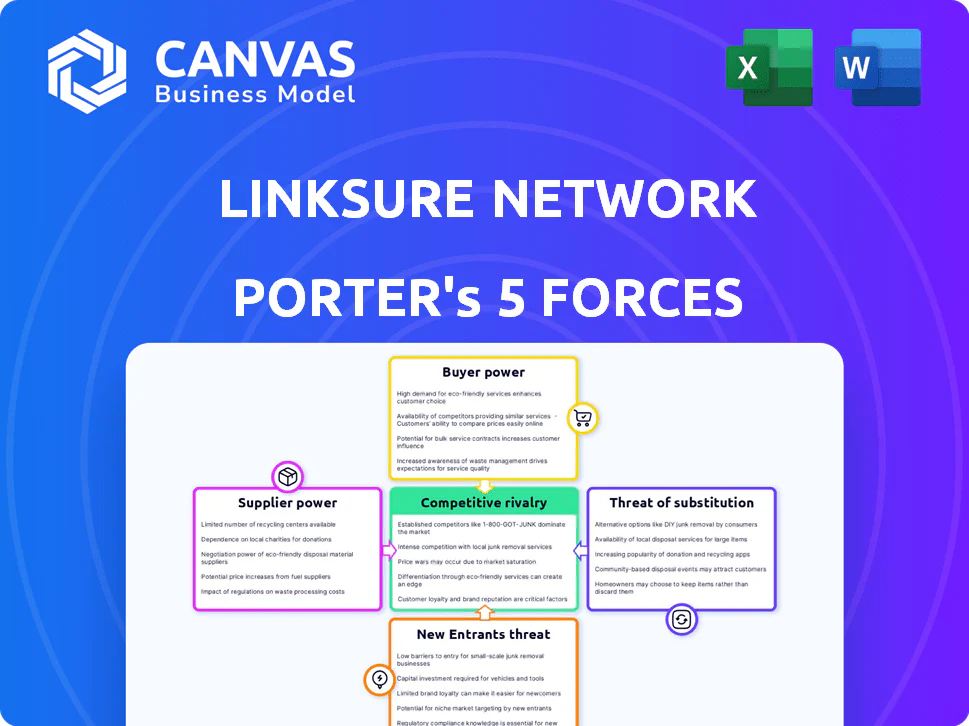
LINKSURE NETWORK PORTER'S FIVE FORCES TEMPLATE RESEARCH
What is included in the product
 Detailed Word Document
Analyzes LinkSure Network's position, revealing competitive pressures & profitability factors.

 Customizable Excel Spreadsheet
Easily adjust Porter's Five Forces for changing telecom landscapes to guide investment decisions.
Full Version Awaits
LinkSure Network Porter's Five Forces Analysis
The Porter's Five Forces analysis previewed here for LinkSure Network is identical to the full document you'll receive. This means the in-depth assessment of industry rivalry, buyer power, supplier power, threats of substitution, and the threat of new entrants is ready for immediate download and use. You'll gain insights into LinkSure Network’s competitive landscape with no edits needed after your purchase. This is the complete analysis, providing a comprehensive strategic overview, instantly accessible upon payment.

Porter's Five Forces Analysis Template

From Overview to Strategy Blueprint
LinkSure Network navigates a complex competitive landscape. Buyer power is moderate, influenced by user choice. Supplier power is low given their network infrastructure. Threat of new entrants remains, yet existing scale is a barrier. Substitute products are a consideration in a rapidly changing tech environment. Rivalry among existing competitors is intense.
This brief snapshot only scratches the surface. Unlock the full Porter's Five Forces Analysis to explore LinkSure Network’s competitive dynamics, market pressures, and strategic advantages in detail.
Suppliers Bargaining Power

Limited Direct Suppliers
LinkSure Network's Wi-Fi Master Key app uses shared Wi-Fi passwords. This peer-to-peer model disperses supplier power among individual users. The company isn't reliant on few key suppliers. In 2024, the app had 800 million users. This fragmentation limits supplier bargaining power.
Dependence on Mobile Operating Systems
The bargaining power of "suppliers" in LinkSure Network's case is largely held by mobile operating system providers like Android and iOS. These platforms control app distribution and usage, impacting LinkSure's reach. For example, in 2024, Android held about 70% of the global mobile OS market share, while iOS had around 28%. Changes in their policies or updates can significantly affect LinkSure's app's functionality and user experience.

Reliance on Internet Service Providers (ISPs)
LinkSure Network's operations rely on the infrastructure provided by Internet Service Providers (ISPs). The quality and availability of ISP services directly impact the user experience of the app, which affects user satisfaction. However, LinkSure Network aggregates access to existing networks, rather than being a direct, large-scale bandwidth customer. In 2024, global internet penetration reached approximately 67%, highlighting the reliance on ISPs.

Data and Technology Providers
LinkSure Network depends on cloud computing and big data technologies. Suppliers of these services, such as Amazon Web Services (AWS) or Microsoft Azure, could have bargaining power. This is especially true if LinkSure becomes highly dependent on a single provider. The global cloud computing market was valued at $670.8 billion in 2024.
- Cloud computing market is projected to reach $1.6 trillion by 2030.
- AWS holds approximately 32% of the cloud infrastructure market.
- Microsoft Azure has around 23% of the market share.
- The big data analytics market was worth $280 billion in 2023.
Content and Advertising Partners
LinkSure Network's advertising revenue stream places advertisers as key suppliers. Their bargaining power hinges on the platform's effectiveness and the availability of alternatives. If LinkSure's reach and user engagement are high, advertisers have less leverage. However, competition from other digital platforms can increase supplier power. In 2024, digital ad spending in China reached approximately $150 billion, showing significant supplier options.
- Advertising revenue is a significant portion of LinkSure Network's income.
- Advertisers have power based on platform performance and alternatives.
- High user engagement and reach reduce advertiser bargaining power.
- Alternative platforms increase supplier options and bargaining power.
Supplier Power Dynamics: A Varied Landscape
LinkSure Network's supplier power varies across different areas. Mobile OS providers like Android and iOS hold significant influence over app distribution. Cloud service providers and advertisers also exert power, particularly if alternatives are limited.
| Supplier Type | Bargaining Power | 2024 Data |
|---|---|---|
| Mobile OS Providers | High | Android 70%, iOS 28% global OS market share |
| ISPs | Moderate | Global internet penetration ~67% |
| Cloud Providers | Moderate to High | Global cloud market $670.8B |
| Advertisers | Moderate | China digital ad spend ~$150B |
Customers Bargaining Power

Large and Fragmented User Base
LinkSure Network, with its vast global user base, benefits from fragmented customer bargaining power. The widespread user base, spanning diverse geographies, dilutes any single user's influence. In 2024, the company likely served millions, reducing the impact of individual customer decisions. This dispersion limits the ability of any user group to affect pricing or services.
Availability of Free Alternatives
LinkSure Network's core service is free Wi-Fi access. However, the bargaining power of customers is high due to readily available alternatives. In 2024, public Wi-Fi hotspots and direct password requests offer users options. This reduces reliance on LinkSure's app, impacting its pricing power.

Low Switching Costs
Customers of LinkSure Network have significant bargaining power due to low switching costs. For example, in 2024, the ease of finding alternative Wi-Fi solutions, such as through other apps or public networks, is high. This makes it simple for users to switch if they are unhappy with LinkSure's service. This ease of switching weakens LinkSure's ability to retain customers.

Data Privacy Concerns
LinkSure Network's reliance on data monetization makes it vulnerable to customer data privacy concerns, potentially increasing customer bargaining power. Growing user awareness of data privacy could lead to decreased app usage or a shift to privacy-focused competitors. In 2024, the global data privacy market was valued at approximately $68.2 billion, showing the importance of data protection. This shift could impact LinkSure's revenue streams.
- Data privacy concerns can reduce user engagement.
- Users might seek alternatives with better privacy.
- Data breaches could erode trust.
- Regulatory changes increase compliance costs.
Influence of User Reviews and Reputation
User reviews and online reputation heavily influence app success. Negative feedback can severely impact user acquisition. For instance, a 2024 survey revealed that 85% of consumers read online reviews before downloading an app. This gives customers considerable bargaining power.
- 85% of consumers read online reviews before downloading an app (2024).
- Negative reviews can significantly decrease user acquisition rates.
- User feedback directly impacts app store rankings and visibility.
- Reputation management is crucial for app success.
User Power: A Double-Edged Sword for the Network
LinkSure Network faces a mixed customer bargaining power dynamic. While a large user base diffuses individual influence, free Wi-Fi alternatives and low switching costs empower users. Data privacy concerns and negative reviews further amplify customer leverage, impacting revenue.
| Aspect | Impact | 2024 Data |
|---|---|---|
| Alternatives | High bargaining power | Public Wi-Fi growth (15% annually) |
| Switching Costs | High bargaining power | Easy app deletion and alternative app options |
| Data Privacy | Increased power | Global data privacy market: $68.2B |
Rivalry Among Competitors

Numerous Direct and Indirect Competitors
The internet access and related services market is fiercely competitive. LinkSure Network contends with direct rivals like other Wi-Fi sharing apps. Indirect competition comes from established internet providers and mobile carriers. In 2024, the global Wi-Fi market was valued at approximately $100 billion, highlighting the intense competition. Data plans from mobile carriers further intensify the rivalry.
Competition from Other Free Wi-Fi Providers
Competition comes from various free Wi-Fi providers, such as businesses and municipalities. The wide availability of these options increases competitive rivalry. In 2024, many cities have expanded free Wi-Fi, increasing the competitive landscape. For instance, a report showed that 60% of cafes offer free Wi-Fi in major cities.

Aggressive Pricing and Service Innovation
LinkSure Network faces intense competition, with rivals using aggressive pricing to gain market share. This competitive environment necessitates constant service innovation. For example, in 2024, competitors invested heavily in faster connectivity options, pressuring LinkSure. This requires LinkSure to frequently update its offerings to stay competitive, impacting profitability.

Presence of Large Tech Companies
Large tech firms, like Google and Meta, can heavily influence the connectivity market. They possess vast financial resources and large user bases, enabling aggressive competition. For example, in 2024, Google invested $1 billion in expanding its global fiber optic network, directly challenging existing connectivity providers. This influx of capital and technological prowess intensifies rivalry.
- Google's 2024 investment in network infrastructure is a key indicator.
- Meta's expansion into VR/AR also impacts connectivity needs.
- These companies can rapidly innovate and scale.
- Smaller firms struggle to match this level of investment.
Differentiation through Value-Added Services
To thrive amid intense competition, LinkSure Network must offer unique value. This means going beyond simple Wi-Fi sharing and providing services that set it apart. Think about including exclusive content or robust security features to attract and retain users. For example, in 2024, the global market for value-added services in the telecom sector was estimated at $350 billion. This illustrates the financial potential of offering differentiated services.
- Content partnerships can increase user engagement.
- Enhanced security builds trust and customer loyalty.
- Value-added services can be monetized through subscriptions.
- Differentiation is crucial for market survival.
Wi-Fi Market: $100B Fuels Fierce Rivalry
Competitive rivalry in LinkSure Network's market is very high. The Wi-Fi market's 2024 valuation at $100 billion indicates intense competition. Aggressive pricing and innovation are common strategies among rivals. Differentiating through unique value-added services is essential.
| Factor | Impact | Example (2024) |
|---|---|---|
| Market Size | High Competition | Global Wi-Fi market: $100B |
| Pricing | Aggressive | Competitors' price wars |
| Innovation | Essential | Faster connectivity investments |
Original: $10.00
-65%$10.00
$3.50LINKSURE NETWORK PORTER'S FIVE FORCES TEMPLATE RESEARCH
What is included in the product
Detailed Word Document
Analyzes LinkSure Network's position, revealing competitive pressures & profitability factors.
Customizable Excel Spreadsheet
Easily adjust Porter's Five Forces for changing telecom landscapes to guide investment decisions.
Full Version Awaits
LinkSure Network Porter's Five Forces Analysis
The Porter's Five Forces analysis previewed here for LinkSure Network is identical to the full document you'll receive. This means the in-depth assessment of industry rivalry, buyer power, supplier power, threats of substitution, and the threat of new entrants is ready for immediate download and use. You'll gain insights into LinkSure Network’s competitive landscape with no edits needed after your purchase. This is the complete analysis, providing a comprehensive strategic overview, instantly accessible upon payment.
Porter's Five Forces Analysis Template
From Overview to Strategy Blueprint
LinkSure Network navigates a complex competitive landscape. Buyer power is moderate, influenced by user choice. Supplier power is low given their network infrastructure. Threat of new entrants remains, yet existing scale is a barrier. Substitute products are a consideration in a rapidly changing tech environment. Rivalry among existing competitors is intense.
This brief snapshot only scratches the surface. Unlock the full Porter's Five Forces Analysis to explore LinkSure Network’s competitive dynamics, market pressures, and strategic advantages in detail.
Suppliers Bargaining Power
Limited Direct Suppliers
LinkSure Network's Wi-Fi Master Key app uses shared Wi-Fi passwords. This peer-to-peer model disperses supplier power among individual users. The company isn't reliant on few key suppliers. In 2024, the app had 800 million users. This fragmentation limits supplier bargaining power.
Dependence on Mobile Operating Systems
The bargaining power of "suppliers" in LinkSure Network's case is largely held by mobile operating system providers like Android and iOS. These platforms control app distribution and usage, impacting LinkSure's reach. For example, in 2024, Android held about 70% of the global mobile OS market share, while iOS had around 28%. Changes in their policies or updates can significantly affect LinkSure's app's functionality and user experience.
Reliance on Internet Service Providers (ISPs)
LinkSure Network's operations rely on the infrastructure provided by Internet Service Providers (ISPs). The quality and availability of ISP services directly impact the user experience of the app, which affects user satisfaction. However, LinkSure Network aggregates access to existing networks, rather than being a direct, large-scale bandwidth customer. In 2024, global internet penetration reached approximately 67%, highlighting the reliance on ISPs.
Data and Technology Providers
LinkSure Network depends on cloud computing and big data technologies. Suppliers of these services, such as Amazon Web Services (AWS) or Microsoft Azure, could have bargaining power. This is especially true if LinkSure becomes highly dependent on a single provider. The global cloud computing market was valued at $670.8 billion in 2024.
- Cloud computing market is projected to reach $1.6 trillion by 2030.
- AWS holds approximately 32% of the cloud infrastructure market.
- Microsoft Azure has around 23% of the market share.
- The big data analytics market was worth $280 billion in 2023.
Content and Advertising Partners
LinkSure Network's advertising revenue stream places advertisers as key suppliers. Their bargaining power hinges on the platform's effectiveness and the availability of alternatives. If LinkSure's reach and user engagement are high, advertisers have less leverage. However, competition from other digital platforms can increase supplier power. In 2024, digital ad spending in China reached approximately $150 billion, showing significant supplier options.
- Advertising revenue is a significant portion of LinkSure Network's income.
- Advertisers have power based on platform performance and alternatives.
- High user engagement and reach reduce advertiser bargaining power.
- Alternative platforms increase supplier options and bargaining power.
Supplier Power Dynamics: A Varied Landscape
LinkSure Network's supplier power varies across different areas. Mobile OS providers like Android and iOS hold significant influence over app distribution. Cloud service providers and advertisers also exert power, particularly if alternatives are limited.
| Supplier Type | Bargaining Power | 2024 Data |
|---|---|---|
| Mobile OS Providers | High | Android 70%, iOS 28% global OS market share |
| ISPs | Moderate | Global internet penetration ~67% |
| Cloud Providers | Moderate to High | Global cloud market $670.8B |
| Advertisers | Moderate | China digital ad spend ~$150B |
Customers Bargaining Power
Large and Fragmented User Base
LinkSure Network, with its vast global user base, benefits from fragmented customer bargaining power. The widespread user base, spanning diverse geographies, dilutes any single user's influence. In 2024, the company likely served millions, reducing the impact of individual customer decisions. This dispersion limits the ability of any user group to affect pricing or services.
Availability of Free Alternatives
LinkSure Network's core service is free Wi-Fi access. However, the bargaining power of customers is high due to readily available alternatives. In 2024, public Wi-Fi hotspots and direct password requests offer users options. This reduces reliance on LinkSure's app, impacting its pricing power.
Low Switching Costs
Customers of LinkSure Network have significant bargaining power due to low switching costs. For example, in 2024, the ease of finding alternative Wi-Fi solutions, such as through other apps or public networks, is high. This makes it simple for users to switch if they are unhappy with LinkSure's service. This ease of switching weakens LinkSure's ability to retain customers.
Data Privacy Concerns
LinkSure Network's reliance on data monetization makes it vulnerable to customer data privacy concerns, potentially increasing customer bargaining power. Growing user awareness of data privacy could lead to decreased app usage or a shift to privacy-focused competitors. In 2024, the global data privacy market was valued at approximately $68.2 billion, showing the importance of data protection. This shift could impact LinkSure's revenue streams.
- Data privacy concerns can reduce user engagement.
- Users might seek alternatives with better privacy.
- Data breaches could erode trust.
- Regulatory changes increase compliance costs.
Influence of User Reviews and Reputation
User reviews and online reputation heavily influence app success. Negative feedback can severely impact user acquisition. For instance, a 2024 survey revealed that 85% of consumers read online reviews before downloading an app. This gives customers considerable bargaining power.
- 85% of consumers read online reviews before downloading an app (2024).
- Negative reviews can significantly decrease user acquisition rates.
- User feedback directly impacts app store rankings and visibility.
- Reputation management is crucial for app success.
User Power: A Double-Edged Sword for the Network
LinkSure Network faces a mixed customer bargaining power dynamic. While a large user base diffuses individual influence, free Wi-Fi alternatives and low switching costs empower users. Data privacy concerns and negative reviews further amplify customer leverage, impacting revenue.
| Aspect | Impact | 2024 Data |
|---|---|---|
| Alternatives | High bargaining power | Public Wi-Fi growth (15% annually) |
| Switching Costs | High bargaining power | Easy app deletion and alternative app options |
| Data Privacy | Increased power | Global data privacy market: $68.2B |
Rivalry Among Competitors
Numerous Direct and Indirect Competitors
The internet access and related services market is fiercely competitive. LinkSure Network contends with direct rivals like other Wi-Fi sharing apps. Indirect competition comes from established internet providers and mobile carriers. In 2024, the global Wi-Fi market was valued at approximately $100 billion, highlighting the intense competition. Data plans from mobile carriers further intensify the rivalry.
Competition from Other Free Wi-Fi Providers
Competition comes from various free Wi-Fi providers, such as businesses and municipalities. The wide availability of these options increases competitive rivalry. In 2024, many cities have expanded free Wi-Fi, increasing the competitive landscape. For instance, a report showed that 60% of cafes offer free Wi-Fi in major cities.
Aggressive Pricing and Service Innovation
LinkSure Network faces intense competition, with rivals using aggressive pricing to gain market share. This competitive environment necessitates constant service innovation. For example, in 2024, competitors invested heavily in faster connectivity options, pressuring LinkSure. This requires LinkSure to frequently update its offerings to stay competitive, impacting profitability.
Presence of Large Tech Companies
Large tech firms, like Google and Meta, can heavily influence the connectivity market. They possess vast financial resources and large user bases, enabling aggressive competition. For example, in 2024, Google invested $1 billion in expanding its global fiber optic network, directly challenging existing connectivity providers. This influx of capital and technological prowess intensifies rivalry.
- Google's 2024 investment in network infrastructure is a key indicator.
- Meta's expansion into VR/AR also impacts connectivity needs.
- These companies can rapidly innovate and scale.
- Smaller firms struggle to match this level of investment.
Differentiation through Value-Added Services
To thrive amid intense competition, LinkSure Network must offer unique value. This means going beyond simple Wi-Fi sharing and providing services that set it apart. Think about including exclusive content or robust security features to attract and retain users. For example, in 2024, the global market for value-added services in the telecom sector was estimated at $350 billion. This illustrates the financial potential of offering differentiated services.
- Content partnerships can increase user engagement.
- Enhanced security builds trust and customer loyalty.
- Value-added services can be monetized through subscriptions.
- Differentiation is crucial for market survival.
Wi-Fi Market: $100B Fuels Fierce Rivalry
Competitive rivalry in LinkSure Network's market is very high. The Wi-Fi market's 2024 valuation at $100 billion indicates intense competition. Aggressive pricing and innovation are common strategies among rivals. Differentiating through unique value-added services is essential.
| Factor | Impact | Example (2024) |
|---|---|---|
| Market Size | High Competition | Global Wi-Fi market: $100B |
| Pricing | Aggressive | Competitors' price wars |
| Innovation | Essential | Faster connectivity investments |
Product Information
Product Information
Shipping & Returns
Shipping & Returns
Description
What is included in the product
Detailed Word Document
Analyzes LinkSure Network's position, revealing competitive pressures & profitability factors.
Customizable Excel Spreadsheet
Easily adjust Porter's Five Forces for changing telecom landscapes to guide investment decisions.
Full Version Awaits
LinkSure Network Porter's Five Forces Analysis
The Porter's Five Forces analysis previewed here for LinkSure Network is identical to the full document you'll receive. This means the in-depth assessment of industry rivalry, buyer power, supplier power, threats of substitution, and the threat of new entrants is ready for immediate download and use. You'll gain insights into LinkSure Network’s competitive landscape with no edits needed after your purchase. This is the complete analysis, providing a comprehensive strategic overview, instantly accessible upon payment.
Porter's Five Forces Analysis Template
From Overview to Strategy Blueprint
LinkSure Network navigates a complex competitive landscape. Buyer power is moderate, influenced by user choice. Supplier power is low given their network infrastructure. Threat of new entrants remains, yet existing scale is a barrier. Substitute products are a consideration in a rapidly changing tech environment. Rivalry among existing competitors is intense.
This brief snapshot only scratches the surface. Unlock the full Porter's Five Forces Analysis to explore LinkSure Network’s competitive dynamics, market pressures, and strategic advantages in detail.
Suppliers Bargaining Power
Limited Direct Suppliers
LinkSure Network's Wi-Fi Master Key app uses shared Wi-Fi passwords. This peer-to-peer model disperses supplier power among individual users. The company isn't reliant on few key suppliers. In 2024, the app had 800 million users. This fragmentation limits supplier bargaining power.
Dependence on Mobile Operating Systems
The bargaining power of "suppliers" in LinkSure Network's case is largely held by mobile operating system providers like Android and iOS. These platforms control app distribution and usage, impacting LinkSure's reach. For example, in 2024, Android held about 70% of the global mobile OS market share, while iOS had around 28%. Changes in their policies or updates can significantly affect LinkSure's app's functionality and user experience.
Reliance on Internet Service Providers (ISPs)
LinkSure Network's operations rely on the infrastructure provided by Internet Service Providers (ISPs). The quality and availability of ISP services directly impact the user experience of the app, which affects user satisfaction. However, LinkSure Network aggregates access to existing networks, rather than being a direct, large-scale bandwidth customer. In 2024, global internet penetration reached approximately 67%, highlighting the reliance on ISPs.
Data and Technology Providers
LinkSure Network depends on cloud computing and big data technologies. Suppliers of these services, such as Amazon Web Services (AWS) or Microsoft Azure, could have bargaining power. This is especially true if LinkSure becomes highly dependent on a single provider. The global cloud computing market was valued at $670.8 billion in 2024.
- Cloud computing market is projected to reach $1.6 trillion by 2030.
- AWS holds approximately 32% of the cloud infrastructure market.
- Microsoft Azure has around 23% of the market share.
- The big data analytics market was worth $280 billion in 2023.
Content and Advertising Partners
LinkSure Network's advertising revenue stream places advertisers as key suppliers. Their bargaining power hinges on the platform's effectiveness and the availability of alternatives. If LinkSure's reach and user engagement are high, advertisers have less leverage. However, competition from other digital platforms can increase supplier power. In 2024, digital ad spending in China reached approximately $150 billion, showing significant supplier options.
- Advertising revenue is a significant portion of LinkSure Network's income.
- Advertisers have power based on platform performance and alternatives.
- High user engagement and reach reduce advertiser bargaining power.
- Alternative platforms increase supplier options and bargaining power.
Supplier Power Dynamics: A Varied Landscape
LinkSure Network's supplier power varies across different areas. Mobile OS providers like Android and iOS hold significant influence over app distribution. Cloud service providers and advertisers also exert power, particularly if alternatives are limited.
| Supplier Type | Bargaining Power | 2024 Data |
|---|---|---|
| Mobile OS Providers | High | Android 70%, iOS 28% global OS market share |
| ISPs | Moderate | Global internet penetration ~67% |
| Cloud Providers | Moderate to High | Global cloud market $670.8B |
| Advertisers | Moderate | China digital ad spend ~$150B |
Customers Bargaining Power
Large and Fragmented User Base
LinkSure Network, with its vast global user base, benefits from fragmented customer bargaining power. The widespread user base, spanning diverse geographies, dilutes any single user's influence. In 2024, the company likely served millions, reducing the impact of individual customer decisions. This dispersion limits the ability of any user group to affect pricing or services.
Availability of Free Alternatives
LinkSure Network's core service is free Wi-Fi access. However, the bargaining power of customers is high due to readily available alternatives. In 2024, public Wi-Fi hotspots and direct password requests offer users options. This reduces reliance on LinkSure's app, impacting its pricing power.
Low Switching Costs
Customers of LinkSure Network have significant bargaining power due to low switching costs. For example, in 2024, the ease of finding alternative Wi-Fi solutions, such as through other apps or public networks, is high. This makes it simple for users to switch if they are unhappy with LinkSure's service. This ease of switching weakens LinkSure's ability to retain customers.
Data Privacy Concerns
LinkSure Network's reliance on data monetization makes it vulnerable to customer data privacy concerns, potentially increasing customer bargaining power. Growing user awareness of data privacy could lead to decreased app usage or a shift to privacy-focused competitors. In 2024, the global data privacy market was valued at approximately $68.2 billion, showing the importance of data protection. This shift could impact LinkSure's revenue streams.
- Data privacy concerns can reduce user engagement.
- Users might seek alternatives with better privacy.
- Data breaches could erode trust.
- Regulatory changes increase compliance costs.
Influence of User Reviews and Reputation
User reviews and online reputation heavily influence app success. Negative feedback can severely impact user acquisition. For instance, a 2024 survey revealed that 85% of consumers read online reviews before downloading an app. This gives customers considerable bargaining power.
- 85% of consumers read online reviews before downloading an app (2024).
- Negative reviews can significantly decrease user acquisition rates.
- User feedback directly impacts app store rankings and visibility.
- Reputation management is crucial for app success.
User Power: A Double-Edged Sword for the Network
LinkSure Network faces a mixed customer bargaining power dynamic. While a large user base diffuses individual influence, free Wi-Fi alternatives and low switching costs empower users. Data privacy concerns and negative reviews further amplify customer leverage, impacting revenue.
| Aspect | Impact | 2024 Data |
|---|---|---|
| Alternatives | High bargaining power | Public Wi-Fi growth (15% annually) |
| Switching Costs | High bargaining power | Easy app deletion and alternative app options |
| Data Privacy | Increased power | Global data privacy market: $68.2B |
Rivalry Among Competitors
Numerous Direct and Indirect Competitors
The internet access and related services market is fiercely competitive. LinkSure Network contends with direct rivals like other Wi-Fi sharing apps. Indirect competition comes from established internet providers and mobile carriers. In 2024, the global Wi-Fi market was valued at approximately $100 billion, highlighting the intense competition. Data plans from mobile carriers further intensify the rivalry.
Competition from Other Free Wi-Fi Providers
Competition comes from various free Wi-Fi providers, such as businesses and municipalities. The wide availability of these options increases competitive rivalry. In 2024, many cities have expanded free Wi-Fi, increasing the competitive landscape. For instance, a report showed that 60% of cafes offer free Wi-Fi in major cities.
Aggressive Pricing and Service Innovation
LinkSure Network faces intense competition, with rivals using aggressive pricing to gain market share. This competitive environment necessitates constant service innovation. For example, in 2024, competitors invested heavily in faster connectivity options, pressuring LinkSure. This requires LinkSure to frequently update its offerings to stay competitive, impacting profitability.
Presence of Large Tech Companies
Large tech firms, like Google and Meta, can heavily influence the connectivity market. They possess vast financial resources and large user bases, enabling aggressive competition. For example, in 2024, Google invested $1 billion in expanding its global fiber optic network, directly challenging existing connectivity providers. This influx of capital and technological prowess intensifies rivalry.
- Google's 2024 investment in network infrastructure is a key indicator.
- Meta's expansion into VR/AR also impacts connectivity needs.
- These companies can rapidly innovate and scale.
- Smaller firms struggle to match this level of investment.
Differentiation through Value-Added Services
To thrive amid intense competition, LinkSure Network must offer unique value. This means going beyond simple Wi-Fi sharing and providing services that set it apart. Think about including exclusive content or robust security features to attract and retain users. For example, in 2024, the global market for value-added services in the telecom sector was estimated at $350 billion. This illustrates the financial potential of offering differentiated services.
- Content partnerships can increase user engagement.
- Enhanced security builds trust and customer loyalty.
- Value-added services can be monetized through subscriptions.
- Differentiation is crucial for market survival.
Wi-Fi Market: $100B Fuels Fierce Rivalry
Competitive rivalry in LinkSure Network's market is very high. The Wi-Fi market's 2024 valuation at $100 billion indicates intense competition. Aggressive pricing and innovation are common strategies among rivals. Differentiating through unique value-added services is essential.
| Factor | Impact | Example (2024) |
|---|---|---|
| Market Size | High Competition | Global Wi-Fi market: $100B |
| Pricing | Aggressive | Competitors' price wars |
| Innovation | Essential | Faster connectivity investments |











