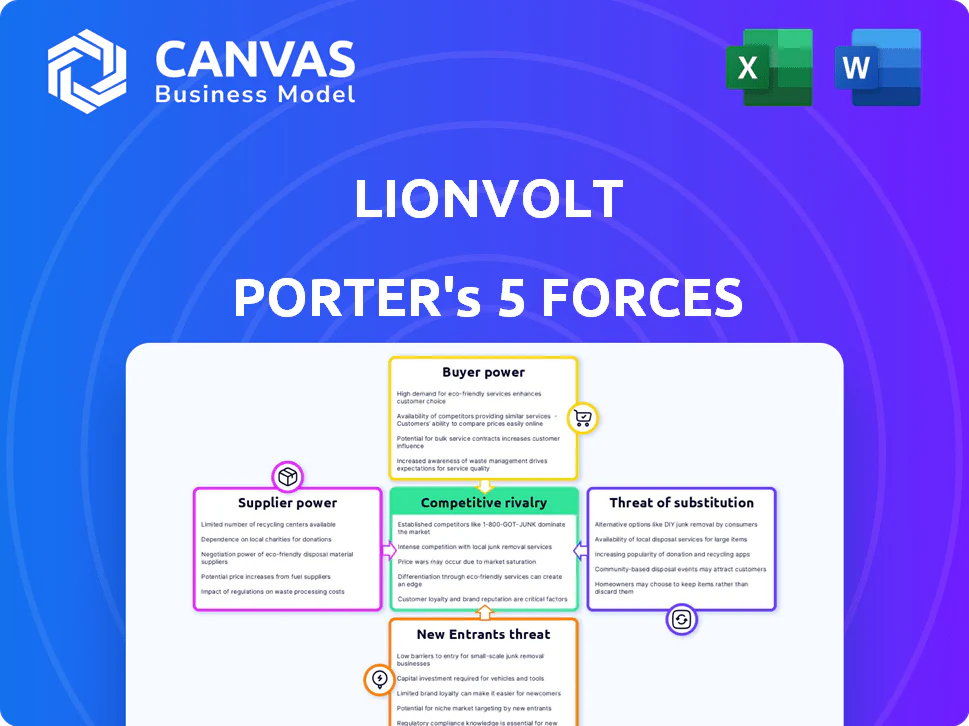
LIONVOLT PORTER'S FIVE FORCES TEMPLATE RESEARCH
What is included in the product
 Detailed Word Document
Analyzes LionVolt's position using Porter's Five Forces, evaluating competitive pressures and strategic implications.

 Customizable Excel Spreadsheet
Instantly identify and measure the competitive landscape with dynamic calculations.
Same Document Delivered
LionVolt Porter's Five Forces Analysis
This LionVolt Porter's Five Forces analysis preview is the complete document. You'll receive this exact, professionally written file instantly after purchase. It's fully formatted and ready to download. The analysis includes all forces and offers actionable insights. No alterations or waiting; it's ready to implement.

Porter's Five Forces Analysis Template

A Must-Have Tool for Decision-Makers
LionVolt's industry faces moderate rivalry, with a mix of established players and emerging competitors in solid-state battery technology.
The bargaining power of suppliers is currently moderate, driven by specialized material requirements and limited sources.
Buyer power is somewhat low, as the technology targets specific markets with high performance needs.
Threat of new entrants is high due to significant R&D investment.
Substitute products pose a moderate threat, as established battery technologies continue to improve.
This brief snapshot only scratches the surface. Unlock the full Porter's Five Forces Analysis to explore LionVolt’s competitive dynamics, market pressures, and strategic advantages in detail.
Suppliers Bargaining Power

Reliance on key materials
LionVolt's solid-state batteries depend on specialized materials, like lithium. The cost and availability of these materials directly affect production expenses and profitability. If only a few suppliers control these resources, their bargaining power increases. For example, in 2024, lithium prices fluctuated significantly, impacting battery makers.
Proprietary technology of suppliers
If suppliers control proprietary technology, like specialized equipment for LionVolt's 3D battery architecture, their power increases. Reliance on patented technology, such as LionVolt’s own 3D design, might lessen this impact. However, specific manufacturing components from limited suppliers could still pose a risk. In 2024, the market for advanced battery manufacturing equipment was estimated at $3.5 billion, highlighting the potential supplier influence.

Supplier concentration
Supplier concentration significantly influences bargaining power. Limited suppliers of critical components boost their leverage. In 2024, the solid-state battery sector faces concentrated supply chains for specialized materials and equipment. For example, the market for lithium metal anodes is projected to reach $500 million by 2027, with a few dominant suppliers. This concentration gives suppliers considerable control over pricing and terms.

Switching costs for LionVolt
LionVolt's ability to switch suppliers significantly impacts supplier power. High switching costs, due to retooling or requalification, increase dependence on existing suppliers. LionVolt's investments in facilities, like the Scottish plant, may lower these costs by controlling some manufacturing aspects. This strategic move potentially reduces supplier bargaining power.
- Switching costs are influenced by factors like specialized equipment and proprietary materials.
- Acquiring its own facilities can provide LionVolt with greater control over its supply chain.
- In 2024, companies are increasingly focused on supply chain resilience to mitigate supplier risk.
- LionVolt's investments align with the trend of vertical integration.
Forward integration threat by suppliers
If suppliers could produce solid-state batteries, they gain power, becoming competitors. This forward integration is a bigger threat for large chemical or manufacturing companies. LionVolt's 3D anode focus might make this less likely for some suppliers, reducing the risk. The battery market's projected size by 2024 was over $100 billion.
- Forward integration increases supplier bargaining power.
- Large chemical/manufacturing firms pose a greater threat.
- LionVolt's anode focus could mitigate this.
- The battery market was over $100B by 2024.
LionVolt's Supplier Dynamics: A Critical Analysis
Supplier bargaining power is significant for LionVolt, especially given its reliance on specialized materials and technology. The concentration of suppliers for key components, like lithium, gives them considerable leverage over pricing and terms. High switching costs, due to specialized equipment, further strengthen suppliers' positions.
LionVolt's strategic moves, such as vertical integration, can mitigate supplier power. In 2024, the focus on supply chain resilience became more important. If suppliers move towards forward integration, they gain power, but LionVolt's 3D anode focus may reduce this risk.
| Factor | Impact on LionVolt | 2024 Data/Insight |
|---|---|---|
| Supplier Concentration | High risk due to limited suppliers for critical components. | Lithium metal anode market projected to $500M by 2027 with few dominant suppliers. |
| Switching Costs | High costs increase dependence on current suppliers. | Investments in facilities, like LionVolt's Scottish plant, may lower these costs. |
| Forward Integration | Suppliers becoming competitors, increasing power. | Battery market size over $100B by 2024. |
Customers Bargaining Power

Customer concentration
LionVolt's bargaining power of customers is a critical aspect. If the company relies on a few large clients, like the automotive sector, those customers wield considerable influence. Currently, LionVolt focuses on sectors like aviation and wearables. In 2024, the global electric vehicle market is projected to reach $800 billion.
Customer's price sensitivity
Customer price sensitivity significantly impacts their bargaining power, especially in competitive sectors. LionVolt, as a battery supplier, faces pressure from price-sensitive customers in the electric vehicle and consumer electronics markets. For instance, in 2024, the global EV market saw intense price competition, with average EV prices fluctuating significantly. This sensitivity compels LionVolt to manage costs effectively.

Availability of substitute products for customers
Customers possess considerable bargaining power due to readily available substitutes. Alternatives include established lithium-ion batteries; in 2024, the global lithium-ion battery market was valued at approximately $70 billion. Continuous advancements in lithium-ion, like LFP and nickel-rich batteries, intensify competition. If LionVolt's pricing or performance lags, customers can easily switch.

Customer's threat of backward integration
The bargaining power of customers, especially in industries like automotive, poses a threat to LionVolt. Major customers could opt for backward integration, producing battery cells themselves, diminishing their need for external suppliers. For instance, Tesla's battery production efforts and partnerships with suppliers like Panasonic exemplify this trend. This reduces LionVolt's market share and pricing power.
- Tesla's Gigafactories: Tesla's investment in its own battery production.
- Automaker Partnerships: Alliances between automakers and battery manufacturers.
- Industry Trends: Growing focus on vertical integration in the automotive sector.
- Market Impact: Potential decline in demand for LionVolt's products.
Importance of LionVolt's battery to the customer's product
If LionVolt's solid-state batteries are key to a customer's product, like electric vehicles, the customer's bargaining power decreases. LionVolt's batteries, promising higher energy density and faster charging, become crucial for product differentiation. This scenario reduces customer leverage in price negotiations, especially if LionVolt's technology is unique. For example, the solid-state battery market is projected to reach $4.2 billion by 2028, underlining its importance.
- High energy density is crucial for extending EV range, which could enhance LionVolt's value.
- Faster charging times, as claimed by LionVolt, are a significant advantage for customers.
- The market for solid-state batteries is rapidly growing, with projections of significant expansion by 2028.
LionVolt's Customer Power: A Market Analysis
LionVolt faces customer bargaining power challenges, especially in competitive markets like EVs. Price sensitivity and readily available battery substitutes, such as lithium-ion, increase customer leverage. The solid-state battery market, though, offers LionVolt a competitive edge.
| Factor | Impact | Data |
|---|---|---|
| Price Sensitivity | High in competitive markets | EV market price fluctuations in 2024. |
| Substitutes | Lithium-ion batteries | $70B lithium-ion market in 2024. |
| Differentiation | Solid-state advantage | $4.2B solid-state market by 2028. |
Rivalry Among Competitors

Number and diversity of competitors
The solid-state battery market currently sees a mix of players. This includes startups like LionVolt and established firms. Automakers are also involved, increasing competition. High rivalry is likely as companies fight for market share in this new sector. In 2024, investments in battery tech reached billions globally.
Industry growth rate
The solid-state battery market's projected growth offers opportunities, potentially easing rivalry. The market is forecasted to reach billions by 2030. However, companies like LionVolt compete intensely to lead production and market share. This dynamic creates robust competition despite overall growth.

Product differentiation
LionVolt's 3D anode architecture is a key differentiator, potentially boosting energy density and charging speed. Competitors' ability to innovate and replicate similar tech affects rivalry intensity. In 2024, the battery market saw significant R&D spending, intensifying competition. Companies like Sila and StoreDot are also pushing boundaries. This rivalry is fueled by $100+ billion in global battery market investments.

Switching costs for customers
Switching costs influence competitive rivalry. LionVolt's 'drop-in' anode solutions could ease this. However, customers face qualification and technical adjustments when integrating new battery tech. These factors introduce switching costs, potentially lessening rivalry. In 2024, the battery market saw significant investments in new technologies, but adoption rates still vary, reflecting these challenges.
- Qualification processes can range from several weeks to months, increasing customer costs.
- Technical adjustments may require specialized engineering expertise and equipment.
- The average cost of switching suppliers in the battery industry is about 5-10% of the initial investment.
- Supply chain issues can further complicate the transition to new battery technologies.
Strategic stakes
The solid-state battery market is crucial for electric vehicles and energy storage. Intense competition drives significant investment, with strategic stakes extremely high. Companies are vying for market leadership, fueling innovation and aggressive rivalry. This competition impacts LionVolt's strategic positioning and resource allocation in the market.
- The global solid-state battery market was valued at USD 1.2 billion in 2023.
- It's projected to reach USD 7.2 billion by 2030, growing at a CAGR of 29.6%.
- Key players like CATL, Samsung, and LG Chem are investing heavily.
- LionVolt faces rivals with substantial financial backing and technological expertise.
LionVolt's Solid-State Battery Battle: Market Dynamics
Competitive rivalry in the solid-state battery market is fierce, with LionVolt facing strong competition. The market's projected growth to $7.2 billion by 2030, at a 29.6% CAGR, attracts significant investment. Companies compete intensely for market share, impacting LionVolt's strategic decisions. In 2024, the battery market saw over $100 billion in investment.
| Factor | Impact on Rivalry | 2024 Data |
|---|---|---|
| Market Growth | High growth can ease rivalry. | Solid-state market valued at $1.2B in 2023, growing at 29.6% CAGR. |
| Innovation | Innovation intensifies competition. | R&D spending in battery tech reached billions. |
| Switching Costs | High costs can lessen rivalry. | Switching costs average 5-10% of initial investment. |
Original: $10.00
-65%$10.00
$3.50LIONVOLT PORTER'S FIVE FORCES TEMPLATE RESEARCH
What is included in the product
Detailed Word Document
Analyzes LionVolt's position using Porter's Five Forces, evaluating competitive pressures and strategic implications.
Customizable Excel Spreadsheet
Instantly identify and measure the competitive landscape with dynamic calculations.
Same Document Delivered
LionVolt Porter's Five Forces Analysis
This LionVolt Porter's Five Forces analysis preview is the complete document. You'll receive this exact, professionally written file instantly after purchase. It's fully formatted and ready to download. The analysis includes all forces and offers actionable insights. No alterations or waiting; it's ready to implement.
Porter's Five Forces Analysis Template
A Must-Have Tool for Decision-Makers
LionVolt's industry faces moderate rivalry, with a mix of established players and emerging competitors in solid-state battery technology.
The bargaining power of suppliers is currently moderate, driven by specialized material requirements and limited sources.
Buyer power is somewhat low, as the technology targets specific markets with high performance needs.
Threat of new entrants is high due to significant R&D investment.
Substitute products pose a moderate threat, as established battery technologies continue to improve.
This brief snapshot only scratches the surface. Unlock the full Porter's Five Forces Analysis to explore LionVolt’s competitive dynamics, market pressures, and strategic advantages in detail.
Suppliers Bargaining Power
Reliance on key materials
LionVolt's solid-state batteries depend on specialized materials, like lithium. The cost and availability of these materials directly affect production expenses and profitability. If only a few suppliers control these resources, their bargaining power increases. For example, in 2024, lithium prices fluctuated significantly, impacting battery makers.
Proprietary technology of suppliers
If suppliers control proprietary technology, like specialized equipment for LionVolt's 3D battery architecture, their power increases. Reliance on patented technology, such as LionVolt’s own 3D design, might lessen this impact. However, specific manufacturing components from limited suppliers could still pose a risk. In 2024, the market for advanced battery manufacturing equipment was estimated at $3.5 billion, highlighting the potential supplier influence.
Supplier concentration
Supplier concentration significantly influences bargaining power. Limited suppliers of critical components boost their leverage. In 2024, the solid-state battery sector faces concentrated supply chains for specialized materials and equipment. For example, the market for lithium metal anodes is projected to reach $500 million by 2027, with a few dominant suppliers. This concentration gives suppliers considerable control over pricing and terms.
Switching costs for LionVolt
LionVolt's ability to switch suppliers significantly impacts supplier power. High switching costs, due to retooling or requalification, increase dependence on existing suppliers. LionVolt's investments in facilities, like the Scottish plant, may lower these costs by controlling some manufacturing aspects. This strategic move potentially reduces supplier bargaining power.
- Switching costs are influenced by factors like specialized equipment and proprietary materials.
- Acquiring its own facilities can provide LionVolt with greater control over its supply chain.
- In 2024, companies are increasingly focused on supply chain resilience to mitigate supplier risk.
- LionVolt's investments align with the trend of vertical integration.
Forward integration threat by suppliers
If suppliers could produce solid-state batteries, they gain power, becoming competitors. This forward integration is a bigger threat for large chemical or manufacturing companies. LionVolt's 3D anode focus might make this less likely for some suppliers, reducing the risk. The battery market's projected size by 2024 was over $100 billion.
- Forward integration increases supplier bargaining power.
- Large chemical/manufacturing firms pose a greater threat.
- LionVolt's anode focus could mitigate this.
- The battery market was over $100B by 2024.
LionVolt's Supplier Dynamics: A Critical Analysis
Supplier bargaining power is significant for LionVolt, especially given its reliance on specialized materials and technology. The concentration of suppliers for key components, like lithium, gives them considerable leverage over pricing and terms. High switching costs, due to specialized equipment, further strengthen suppliers' positions.
LionVolt's strategic moves, such as vertical integration, can mitigate supplier power. In 2024, the focus on supply chain resilience became more important. If suppliers move towards forward integration, they gain power, but LionVolt's 3D anode focus may reduce this risk.
| Factor | Impact on LionVolt | 2024 Data/Insight |
|---|---|---|
| Supplier Concentration | High risk due to limited suppliers for critical components. | Lithium metal anode market projected to $500M by 2027 with few dominant suppliers. |
| Switching Costs | High costs increase dependence on current suppliers. | Investments in facilities, like LionVolt's Scottish plant, may lower these costs. |
| Forward Integration | Suppliers becoming competitors, increasing power. | Battery market size over $100B by 2024. |
Customers Bargaining Power
Customer concentration
LionVolt's bargaining power of customers is a critical aspect. If the company relies on a few large clients, like the automotive sector, those customers wield considerable influence. Currently, LionVolt focuses on sectors like aviation and wearables. In 2024, the global electric vehicle market is projected to reach $800 billion.
Customer's price sensitivity
Customer price sensitivity significantly impacts their bargaining power, especially in competitive sectors. LionVolt, as a battery supplier, faces pressure from price-sensitive customers in the electric vehicle and consumer electronics markets. For instance, in 2024, the global EV market saw intense price competition, with average EV prices fluctuating significantly. This sensitivity compels LionVolt to manage costs effectively.
Availability of substitute products for customers
Customers possess considerable bargaining power due to readily available substitutes. Alternatives include established lithium-ion batteries; in 2024, the global lithium-ion battery market was valued at approximately $70 billion. Continuous advancements in lithium-ion, like LFP and nickel-rich batteries, intensify competition. If LionVolt's pricing or performance lags, customers can easily switch.
Customer's threat of backward integration
The bargaining power of customers, especially in industries like automotive, poses a threat to LionVolt. Major customers could opt for backward integration, producing battery cells themselves, diminishing their need for external suppliers. For instance, Tesla's battery production efforts and partnerships with suppliers like Panasonic exemplify this trend. This reduces LionVolt's market share and pricing power.
- Tesla's Gigafactories: Tesla's investment in its own battery production.
- Automaker Partnerships: Alliances between automakers and battery manufacturers.
- Industry Trends: Growing focus on vertical integration in the automotive sector.
- Market Impact: Potential decline in demand for LionVolt's products.
Importance of LionVolt's battery to the customer's product
If LionVolt's solid-state batteries are key to a customer's product, like electric vehicles, the customer's bargaining power decreases. LionVolt's batteries, promising higher energy density and faster charging, become crucial for product differentiation. This scenario reduces customer leverage in price negotiations, especially if LionVolt's technology is unique. For example, the solid-state battery market is projected to reach $4.2 billion by 2028, underlining its importance.
- High energy density is crucial for extending EV range, which could enhance LionVolt's value.
- Faster charging times, as claimed by LionVolt, are a significant advantage for customers.
- The market for solid-state batteries is rapidly growing, with projections of significant expansion by 2028.
LionVolt's Customer Power: A Market Analysis
LionVolt faces customer bargaining power challenges, especially in competitive markets like EVs. Price sensitivity and readily available battery substitutes, such as lithium-ion, increase customer leverage. The solid-state battery market, though, offers LionVolt a competitive edge.
| Factor | Impact | Data |
|---|---|---|
| Price Sensitivity | High in competitive markets | EV market price fluctuations in 2024. |
| Substitutes | Lithium-ion batteries | $70B lithium-ion market in 2024. |
| Differentiation | Solid-state advantage | $4.2B solid-state market by 2028. |
Rivalry Among Competitors
Number and diversity of competitors
The solid-state battery market currently sees a mix of players. This includes startups like LionVolt and established firms. Automakers are also involved, increasing competition. High rivalry is likely as companies fight for market share in this new sector. In 2024, investments in battery tech reached billions globally.
Industry growth rate
The solid-state battery market's projected growth offers opportunities, potentially easing rivalry. The market is forecasted to reach billions by 2030. However, companies like LionVolt compete intensely to lead production and market share. This dynamic creates robust competition despite overall growth.
Product differentiation
LionVolt's 3D anode architecture is a key differentiator, potentially boosting energy density and charging speed. Competitors' ability to innovate and replicate similar tech affects rivalry intensity. In 2024, the battery market saw significant R&D spending, intensifying competition. Companies like Sila and StoreDot are also pushing boundaries. This rivalry is fueled by $100+ billion in global battery market investments.
Switching costs for customers
Switching costs influence competitive rivalry. LionVolt's 'drop-in' anode solutions could ease this. However, customers face qualification and technical adjustments when integrating new battery tech. These factors introduce switching costs, potentially lessening rivalry. In 2024, the battery market saw significant investments in new technologies, but adoption rates still vary, reflecting these challenges.
- Qualification processes can range from several weeks to months, increasing customer costs.
- Technical adjustments may require specialized engineering expertise and equipment.
- The average cost of switching suppliers in the battery industry is about 5-10% of the initial investment.
- Supply chain issues can further complicate the transition to new battery technologies.
Strategic stakes
The solid-state battery market is crucial for electric vehicles and energy storage. Intense competition drives significant investment, with strategic stakes extremely high. Companies are vying for market leadership, fueling innovation and aggressive rivalry. This competition impacts LionVolt's strategic positioning and resource allocation in the market.
- The global solid-state battery market was valued at USD 1.2 billion in 2023.
- It's projected to reach USD 7.2 billion by 2030, growing at a CAGR of 29.6%.
- Key players like CATL, Samsung, and LG Chem are investing heavily.
- LionVolt faces rivals with substantial financial backing and technological expertise.
LionVolt's Solid-State Battery Battle: Market Dynamics
Competitive rivalry in the solid-state battery market is fierce, with LionVolt facing strong competition. The market's projected growth to $7.2 billion by 2030, at a 29.6% CAGR, attracts significant investment. Companies compete intensely for market share, impacting LionVolt's strategic decisions. In 2024, the battery market saw over $100 billion in investment.
| Factor | Impact on Rivalry | 2024 Data |
|---|---|---|
| Market Growth | High growth can ease rivalry. | Solid-state market valued at $1.2B in 2023, growing at 29.6% CAGR. |
| Innovation | Innovation intensifies competition. | R&D spending in battery tech reached billions. |
| Switching Costs | High costs can lessen rivalry. | Switching costs average 5-10% of initial investment. |
Product Information
Product Information
Shipping & Returns
Shipping & Returns
Description
What is included in the product
Detailed Word Document
Analyzes LionVolt's position using Porter's Five Forces, evaluating competitive pressures and strategic implications.
Customizable Excel Spreadsheet
Instantly identify and measure the competitive landscape with dynamic calculations.
Same Document Delivered
LionVolt Porter's Five Forces Analysis
This LionVolt Porter's Five Forces analysis preview is the complete document. You'll receive this exact, professionally written file instantly after purchase. It's fully formatted and ready to download. The analysis includes all forces and offers actionable insights. No alterations or waiting; it's ready to implement.
Porter's Five Forces Analysis Template
A Must-Have Tool for Decision-Makers
LionVolt's industry faces moderate rivalry, with a mix of established players and emerging competitors in solid-state battery technology.
The bargaining power of suppliers is currently moderate, driven by specialized material requirements and limited sources.
Buyer power is somewhat low, as the technology targets specific markets with high performance needs.
Threat of new entrants is high due to significant R&D investment.
Substitute products pose a moderate threat, as established battery technologies continue to improve.
This brief snapshot only scratches the surface. Unlock the full Porter's Five Forces Analysis to explore LionVolt’s competitive dynamics, market pressures, and strategic advantages in detail.
Suppliers Bargaining Power
Reliance on key materials
LionVolt's solid-state batteries depend on specialized materials, like lithium. The cost and availability of these materials directly affect production expenses and profitability. If only a few suppliers control these resources, their bargaining power increases. For example, in 2024, lithium prices fluctuated significantly, impacting battery makers.
Proprietary technology of suppliers
If suppliers control proprietary technology, like specialized equipment for LionVolt's 3D battery architecture, their power increases. Reliance on patented technology, such as LionVolt’s own 3D design, might lessen this impact. However, specific manufacturing components from limited suppliers could still pose a risk. In 2024, the market for advanced battery manufacturing equipment was estimated at $3.5 billion, highlighting the potential supplier influence.
Supplier concentration
Supplier concentration significantly influences bargaining power. Limited suppliers of critical components boost their leverage. In 2024, the solid-state battery sector faces concentrated supply chains for specialized materials and equipment. For example, the market for lithium metal anodes is projected to reach $500 million by 2027, with a few dominant suppliers. This concentration gives suppliers considerable control over pricing and terms.
Switching costs for LionVolt
LionVolt's ability to switch suppliers significantly impacts supplier power. High switching costs, due to retooling or requalification, increase dependence on existing suppliers. LionVolt's investments in facilities, like the Scottish plant, may lower these costs by controlling some manufacturing aspects. This strategic move potentially reduces supplier bargaining power.
- Switching costs are influenced by factors like specialized equipment and proprietary materials.
- Acquiring its own facilities can provide LionVolt with greater control over its supply chain.
- In 2024, companies are increasingly focused on supply chain resilience to mitigate supplier risk.
- LionVolt's investments align with the trend of vertical integration.
Forward integration threat by suppliers
If suppliers could produce solid-state batteries, they gain power, becoming competitors. This forward integration is a bigger threat for large chemical or manufacturing companies. LionVolt's 3D anode focus might make this less likely for some suppliers, reducing the risk. The battery market's projected size by 2024 was over $100 billion.
- Forward integration increases supplier bargaining power.
- Large chemical/manufacturing firms pose a greater threat.
- LionVolt's anode focus could mitigate this.
- The battery market was over $100B by 2024.
LionVolt's Supplier Dynamics: A Critical Analysis
Supplier bargaining power is significant for LionVolt, especially given its reliance on specialized materials and technology. The concentration of suppliers for key components, like lithium, gives them considerable leverage over pricing and terms. High switching costs, due to specialized equipment, further strengthen suppliers' positions.
LionVolt's strategic moves, such as vertical integration, can mitigate supplier power. In 2024, the focus on supply chain resilience became more important. If suppliers move towards forward integration, they gain power, but LionVolt's 3D anode focus may reduce this risk.
| Factor | Impact on LionVolt | 2024 Data/Insight |
|---|---|---|
| Supplier Concentration | High risk due to limited suppliers for critical components. | Lithium metal anode market projected to $500M by 2027 with few dominant suppliers. |
| Switching Costs | High costs increase dependence on current suppliers. | Investments in facilities, like LionVolt's Scottish plant, may lower these costs. |
| Forward Integration | Suppliers becoming competitors, increasing power. | Battery market size over $100B by 2024. |
Customers Bargaining Power
Customer concentration
LionVolt's bargaining power of customers is a critical aspect. If the company relies on a few large clients, like the automotive sector, those customers wield considerable influence. Currently, LionVolt focuses on sectors like aviation and wearables. In 2024, the global electric vehicle market is projected to reach $800 billion.
Customer's price sensitivity
Customer price sensitivity significantly impacts their bargaining power, especially in competitive sectors. LionVolt, as a battery supplier, faces pressure from price-sensitive customers in the electric vehicle and consumer electronics markets. For instance, in 2024, the global EV market saw intense price competition, with average EV prices fluctuating significantly. This sensitivity compels LionVolt to manage costs effectively.
Availability of substitute products for customers
Customers possess considerable bargaining power due to readily available substitutes. Alternatives include established lithium-ion batteries; in 2024, the global lithium-ion battery market was valued at approximately $70 billion. Continuous advancements in lithium-ion, like LFP and nickel-rich batteries, intensify competition. If LionVolt's pricing or performance lags, customers can easily switch.
Customer's threat of backward integration
The bargaining power of customers, especially in industries like automotive, poses a threat to LionVolt. Major customers could opt for backward integration, producing battery cells themselves, diminishing their need for external suppliers. For instance, Tesla's battery production efforts and partnerships with suppliers like Panasonic exemplify this trend. This reduces LionVolt's market share and pricing power.
- Tesla's Gigafactories: Tesla's investment in its own battery production.
- Automaker Partnerships: Alliances between automakers and battery manufacturers.
- Industry Trends: Growing focus on vertical integration in the automotive sector.
- Market Impact: Potential decline in demand for LionVolt's products.
Importance of LionVolt's battery to the customer's product
If LionVolt's solid-state batteries are key to a customer's product, like electric vehicles, the customer's bargaining power decreases. LionVolt's batteries, promising higher energy density and faster charging, become crucial for product differentiation. This scenario reduces customer leverage in price negotiations, especially if LionVolt's technology is unique. For example, the solid-state battery market is projected to reach $4.2 billion by 2028, underlining its importance.
- High energy density is crucial for extending EV range, which could enhance LionVolt's value.
- Faster charging times, as claimed by LionVolt, are a significant advantage for customers.
- The market for solid-state batteries is rapidly growing, with projections of significant expansion by 2028.
LionVolt's Customer Power: A Market Analysis
LionVolt faces customer bargaining power challenges, especially in competitive markets like EVs. Price sensitivity and readily available battery substitutes, such as lithium-ion, increase customer leverage. The solid-state battery market, though, offers LionVolt a competitive edge.
| Factor | Impact | Data |
|---|---|---|
| Price Sensitivity | High in competitive markets | EV market price fluctuations in 2024. |
| Substitutes | Lithium-ion batteries | $70B lithium-ion market in 2024. |
| Differentiation | Solid-state advantage | $4.2B solid-state market by 2028. |
Rivalry Among Competitors
Number and diversity of competitors
The solid-state battery market currently sees a mix of players. This includes startups like LionVolt and established firms. Automakers are also involved, increasing competition. High rivalry is likely as companies fight for market share in this new sector. In 2024, investments in battery tech reached billions globally.
Industry growth rate
The solid-state battery market's projected growth offers opportunities, potentially easing rivalry. The market is forecasted to reach billions by 2030. However, companies like LionVolt compete intensely to lead production and market share. This dynamic creates robust competition despite overall growth.
Product differentiation
LionVolt's 3D anode architecture is a key differentiator, potentially boosting energy density and charging speed. Competitors' ability to innovate and replicate similar tech affects rivalry intensity. In 2024, the battery market saw significant R&D spending, intensifying competition. Companies like Sila and StoreDot are also pushing boundaries. This rivalry is fueled by $100+ billion in global battery market investments.
Switching costs for customers
Switching costs influence competitive rivalry. LionVolt's 'drop-in' anode solutions could ease this. However, customers face qualification and technical adjustments when integrating new battery tech. These factors introduce switching costs, potentially lessening rivalry. In 2024, the battery market saw significant investments in new technologies, but adoption rates still vary, reflecting these challenges.
- Qualification processes can range from several weeks to months, increasing customer costs.
- Technical adjustments may require specialized engineering expertise and equipment.
- The average cost of switching suppliers in the battery industry is about 5-10% of the initial investment.
- Supply chain issues can further complicate the transition to new battery technologies.
Strategic stakes
The solid-state battery market is crucial for electric vehicles and energy storage. Intense competition drives significant investment, with strategic stakes extremely high. Companies are vying for market leadership, fueling innovation and aggressive rivalry. This competition impacts LionVolt's strategic positioning and resource allocation in the market.
- The global solid-state battery market was valued at USD 1.2 billion in 2023.
- It's projected to reach USD 7.2 billion by 2030, growing at a CAGR of 29.6%.
- Key players like CATL, Samsung, and LG Chem are investing heavily.
- LionVolt faces rivals with substantial financial backing and technological expertise.
LionVolt's Solid-State Battery Battle: Market Dynamics
Competitive rivalry in the solid-state battery market is fierce, with LionVolt facing strong competition. The market's projected growth to $7.2 billion by 2030, at a 29.6% CAGR, attracts significant investment. Companies compete intensely for market share, impacting LionVolt's strategic decisions. In 2024, the battery market saw over $100 billion in investment.
| Factor | Impact on Rivalry | 2024 Data |
|---|---|---|
| Market Growth | High growth can ease rivalry. | Solid-state market valued at $1.2B in 2023, growing at 29.6% CAGR. |
| Innovation | Innovation intensifies competition. | R&D spending in battery tech reached billions. |
| Switching Costs | High costs can lessen rivalry. | Switching costs average 5-10% of initial investment. |











