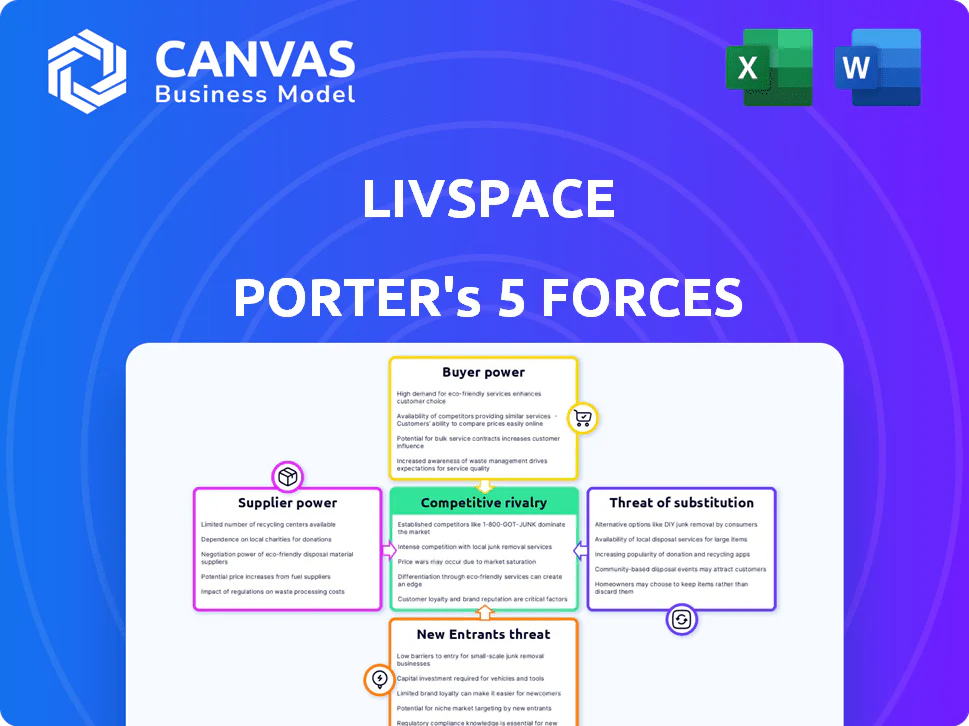
LIVSPACE PORTER'S FIVE FORCES TEMPLATE RESEARCH

Go Beyond the Preview-Access the Full Strategic Report
Livspace faces intense buyer power, platform-driven competition, and moderate supplier leverage-this snapshot highlights key pressures but omits force-by-force ratings, charts, and tactical recommendations; unlock the full Porter's Five Forces Analysis to get detailed metrics, scenario-driven implications, and actionable strategy for investment or market play.
Suppliers Bargaining Power

Fragmented Vendor Ecosystem Limits Individual Leverage
The home-interior supply base is highly fragmented-tens of thousands of small contractors and local suppliers-so no single vendor can price-gouge Livspace; by 2025 Livspace aggregates demand across 110+ cities and served ~250,000 projects in FY2025, forcing suppliers to accept standardized rates for steady volume.
Strategic Backward Integration Through Acquisitions
Livspace has neutralized supplier power via strategic backward integration, buying Abby Lighting for $23 million in late 2025 and investing in furniture-hardware startup TplusA, securing high-margin lighting and specialized hardware supply and cutting middlemen.
These moves cut vendor dependence, improved gross margin by an estimated 160-220 basis points in FY2025, and shield Livspace from global supply-chain volatility and input-price shocks.

Technological Lock-in via Proprietary Design Tools
Livspace integrates suppliers into its Canvas platform, covering 3D modeling to invoicing; in 2025 Canvas handled 85% of project workflows and routed ~70% of vendor leads, per company filings.
Onboarding and training create high switching costs-vendors losing ~60% of lead flow and facing 20-30% slower execution if they leave, based on Livspace vendor surveys 2025.
The resulting walled-garden reduces individual suppliers' bargaining power; Livspace's supply-side concentration lets it capture margin and set standardized pricing terms across ~12,000 active vendors in 2025.

Expansion of High-Margin Private Labels
Livspace's expansion into high-margin private labels for kitchen appliances, chimneys, and soft furnishings lets the company set specs and costs, cutting supplier leverage and protecting margins; private labels accounted for 28% of product GMV and improved contribution margin by ~420 bps in FY2025.
Controlling brand and distribution reduces third-party brands' negotiating power over shelf space and margins; private-label unit economics helped Livspace reduce COGS per order by ₹1,200 and support the company's drive to EBITDA profitability as of March 2026.
- Private labels = 28% product GMV FY2025
- Contribution margin +420 bps vs FY2024
- COGS per order down ~₹1,200
- Key lever toward EBITDA profitability (Mar 2026)
Volume-Based Procurement Power in Raw Materials
Livspace's scale-over 5 million SKUs sold and sourcing from 15+ international factories-lets it secure bulk discounts on plywood, laminates, and glass, undercutting local designers and creating a cost moat.
Centralized procurement across 200+ retail outlets makes Livspace the price setter with better gross margins; FY2025 procurement volume rose ~18% YoY, lifting commodity cost savings to an estimated $42M.
- 5M+ SKUs sold
- 15+ international factories
- 200+ retail outlets centralized
- FY2025 procurement volume +18% YoY, ~$42M savings
Livspace cuts COGS ₹1,200, boosts margin 420bps; $42M commodity savings, 28% private label
Suppliers have weak bargaining power: Livspace centralized procurement (200+ outlets), 12,000 vendors, 110+ cities and ~250,000 projects FY2025, 28% private-label GMV, Canvas routed 70% vendor leads, private labels cut COGS/order ~₹1,200 and contribution margin +420 bps, estimated commodity savings ~$42M in FY2025.
| Metric | FY2025 |
|---|---|
| Projects | ~250,000 |
| Active vendors | 12,000 |
| Private-label GMV | 28% |
| COGS/order | -₹1,200 |
| Contribution margin | +420 bps |
| Commodity savings | $42M |
What is included in the product
 Detailed Word Document
Tailored Porter's Five Forces for Livspace: uncovers competitive drivers, buyer/supplier power, entry barriers, substitutes, and disruptive threats, with strategic commentary to inform investor decks and internal strategy.

 Customizable Excel Spreadsheet
A concise Porter's Five Forces sheet for Livspace that highlights competitive threats and supplier/buyer leverage-ideal for quick strategy pivots and boardroom decisions.
Customers Bargaining Power

High Price Sensitivity in Mass-Premium Segments
Despite rising demand for organized design, Indian homeowners stay price-sensitive: in FY2025 Livspace reported average order value of ₹3.8 lakh while many compare quotes to neighborhood carpenters charging ~40-60% less, driving high bargaining power.
This sensitivity is strongest in Tier‑II/III where Livspace expanded to 110+ cities by 2025 and conversion costs rose 12% YoY, forcing tighter price justification.
To retain customers, Livspace leans on 5‑year warranties and no‑questions‑asked replacement policies covering ~22% of projects in FY2025, key to preventing defections to cheaper unorganized players.
Low Switching Costs for Early-Stage Leads
In discovery, customers face near-zero switching costs and can take designs to rivals like HomeLane or Design Cafe; a 2025 survey shows 62% of Indian homeowners compare 3+ platforms before choosing a vendor.
Free 3D tools and Instagram/Pinterest inspiration leave shoppers well informed; searches for "home design" rose 28% YoY in 2025, aiding easy comparison.
Livspace reduces churn by pushing rapid conversion - average lead-to-order time cut to 14 days in FY2025 - and offers integrated financing (BNPL and 12-36 month EMIs) to make staying more convenient than switching.

Demand for Transparency and Real-Time Tracking
Modern customers in 2026 expect a Zomato-like renovation experience with real-time milestone and delivery updates; 68% of Indian homeowners surveyed in 2025 said live tracking would reduce cancellations, so lack of transparency raises churn risk sharply.
Negative social proof spreads fast-Livspace saw Net Promoter Score drops of 12 points in pilots without live updates-so customers now wield pricing and retention power.
To defend trust Livspace invested $45M in its consumer app in FY2025, boosting on-time delivery rate to 87% and cutting cancellations by 19% versus FY2024.

Rise of Informed Decision-Making via Social Proof
With information democratized, buyers use NoBroker and price-comparison apps to dissect Livspace quotes, while peer reviews and renovation videos drive choices; in 2025, 68% of home-renovation customers cited online reviews as decisive, raising customer bargaining power.
This amplifies risk: a single public failure can cut referral rates-Livspace reported a 12% dip in net promoter score after a 2024 service lapse-so execution quality must be airtight.
- 68% cite online reviews (2025)
- NoBroker/price apps increase quote transparency
- Unboxing videos shape purchase decisions
- 12% NPS drop after 2024 failure
Premiumization and the 'Experience' Expectation
Targeting Vesta and Vinciago premium segments shifts bargaining power from price to experience; Livspace reported 2025 FY premium-segment revenue of INR 1,020 crore (25% of total INR 4,080 crore), so customers demand bespoke designs and dedicated project managers.
High-net-worth clients pay premiums but expect near-zero defects and strict SLAs; churn risk rises if Net Promoter Score falls-Livspace's 2025 reported NPS was 58, so operational excellence replaced growth-at-all-costs.
Customers exert power by insisting on accountability and perfection, forcing higher per-project costs (average premium-project ticket INR 9.5 lakh in 2025) and tighter quality controls across delivery and supplier management.
- 2025 premium revenue INR 1,020 crore
Customers Dictate Pricing: High AOV but comparison, reviews, low switching cut margins
Customers hold high bargaining power: FY2025 AOV ₹3.8L vs unorganized 40-60% lower, 62% compare 3+ platforms, 68% cite online reviews, lead-to-order 14 days, premium revenue ₹1,020cr (25% of ₹4,080cr), NPS 58; info, low switching costs, and real-time expectations drive price and retention pressure.
| Metric | FY2025 |
|---|---|
| AOV | ₹3.8L |
| Premium rev | ₹1,020cr |
| Total rev | ₹4,080cr |
| NPS | 58 |
| Compare platforms | 62% |
| Online reviews decisive | 68% |
Preview Before You Purchase
Livspace Porter's Five Forces Analysis
This preview shows the exact Livspace Porter's Five Forces analysis you'll receive immediately after purchase-fully formatted, professionally written, and ready to use with no placeholders or mockups.
The document displayed here is the complete deliverable; once you buy, you'll get instant access to this identical file for download and application.

LIVSPACE PORTER'S FIVE FORCES TEMPLATE RESEARCH
Go Beyond the Preview-Access the Full Strategic Report
Livspace faces intense buyer power, platform-driven competition, and moderate supplier leverage-this snapshot highlights key pressures but omits force-by-force ratings, charts, and tactical recommendations; unlock the full Porter's Five Forces Analysis to get detailed metrics, scenario-driven implications, and actionable strategy for investment or market play.
Suppliers Bargaining Power
Fragmented Vendor Ecosystem Limits Individual Leverage
The home-interior supply base is highly fragmented-tens of thousands of small contractors and local suppliers-so no single vendor can price-gouge Livspace; by 2025 Livspace aggregates demand across 110+ cities and served ~250,000 projects in FY2025, forcing suppliers to accept standardized rates for steady volume.
Strategic Backward Integration Through Acquisitions
Livspace has neutralized supplier power via strategic backward integration, buying Abby Lighting for $23 million in late 2025 and investing in furniture-hardware startup TplusA, securing high-margin lighting and specialized hardware supply and cutting middlemen.
These moves cut vendor dependence, improved gross margin by an estimated 160-220 basis points in FY2025, and shield Livspace from global supply-chain volatility and input-price shocks.
Technological Lock-in via Proprietary Design Tools
Livspace integrates suppliers into its Canvas platform, covering 3D modeling to invoicing; in 2025 Canvas handled 85% of project workflows and routed ~70% of vendor leads, per company filings.
Onboarding and training create high switching costs-vendors losing ~60% of lead flow and facing 20-30% slower execution if they leave, based on Livspace vendor surveys 2025.
The resulting walled-garden reduces individual suppliers' bargaining power; Livspace's supply-side concentration lets it capture margin and set standardized pricing terms across ~12,000 active vendors in 2025.
Expansion of High-Margin Private Labels
Livspace's expansion into high-margin private labels for kitchen appliances, chimneys, and soft furnishings lets the company set specs and costs, cutting supplier leverage and protecting margins; private labels accounted for 28% of product GMV and improved contribution margin by ~420 bps in FY2025.
Controlling brand and distribution reduces third-party brands' negotiating power over shelf space and margins; private-label unit economics helped Livspace reduce COGS per order by ₹1,200 and support the company's drive to EBITDA profitability as of March 2026.
- Private labels = 28% product GMV FY2025
- Contribution margin +420 bps vs FY2024
- COGS per order down ~₹1,200
- Key lever toward EBITDA profitability (Mar 2026)
Volume-Based Procurement Power in Raw Materials
Livspace's scale-over 5 million SKUs sold and sourcing from 15+ international factories-lets it secure bulk discounts on plywood, laminates, and glass, undercutting local designers and creating a cost moat.
Centralized procurement across 200+ retail outlets makes Livspace the price setter with better gross margins; FY2025 procurement volume rose ~18% YoY, lifting commodity cost savings to an estimated $42M.
- 5M+ SKUs sold
- 15+ international factories
- 200+ retail outlets centralized
- FY2025 procurement volume +18% YoY, ~$42M savings
Livspace cuts COGS ₹1,200, boosts margin 420bps; $42M commodity savings, 28% private label
Suppliers have weak bargaining power: Livspace centralized procurement (200+ outlets), 12,000 vendors, 110+ cities and ~250,000 projects FY2025, 28% private-label GMV, Canvas routed 70% vendor leads, private labels cut COGS/order ~₹1,200 and contribution margin +420 bps, estimated commodity savings ~$42M in FY2025.
| Metric | FY2025 |
|---|---|
| Projects | ~250,000 |
| Active vendors | 12,000 |
| Private-label GMV | 28% |
| COGS/order | -₹1,200 |
| Contribution margin | +420 bps |
| Commodity savings | $42M |
What is included in the product
Detailed Word Document
Tailored Porter's Five Forces for Livspace: uncovers competitive drivers, buyer/supplier power, entry barriers, substitutes, and disruptive threats, with strategic commentary to inform investor decks and internal strategy.
Customizable Excel Spreadsheet
A concise Porter's Five Forces sheet for Livspace that highlights competitive threats and supplier/buyer leverage-ideal for quick strategy pivots and boardroom decisions.
Customers Bargaining Power
High Price Sensitivity in Mass-Premium Segments
Despite rising demand for organized design, Indian homeowners stay price-sensitive: in FY2025 Livspace reported average order value of ₹3.8 lakh while many compare quotes to neighborhood carpenters charging ~40-60% less, driving high bargaining power.
This sensitivity is strongest in Tier‑II/III where Livspace expanded to 110+ cities by 2025 and conversion costs rose 12% YoY, forcing tighter price justification.
To retain customers, Livspace leans on 5‑year warranties and no‑questions‑asked replacement policies covering ~22% of projects in FY2025, key to preventing defections to cheaper unorganized players.
Low Switching Costs for Early-Stage Leads
In discovery, customers face near-zero switching costs and can take designs to rivals like HomeLane or Design Cafe; a 2025 survey shows 62% of Indian homeowners compare 3+ platforms before choosing a vendor.
Free 3D tools and Instagram/Pinterest inspiration leave shoppers well informed; searches for "home design" rose 28% YoY in 2025, aiding easy comparison.
Livspace reduces churn by pushing rapid conversion - average lead-to-order time cut to 14 days in FY2025 - and offers integrated financing (BNPL and 12-36 month EMIs) to make staying more convenient than switching.
Demand for Transparency and Real-Time Tracking
Modern customers in 2026 expect a Zomato-like renovation experience with real-time milestone and delivery updates; 68% of Indian homeowners surveyed in 2025 said live tracking would reduce cancellations, so lack of transparency raises churn risk sharply.
Negative social proof spreads fast-Livspace saw Net Promoter Score drops of 12 points in pilots without live updates-so customers now wield pricing and retention power.
To defend trust Livspace invested $45M in its consumer app in FY2025, boosting on-time delivery rate to 87% and cutting cancellations by 19% versus FY2024.
Rise of Informed Decision-Making via Social Proof
With information democratized, buyers use NoBroker and price-comparison apps to dissect Livspace quotes, while peer reviews and renovation videos drive choices; in 2025, 68% of home-renovation customers cited online reviews as decisive, raising customer bargaining power.
This amplifies risk: a single public failure can cut referral rates-Livspace reported a 12% dip in net promoter score after a 2024 service lapse-so execution quality must be airtight.
- 68% cite online reviews (2025)
- NoBroker/price apps increase quote transparency
- Unboxing videos shape purchase decisions
- 12% NPS drop after 2024 failure
Premiumization and the 'Experience' Expectation
Targeting Vesta and Vinciago premium segments shifts bargaining power from price to experience; Livspace reported 2025 FY premium-segment revenue of INR 1,020 crore (25% of total INR 4,080 crore), so customers demand bespoke designs and dedicated project managers.
High-net-worth clients pay premiums but expect near-zero defects and strict SLAs; churn risk rises if Net Promoter Score falls-Livspace's 2025 reported NPS was 58, so operational excellence replaced growth-at-all-costs.
Customers exert power by insisting on accountability and perfection, forcing higher per-project costs (average premium-project ticket INR 9.5 lakh in 2025) and tighter quality controls across delivery and supplier management.
- 2025 premium revenue INR 1,020 crore
Customers Dictate Pricing: High AOV but comparison, reviews, low switching cut margins
Customers hold high bargaining power: FY2025 AOV ₹3.8L vs unorganized 40-60% lower, 62% compare 3+ platforms, 68% cite online reviews, lead-to-order 14 days, premium revenue ₹1,020cr (25% of ₹4,080cr), NPS 58; info, low switching costs, and real-time expectations drive price and retention pressure.
| Metric | FY2025 |
|---|---|
| AOV | ₹3.8L |
| Premium rev | ₹1,020cr |
| Total rev | ₹4,080cr |
| NPS | 58 |
| Compare platforms | 62% |
| Online reviews decisive | 68% |
Preview Before You Purchase
Livspace Porter's Five Forces Analysis
This preview shows the exact Livspace Porter's Five Forces analysis you'll receive immediately after purchase-fully formatted, professionally written, and ready to use with no placeholders or mockups.
The document displayed here is the complete deliverable; once you buy, you'll get instant access to this identical file for download and application.
Product Information
Product Information
Shipping & Returns
Shipping & Returns
Description
Go Beyond the Preview-Access the Full Strategic Report
Livspace faces intense buyer power, platform-driven competition, and moderate supplier leverage-this snapshot highlights key pressures but omits force-by-force ratings, charts, and tactical recommendations; unlock the full Porter's Five Forces Analysis to get detailed metrics, scenario-driven implications, and actionable strategy for investment or market play.
Suppliers Bargaining Power
Fragmented Vendor Ecosystem Limits Individual Leverage
The home-interior supply base is highly fragmented-tens of thousands of small contractors and local suppliers-so no single vendor can price-gouge Livspace; by 2025 Livspace aggregates demand across 110+ cities and served ~250,000 projects in FY2025, forcing suppliers to accept standardized rates for steady volume.
Strategic Backward Integration Through Acquisitions
Livspace has neutralized supplier power via strategic backward integration, buying Abby Lighting for $23 million in late 2025 and investing in furniture-hardware startup TplusA, securing high-margin lighting and specialized hardware supply and cutting middlemen.
These moves cut vendor dependence, improved gross margin by an estimated 160-220 basis points in FY2025, and shield Livspace from global supply-chain volatility and input-price shocks.
Technological Lock-in via Proprietary Design Tools
Livspace integrates suppliers into its Canvas platform, covering 3D modeling to invoicing; in 2025 Canvas handled 85% of project workflows and routed ~70% of vendor leads, per company filings.
Onboarding and training create high switching costs-vendors losing ~60% of lead flow and facing 20-30% slower execution if they leave, based on Livspace vendor surveys 2025.
The resulting walled-garden reduces individual suppliers' bargaining power; Livspace's supply-side concentration lets it capture margin and set standardized pricing terms across ~12,000 active vendors in 2025.
Expansion of High-Margin Private Labels
Livspace's expansion into high-margin private labels for kitchen appliances, chimneys, and soft furnishings lets the company set specs and costs, cutting supplier leverage and protecting margins; private labels accounted for 28% of product GMV and improved contribution margin by ~420 bps in FY2025.
Controlling brand and distribution reduces third-party brands' negotiating power over shelf space and margins; private-label unit economics helped Livspace reduce COGS per order by ₹1,200 and support the company's drive to EBITDA profitability as of March 2026.
- Private labels = 28% product GMV FY2025
- Contribution margin +420 bps vs FY2024
- COGS per order down ~₹1,200
- Key lever toward EBITDA profitability (Mar 2026)
Volume-Based Procurement Power in Raw Materials
Livspace's scale-over 5 million SKUs sold and sourcing from 15+ international factories-lets it secure bulk discounts on plywood, laminates, and glass, undercutting local designers and creating a cost moat.
Centralized procurement across 200+ retail outlets makes Livspace the price setter with better gross margins; FY2025 procurement volume rose ~18% YoY, lifting commodity cost savings to an estimated $42M.
- 5M+ SKUs sold
- 15+ international factories
- 200+ retail outlets centralized
- FY2025 procurement volume +18% YoY, ~$42M savings
Livspace cuts COGS ₹1,200, boosts margin 420bps; $42M commodity savings, 28% private label
Suppliers have weak bargaining power: Livspace centralized procurement (200+ outlets), 12,000 vendors, 110+ cities and ~250,000 projects FY2025, 28% private-label GMV, Canvas routed 70% vendor leads, private labels cut COGS/order ~₹1,200 and contribution margin +420 bps, estimated commodity savings ~$42M in FY2025.
| Metric | FY2025 |
|---|---|
| Projects | ~250,000 |
| Active vendors | 12,000 |
| Private-label GMV | 28% |
| COGS/order | -₹1,200 |
| Contribution margin | +420 bps |
| Commodity savings | $42M |
What is included in the product
Detailed Word Document
Tailored Porter's Five Forces for Livspace: uncovers competitive drivers, buyer/supplier power, entry barriers, substitutes, and disruptive threats, with strategic commentary to inform investor decks and internal strategy.
Customizable Excel Spreadsheet
A concise Porter's Five Forces sheet for Livspace that highlights competitive threats and supplier/buyer leverage-ideal for quick strategy pivots and boardroom decisions.
Customers Bargaining Power
High Price Sensitivity in Mass-Premium Segments
Despite rising demand for organized design, Indian homeowners stay price-sensitive: in FY2025 Livspace reported average order value of ₹3.8 lakh while many compare quotes to neighborhood carpenters charging ~40-60% less, driving high bargaining power.
This sensitivity is strongest in Tier‑II/III where Livspace expanded to 110+ cities by 2025 and conversion costs rose 12% YoY, forcing tighter price justification.
To retain customers, Livspace leans on 5‑year warranties and no‑questions‑asked replacement policies covering ~22% of projects in FY2025, key to preventing defections to cheaper unorganized players.
Low Switching Costs for Early-Stage Leads
In discovery, customers face near-zero switching costs and can take designs to rivals like HomeLane or Design Cafe; a 2025 survey shows 62% of Indian homeowners compare 3+ platforms before choosing a vendor.
Free 3D tools and Instagram/Pinterest inspiration leave shoppers well informed; searches for "home design" rose 28% YoY in 2025, aiding easy comparison.
Livspace reduces churn by pushing rapid conversion - average lead-to-order time cut to 14 days in FY2025 - and offers integrated financing (BNPL and 12-36 month EMIs) to make staying more convenient than switching.
Demand for Transparency and Real-Time Tracking
Modern customers in 2026 expect a Zomato-like renovation experience with real-time milestone and delivery updates; 68% of Indian homeowners surveyed in 2025 said live tracking would reduce cancellations, so lack of transparency raises churn risk sharply.
Negative social proof spreads fast-Livspace saw Net Promoter Score drops of 12 points in pilots without live updates-so customers now wield pricing and retention power.
To defend trust Livspace invested $45M in its consumer app in FY2025, boosting on-time delivery rate to 87% and cutting cancellations by 19% versus FY2024.
Rise of Informed Decision-Making via Social Proof
With information democratized, buyers use NoBroker and price-comparison apps to dissect Livspace quotes, while peer reviews and renovation videos drive choices; in 2025, 68% of home-renovation customers cited online reviews as decisive, raising customer bargaining power.
This amplifies risk: a single public failure can cut referral rates-Livspace reported a 12% dip in net promoter score after a 2024 service lapse-so execution quality must be airtight.
- 68% cite online reviews (2025)
- NoBroker/price apps increase quote transparency
- Unboxing videos shape purchase decisions
- 12% NPS drop after 2024 failure
Premiumization and the 'Experience' Expectation
Targeting Vesta and Vinciago premium segments shifts bargaining power from price to experience; Livspace reported 2025 FY premium-segment revenue of INR 1,020 crore (25% of total INR 4,080 crore), so customers demand bespoke designs and dedicated project managers.
High-net-worth clients pay premiums but expect near-zero defects and strict SLAs; churn risk rises if Net Promoter Score falls-Livspace's 2025 reported NPS was 58, so operational excellence replaced growth-at-all-costs.
Customers exert power by insisting on accountability and perfection, forcing higher per-project costs (average premium-project ticket INR 9.5 lakh in 2025) and tighter quality controls across delivery and supplier management.
- 2025 premium revenue INR 1,020 crore
Customers Dictate Pricing: High AOV but comparison, reviews, low switching cut margins
Customers hold high bargaining power: FY2025 AOV ₹3.8L vs unorganized 40-60% lower, 62% compare 3+ platforms, 68% cite online reviews, lead-to-order 14 days, premium revenue ₹1,020cr (25% of ₹4,080cr), NPS 58; info, low switching costs, and real-time expectations drive price and retention pressure.
| Metric | FY2025 |
|---|---|
| AOV | ₹3.8L |
| Premium rev | ₹1,020cr |
| Total rev | ₹4,080cr |
| NPS | 58 |
| Compare platforms | 62% |
| Online reviews decisive | 68% |
Preview Before You Purchase
Livspace Porter's Five Forces Analysis
This preview shows the exact Livspace Porter's Five Forces analysis you'll receive immediately after purchase-fully formatted, professionally written, and ready to use with no placeholders or mockups.
The document displayed here is the complete deliverable; once you buy, you'll get instant access to this identical file for download and application.











