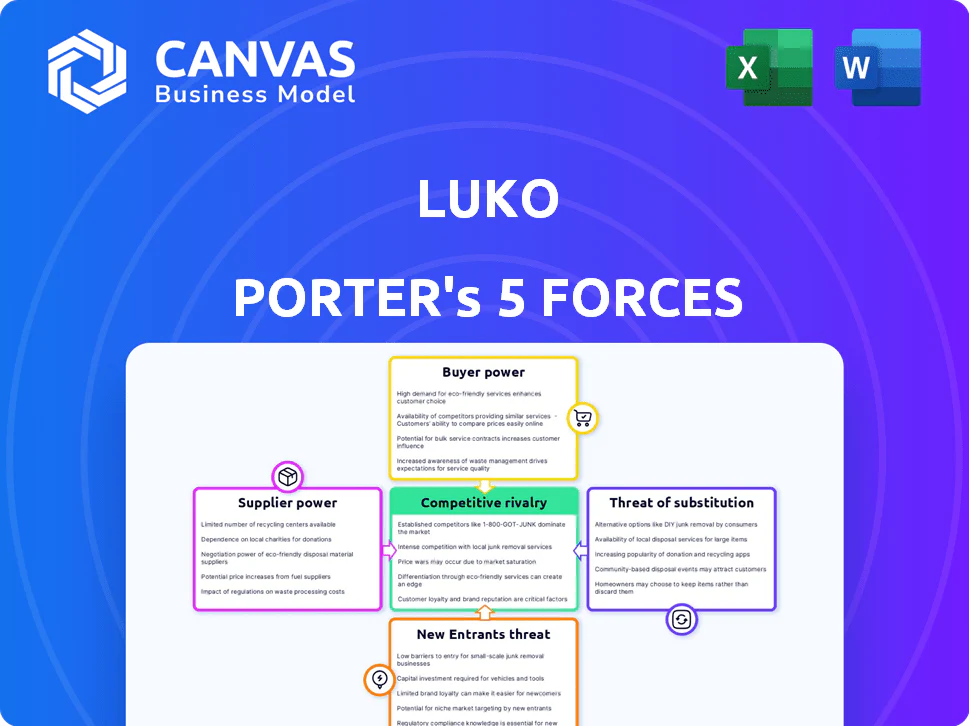
LUKO PORTER'S FIVE FORCES TEMPLATE RESEARCH
What is included in the product
 Detailed Word Document
Tailored exclusively for Luko, analyzing its position within its competitive landscape.

 Customizable Excel Spreadsheet
Gain actionable insights with an intuitive scoring system for each force, empowering strategic planning.
What You See Is What You Get
Luko Porter's Five Forces Analysis
This preview demonstrates the complete Porter's Five Forces analysis you'll receive. It's a professionally crafted document, identical to what you'll download immediately after purchase. The analysis is fully formatted and ready for your use right away, no editing needed.

Porter's Five Forces Analysis Template

Elevate Your Analysis with the Complete Porter's Five Forces Analysis
Luko operates within a dynamic insurance market, shaped by competitive forces. The threat of new entrants, particularly from tech-driven disruptors, is significant. Buyer power is moderate, as consumers have options, but switching costs exist. The competitive rivalry is intense, with established players and innovative challengers vying for market share. The analysis reveals the strength and intensity of each market force affecting Luko, complete with visuals and summaries for fast, clear interpretation.
Suppliers Bargaining Power

Reliance on Technology Providers
Luko's digital operations heavily rely on technology suppliers, including AI and claims processing platforms. The bargaining power of these suppliers is significant if their technology is critical and not easily replaceable. For example, the global AI market was valued at $150 billion in 2023, with a projected growth to $1.8 trillion by 2030, indicating the strategic importance and potential supplier power.
Underwriting and Reinsurance Partners
As an insurance provider, Luko's partnerships with underwriters and reinsurers, like Munich Re and Swiss Re, are key. These partners' size and market concentration impact their bargaining power. In 2024, Munich Re reported a net profit of €4.6 billion. This influences Luko's terms and profitability.

Providers of Smart Home Devices
Luko relies on smart home device suppliers, making supplier bargaining power a key factor. The availability of alternatives significantly impacts this power; if many suppliers exist, Luko has more leverage. For instance, the smart home market reached $65.6 billion in 2023, showing diverse supplier options.
The importance of these devices to Luko’s service affects supplier power too. If these devices are critical to Luko's offerings, suppliers can exert more influence. Considering the rising demand for smart home security, expected to hit $83.3 billion by 2024, suppliers in this niche may gain strength.

Data and Analytics Providers
Luko's reliance on data and analytics for pricing and risk management means its suppliers hold significant power. These suppliers, offering unique or high-quality data, can influence Luko's operational costs and competitive edge. Their market position and the availability of alternative data sources further define this power dynamic. According to Statista, the global market for data analytics is projected to reach $132.9 billion in 2024.
- Data Uniqueness: Proprietary or specialized data grants suppliers leverage.
- Data Quality: High-accuracy data is crucial for Luko's effectiveness.
- Market Position: Dominant suppliers dictate terms.
- Alternative Availability: The presence of substitutes reduces supplier power.
Marketing and Distribution Partners
Luko, being digital-first, still needs marketing and distribution partners. These partners' cost and availability affect Luko's operations. For instance, digital marketing costs rose in 2024. This can impact Luko's profitability.
- Digital ad spending reached $225 billion in 2024.
- Influencer marketing costs increased by 15% in 2024.
- Distribution platform fees may vary.
- Partner availability can impact expansion.
Supplier Power Dynamics at Play
Luko faces supplier bargaining power across tech, insurance, and devices. Key tech suppliers, vital for AI and claims, hold significant influence, mirroring the $1.8T AI market projection by 2030. Underwriters like Munich Re, with a 2024 net profit of €4.6B, also impact terms.
Smart home device suppliers and data analytics providers play crucial roles. The smart home market, valued at $83.3B in 2024, and the data analytics market, projected at $132.9B in 2024, highlight their leverage. Digital marketing, with $225B spent in 2024, further shapes this dynamic.
| Supplier Type | Market Size (2024) | Impact on Luko |
|---|---|---|
| AI Technology | $1.8T (by 2030) | Critical for operations |
| Underwriters | Munich Re €4.6B net profit | Influences terms |
| Smart Home Devices | $83.3B | Essential for service |
| Data Analytics | $132.9B | Pricing & risk management |
| Marketing Partners | $225B digital ad spend | Affects profitability |
Customers Bargaining Power

Availability of Alternatives
Customers in the home insurance market, like those considering Luko, enjoy many choices. These range from established insurers to newer insurtech companies. This broad availability boosts customer power, as they can easily change providers. For example, in 2024, the home insurance market saw over 1,000 providers. Customers can quickly compare policies and prices.
Low Switching Costs
Switching home insurance providers is often straightforward, particularly with digital platforms. Luko, for example, emphasizes the simplicity of switching to their services. Low switching costs amplify customer bargaining power, enabling them to readily choose competitors. In 2024, the average time to switch insurance providers was about 10-15 minutes via online platforms. This ease of change gives customers significant leverage. This makes it easier for customers to negotiate better terms.

Price Sensitivity
Customers in the insurance sector are price-conscious. Luko's strategy of fair pricing and transparency indicates that clients actively compare costs, strengthening their ability to select based on price. In 2024, the average insurance customer looked at 3-5 different providers before making a decision. This price sensitivity is a key factor.

Access to Information
Luko's digital presence and the insurance market's nature provide customers with extensive information. This includes details on various providers, coverage options, and pricing structures. The transparency offered by digital platforms strengthens customers' ability to compare and negotiate terms, increasing their bargaining power. The insurance industry's digital transformation has led to increased price comparison, with sites like CompareTheMarket and Confused.com experiencing high user traffic in 2024.
- Customers can readily compare Luko's offerings with competitors.
- Digital platforms facilitate price and feature comparisons.
- Increased transparency empowers informed decision-making.
- Negotiation leverage due to access to diverse options.
Influence of Online Reviews and Reputation
Online reviews and Luko's reputation heavily influence customer choices. Positive reviews attract new clients, while negative ones can deter them. Data from 2024 indicates that 85% of consumers trust online reviews as much as personal recommendations, boosting customer bargaining power. This impacts Luko's ability to set prices and terms.
- 85% of consumers trust online reviews as much as personal recommendations (2024 data).
- Negative reviews can significantly reduce conversion rates.
- Positive reviews can drive up to 20% more sales.
- Luko needs to actively manage its online presence.
Home Insurance: Customer Power Dynamics
Customers in the home insurance market have considerable bargaining power. They can easily switch providers, leveraging digital platforms for quick comparisons. Price sensitivity is high, with many customers comparing multiple options before deciding. Online reviews further influence choices, affecting Luko's market position.
| Factor | Impact | Data (2024) |
|---|---|---|
| Switching Costs | Low | Avg. switch time: 10-15 mins online |
| Price Sensitivity | High | Avg. providers compared: 3-5 |
| Online Reviews | Significant | 85% trust reviews like recommendations |
Rivalry Among Competitors

Presence of Traditional Insurers
Luko faces intense competition from traditional insurers like AXA and Allianz, which have vast financial resources. These established players boast extensive customer bases and decades of brand recognition, creating a significant barrier to entry. In 2024, AXA reported over €100 billion in revenues, showcasing their market dominance. This financial strength enables them to invest heavily in technology and marketing, intensifying the competitive landscape.
Other Insurtech Startups
The insurtech landscape is competitive, with startups like Lemonade and Hippo vying for market share. These firms, similar to Luko, leverage technology to offer insurance. In 2024, Lemonade's market cap fluctuated, reflecting the sector's volatility. Competition drives innovation but also intensifies the pressure on profitability for all players.

Focus on Digital Experience and Transparency
Luko's digital focus and transparent pricing are key differentiators. Rivals mimicking this, like Lemonade, intensify competition. In 2024, Lemonade's customer base grew, showing digital insurance's appeal. Increased digital adoption by all players, intensifies rivalry.

Technological Innovation
Luko, using AI and smart home tech, faces intense rivalry due to tech innovation. Competitors constantly develop platforms and analytics, increasing the competitive pressure. The home insurance market saw a 10% increase in insurtech funding in 2024, highlighting the rapid innovation pace. This forces Luko to stay ahead.
- Insurtech funding grew by 10% in 2024, showing innovation.
- Competitors are launching new platforms and analytics.
- Luko must continually update its tech to stay competitive.
- Preventative tech development fuels the rivalry.
Pricing Strategies
Luko's commitment to fair and transparent pricing is a key factor in competitive rivalry. Competitors' pricing strategies, such as aggressive discounts or innovative pricing models, significantly affect Luko's market position. The insurance market is intensely competitive, with companies constantly adjusting prices to attract customers. This pricing dynamic directly shapes the level of rivalry.
- In 2024, the average home insurance premium increased by approximately 15% due to inflation and rising claims.
- Companies like Lemonade use AI to offer competitive pricing, challenging traditional insurers.
- Transparent pricing models, like those Luko promotes, can attract customers seeking clarity.
Insurance Market Heats Up: Competition Intensifies
Competitive rivalry in Luko's market is high, fueled by established insurers with vast resources and insurtech startups. Digital focus and innovation intensify competition, with companies constantly developing new platforms. Pricing strategies also significantly impact market position, with the average home insurance premium increasing by 15% in 2024.
| Factor | Impact | Data (2024) |
|---|---|---|
| Established Insurers | Strong Brand, Resources | AXA Revenue: €100B+ |
| Insurtech Startups | Tech-Driven Competition | Lemonade Market Cap Fluctuated |
| Pricing Pressure | Aggressive Discounts | Premium Increase: 15% |
Original: $10.00
-65%$10.00
$3.50LUKO PORTER'S FIVE FORCES TEMPLATE RESEARCH
What is included in the product
Detailed Word Document
Tailored exclusively for Luko, analyzing its position within its competitive landscape.
Customizable Excel Spreadsheet
Gain actionable insights with an intuitive scoring system for each force, empowering strategic planning.
What You See Is What You Get
Luko Porter's Five Forces Analysis
This preview demonstrates the complete Porter's Five Forces analysis you'll receive. It's a professionally crafted document, identical to what you'll download immediately after purchase. The analysis is fully formatted and ready for your use right away, no editing needed.
Porter's Five Forces Analysis Template
Elevate Your Analysis with the Complete Porter's Five Forces Analysis
Luko operates within a dynamic insurance market, shaped by competitive forces. The threat of new entrants, particularly from tech-driven disruptors, is significant. Buyer power is moderate, as consumers have options, but switching costs exist. The competitive rivalry is intense, with established players and innovative challengers vying for market share. The analysis reveals the strength and intensity of each market force affecting Luko, complete with visuals and summaries for fast, clear interpretation.
Suppliers Bargaining Power
Reliance on Technology Providers
Luko's digital operations heavily rely on technology suppliers, including AI and claims processing platforms. The bargaining power of these suppliers is significant if their technology is critical and not easily replaceable. For example, the global AI market was valued at $150 billion in 2023, with a projected growth to $1.8 trillion by 2030, indicating the strategic importance and potential supplier power.
Underwriting and Reinsurance Partners
As an insurance provider, Luko's partnerships with underwriters and reinsurers, like Munich Re and Swiss Re, are key. These partners' size and market concentration impact their bargaining power. In 2024, Munich Re reported a net profit of €4.6 billion. This influences Luko's terms and profitability.
Providers of Smart Home Devices
Luko relies on smart home device suppliers, making supplier bargaining power a key factor. The availability of alternatives significantly impacts this power; if many suppliers exist, Luko has more leverage. For instance, the smart home market reached $65.6 billion in 2023, showing diverse supplier options.
The importance of these devices to Luko’s service affects supplier power too. If these devices are critical to Luko's offerings, suppliers can exert more influence. Considering the rising demand for smart home security, expected to hit $83.3 billion by 2024, suppliers in this niche may gain strength.
Data and Analytics Providers
Luko's reliance on data and analytics for pricing and risk management means its suppliers hold significant power. These suppliers, offering unique or high-quality data, can influence Luko's operational costs and competitive edge. Their market position and the availability of alternative data sources further define this power dynamic. According to Statista, the global market for data analytics is projected to reach $132.9 billion in 2024.
- Data Uniqueness: Proprietary or specialized data grants suppliers leverage.
- Data Quality: High-accuracy data is crucial for Luko's effectiveness.
- Market Position: Dominant suppliers dictate terms.
- Alternative Availability: The presence of substitutes reduces supplier power.
Marketing and Distribution Partners
Luko, being digital-first, still needs marketing and distribution partners. These partners' cost and availability affect Luko's operations. For instance, digital marketing costs rose in 2024. This can impact Luko's profitability.
- Digital ad spending reached $225 billion in 2024.
- Influencer marketing costs increased by 15% in 2024.
- Distribution platform fees may vary.
- Partner availability can impact expansion.
Supplier Power Dynamics at Play
Luko faces supplier bargaining power across tech, insurance, and devices. Key tech suppliers, vital for AI and claims, hold significant influence, mirroring the $1.8T AI market projection by 2030. Underwriters like Munich Re, with a 2024 net profit of €4.6B, also impact terms.
Smart home device suppliers and data analytics providers play crucial roles. The smart home market, valued at $83.3B in 2024, and the data analytics market, projected at $132.9B in 2024, highlight their leverage. Digital marketing, with $225B spent in 2024, further shapes this dynamic.
| Supplier Type | Market Size (2024) | Impact on Luko |
|---|---|---|
| AI Technology | $1.8T (by 2030) | Critical for operations |
| Underwriters | Munich Re €4.6B net profit | Influences terms |
| Smart Home Devices | $83.3B | Essential for service |
| Data Analytics | $132.9B | Pricing & risk management |
| Marketing Partners | $225B digital ad spend | Affects profitability |
Customers Bargaining Power
Availability of Alternatives
Customers in the home insurance market, like those considering Luko, enjoy many choices. These range from established insurers to newer insurtech companies. This broad availability boosts customer power, as they can easily change providers. For example, in 2024, the home insurance market saw over 1,000 providers. Customers can quickly compare policies and prices.
Low Switching Costs
Switching home insurance providers is often straightforward, particularly with digital platforms. Luko, for example, emphasizes the simplicity of switching to their services. Low switching costs amplify customer bargaining power, enabling them to readily choose competitors. In 2024, the average time to switch insurance providers was about 10-15 minutes via online platforms. This ease of change gives customers significant leverage. This makes it easier for customers to negotiate better terms.
Price Sensitivity
Customers in the insurance sector are price-conscious. Luko's strategy of fair pricing and transparency indicates that clients actively compare costs, strengthening their ability to select based on price. In 2024, the average insurance customer looked at 3-5 different providers before making a decision. This price sensitivity is a key factor.
Access to Information
Luko's digital presence and the insurance market's nature provide customers with extensive information. This includes details on various providers, coverage options, and pricing structures. The transparency offered by digital platforms strengthens customers' ability to compare and negotiate terms, increasing their bargaining power. The insurance industry's digital transformation has led to increased price comparison, with sites like CompareTheMarket and Confused.com experiencing high user traffic in 2024.
- Customers can readily compare Luko's offerings with competitors.
- Digital platforms facilitate price and feature comparisons.
- Increased transparency empowers informed decision-making.
- Negotiation leverage due to access to diverse options.
Influence of Online Reviews and Reputation
Online reviews and Luko's reputation heavily influence customer choices. Positive reviews attract new clients, while negative ones can deter them. Data from 2024 indicates that 85% of consumers trust online reviews as much as personal recommendations, boosting customer bargaining power. This impacts Luko's ability to set prices and terms.
- 85% of consumers trust online reviews as much as personal recommendations (2024 data).
- Negative reviews can significantly reduce conversion rates.
- Positive reviews can drive up to 20% more sales.
- Luko needs to actively manage its online presence.
Home Insurance: Customer Power Dynamics
Customers in the home insurance market have considerable bargaining power. They can easily switch providers, leveraging digital platforms for quick comparisons. Price sensitivity is high, with many customers comparing multiple options before deciding. Online reviews further influence choices, affecting Luko's market position.
| Factor | Impact | Data (2024) |
|---|---|---|
| Switching Costs | Low | Avg. switch time: 10-15 mins online |
| Price Sensitivity | High | Avg. providers compared: 3-5 |
| Online Reviews | Significant | 85% trust reviews like recommendations |
Rivalry Among Competitors
Presence of Traditional Insurers
Luko faces intense competition from traditional insurers like AXA and Allianz, which have vast financial resources. These established players boast extensive customer bases and decades of brand recognition, creating a significant barrier to entry. In 2024, AXA reported over €100 billion in revenues, showcasing their market dominance. This financial strength enables them to invest heavily in technology and marketing, intensifying the competitive landscape.
Other Insurtech Startups
The insurtech landscape is competitive, with startups like Lemonade and Hippo vying for market share. These firms, similar to Luko, leverage technology to offer insurance. In 2024, Lemonade's market cap fluctuated, reflecting the sector's volatility. Competition drives innovation but also intensifies the pressure on profitability for all players.
Focus on Digital Experience and Transparency
Luko's digital focus and transparent pricing are key differentiators. Rivals mimicking this, like Lemonade, intensify competition. In 2024, Lemonade's customer base grew, showing digital insurance's appeal. Increased digital adoption by all players, intensifies rivalry.
Technological Innovation
Luko, using AI and smart home tech, faces intense rivalry due to tech innovation. Competitors constantly develop platforms and analytics, increasing the competitive pressure. The home insurance market saw a 10% increase in insurtech funding in 2024, highlighting the rapid innovation pace. This forces Luko to stay ahead.
- Insurtech funding grew by 10% in 2024, showing innovation.
- Competitors are launching new platforms and analytics.
- Luko must continually update its tech to stay competitive.
- Preventative tech development fuels the rivalry.
Pricing Strategies
Luko's commitment to fair and transparent pricing is a key factor in competitive rivalry. Competitors' pricing strategies, such as aggressive discounts or innovative pricing models, significantly affect Luko's market position. The insurance market is intensely competitive, with companies constantly adjusting prices to attract customers. This pricing dynamic directly shapes the level of rivalry.
- In 2024, the average home insurance premium increased by approximately 15% due to inflation and rising claims.
- Companies like Lemonade use AI to offer competitive pricing, challenging traditional insurers.
- Transparent pricing models, like those Luko promotes, can attract customers seeking clarity.
Insurance Market Heats Up: Competition Intensifies
Competitive rivalry in Luko's market is high, fueled by established insurers with vast resources and insurtech startups. Digital focus and innovation intensify competition, with companies constantly developing new platforms. Pricing strategies also significantly impact market position, with the average home insurance premium increasing by 15% in 2024.
| Factor | Impact | Data (2024) |
|---|---|---|
| Established Insurers | Strong Brand, Resources | AXA Revenue: €100B+ |
| Insurtech Startups | Tech-Driven Competition | Lemonade Market Cap Fluctuated |
| Pricing Pressure | Aggressive Discounts | Premium Increase: 15% |
Product Information
Product Information
Shipping & Returns
Shipping & Returns
Description
What is included in the product
Detailed Word Document
Tailored exclusively for Luko, analyzing its position within its competitive landscape.
Customizable Excel Spreadsheet
Gain actionable insights with an intuitive scoring system for each force, empowering strategic planning.
What You See Is What You Get
Luko Porter's Five Forces Analysis
This preview demonstrates the complete Porter's Five Forces analysis you'll receive. It's a professionally crafted document, identical to what you'll download immediately after purchase. The analysis is fully formatted and ready for your use right away, no editing needed.
Porter's Five Forces Analysis Template
Elevate Your Analysis with the Complete Porter's Five Forces Analysis
Luko operates within a dynamic insurance market, shaped by competitive forces. The threat of new entrants, particularly from tech-driven disruptors, is significant. Buyer power is moderate, as consumers have options, but switching costs exist. The competitive rivalry is intense, with established players and innovative challengers vying for market share. The analysis reveals the strength and intensity of each market force affecting Luko, complete with visuals and summaries for fast, clear interpretation.
Suppliers Bargaining Power
Reliance on Technology Providers
Luko's digital operations heavily rely on technology suppliers, including AI and claims processing platforms. The bargaining power of these suppliers is significant if their technology is critical and not easily replaceable. For example, the global AI market was valued at $150 billion in 2023, with a projected growth to $1.8 trillion by 2030, indicating the strategic importance and potential supplier power.
Underwriting and Reinsurance Partners
As an insurance provider, Luko's partnerships with underwriters and reinsurers, like Munich Re and Swiss Re, are key. These partners' size and market concentration impact their bargaining power. In 2024, Munich Re reported a net profit of €4.6 billion. This influences Luko's terms and profitability.
Providers of Smart Home Devices
Luko relies on smart home device suppliers, making supplier bargaining power a key factor. The availability of alternatives significantly impacts this power; if many suppliers exist, Luko has more leverage. For instance, the smart home market reached $65.6 billion in 2023, showing diverse supplier options.
The importance of these devices to Luko’s service affects supplier power too. If these devices are critical to Luko's offerings, suppliers can exert more influence. Considering the rising demand for smart home security, expected to hit $83.3 billion by 2024, suppliers in this niche may gain strength.
Data and Analytics Providers
Luko's reliance on data and analytics for pricing and risk management means its suppliers hold significant power. These suppliers, offering unique or high-quality data, can influence Luko's operational costs and competitive edge. Their market position and the availability of alternative data sources further define this power dynamic. According to Statista, the global market for data analytics is projected to reach $132.9 billion in 2024.
- Data Uniqueness: Proprietary or specialized data grants suppliers leverage.
- Data Quality: High-accuracy data is crucial for Luko's effectiveness.
- Market Position: Dominant suppliers dictate terms.
- Alternative Availability: The presence of substitutes reduces supplier power.
Marketing and Distribution Partners
Luko, being digital-first, still needs marketing and distribution partners. These partners' cost and availability affect Luko's operations. For instance, digital marketing costs rose in 2024. This can impact Luko's profitability.
- Digital ad spending reached $225 billion in 2024.
- Influencer marketing costs increased by 15% in 2024.
- Distribution platform fees may vary.
- Partner availability can impact expansion.
Supplier Power Dynamics at Play
Luko faces supplier bargaining power across tech, insurance, and devices. Key tech suppliers, vital for AI and claims, hold significant influence, mirroring the $1.8T AI market projection by 2030. Underwriters like Munich Re, with a 2024 net profit of €4.6B, also impact terms.
Smart home device suppliers and data analytics providers play crucial roles. The smart home market, valued at $83.3B in 2024, and the data analytics market, projected at $132.9B in 2024, highlight their leverage. Digital marketing, with $225B spent in 2024, further shapes this dynamic.
| Supplier Type | Market Size (2024) | Impact on Luko |
|---|---|---|
| AI Technology | $1.8T (by 2030) | Critical for operations |
| Underwriters | Munich Re €4.6B net profit | Influences terms |
| Smart Home Devices | $83.3B | Essential for service |
| Data Analytics | $132.9B | Pricing & risk management |
| Marketing Partners | $225B digital ad spend | Affects profitability |
Customers Bargaining Power
Availability of Alternatives
Customers in the home insurance market, like those considering Luko, enjoy many choices. These range from established insurers to newer insurtech companies. This broad availability boosts customer power, as they can easily change providers. For example, in 2024, the home insurance market saw over 1,000 providers. Customers can quickly compare policies and prices.
Low Switching Costs
Switching home insurance providers is often straightforward, particularly with digital platforms. Luko, for example, emphasizes the simplicity of switching to their services. Low switching costs amplify customer bargaining power, enabling them to readily choose competitors. In 2024, the average time to switch insurance providers was about 10-15 minutes via online platforms. This ease of change gives customers significant leverage. This makes it easier for customers to negotiate better terms.
Price Sensitivity
Customers in the insurance sector are price-conscious. Luko's strategy of fair pricing and transparency indicates that clients actively compare costs, strengthening their ability to select based on price. In 2024, the average insurance customer looked at 3-5 different providers before making a decision. This price sensitivity is a key factor.
Access to Information
Luko's digital presence and the insurance market's nature provide customers with extensive information. This includes details on various providers, coverage options, and pricing structures. The transparency offered by digital platforms strengthens customers' ability to compare and negotiate terms, increasing their bargaining power. The insurance industry's digital transformation has led to increased price comparison, with sites like CompareTheMarket and Confused.com experiencing high user traffic in 2024.
- Customers can readily compare Luko's offerings with competitors.
- Digital platforms facilitate price and feature comparisons.
- Increased transparency empowers informed decision-making.
- Negotiation leverage due to access to diverse options.
Influence of Online Reviews and Reputation
Online reviews and Luko's reputation heavily influence customer choices. Positive reviews attract new clients, while negative ones can deter them. Data from 2024 indicates that 85% of consumers trust online reviews as much as personal recommendations, boosting customer bargaining power. This impacts Luko's ability to set prices and terms.
- 85% of consumers trust online reviews as much as personal recommendations (2024 data).
- Negative reviews can significantly reduce conversion rates.
- Positive reviews can drive up to 20% more sales.
- Luko needs to actively manage its online presence.
Home Insurance: Customer Power Dynamics
Customers in the home insurance market have considerable bargaining power. They can easily switch providers, leveraging digital platforms for quick comparisons. Price sensitivity is high, with many customers comparing multiple options before deciding. Online reviews further influence choices, affecting Luko's market position.
| Factor | Impact | Data (2024) |
|---|---|---|
| Switching Costs | Low | Avg. switch time: 10-15 mins online |
| Price Sensitivity | High | Avg. providers compared: 3-5 |
| Online Reviews | Significant | 85% trust reviews like recommendations |
Rivalry Among Competitors
Presence of Traditional Insurers
Luko faces intense competition from traditional insurers like AXA and Allianz, which have vast financial resources. These established players boast extensive customer bases and decades of brand recognition, creating a significant barrier to entry. In 2024, AXA reported over €100 billion in revenues, showcasing their market dominance. This financial strength enables them to invest heavily in technology and marketing, intensifying the competitive landscape.
Other Insurtech Startups
The insurtech landscape is competitive, with startups like Lemonade and Hippo vying for market share. These firms, similar to Luko, leverage technology to offer insurance. In 2024, Lemonade's market cap fluctuated, reflecting the sector's volatility. Competition drives innovation but also intensifies the pressure on profitability for all players.
Focus on Digital Experience and Transparency
Luko's digital focus and transparent pricing are key differentiators. Rivals mimicking this, like Lemonade, intensify competition. In 2024, Lemonade's customer base grew, showing digital insurance's appeal. Increased digital adoption by all players, intensifies rivalry.
Technological Innovation
Luko, using AI and smart home tech, faces intense rivalry due to tech innovation. Competitors constantly develop platforms and analytics, increasing the competitive pressure. The home insurance market saw a 10% increase in insurtech funding in 2024, highlighting the rapid innovation pace. This forces Luko to stay ahead.
- Insurtech funding grew by 10% in 2024, showing innovation.
- Competitors are launching new platforms and analytics.
- Luko must continually update its tech to stay competitive.
- Preventative tech development fuels the rivalry.
Pricing Strategies
Luko's commitment to fair and transparent pricing is a key factor in competitive rivalry. Competitors' pricing strategies, such as aggressive discounts or innovative pricing models, significantly affect Luko's market position. The insurance market is intensely competitive, with companies constantly adjusting prices to attract customers. This pricing dynamic directly shapes the level of rivalry.
- In 2024, the average home insurance premium increased by approximately 15% due to inflation and rising claims.
- Companies like Lemonade use AI to offer competitive pricing, challenging traditional insurers.
- Transparent pricing models, like those Luko promotes, can attract customers seeking clarity.
Insurance Market Heats Up: Competition Intensifies
Competitive rivalry in Luko's market is high, fueled by established insurers with vast resources and insurtech startups. Digital focus and innovation intensify competition, with companies constantly developing new platforms. Pricing strategies also significantly impact market position, with the average home insurance premium increasing by 15% in 2024.
| Factor | Impact | Data (2024) |
|---|---|---|
| Established Insurers | Strong Brand, Resources | AXA Revenue: €100B+ |
| Insurtech Startups | Tech-Driven Competition | Lemonade Market Cap Fluctuated |
| Pricing Pressure | Aggressive Discounts | Premium Increase: 15% |











