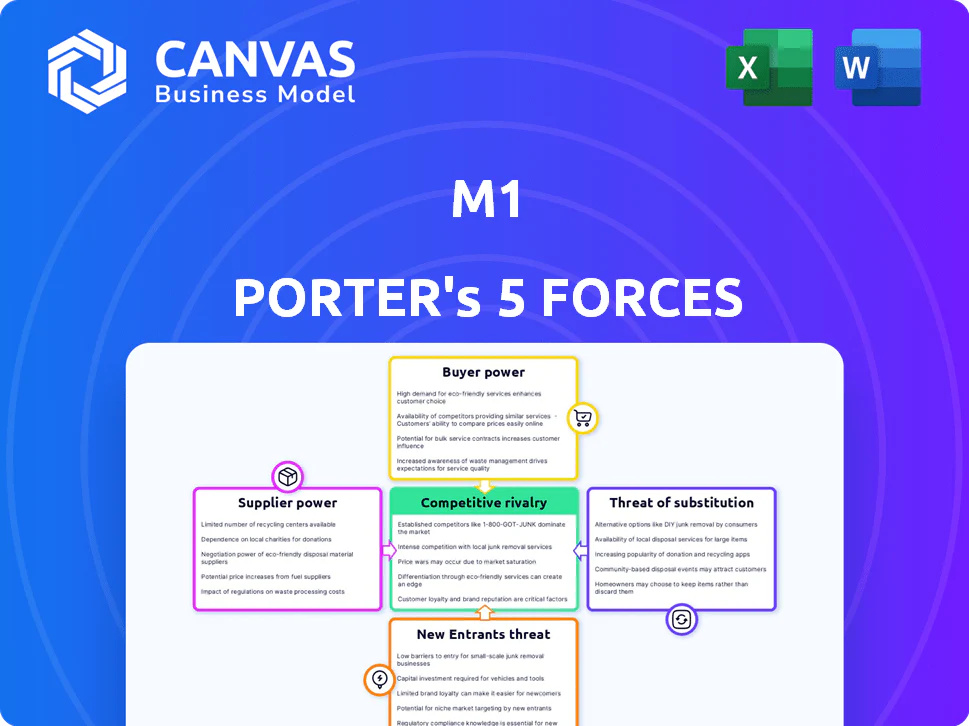
M1 PORTER'S FIVE FORCES TEMPLATE RESEARCH
What is included in the product
 Detailed Word Document
M1's competitive landscape is analyzed, considering rivalry, new entrants, and buyer/supplier power.

 Customizable Excel Spreadsheet
A clear, one-sheet summary of all five forces—perfect for quick decision-making.
Preview the Actual Deliverable
M1 Porter's Five Forces Analysis
This M1 Porter's Five Forces analysis preview is the complete, ready-to-use document you'll receive immediately after purchase. It details the competitive landscape of the M1 product, examining threats of new entrants, bargaining power of suppliers, and more. This is the exact, professionally written analysis you will get, ready for your immediate use. The formatting and content you see here is what you download—no surprises.

Porter's Five Forces Analysis Template

Elevate Your Analysis with the Complete Porter's Five Forces Analysis
M1's competitive landscape is shaped by industry forces. Buyer power, supplier power, and the threat of new entrants all play a role. The intensity of rivalry among existing competitors also matters. Finally, the threat of substitutes impacts the overall market dynamics.
This preview is just the beginning. The full analysis provides a complete strategic snapshot with force-by-force ratings, visuals, and business implications tailored to M1.
Suppliers Bargaining Power

Dependency on Technology Providers
M1's fintech model hinges on technology providers. This reliance can empower suppliers due to the specialized nature of financial tech. The cost and complexity of switching providers further amplify their leverage. In 2024, fintech spending hit $170 billion globally, highlighting supplier importance.
Reliance on Clearing Houses
M1 Finance relies on clearing houses to process trades. They use their own self-clearing broker-dealer along with Apex Clearing Corporation. In 2024, Apex Clearing processed approximately $2.5 trillion in assets. This dependence gives these entities influence.

Access to Market Data and Information
M1 relies on market data suppliers, giving them some leverage. The cost and access to this data impact M1's service offerings. M1 provides free stock research from Quotemedia and Factset, but options are limited. For example, FactSet's revenue in 2023 was $2.09 billion, showing their market influence.

Banking Infrastructure and Services
M1's digital banking services heavily rely on partnerships with traditional banks, creating a dynamic where suppliers (banks) wield bargaining power. These banks dictate terms and conditions, influencing M1's service offerings and operational costs. This reliance can lead to increased expenses or limitations on features for M1's users. For instance, in 2024, the costs associated with regulatory compliance and maintaining banking infrastructure have risen by approximately 7%.
- Partner bank fees and charges directly impact M1's profitability.
- Regulatory compliance costs are a significant factor.
- Changes in partner bank policies can affect M1's service offerings.
- The bargaining power of banks can influence the user experience.
Potential for Increased Software Costs
M1's reliance on proprietary software platforms exposes it to supplier bargaining power, particularly impacting software costs. The specialized nature of financial software and the vendors providing those services can drive up expenses for maintenance, updates, and new development. For example, software spending in the financial sector rose by 7.5% in 2024. These costs directly affect M1's operational efficiency and profitability. M1 must carefully manage these supplier relationships to mitigate potential cost increases.
- Software spending in the financial sector rose by 7.5% in 2024.
- Proprietary software maintenance can be costly.
- Vendor specialization increases supplier power.
- Cost management is crucial for profitability.
Supplier Power Dynamics at a Fintech Platform
M1 Finance faces supplier bargaining power across various areas, including technology, clearing services, market data, banking partnerships, and software platforms. These suppliers have leverage due to specialization and the costs associated with switching. Managing these relationships is crucial for controlling expenses and maintaining profitability. In 2024, fintech spending reached $170 billion, highlighting the importance of supplier influence.
| Supplier Type | Impact on M1 | 2024 Data |
|---|---|---|
| Fintech Providers | Software costs, innovation | Fintech spending: $170B |
| Clearing Houses | Trade processing, fees | Apex Clearing: $2.5T assets |
| Market Data | Research costs, access | FactSet revenue: $2.09B |
| Partner Banks | Fees, compliance, features | Compliance costs up 7% |
| Software Platforms | Maintenance, updates | Software spending up 7.5% |
Customers Bargaining Power

Availability of Alternatives
M1 faces substantial customer bargaining power due to the availability of alternatives. The financial services market is crowded, with platforms like Robinhood and Fidelity also offering investment services. In 2024, these competitors collectively managed trillions of dollars in assets. This fierce competition pressures M1 to offer competitive pricing and services.
Low Switching Costs (in some aspects)
Switching investment platforms is relatively easy, with data portability and feature similarities reducing costs for customers. However, transferring fractional shares can complicate the process. In 2024, the average time to transfer assets between brokerage accounts was around 5-7 business days, highlighting moderate switching ease. Data from the SEC shows increasing investor mobility.

Price Sensitivity
M1's commission-free model and tiered fees underscore customer price sensitivity. In 2024, M1's tiered fee structure was a key factor for investors. Customers can influence M1 to maintain low fees, particularly those with smaller balances. The monthly fee structure for smaller accounts emphasizes this dynamic.

Access to Information and Financial Literacy
Financially savvy customers, armed with investment knowledge, can easily compare M1 with rivals and demand better deals. M1 offers educational materials, yet some users find them less comprehensive than those of competitors. This empowers informed customers to negotiate or switch platforms. Increased financial literacy shifts the balance toward the customer.
- Financial literacy is growing; in 2024, 57% of U.S. adults are considered financially literate.
- Platforms with superior educational resources often attract and retain more customers.
- Customer churn rates can increase if educational support is lacking.
- The average customer tenure on investment platforms is around 3-5 years.
User Reviews and Social Influence
User reviews and social influence heavily shape M1's customer perception. Negative online feedback can deter potential users, strengthening customer bargaining power. For example, a 2024 study showed that 85% of consumers trust online reviews as much as personal recommendations. This directly impacts M1's user acquisition costs and retention rates. This influence means M1 must actively manage its online reputation to stay competitive.
- 85% of consumers trust online reviews.
- Negative reviews increase customer bargaining power.
- M1 needs to manage its online reputation.
- User acquisition and retention are key metrics.
Customer Power: High Stakes for M1
M1's customer bargaining power is high due to market competition and ease of switching platforms. Customers can compare options and demand better deals, with financial literacy on the rise. Online reviews significantly influence customer decisions, impacting M1's reputation and user acquisition.
| Factor | Impact | Data (2024) |
|---|---|---|
| Market Competition | Increased pressure on pricing and services | Trillions managed by competitors like Robinhood & Fidelity |
| Switching Costs | Lowers customer loyalty | Avg. transfer time: 5-7 days |
| Financial Literacy | Empowers informed decisions | 57% of US adults are financially literate |
Rivalry Among Competitors

Numerous Competitors in Fintech
M1 Finance competes in fintech, a crowded market. It battles robo-advisors like Betterment and Wealthfront. Traditional brokerages such as Fidelity and Charles Schwab with digital platforms are also rivals. In 2024, the robo-advisor market is valued at over $1 trillion, showing the intense competition. Other financial apps add to the rivalry.
Differentiation through Unique Features
M1 Finance distinguishes itself with its 'pie' investing, fractional shares, and automated rebalancing, appealing to investors seeking customization and automation. However, competitive dynamics are fierce. For instance, in 2024, Robinhood and Fidelity also enhanced their offerings with fractional shares and automated investment tools, increasing the competitive pressure. This constant innovation requires M1 to continually refine its features to retain its user base. The market share of M1 Finance in 2024 was approximately 1.8%.

Pressure on Fees and Pricing
Competitive rivalry significantly affects M1's fee structure. Commission-free trading is standard, forcing M1 to compete on other fees. M1 charges platform fees for smaller accounts; a potential drawback. In 2024, competitors like Robinhood have expanded services. This intensifies the pressure to offer attractive, transparent pricing.

Marketing and Brand Building
Fintech firms like M1 Finance heavily invest in marketing and brand building. Competitive advertising, including promotional activities, fuels rivalry. In 2024, digital ad spending in the finance sector reached billions, intensifying competition. M1 has faced regulatory scrutiny over its marketing practices, including influencer use. This adds another layer of complexity to their brand-building efforts.
- M1 Finance utilizes social media influencers.
- Digital ad spending in the finance sector reached billions in 2024.
- Competitive advertising is a significant factor.
- Regulatory scrutiny adds complexity.
Innovation and Technology Development
Innovation and technology development are critical in the fintech sector's competitive landscape. The need to continuously innovate in technology and features is key to maintaining a competitive edge. Technological advancements drive rivalry, as companies aim for sophisticated and user-friendly platforms. For example, in 2024, fintech investments reached over $110 billion globally.
- Rapid technological advancements demand constant upgrades.
- Companies invest heavily in R&D to stay ahead.
- User experience and platform sophistication are key differentiators.
- The fintech market is highly dynamic.
Fintech Fight: Market Share & Investment Insights
M1 Finance faces intense rivalry in the fintech market. Competitors like Robinhood and Fidelity offer similar services, increasing pressure. Innovation and marketing are crucial for staying competitive. In 2024, the fintech market saw over $110 billion in investments.
| Aspect | Details | 2024 Data |
|---|---|---|
| Market Size | Robo-advisor market | $1+ trillion |
| M1 Market Share | Approximate share | 1.8% |
| Fintech Investment | Global investment | Over $110 billion |
Original: $10.00
-65%$10.00
$3.50M1 PORTER'S FIVE FORCES TEMPLATE RESEARCH
What is included in the product
Detailed Word Document
M1's competitive landscape is analyzed, considering rivalry, new entrants, and buyer/supplier power.
Customizable Excel Spreadsheet
A clear, one-sheet summary of all five forces—perfect for quick decision-making.
Preview the Actual Deliverable
M1 Porter's Five Forces Analysis
This M1 Porter's Five Forces analysis preview is the complete, ready-to-use document you'll receive immediately after purchase. It details the competitive landscape of the M1 product, examining threats of new entrants, bargaining power of suppliers, and more. This is the exact, professionally written analysis you will get, ready for your immediate use. The formatting and content you see here is what you download—no surprises.
Porter's Five Forces Analysis Template
Elevate Your Analysis with the Complete Porter's Five Forces Analysis
M1's competitive landscape is shaped by industry forces. Buyer power, supplier power, and the threat of new entrants all play a role. The intensity of rivalry among existing competitors also matters. Finally, the threat of substitutes impacts the overall market dynamics.
This preview is just the beginning. The full analysis provides a complete strategic snapshot with force-by-force ratings, visuals, and business implications tailored to M1.
Suppliers Bargaining Power
Dependency on Technology Providers
M1's fintech model hinges on technology providers. This reliance can empower suppliers due to the specialized nature of financial tech. The cost and complexity of switching providers further amplify their leverage. In 2024, fintech spending hit $170 billion globally, highlighting supplier importance.
Reliance on Clearing Houses
M1 Finance relies on clearing houses to process trades. They use their own self-clearing broker-dealer along with Apex Clearing Corporation. In 2024, Apex Clearing processed approximately $2.5 trillion in assets. This dependence gives these entities influence.
Access to Market Data and Information
M1 relies on market data suppliers, giving them some leverage. The cost and access to this data impact M1's service offerings. M1 provides free stock research from Quotemedia and Factset, but options are limited. For example, FactSet's revenue in 2023 was $2.09 billion, showing their market influence.
Banking Infrastructure and Services
M1's digital banking services heavily rely on partnerships with traditional banks, creating a dynamic where suppliers (banks) wield bargaining power. These banks dictate terms and conditions, influencing M1's service offerings and operational costs. This reliance can lead to increased expenses or limitations on features for M1's users. For instance, in 2024, the costs associated with regulatory compliance and maintaining banking infrastructure have risen by approximately 7%.
- Partner bank fees and charges directly impact M1's profitability.
- Regulatory compliance costs are a significant factor.
- Changes in partner bank policies can affect M1's service offerings.
- The bargaining power of banks can influence the user experience.
Potential for Increased Software Costs
M1's reliance on proprietary software platforms exposes it to supplier bargaining power, particularly impacting software costs. The specialized nature of financial software and the vendors providing those services can drive up expenses for maintenance, updates, and new development. For example, software spending in the financial sector rose by 7.5% in 2024. These costs directly affect M1's operational efficiency and profitability. M1 must carefully manage these supplier relationships to mitigate potential cost increases.
- Software spending in the financial sector rose by 7.5% in 2024.
- Proprietary software maintenance can be costly.
- Vendor specialization increases supplier power.
- Cost management is crucial for profitability.
Supplier Power Dynamics at a Fintech Platform
M1 Finance faces supplier bargaining power across various areas, including technology, clearing services, market data, banking partnerships, and software platforms. These suppliers have leverage due to specialization and the costs associated with switching. Managing these relationships is crucial for controlling expenses and maintaining profitability. In 2024, fintech spending reached $170 billion, highlighting the importance of supplier influence.
| Supplier Type | Impact on M1 | 2024 Data |
|---|---|---|
| Fintech Providers | Software costs, innovation | Fintech spending: $170B |
| Clearing Houses | Trade processing, fees | Apex Clearing: $2.5T assets |
| Market Data | Research costs, access | FactSet revenue: $2.09B |
| Partner Banks | Fees, compliance, features | Compliance costs up 7% |
| Software Platforms | Maintenance, updates | Software spending up 7.5% |
Customers Bargaining Power
Availability of Alternatives
M1 faces substantial customer bargaining power due to the availability of alternatives. The financial services market is crowded, with platforms like Robinhood and Fidelity also offering investment services. In 2024, these competitors collectively managed trillions of dollars in assets. This fierce competition pressures M1 to offer competitive pricing and services.
Low Switching Costs (in some aspects)
Switching investment platforms is relatively easy, with data portability and feature similarities reducing costs for customers. However, transferring fractional shares can complicate the process. In 2024, the average time to transfer assets between brokerage accounts was around 5-7 business days, highlighting moderate switching ease. Data from the SEC shows increasing investor mobility.
Price Sensitivity
M1's commission-free model and tiered fees underscore customer price sensitivity. In 2024, M1's tiered fee structure was a key factor for investors. Customers can influence M1 to maintain low fees, particularly those with smaller balances. The monthly fee structure for smaller accounts emphasizes this dynamic.
Access to Information and Financial Literacy
Financially savvy customers, armed with investment knowledge, can easily compare M1 with rivals and demand better deals. M1 offers educational materials, yet some users find them less comprehensive than those of competitors. This empowers informed customers to negotiate or switch platforms. Increased financial literacy shifts the balance toward the customer.
- Financial literacy is growing; in 2024, 57% of U.S. adults are considered financially literate.
- Platforms with superior educational resources often attract and retain more customers.
- Customer churn rates can increase if educational support is lacking.
- The average customer tenure on investment platforms is around 3-5 years.
User Reviews and Social Influence
User reviews and social influence heavily shape M1's customer perception. Negative online feedback can deter potential users, strengthening customer bargaining power. For example, a 2024 study showed that 85% of consumers trust online reviews as much as personal recommendations. This directly impacts M1's user acquisition costs and retention rates. This influence means M1 must actively manage its online reputation to stay competitive.
- 85% of consumers trust online reviews.
- Negative reviews increase customer bargaining power.
- M1 needs to manage its online reputation.
- User acquisition and retention are key metrics.
Customer Power: High Stakes for M1
M1's customer bargaining power is high due to market competition and ease of switching platforms. Customers can compare options and demand better deals, with financial literacy on the rise. Online reviews significantly influence customer decisions, impacting M1's reputation and user acquisition.
| Factor | Impact | Data (2024) |
|---|---|---|
| Market Competition | Increased pressure on pricing and services | Trillions managed by competitors like Robinhood & Fidelity |
| Switching Costs | Lowers customer loyalty | Avg. transfer time: 5-7 days |
| Financial Literacy | Empowers informed decisions | 57% of US adults are financially literate |
Rivalry Among Competitors
Numerous Competitors in Fintech
M1 Finance competes in fintech, a crowded market. It battles robo-advisors like Betterment and Wealthfront. Traditional brokerages such as Fidelity and Charles Schwab with digital platforms are also rivals. In 2024, the robo-advisor market is valued at over $1 trillion, showing the intense competition. Other financial apps add to the rivalry.
Differentiation through Unique Features
M1 Finance distinguishes itself with its 'pie' investing, fractional shares, and automated rebalancing, appealing to investors seeking customization and automation. However, competitive dynamics are fierce. For instance, in 2024, Robinhood and Fidelity also enhanced their offerings with fractional shares and automated investment tools, increasing the competitive pressure. This constant innovation requires M1 to continually refine its features to retain its user base. The market share of M1 Finance in 2024 was approximately 1.8%.
Pressure on Fees and Pricing
Competitive rivalry significantly affects M1's fee structure. Commission-free trading is standard, forcing M1 to compete on other fees. M1 charges platform fees for smaller accounts; a potential drawback. In 2024, competitors like Robinhood have expanded services. This intensifies the pressure to offer attractive, transparent pricing.
Marketing and Brand Building
Fintech firms like M1 Finance heavily invest in marketing and brand building. Competitive advertising, including promotional activities, fuels rivalry. In 2024, digital ad spending in the finance sector reached billions, intensifying competition. M1 has faced regulatory scrutiny over its marketing practices, including influencer use. This adds another layer of complexity to their brand-building efforts.
- M1 Finance utilizes social media influencers.
- Digital ad spending in the finance sector reached billions in 2024.
- Competitive advertising is a significant factor.
- Regulatory scrutiny adds complexity.
Innovation and Technology Development
Innovation and technology development are critical in the fintech sector's competitive landscape. The need to continuously innovate in technology and features is key to maintaining a competitive edge. Technological advancements drive rivalry, as companies aim for sophisticated and user-friendly platforms. For example, in 2024, fintech investments reached over $110 billion globally.
- Rapid technological advancements demand constant upgrades.
- Companies invest heavily in R&D to stay ahead.
- User experience and platform sophistication are key differentiators.
- The fintech market is highly dynamic.
Fintech Fight: Market Share & Investment Insights
M1 Finance faces intense rivalry in the fintech market. Competitors like Robinhood and Fidelity offer similar services, increasing pressure. Innovation and marketing are crucial for staying competitive. In 2024, the fintech market saw over $110 billion in investments.
| Aspect | Details | 2024 Data |
|---|---|---|
| Market Size | Robo-advisor market | $1+ trillion |
| M1 Market Share | Approximate share | 1.8% |
| Fintech Investment | Global investment | Over $110 billion |
Product Information
Product Information
Shipping & Returns
Shipping & Returns
Description
What is included in the product
Detailed Word Document
M1's competitive landscape is analyzed, considering rivalry, new entrants, and buyer/supplier power.
Customizable Excel Spreadsheet
A clear, one-sheet summary of all five forces—perfect for quick decision-making.
Preview the Actual Deliverable
M1 Porter's Five Forces Analysis
This M1 Porter's Five Forces analysis preview is the complete, ready-to-use document you'll receive immediately after purchase. It details the competitive landscape of the M1 product, examining threats of new entrants, bargaining power of suppliers, and more. This is the exact, professionally written analysis you will get, ready for your immediate use. The formatting and content you see here is what you download—no surprises.
Porter's Five Forces Analysis Template
Elevate Your Analysis with the Complete Porter's Five Forces Analysis
M1's competitive landscape is shaped by industry forces. Buyer power, supplier power, and the threat of new entrants all play a role. The intensity of rivalry among existing competitors also matters. Finally, the threat of substitutes impacts the overall market dynamics.
This preview is just the beginning. The full analysis provides a complete strategic snapshot with force-by-force ratings, visuals, and business implications tailored to M1.
Suppliers Bargaining Power
Dependency on Technology Providers
M1's fintech model hinges on technology providers. This reliance can empower suppliers due to the specialized nature of financial tech. The cost and complexity of switching providers further amplify their leverage. In 2024, fintech spending hit $170 billion globally, highlighting supplier importance.
Reliance on Clearing Houses
M1 Finance relies on clearing houses to process trades. They use their own self-clearing broker-dealer along with Apex Clearing Corporation. In 2024, Apex Clearing processed approximately $2.5 trillion in assets. This dependence gives these entities influence.
Access to Market Data and Information
M1 relies on market data suppliers, giving them some leverage. The cost and access to this data impact M1's service offerings. M1 provides free stock research from Quotemedia and Factset, but options are limited. For example, FactSet's revenue in 2023 was $2.09 billion, showing their market influence.
Banking Infrastructure and Services
M1's digital banking services heavily rely on partnerships with traditional banks, creating a dynamic where suppliers (banks) wield bargaining power. These banks dictate terms and conditions, influencing M1's service offerings and operational costs. This reliance can lead to increased expenses or limitations on features for M1's users. For instance, in 2024, the costs associated with regulatory compliance and maintaining banking infrastructure have risen by approximately 7%.
- Partner bank fees and charges directly impact M1's profitability.
- Regulatory compliance costs are a significant factor.
- Changes in partner bank policies can affect M1's service offerings.
- The bargaining power of banks can influence the user experience.
Potential for Increased Software Costs
M1's reliance on proprietary software platforms exposes it to supplier bargaining power, particularly impacting software costs. The specialized nature of financial software and the vendors providing those services can drive up expenses for maintenance, updates, and new development. For example, software spending in the financial sector rose by 7.5% in 2024. These costs directly affect M1's operational efficiency and profitability. M1 must carefully manage these supplier relationships to mitigate potential cost increases.
- Software spending in the financial sector rose by 7.5% in 2024.
- Proprietary software maintenance can be costly.
- Vendor specialization increases supplier power.
- Cost management is crucial for profitability.
Supplier Power Dynamics at a Fintech Platform
M1 Finance faces supplier bargaining power across various areas, including technology, clearing services, market data, banking partnerships, and software platforms. These suppliers have leverage due to specialization and the costs associated with switching. Managing these relationships is crucial for controlling expenses and maintaining profitability. In 2024, fintech spending reached $170 billion, highlighting the importance of supplier influence.
| Supplier Type | Impact on M1 | 2024 Data |
|---|---|---|
| Fintech Providers | Software costs, innovation | Fintech spending: $170B |
| Clearing Houses | Trade processing, fees | Apex Clearing: $2.5T assets |
| Market Data | Research costs, access | FactSet revenue: $2.09B |
| Partner Banks | Fees, compliance, features | Compliance costs up 7% |
| Software Platforms | Maintenance, updates | Software spending up 7.5% |
Customers Bargaining Power
Availability of Alternatives
M1 faces substantial customer bargaining power due to the availability of alternatives. The financial services market is crowded, with platforms like Robinhood and Fidelity also offering investment services. In 2024, these competitors collectively managed trillions of dollars in assets. This fierce competition pressures M1 to offer competitive pricing and services.
Low Switching Costs (in some aspects)
Switching investment platforms is relatively easy, with data portability and feature similarities reducing costs for customers. However, transferring fractional shares can complicate the process. In 2024, the average time to transfer assets between brokerage accounts was around 5-7 business days, highlighting moderate switching ease. Data from the SEC shows increasing investor mobility.
Price Sensitivity
M1's commission-free model and tiered fees underscore customer price sensitivity. In 2024, M1's tiered fee structure was a key factor for investors. Customers can influence M1 to maintain low fees, particularly those with smaller balances. The monthly fee structure for smaller accounts emphasizes this dynamic.
Access to Information and Financial Literacy
Financially savvy customers, armed with investment knowledge, can easily compare M1 with rivals and demand better deals. M1 offers educational materials, yet some users find them less comprehensive than those of competitors. This empowers informed customers to negotiate or switch platforms. Increased financial literacy shifts the balance toward the customer.
- Financial literacy is growing; in 2024, 57% of U.S. adults are considered financially literate.
- Platforms with superior educational resources often attract and retain more customers.
- Customer churn rates can increase if educational support is lacking.
- The average customer tenure on investment platforms is around 3-5 years.
User Reviews and Social Influence
User reviews and social influence heavily shape M1's customer perception. Negative online feedback can deter potential users, strengthening customer bargaining power. For example, a 2024 study showed that 85% of consumers trust online reviews as much as personal recommendations. This directly impacts M1's user acquisition costs and retention rates. This influence means M1 must actively manage its online reputation to stay competitive.
- 85% of consumers trust online reviews.
- Negative reviews increase customer bargaining power.
- M1 needs to manage its online reputation.
- User acquisition and retention are key metrics.
Customer Power: High Stakes for M1
M1's customer bargaining power is high due to market competition and ease of switching platforms. Customers can compare options and demand better deals, with financial literacy on the rise. Online reviews significantly influence customer decisions, impacting M1's reputation and user acquisition.
| Factor | Impact | Data (2024) |
|---|---|---|
| Market Competition | Increased pressure on pricing and services | Trillions managed by competitors like Robinhood & Fidelity |
| Switching Costs | Lowers customer loyalty | Avg. transfer time: 5-7 days |
| Financial Literacy | Empowers informed decisions | 57% of US adults are financially literate |
Rivalry Among Competitors
Numerous Competitors in Fintech
M1 Finance competes in fintech, a crowded market. It battles robo-advisors like Betterment and Wealthfront. Traditional brokerages such as Fidelity and Charles Schwab with digital platforms are also rivals. In 2024, the robo-advisor market is valued at over $1 trillion, showing the intense competition. Other financial apps add to the rivalry.
Differentiation through Unique Features
M1 Finance distinguishes itself with its 'pie' investing, fractional shares, and automated rebalancing, appealing to investors seeking customization and automation. However, competitive dynamics are fierce. For instance, in 2024, Robinhood and Fidelity also enhanced their offerings with fractional shares and automated investment tools, increasing the competitive pressure. This constant innovation requires M1 to continually refine its features to retain its user base. The market share of M1 Finance in 2024 was approximately 1.8%.
Pressure on Fees and Pricing
Competitive rivalry significantly affects M1's fee structure. Commission-free trading is standard, forcing M1 to compete on other fees. M1 charges platform fees for smaller accounts; a potential drawback. In 2024, competitors like Robinhood have expanded services. This intensifies the pressure to offer attractive, transparent pricing.
Marketing and Brand Building
Fintech firms like M1 Finance heavily invest in marketing and brand building. Competitive advertising, including promotional activities, fuels rivalry. In 2024, digital ad spending in the finance sector reached billions, intensifying competition. M1 has faced regulatory scrutiny over its marketing practices, including influencer use. This adds another layer of complexity to their brand-building efforts.
- M1 Finance utilizes social media influencers.
- Digital ad spending in the finance sector reached billions in 2024.
- Competitive advertising is a significant factor.
- Regulatory scrutiny adds complexity.
Innovation and Technology Development
Innovation and technology development are critical in the fintech sector's competitive landscape. The need to continuously innovate in technology and features is key to maintaining a competitive edge. Technological advancements drive rivalry, as companies aim for sophisticated and user-friendly platforms. For example, in 2024, fintech investments reached over $110 billion globally.
- Rapid technological advancements demand constant upgrades.
- Companies invest heavily in R&D to stay ahead.
- User experience and platform sophistication are key differentiators.
- The fintech market is highly dynamic.
Fintech Fight: Market Share & Investment Insights
M1 Finance faces intense rivalry in the fintech market. Competitors like Robinhood and Fidelity offer similar services, increasing pressure. Innovation and marketing are crucial for staying competitive. In 2024, the fintech market saw over $110 billion in investments.
| Aspect | Details | 2024 Data |
|---|---|---|
| Market Size | Robo-advisor market | $1+ trillion |
| M1 Market Share | Approximate share | 1.8% |
| Fintech Investment | Global investment | Over $110 billion |











