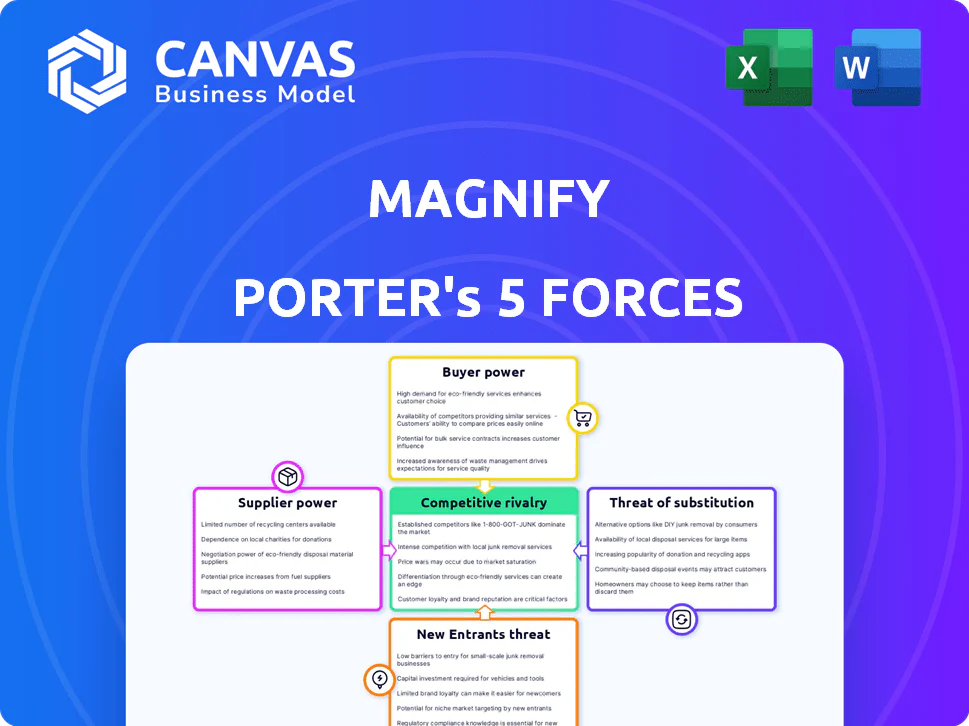
MAGNIFY PORTER'S FIVE FORCES TEMPLATE RESEARCH
What is included in the product
 Detailed Word Document
Analyzes Magnify's competitive landscape, assessing threats, and opportunities.

 Customizable Excel Spreadsheet
A clear, one-sheet summary of all five forces—perfect for quick decision-making.
What You See Is What You Get
Magnify Porter's Five Forces Analysis
This preview provides a comprehensive look at Magnify's Porter's Five Forces Analysis. The document explores the competitive landscape. It assesses industry rivalry, and buyer/supplier power. The threat of new entrants and substitutes are also evaluated. The final version is exactly what you receive after purchase.

Porter's Five Forces Analysis Template

Elevate Your Analysis with the Complete Porter's Five Forces Analysis
Magnify faces competition from established players and potential disruptors, impacting its market share. Buyer power is moderate, with some negotiation leverage. Supplier influence is relatively low due to diverse vendors. Substitute products pose a manageable threat currently. New entrants face high barriers to entry. Ready to move beyond the basics? Get a full strategic breakdown of Magnify’s market position, competitive intensity, and external threats—all in one powerful analysis.
Suppliers Bargaining Power

Availability of AI and Machine Learning Technologies
The bargaining power of AI/ML tech suppliers is significant. While core models are widely available, specialized datasets or algorithms can create supplier leverage. This is especially true if those suppliers are crucial for optimizing post-sales orchestration.
Magnify's dependence on specific AI/ML capabilities directly impacts this power dynamic. The market for AI services is expected to reach $300 billion in 2024.
Companies needing cutting-edge AI solutions might face higher costs or dependence on specific vendors. As of 2024, the top 5 AI companies control a significant portion of the market.
This concentration increases supplier power, particularly for advanced, proprietary AI/ML offerings. Magnify must carefully assess its AI/ML needs.
This will help them mitigate supplier risks and negotiate effectively. The global AI market is projected to reach over $1.5 trillion by 2030.
Integration with Existing Systems
Magnify's integration with systems like Salesforce, and Zendesk is crucial. The ease and cost of integration are influenced by these providers. For example, Salesforce holds a 23.8% market share in CRM, potentially influencing Magnify's costs.

Data Availability and Quality
Magnify's AI success hinges on data quality. Suppliers of unique, crucial data or tools gain bargaining power. In 2024, data quality issues cost businesses an average of $12.9 million annually. High-value data is key for optimal AI performance.

Talent Pool for AI and Machine Learning Expertise
The bargaining power of suppliers, specifically regarding AI and machine learning talent, significantly impacts Magnify. A limited talent pool of AI and machine learning experts strengthens their position, affecting Magnify's operational costs and innovation capabilities. This situation is amplified within the competitive AI software market. Demand for AI specialists surged in 2024, with salaries increasing by 15-20% due to high demand.
- The global AI market was valued at $196.6 billion in 2023.
- AI job postings increased by 30% in 2024.
- The average salary for AI engineers in the US is $160,000.
- The shortage of AI talent is projected to continue through 2025.
Cloud Infrastructure Providers
Magnify, as a SaaS platform, depends on cloud providers like AWS, Azure, or Google Cloud. These providers' pricing and terms directly impact Magnify's costs, showing supplier power. In 2024, AWS held about 32% of the cloud infrastructure market, followed by Microsoft Azure at 25% and Google Cloud at 11%. This concentration gives these suppliers significant leverage.
- AWS, Azure, and Google Cloud control a major share of the cloud market.
- Pricing from these providers directly affects Magnify's expenses.
- Supplier power is high due to limited alternatives and market concentration.
- Negotiating power depends on Magnify's usage volume and commitment.
AI/ML & Cloud: Supplier Power Dynamics
Magnify faces supplier power challenges in AI/ML and cloud services. AI service costs are influenced by key vendors, with the market reaching $300 billion in 2024. Cloud providers like AWS, controlling 32% of the market in 2024, affect costs.
| Aspect | Impact on Magnify | 2024 Data |
|---|---|---|
| AI/ML Suppliers | Higher costs, dependence | Top 5 AI firms control a significant market share. |
| Data Suppliers | Influences AI performance and costs | Data quality issues cost businesses ~$12.9M annually. |
| Cloud Providers | Affects operational costs | AWS (32%), Azure (25%), Google Cloud (11%) market share. |
Customers Bargaining Power

Availability of Alternative Solutions
Customer bargaining power increases with the availability of alternatives. Magnify faces this as customers can choose competitors or in-house solutions. This limits Magnify's pricing power. For example, in 2024, the customer relationship management (CRM) market was valued at over $70 billion, showing significant competition. This competition necessitates Magnify offering competitive pricing to attract customers.
Customer Concentration
If Magnify's customer base is concentrated among a few large entities, those customers likely wield substantial bargaining power. These key customers, vital to Magnify's revenue, can demand better pricing or tailored services. For example, if 70% of Magnify's sales come from just three clients, their influence is considerable. This dynamic can squeeze profit margins, as seen in industries where a few major retailers dictate terms to suppliers.

Switching Costs
Switching costs significantly affect customer bargaining power. Low switching costs empower customers to seek better terms. Magnify's no-code interface and integrations aim to minimize these costs. In 2024, the average customer churn rate across SaaS platforms was around 10-15%, highlighting the ease with which customers switch.

Customer's Understanding of Value Proposition
Customers who see significant value in Magnify's platform, especially regarding ROI, are less likely to strongly bargain on price. Demonstrating clear benefits, like reduced customer churn, is key to lessening customer bargaining power. For instance, if Magnify can prove a 15% reduction in churn, customers may accept the price. This value proposition is crucial in maintaining pricing power.
- Demonstrating value reduces price sensitivity.
- Highlighting ROI is essential.
- Quantifiable benefits like churn reduction are key.
- Strong value proposition supports pricing.
Customer Data Ownership and Portability
Customers' ability to control and move their data affects their leverage. If Magnify's customers can easily take their data elsewhere, they have more bargaining power. Conversely, if data portability is difficult, customer power decreases. For example, in 2024, 68% of consumers expressed concerns about data privacy, highlighting the importance of data control.
- Data portability enhances customer choice.
- Lack of portability can create vendor lock-in.
- Data privacy regulations are increasing.
- Customer data control impacts loyalty.
Customer Power: A Profitability Squeeze
Customer bargaining power significantly impacts Magnify's profitability, especially when alternatives are readily available, as the CRM market in 2024 showed. Concentrated customer bases, where a few key clients drive most revenue, amplify this power, potentially squeezing margins. Low switching costs, reflected in SaaS churn rates of 10-15% in 2024, further empower customers to negotiate.
| Factor | Impact | 2024 Data/Example |
|---|---|---|
| Alternatives | Increased customer choice | CRM market valued at $70B+ |
| Customer Concentration | Higher bargaining power | 70% sales from 3 clients |
| Switching Costs | Empowers customers | SaaS churn 10-15% |
Rivalry Among Competitors

Number and Diversity of Competitors
The post-sales orchestration market is expanding, drawing in diverse competitors. Rivalry intensifies with more firms providing similar solutions. This includes CRM and customer success platforms, and AI automation tools. In 2024, this market saw a 20% increase in new entrants.
Market Growth Rate
The AI customer service market is booming, with projections showing substantial expansion. A high growth rate can ease rivalry by providing avenues for multiple companies to flourish. For example, the global AI market is expected to reach $1.81 trillion by 2030. This growth also draws in new competitors, potentially intensifying rivalry down the line.

Differentiation of Offerings
Magnify's platform differentiation significantly affects competitive rivalry. The emphasis on AI, machine learning, and no-code integration sets it apart. Highly differentiated offerings, like Magnify's, can reduce price-based competition. In 2024, AI-driven platforms saw a 30% increase in market share.

Switching Costs for Customers
In B2B SaaS, high switching costs, like data migration expenses or retraining, can reduce rivalry among existing vendors. This is because customers are less likely to switch. However, this intensifies competition for new customers. Companies with robust platforms and integrations often benefit from higher customer retention. The average customer retention rate in the SaaS industry in 2024 was around 85%.
- Data migration can cost businesses up to $50,000.
- Retraining employees on a new platform costs an average of $2,000 per employee.
- SaaS companies with strong integrations see customer retention rates up to 90%.
Brand Identity and Customer Loyalty
Strong brand identity and customer loyalty significantly shape competitive rivalry. Companies with robust reputations and loyal customer bases often experience reduced vulnerability to competitors. Magnify, focusing on customer growth automation, benefits from this dynamic. Positive testimonials further solidify its position, fostering a competitive advantage. This approach makes it harder for rivals to steal market share.
- Customer retention rates can increase profitability by 25-95%, showing loyalty's financial impact.
- Companies with strong brands often command premium pricing, enhancing profitability.
- High switching costs, due to brand loyalty, protect against price wars.
- Magnify's strategy aligns with these factors, enhancing its competitive edge.
Market Dynamics: Growth, Differentiation, and Costs
Competitive rivalry in the market is shaped by several factors. Market growth and differentiation impact competition levels. High switching costs and brand loyalty also affect rivalry dynamics.
| Factor | Impact | Data (2024) |
|---|---|---|
| Market Growth | Can ease rivalry by providing avenues for multiple companies to flourish. | AI market expected to reach $1.81T by 2030. |
| Differentiation | Reduces price-based competition. | AI-driven platforms saw a 30% increase in market share. |
| Switching Costs | Reduce rivalry among existing vendors. | Data migration costs up to $50,000. |
Original: $10.00
-65%$10.00
$3.50MAGNIFY PORTER'S FIVE FORCES TEMPLATE RESEARCH
What is included in the product
Detailed Word Document
Analyzes Magnify's competitive landscape, assessing threats, and opportunities.
Customizable Excel Spreadsheet
A clear, one-sheet summary of all five forces—perfect for quick decision-making.
What You See Is What You Get
Magnify Porter's Five Forces Analysis
This preview provides a comprehensive look at Magnify's Porter's Five Forces Analysis. The document explores the competitive landscape. It assesses industry rivalry, and buyer/supplier power. The threat of new entrants and substitutes are also evaluated. The final version is exactly what you receive after purchase.
Porter's Five Forces Analysis Template
Elevate Your Analysis with the Complete Porter's Five Forces Analysis
Magnify faces competition from established players and potential disruptors, impacting its market share. Buyer power is moderate, with some negotiation leverage. Supplier influence is relatively low due to diverse vendors. Substitute products pose a manageable threat currently. New entrants face high barriers to entry. Ready to move beyond the basics? Get a full strategic breakdown of Magnify’s market position, competitive intensity, and external threats—all in one powerful analysis.
Suppliers Bargaining Power
Availability of AI and Machine Learning Technologies
The bargaining power of AI/ML tech suppliers is significant. While core models are widely available, specialized datasets or algorithms can create supplier leverage. This is especially true if those suppliers are crucial for optimizing post-sales orchestration.
Magnify's dependence on specific AI/ML capabilities directly impacts this power dynamic. The market for AI services is expected to reach $300 billion in 2024.
Companies needing cutting-edge AI solutions might face higher costs or dependence on specific vendors. As of 2024, the top 5 AI companies control a significant portion of the market.
This concentration increases supplier power, particularly for advanced, proprietary AI/ML offerings. Magnify must carefully assess its AI/ML needs.
This will help them mitigate supplier risks and negotiate effectively. The global AI market is projected to reach over $1.5 trillion by 2030.
Integration with Existing Systems
Magnify's integration with systems like Salesforce, and Zendesk is crucial. The ease and cost of integration are influenced by these providers. For example, Salesforce holds a 23.8% market share in CRM, potentially influencing Magnify's costs.
Data Availability and Quality
Magnify's AI success hinges on data quality. Suppliers of unique, crucial data or tools gain bargaining power. In 2024, data quality issues cost businesses an average of $12.9 million annually. High-value data is key for optimal AI performance.
Talent Pool for AI and Machine Learning Expertise
The bargaining power of suppliers, specifically regarding AI and machine learning talent, significantly impacts Magnify. A limited talent pool of AI and machine learning experts strengthens their position, affecting Magnify's operational costs and innovation capabilities. This situation is amplified within the competitive AI software market. Demand for AI specialists surged in 2024, with salaries increasing by 15-20% due to high demand.
- The global AI market was valued at $196.6 billion in 2023.
- AI job postings increased by 30% in 2024.
- The average salary for AI engineers in the US is $160,000.
- The shortage of AI talent is projected to continue through 2025.
Cloud Infrastructure Providers
Magnify, as a SaaS platform, depends on cloud providers like AWS, Azure, or Google Cloud. These providers' pricing and terms directly impact Magnify's costs, showing supplier power. In 2024, AWS held about 32% of the cloud infrastructure market, followed by Microsoft Azure at 25% and Google Cloud at 11%. This concentration gives these suppliers significant leverage.
- AWS, Azure, and Google Cloud control a major share of the cloud market.
- Pricing from these providers directly affects Magnify's expenses.
- Supplier power is high due to limited alternatives and market concentration.
- Negotiating power depends on Magnify's usage volume and commitment.
AI/ML & Cloud: Supplier Power Dynamics
Magnify faces supplier power challenges in AI/ML and cloud services. AI service costs are influenced by key vendors, with the market reaching $300 billion in 2024. Cloud providers like AWS, controlling 32% of the market in 2024, affect costs.
| Aspect | Impact on Magnify | 2024 Data |
|---|---|---|
| AI/ML Suppliers | Higher costs, dependence | Top 5 AI firms control a significant market share. |
| Data Suppliers | Influences AI performance and costs | Data quality issues cost businesses ~$12.9M annually. |
| Cloud Providers | Affects operational costs | AWS (32%), Azure (25%), Google Cloud (11%) market share. |
Customers Bargaining Power
Availability of Alternative Solutions
Customer bargaining power increases with the availability of alternatives. Magnify faces this as customers can choose competitors or in-house solutions. This limits Magnify's pricing power. For example, in 2024, the customer relationship management (CRM) market was valued at over $70 billion, showing significant competition. This competition necessitates Magnify offering competitive pricing to attract customers.
Customer Concentration
If Magnify's customer base is concentrated among a few large entities, those customers likely wield substantial bargaining power. These key customers, vital to Magnify's revenue, can demand better pricing or tailored services. For example, if 70% of Magnify's sales come from just three clients, their influence is considerable. This dynamic can squeeze profit margins, as seen in industries where a few major retailers dictate terms to suppliers.
Switching Costs
Switching costs significantly affect customer bargaining power. Low switching costs empower customers to seek better terms. Magnify's no-code interface and integrations aim to minimize these costs. In 2024, the average customer churn rate across SaaS platforms was around 10-15%, highlighting the ease with which customers switch.
Customer's Understanding of Value Proposition
Customers who see significant value in Magnify's platform, especially regarding ROI, are less likely to strongly bargain on price. Demonstrating clear benefits, like reduced customer churn, is key to lessening customer bargaining power. For instance, if Magnify can prove a 15% reduction in churn, customers may accept the price. This value proposition is crucial in maintaining pricing power.
- Demonstrating value reduces price sensitivity.
- Highlighting ROI is essential.
- Quantifiable benefits like churn reduction are key.
- Strong value proposition supports pricing.
Customer Data Ownership and Portability
Customers' ability to control and move their data affects their leverage. If Magnify's customers can easily take their data elsewhere, they have more bargaining power. Conversely, if data portability is difficult, customer power decreases. For example, in 2024, 68% of consumers expressed concerns about data privacy, highlighting the importance of data control.
- Data portability enhances customer choice.
- Lack of portability can create vendor lock-in.
- Data privacy regulations are increasing.
- Customer data control impacts loyalty.
Customer Power: A Profitability Squeeze
Customer bargaining power significantly impacts Magnify's profitability, especially when alternatives are readily available, as the CRM market in 2024 showed. Concentrated customer bases, where a few key clients drive most revenue, amplify this power, potentially squeezing margins. Low switching costs, reflected in SaaS churn rates of 10-15% in 2024, further empower customers to negotiate.
| Factor | Impact | 2024 Data/Example |
|---|---|---|
| Alternatives | Increased customer choice | CRM market valued at $70B+ |
| Customer Concentration | Higher bargaining power | 70% sales from 3 clients |
| Switching Costs | Empowers customers | SaaS churn 10-15% |
Rivalry Among Competitors
Number and Diversity of Competitors
The post-sales orchestration market is expanding, drawing in diverse competitors. Rivalry intensifies with more firms providing similar solutions. This includes CRM and customer success platforms, and AI automation tools. In 2024, this market saw a 20% increase in new entrants.
Market Growth Rate
The AI customer service market is booming, with projections showing substantial expansion. A high growth rate can ease rivalry by providing avenues for multiple companies to flourish. For example, the global AI market is expected to reach $1.81 trillion by 2030. This growth also draws in new competitors, potentially intensifying rivalry down the line.
Differentiation of Offerings
Magnify's platform differentiation significantly affects competitive rivalry. The emphasis on AI, machine learning, and no-code integration sets it apart. Highly differentiated offerings, like Magnify's, can reduce price-based competition. In 2024, AI-driven platforms saw a 30% increase in market share.
Switching Costs for Customers
In B2B SaaS, high switching costs, like data migration expenses or retraining, can reduce rivalry among existing vendors. This is because customers are less likely to switch. However, this intensifies competition for new customers. Companies with robust platforms and integrations often benefit from higher customer retention. The average customer retention rate in the SaaS industry in 2024 was around 85%.
- Data migration can cost businesses up to $50,000.
- Retraining employees on a new platform costs an average of $2,000 per employee.
- SaaS companies with strong integrations see customer retention rates up to 90%.
Brand Identity and Customer Loyalty
Strong brand identity and customer loyalty significantly shape competitive rivalry. Companies with robust reputations and loyal customer bases often experience reduced vulnerability to competitors. Magnify, focusing on customer growth automation, benefits from this dynamic. Positive testimonials further solidify its position, fostering a competitive advantage. This approach makes it harder for rivals to steal market share.
- Customer retention rates can increase profitability by 25-95%, showing loyalty's financial impact.
- Companies with strong brands often command premium pricing, enhancing profitability.
- High switching costs, due to brand loyalty, protect against price wars.
- Magnify's strategy aligns with these factors, enhancing its competitive edge.
Market Dynamics: Growth, Differentiation, and Costs
Competitive rivalry in the market is shaped by several factors. Market growth and differentiation impact competition levels. High switching costs and brand loyalty also affect rivalry dynamics.
| Factor | Impact | Data (2024) |
|---|---|---|
| Market Growth | Can ease rivalry by providing avenues for multiple companies to flourish. | AI market expected to reach $1.81T by 2030. |
| Differentiation | Reduces price-based competition. | AI-driven platforms saw a 30% increase in market share. |
| Switching Costs | Reduce rivalry among existing vendors. | Data migration costs up to $50,000. |
Product Information
Product Information
Shipping & Returns
Shipping & Returns
Description
What is included in the product
Detailed Word Document
Analyzes Magnify's competitive landscape, assessing threats, and opportunities.
Customizable Excel Spreadsheet
A clear, one-sheet summary of all five forces—perfect for quick decision-making.
What You See Is What You Get
Magnify Porter's Five Forces Analysis
This preview provides a comprehensive look at Magnify's Porter's Five Forces Analysis. The document explores the competitive landscape. It assesses industry rivalry, and buyer/supplier power. The threat of new entrants and substitutes are also evaluated. The final version is exactly what you receive after purchase.
Porter's Five Forces Analysis Template
Elevate Your Analysis with the Complete Porter's Five Forces Analysis
Magnify faces competition from established players and potential disruptors, impacting its market share. Buyer power is moderate, with some negotiation leverage. Supplier influence is relatively low due to diverse vendors. Substitute products pose a manageable threat currently. New entrants face high barriers to entry. Ready to move beyond the basics? Get a full strategic breakdown of Magnify’s market position, competitive intensity, and external threats—all in one powerful analysis.
Suppliers Bargaining Power
Availability of AI and Machine Learning Technologies
The bargaining power of AI/ML tech suppliers is significant. While core models are widely available, specialized datasets or algorithms can create supplier leverage. This is especially true if those suppliers are crucial for optimizing post-sales orchestration.
Magnify's dependence on specific AI/ML capabilities directly impacts this power dynamic. The market for AI services is expected to reach $300 billion in 2024.
Companies needing cutting-edge AI solutions might face higher costs or dependence on specific vendors. As of 2024, the top 5 AI companies control a significant portion of the market.
This concentration increases supplier power, particularly for advanced, proprietary AI/ML offerings. Magnify must carefully assess its AI/ML needs.
This will help them mitigate supplier risks and negotiate effectively. The global AI market is projected to reach over $1.5 trillion by 2030.
Integration with Existing Systems
Magnify's integration with systems like Salesforce, and Zendesk is crucial. The ease and cost of integration are influenced by these providers. For example, Salesforce holds a 23.8% market share in CRM, potentially influencing Magnify's costs.
Data Availability and Quality
Magnify's AI success hinges on data quality. Suppliers of unique, crucial data or tools gain bargaining power. In 2024, data quality issues cost businesses an average of $12.9 million annually. High-value data is key for optimal AI performance.
Talent Pool for AI and Machine Learning Expertise
The bargaining power of suppliers, specifically regarding AI and machine learning talent, significantly impacts Magnify. A limited talent pool of AI and machine learning experts strengthens their position, affecting Magnify's operational costs and innovation capabilities. This situation is amplified within the competitive AI software market. Demand for AI specialists surged in 2024, with salaries increasing by 15-20% due to high demand.
- The global AI market was valued at $196.6 billion in 2023.
- AI job postings increased by 30% in 2024.
- The average salary for AI engineers in the US is $160,000.
- The shortage of AI talent is projected to continue through 2025.
Cloud Infrastructure Providers
Magnify, as a SaaS platform, depends on cloud providers like AWS, Azure, or Google Cloud. These providers' pricing and terms directly impact Magnify's costs, showing supplier power. In 2024, AWS held about 32% of the cloud infrastructure market, followed by Microsoft Azure at 25% and Google Cloud at 11%. This concentration gives these suppliers significant leverage.
- AWS, Azure, and Google Cloud control a major share of the cloud market.
- Pricing from these providers directly affects Magnify's expenses.
- Supplier power is high due to limited alternatives and market concentration.
- Negotiating power depends on Magnify's usage volume and commitment.
AI/ML & Cloud: Supplier Power Dynamics
Magnify faces supplier power challenges in AI/ML and cloud services. AI service costs are influenced by key vendors, with the market reaching $300 billion in 2024. Cloud providers like AWS, controlling 32% of the market in 2024, affect costs.
| Aspect | Impact on Magnify | 2024 Data |
|---|---|---|
| AI/ML Suppliers | Higher costs, dependence | Top 5 AI firms control a significant market share. |
| Data Suppliers | Influences AI performance and costs | Data quality issues cost businesses ~$12.9M annually. |
| Cloud Providers | Affects operational costs | AWS (32%), Azure (25%), Google Cloud (11%) market share. |
Customers Bargaining Power
Availability of Alternative Solutions
Customer bargaining power increases with the availability of alternatives. Magnify faces this as customers can choose competitors or in-house solutions. This limits Magnify's pricing power. For example, in 2024, the customer relationship management (CRM) market was valued at over $70 billion, showing significant competition. This competition necessitates Magnify offering competitive pricing to attract customers.
Customer Concentration
If Magnify's customer base is concentrated among a few large entities, those customers likely wield substantial bargaining power. These key customers, vital to Magnify's revenue, can demand better pricing or tailored services. For example, if 70% of Magnify's sales come from just three clients, their influence is considerable. This dynamic can squeeze profit margins, as seen in industries where a few major retailers dictate terms to suppliers.
Switching Costs
Switching costs significantly affect customer bargaining power. Low switching costs empower customers to seek better terms. Magnify's no-code interface and integrations aim to minimize these costs. In 2024, the average customer churn rate across SaaS platforms was around 10-15%, highlighting the ease with which customers switch.
Customer's Understanding of Value Proposition
Customers who see significant value in Magnify's platform, especially regarding ROI, are less likely to strongly bargain on price. Demonstrating clear benefits, like reduced customer churn, is key to lessening customer bargaining power. For instance, if Magnify can prove a 15% reduction in churn, customers may accept the price. This value proposition is crucial in maintaining pricing power.
- Demonstrating value reduces price sensitivity.
- Highlighting ROI is essential.
- Quantifiable benefits like churn reduction are key.
- Strong value proposition supports pricing.
Customer Data Ownership and Portability
Customers' ability to control and move their data affects their leverage. If Magnify's customers can easily take their data elsewhere, they have more bargaining power. Conversely, if data portability is difficult, customer power decreases. For example, in 2024, 68% of consumers expressed concerns about data privacy, highlighting the importance of data control.
- Data portability enhances customer choice.
- Lack of portability can create vendor lock-in.
- Data privacy regulations are increasing.
- Customer data control impacts loyalty.
Customer Power: A Profitability Squeeze
Customer bargaining power significantly impacts Magnify's profitability, especially when alternatives are readily available, as the CRM market in 2024 showed. Concentrated customer bases, where a few key clients drive most revenue, amplify this power, potentially squeezing margins. Low switching costs, reflected in SaaS churn rates of 10-15% in 2024, further empower customers to negotiate.
| Factor | Impact | 2024 Data/Example |
|---|---|---|
| Alternatives | Increased customer choice | CRM market valued at $70B+ |
| Customer Concentration | Higher bargaining power | 70% sales from 3 clients |
| Switching Costs | Empowers customers | SaaS churn 10-15% |
Rivalry Among Competitors
Number and Diversity of Competitors
The post-sales orchestration market is expanding, drawing in diverse competitors. Rivalry intensifies with more firms providing similar solutions. This includes CRM and customer success platforms, and AI automation tools. In 2024, this market saw a 20% increase in new entrants.
Market Growth Rate
The AI customer service market is booming, with projections showing substantial expansion. A high growth rate can ease rivalry by providing avenues for multiple companies to flourish. For example, the global AI market is expected to reach $1.81 trillion by 2030. This growth also draws in new competitors, potentially intensifying rivalry down the line.
Differentiation of Offerings
Magnify's platform differentiation significantly affects competitive rivalry. The emphasis on AI, machine learning, and no-code integration sets it apart. Highly differentiated offerings, like Magnify's, can reduce price-based competition. In 2024, AI-driven platforms saw a 30% increase in market share.
Switching Costs for Customers
In B2B SaaS, high switching costs, like data migration expenses or retraining, can reduce rivalry among existing vendors. This is because customers are less likely to switch. However, this intensifies competition for new customers. Companies with robust platforms and integrations often benefit from higher customer retention. The average customer retention rate in the SaaS industry in 2024 was around 85%.
- Data migration can cost businesses up to $50,000.
- Retraining employees on a new platform costs an average of $2,000 per employee.
- SaaS companies with strong integrations see customer retention rates up to 90%.
Brand Identity and Customer Loyalty
Strong brand identity and customer loyalty significantly shape competitive rivalry. Companies with robust reputations and loyal customer bases often experience reduced vulnerability to competitors. Magnify, focusing on customer growth automation, benefits from this dynamic. Positive testimonials further solidify its position, fostering a competitive advantage. This approach makes it harder for rivals to steal market share.
- Customer retention rates can increase profitability by 25-95%, showing loyalty's financial impact.
- Companies with strong brands often command premium pricing, enhancing profitability.
- High switching costs, due to brand loyalty, protect against price wars.
- Magnify's strategy aligns with these factors, enhancing its competitive edge.
Market Dynamics: Growth, Differentiation, and Costs
Competitive rivalry in the market is shaped by several factors. Market growth and differentiation impact competition levels. High switching costs and brand loyalty also affect rivalry dynamics.
| Factor | Impact | Data (2024) |
|---|---|---|
| Market Growth | Can ease rivalry by providing avenues for multiple companies to flourish. | AI market expected to reach $1.81T by 2030. |
| Differentiation | Reduces price-based competition. | AI-driven platforms saw a 30% increase in market share. |
| Switching Costs | Reduce rivalry among existing vendors. | Data migration costs up to $50,000. |











